
Quick Answer
Structure a year-long retainer by defining the model first, then matching payment cadence to the relationship, scope stability, and payment risk. Decide whether the client is paying for work or for access to your expertise, state exactly what the advance secures, and document the schedule, included scope, service boundaries, and refund logic before invoicing starts. Annual upfront, monthly, and split structures can all work if the terms are explicit.
Start Here and Pick the Right Retainer Structure Fast#
Start with risk, not preference. For a year-long retainer, no single payment schedule is automatically right. The right structure depends on your relationship with the client and the level of trust in your expertise.
If you are a freelance consultant, creator, or small team focused on cash flow and practical invoicing, keep the goal simple: choose the model first, then document a schedule the other side can actually follow.
Define the retainer model first#
Treat the retainer as advance-paid work or access to expertise. A retainer agreement is commonly framed as a long-term work-for-hire setup for ongoing services, and it can be paid in advance for work defined over time. The payment schedule only works once you define what the money actually buys.
Use this first checkpoint:
- Pay for Work: the client is paying for agreed work.
- Pay for Access: the client is paying for ongoing access to your expertise.
If you cannot state the model in one sentence, pause before choosing cadence.
State what the client is buying#
Define what the client is actually buying. A consulting retainer is often a monthly arrangement for ongoing work or access to expertise, but that does not mean every year-long deal should be billed monthly. Clarify whether the client is buying a set number of service hours, ongoing advisory access, or recurring deliverables.
Write one plain sentence in your draft agreement, for example:
- "Client is purchasing ongoing strategic access."
- "Client is purchasing a set number of service hours per month."
A monthly charge tied to a defined number of service hours is a grounded contract pattern.
Match cadence to relationship and model#
Match payment cadence to the relationship and model. This is where the model becomes a business decision instead of a billing habit.
Use the relationship as your filter:
- If the engagement is primarily defined work, a Pay for Work structure may fit.
- If the engagement is primarily ongoing access, a Pay for Access structure may fit.
- If the model is unclear, restate scope before setting cadence.
Keep the tradeoff in view. A retainer can support steadier cash flow, but only when the model and cadence match.
Lock the decision before invoicing starts#
Document the decision before invoicing starts. In your agreement draft, lock these four items:
- Model type: Pay for Work or Pay for Access
- Payment schedule
- What is included
- What is out of scope
Final check: your schedule should match the model sentence from the earlier step. If those two conflict, fix that before negotiating price or sending invoices.
For a step-by-step walkthrough, see How to Structure a Retainer Agreement for a Fractional CMO Role.
Define the Retainer Before You Price It#
Define the retainer first, then set amount and cadence. If you price before definition, the agreement can turn into a vague promise and disputes become harder to resolve.
State what the advance secures#
Treat the advance as payment for commitment, access, or reserved capacity, not a guaranteed outcome. In ongoing engagements, that often means reserving service capacity rather than pre-buying every deliverable.
Write one sentence in the agreement stating what the advance secures. Keep it concrete: a defined scope and reserved service capacity, such as a set number of hours. Checkpoint: if the sentence reads like a results guarantee, rewrite it before discussing price.
Separate earned from unearned amounts#
Separate what is earned from what is unearned in the advance. A single payment can include both, so your agreement should state when funds are earned and what is refundable if the relationship ends early.
Use caution with labels like "nonrefundable." In Wisconsin rules, labels alone do not necessarily change how an advance is classified. Relevant treatment is cited in SCR 20:1.5(f), SCR 20:1.16(d), and SCR 20:1.15(b)(1) and (3). This is not a universal rule across jurisdictions, but it is a practical warning. Labeling is not a substitute for clear earning logic.
Checkpoint: if the advance includes both fees and costs, identify the cost portion separately.
Lock scope and service boundaries before pricing#
Lock scope of work and service boundaries before you discuss amount. Scope defines included work. Boundaries define limits such as included capacity (for example, set hours) and how deliverables are handled when requests exceed the agreed level.
Use plain language for:
- included scope of work
- capacity limits (such as set hours)
- deliverable handling for extra or overflow requests
If a third party cannot quickly see what is included, what is capped, and when money is earned, pricing is premature.
You might also find this useful: How to De-Risk a Fixed-Price Project with a Phased Payment Schedule.
Prepare Inputs Before You Choose a Payment Schedule#
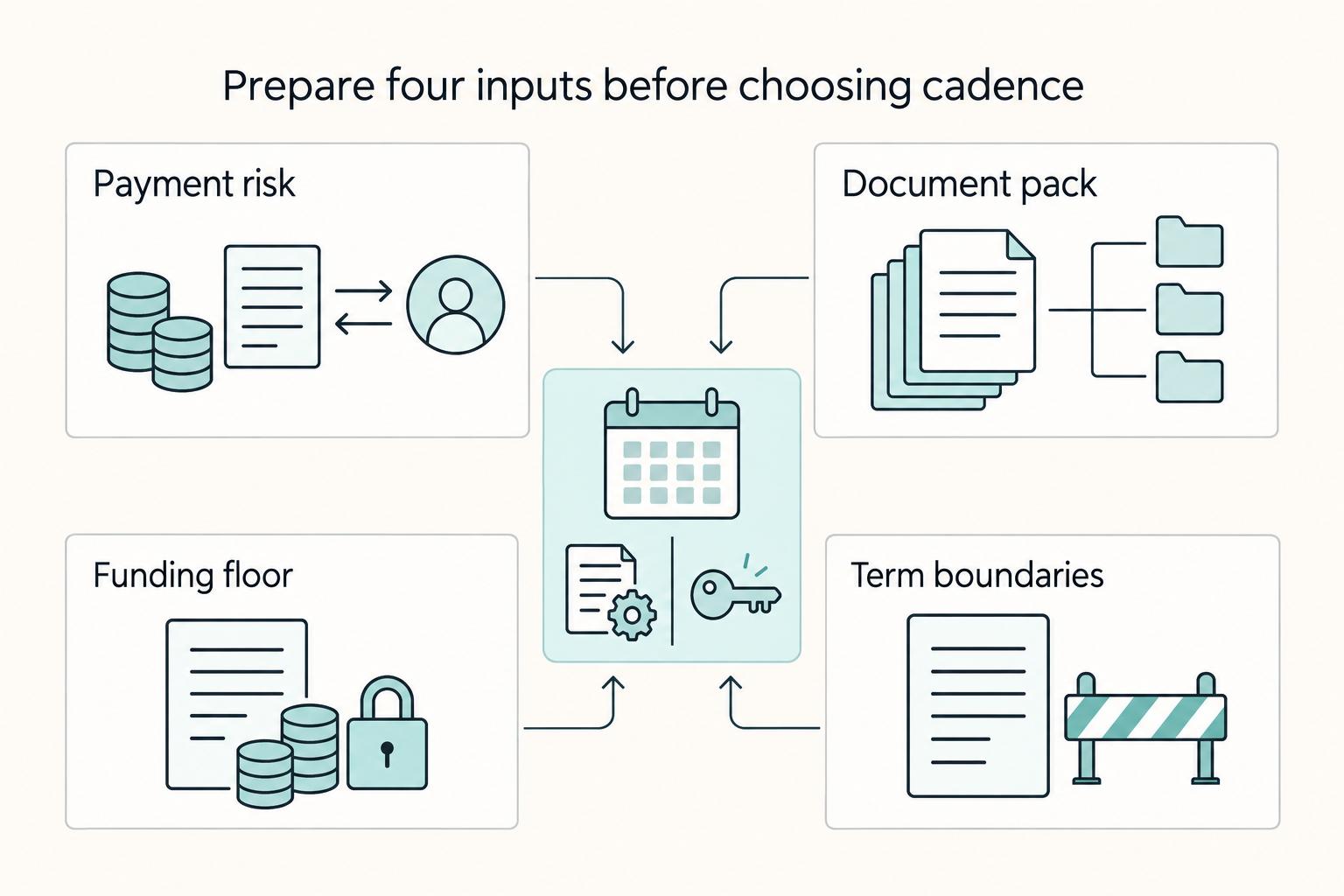
Before you pick cadence, make the risk visible. For a year-long retainer, have four inputs in front of you: your cash position, the client's payment behavior, a minimum document pack, and your non-negotiable terms.
| Input | What to prepare | Checkpoint |
|---|---|---|
| Payment-risk data | Current cash flow pressure, typical collection lag, prior dispute or chargeback incidents, and this client's payment behavior | If you cannot clearly state your usual lag and how this client compares, you are choosing blind |
| Minimum document pack | Draft scope of work, clear service boundaries, and a preferred renewal term | If a third party cannot tell what is included each period and what happens at renewal, your schedule is not ready |
| Upfront funding floor | How much upfront payment you need and how much unpaid service time you are willing to carry before pausing delivery | Write that down before negotiation |
| Negotiation boundaries | Your positions on refund provision, termination term, and delay triggers | If you cannot state "if X happens, we pause on Y and handle remaining funds under Z," finalize your positions before sending terms |
Keep the engagement classification in view while you prepare these inputs: Pay for Work or Pay for Access. The right choice still depends on the client relationship and trust in your expertise.
Gather payment-risk data from your records#
Gather baseline payment-risk data from your own records, not memory. Pull recent invoices and note your current cash flow pressure, typical collection lag, prior dispute or chargeback incidents, and this client's payment behavior.
Keep it simple. A short note is enough if it tells you how long you usually carry work before cash arrives and whether this client increases that risk.
Checkpoint: if you cannot clearly state your usual lag and how this client compares, you are choosing blind.
Build the minimum document pack#
Build a minimum document pack before you discuss cadence: draft scope of work, clear service boundaries, and a preferred renewal term.
Scope should state what is included. Boundaries should state limits and how over-capacity requests are handled. Renewal should state what happens at the end of the term so payment expectations do not reset by assumption.
Checkpoint: if a third party cannot tell what is included each period and what happens at renewal, your schedule is not ready.
Set your upfront funding floor#
Decide in advance how much upfront payment you need so you are not financing the client.
Set an amount you can defend based on your own risk tolerance. Decide how much unpaid service time you are willing to carry before pausing delivery, and write that down before negotiation. More collected earlier can lower your exposure. Less collected earlier can shift more month-to-month risk to you.
Set negotiation boundaries before you send terms#
Set negotiation boundaries in advance for the terms most likely to move: refund provision, termination term, and delay triggers.
You do not need final legal wording yet, but you do need clear business positions. Define what you can accept if the relationship ends early, what notice window is workable, and which events pause service. Checkpoint: if you cannot state "if X happens, we pause on Y and handle remaining funds under Z," finalize your positions before sending terms.
We covered this in detail in Day Rate or Project Rate for Consulting Engagements.
Compare Annual Upfront, Monthly, and Split Cadence#
Use one scoring frame across all three options, then choose the cadence whose risks you can document and control before work starts.
Score each cadence on the same criteria#
Compare annual one-time payment, monthly retainer, and split upfront payment + monthly top-ups on the same four tests: payment-timing clarity, client approval friction, payment-status visibility, and invoicing overhead.
| Cadence | What to confirm before you choose it | Common failure point to check early |
|---|---|---|
| Annual one-time payment | The client can approve full-year prepay, and scope and service boundaries are documented before commencement. | Approval and commencement conditions are not captured in one place. |
| Monthly retainer | Due dates, service period, and pause/resume handling are written clearly. | Payment status and service status are tracked separately. |
| Split upfront + monthly top-ups | Upfront amount, top-up timing, and invoice math are explicit and easy to trace. | Remaining coverage is not stated unambiguously. |
Checkpoint: if you are judging one option on payment timing and another on client preference, stop and rescore with the same criteria.
Apply one tradeoff rule#
If client risk or scope volatility is high, do not rely on assumptions. Choose a cadence only after the start conditions, payment checkpoints, and fallback path are explicit in the agreement and your operating process.
Set a pre-activation checkpoint#
Before service starts, set a clear commencement gate: signed agreement plus first required payment received.
For annual terms, that means the full upfront payment is posted. For monthly, month one is posted. For split, the upfront amount is posted and top-up mechanics are documented. Record this checkpoint in your internal decision log so payment status and current coverage are visible in one place before kickoff.
Related reading: A Guide to Invoice Factoring for Freelancers.
Use Decision Rules to Choose Your Structure#
After scoring the options, choose the structure you can explain and enforce before work starts. Simple if-then rules are more useful than preference.
Choose the priority first#
Pick one priority first, then map it to pay-for-work, pay-for-access, or fixed-fee boundaries.
| If this matters most | Favor this structure | Why it fits | Main watchout |
|---|---|---|---|
| Predictable recurring revenue and deeper client relationships | Pay for Access retainer (often monthly) | Retainers are built for ongoing work or access to expertise | Relationship trust needs to support an access-based model |
| Clear project boundaries and simpler budgeting | Pay for Work retainer or fixed-fee scope | Defined scope is easier to price and track | Less flexibility if needs change |
| Advance commitment before all details are fully set | Retainer with advance payment and defined service capacity | Retainers can be paid in advance, and recurring retainers can tie fees to a set service-hours allocation | Service delivery structure and pricing method must be explicit before send |
Relationship strength matters here. If trust is still developing, use tighter boundaries and simpler terms.
Set one non-negotiable risk rule#
Use this as an internal rule: if your service delivery structure and pricing methodology are not clearly defined, do not accept a year-long retainer in its current form.
That mismatch can make delivery harder for you and the client. Instead of weakening terms, revise the deal so structure, scope, and pricing clearly match.
Match payment structure to scope stability#
Stable, clearly defined scope usually fits pay-for-work or fixed-fee boundaries. Ongoing, access-based support usually fits recurring terms tied to defined service capacity. If added work cannot be identified clearly in the agreement, tighten the SOW before choosing a more prepaid structure.
If you need help with that piece, see How to structure an 'SOW' for a retainer-based consulting engagement.
Run a pre-send consistency check#
Before sending terms, confirm your service delivery structure and pricing method describe the same deal across the agreement, SOW, and invoice.
- Confirm the
payment schedulematches the delivery model. - Confirm advance-payment handling is clear, including how amounts are applied to defined services.
- Confirm pricing methodology is explicit and consistent with the service structure.
- Confirm invoice language, scope boundaries, and coverage period all match.
If you cannot answer these in one pass, tighten the terms before sending: what period is covered, what is included, and how scope changes are handled.
Draft Contract Clauses That Control Payment Risk#
For a year-long retainer, payment risk usually drops when payment terms, scope of work, service boundaries, and earned-versus-unearned treatment are defined clearly.
Write the payment schedule clearly#
Define amount, due date, coverage period, invoice timing, and the event that allows work to start.
If terms are annual, specify the exact 12-month coverage period. If terms are monthly or split, state what each installment covers and whether service pauses for late or partial payment. Avoid vague phrases unless they are paired with concrete billing and application rules. A third party should be able to match contract, invoice, and service period without clarification.
Separate scope from service boundaries#
Keep scope of work and service boundaries in separate clauses.
Scope of work: what is included.Service boundaries: limits, exclusions, access window, response expectations, deliverable handling, and what requires a change order or separate fee.
This separation helps prevent scope creep and reduces payment friction later. If you need flexibility, include a true-up provision and define both the trigger and the billing method. If true-up language says only "as needed," it is still ambiguous.
Define earned and unearned treatment precisely#
Define when amounts become earned and what remains unearned.
There is no single global rule that applies the same way across jurisdictions and contract types, so your agreement should use a definition you can document. Tie the refund provision directly to that definition so early-termination outcomes are clear.
Use this ambiguity test before finalizing:
- When is each payment due, and what exact period does it cover?
- When does an advance become earned?
- What amount remains unearned at any point?
- If the engagement ends early, what is refunded, credited, or retained?
If a neutral third party cannot answer those from the agreement, the clause is too vague.
Add change, exit, renewal, and dispute protections#
Consider including a refund provision, true-up provision, termination term, renewal term, and dispute resolution clause as practical risk controls.
Termination term: who can end the agreement, required notice, treatment of in-progress work, and handling of unpaid or unused amounts.Renewal term: whether the retainer expires, auto-renews, or renews only in writing.Dispute resolution clause: what happens to disputed funds while the dispute is open.
In the California legal-services context, Rule 1.15 requires advances for fees to be handled in a labeled trust account and states that the disputed portion is not withdrawn until resolution. That does not automatically apply to non-lawyer service contracts, but it is a useful drafting model for disputed-fund handling.
Include a plain-English jurisdiction caveat: accounting and legal treatment of advance fees varies by location and profession, so local counsel review may be required. This is especially important in regulated contexts, including legal-services rules such as trust-account handling, five-year record retention, and signed-writing requirements in some flat-fee situations above $1,000.00.
Keep a complete record set with the contract: signed agreement, SOW, invoice schedule, change orders, and earned-versus-unearned tracking. If your records cannot show when money became earned, the clause set is not finished.
Before sending terms, create a practical first draft you can legal-review using the Freelance Contract Generator.
Build the Invoicing Sequence So Payments Arrive on Time#
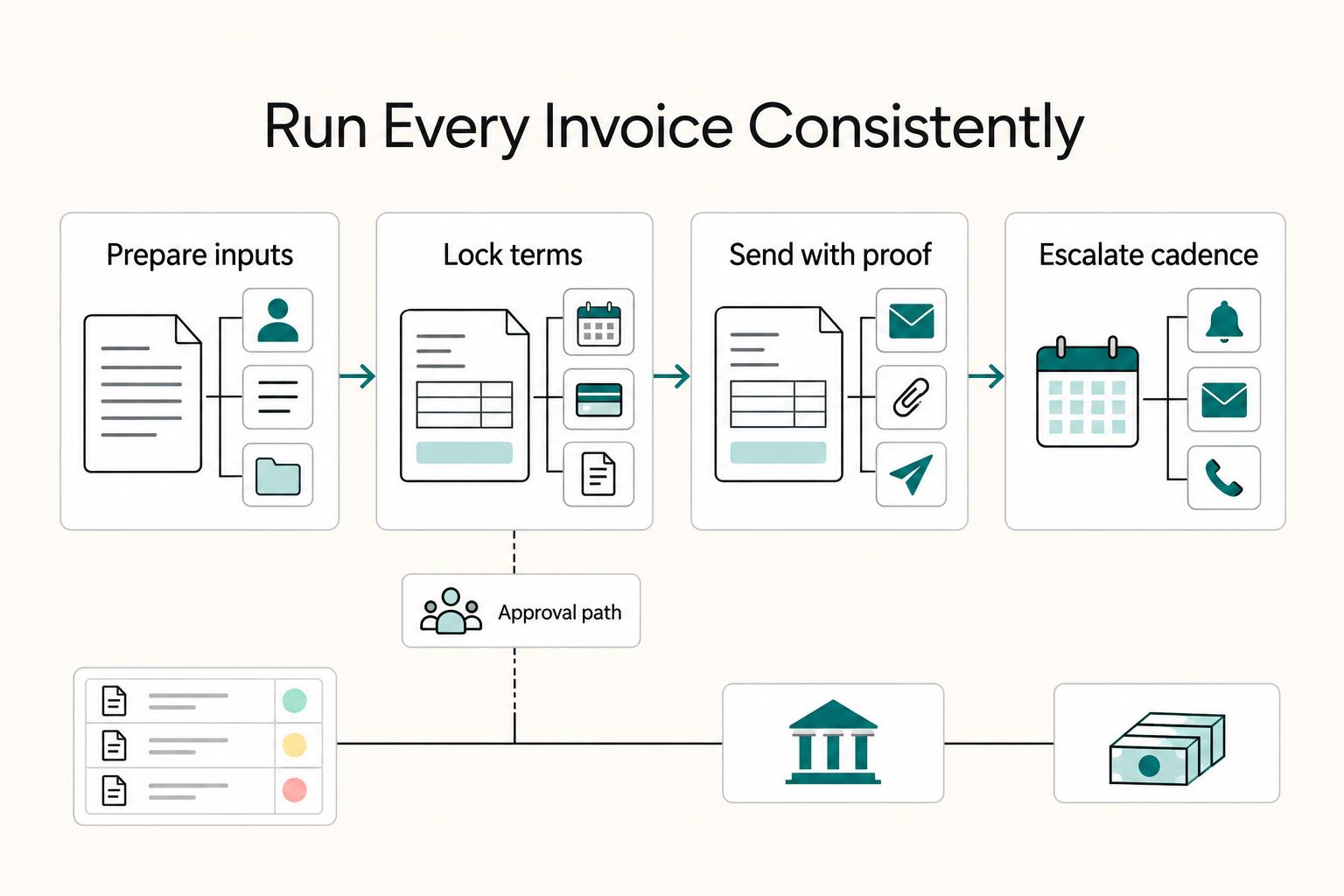
Use one operating rule to reduce late-payment risk: send the invoice, confirm receipt, verify the payment is posted, then release the service period or phase tied to the payment schedule.
Set the invoice trigger before any work starts#
Lock payment terms during negotiation, not after kickoff. There is no universal "typical" waiting period, so define the rule in the agreement and mirror it in invoicing. If terms are 10-day, 30-day, or COD, set that before any delivery starts.
If you start work before payment under non-COD terms, you are extending trade credit. That can be a deliberate choice, but unpaid invoices can still hit operating cash flow hard. Treat resistance to clear upfront terms as a possible payment-risk signal.
Build invoices to limit avoidable disputes#
Make each invoice readable against the contract the client already approved. The goal is simple: someone outside the deal should be able to match invoice, scope, and payment period without extra interpretation.
Include core details consistently, such as:
- service period covered
- line item wording that matches the approved scope of work or service bucket
- payment schedule reference, such as annual upfront, monthly installment, or split structure
- for retainer or split models, what amount is being billed now and what balance remains
- remaining amount due for that invoice
For split or drawdown models, be explicit about what is being billed and what balance is being applied.
Verify receipt and posting before services go live#
Do not treat "invoice sent" as "payment available." Keep those statuses separate and require a posting check before release.
Use this sequence:
- Send the invoice through the agreed billing channel.
- Confirm receipt if there is no acknowledgment.
- Check payment confirmation in the processor or bank account.
- Reconcile invoice number, amount, payer name, and received date.
- Mark services active only after reconciliation is complete.
If a client says payment was made but you cannot match it, pause the next phase and request remittance details or transfer proof.
Keep payment records traceable#
When choosing or using payment rails, prioritize traceability. Whether you use hosted links, account transfer details, or another agreed rail, keep records that can be matched to the invoice and payment schedule.
For each payment, retain:
- issued invoice
- client acknowledgment, when available
- processor receipt or bank confirmation
- ledger entry showing the invoice as paid
If records do not match cleanly, do not activate the retainer period yet.
Related: How to Set Up a Business Bank Account in the UK as a Non-Resident.
Track Earned vs Unearned Funds Without Confusion#
Once payment posts, separate what is earned from what is still unearned. Treat each prepaid amount as movement, not just a balance: cash received, amount earned, and remaining unearned balance. That split helps reduce refund confusion and reporting errors.
Build a client ledger that shows status changes clearly#
Keep one client ledger per account with opening retainer balance, new funds received, amount moved to earned, remaining unearned amount, and adjustments such as credits or refunds.
Your ledger should answer one question quickly: how much of the prepayment is still tied to undelivered service? Prepaid amounts are generally recorded as a liability until service is delivered, then reclassified over time as earned.
For each ledger change, map it to:
- the invoice or payment record
- the related service period or deliverable
- the matching clause in the agreement
Move funds to earned only on defined events#
Do not treat funds as earned just because time passed informally. Use triggers already defined in your agreement, such as a completed service period, delivered scope block, or another stated event.
For each transfer from unearned to earned, record:
- date of status change
- amount moved
- covered service period or scope item
- clause reference in the agreement
- supporting record, such as an invoice, delivery record, or approval (if required)
Manual tracking is error-prone, so agreement clarity matters. If scope, payment terms, and exclusions are vague, your ledger becomes guesswork.
Run the true-up at checkpoints and scope changes#
Use the agreement's review points and scope-change moments for true-up checks. The goal is to confirm the balance still matches services actually delivered.
A practical internal control is a three-way reconciliation-style review:
- agreement
- invoice and payment history
- client ledger
If those records do not align, correct them before the next billing cycle or refund discussion.
Define refund logic before a pause or termination#
Set refund logic early: what unused funds are returned under the refund provision, and what amounts are retained as earned. Keep this tied to contract language, not end-of-project negotiation.
Use a line-by-line review when a client pauses, terminates, or requests a refund:
- funds linked to undelivered service generally stay unearned unless the agreement says otherwise
- funds linked to delivered service can generally be retained as earned
Final checkpoint: every status change should map to a clause in the agreement. If it does not, treat that as a control gap and fix it before the next retainer cycle.
For the full breakdown, read A Deep Dive into Wise's API for Automated Payments.
Handle Mid-Year Changes Without Breaking the Deal#
Mid-year changes are manageable if you update terms before delivery changes. Keep the work, access level, and payment schedule aligned with what you are actually providing.
Formalize scope expansion before extra work starts#
When the scope of work expands, document the added work in writing before it starts, for example in an addendum. Keep it specific: what changed, when it starts, whether the price changes, and how the updated payment schedule will be invoiced.
If your retainer blends ongoing access and defined deliverables, separate them clearly. Access and work are different commitments, so new deliverables should not be folded into the old charge by default.
Apply boundaries before cutting fees#
If demand drops, check service boundaries before renegotiating price. Review three items together: what the client used, what the agreement reserved, and whether the fee is covering access, work, or both.
Lower usage does not always mean the arrangement is wrong, especially when part of the charge covers availability or continued service. But if it behaves more like pay-for-work and underuse is consistent, rebalance future billing or narrow scope in writing.
Use renewal and termination checkpoints as decision dates#
Treat renewal term and termination term dates as operating checkpoints, not boilerplate. Before the next invoice, confirm contract status, the next service window, and whether any notice or amendment is already agreed.
This can help reduce the risk of silent rollover or abrupt service gaps. Use the signed agreement as the source of truth for timing and notice.
Pause repeated scope drift until terms are updated#
If out-of-scope requests keep recurring, stop processing new extras until updated terms are approved. That is a business control, not a legal rule, but it keeps billing and delivery defensible.
If a request cannot be tied to current scope, boundaries, or an approved addendum, do not treat it as included. Otherwise, billing and delivery can drift out of sync.
If you want a deeper dive, read The Silent Profit Killer: How to Stop Margin Erosion in Your Freelance Business.
Prevent Common Failure Modes in Year-Long Retainers#
A year-long retainer is easier to protect when you control four risks: scope drift, payment drift, weak dispute records, and unclear exit terms.
Freeze extras when service boundaries blur#
When service boundaries get fuzzy, over-delivery can start before billing conflict does. If a request cannot be tied to current scope, stop treating it as included, restate what the retainer covers, and issue an addendum before more work starts.
Use a simple check: can someone read the agreement, scope, and latest invoice and tell whether the work is included? If not, tighten the terms. This matters even more when the retainer combines pay-for-work and pay-for-access models. Access can be mistaken for unlimited output unless you separate those commitments in writing.
For existing-client fee changes, California attorney ethics guidance says modifications may receive close scrutiny and should be documented as fair, clearly explained, and consented to by the client. That same guidance treats Rule 3-300 coverage as unsettled and presents full Rule 3-300 compliance as a prudent approach in attorney-client fee modifications, not as a universal freelance rule.
Enforce the monthly payment gate#
A monthly retainer can break down when delivery continues after late or partial payment. Follow the grace-window and service-pause terms already in your agreement instead of carrying the shortfall forward informally.
Keep the account status binary: invoice issued, receipt confirmed, payment posted, service active. If one is missing, the account is not current. For partial payment, log the unpaid amount against that invoice so the balance and service status stay clear.
Build a chargeback evidence file before you need it#
Dispute defense is easier when records are centralized before a dispute starts. Keep one file with the signed agreement, approved addenda, invoicing, payment confirmations, and written acceptance evidence.
If your model is access-based, keep evidence of access delivery as well, such as scheduled calls, response records, and reserved capacity. Run a short monthly check: invoice period, what was delivered or reserved, and where the client acknowledged it. If your records are inconsistent, standardize naming and storage now, or revisit The Complete Guide to Invoicing as a Freelancer.
Close out using earned versus unearned logic#
Exit disputes are easier to resolve when the agreement states how any earned portion, unearned portion, and refund provision apply. At closeout, reconcile those clauses to your ledger instead of renegotiating from scratch.
Create a final closeout pack: termination date, service window covered, invoices paid, amount treated as earned, any unearned balance, and the contract language supporting the result. If you cannot map the outcome back to signed terms, treat that as a contract-design gap to fix before the next retainer.
Use This Copy-Paste Retainer Payment Checklist#
Before you send the final agreement or first invoice, run this pre-go-live check. Retainer failures often come from vague scope or undocumented payment steps.
- Choose one payment model and write the tradeoff beside it.
Select one payment cadence and state why it fits this client. If relevant, label the retainer as Pay for Work or Pay for Access so expectations are clear. Checkpoint: one sentence explains why this structure fits.
- Lock the contract core before discussing start dates.
Confirm the agreement clearly states the parties, services, term length, payment structure, and scope of work. Separate included work from excluded work so both sides use the same definitions. Checkpoint: a third party can tell what the client is receiving and what is out of scope.
- Add protection clauses for edge cases.
Review the refund provision, termination term, and dispute resolution clause. If changes during the year are likely, define how scope and fees will be updated in writing. Checkpoint: default language does not accidentally shift risk in a way either side did not intend.
- Set invoicing sequence and evidence retention before go-live.
Write the order of operations: issue invoice, confirm receipt, verify payment status, then activate service. Keep one evidence set with the signed agreement, final scope, invoices, payment confirmations, approved scope changes, and delivery or acceptance records to support dispute or chargeback defense. Checkpoint: contract terms, invoice details, and payment status all match before work is marked active.
- Enforce a no-work-before-documentation rule.
Do not start services until terms and the payment path are documented. If your agreement requires payment before work starts, treat the engagement as not live until payment is confirmed. Go-live outcome: signed terms, documented payment route, and confirmed payment status before any real work starts.
Once your retainer terms are locked, standardize billing with a reusable Free Invoice Generator.
Frequently Asked Questions
Can a year-long retainer be paid in one annual payment?
Yes, if both sides agree and the agreement makes the payment terms clear. An annual upfront payment can fit a retainer because it secures your services in advance. If the relationship ends early, the agreement should explain how any unused portion is handled.
Is a retainer fee the same as a guaranteed deliverable?
No. A retainer secures access to ongoing services, but it does not guarantee an outcome or final product by itself. If deliverables are expected, define them in the scope of work with clear limits, such as advisory hours per month or a recurring deliverable cap.
How do I choose between annual upfront and monthly retainer terms?
Use annual upfront when both parties want one advance payment to secure services. Use a recurring schedule when both sides prefer periodic payments, such as monthly or quarterly. Either can work if the terms are explicit.
What must be inside a year-long retainer fee agreement to protect both sides?
At minimum, clearly state the services and the payment terms. The scope should set clear expectations while staying flexible enough to handle changing needs. Clear drafting matters because retainers are commonly misunderstood, and transparent terms protect both sides.
When should unused retainer funds be refunded?
Unused portions can be refunded when services cost less than initially planned and the agreement allows it. Do not assume one universal deadline or one automatic rule. Reconcile the closeout against the signed refund language and process any refundable balance accordingly.
What should I do if scope changes in the middle of the year?
When scope changes, update the agreement in writing so the new work is clearly covered. Revise the scope and payment terms so expectations and billing stay aligned. This helps prevent new requests from being treated as covered under outdated terms.
Try a related tool
Researched and edited by the Gruv editorial team. Gruv builds cross-border billing, payouts, and finance-operations software for global businesses.
Sources
- acquisition.gov/far/part-31trusted
- acquisition.gov/dfars/part-252-solicitation-provisions-and-c...trusted
- armedservices.house.gov/uploadedfiles/rcp_text_of_house_amendment_to...trusted
- calbar.ca.gov/Portals/0/documents/rules/Rule_1.15-Exec_Sum...trusted
- calbar.ca.gov/sites/default/files/portals/0/documents/ethi...trusted
- comptroller.war.gov/portals/45/documents/fmr/volume_02a.pdftrusted
- congress.gov/119/plaws/publ60/PLAW-119publ60.pdftrusted
- courts.maine.gov/rules/text/mr_prof_conduct_plus_2023-09-28.pdftrusted
Educational content only. Not legal, tax, or financial advice.
Related Posts

Stop Freelance Profit Margin Erosion Before It Hits Cashflow
Revenue can hold steady while the business underneath it gets weaker. What comes in matters, but what you keep after the work is delivered is the clearer signal of health.
How to Invoice as a Freelancer Without Chasing Late Payments
Set one standard from the start: every freelance invoice should identify the client, itemize the work, state agreed terms, and be tracked until funds settle. That habit helps prevent avoidable payment delays and keeps cash flow more predictable.

How to Set Up a Business Bank Account in the UK as a Non-Resident
Opening a UK business bank account as a non-resident director is one of the harder early operating tasks for a global founder. The process is full of inconsistent eligibility rules, preventable rejections, and risks you often only see after approval. The way through is not a loophole. It is a disciplined sequence.