
Quick Answer
To structure a husband and wife business for S-corp treatment, first confirm who owns the business, whether both spouses materially participate, whether one spouse directs the other as an employee, and whether the business is held in an LLC or similar entity. If the facts fit a qualified joint venture instead, test that first; if records are mixed, pause before filing Form 2553.
Start here and pick the right path before you file#
You can usually sort this out in one sitting if you classify the facts first. Start with federal tax treatment, then look at state-law ownership issues only when they matter.
| Federal lane | Use when | Key note |
|---|---|---|
| Subchapter S treatment | You want corporate treatment under Subchapter S | Evaluate the S-corp path next |
| Qualified joint venture (QJV) treatment | The business is jointly run by a married couple filing a joint return, both spouses materially participate, and the business is not held in a state-law entity such as an LLC | Each spouse reports their share on the appropriate sole-proprietor form, such as Schedule C (Form 1040) |
| Legal-tax review before filing | Your facts are mixed | Pause instead of forcing a filing position |
Before you start, confirm these facts before any election or return:
- Who owns the business
- Whether both spouses materially participate
- Who controls day-to-day management
- Whether the business is held in a state-law entity (such as an LLC)
Those facts usually decide the federal lane. If one spouse substantially controls management and the other works under that spouse's direction and control, the second spouse is treated as an employee and is subject to income tax and FICA withholding. If both spouses have equal say, provide substantially equal services, and contribute capital, the IRS describes a partnership-type relationship.
Choose the federal lane first.
Keep the first decision narrow:
- Subchapter S treatment
- Qualified joint venture (QJV) treatment
- Pause and get legal-tax review before filing
QJV is available only in a specific fact pattern: the business is jointly run by a married couple filing a joint return, both spouses materially participate, and the business is not held in a state-law entity such as an LLC. When QJV applies, each spouse reports their share on the appropriate sole-proprietor form, such as Schedule C (Form 1040).
Use this quick rule:
- If you co-own the business, both materially participate, and the business is not held in an LLC or similar entity, test QJV first.
- If you want corporate treatment under Subchapter S, evaluate the S-corp path next.
- If your facts are mixed, pause and get legal-tax review instead of forcing a filing position.
Verify filing-critical facts. Before filing, confirm whether:
- You file a joint return
- Both spouses materially participate
- The business is co-owned by both spouses
- One spouse directs the other as an employee
These facts separate Form 1065 partnership logic, Schedule C treatment, and employee payroll treatment. By the end of this guide, you should know whether the right path is Subchapter S, qualified joint venture, or a deliberate stop for professional review.
Step 1 Decide whether an S corporation is actually your best fit#
Choose the filing path that matches how the business is structured today. If you change structure midstream, you can run into location-based restrictions, tax consequences, or unintended dissolution.
If you want S-corp treatment and can handle corporate-style administration, evaluate that lane. If you are considering a different path, verify it against your current entity setup before you file.
Compare the paths side by side#
| Path | Main filing | Usually fits when | Early caution |
|---|---|---|---|
| S election | Form 2553 election, then Form 1120-S after the election takes effect | You want tax treatment under Subchapter S and can support the election and ongoing filings | Election must be valid and timely; missing required signatures can make Form 2553 untimely |
| Non-S path | Depends on your current legal structure and facts | You are not electing S-corp status | Do not assume a filing lane is required or preferred until you verify your specific facts |
Practical checkpoint: choose structure before state registration, not after filings are already underway.
Apply a clear decision rule#
Use this sequence before you prepare returns:
- If you are considering a non-S path, verify that it matches your current entity setup before preparing returns.
- If you want Subchapter S treatment, move to the Form 2553 eligibility and filing checkpoints.
- If facts are mixed or the entity setup conflicts with the path you want, pause and verify before filing.
Eliminate bad fits early#
Start with the friction points that actually break filings:
- If your current legal structure conflicts with the filing path you want, treat that as a core decision fact, not a footnote.
- For an S election, use current Form 2553 instructions and confirm the correct Service Center submission path, whether mail or fax.
- Verify signatures before filing Form 2553. Missing required signatures can break timeliness and disrupt return processing.
Verify eligibility before you file#
Before you commit, make sure the path you want does not conflict with Form 2553 eligibility requirements or your current entity documents.
For this route, treat filing as a chain. Start with a valid Form 2553 submission. Then confirm the IRS acceptance or nonacceptance acknowledgment and the effective date. After that, file the initial Form 1120-S so IRS filing-status records line up with the election. If no acceptance or nonacceptance notice arrives, follow up at 800-829-4933.
You might also find this useful: How to Revoke an S-Corp Election.
Step 2 Gather prerequisites and your filing evidence pack#
Do the document work before you file. Confirm entity details, ownership records, and your Form 2553 signature plan are complete and consistent.
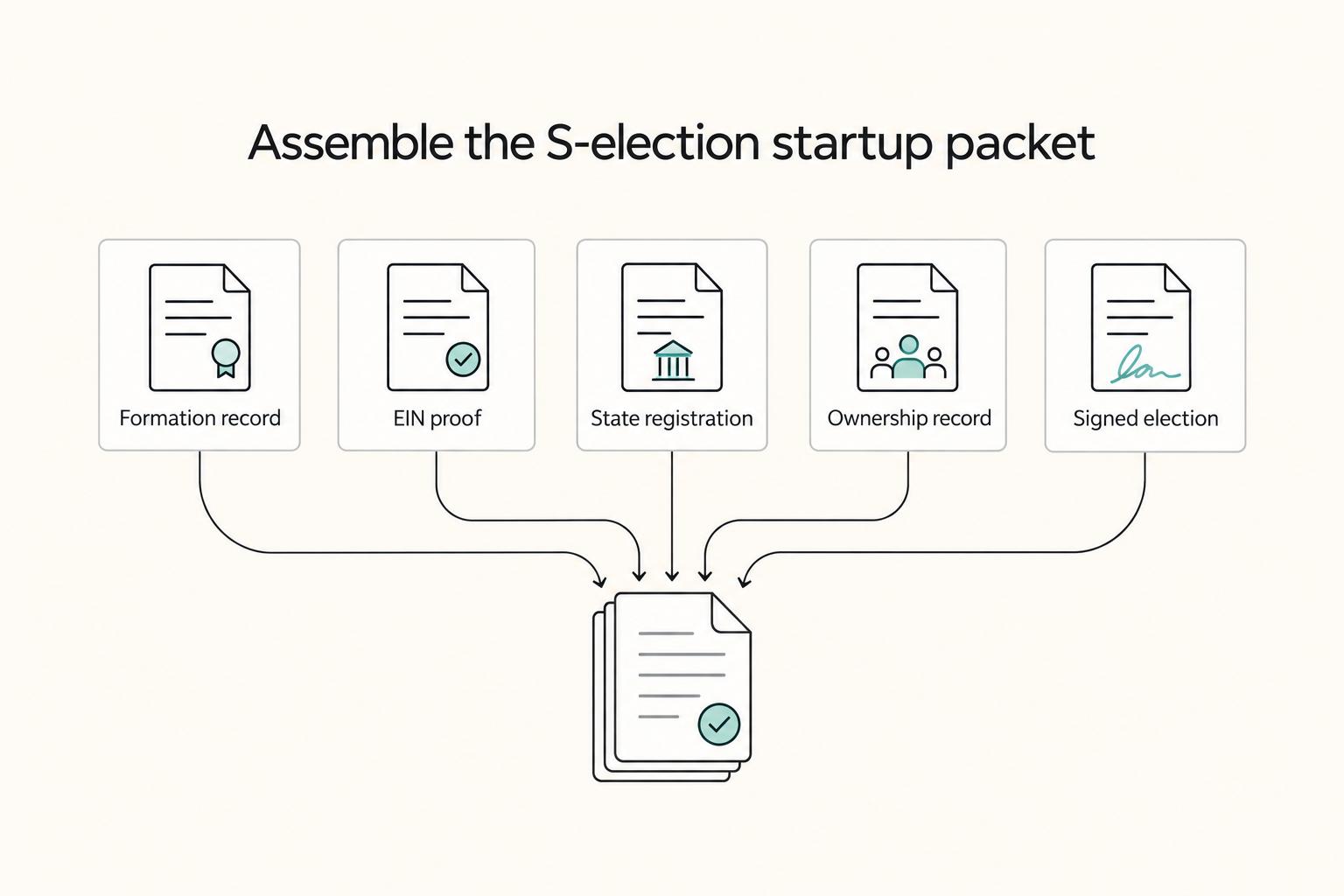
Build the startup packet first#
Build one pre-filing packet so you can complete Form 2553 without guessing.
| Packet item | Why it matters | What to verify before filing |
|---|---|---|
| Entity formation documents | Form 2553 acceptance depends on meeting eligibility tests and providing required entity information | Exact legal entity name matches organizing documents |
| EIN confirmation | Form 2553 includes a specific EIN field (Item A) | EIN ties to the same entity you plan to elect for |
| State registration records | Keep key identity details consistent across records | Name, address, and registration details are consistent |
| Ownership records | You need a clear ownership record to complete consent documentation accurately | Ownership percentages and effective dates are documented |
| Draft Form 2553 signature plan | Form 2553 requires shareholder consent plus an officer signature | You know who signs as officer and who signs the Shareholder's Consent Statement |
Checkpoint: the entity name, address, EIN, and ownership details should match across formation papers, state records, and draft election documents. If they do not, reconcile them first.
Prepare spouse role evidence now#
Write a short memo now covering each spouse's management duties, capital contributions, and expected service levels. Keep it direct: who controls management decisions, who performs services, and whether authority is equal or directional.
This memo supports the classification decision from Step 1. If one spouse substantially controls management and the other works under that spouse's direction and control, the second spouse is treated as an employee subject to income tax and FICA (Social Security and Medicare) withholding. If both spouses have equal say, perform services, and contribute capital, the relationship points toward partnership-type treatment, and business income is generally reported on Form 1065 unless an S or C election applies.
Use the same memo to support compensation treatment. The IRS can reclassify shareholder payments from non-wage distributions as wages. Keep a clear record of why each spouse is treated as an owner, an employee, or both, and how that supports reasonable compensation.
Create the tax-admin checklist before first pay#
Set up payroll administration before money starts moving. If either spouse will be treated as an employee, make sure your setup can track income tax and FICA withholding and keep wages separate from shareholder distributions.
Map your accounts so wage and distribution categories stay separate in the books.
Also build a working internal calendar for payroll and return-prep milestones, so you do not reconstruct payroll treatment from bank activity at year-end.
Add a pause-and-escalate list#
Use a short trigger list and stop if any item appears:
- Ownership records do not clearly show whether one spouse or both spouses hold the interest.
- The spouse role memo and ownership records conflict.
- You cannot determine who must sign the Shareholder's Consent Statement on Form 2553.
- A spouse may have rights tied to community property, but title and records do not make ownership clear.
- Required shareholder consent or other supporting documentation for the planned election is missing.
If any trigger applies, resolve it before filing.
Need the full breakdown? Read The S-Corp Election for LLCs: A Tax-Saving Strategy for High-Earning Freelancers.
Step 3 Set ownership and spouse roles the IRS can actually defend#
Treat ownership and working roles as separate facts, then align your pay and reporting to those facts.
Separate ownership from day-to-day work#
Define two things for each spouse: what that spouse legally owns and what that spouse actually does in the business.
A spouse may be an owner, an employee, or both, depending on the facts. Keep those categories consistent across ownership records, entity documents, and any S or C election filings. If those records conflict, fix that before payroll or distributions begin.
Apply the control rule before money starts moving#
Use control first before you decide how to pay anyone. If one spouse substantially controls management and the other works under that spouse's direction and control, the working spouse is treated as an employee.
That pay is subject to income tax and FICA (Social Security and Medicare) withholding, so treat it as wages rather than owner draws. If that is your tax treatment, keep the compensation rule in view as well. Shareholder-employees must receive reasonable compensation before non-wage distributions, and the IRS can reclassify non-wage distributions as wages.
Match the facts to the reporting logic#
Once ownership and roles are clear, use the reporting path that matches how the spouses actually operate.
| Fact pattern | IRS description | Reporting logic |
|---|---|---|
| Both spouses have equal say, provide substantially equal services, and contribute capital | Partnership-type relationship | Report income on Form 1065 unless S or C status is elected |
| One spouse substantially controls management and the other works under that spouse's direction and control | Employer/employee relationship | Treat the working spouse's pay as wages subject to income tax and FICA withholding |
| S corporation status is in place and a spouse performs services as a shareholder-employee | Shareholder-employee compensation rule | Pay reasonable compensation before non-wage distributions |
Also remember that Form 1065 is an information return, and partnership items generally pass through to partners.
Keep records that support your classification#
You do not need an elaborate file, but you do need consistency. Keep ownership, role, and pay treatment aligned, and make sure your reporting and payment history supports that same classification outcome over time.
Related reading: The Pros and Cons of Second Citizenship for US Nationals.
Step 4 Handle community property and Form 2553 consent correctly#
This works only if your shareholder list is right, all required shareholder consents are complete, and an officer has signed. Use community-property questions and ownership labels as review flags, then document the conclusion before you submit.
Review title and marital-property facts together#
When community-property questions come up, treat title as one input, not an automatic answer by itself. For federal filing, the anchor rule is the same: the Internal Revenue Service (IRS) requires Form 2553 to be signed by all shareholders, and acceptance depends on meeting the "Who May Elect" tests.
If only one spouse is listed as owner, pause and confirm that your shareholder conclusion is consistent across your records. Keep a short dated file note showing why the listed shareholders are the right ones for this election.
Apply Form 2553 consent mechanics exactly#
Once you know who belongs in the shareholder set, follow the consent mechanics exactly. If your review concludes a spouse belongs in the election, include that spouse in the consent package now. In Part I, list each shareholder or former shareholder name and address, complete Column K (Shareholder's Consent Statement), and use a continuation sheet or separate consent statement when needed.
If your conclusion is that the non-titled spouse does not belong on the shareholder list, keep the supporting record in the file. One risk is rejection. Another is having no contemporaneous support for who did and did not sign.
Treat ownership labels as red flags, not shortcuts#
An ownership label should trigger extra reconciliation work, not an automatic signature decision. Compare that label against the shareholder list and the intended election ownership story.
If those documents do not align, resolve the mismatch before filing. It is much easier to clean this up now than to fix an election issue later.
Run a final execution checkpoint before submission#
| Checkpoint | What to confirm |
|---|---|
| Shareholder list | Each shareholder you decided belongs on the election is listed with name and address |
| Shareholder consent | Each required shareholder consent is signed in Column K or attached on a valid continuation or separate consent statement |
| Officer signature | The officer signature is complete |
| Additional page 2 copies | Attach them if the shareholder rows run out |
Do not submit until you have one clean shareholder list and one complete consent package with no unresolved spouse-interest questions.
Related: How to Create a Buy-Sell Agreement for a Partnership.
Step 5 Build payroll and compensation with fewer surprises#
Set payroll first, then take distributions. In a business taxed under Subchapter S, shareholder-employees should receive reasonable compensation for services before non-wage distributions.
Set owner payroll cadence before you take distributions#
Start with the spouse who is clearly performing services and put a payroll cadence in place now. Keep the rule simple: payroll first, distributions second.
Use the Form 1120-S wage-treatment language as a checkpoint: officer payments for services are treated as wages to the extent they are reasonable compensation. Your file note should state who performed services, when payroll started, and why payments are treated as wages before distributions.
Add spouse payroll only when the role supports employee treatment#
Do not put both spouses on payroll by default. Add spouse payroll when the facts support employee treatment, including when one spouse directs and controls the business and the other works under that direction and control.
If spouses operate more like a partnership-type relationship, business income is generally reported on Form 1065 unless there is an S- or C-corporation election. Do not use payroll entries to paper over an unresolved classification question.
Build the compensation file you will need later#
Make the record set complete and boring from the start:
- payroll reports for each wage run
- records of withheld FICA (Social Security and Medicare) and income tax
- a short compensation memo tying wages to actual services
- clear bookkeeping separation between wages and non-wage distributions
This is easier to defend when it is created during the year instead of rebuilt later.
Correct misclassified wages quickly and document the fix#
If payments were treated as draws or distributions when they should have been wages, address that promptly. The IRS can reclassify shareholder non-wage distributions as wages, which can create payroll and tax correction risk.
Document the correction in a dated memo, identify which payments are being recharacterized, and align the books and withholding records. Work with your payroll provider and tax preparer on required correction steps so the final records tell one consistent story.
For a step-by-step walkthrough, see How to Run Payroll for an S-Corp with a Single Employee (Yourself).
As you lock payroll timing and correction workflows, review Gruv Payouts to design approval-gated payouts with status tracking and audit-ready records.
Step 6 Handle health insurance in the right order#
After payroll is in place, handle health insurance so reimbursements, payroll records, and year-end reporting stay aligned. The goal is one clear record trail, not a year-end reconstruction project.
Write the reimbursement approach before posting payments#
If you plan to reimburse premiums or other employee expenses, document that approach before money moves. Keep the file practical: the written policy, premium statements or invoices, proof of payment, and a short note tying the expense to the spouse or shareholder-employee classification from earlier steps.
If spouse roles are still unresolved, pause. Do not use reimbursements to cover up an owner-versus-employee classification issue.
Track payments through payroll records, not owner draws#
A common failure is paying premiums from the business account and booking them as distributions or generic expenses. That can create mismatches when payroll, bookkeeping, and the W-2 are finalized.
Before the first reimbursement, get written confirmation from payroll and tax support on how amounts will be tracked for W-2 reporting. A dated email plus payroll mapping is usually enough.
Use a payroll-and-tax coordination checkpoint#
Ask your payroll provider and tax preparer to confirm the same handling method for reimbursements, payroll entries, and W-2 reporting before you process payments. That keeps everyone working from one approach instead of ad hoc rules.
Reconcile monthly as an internal control#
Run a monthly check so payroll entries, reimbursement records, and bank payments agree. If they do not, fix the coding before quarter close so errors do not carry into year-end reporting.
This pairs well with our guide on How to Handle Shareholder Distributions in an S-Corp.
Step 7 Address trust and ownership edge cases before they become expensive#
Before you retitle shares or file ownership updates, pause and confirm that legal ownership, beneficial ownership, and eligibility still line up. This matters most when trusts or other shared ownership structures are involved.
Review how ownership is documented today#
Start with the current ownership and tax record trail, then make sure each record tells the same ownership story. Confirm who is listed as owner, who may hold a beneficial interest, and whether trust language, if any, is consistent with those records.
If an LLC is involved, treat entity form as an extra checkpoint. The IRS IRM specifically flags "Special Considerations for Limited Liability Companies (LLCs)" as a separate consideration area.
Confirm the post-change structure still fits S-corp eligibility#
Before any transfer, run the proposed structure through tax and legal review for S-corp eligibility. Use IRM 4.31.5.2.1, "S Corporation - Defined," as a baseline checkpoint, and do not treat this excerpt as providing detailed trust-shareholder eligibility rules by itself.
Do not approve trust ownership decisions based on non-authoritative hypotheticals. In this research set, one non-IRS source is explicitly labeled "Hypothetical Fact Situation for Discussion."
Escalate ambiguity before filing changes#
If trust language is unclear, or beneficial ownership is not clear from the records, get attorney and tax sign-off before filing anything. Keep that sign-off in the ownership file.
Also treat gaps in ownership reporting records as a stop signal. The IRS IRM includes a specific documentation failure path at 4.31.5.3.4, "Missing Schedules K-1," so resolve inconsistencies before moving forward.
We covered this in detail in The Pros and Cons of a C-Corp for a Freelance Business.
Step 8 Fix the mistakes competitors usually skip#
The fastest way to reduce risk is to treat this as a records-control step. Make sure your election file, role records, and ownership records still match before you file anything new.
Recheck the election package before you touch anything else#
Start with Form 2553. The form states the election can be accepted only if the "Who May Elect" tests are met, so confirm the full filed package is complete, not just partially signed.
Check the basics in one place: the officer signature, the Shareholder's Consent Statement, and any extra page 2 copies if the shareholder rows exceeded the form. If you cannot produce the filed version and related election records together, treat the election file as incomplete.
Match the mistake to the recovery path#
Use the recovery path that fits the break instead of reaching for one generic fix.
| Mistake type | What usually went wrong | First recovery move | Verification point |
|---|---|---|---|
| Incomplete Form 2553 consent record | Missing shareholder consent entries, missing officer signature, or missing continuation pages | Rebuild the full election packet and evaluate whether a late-election path is needed | Consent entries are complete, officer signature is present, and continuation pages are included |
| Late election documentation gap | Election was filed late but the support file is thin | Prepare a dated reasonable-cause explanation and complete the supporting packet | Late-election file includes the explanation, corrected packet, and dated support records |
| Role/ownership record mismatch | Internal records tell conflicting stories about roles or ownership | Pause new filings and reconcile records with dated evidence | Ownership and internal role records align |
Rebuild documentation with dated evidence, not memory#
When records conflict, rebuild from documents created close to the event date. Use signed ownership records, internal approvals, and filed tax-period documents so the file shows a clear timeline.
The goal is simple: a later reviewer should be able to see when a change happened, what changed, and which records support it.
Keep an annual entity health file#
Create one annual entity health file and keep it current. Include:
- filed Form 2553, including consent pages and continuation pages
- proof of submission and acceptance records
- any late-election reasonable-cause materials
- ownership records and a short dated memo describing role or ownership changes
If you keep this file current each year, you will catch drift earlier and make corrections before they become expensive.
Step 9 Run an annual compliance review that catches drift early#
Use this review to catch fact changes before they turn into filing or record problems. Keep it document-based and run it once a year as part of year-end close.
Build a yearly review table from records#
| Review line | What to check | Evidence to keep | Red flag |
|---|---|---|---|
| Specified person status | Whether the filer is a specified person for Form 8938 purposes | Dated records supporting filer status | Status changed but filing approach did not |
| Reportable foreign asset interest | Whether the filer has an interest in specified foreign financial assets required to be reported | Asset records and year-end valuation support | Assets appear reportable but no Form 8938 decision is documented |
| Return filing requirement | Whether an income tax return is required for the year | Filing requirement workpapers and return records | Filing requirement changed but Form 8938 treatment did not |
| Annual asset changes | Whether any foreign assets were acquired or sold during the tax year | Transaction records and dated summaries | Acquisitions or dispositions occurred but no recheck was done |
| Form interaction check | Whether Form 8938 and FBAR were tested separately when relevant | Separate Form 8938 and FBAR review notes | Team assumed one filing satisfied both |
If a row cannot be tied to dated records, treat it as unresolved and fix it before final filing.
Run a separate cross-border trigger check#
Foreign assets need a separate review. Run a distinct FATCA and FBAR check when foreign financial assets are in scope. For Form 8938, confirm both gates first: the filer is a specified person, and the filer has an interest in specified foreign financial assets required to be reported.
If Form 8938 is required, attach it to the annual return and file by that return's due date, including extensions. Do not treat Form 8938 and FinCEN Form 114 (FBAR) as interchangeable. Filing Form 8938 does not remove an FBAR filing requirement when FBAR applies.
Use a simple annual change question: were any foreign assets acquired or sold during the tax year? Also apply the IRS exception that if no income tax return is required for the year, Form 8938 is not required.
For certain domestic entities, the Form 8938 instructions include thresholds: more than $50,000 on the last day of the tax year or more than $75,000 at any time during the tax year.
Add change-detection rules that force a recheck#
Certain changes should trigger an immediate recheck, especially:
- status changes that affect whether the filer is a specified person
- foreign assets acquired or sold during the year
- facts that may change whether Form 8938 is required
- facts that may trigger a separate FBAR obligation
When one trigger occurs, rerun Form 8938 and FBAR checks together instead of waiting for next year.
Copy and use this checklist before you file#
Use this as a stop check, not a reminder list. If any foreign-asset classification or filing trigger is unclear, pause and get tax-legal review before filing.
Step 1. Confirm whether Form 8938 applies to you. Verify that you are a specified person (a specified individual or specified domestic entity) and confirm whether an income tax return is required for the year. If no income tax return is required, Form 8938 is not required even if foreign assets exceed the reporting threshold.
Step 2. Run the Form 8938 threshold test for your filer profile. Check both measurements for the tax year: the value on the last day of the tax year and the highest value at any time during the year.
| Form 8938 filer profile | Last day of tax year | Any time during year |
|---|---|---|
| Married filing jointly, living in the U.S. | More than $100,000 | More than $150,000 |
| Married filing jointly, living outside the U.S. | More than $400,000 | More than $600,000 |
| Specified domestic entity | More than $50,000 | More than $75,000 |
Step 3. Confirm Form 8938 filing mechanics. Attach Form 8938 to your annual return and file it by that return's due date, including extensions.
Step 4. Evaluate FBAR as a separate requirement. Form 8938 does not replace FBAR. FBAR (FinCEN Form 114) is filed with FinCEN, not with the IRS.
Step 5. Run the FBAR threshold check and escalate edge cases. If the aggregate value of foreign financial accounts exceeds $10,000 at any time during the calendar year, evaluate FBAR filing separately. If anything is unclear, determine whether you need Form 8938, FBAR, or both before filing.
When your structure and compliance checklist are finalized, use Gruv Docs to map a traceable collect-convert-payout workflow your team can implement with clear controls.
Frequently Asked Questions
Can a husband and wife both be owners of an S corporation?
Yes, potentially. A husband and wife can both be owners if the corporation meets the IRS Who May Elect requirements and Form 2553 is filed correctly. Part I, item J should list each shareholder or former shareholder, and your ownership records should match that filing.
Does a married couple count as one shareholder or two under Code Section 1361?
Do not assume the answer is one or two just because you are married. Form 2553 explicitly addresses family-as-one counting in Box G only when more than 100 shareholders are listed and family aggregation would reduce that number to 100 or fewer. Treat spouse counting as fact-specific and confirm it against the actual ownership structure.
If only one spouse is on title, does the other spouse still need to sign Form 2553?
Maybe. Form 2553 requires all shareholders to sign the Shareholder's Consent Statement in Part I, item K, and it also requires an officer signature. The key issue is whether the non-titled spouse is a shareholder under your facts, so confirm that before filing.
When should a spouse be treated as an employee instead of a co-owner?
Use control and role documentation first. If one spouse substantially controls management and the other works under that spouse's direction and control, the working spouse is treated as an employee subject to income tax and FICA withholding. Keep ownership and work-role records separate and confirm the treatment before payroll starts.
Can we use a qualified joint venture instead of an S corporation?
Maybe, but only in a specific fact pattern. A qualified joint venture is available when a married couple files a joint return, both spouses materially participate, and the business is not held in a state-law entity such as an LLC. If those facts do not fit, evaluate Subchapter S or get legal-tax review before filing.
What is the minimum setup checklist for a husband-wife S corporation?
Start with dated ownership records and a current Form 2553 completed with Part I, item J for each shareholder or former shareholder. Make sure every required shareholder consent in Part I, item K is signed and that an officer signature is included. Keep the signed election, proof of submission and acceptance, and any late-election reasonable-cause materials together for annual compliance review.
Researched and edited by the Gruv editorial team. Gruv builds cross-border billing, payouts, and finance-operations software for global businesses.
Sources
Educational content only. Not legal, tax, or financial advice.
Related Posts

Sole Proprietorship vs LLC for Global Freelancers in 2026
For most freelancers in 2026, the practical default is still simple: use the simplest structure you can run cleanly, then formalize when risk actually rises. If your work is still in validation mode and the downside is contained, a sole proprietorship is often the practical starting point. When contract exposure, delivery stakes, or dispute risk starts climbing, forming an LLC deserves earlier attention.
How to Create a Buy-Sell Agreement for a Partnership
**Treat your buy-sell agreement for partnership as core operating infrastructure, not paperwork for later.** Freelancers and consultants move fast on client delivery, but shared ownership risk keeps running in the background until one partner leaves, becomes disabled, goes bankrupt, or goes through a divorce.

The Freelance Payment Penalty: A Modeled Audit of Platform Fees, FX Spreads, and Payout Delays
The money rarely disappears through a single, easy-to-spot fee. The real loss is stacked. A marketplace takes its commission, a processor adds a charge for international cards, a bank or payment company converts the currency at a spread, a platform holds the funds before release, and a wire sheds a little to intermediaries on the way in. Each layer looks defensible on its own, but the worker feels the combined result as a smaller deposit and a later payday.