
Quick Answer
Define service warranty clause development around a single completion checkpoint: written acceptance closes delivery and starts limited defect support. Require defect notices to reference accepted requirements, choose a clear remedy sequence, and keep out-of-scope requests in change-order terms. For international projects, state governing law, forum method, and notice rules as separate clauses. That structure narrows ambiguity, protects final invoicing, and reduces unpaid post-launch work.
Why Your Standard Warranty Clause is a Ticking Time Bomb for Your Cash Flow#
A vague warranty clause weakens your payment position because it blurs one critical handoff: when delivery is complete and when limited defect support begins. When that line is unclear, clients can delay acceptance, reopen scope after delivery, or dispute the final invoice.
The fix is simple: tie completion to acceptance, keep warranty duties separate from delivery, and limit what happens after acceptance to a defined defect process. That gives you a clean finish line for the work and a narrower path for anything that comes after it.
Step 1. Tie completion to acceptance#
Make acceptance your completion trigger. Acceptance is the formal act that treats services as complete performance, and in federal payment rules, due-date timing runs from acceptance, not only from invoice submission. Those same rules also show the risk: if quality or compliance is disputed, constructive acceptance may not apply.
In practice, you want one clear acceptance record, such as a dated approval email, ticket, or signed note, confirming the work met agreed requirements. Without that record, a post-delivery disagreement is more likely to become a payment dispute.
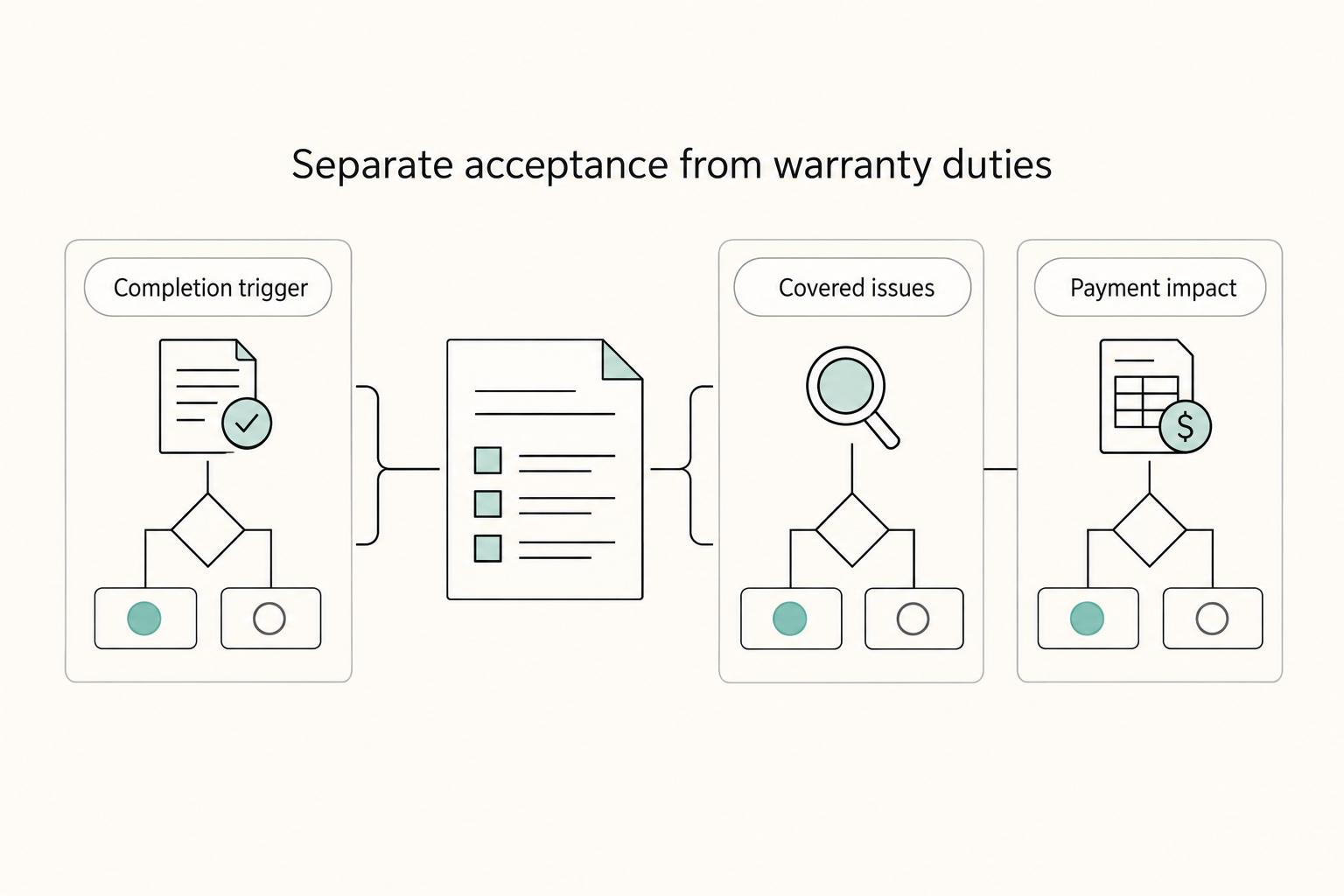
Step 2. Separate acceptance from warranty duties#
Keep delivery duties and warranty duties distinct. Before acceptance, your job is to deliver conforming work. After acceptance, your obligation should narrow to defect remedies tied to the accepted deliverable and a defined notice window.
| Issue | Template-style warranty | Structured warranty |
|---|---|---|
| Completion trigger | Implied or unclear | Starts from final acceptance |
| Covered issues | Broad "any problems" language | Defects in accepted work, reported in the notice window |
| Payment impact | More room to delay sign-off or contest final invoice | Clearer basis to close delivery and collect final payment |
This separation creates clearer boundaries. If your clause says you will fix "all issues after launch," new requests can be relabeled as warranty work, and scope creep can turn into unpaid work.
Step 3. Limit the post-acceptance remedy#
Define the notice period, the defect scope, and the remedy options. In federal service clauses, one example is notice within 30 days from acceptance, with remedies framed as reperformance or price adjustment rather than open-ended rework. Use that structure in your own contract language: clear window, clear defect standard, clear remedy, and written agreement for scope changes.
The next sections turn that into a workable contract setup: a clean acceptance handoff, tighter remedy wording, and clearer cross-border terms.
Related: How to Write a Warranty and Disclaimer Clause for a Software Product.
Pillar 1: Fortify Your Professionalism with a Proactive Warranty#
Set the warranty process before work starts, not after something breaks. If you explain the handoff and support rules early, you reduce ambiguity between delivery handoff and ongoing help.
Step 1. Introduce warranty terms before authorization#
Bring warranty and support expectations into the proposal or order summary, not only at contract close. Tell the client plainly which document authorizes services, how deliverables are defined, and how support requests will be reviewed.
Use the activation document as the anchor. A Work Order is the practical checkpoint because it ties services and deliverables to what it specifies, and service use or purchase is authorized there. If you use repeatable support rules, keep them in an Operations Framework and incorporate it into each Work Order unless excluded.
| Reactive warranty conversation | Early warranty conversation |
|---|---|
| Client expectation-setting | Warranty limits appear after an issue is raised |
| Response boundaries | Requests arrive without an agreed filter |
| Project-close predictability | Acceptance and support are treated as one blur |
Step 2. Explain the purpose as clarity at handoff#
Frame this as operational clarity, not legal positioning. The goal is a cleaner handoff and fewer scope arguments, with everyone following the same written process.
Use document hierarchy to avoid ambiguity. If your master agreement and Work Order conflict, the Work Order can control. Put project-specific details there so authorization points and service scope are explicit. If your acceptance mechanics are still vague, tighten them first in How to Structure a 'Testing and Acceptance' Clause in a Software Development Contract.
Step 3. Verify first, then triage#
Do not start with severity. First confirm whether the request maps to deliverables described in the Work Order. Only verified in-scope issues should enter warranty triage.
| Severity | Meaning after verification |
|---|---|
| Critical | Work-Order-defined core function is unavailable |
| Major | An important Work-Order-defined function is materially impaired |
| Minor | Lower-impact issue within Work-Order-defined scope |
That order matters because if you skip verification, ordinary support issues and new requests can slide into the warranty queue.
Step 4. Use one repeatable talk track in proposals and kickoff#
Consistency matters more than polish here, so use the same plain explanation in the proposal, the signed paperwork, and the kickoff meeting:
- The Work Order authorizes services and defines deliverables.
- Your handoff or acceptance process should be documented against those deliverables.
- Reported issues are reviewed against the Work Order-defined deliverables and scope.
- Verified in-scope issues are triaged and handled within the written process.
- Requests outside Work Order scope are handled through separate written agreement.
Keep your records tight: signed Work Order, any incorporated Operations Framework, handoff/acceptance record, and kickoff recap. That record set helps keep post-handoff disputes from drifting into open-ended support.
Pillar 2: Make the Warranty Remedy Path Clear in the Contract#
Once acceptance is clear, make the warranty remedy path just as clear in the contract itself. In service warranty clause development, the practical goal is simple: a reported issue should move through a defined process with clear decision ownership. One universal software-warranty process is not established, so treat process details as negotiated drafting choices.
Step 1. Define the remedy framework in one read#
Your clause should answer three questions without forcing anyone to infer the rest: what makes a defect notice valid, who chooses the remedy path, and which remedy paths exist.
Use written notice with enough detail to verify the issue against the accepted deliverable. Keep this practical, but specific enough that vague complaints cannot skip the verification step.
Then make remedy control explicit. Either one party chooses from listed remedies, or the contract states a sequence or escalation path if there is disagreement.
Step 2. Keep exclusive remedy language, and fence the scope#
If your deal allows it, keep an exclusive-remedy concept so covered issues stay inside the warranty process instead of turning into ad hoc demands. Then separate warranty defects from requests that belong in another commercial path, such as change requests, enhancements, or client-environment issues, using your own contract definitions.
Just as important, keep that logic in the document that is actually executed. In the April 16, 2025 addendum for North Bay Village RFP#2025-003, bidders were told to execute the Professional Services Agreement in substantially the provided form. The Village also said terms may be negotiated when required by law, regulation, or professional standards. It further said it would not execute a separate engagement letter by default, while allowing incorporation into the final agreement. The drafting takeaway is practical: if your remedy terms live only in unsigned side paper, relying on them later can be uncertain.
Step 3. Use a decision table before final clause text#
Draft the logic before you draft the clause. If you cannot map the remedy path in plain terms first, the final wording can leave ambiguity.
| Remedy path | Trigger condition | Client obligations | Related contract section |
|---|---|---|---|
| Confirm the primary remedy path from the governing contract | Confirm the trigger condition from the governing contract | Confirm the client cooperation duties from the governing contract | Confirm the related contract section from the governing contract |
| Confirm the alternative remedy path from the governing contract | Confirm the fallback trigger from the governing contract | Confirm the required cooperation from the governing contract | Confirm the related contract section from the governing contract |
| Confirm the escalation path from the governing contract | Confirm the unresolved-cure condition from the governing contract | Confirm any stop-use or confirmation steps from the governing contract | Confirm the related contract section from the governing contract |
If you cannot tie each path back to acceptance and invoicing language in your agreement, the clause may still leave revenue exposed.
Step 4. Cross-reference the risk stack#
Do not review the warranty clause by itself. In many agreements, warranty language sets the operational fix path, while limitation-of-liability language sets the financial ceiling. Cross-reference both so they work together in practice.
Apply the same side-by-side check to indemnity wording. The same North Bay Village addendum records a bidder concern that indemnification language could conflict with professional-independence rules. The broader lesson is that one clause can quietly undercut another if you do not reconcile them together.
Before finalizing, use this checklist:
- Define written defect notice requirements tied to accepted deliverables.
- Set the cure workflow in order, including remedy-selection authority.
- Tie any re-test or re-acceptance loop back to your acceptance mechanics, if your contract uses one.
- Add an escalation path when cure is not feasible.
- Cross-reference warranty and liability clauses so the risk allocation is internally consistent.
If you need to tighten that cross-reference next, use A Deep Dive into the 'Limitation of Liability' Clause for Freelance Software Developers.
Pillar 3: De-Risk Your Global Operations#
In cross-border deals, vague dispute terms can create avoidable enforcement risk. The cleanest approach is to draft governing law, forum, and notice mechanics as separate operating decisions.
Before drafting, confirm: counterparty legal name, registered address, notice email, contract language, and where assets or receivables are located. If any of that is unknown, your dispute terms are not operational yet.
Step 1. Choose governing law and forum as separate decisions#
Treat these as two clauses, not one concept. Choice of law selects the legal rules for the contract. Jurisdiction or arbitration selects where and how disputes are decided.
| Decision | Article wording | Key point |
|---|---|---|
| Choice of law | Selects the legal rules for the contract | Governing law alone does not decide hearing venue |
| Exclusive choice of court agreement | Use it if you want court litigation | State it clearly |
| Arbitration | Selects where and how disputes are decided | Agree on that method during negotiation, not after a dispute starts |
Governing law alone does not decide hearing venue. If you want court litigation, state an exclusive choice of court agreement clearly. The Hague choice-of-court framework is designed to support certainty for exclusive court clauses, but applicability depends on contracting states and dispute scope. Verify coverage instead of assuming it.
If you want arbitration, agree on that method during negotiation, not after a dispute starts. For ICC arbitration, the rules currently referenced by ICC entered into force on 1 January 2021. ICC cost planning includes institution and tribunal components, not only external legal fees.
Step 2. Pick the forum you can enforce#
Start with enforceability, not preference. A judgment or award only helps if you can enforce it where the counterparty's assets are located. Under the New York Convention framework, arbitral awards are recognized and enforced across contracting states, but enforcement still follows the procedure of the territory where enforcement is sought.
Before you accept forum terms, use this quick filter:
| Drafting pattern | Example problem | Operational risk |
|---|---|---|
| Law in one place, court in another | Country A law, Country B courts | Can require more foreign-law briefing, added local counsel cost, and procedural friction |
| Court selected, enforcement path ignored | Court chosen with no practical route to assets | Risk of an expensive win that is hard to collect |
| Arbitration named, method unclear | Arbitration stated without aligned language/seat/rules | Higher risk of early disputes over procedure, language, and timing |
| Aligned drafting | Law, forum method, contract language, and asset geography are aligned | Lower uncertainty and clearer decision paths |
A simple checkpoint is this: if payment stopped tomorrow, could you say where and how enforcement would happen? If not, keep drafting.
Step 3. Lock the notice and timing mechanics#
Even good forum terms can fail in practice if notice and timing mechanics are vague. Cross-border disputes can escalate when parties cannot agree on when notice was received or when the response clock started.
| Element | What to state | Timing note |
|---|---|---|
| Notice method and destination details | Name the notice email and any physical address | Name who may update them |
| Deemed-receipt trigger | Use explicit deemed-receipt language | Counting starts the next day after deemed communication |
| Business hours and time zone | Define them directly in the contract | Current local-law requirement pending legal/source/adviser verification |
| Holiday treatment | Holiday exclusions pending local-law/source/adviser verification | Response windows define holiday treatment |
Define notice method and destination details. ICC materials route communications to a party's last notified address, which is a useful model. Name the notice email, any physical address, and who may update them.
Then define when clocks start. Use deemed-receipt language only after contract and legal review confirms it fits the deal, and make clear when counting begins. Define business hours, time zone, weekday coverage, and holiday treatment directly in the contract after local-law/source/adviser verification.
Before signing any cross-border contract, confirm:
- Governing law is separate from court or arbitration forum.
- Forum terms match realistic enforcement geography.
- Contract language is aligned with dispute method, or translation risk is accepted.
- Notice clause states method, address, email, and deemed-receipt trigger.
- Response windows define start point, business hours, time zone, and holiday treatment.
For a step-by-step walkthrough, see How to Write a Limitation of Liability Clause for a Freelance Contract.
From Legal Chore to Strategic Weapon#
A strong warranty clause is not just legal cleanup. It is one of the main controls for protecting revenue, protecting time, and showing buyers that your delivery process is reliable. Use FAR-style logic as drafting guidance, then adapt it to your private contract terms.
Protect revenue with one acceptance event and one payment trigger#
Tie final payment, and where applicable warranty timing, to the same written acceptance event. State that acceptance is documented by the client's authorized representative, and that this acceptance triggers release of the final invoice. Keep a dated acceptance record tied to each deliverable or milestone so there is a clear finish line. If this is still unclear in your contract stack, tighten it in your testing and acceptance clause.
Protect time by triaging every post-acceptance issue before work starts#
Do not let every reported issue turn into immediate warranty work. Route each issue through a simple three-way check before anyone starts fixing anything:
| Issue type | Definition | Handled through |
|---|---|---|
| Defect | Nonconformance to written contract requirements | Warranty cure |
| Environment issue | Conditions outside agreed requirements | The non-warranty support path your contract defines |
| Change request | New behavior or scope | Your change-control terms and a written change order |
Require written defect notice with the affected deliverable, reproduction steps, environment details, and discovery date before warranty work begins.
Signal reliability by defining response, remedy, and escalation up front#
Buyers trust the process when the remedy path is explicit. Set a clear sequence: written notice, your review, correction or reperformance for confirmed defects, and a defined fallback, such as price reduction, only if correction is not possible and your contract allows it. Then send unresolved matters to one escalation path under the main disputes clause.
In practice, that means a clause set with aligned definitions, a written notice process, response timing, cure method, exclusions, change-order routing, and one disputes path.
We covered this in detail in How to Write an Arbitration Clause for a Freelance Contract.
Frequently Asked Questions
How is a warranty different from an SLA?
A warranty is about whether delivered work conforms to contract requirements and is free from defects. If you include SLA language, define it separately and keep it from quietly expanding warranty scope.
How do you stop scope creep from sneaking in through the warranty?
Define defects by reference to written contract requirements, not general expectations. If a request goes beyond those requirements, treat it through your change process instead of warranty work. Then check that the same terms are used consistently across your contract documents.
What remedies should your warranty clause include?
State the remedy path clearly so failure does not turn into open-ended argument. Keep the cure mechanism limited and explicit, and make any refund language explicit if you include it. A warranty without a defined remedy is much harder to enforce cleanly.
Should the warranty clause say anything about governing law or jurisdiction?
The grounding provided here does not establish governing-law or jurisdiction drafting rules. Treat those terms as separate legal provisions and confirm they align with the rest of your agreement.
How do you define “professional and workmanlike manner” without leaving it vague?
That phrase works better when tied to objective contract requirements. AIA A201-2017 Section 3.5.1 uses this structure by linking quality to conformity with contract documents and freedom from defects. In your deal, pair quality language with concrete acceptance criteria and test steps. If those are still loose, tighten them in your testing and acceptance clause.
How long should the warranty window be in 2026?
Do not copy timing from a random template. A common confusion is treating a correction period as the same thing as a warranty. In construction context, that correction period is often described as usually 12 months, but that is context-specific. Choose timing only after you verify your current market range and align it with your acceptance mechanics and delivery model.
What documents should you review before you trust the warranty wording?
Review the full contract stack, not only the paragraph labeled “warranty.” Conflicts can come from mismatched definitions of deliverable, defect, acceptance, exclusions, or notice timing across documents. If those definitions are not aligned, fix them before finalizing the warranty language.
What is the clearest practical takeaway when you draft service warranty clause development language?
Tie the promise to written requirements, keep remedies bounded, and remove cross-document contradictions. If you cannot point to how acceptance happens and how out-of-scope work is handled, the warranty is still too vague. Precision is what protects cash flow and limits dispute risk.
Try a related tool
Researched and edited by the Gruv editorial team. Gruv builds cross-border billing, payouts, and finance-operations software for global businesses.
Sources
- acquisition.gov/far/52.246-20trusted
- acquisition.gov/dfars/part-252-solicitation-provisions-and-c...trusted
- bis.gov/media/147trusted
- cops.usdoj.gov/pdf/2023ProgramDocs/cpd_de_escalation/lea_so...trusted
- courts.ca.gov/system/filestrusted
- ecfr.gov/current/title-48/chapter-1/subchapter-H/part...trusted
- michigan.gov/dtmb/-/media/Project/Websites/dtmb/Procureme...trusted
- nitc.nebraska.gov/advisory-groups/technical-panel/meetings/doc...trusted
Educational content only. Not legal, tax, or financial advice.
Related Posts

Germany Freelance Visa Application Path for Freiberufler and Gewerbe
Choose your track before you collect documents. That first decision determines what your file needs to prove and which label should appear everywhere: `Freiberufler` for liberal-profession services, or `Selbständiger/Gewerbetreibender` for business and trade activity.

Limitation of Liability Clause for Freelance Software Developers
Start by setting the structure, not just a number. Liability terms allocate risk, so your first move is to define how risk is organized before you negotiate the cap amount. Use these terms consistently from round one:
How to Structure a 'Testing and Acceptance' Clause in a Software Development Contract
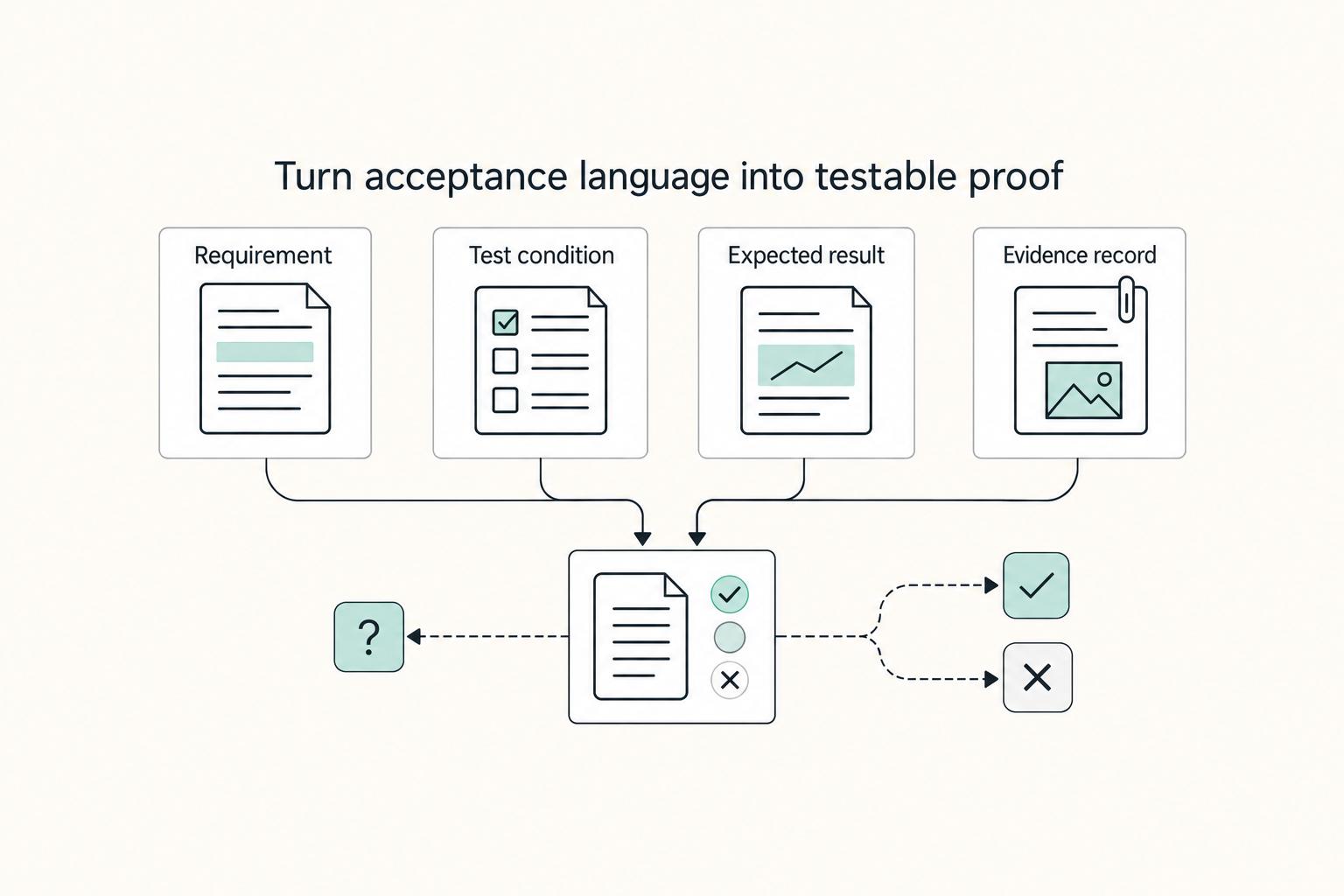
Scope creep usually gets blamed first, but a weak **testing and acceptance clause** is often what lets it happen. When that clause is vague, you lose control over the three things that decide whether a project stays profitable: what counts as done, what counts as extra work, and when final payment is due.