
Quick Answer
A strong referral fee agreement should clearly define what counts as a qualified referral, what triggers payment, when payment is due, how long fees can continue, and how cancellations, refunds, and non-payment are handled. It should also set role limits, client-relationship boundaries, required proof, dispute mechanics, and any cross-border payment or tax-document checks so the deal can be run from the document itself.
Beyond the Document: Why Your Referral Agreement is a Strategic Asset#
Your referral fee agreement should run the deal, not just record it. It should clearly say who gets paid, what triggers payment, when payment is due, how long obligations last, and what happens if a deal is canceled or never closes. If those points are unclear, you are still carrying avoidable risk.
| Issue | Informal referral deal | Structured referral fee agreement |
|---|---|---|
| Clarity | Terms are implied or discussed later | Defines qualified referral, fee trigger, and payment timing |
| Dispute handling | Depends on memory, messages, and interpretation | Written terms are the first reference point |
| Payment predictability | Fee percentage may be discussed, timing may not be | States amount or percentage and exact payment timing |
| Lead quality | Qualification expectations are often unclear | Clear expectations can improve the flow of qualified referrals |
Lock down the risk points before signing#
Start with the terms most likely to create disputes. Get written answers on what counts as a qualified referral, when commission is earned, whether payment is owed if the client does not proceed, how cancellations or refunds are handled, and how long referral fees can continue. If term limits are vague, payment obligations can last much longer than you intended. As a quick test, you should be able to point to one clear clause for each item above.
Set relationship boundaries early#
Payment terms are only part of it. A strong agreement also sets expectations about client-relationship responsibilities and who controls commercial decisions.
That matters because disputes often start when boundaries are implied instead of stated. Use the agreement to make clear who handles ongoing contact, who discusses pricing, and where the referrer's role stops. This helps both sides work from the same expectations and reduces conflict later.
Operational proof to keep on file: referral introduction message, date received, internal lead record, and the transaction record tied to fee eligibility.
Confirm the agreement is operationally usable#
Before approval, make sure the agreement can actually be run by your team, not just signed. Use this checklist:
| Check | What to verify |
|---|---|
| Payment trigger | An explicit clause lets your team verify the payment trigger |
| Payment timing | An explicit clause lets your team verify the payment timing |
| Duration | An explicit clause lets your team verify the duration |
| Cancellation outcome | An explicit clause lets your team verify the cancellation outcome |
| Client-relationship boundaries | Explicit clauses define the client-relationship boundaries |
| Referral-credit evidence | The agreement names evidence such as an intro message, signed order, paid invoice, or another named record |
| Public promotion | Check whether material-connection disclosure may apply if a partner promotes you publicly |
| U.S. or cross-border payments | Confirm the correct current reporting path and forms for your specific facts |
If you cannot answer those questions from the document itself, the agreement still needs work.
If you want a deeper dive, read Germany Freelance Visa: A Step-by-Step Application Guide.
Give Each Payment, Access, and Exit Term Its Own Clause#
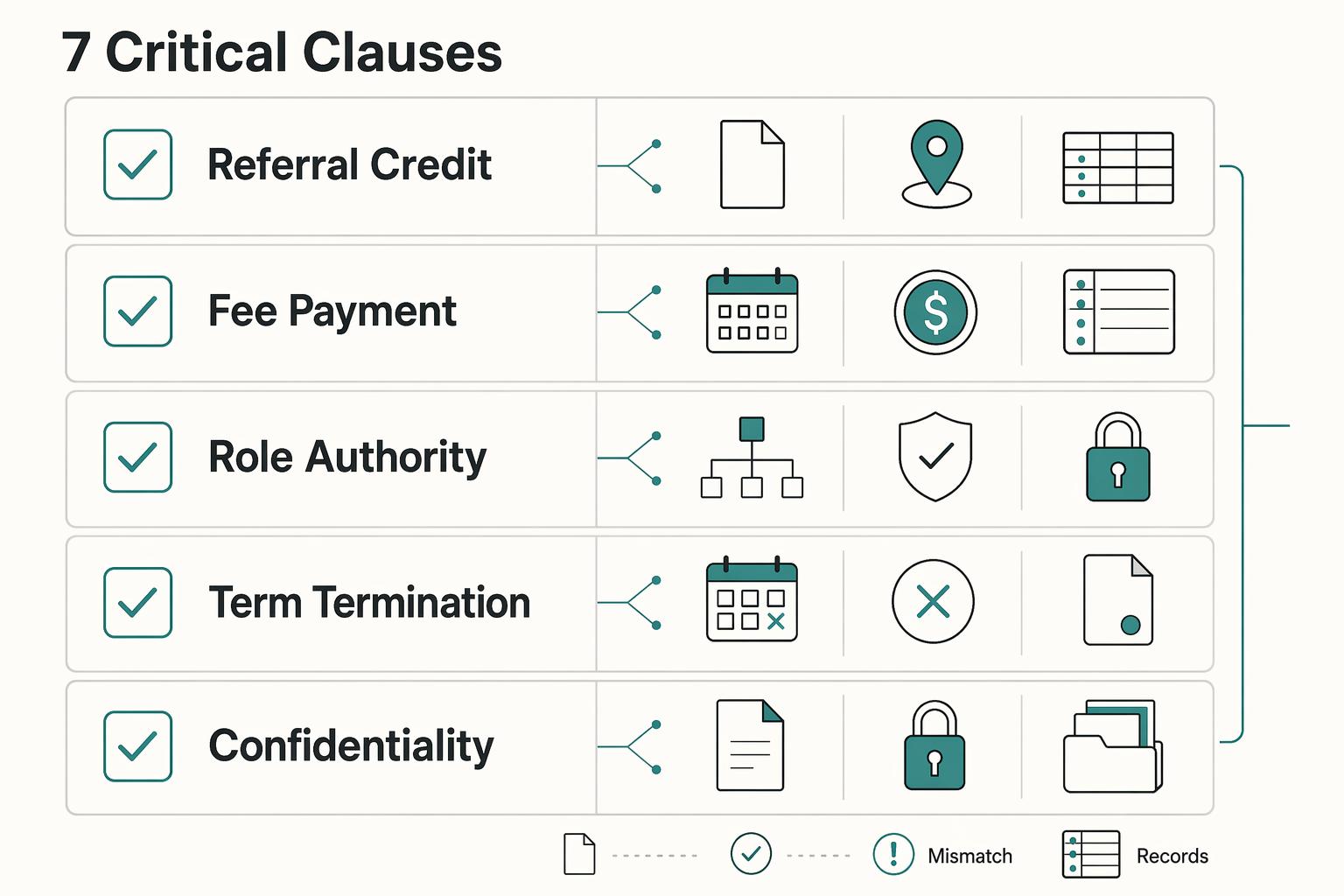
If a term controls payment, client access, or exit rights, give it its own clause. In practice, agreements are easier to run and defend when they are built from explicit commitments instead of one broad paragraph.
| Clause | What it should cover |
|---|---|
| Referral-credit terms | Trigger event, required proof, exclusions, and accepted evidence format such as email, a CRM entry, or another named record |
| Fee and payment terms | What the fee is calculated from, when it is earned, when it is paid, and treatment of partial payment, cancellation, refund, or non-payment |
| Role and authority limits | What the referrer can and cannot do, and who may discuss pricing, issue commitments, or present official terms |
| Term and termination | Start, end, renewal, termination method, and what happens to already introduced leads after termination |
| Confidentiality and IP | Confidential information, permitted use, what remains your property, and any brand-use limits or approval rules |
| Dispute resolution and governing mechanics | Governing law, the dispute forum or process, notice mechanics, and any pre-dispute negotiation step |
| Non-circumvention or client non-solicitation | Prohibited conduct, covered clients or categories, and the applicable period |
A useful drafting habit is clause discipline. Label each clause, control how it is incorporated, and track revisions. That mirrors how formal clause systems handle contract text, for example, FAR Part 52/Subparts 52.1 and 52.2. For your own template, keep a date and version so you are not relying on stale language.
That structure supports maintenance discipline, not referral-fee-specific legal requirements. Treat the checkpoints below as drafting prompts to validate for your situation.
| Risk area | Weak drafting | Defensible drafting outcome |
|---|---|---|
| Ambiguity | "Referral counts when client comes in through partner" | You define the trigger event, required proof, and exclusions |
| Payout disputes | "Commission paid after project starts" | You define fee basis, timing, currency, offsets, and records |
| Relationship risk | "Partner will help sell services" | You define authority limits, contact boundaries, and client ownership |
| Enforceability pressure | Exit, confidentiality, and disputes mixed into one paragraph | You separate clauses and define notice and dispute mechanics clearly |
- Define referral-credit terms in your draft.
If you use terms like "qualified referral," define the trigger event, required proof, and exclusions. Also state what evidence format you accept, such as email, a CRM entry, or another named record.
- Set fee and payment terms explicitly (if used).
If the agreement includes a referral fee, define what the fee is calculated from, when it is earned, and when it is paid. Also state how partial payment, cancellation, refund, or non-payment is handled. Any unverified threshold, timing rule, cancellation treatment, refund treatment, or non-payment rule must be checked against contract, legal, finance, tax, or source records before use.
- State role and authority limits.
Define what the referrer can and cannot do on your behalf, and who may discuss pricing, issue commitments, or present official terms.
- Control term and termination.
Define the start, end, renewal, termination method, and what happens to already introduced leads after termination. If post-termination fees are allowed, define the conditions and proof. If not, say so directly.
- Protect confidentiality and IP.
Define confidential information, permitted use, and what remains your property, such as proposals, pricing materials, brand assets, and trademarks. If brand use is allowed, limit the scope and require approval rules.
- Add dispute resolution and governing mechanics.
Define governing law, the dispute forum or process, and notice mechanics. If you want a pre-dispute negotiation step, write it explicitly.
- Add non-circumvention or client non-solicitation protections (if used).
If the referrer gets client access, define the prohibited conduct, the covered clients or categories, and the applicable period using terms you have verified for your context.
Revise before sending if you see any of these red flags:
- undefined trigger terms like "successful referral" or "closed deal"
- payment language with no fee basis, no timing, or no refund or chargeback treatment
- missing authority limits on who can speak or commit for your business
- missing notice, governing, or dispute mechanics
- missing compliance language where public promotion, cross-border payments, or regulated services are involved
Related: How to Build a Referral Program for Your Freelance Business. Before you send your draft, pressure-test your clause structure so definitions, payment triggers, and dispute terms stay consistent: Use the freelance contract generator.
The Global Professional's Blind Spot: Navigating Cross-Border Compliance#
Once the core clauses are solid, cross-border deals show whether they actually work. Before you sign a cross-border agreement, document what is verified and what is still unverified for dispute terms, payment mechanics, and tax-document screening.
Choose a dispute setup you can actually use#
Document governing-law, forum/process, and notice terms clearly, then route unresolved points for jurisdiction-specific legal review.
Write these points so they function together:
- governing law
- forum or dispute process
- notice method
- notice contact details
If you rely on U.S. federal wording while drafting, verify legal language against an official Federal Register edition and the linked official PDF on govinfo.gov, not only FederalRegister.gov page text. FederalRegister.gov text alone does not provide legal notice or judicial notice.
Checkpoint: before signing, confirm the language you are relying on was validated against official-source text.
Lock payment mechanics before payout#
In cross-border deals, payment operations matter as much as the percentage. This section does not set default rules for currency, conversion timing, transfer rail, fee allocation, or failed-payment remedies; treat those items as jurisdiction- and contract-specific until verified.
| Decision point | What to document clearly | Status to record |
|---|---|---|
| Fee basis | Contractual base, plus exclusions, refunds, reversals, and offsets | Verified or unverified |
| Invoice currency | Invoice currency and payout currency, if different | Verified or unverified |
| Conversion timing | Conversion trigger and reference source | Verified or unverified |
| Transfer method | Method, required payee details, and when payment is deemed made | Verified or unverified |
| Fee allocation | Which party bears transfer and receiving fees | Verified or unverified |
| Failed or returned payment | Process owner, return-cost handling, and pause/resume rule | Verified or unverified |
Checkpoint: if any payment item is unverified, flag it explicitly before payout.
Use a tax-document gate before first payout#
Do not treat tax paperwork as cleanup. Use an initial screening step before payout, and include handling for records submitted in a foreign language.
| Step | Action |
|---|---|
| 1 | Collect payee legal identity, payment details, and tax/residency records required by your process |
| 2 | Run initial screening and confirm payee status, contract party, and payment profile alignment |
| 3 | Flag files that are missing, inconsistent, expired, or not reviewable, including language issues, for follow-up before release |
| 4 | Current referral-fee threshold pending contract, legal, finance, tax, or source-record verification. |
Do not assume independent-contractor wording alone resolves local classification, withholding, or reporting analysis.
For a step-by-step walkthrough, see How to Set Up a Retainer Agreement with a Client.
Conclusion: From Document to Growth Engine#
Treat your agreement as the document that runs referrals, not a one-time legal form. This can reduce payout disputes, set cleaner partner expectations, and lower cross-border execution risk by using one set of definitions and one process each time.
Finalize one template#
Finalize one template and stop renegotiating core definitions from scratch. Lock the payment condition and amount, exclusions, governing law clause, forum selection clause, and a dispute path, for example, mediation before arbitration if that fits your approach. Before sharing it, run one sample referral and confirm you can point to the exact record that shows the fee was earned.
Make onboarding match the contract#
Make onboarding match the contract line by line. If payout is released only after the trigger is documented, require that same proof, plus identity and payment details, before the first payout. In a U.S. process, start by collecting Form W-9 and keep it for four years. For foreign payees in a U.S. withholding or reporting context, request Form W-8 BEN when requested by the payer or withholding agent. When teams use different definitions, disputes are more likely. Your contract trigger, CRM trigger, and finance trigger should match.
| Area | Ad hoc handling | Agreement-led handling |
|---|---|---|
| Payment clarity | Fee is discussed informally and may be reinterpreted later | Conditions and amount are written and tested |
| Dispute handling | Disputes can start once money is due | Governing law, forum, and dispute steps are pre-decided |
| Cross-border readiness | Terms may be handled late, during issues | Governing law and forum selection are set upfront |
| Tax and records | Required forms may be discovered at payout time | W-9 or W-8 BEN requests are built into onboarding |
Run the same review before every payment#
Run every referral through the same review steps before payment. Verify the trigger document, confirm the contract party matches the payee, and check whether public endorsements need clear and conspicuous disclosure of a material connection. If a U.S. payee does not meet TIN requirements, backup withholding can apply at 24%, so tax collection cannot be an afterthought.
Before you scale partner volume, make sure your agreement stays consistent with your service contract, invoicing process, and tax or compliance process. If those parts conflict, the issue often appears at payout time, not at signature.
You might also find this useful: How to Create a Referral Program for Your SaaS Product. If you will pay referral partners across borders, align your contract with a payout flow that has status tracking and compliance gates: Explore Gruv Payouts.
Frequently Asked Questions
Do you need to deal with tax when you pay or receive a referral fee?
Usually, yes, but tax treatment varies by jurisdiction and deal structure. Handle responsibilities in writing before the first payout, confirm local reporting requirements, and screen tax documents before release.
Is a cross-border referral agreement enforceable?
Sometimes, but enforceability depends on the jurisdictions involved and the quality of the drafting. Use a written agreement with clear scope, payment trigger, records process, and dispute terms, then verify locally before signature.
What should count as a successful referral?
Use one trigger event you can prove and document. That can be an accepted referral or a closing milestone, and you can also limit how long payment is due. If the trigger cannot be tied to a record, it is too vague.
Should you use a percentage or a fixed fee?
Either can work if you define the math precisely. State whether compensation is a percentage of sale proceeds or a fixed fee per referral, and write the calculation base and exclusions clearly. Before signing, run one sample payout calculation so both sides see the same result.
How should you track referrals and payouts?
Treat written records as a contract requirement. Keep one source of truth that links the referrer, the referred customer, the trigger document, and payout status. That helps reduce disputes about who introduced whom and when payment was earned.
Do you need disclosure if the referrer publicly recommends you?
Yes. When there is a material connection consumers would not expect, it should be disclosed clearly and conspicuously. Your agreement should also require public endorsements to be truthful and not misleading.
What is the difference between a referral agreement and a commission arrangement?
A referral agreement is the contract for the referral relationship. Commission or a fixed fee is one compensation method inside that agreement. Define referred-customer types and exclusions clearly so role expectations stay clear.
Can one short agreement cover every industry and jurisdiction?
No. Compliance obligations vary by industry and location, so build a base agreement and add sector-specific requirements where needed. The article notes that Texas real estate license holders have written notice requirements tied to the IABS form, and the updated form is required beginning January 1, 2026.
When should you actually release payment?
Release payment only after the trigger event is documented and the required records are complete. If your model is closing-based, require closing documentation first and set a clear deadline. One live program example expects documentation and referral fee payment within 14 days of closing.
Try a related tool
Researched and edited by the Gruv editorial team. Gruv builds cross-border billing, payouts, and finance-operations software for global businesses.
Sources
- acquisition.gov/far/part-52trusted
- calbar.ca.gov/sites/default/files/portals/0/documents/publ...trusted
- congress.gov/crs-product/R48784trusted
- ecfr.gov/current/title-48/chapter-1/subchapter-H/part-52trusted
- ecfr.gov/current/title-16/chapter-I/subchapter-B/part...trusted
- federalregister.gov/documents/2021/01/07/2020-29274/independent-...trusted
- ftc.gov/business-guidance/resources/ftcs-endorsement...trusted
- irs.gov/businesses/small-businesses-self-employed/fo...trusted
Educational content only. Not legal, tax, or financial advice.
Related Posts

Germany Freelance Visa Application Path for Freiberufler and Gewerbe
Choose your track before you collect documents. That first decision determines what your file needs to prove and which label should appear everywhere: `Freiberufler` for liberal-profession services, or `Selbständiger/Gewerbetreibender` for business and trade activity.

Build a Freelance Referral Program Without Payout Disputes
Your week one control set is a practical baseline: the offer, the Referral Program Terms and Conditions, and the decision log. If a payout decision cannot point to one clause in the terms and one dated record entry, you are not ready to launch.

How to Create a Referral Program for Your SaaS Product
A major early risk is not the reward. It is launching with fuzzy attribution, unclear ownership, and payout rules nobody can defend once disputes start. Build this channel as part of your revenue system, not as a side tactic. Otherwise, you may end up cleaning up support, finance, and trust issues after the first signups arrive.