
Quick Answer
To structure a software maintenance agreement, build one repeatable system that locks scope boundaries, tiered SLA commitments, payment protections, and audit-ready proof before support begins. Separate maintenance from upgrade work, define remedies for missed service levels, and finalize Termination, Limitation of Liability, Indemnification, Governing Law, Jurisdiction, and Dispute Resolution in plain language. Then run every request through the same classification and evidence workflow.
Define the Maintenance Agreement Terms Before Support Starts#
Run every client through a clear software maintenance agreement (SMA) before support starts. Define scope, SLA commitments, payment rules, and proof requirements up front. This is an operator workflow, not legal theater. Use it to protect delivery quality, keep maintenance profitable, and cut the argument loops that drain recurring revenue. If you work solo, this is the contract system that protects your capacity.
A strong SMA works because it defines enforceable boundaries in plain language. A vague support agreement does the opposite. When you sell "unlimited help" or rely on broad SLA wording, scope and payment disputes become more likely.
- Step 1. Define support boundaries. List what counts as in-scope maintenance, what counts as upgrade work, and what always needs a separate change order.
Expected outcome: You can classify any request in one sentence.
- Step 2. Translate promises into an SLA. Set clear response terms, define responsibilities, and state remedies for missed service levels.
Expected outcome: You can resolve urgency disputes with rules, not emotion.
- Step 3. Lock payment protection early. Tie invoicing to clear service periods, set notice requirements, and avoid auto-renewal traps with long notice windows that can run 90 to 120 days.
Expected outcome: You can forecast cash flow and enforce late payment consequences.
- Step 4. Set cross-border terms early. Pick governing law and jurisdiction before redlines expand, then align currency and payout terms with those choices, since enforcement rules vary by jurisdiction.
Expected outcome: Your legal terms and payment operations match.
- Step 5. Build audit-ready records. Keep dated service records and written remedy notices so you can prove delivery and invoke contract rights.
Expected outcome: You hold operational proof if a dispute starts.
| If you stay vague | If you run the SMA playbook |
|---|---|
| Scope creep eats margin | Scope rules protect billable boundaries |
| SLA debates escalate | SLA rules drive consistent triage |
| Payment delays repeat | Payment terms trigger clear action |
| Disputes become opinion battles | Records support enforceable decisions |
Picture a freelance developer handling a late-night "critical" request that actually adds new functionality. With this playbook, you classify it as out of scope, issue a scoped add-on, and keep the core support service on track.
What to Prepare Before You Draft Anything#
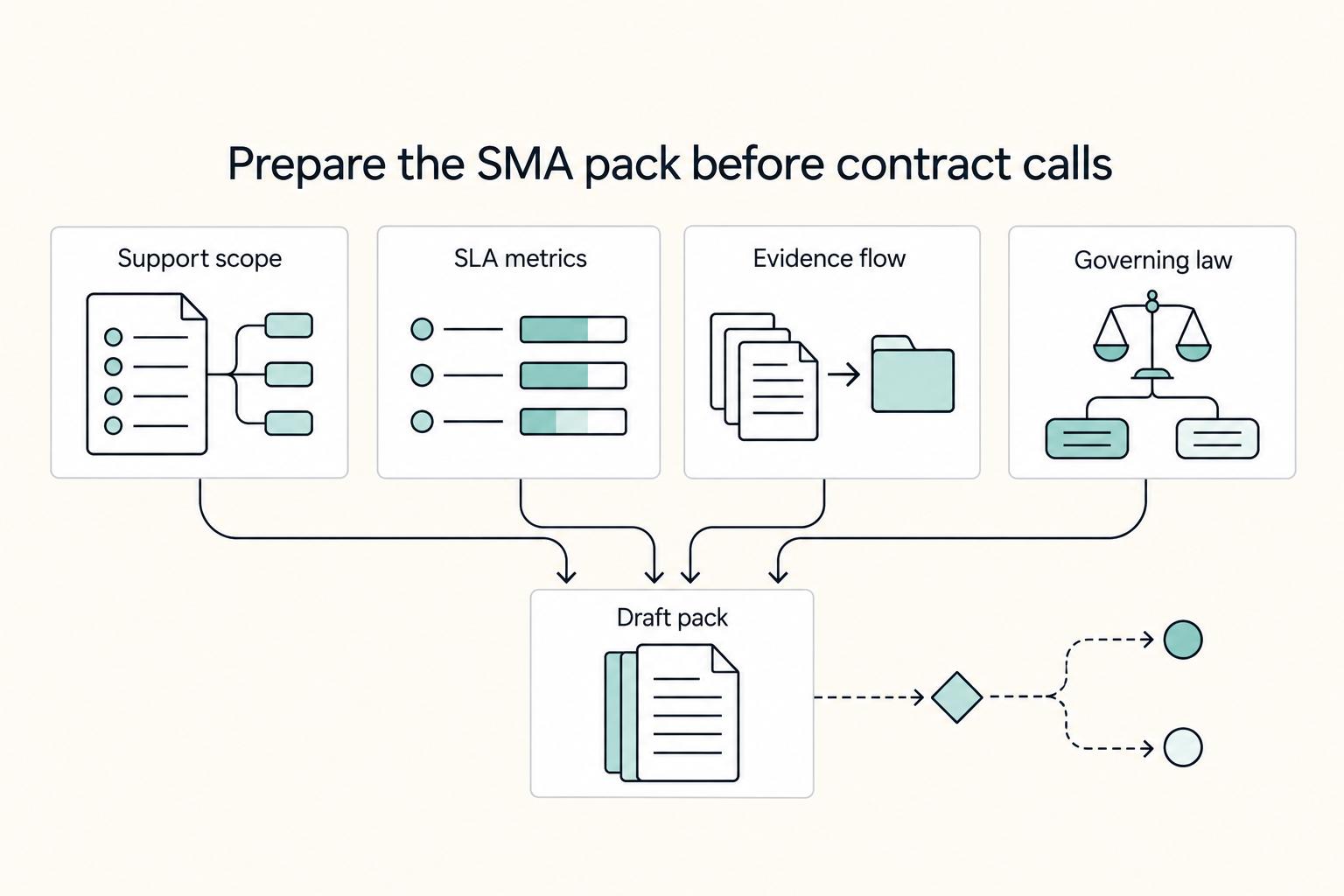
Prepare a reusable pre-draft pack that locks scope, SLA commitments, evidence workflow, and governing law choices before your first contract call. The point is to avoid rewriting your SMA live during sales conversations. Do this once, then reuse it across support agreements for more consistent deals.
- Step 1. Gather baseline contract documents. Label template clauses Reuse, Edit or Custom, then review service boundaries, payment triggers and applicable law. A template’s brand does not establish validity or enforceability for the actual deal.
Expected outcome: You know exactly what you can reuse and what needs custom drafting.
- Step 2. Pre-decide your service model and SLA. Define your standard maintenance model and any enhanced support option before discovery calls. Set response commitments as written SLA terms, not verbal promises. If you sell annual support, decide your default contract cadence, typically a 12 month term. For a deeper SLA structure, use How to Create a Service Level Agreement (SLA) for Your Freelance Services.
Expected outcome: You can quote scope and service levels without improvising.
- Step 3. Prepare operational proof assets. Set up the records you can actually maintain: ticket workflow, incident logs, change history, and invoicing cadence tied to maintenance releases. Strong incident documentation keeps work organized and reduces delays, user frustration, and reputational risk when issues escalate.
Expected outcome: You can prove what you delivered and when you delivered it.
- Step 4. Confirm cross-border legal variables early. Choose governing law up front because that clause selects which legal system interprets the contract and reduces dispute uncertainty. Then align jurisdiction and operational terms so legal language and operations point in the same direction.
Expected outcome: You avoid late-stage redlines that stall signature.
| Pre-draft item | Why it matters | Fast verification check |
|---|---|---|
| Baseline SMA clauses | Speeds drafting with a reusable baseline | Every clause has Reuse, Edit, or Custom |
| SLA and enhanced support model | Clarifies written commitments during sales | You can map requests to your defined service tiers |
| Evidence workflow | Supports incident handling and later proof | Tickets, logs, and release references match invoices |
| Governing law and jurisdiction choices | Reduces dispute ambiguity | Legal forum and operational terms align |
What Exactly Should Your Software Maintenance Agreement Cover?#
Treat your SMA as a request-classification system that routes every ticket into in-scope support, enhanced support, or paid project work before you start. Your pre-draft pack gives you the inputs. This section turns them into contract language that protects recurring revenue and limits scope creep.
An SMA is strongest when you state technical support and update obligations in plain terms. Vague support language invites scope creep. Spell out the environments you support, set response windows in the Service Level Agreement (SLA), and include a visible "not included" block.
- Define product boundaries in writing. Name the environments you support, then spell out how you handle hotfixes, service packs, performance cases, and data-corruption incidents in each one.
Verification point: A new client can read one page and identify exactly where your support starts and stops.
- Separate maintenance from product growth work. Classify bug fixes and maintenance releases as maintenance. Treat feature requests as separate scope unless you explicitly include them.
Verification point: Your team can label incoming requests quickly and consistently.
- Tie service windows to support levels. Define standard support response windows, then define enhanced support eligibility with objective prerequisites such as active plan status, valid licenses, or paid maintenance status.
Verification point: You can enforce one rule set for every client without ad hoc exceptions.
- Limit legacy obligations and document exclusions. Commit bug-fix work to currently supported releases, not every historical version, and list exclusions in a hard "not included" section.
Verification point: Exclusions and change-order triggers are visible in the signed contract.
| Request type | Contract treatment | Revenue path |
|---|---|---|
| Defect in supported release | In scope maintenance | Included in maintenance fee |
| Scheduled maintenance release | In scope maintenance | Included in maintenance terms |
| New feature request | Out of scope | New statement of work |
| Upgrade on unsupported release | Typically out of scope | Paid remediation or upgrade project |
How Do You Set Service Levels Without Overcommitting?#
Set SLA commitments that match your staffing and service model. Define response, restoration and resolution separately, and state any service-credit procedure, eligibility and limits. Whether credits are the exclusive remedy is a negotiated legal question, not an automatic cap on all liability.
- Step 1. Define tier coverage first. Put billing and subscription support, plus technical break-fix support, in your baseline tier. Reserve advisory, escalation, and account-management services for higher tiers so entry plans stay realistic.
Verification point: You can point to one tier table and explain exactly what each client bought.
- Step 2. Classify incidents by business impact. Define severity levels by impact, then set priority with an impact-plus-urgency rule so urgent labels do not become negotiation tactics. Keep the rule short and operational so your team uses it the same way every time.
Verification point: Two team members classify the same incident and reach the same priority.
- Step 3. Commit response windows you can sustain. If you offer a high-severity response target such as one hour or less, tie it to explicit conditions. State coverage windows clearly, including when 24x7 applies and when coverage is limited to local business hours by language or program.
Verification point: Your contract text matches your staffing model.
- Step 4. Specify escalation flow and client obligations. Name handoff points, approval owners, communication channels, and client-side prerequisites for diagnosis. Link missed commitments to contract remedies, not informal discounts decided on live calls.
Verification point: Any incident follows one written path from intake to closure.
- Step 5. Write remedy and warranty boundaries. Document the service credit remedy, including eligibility and claim steps. Keep warranty boundaries tied to what you control. Add coverage qualifiers when external providers control patch or integration timing.
Verification point: Finance and delivery teams can execute the remedy process without legal guesswork.
| Overcommitment risk | Contract control | Operator outcome |
|---|---|---|
| Every issue marked critical | Severity plus impact-urgency rule | Predictable triage |
| Premium help expected in base plan | Tiered SLA coverage | Protected margin |
| Disputes over missed targets | Service credit remedy procedure | Consistent remedies |
| Third-party delays blamed on you | Qualified supplier warranties | Fair accountability |
Need a quick next step? Try the SOW generator.
Which Commercial and Risk Clauses Protect Margin While Keeping Deals Fast?#
Protect margin by running your SMA as a fixed commercial system: pricing blocks, non-payment termination, capped liability, targeted indemnification, strict confidentiality clauses, and defined transition assistance terms. Your SLA only works if the economics and risk controls make it sustainable.
| Clause area | What to define | Verification |
|---|---|---|
| Pricing blocks and renewal | Included service blocks, renewal term, price changes and explicit notice dates chosen for this deal | You can explain renewal outcomes without opening a second document |
| Non-payment and termination | Due dates, notices, agreed cure period, permitted suspension or termination and approval for extra charges | Finance can run the non-payment process from contract text alone |
| Limitation of liability | Recoverable damages capped to a defined monetary amount tied to contract fees; exclude indirect or consequential loss categories where enforceable | Review cap scope, exclusions, carve-outs and enforceability; a fee-based cap may not cover every claim |
| Indemnification and confidentiality | Limit indemnification to controllable risks; define protected information, allowed use, and disclosure limits before credentials or production access | Access starts only after both sides accept confidentiality and data-handling obligations |
| Transition assistance | Write post-exit support as a separate service with scope, rates, and a clear end point, with paid support where agreed by both parties | Offboarding protects recurring revenue instead of creating unpaid cleanup |
Keep service definitions consistent across the SMA and SLA so legal, delivery, and invoicing follow one rulebook.
- Step 1. Define pricing and renewal. State the renewal term, notice deadline and permitted price changes explicitly. The DoD ESI negotiation paper offers a method for gathering requirements and price evidence in commercial software procurement; it is not a current freelancer-market tariff or a universal notice rule.
Verification point: You can explain renewal outcomes without opening a second document.
- Step 2. Pair non-payment consequences with termination boundaries. State due dates, written notice and an agreed cure period before suspension or termination, subject to applicable law. Define emergency duties, return of client property and any obligations that survive termination.
Verification point: Finance can run the non-payment process from contract text alone.
- Step 3. Set limitation of liability to match contract value. Cap recoverable damages at a defined monetary amount tied to contract fees, and exclude indirect or consequential loss categories you cannot underwrite as a freelance developer, where enforceable. Keep the language aligned with the real delivery model in your maintenance work.
Verification point: Review the cap, excluded losses, uncapped obligations and mandatory-law limits together; do not assume the quoted cap is the entire possible exposure.
- Step 4. Narrow indemnification and lock confidentiality before access. Limit indemnification to controllable risks, including intellectual property infringement claims tied to what you supply. Add confidentiality clauses that define protected information, allowed use, and disclosure limits before anyone receives credentials or production access.
Verification point: Access starts only after both sides accept confidentiality and data-handling obligations.
- Step 5. Define finite transition assistance terms. Write post-exit support as a separate service with scope, rates, and a clear end point, with paid support where agreed by both parties. In a typical handover, the client exits your support agreement and you deliver only the transition support defined in the contract at negotiated rates.
Verification point: Offboarding protects recurring revenue instead of creating unpaid cleanup.
What Changes in Cross-Border Deals for Governing Law and Jurisdiction?#
Set governing law first, then lock jurisdiction and dispute resolution so cross-border risk stays predictable. The goal here is not legal perfection. It is to stop late-stage redlines from reopening terms you already settled.
| Cross-border item | What to set | Verification |
|---|---|---|
| Governing law, forum, and dispute path | Draft them as one sequence: governing law, exclusive or non-exclusive forum, then dispute resolution mechanics such as court, arbitration, or an escalation path | Your contract names one law, one primary forum, and one dispute path without contradictions |
| UK NIS relevance | Check whether either party is a regulated operator of essential services or a relevant digital service provider; suppliers can also have contractual security duties | You can show a short scope note explaining why NIS duties apply or do not apply |
| Enforceability and counsel review | State that forum selection improves clarity but does not guarantee frictionless enforcement; if you choose arbitration, confirm where awards can be recognized and enforced; require local counsel review when parties, assets, or performance span multiple jurisdictions | Your playbook names when local counsel must review before final signature |
| Currency, invoicing, and payout | When a foreign-currency invoice charges UK VAT, show the total VAT payable in sterling; agree a suitable conversion method and invoicing responsibilities | Finance can issue a compliant invoice and collect payment without manual legal interpretation |
- Step 1. Choose governing law before forum details. Governing law sets the legal rules for interpretation, while jurisdiction picks where parties resolve disputes. Draft them as one sequence: governing law, exclusive or non-exclusive forum, then dispute resolution mechanics (court, arbitration, or escalation path). This structure can reduce jurisdiction conflict and make dispute planning clearer.
Verification point: Your contract names one law, one primary forum, and one dispute path without contradictions.
- Step 2. Check cybersecurity responsibilities. UK NIS duties depend on the regulated role and service. A freelance maintainer is not automatically a regulated operator just because the client serves an essential sector. Determine direct duties and any security, incident-notice or access requirements imposed through the contract.
Verification point: You can show a short scope note explaining why NIS duties apply or do not apply.
- Step 3. Write enforceability caveats and counsel triggers. State that forum selection improves clarity but does not guarantee frictionless enforcement in every country or dispute type. Some frameworks allow exclusions, and enforcement can face delays. If you choose arbitration, confirm where awards can be recognized and enforced. Then require local counsel review when parties, assets, or performance span multiple jurisdictions.
Verification point: Your playbook names when local counsel must review before final signature.
- Step 4. Align currency and invoicing. A foreign-currency invoice charging UK VAT must show total VAT payable in sterling. Confirm the conversion method and other required invoice fields. This does not require every commercial amount or the actual customer payment to be in sterling.
Verification point: Finance can issue a compliant invoice and collect payment without manual legal interpretation.
How Do You Make the Agreement Audit-Ready in Daily Operations?#
Make your SMA audit-ready by defining proof requirements and enforcing them in tickets, SLAs, and invoices. Cross-border clauses and risk terms only help if you can prove what happened, when it happened, and what the contract says should happen next.
- Step 1. Define records and access rights. List relevant service, ticket, approval and invoice records, who may access them and the applicable retention periods. Federal procurement record rules are not a universal three-year standard for freelance software support. Protect confidential and personal information in audit access.
Verification point: Your contract states what records exist, who holds them, and how long they stay accessible.
- Step 2. Enforce traceability for every maintenance release. Require a unique ticket ID, recorded timestamp, and status-change history, plus any change-reference or approval fields your process requires, before you mark work billable. This keeps maintenance delivery, acceptance, and invoicing aligned.
Verification point: Finance can trace each invoice line to a ticket and an accepted release record.
| Workflow event | Required proof | Operator outcome |
|---|---|---|
| Incident opened | Unique ID plus date and time | No orphan issues |
| Release submitted | Ticket ID plus timestamp | Clean billing trail |
| Release accepted | Status-change history plus timestamp | Fewer acceptance disputes |
- Step 3. Build a dispute file before conflict starts. For each incident, capture communications, current SLA status, remediation steps, and status-history updates. Then define a staged path in the agreement: negotiation first, management escalation second, then mediation or arbitration if your clause includes it.
Verification point: You can export one complete dispute file in minutes, not days.
- Step 4. Define third-party dependencies. State what you will do while waiting for an upstream vendor, including diagnosis, escalation and any feasible workaround. An upstream delay is excluded from an SLA only if the agreed clause and applicable law support that exclusion; document it rather than assuming your obligations stop.
Verification point: Your records distinguish third-party release dependencies from your own delivery obligations.
- Step 5. Separate closure from remedy deadlines. Record the implemented action and agreed acceptance condition before closing a ticket. Apply credits or escalation at the trigger and claim deadline in the contract; do not require completed remediation when the clause permits a remedy earlier.
Verification point: Two reviewers can reach the same close-or-escalate decision from the file.
Common Mistakes and Fast Recovery Moves#
Prevent contract pain by treating your SMA as a system, not just a template file. That makes drafting mistakes easier to spot and fix quickly. Here are common failures and fast recovery moves to get you back to a clean baseline.
| Issue | Recovery move | Verification |
|---|---|---|
| Template drift | Mark every placeholder and every market-specific clause before negotiation starts; adapt generic PandaDoc or ContractsCounsel language to the actual deal | Your draft names the governing law, jurisdiction, and dispute path with no bracketed placeholders |
| Risk-clause redline | Prioritize Limitation of Liability, price and charges, and Indemnification; test service scope and SLA remedy design; require written approval for extra charges | Your redline checklist ties each risk clause to your real delivery and billing model |
| Upgrade classification | Define what stays in baseline maintenance and what triggers a paid change order; use written change orders to update scope, cost, and timeline after signing | Sales, delivery, and finance all use one signed change-order workflow |
| Remedy and forum language | Review SLA-credit language and dispute-resolution fields one more time; complete bracketed forum fields; confirm both sides accept the final dispute path in writing | Remedy language and forum details are fully completed and explicitly accepted before execution |
- Step 1. Diagnose template drift before redlines. Generic language from PandaDoc or ContractsCounsel templates can help you start, but it must be adapted to the actual deal. Forum text can contain placeholders, and copy-paste terms can miss your governing law and jurisdiction details in a cross-border support agreement. Mark every placeholder and every market-specific clause before negotiation starts.
Verification point: Your draft names the governing law, jurisdiction, and dispute path with no bracketed placeholders.
- Step 2. Run a focused risk-clause redline pass. Prioritize the clauses that negotiations fight over most often: Limitation of Liability, price and charges, and Indemnification. Then test service scope and your SLA remedy design, because some service-credit wording can make credits the sole remedy if you do not adjust it. Require written approval for extra charges so commercial changes stay controlled.
Verification point: Your redline checklist ties each risk clause to your real delivery and billing model.
- Step 3. Reclassify upgrade work with a written change-order path. Do not assume all upgrades are included maintenance. Upgrade entitlement varies by agreement, so define what stays in baseline maintenance and what triggers a paid change order. Use written change orders to update scope, cost, and timeline after signing.
Verification point: Sales, delivery, and finance all use one signed change-order workflow.
- Step 4. Finalize remedy and forum language before signature. Review SLA-credit language and dispute-resolution fields one more time so you do not accept sole-remedy wording or unresolved jurisdiction placeholders by default. Complete bracketed forum fields and confirm both sides accept the final dispute path in writing.
Verification point: Remedy language and forum details are fully completed and explicitly accepted before execution.
Build Once and Reuse the 10-Minute SMA System#
Run one repeatable SMA system: lock scope, define measurable SLA metrics, control risk, align cross-border rules, and prove delivery with chronological evidence. By this point, you have the pieces. The win is turning them into one playbook you can run across deals, then adapt for jurisdiction and program requirements.
- Step 1. Standardize your scope matrix. Define what your support agreement includes for fixes, maintenance releases, upgrades, and exclusions. Keep enhanced support separate from baseline maintenance so clients and delivery teams read the same boundaries.
Verification point: Sales and delivery classify the same request the same way.
- Step 2. Lock SLA tiers and service credit scheme triggers. Use measurable SLA targets such as response and resolution times, then pair misses with prewritten service credit rules in the contract. Keep remedies bounded and predictable so you solve service issues without opening pricing disputes.
Verification point: A missed target follows the documented remedy path in the contract.
- Step 3. Finalize risk clauses against your real model. Confirm key clauses, such as termination, Limitation of Liability, Indemnification, and confidentiality, in one pass. As a freelance developer, tie each clause to work you can actually deliver and risks you can actually absorb.
Verification point: Your legal terms match your staffing, tooling, and cash flow.
- Step 4. Align cross-border enforceability settings. Set governing law, jurisdiction, and dispute resolution together so forum language does not conflict. Keep these settings explicit in every reusable template version.
Verification point: Every outbound draft shows one coherent cross-border dispute framework.
- Step 5. Operationalize audit rights with traceable records. Map audit rights to ticket IDs, approvals, change history, and invoice evidence. Keep a chronological audit log of system activity and decisions so reconciliation stays practical.
Verification point: Finance can tie each invoice line to accepted delivery proof.
Imagine a client questions a monthly charge after a release cycle. You pull ticket history, approval timestamps, SLA status, and remedy actions in minutes, then close the dispute without rewriting terms.
Copy-paste checklist:
- Define SMA scope for fixes, maintenance releases, upgrades, and exclusions.
- Set SLA tiers and service credit scheme triggers.
- Finalize Termination, Limitation of Liability, and Indemnification.
- Confirm Governing Law, Jurisdiction, and Dispute Resolution.
- Lock confidentiality clauses and access controls.
- Map audit rights to ticketing, approvals, and invoice evidence.
- Publish escalation and recovery playbook for missed service levels.
- Adapt jurisdiction-specific terms before signature.
Use policy gates, traceable records, and clear reconciliation workflows for every new agreement.
Frequently Asked Questions
What is a software maintenance agreement and how is it different from an SLA?
A software maintenance agreement is the core support contract that defines ongoing technical support, updates, scope, and payment terms. An SLA defines service performance targets inside that relationship, such as response, resolution, and uptime metrics. Use the SMA to set boundaries and commercial rules. Use the SLA to run day-to-day triage without renegotiating priorities on every ticket.
What should be included in a software maintenance agreement for freelance client work?
Include scope boundaries for fixes, maintenance releases, and out-of-scope requests; payment terms tied to the contract term; and clear completion criteria for completed work. Add risk clauses for liability limits, termination, confidentiality, and any indemnity obligations you intend to accept. Most importantly, define a change-order workflow so "quick asks" cannot bypass pricing and written approval.
Does software maintenance include new versions and upgrades by default?
No default applies across every support agreement. Some agreements include future updates and enhancements, while others limit access, so you must state upgrade treatment explicitly. If you want fewer disputes, keep the language binary: what counts as maintenance, what counts as upgrade work, and what triggers a paid change order.
How long should a maintenance agreement term be for recurring support?
Set the term based on your delivery rhythm, invoicing cadence, and how often you expect scope or pricing to change. Do not rely on a universal term length rule. Whatever you choose, make renewal notice, SLA reviews, and payment operations follow the same cycle so you are not managing exceptions by hand.
How do I limit liability and prevent support scope creep?
Liability rules vary by jurisdiction, so set limits and excluded loss categories in clear contract language and get legal review when needed. Then make scope enforceable: use a scope matrix, classify every request, and require written approval before any additional charges or expanded work. If you offer service credits for SLA misses, write a clear procedure so disputes follow a predictable path.
What should change in Governing Law, Jurisdiction, and Dispute Resolution for cross-border clients?
Choose governing law first, then choose jurisdiction, then define dispute resolution steps so the clauses do not conflict. Treat law choice and forum choice as separate decisions, because each affects enforceability differently. If the deal crosses borders, add a lawyer review trigger before signature.
When should I use a template versus a lawyer-reviewed contract draft?
Use a template to accelerate first-draft structure and internal alignment, not as final legal protection. Move to lawyer review when the deal is cross-border or heavily negotiated on liability and indemnity. Templates get you to a consistent baseline. Counsel review is what you use when the downside of "almost right" is too expensive.
Try a related tool
Researched and edited by the Gruv editorial team. Gruv builds cross-border billing, payouts, and finance-operations software for global businesses.
Sources
Includes 5 external sources outside the trusted-domain allowlist.
- eur-lex.europa.eu/EN/legal-content/summary/choice-of-court-agr...trusted
- itvmo.gsa.gov/assets/files/Software-Maintenance-Negotiatio...trusted
- gov.uk/hmrc-internal-manuals/vat-trader-records/vat...external
- ico.org.uk/for-organisations/the-guide-to-nis/what-is-nisexternal
- motorolasolutions.com/en_xa/services/lifecycle-management/software...external
- tridium.com/us/en/services-support/software-maintenance-...external
- vykon.com/us/en/services-support/software-maintenance-...external
Educational content only. Not legal, tax, or financial advice.
Related Posts

Germany Freelance Visa Application Path for Freiberufler and Gewerbe
Choose your track before you collect documents. That first decision determines what your file needs to prove and which label should appear everywhere: `Freiberufler` for liberal-profession services, or `Selbständiger/Gewerbetreibender` for business and trade activity.
How to Build a One-Page Freelance Service Level Agreement
A **freelance service level agreement** can document service expectations, but it does not determine worker status or tax treatment on its own.

How to Set Up a Business Bank Account in the UK as a Non-Resident
A non-resident director can run a UK company, but incorporation does not guarantee a UK business account. Providers separately assess your residence, where the business operates, ownership, activity and payment needs. Start with those facts before submitting an application.