
Quick Answer
Structure the clause as a continuity control: name only the personnel truly essential to delivery, define their roles, list trigger events, and set clear notice, approval, and replacement steps. Put baseline terms in the MSA, mirror project specific staffing in the SOW, separate interim coverage from permanent replacement, and link cure periods, payment controls, and termination rights to the contract.
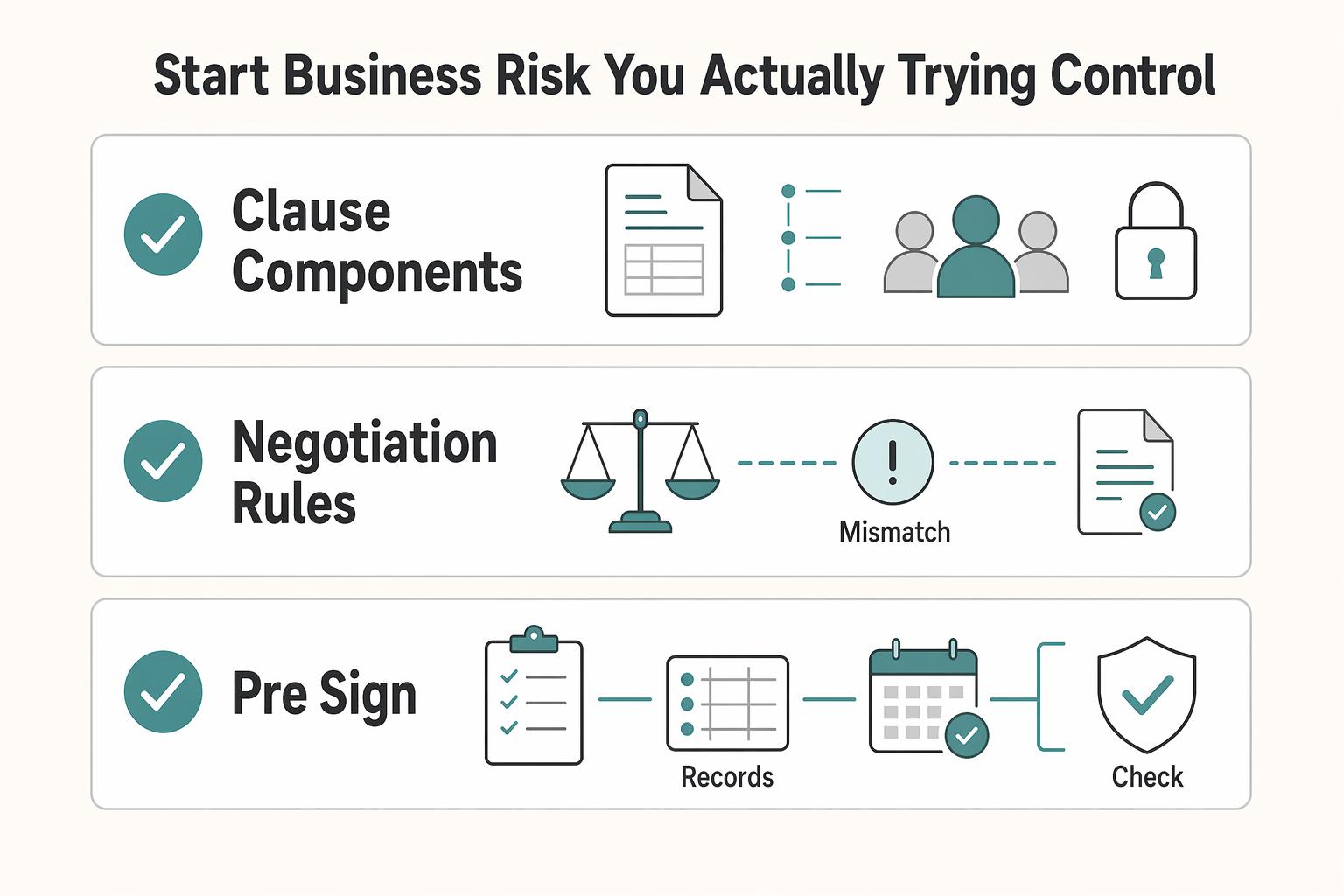
Start with the business risk you are actually trying to control#
Step 1: Name the risk before you draft. Key person risk in a consulting agreement is a continuity control, not legal decoration. If delivery depends on one person or a small group, losing that capacity can quickly lead to missed deadlines and disputes about what was promised.
That is key person risk in plain language: the work depends heavily on a few individuals. Your agreement should make that dependency and the risk allocation explicit. It does not need heavy legal jargon, but it does need to be clear.
Use this quick check: if the key person stepped away next month, would delivery materially suffer? If yes, you have a real risk to contract for.
Step 2: Keep the clause in the right contract context. This article is about consulting agreements in services work. It is not trying to import fund-style key person terms from investment or hedge fund documents into a services deal.
That distinction matters because copied clauses are a common contract risk. The same goes for relying on a loose "scope and fee" email and planning to fix details later. Without a properly drafted agreement, even good-faith projects can drift into confusion over deliverables, payment, timelines, or IP.
Step 3: Define the practical outcome for this article. The goal is to protect delivery without making signature harder than necessary. You should leave this guide with:
- clause components you can use
- negotiation rules that help you handle pushback without giving up core protection
- a pre-sign checklist you can run before anyone signs
Start by defining the dependency risk accurately, then build remedies around it.
What a Key Person Clause covers in a consulting deal#
In a consulting deal, a Key Person Clause or Consultant's Key Personnel Clause serves as a continuity control. It names the people essential to delivery, defines their roles, and sets how personnel changes are handled with client consent.
| Term | Use here | Note |
|---|---|---|
| Key Person Clause / Consultant's Key Personnel Clause | Continuity control | Names the people essential to delivery, defines their roles, and sets how personnel changes are handled with client consent |
| Key Person Insurance | Separate contractual mechanism | Does not replace staffing or service-performance continuity obligations |
| Master Service Agreement (MSA) | Baseline rule | Governs the broader relationship and future work |
| Statement of Work (SOW) | Project-specific staffing detail | Can mirror project-specific names or role allocations so the staffing dependency is explicit for that engagement |
| Fund-style Key Man Clause | Investment mechanism | Can block new investments when key people are unavailable and is designed for investment activity, not consulting delivery |
Treat it as a staffing commitment, not a general quality promise. In practice, that usually means the clause names the key person, defines their role, and states that they are expected to perform a substantial portion of the services unless the client agrees in writing to a change. If you want a tighter checkpoint, require full names and short 1-2 page resumes for nominated key personnel before assignment, with client approval required.
Keep this separate from Key Person Insurance. It does not replace staffing or service-performance continuity obligations.
For placement, keep the baseline rule in the Master Service Agreement (MSA) because it governs the broader relationship and future work. If your deal uses a Statement of Work (SOW), you can mirror project-specific names or role allocations there so the staffing dependency is explicit for that engagement.
Use fund and investment examples only as background, not as templates. A fund-style Key Man Clause can block new investments when key people are unavailable, but that mechanism is designed for investment activity, not consulting delivery.
Related: How to Write a Master Service Agreement (MSA) for Long-Term Client Engagements.
What to prepare before you draft#
Before you draft, get the contract set and the staffing facts in one place. That makes the clause workable and reduces later disputes about deliverables, timelines, and who is responsible for the work.
- Pull the current Master Service Agreement (MSA), active Statement of Work (SOW), and any redlines on staffing, approvals, or replacement rights. If you use a standalone Consulting Agreement, include that plus any project addenda.
- Confirm where scope and staffing obligations actually live in the current paper trail. If they are split across versions, align that first before drafting the personnel clause.
- Identify the roles that are truly critical to delivery, then align timing labels to terms already used in the deal. Make the trigger timing explicit in the clause instead of assuming everyone reads it the same way.
- Map staffing dependencies and decide which changes should require approval versus simple notice, based on your agreement structure.
- Build a compact evidence pack: role descriptions, deliverables, milestones, deadlines, and escalation contacts for notice and replacement decisions. If named-person approval is required, include full names and short 1-2 page resumes for proposed key personnel.
This pairs well with our guide on How to Structure a Success Fee in a Consulting Agreement.
Choose who is truly key personnel and who is replaceable#
Be selective here. Name as key personnel only the roles that would disrupt delivery decisions or outcomes if they disappeared from the engagement. Keep the rest replaceable so staffing can flex without creating unnecessary contract friction.
| Tier | When to use | Change rule |
|---|---|---|
| Must-name roles | Losing the role would disrupt core delivery decisions or milestone outcomes | Treat it as key and name it explicitly |
| Approval-required substitutes | The role is replaceable only through the agreed approval path | Use the agreed approval path, for example Prior Written Consent |
| Freely replaceable support roles | The role is mainly process, coordination, or administrative support unless the contract says otherwise | Use lighter notice or approval mechanics if the contract allows it |
Use a role test, not a title test, against the live Statement of Work (SOW):
- If losing the role would disrupt core delivery decisions or milestone outcomes, treat it as key and name it explicitly.
- If the role is mainly process, coordination, or administrative support, keep it replaceable unless the contract says otherwise.
Do not treat senior titles as automatically key. A Chief Executive Officer (CEO) or Chief Financial Officer (CFO) is only key if that person is actually performing the delivery role the project depends on. The clause should protect delivery continuity, not title prestige.
Because contracts handle key-role designation differently, place roles into clear operating tiers before drafting:
- Must-name roles: explicitly identified because the work depends on their judgment, expertise, or client relationship.
- Approval-required substitutes: replaceable only through the agreed approval path, for example Prior Written Consent.
- Freely replaceable support roles: support roles your contract allows to be replaced with lighter notice or approval mechanics.
For each must-name role, add a short verification note in your draft file: why it is key, what decisions it owns, and the minimum qualifications for any replacement. Then confirm in good faith that the proposed individual is available and committed. If availability changes before signing, follow the contract's change-notice process and update the paper trail immediately.
You might also find this useful: A Guide to Key Person Insurance for Small Agencies.
Define trigger events and notice obligations with dates and owners#
Once you know who matters most, define exactly what counts as a problem and what happens next. This part of the clause should be operational, not implied. State the trigger, the notice, and the response path so both sides can verify the same events the same way.
When personnel-change terms are vague, each side can attach a different meaning to the same facts. That is where assent disputes start, because contracts are judged by outward actions and records, not private intent.
Step 1 Name the trigger events you want to count#
Avoid broad language like "if the key person is unavailable." List only the events you actually want to monitor and enforce in this engagement.
Define those events as contract choices, not automatic legal defaults, and describe them clearly enough that both parties can read them the same way.
Step 2 Attach a clear notice obligation to each trigger#
For each trigger, state:
- who sends notice and who receives it
- how notice is delivered
- what information the notice should include so the other side can evaluate impact and next steps
This keeps the record objective and reduces later arguments about whether notice was actually given.
Step 3 Tie timing and acceptance mechanics to the contract text#
If your agreement uses defined timing terms, use them consistently so notice windows are clear.
Also state how acceptance or acknowledgment is communicated. If acceptance is by promise, the default rule is that the offeree must use due diligence to notify the offeror, unless your contract changes that rule.
Step 4 Add a written confirmation checkpoint#
Add a simple verification step after notice: written confirmation of receipt and next steps. You can set the timing by contract; a next-day confirmation is one possible drafting choice.
Then keep the full paper trail together: notice, acknowledgment, interim plan, and any replacement proposal. In a dispute over the clause, that file is what makes the process provable.
We covered this in detail in How to Structure a 'Testing and Acceptance' Clause in a Software Development Contract.
Set substitution approval rules and cure periods that keep the deal moving#
This is where many personnel clauses either become usable or become a bottleneck. The fix is straightforward: make the approval path explicit so continuity decisions and contract validity stay aligned.
Step 1 Define approval as a documented contract act#
Write the substitution approval and written-consent requirements as concrete actions: who approves, in what form, and when approval becomes effective.
If the personnel term sits in the main agreement, align it with the amendment clause so you do not treat an informal email as final approval when the contract requires changes through a bilateral executed amendment.
Step 2 Split interim coverage from permanent replacement#
Do not assume interim substitution is allowed by default. If you want it, say so directly and include the notice and documentation required to maintain continuity.
Then state separately that permanent replacement follows the formal written approval path in your contract.
Step 3 Define replacement criteria where scope is already controlled#
Set out what counts as an acceptable replacement in the governing delivery document, such as the Work Order, so review is tied to the actual role and scope.
Require a complete replacement package so approval decisions are made against the same written criteria each time.
Step 4 Set a cure period with written milestones#
A cure period works best when it is milestone-based, not just a clock.
A default cure length is not provided here, so if you use one, write the timing explicitly and link missed milestones to the remedies section so escalation is clear.
Step 5 Add timing guardrails and conflict control#
To prevent silent delay, you can require an approve-or-reject response by the deadline stated in the contract, and require written reasons for any rejection against the agreed criteria.
If personnel terms appear across multiple documents, include an order-of-precedence rule so conflicts resolve cleanly. This matters near term end: no new Work Orders can be authorized after termination, while already authorized Work Orders can continue until completed.
Choose remedies and Termination paths before problems happen#
Do not wait until a staffing issue appears to decide what the consequences are. Set the remedy path in advance so payment, continuity, and exit decisions follow the contract instead of negotiation pressure.
Step 1 Match each remedy to the engagement structure#
Use a graduated ladder in the Consulting Agreement rather than jumping straight to termination.
| Contract control | Typical use | Main value | Drafting guardrail |
|---|---|---|---|
| Reassignment right | Key personnel no longer fit the engagement | Keeps work moving without immediate exit | State that the client may require reassignment during the term and that reassignment happens immediately after notice |
| Schedule and termination linkage | Delivery dates slip or sequencing changes | Preserves the client's termination option | State that service schedules do not narrow termination rights under the main agreement |
| Payment scope control | Billing disputes or scope drift | Limits payment to what the contract allows | State that only contract-specified payments are payable |
| Invoice and duplicate-billing controls | Ongoing invoice review | Creates operational checkpoints before payment | Require invoices in the contract-specified method and bar duplicate billing unless specifically authorized |
Step 2 Draft differently for one specialist vs a team retainer#
For a short project built around one named specialist, make the reassignment and termination path explicit.
For a multi-person retainer, reassignment and interim coverage can be the first response. Some agreements are explicit that the client can require reassignment during the term, and the consultant must do so immediately after notice.
Also align remedies with hierarchy rules across documents. If your Statement of Work schedule and your main agreement conflict, your order-of-precedence clause should state which controls, and your termination right should not be narrowed by delivery timelines.
Step 3 Write escalation as a documented sequence#
Document one order for handling failure: notice, interim mitigation, replacement attempt, review, then evaluate termination if unresolved.
Before final remedy, confirm the paper trail: the interim plan was issued, replacement was reviewed against SOW criteria, and milestones were recorded as met or missed.
Control transition billing explicitly. Some agreements bar duplicate billing by more than one person for the same services unless specifically authorized.
Step 4 Lock payment, pause, and exit mechanics#
State what remains payable and what pauses.
Use contract-level payment controls: only specified payments are due, and invoices must follow the contract's required submission method. That helps separate payable approved work from unapproved, duplicated, or noncompliant billing.
If pricing is time-and-materials on a not-to-exceed basis, clarify how pause and replacement work count against that cap.
For exit, define end-of-engagement steps in the agreement and SOW package so termination can be executed without scope disputes.
For a step-by-step walkthrough, see How to Handle Severance and Termination Clauses in a Consulting Agreement.
Align key person terms with Limitation of Liability and Indemnification#
A strong staffing clause should protect continuity without blowing up the MSA's risk allocation. Put staffing duties in the SOW, keep liability-cap logic in the master agreement, and make sure indemnity is not being expanded by accident.
Step 1 Map each key-person consequence against the liability cap#
Start with the MSA limitation-of-liability clause, since it sets the maximum recoverable damages. The master agreement usually carries stable cross-project terms, while the SOW handles project specifics, so staffing commitments can sit in the SOW but cap logic should stay aligned with the MSA.
For each trigger, label the remedy path clearly:
- direct breach claim, and whether it is capped
- contractual remedy such as service credits or holdback
- termination right
- indemnity, if any
If you cannot trace each trigger to one remedy path in one read-through, tighten the drafting before signature.
Step 2 Keep indemnification narrow and tied to third-party risk#
Treat ordinary key-person failure as a contract-performance issue unless the contract says otherwise. In one public contract example, indemnity is limited to third-party claims and direct damages are handled as direct claims; that structure can help avoid overreach.
Check that the personnel section does not route routine continuity failures into indemnity by default. Also verify whether indemnity is reciprocal, because some counterparties may not provide reciprocal indemnity at all.
Step 3 Use an order-of-precedence rule to stop MSA and SOW collisions#
Add a clear order-of-precedence clause so conflicts are resolved by contract language, not by argument later. If the MSA contains limitation-of-liability and indemnification terms, state whether those control unless a specific SOW override is expressly written.
Use the SOW for project-level staffing detail, but make clear whether those details can change the cap or indemnity framework. Matching document dates or using a shared signature package does not replace an explicit order-of-precedence rule.
Step 4 Run a contradiction check before you accept redlines#
Before signing, test the package for internal conflicts:
- termination remedy vs open-ended damages for the same staffing event
- broad damages language vs the liability cap
- third-party indemnity scope vs direct delivery disputes
- stronger SOW staffing promises vs MSA risk terms
If a client asks for unlimited exposure tied to personnel changes, narrow the trigger or treat it as a priced risk increase. This is where negotiations often erode consultant protections, so keep the staffing promise strong but bounded.
Related reading: How to Handle a 'Liquidated Damages' Clause in a Contract.
Draft for cross-border enforceability with Governing Law, Jurisdiction, and Dispute Resolution#
If the deal is cross-border, the staffing clause is only as useful as the enforcement path behind it. Governing law, forum, and dispute route affect interpretation, remedies, and where enforcement happens.
Step 1 State Governing Law and Jurisdiction plainly#
Your Governing Law Clause should name the legal framework for interpreting and enforcing the contract. Your Jurisdiction Clause should name where disputes are resolved. Treat both as core terms, not boilerplate, especially when the parties are in different jurisdictions.
If neither side accepts the other party's home law, a neutral option commonly used in international disputes can be New York, English, or Singapore law. Avoid obscure or unpredictable forums, which can make enforcement harder and legal costs higher.
Step 2 Define the dispute path clearly#
Set out the dispute path you actually want to use. You can include a negotiation step and then move to arbitration or named courts, but the contract should be clear about what happens if early steps do not resolve the issue.
If you want broad scope, say the clause applies to disputes or claims, including non-contractual disputes or claims.
Arbitration is common in international contracts because it offers a private forum and enforcement advantages under the New York Convention in more than 160 countries. It is not automatically cheaper, and complex matters can still be expensive.
Step 3 When legal systems differ, make scope explicit#
When parties are in different jurisdictions, give jurisdiction and choice-of-law wording specific attention rather than treating it as boilerplate.
State clearly whether your forum language is exclusive or non-exclusive, and whether it covers non-contractual disputes or claims.
Step 4 Assume no single template fits every country#
Do not assume one template will work the same way everywhere.
Use the structure that fits the deal: exclusive jurisdiction in some cases, non-exclusive jurisdiction in others. Final check before signature: can both sides understand the cross-border enforcement path in one read? If not, simplify.
Need the full breakdown? Read How to structure an 'SOW' for a retainer-based consulting engagement.
Negotiate faster with scripts, red flags, and recovery moves#
Most negotiation delay comes from subjective approval fights. One practical fix is to keep the core principles in the Master Service Agreement (MSA) and put checkable role criteria in the Statement of Work (SOW).
Step 1 Ask for objective approval tests#
If you are the freelancer or consultant, ask for approval criteria you can actually check and a clear remediation path with defined deliverables.
- "I can accept approval for a permanent replacement if approval is based on stated criteria, not general preference."
- "Let's define a qualified replacement in the SOW by role, seniority, relevant experience, and onboarding needs."
- "If you reject a substitute, please map the reason to those criteria so I can address it."
- "During remediation, let's name required outputs: interim staffing plan, knowledge-transfer notes, and replacement profile."
Use a simple test: could a third party explain why a substitute passes or fails from the contract text alone? If not, approval may still be discretionary. A practical drafting pattern is to require concrete artifacts in the SOW. In other settings, SOWs use specific proof items for objective evaluation.
Step 2 Ask for continuity without freezing substitutions#
If you are the client, protect continuity without making substitutions functionally impossible.
- "We need continuity if the named person becomes unavailable, and we also need a workable substitution path."
- "Allow interim coverage for continuity, then complete formal approval for the permanent replacement."
- "The transition plan should state who covers what and how performance is maintained during review."
- "If remediation fails, include a clear Termination Right, but avoid automatic termination before a replacement attempt and review."
The logic is practical: protect ongoing performance while the change is implemented.
Step 3 Flag red clauses early and use an MSA/SOW split when talks stall#
Mark up three red flags immediately: indefinite approval windows, vague "material involvement," and automatic Termination Right with no remediation structure. These terms can create delay and dispute risk.
If negotiation stalls, split the issue. Keep clause principles in the MSA and move detailed role criteria to the SOW. That approach is often easier to close because the clause language is not one-size-fits-all and should be adapted to the service use case. Resolve role criteria early, since some processes lock the SOW later in the cycle.
Step 4 Close out with an audit-friendly contract log#
Before signature, centralize the approved MSA, current SOW, staffing notices, approval messages, and remediation communications in one contract log.
If your process supports it, connect that log to invoice or payout checks. This matters in fixed-price structures, where cost escalation risk can sit with the contractor, so continuity and approval records can affect commercial outcomes.
Use this copy-paste checklist before signature#
Do not sign until the Master Service Agreement (MSA) and Statement of Work (SOW) are aligned on relationship terms and project details. Use a written checklist, not memory.
| Check | What to verify | Example/detail |
|---|---|---|
| MSA/SOW structure and scope | The MSA should govern relationship-level terms, and each SOW should state project-level details, including who will provide services and related fees | If one MSA covers multiple SOWs, verify each active SOW before execution |
| Formal pre-sign checklist | Run the agreement through a written checklist document rather than an ad hoc review | Treat Prohibited Clauses and Risky Clauses as separate review buckets |
| Review checkpoint | Include a clear consultation and go/no-go decision point | Decide whether to proceed with the contract before signature |
| Policy and approval applicability | Verify which internal policy and approval path applies before execution | Applies to consultant-service engagements |
| Internal consistency across documents | Make sure the MSA and SOW do not conflict on core obligations, staffing, or fees | Execution-ready terms should be clear in both documents |
| SOW operability | Confirm the SOW includes concrete, measurable commitments where relevant | Example: 06/01/2020 to 5/31/2021; 4 hours or less |
- Confirm MSA/SOW structure and scope.
The MSA should govern relationship-level terms, and each SOW should state project-level details, including who will provide services and related fees. If one MSA covers multiple SOWs, verify each active SOW before execution.
- Use a formal pre-sign checklist.
Run the agreement through a written checklist document rather than an ad hoc review. Treat Prohibited Clauses and Risky Clauses as separate review buckets.
- Set an explicit review checkpoint before signature.
Include a clear consultation and go/no-go decision point so the team can decide whether to proceed with the contract.
- Confirm policy and approval applicability.
For consultant-service engagements, verify which internal policy and approval path applies before execution.
- Check for internal consistency across documents.
Make sure the MSA and SOW do not conflict on core obligations, staffing, or fees, and that execution-ready terms are clear in both documents.
- Audit SOW operability before execution.
Confirm the SOW includes concrete, measurable commitments where relevant. For example, a defined coverage period like 06/01/2020 to 5/31/2021 and a response-time commitment like 4 hours or less.
Before signing, create a clean baseline agreement and finalize your MSA/SOW terms and checklist decisions.
Frequently Asked Questions
What is a key person clause in a consulting agreement?
A key person clause identifies the consultant team members who are essential to contract performance. It is meant to protect continuity and service quality by keeping agreed experts involved. In many consulting contracts, the named people appear in the SOW, with approval and consequence mechanics defined in the contract terms.
Key person clause vs key person insurance: what problem does each solve?
They solve different problems. A key person clause controls delivery terms in the contract, including who must remain involved, whether approval is needed for changes, and what happens after a trigger event. Key person insurance is separate and should be reviewed separately.
Can a consultant replace key personnel without client approval?
Only if the contract allows it. Many Consultant's Key Personnel clauses require prior written consent before changes. Check whether the person is named in the SOW and whether substitution is an approval event under the contract.
What should happen if the key person leaves mid-project?
The contract should trigger a defined response path rather than ad hoc decisions. The clause can state trigger events such as resignation, incapacitation, or death and then set the next steps. Those steps can include requiring a replacement, renegotiation, pausing part of the work, or termination, depending on the clause.
When should a client use a cure period instead of immediate termination?
Use a cure period when the contract allows a time-bound replacement process instead of immediate termination. The article emphasizes making the cure period milestone based and writing the timing explicitly. Sample consulting language shows a concrete timeline, such as 30 days after a client request to replace a key person who is not meeting performance requirements.
Does one key person clause template work across all jurisdictions?
No. Key person language should be adapted to the specific contract and service context, not reused unchanged everywhere. The article also warns against importing investment-style key man language into consulting deals without review because it addresses a different problem.
Researched and edited by the Gruv editorial team. Gruv builds cross-border billing, payouts, and finance-operations software for global businesses.
Sources
- acquisition.gov/far/part-52trusted
- acquisition.gov/far/subpart-52.2trusted
- acus.gov/sites/default/files/documents/I%201986-03%20...trusted
- comptroller.texas.gov/purchasing/docs/96-1809-4.0.pdftrusted
- congress.gov/congressional-record/volume-171/issue-113/se...trusted
- courts.ca.gov/system/filestrusted
- cslb.ca.gov/Resources/GuidesAndPublications/2024/2024-CA...trusted
- dgs.ca.gov/-/media/Divisions/OLS/Resources/SCM-VI---08-...trusted
Educational content only. Not legal, tax, or financial advice.
Related Posts

Germany Freelance Visa Application Path for Freiberufler and Gewerbe
Choose your track before you collect documents. That first decision determines what your file needs to prove and which label should appear everywhere: `Freiberufler` for liberal-profession services, or `Selbständiger/Gewerbetreibender` for business and trade activity.

Master Service Agreement for Freelancers in Long-Term Client Engagements
If you expect repeat work with the same client, set the contract architecture first: one reusable MSA for standing terms, then project documents for each engagement. The point is not just speed. It is making sure your baseline terms are set before they repeat across future projects. Treat each document as a separate layer:

The Freelance Payment Penalty: A Modeled Audit of Platform Fees, FX Spreads, and Payout Delays
The money rarely disappears through a single, easy-to-spot fee. The real loss is stacked. A marketplace takes its commission, a processor adds a charge for international cards, a bank or payment company converts the currency at a spread, a platform holds the funds before release, and a wire sheds a little to intermediaries on the way in. Each layer looks defensible on its own, but the worker feels the combined result as a smaller deposit and a later payday.