
Quick Answer
Start by validating authority, IP rights, and operating fit, then draft the joint venture for software product around five enforceable blocks: IP boundaries, finance rules, governance, liability/structure, and exit mechanics. Put ownership and licensing terms in signed writing, especially where prior code is involved under 17 U.S.C. § 204. Add a one-page decision map for solo calls, joint approvals, and deadlock escalation. Before signing, confirm repository control, communication channels, and documentation standards so day-one operations match the contract.
Is This Partnership Built to Last? A Pre-Commitment Diligence Checklist#
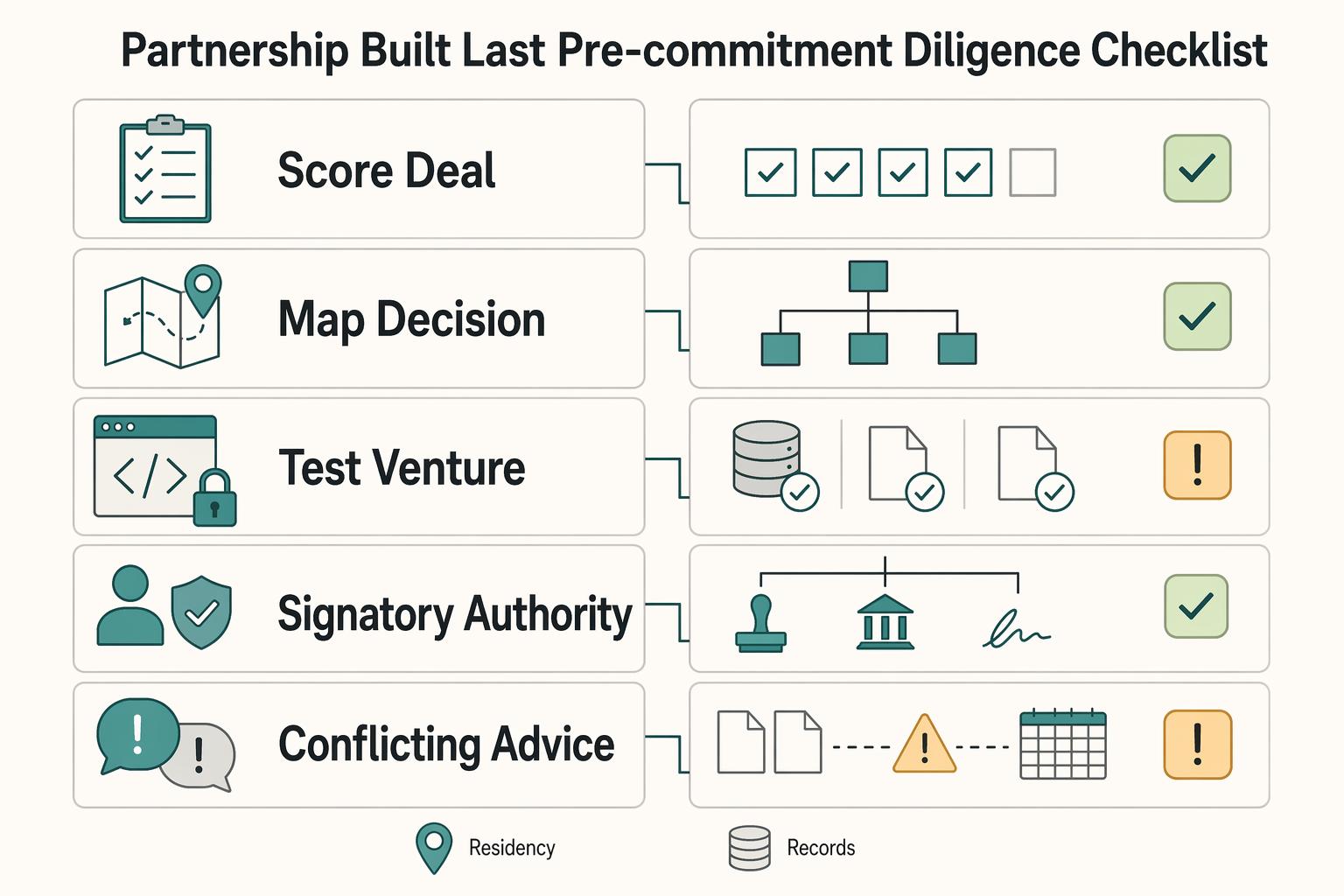
Before you draft terms for a joint venture for software product, make a clear go or no-go call on the people, rights, and authority involved. If either side cannot prove who can sign, what code they can legally contribute, or how deadlocks get resolved, pause and fix that first.
| Step | Focus | Verification |
|---|---|---|
| Score the deal before you negotiate | Authority, conflicts, prior code and assets, money and contribution assumptions, and governance habits | Folder with authority documents, a conflict confirmation, and a contribution memo |
| Map decision rights before you talk economics | Solo decision, joint approval, and escalation path | A single page showing who decides what |
| Test how the venture will operate before you sign | Access, documentation, and day-one control of shared assets | Written notes, open document requests, and a clear answer on whether the pair will still make decisions cleanly under pressure |
Before you start: ask each party for its governing documents, a list of existing client or employer restrictions that could affect the venture, and a short written summary of what it expects to contribute in cash, time, code, and contacts.
Step 1. Score the deal before you negotiate. Start with a simple checklist that forces concrete answers, not impressions. You are testing whether the other side is actually ready for a shared-profit build, whether the decision makers are real, and whether the assets they promise are clean enough to use.
| Diligence area | Aligned | Warning sign | Deal-breaker |
|---|---|---|---|
| Signatory authority | They show the operating agreement, board consent, or other governing document and identify exactly who can bind the entity | They say "I can sign" but cannot show the document trail | The actual authority is unclear, disputed, or limited in a way that blocks the deal |
| Existing conflicts | They confirm in writing the venture does not breach client, employer, or other binding agreements | They mention "a few restrictions" but have not reviewed them | A current contract bars the work, the product category, or the customer segment |
| Prior code and assets | They list what is pre-existing, what will be contributed, and who owns each item | They mix old and new code without a clear boundary | They cannot transfer or license the code, or they rely on oral promises instead of signed paperwork |
| Money and contribution assumptions | They can explain who pays startup costs, how uneven inputs are treated, and what runway expectations each side has | They want to "figure out the money later" | One side is depending on immediate revenue or hidden reimbursement to stay afloat |
| Governance habits | They agree on repository permissions, code owner approvals, and release records | They are casual about access and documentation | They resist audit trails, shared visibility, or approval controls |
Verification point: by the end of this step, you should have a folder with authority documents, a conflict confirmation, and a contribution memo. If the other party is an LLC, remember that default authority can sit with each member or manager unless the LLC agreement changes that. Do not assume titles tell you enough.
Two red flags deserve extra attention. First, copyright transfer of prior code or content generally needs a signed writing under 17 U.S.C. § 204, so "we all understand it belongs to the venture" is not enough. Second, do not assume ownership outcomes for newly built software without drafting, because work made for hire rules can change who is treated as the author by default. If contributed code includes Apache-2.0 material, note any notice obligations for modified files before you promise clean reuse.
If you and the other party are also competitors, add legal review before moving forward. The FTC and DOJ withdrew the old collaboration guidelines on December 11, 2024, and current agency direction points businesses back to statutes and case law, not old comfort language.
Step 2. Map decision rights before you talk economics. Control failures can derail a venture. If you do not map decision rights early, money talks become guesswork because no one knows who can approve what.
Use a one-page decision-rights map with three buckets:
- Solo decision: domain-specific calls one partner can make alone, such as day-to-day engineering choices within an approved scope
- Joint approval: decisions that affect risk, ownership, or strategy, such as taking on debt, changing product scope materially, licensing core IP, or admitting another partner
- Escalation path: named reviewer, mediation step, or other tie-break process
Treat the deadlock mechanism as deal-specific legal drafting that must be verified against governing law and entity documents before use. That matters because deadlock remedies can be severe. In a Delaware Chancery example from Jan. 29, 2021, a unanimity requirement paired with an automatic dissolution consequence was enforced. Do not copy a mechanism from another deal without checking your jurisdiction and entity documents. You should also be able to hand someone new to the deal a single page showing who decides what.
Step 3. Test how the venture will operate before you sign. Before signing, pressure-test the operating basics, not just the economics. Problems can show up in access, documentation, and day-one control of shared assets.
Ask who owns the shared communication channels, who controls repository admin rights, and who can remove access if the relationship sours. Repository account compromise is a known attack path, so "we'll share one admin login for now" is not a harmless shortcut.
Set documentation rules early. At minimum, agree on code owner approval for changes made by others and what gets archived for each release, such as code, package files, third-party libraries, documentation, and relevant data inventories. Then hold one explicit alignment meeting with this agenda:
- confirm contributions and assumptions, including uneven cash versus labor inputs
- confirm runway expectations and what happens if revenue arrives later than expected
- confirm pre-existing IP boundaries and required transfer or license documents
- confirm decision rights, escalation, and repository/channel ownership
Verification point: leave that meeting with written notes, open document requests, and at least one clear answer to this question. If pressure hits in month one, will this pair still make decisions cleanly? If the answer is "maybe," do not start drafting the joint venture agreement yet.
If you want a deeper dive, read Germany Freelance Visa: A Step-by-Step Application Guide. If you want a quick next step for "joint venture for software product," try the SOW generator.
Write five clauses covering ownership, money, control, liability, and exit#
Once your diligence folder supports a yes, your contract should remove predictable dispute points before they get expensive. For this software JV, write five clauses so ownership, money, control, liability structure, and separation are clear enough to run day to day.
| Clause | Include | Drafting note |
|---|---|---|
| IP boundary | Background IP schedule, license to the JV, foreground IP assignment | Require pre-release disclosure of open-source and third-party components |
| Finance | Distribution rules, spending approvals, loss handling, contribution tracking | Put it into the agreement before anyone spends |
| Governance | Decision-rights matrix with sole authority, joint consent, and delegated authority | Include signature authority and a deadlock escalation path |
| Liability and structure | Entity formation, cross-border enforceability, tax treatment coordination, insurance alignment | Confirm interpretation pages are current before inserting jurisdiction-specific language |
| Exit | Trigger events, notice and cure workflow, valuation method, transfer restrictions, continuity steps | Current notice/cure period pending contract, legal, and source-record verification |
Step 1. Define the IP boundary in writing. Write the ownership model so nobody has to infer it later. Attach a background IP schedule that lists each party's pre-existing code, libraries, designs, data, content, and tools. Then define the license to the JV for that background IP: purpose, duration, sublicensing limits, and what happens at termination. For new work, state how foreground IP is assigned, and tie that to signed assignment paperwork. Require pre-release disclosure of open-source and third-party components so usage rights are reviewed before launch. If you leave this vague, ownership and usage disputes are much more likely.
Step 2. Write a finance clause that survives uneven contributions. A simple profit split usually breaks once inputs diverge. Put distribution rules, spending approvals, loss handling, and contribution tracking into the agreement before anyone spends.
| Finance item | Baseline option | Partner-friendly option | Risk-control option |
|---|---|---|---|
| Distributions | Distribute on a fixed schedule after booked expenses | Distribute on schedule, with agreed reserves for product needs | Distribute only after reserve target is met and financial review is signed off |
| Expense approvals | Routine expenses handled by role | One partner may approve within agreed categories | Joint written approval above the current approval threshold, pending finance, legal, and source-record verification |
| Loss allocation | Allocate by ownership percentages | Allocate with agreed adjustments for unequal inputs | Special treatment only after tax and legal review |
| Contribution tracking | Track cash only | Track cash plus agreed labor and asset inputs | Monthly ledger, evidence pack, and signoff for disputed entries |
Step 3. Build governance around a decision-rights matrix. Do not rely on "the parties will cooperate." Attach a one-page matrix with sole authority, joint consent, and delegated authority so people can execute under pressure. Include signature authority by entity and document type, and include a deadlock escalation path that links directly to the exit mechanics. If deadlock is unresolved, the contract should already state which separation path starts next.
Step 4. Treat liability and structure as a checklist decision. Do not force a one-size-fits-all entity outcome. Record that you reviewed at least: entity formation, cross-border enforceability, tax treatment coordination, and insurance alignment before finalizing structure. If you rely on regulatory interpretation pages, confirm they are current before inserting jurisdiction-specific language. For example, the SEC consolidated Corporation Finance Interpretations page dated July 1, 2025 is marked out of date and directs users to current interpretation pages, including Securities Act Rules CFIs marked UPDATED 03/06/26.
Step 5. Make the exit clause operational before you need it. Your exit clause should be executable, not symbolic. Define trigger events, notice and cure workflow, valuation method, transfer restrictions, and continuity steps that keep operations running during separation. For jurisdiction-specific legal drafting, verify the notice and cure period from contract, legal, and source records before use. Also state who controls client communications, support handoff, invoicing continuity, and code/repository access while separation is underway. Related: How to Structure a Joint Venture Agreement Between Two Freelancers.
Beyond the Contract: The Operational Cadence for a Frictionless Partnership#
Your contract only works in practice if you set operating rules right after signing. Put those rules in writing before money moves, code ships, or decisions get buried in chat.
| Operating area | What to set | Verification or record |
|---|---|---|
| Financial transparency | Shared financial trail, expense approval workflow, reconciliation cadence, reimbursement documentation | Either partner can find the latest statement, open expenses, and last signed reconciliation in one folder |
| Engineering collaboration | Workflow rules for production, review, releases, and incident handoff | A non-technical partner can identify who can merge, who can release, and who leads first response when production breaks |
| Communication protocol | Official channels for binding decisions, channels for working discussion, and when live calls are required | If discussed live, post same-day written confirmation in the official channel |
| Recurring business review | Fixed agenda plus a decision log | Log each meeting with decision made, owner, due date, and evidence or follow-up required |
Step 1. Lock down financial transparency before the first invoice or spend#
Create one shared financial trail from day one, and document it before the first reimbursement, invoice, or card charge. Keep the model aligned to your agreement, but make sure both of you can follow it without interpretation.
Use this operating checklist:
- account ownership and access controls: named admins, viewers, and who can change permissions
- expense approval workflow: what needs written pre-approval vs what can be reported after spend
- reconciliation cadence: who runs it, where it is recorded, and who signs off
- reimbursement documentation: receipt or invoice copy, business purpose, date, payee, and approver record
Verification point: either partner can open one folder and find the latest statement, open expenses, and last signed reconciliation.
Step 2. Choose an engineering collaboration model that matches the product and the people#
Decide workflow rules early so delivery does not depend on assumptions. Align on how work moves to production, how review is handled, who owns releases, and who leads incident handoff.
| Workflow choice | Lighter structure | Heavier structure | Tradeoff to agree in advance |
|---|---|---|---|
| Branching model | Short-lived branches close to main | Longer-lived release or feature branches | Simpler flow vs more release control |
| Pull-request expectations | Small PRs with lightweight notes | Formal PR template with fuller review record | Faster merges vs stronger audit trail |
| Release ownership | One delivery lead runs release | Joint release signoff before production | Clear execution vs shared control |
| Incident response handoff | Builder stays primary through fix | Structured handoff to support/ops owner | Continuity vs role separation |
Verification point: a non-technical partner should be able to read one page and identify who can merge, who can release, and who leads first response when production breaks.
Step 3. Make communication protocol explicit#
Treat decision channels as part of risk control, not preference. Define which channels are official for binding decisions, which are for working discussion, and when live calls are required.
Write down what must be captured in writing: scope changes, pricing changes, customer commitments, security issues, IP-use decisions, and out-of-path spending. If you discuss it live, post same-day written confirmation in the official channel. If a decision remains unresolved, escalate it into the governance path already defined in your agreement.
Step 4. Run a recurring business review with a decision log#
Use a standing review to keep both partners aligned before friction hardens into conflict. This is especially important when you are operating across borders.
Keep a fixed agenda each cycle:
- cash position and open obligations
- product progress and release status
- customer and market signals
- active risks and blockers
- KPI checkpoint: confirm the current threshold against finance and source records
- unresolved decisions requiring governance escalation
Log each meeting with: decision made, owner, due date, and evidence or follow-up required. The process is working when both partners can point to the same priorities and same open risks without re-litigating prior decisions.
For a step-by-step walkthrough, see How to Write a Warranty and Disclaimer Clause for a Software Product.
From Handshake to High-Growth: Your Partnership, Fortified#
You are ready to start only when your diligence, contract clauses, operating cadence, and FAQ decisions are all documented and usable in practice, not just agreed in principle.
Before work begins, confirm you can point to each of these in writing:
- clear ownership treatment for pre-existing IP and newly created work
- clear decision rights for scope, spend, and product changes
- clear finance controls and records for approvals and business-purpose spending
- a clear exit path for ending or transferring the collaboration
If any of this still lives in chat or memory, pause and fix it first. Strategic partnerships are often described as failing when expectations, objectives, and communication drift, so your structure is what protects the relationship.
Now package everything into one execution packet before kickoff: the agreement draft, a decision log template, and a short operating checklist for meetings, approvals, and records. Start only after that packet is complete and signed, so execution stays risk-managed from day one.
You might also find this useful: How to Structure an Affiliate Agreement for Your Digital Product.
Frequently Asked Questions
How do two freelancers form a joint venture for a software project?
You can do it by contract alone or through a separate entity, depending on scope and jurisdiction. Make sure every asset contributor is a party to the joint venture agreement. If you form a JV company, consider making the company a party too so obligations can be enforced cleanly.
How do you split equity between a technical and non-technical partner?
The provided guidance does not set a standard percentage split. Set the split in the JV agreement, tie it to agreed contributions, and define how changes are handled before disputes arise.
What is the simplest way to manage joint venture finances?
Keep venture money out of personal accounts when possible. If you use a dedicated account, set approval rights and define the documentation standard for spending and reimbursements.
Who owns the source code in a joint venture for software product?
Whoever your signed documents say owns it. Separate background IP from newly created IP in the agreement, and state assignment and license terms clearly.
What's the difference between a joint venture and a general partnership?
In the provided guidance, a JV is usually tied to a specific goal, and use of the term can vary by context and jurisdiction. Do not rely on the name alone. Confirm your governance, loss-funding, competition limits, and buyout terms in writing, and revisit the earlier agreement section if any of those are still vague.
Try a related tool
Researched and edited by the Gruv editorial team. Gruv builds cross-border billing, payouts, and finance-operations software for global businesses.
Sources
- courts.delaware.gov/Opinions/Download.aspxtrusted
- delcode.delaware.gov/title6/c018/sc04/index.htmltrusted
- ftc.gov/news-events/news/press-releases/2024/12/ftc-...trusted
- ftc.gov/system/files/ftc_gov/pdf/v250000collaboratio...trusted
- justice.gov/atr/media/1380001/dltrusted
- justice.gov/opa/pr/justice-department-and-federal-trade-...trusted
- law.cornell.edu/wex/Joint_venturetrusted
- law.cornell.edu/uscode/text/17/201trusted
Educational content only. Not legal, tax, or financial advice.
Related Posts

Germany Freelance Visa Application Path for Freiberufler and Gewerbe
Choose your track before you collect documents. That first decision determines what your file needs to prove and which label should appear everywhere: `Freiberufler` for liberal-profession services, or `Selbständiger/Gewerbetreibender` for business and trade activity.
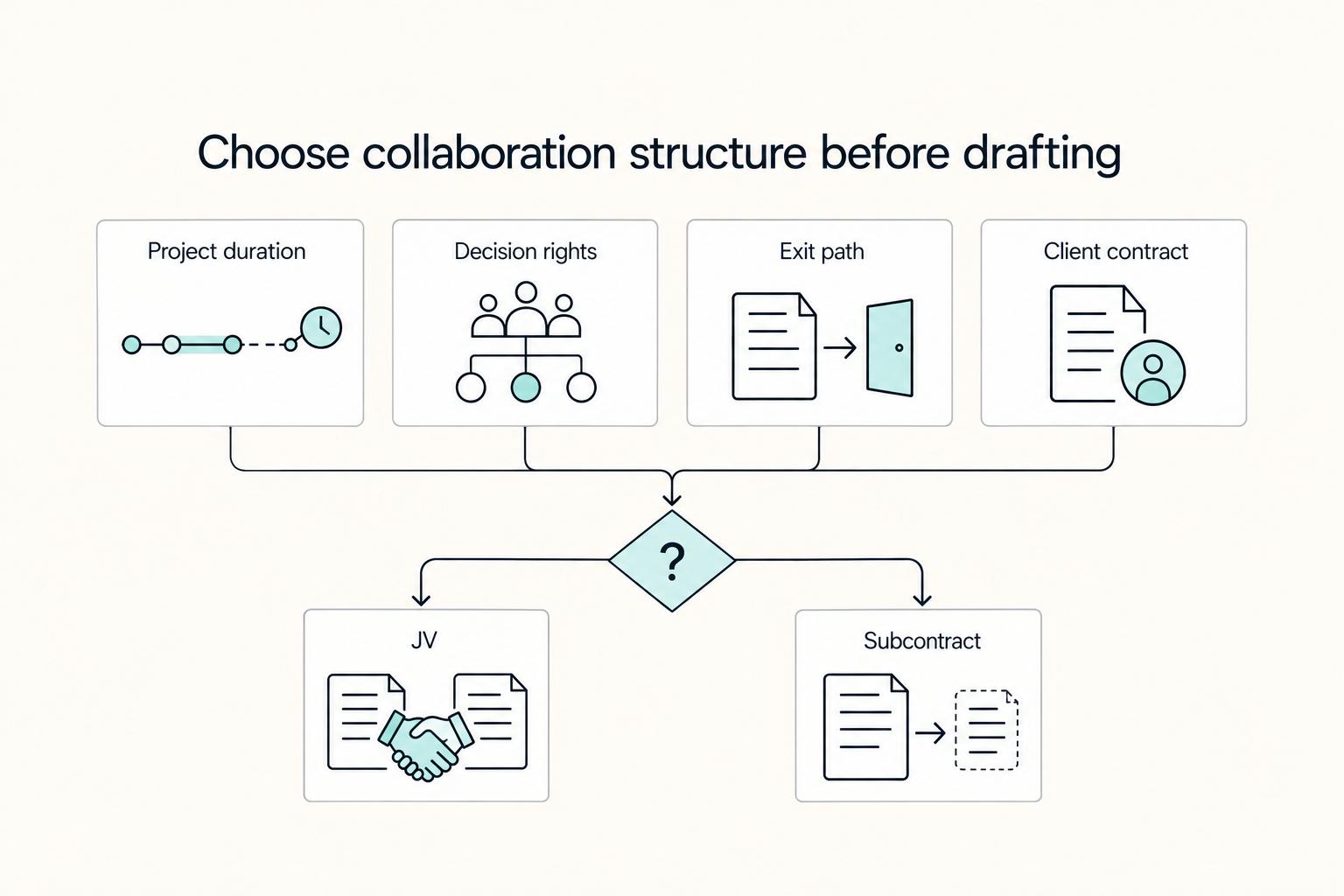
How to Structure a Joint Venture Agreement Between Two Freelancers
Treat the **freelance joint venture agreement** as a working document you can use day to day, not a ceremonial signature page. Put it in place before work starts so everyone involved is working from the same written terms.
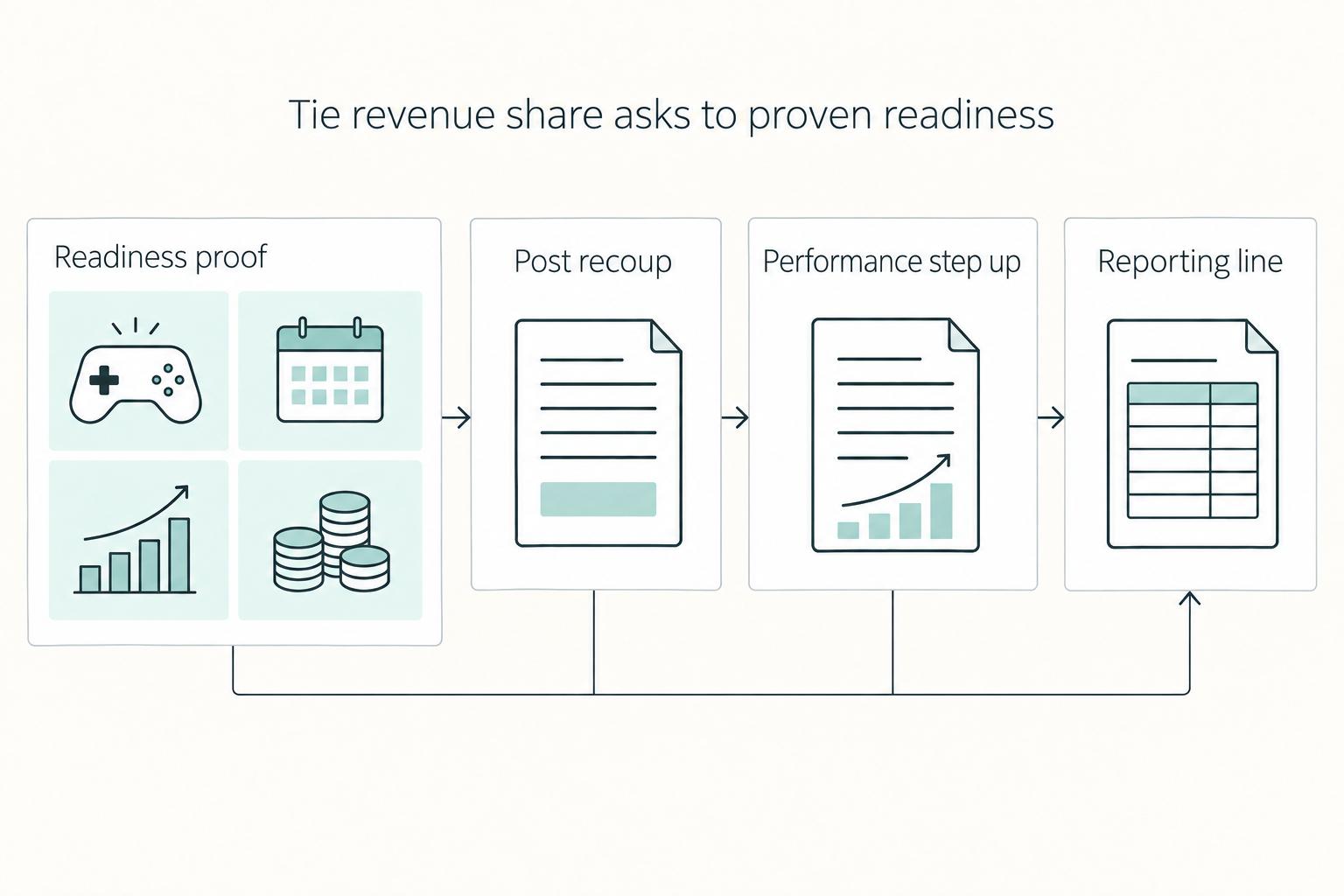
Game Developer Revenue Sharing Agreements That Hold Up After Launch
A **game developer revenue sharing agreement** is not a document you sign and forget. It is the financial blueprint for your studio's survival and the practical foundation of your most important business partnership.