
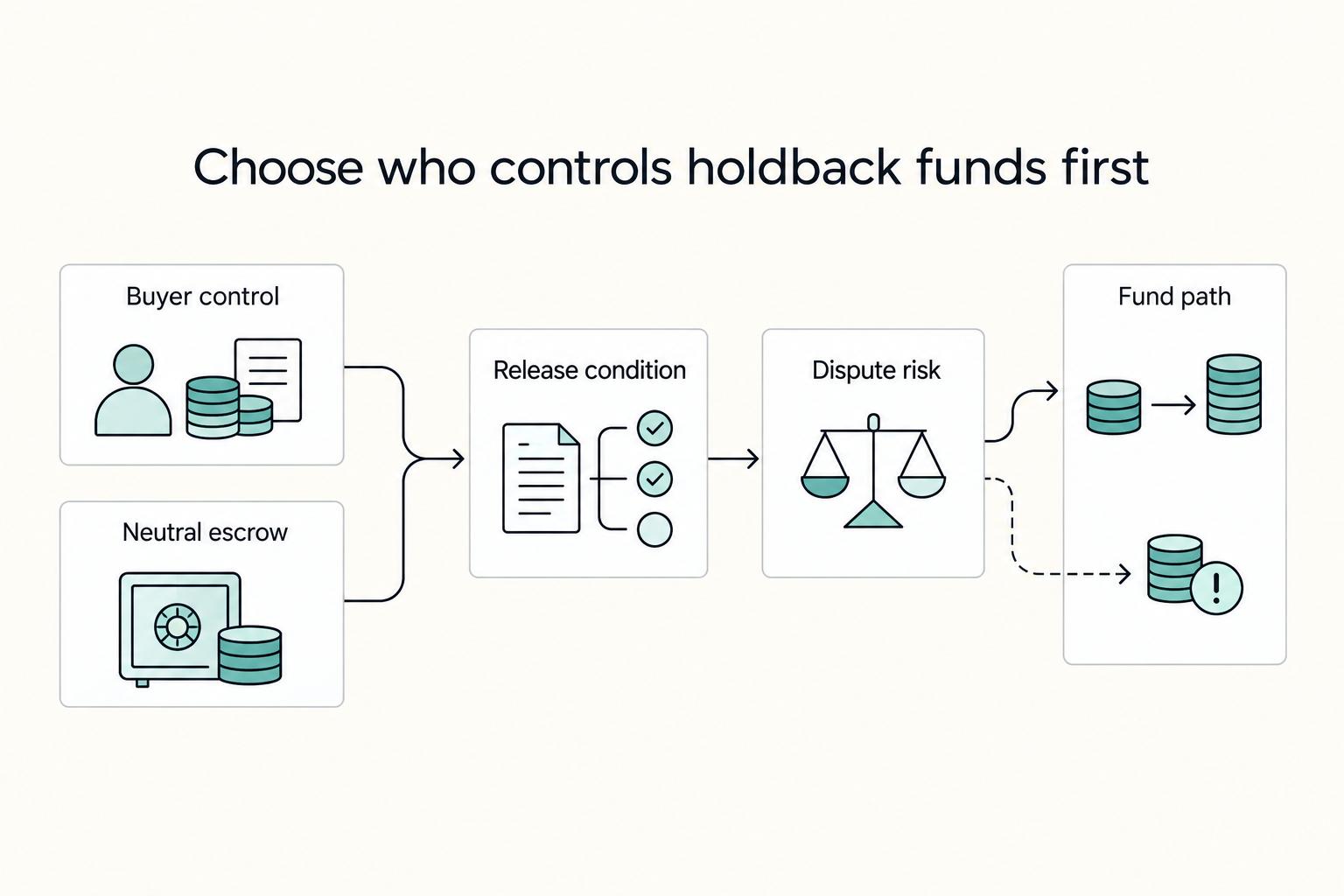
Quick Answer
Use a holdback in purchase agreement terms only when you can name a specific post-closing issue, the exact evidence required, and the release event. Draft in sequence: withheld amount at closing, claim trigger, proof standard, release timing, then dispute handling. Decide fund control early by choosing buyer-held holdback or escrow. Then align the clause with indemnification scope, liability-cap interaction, termination effects, and forum terms so release can be decided without guesswork.
Structure a holdback that protects you without slowing the deal#
A workable holdback provision does one job well. It lets both sides move forward now without reopening the purchase-price fight later. In a smaller cross-border deal, the practical route is straightforward drafting: name the risk, name the proof, and name the release path.
You want the clause to survive negotiation and still work when money moves. That means it has to be precise enough for the buyer to rely on and clear enough for the seller to live with.
Before you start#
This guide is for freelancers, consultants, and small business sellers handling practical deal terms themselves or with light counsel support. It is not a large firm M&A manual, and it is not legal advice for every jurisdiction.
If your buyer, seller, or funds sit across borders, check local enforceability before you sign. Pay special attention to setoff rights, treatment of funds held by a third party, notice rules, and dispute handling.
A useful drafting mindset is to place the clause where the contract already allocates money and risk. In one SEC-filed share sale agreement, Purchase Price, Closing, Representations and Warranties, and Special Indemnities appear as distinct sections. That matters because a holdback can touch all four, even in a smaller deal.
Step 1 Define the exact drafting outcome#
Draft toward one practical result: before completion, both sides should know what amount is being withheld, why, where it sits, and what releases it. If you cannot explain those points in one short sentence, the clause is still too loose.
Before you redline, confirm the agreement has a clear home for the economic term and a clear home for the risk term. If the withheld amount is buried in general payment language while the trigger sits somewhere else, disputes are more likely.
One failure mode is treating the holdback like a vague safety cushion. That slows deals down. Buyers ask for broad discretion, sellers push back, and no one can tell at completion whether the money stays with the buyer, moves to a neutral account, or gets released later.
Step 2 Set the scope for the kind of deal you are actually doing#
This guide assumes a smaller negotiated transaction, not a heavily staffed acquisition with custom schedules for every issue. The goal is usable drafting you can review, challenge, and tighten without turning a modest sale into a document marathon.
If your deal needs a neutral third party to hold and disburse funds, that is escrow in the ordinary sense. In general, that structure collects funds at closing and refunds them after a specified issue is resolved. That can solve a real problem without delaying the transaction, but do not assume real estate-style mechanics automatically carry over into a business deal.
Use this guide for clause components, not jurisdiction shortcuts. The promise here is practical: clause components, decision rules, and fallback terms you can use today. The goal is to show what to name, what to tie together, and what to reject when the other side wants open-ended withholding rights.
Before signature, make sure the draft aligns the payment term with the funding mechanics and the related breach language. If those parts do not match, the clause may look agreed on paper but fail when someone actually tries to claim or release funds.
Decide when a holdback is actually the right tool#
Use a holdback only when you can define one specific post-signing issue and a clear release path. If you cannot state the trigger, the evidence, and the release timing in one sentence, pause and use a different mechanism.
Step 1 Match the tool to a defined issue#
Tie the holdback to a named issue that can be checked after signing, not broad phrases like "pending issues" or "subject to buyer satisfaction." Vague wording usually delays the real dispute instead of resolving it.
Step 2 Do not collapse different mechanisms into one clause#
Treat holdback, escrow, purchase price adjustment, and earn-out as separate tools. In one SEC-filed purchase agreement, Escrow appears at 1.5, Purchase Price Adjustment at 1.6, and Earn-Out at 1.8, which is a practical drafting signal not to force future-performance terms into a holdback.
If you need that comparison in more detail, see How to Handle an 'Earn-Out' in a Business Sale Agreement.
Step 3 Use escrow when fund control is the real concern#
If the core question is who controls the withheld funds, use escrow terms rather than leaving the amount in a buyer-held holdback. Confirm who holds funds, who can send release instructions, and what happens if one side does not respond.
Prepare your evidence pack before drafting any clause#
Start with proof, not clause language. A holdback works only when both sides can verify the same specific task or confirmation that controls release.
Step 1 Build one shared file for the holdback issue#
Create a single evidence pack for the exact item tied to the withheld funds. Keep one set of documents, one version history, and one list of open points so the release standard stays tied to a specific obligation instead of drifting into general debate.
Step 2 Sort each issue into the right contract bucket#
Classify each unresolved point before redlines: what must be true now, what must be done later, and what later event controls release. In agreement structure, keep these functions distinct by using the right buckets, such as representations and warranties, covenants, and termination events, rather than blending them into indemnification by default.
Step 3 Define release proof before drafting language#
Write the exact proof needed to release funds for each item, in plain terms both sides can check. If funds are held after closing, confirm the escrow mechanics up front: who holds the money, when release instructions can be sent, and what completion proof is required. If both sides cannot confirm the same evidence pack before markup, pause redlines until they can. Related: A Guide to Selling Your Freelance Business or Agency.
Draft the holdback clause in the right order#
Draft the clause in a fixed sequence so the mechanics do not conflict: amount, trigger, proof, release timing, then dispute handling.
| Draft point | Include | Article note |
|---|---|---|
| Withheld amount | The exact portion of purchase price withheld at closing, and whether any release or drawdown changes purchase price | This helps avoid double-counting risk later |
| Claim trigger | The specific indemnification obligations and representations and warranties or other named obligations that allow a claim | Avoid open-ended triggers like "any dispute" or "buyer dissatisfaction" |
| Proof and release timing | What counts as sufficient support, such as a claim notice or other defined written proof, plus a clear release date or event | Avoid vague release tests like "once resolved" without an objective standard |
| Closing mechanics | Who sends release instructions, who receives them, and where funds sit after closing | If funds are placed with a third party, structure it as escrow and draft accordingly |
| Termination and partial disputes | What happens at termination and after notice deadlines | Undisputed amounts are released, and only the disputed portion stays withheld |
Step 1 State the withheld amount in the purchase-price mechanics#
Start with the exact portion of purchase price withheld at closing, and keep it with the consideration structure. A purchase agreement can separate post-closing adjustments from withholding rights, which is a useful drafting pattern. Make one point explicit: whether any release or drawdown changes purchase price, so you do not create double-counting risk later.
Step 2 Tie the trigger to named breaches and indemnification#
Define exactly what allows a claim against the holdback. Tie it to indemnification obligations and the specific representations and warranties, or other named obligations, that matter in your deal. Avoid open-ended triggers like "any dispute" or "buyer dissatisfaction."
Step 3 Define proof and release timing together#
Set the evidence standard and release timing in the same draft pass. State what counts as sufficient support, for example a claim notice or other defined written proof, and pair it with a clear release date or event. Avoid vague release tests like "once resolved" without an objective standard.
Step 4 Add closing mechanics and fund location#
Write the operational mechanics directly into the clause: who sends release instructions, who receives them, and where funds sit after closing. If funds stay with the buyer, keep the language consistent with a holdback structure. If funds are placed with a third party, structure it as escrow and draft accordingly. Also state that holdback obligations are contingent on closing, so they do not float if the transaction never closes.
Step 5 Cover termination, late notices, and partial disputes#
State what happens at termination and after notice deadlines so funds are not frozen by silence. Then add a partial-claim rule: undisputed amounts are released, and only the disputed portion stays withheld.
Use one final check before signing: can a neutral reader identify who holds funds, what triggers a claim, what proof is required, and when undisputed money must be released? If not, keep drafting.
Compare holdback, escrow, and earn-out before you lock terms#
Choose fund control first, not wording. If trust is thin, default to an escrow holdback agreement with a neutral third-party account instead of leaving the money in the buyer's control.
Step 1 Compare control of funds before anything else#
The fastest way to prevent release fights is to define who holds the money after closing.
| Structure | Who controls funds after closing | Typical dispute friction | Seller payment-risk posture |
|---|---|---|---|
| Buyer-held holdback | Buyer retains part of the purchase price | Arguments over whether claim or release conditions were met | Higher, because one side already controls the cash |
| Escrow holdback | Neutral third party holds funds in a separate escrow account | Arguments over whether notice or release instructions were properly triggered | Lower control risk, because neither side holds funds alone |
| Earn-out | Separate pricing term | Do not merge into holdback or escrow release mechanics | Different term family; negotiate separately |
A buyer-held holdback is simpler to set up, but it can create a "you pay me when I say so" dynamic. Escrow adds administration, but reduces unilateral control.
Step 2 Keep escrow, post-closing adjustment, and withholding in separate lanes#
Use document structure as a quality check. In an SEC-filed purchase agreement dated July 21, 2024, the table of contents separates Section 2.2 | Escrow, Section 2.4 | Post-Closing Adjustment, and Section 2.7 | Withholding. Keep that same separation in your draft so each mechanism has a clear job.
If your redline makes one retained amount look like it covers everything, expect conflict at release.
Step 3 Set a default rule based on trust and enforceability#
For most independent sellers, if the buyer is new, cross-border, or hard to enforce against, lean toward escrow holdback. Use a buyer-held holdback only when counterparty behavior is proven and release conditions are tightly defined.
The tradeoff is straightforward: escrow adds setup work, but it usually reduces avoidable payment-control disputes later.
Final check before signing: confirm, in one pass, who holds funds, what triggers release, how disputes are noticed, and which terms are separate from holdback or escrow.
For a step-by-step walkthrough, see How to Structure a 'Teaming Agreement' for a Government Contract Bid.
Align the holdback with indemnification and liability caps#
The holdback should secure the same post-closing risks your indemnification clause covers, with the same boundaries, or you create avoidable release fights.
| Alignment point | What to match | Article note |
|---|---|---|
| Covered claims | Use the same claim categories in holdback and indemnification | The article names breaches of representations and warranties, pre-closing liabilities, and specifically named contingencies |
| Liability cap | State whether the holdback sits inside or outside the liability cap | If it is inside, the retained amount can operate as a defined cap on the purchase price portion at risk |
| Recovery order | Write the order for setoff across holdback, indemnity payments, and any purchase price adjustment | For the same loss, one recovery path should reduce or block the others |
| Release and survival | State what survives, what gets released, and what notice stops release | Release conditions can be time-based or event-driven, and any claim notice should identify the breach category, amount claimed, and supporting materials already required under the agreement |
Step 1 Match covered claims line by line. If the holdback secures indemnification, list the same claim categories in both places: breaches of representations and warranties, pre-closing liabilities, and any specifically named contingencies. Then check that the release exceptions use that same list. If one clause says "any losses" and the other is narrower, resolve that before signing.
Step 2 State cap interaction explicitly. Say in one clear sentence whether the holdback sits inside or outside your liability cap. If it is inside, the retained amount can operate as a defined cap on the purchase price portion at risk. If it is outside, make that explicit so neither side assumes the withheld funds are the full limit.
Step 3 Set recovery order and prevent double recovery. Write the order for setoff across holdback, indemnity payments, and any purchase price adjustment. For the same loss, state how one recovery path reduces or blocks the others. Do not leave room to collect the same shortfall twice through different clauses.
Step 4 Tie release mechanics to survival and termination. State what survives, what gets released, and what notice stops release. Keep release conditions clear and objective, whether time-based, for example 12 months post-closing, or event-driven. Require any claim notice to identify the breach category, amount claimed, and supporting materials already required under the agreement.
Related reading: How to Structure an Affiliate Agreement for Your Digital Product.
Lock governing law, jurisdiction, and dispute paths before signature#
Lock these terms before signature so holdback disputes can be resolved in a defined forum, on a defined path, with defined timing.
Step 1: State governing law once, then make every related document match. Put the Governing Law clause in the main purchase agreement and confirm the same choice appears consistently in schedules, exhibits, third-party holdback or escrow documents, and side letters.
Step 2: Name jurisdiction and venue for holdback disputes. Specify where disputes over withheld funds, release notices, and related indemnification issues will be heard. Avoid split forums unless you are using a narrow, explicit carve-out.
Step 3: Choose the dispute path and define holdback deadlines. If you use court, arbitration, or staged escalation, state it clearly and tie it to holdback mechanics: claim notice timing, response timing, escalation timing, if any, and release timing for undisputed amounts.
Step 4: Run a cross-border practicality check. Before you sign, confirm the path is workable in practice: likely enforceability where the counterparty or funds are located, service-of-process logistics, whether to name an agent for service, and whether your expected evidence can be used in the chosen forum.
Negotiate faster with fallback terms and red-flag triggers#
Negotiations move faster when your fallback terms are set before redlines and your red flags are explicit from the start.
Step 1 Set your three-position ladder before the next draft. Define a preferred term, an acceptable fallback, and a walk-away line for the holdback provision. Keep each position on the same points: amount withheld, claim categories, evidence required to withhold, release conditions, and who controls the funds after closing. If any version still uses vague language like "upon satisfactory performance," tighten it, because vague release language invites disputes.
Step 2 Raise seller-side red flags immediately. Push back early on open-ended claim windows, undefined evidence standards, and unilateral buyer release control. If the buyer holds the funds directly, treat that as added leverage risk in post-closing release discussions. A practical fallback is escrow, where a neutral third party holds funds for a defined purpose and period.
Step 3 Unstick negotiations by narrowing what can trigger claims. If talks stall on percentage, move to scope. Limit claims to named risk buckets, such as covenant breaches or post-closing purchase price adjustments, and require written notice periods, response windows, and specified evidence to withhold funds. This reduces the risk that broad "any claim" language keeps funds frozen.
Step 4 Trade concessions only with reciprocity. If the holdback gets wider, ask to narrow what obligations it secures or shorten how long those obligations run. If the release path gets longer, ask for clearer proof standards and release mechanics for undisputed amounts. Keep your walk-away line tied to your BATNA: what you will do if no workable deal is reached.
Use this copy-paste checklist before you sign#
Use this final pass to lock down release mechanics so a neutral reader can decide what gets released, when, and why.
- State the release mechanics in plain language.
Your clause should name the trigger, proof standard, release date, and dispute path. If release depends on acceptance or remediation, name the document or event that proves completion.
- Check for internal conflicts across related clauses.
Review the holdback section alongside Indemnification, Limitation of Liability, and Termination. The goal is consistency on what the holdback secures, what survives termination, and how timing works.
- Keep forum terms consistent across all deal documents.
Align Governing Law, Jurisdiction, and Dispute Resolution in the purchase agreement, schedules, exhibits, and any side document. Use the agreement's article structure to catch conflicts before signature.
- Confirm where funds sit and how release is processed at Closing.
Decide whether funds are buyer-held or in escrow. If you use escrow, document the mechanics in the main agreement and, where needed, an escrow-holdback addendum tied to closing duties. Define who sends release notice, where it goes, and what support is required.
- Replace undefined or subjective terms before signing.
If the agreement uses defined terms, verify every capitalized term in the holdback clause is actually defined. Replace vague language with measurable wording tied to a document, event, or date.
Frequently Asked Questions
What is a holdback in a purchase agreement?
A holdback is part of the purchase price that is withheld when the deal is completed. The usual reason is buyer protection when a post-closing requirement still needs to be satisfied. If you cannot point to the exact requirement and the proof needed, the clause is too loose.
How is a holdback different from escrow?
A holdback describes the money being withheld. Escrow describes where that money sits: in a neutral third-party account instead of under one party's control. In an escrow holdback structure, funds are set aside at closing and released after agreed conditions are met.
Should I use a holdback or an earn-out?
Use a holdback when release can be tied to specific post-closing requirements and clear proof. If payment is tied to future performance, keep that structure clearly separated from holdback release terms so the purpose of withheld funds is not disputed. For the performance-based path, see How to Handle an 'Earn-Out' in a Business Sale Agreement.
What should a holdback clause include to be enforceable?
To reduce ambiguity, name the amount withheld, the trigger, how completion is shown, and the release timing. In the purchase agreement, vague wording like "upon satisfactory performance" is a red flag because it gives no measurable release test. A good verification check is simple: could a neutral third party read the clause and decide release without guessing?
Who holds the funds and when should they be released?
In an escrow holdback setup, funds are set aside in a neutral third-party account at closing until agreed work is completed or other post-closing requirements are met. Release should happen on a defined event, not goodwill. Write the release notice mechanics too, so funds do not stay frozen because no deadline was set.
What happens if there is a dispute before release?
There is no single mandatory dispute process or forum, so your agreement should define one clearly. In the holdback examples, if required work is not completed, withheld funds may be used to cover that specific cost.
How do governing law and jurisdiction affect holdback enforcement?
They matter because holdback rules are not universal across jurisdictions or deal types. Keep governing law, jurisdiction, and dispute language consistent across the acquisition agreement, schedules, and any third-party account document. Also be careful with outside examples: published figures such as 120% to 150%, 10%, 180 days, or $5,000 come from specific mortgage-program contexts, not universal rules for commercial contracts.
Try a related tool
Researched and edited by the Gruv editorial team. Gruv builds cross-border billing, payouts, and finance-operations software for global businesses.
Sources
- courts.ca.gov/system/files/file/itac-20210324-materials.pdftrusted
- docs.cpuc.ca.gov/PublishedDocs/Published/G000/M345/K009/34500...trusted
- file.lacounty.gov/SDSInter/bos/supdocs/207596.pdftrusted
- legislature.maine.gov/testimony/resources/JUD20260311Rinaldi134176...trusted
- michigan.gov/-/media/Project/Websites/dtmb/Procurement/Co...trusted
- occ.gov/static/ots/bulletins/regulatory-bulletin/ots...trusted
- occ.treas.gov/publications-and-resources/publications/comp...trusted
- sec.gov/Archives/edgar/data/1582982/0001493152210133...trusted
Educational content only. Not legal, tax, or financial advice.
Related Posts

Germany Freelance Visa Application Path for Freiberufler and Gewerbe
Choose your track before you collect documents. That first decision determines what your file needs to prove and which label should appear everywhere: `Freiberufler` for liberal-profession services, or `Selbständiger/Gewerbetreibender` for business and trade activity.
A Guide to Selling Your Freelance Business or Agency
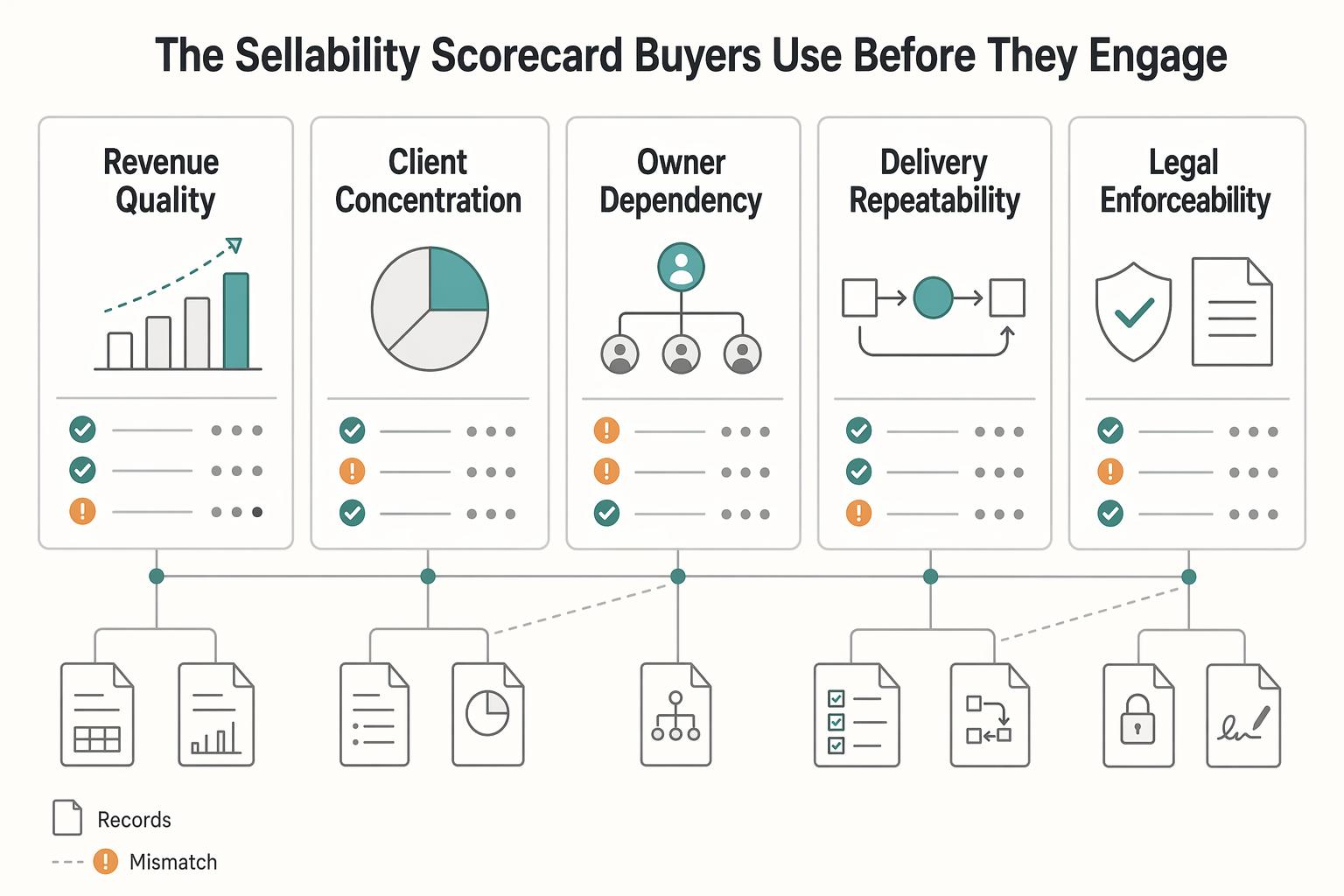
**When you sell your freelance business, buyers are paying for a reliable asset they can verify, transfer, and run, not for your personal hustle.** A common mistake is mixing advice about winning clients with advice about closing an acquisition. Those are different jobs. This guide is a sellability-to-close playbook designed to reduce surprises before buyer conversations begin.
How to Handle an Earn-Out in a Business Sale Agreement
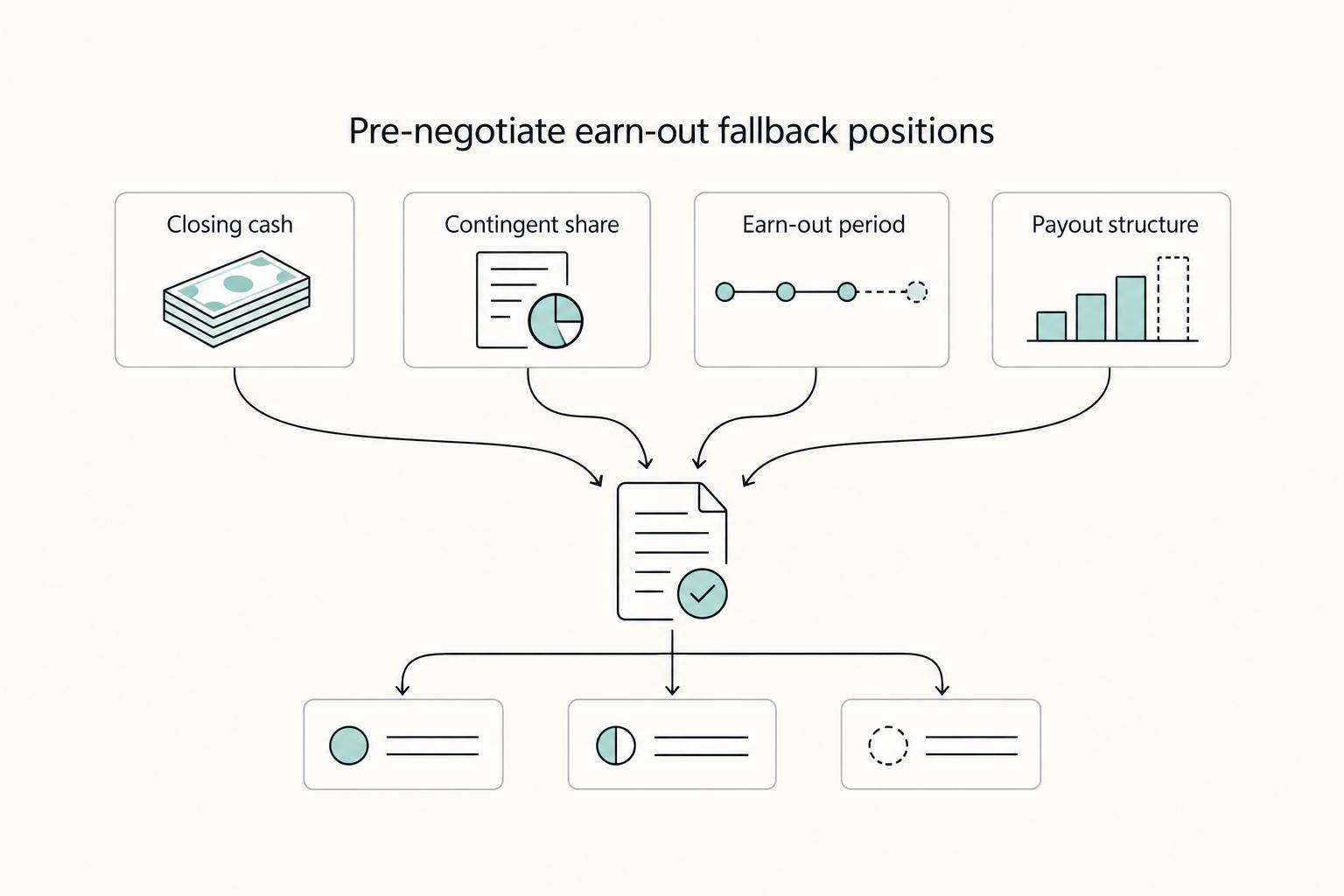
Start with the real answer: an **earn-out in business sale** can bridge a valuation gap, but for a seller it also turns part of the price into delayed payment risk. The headline number only matters if the contingent piece is clear, measurable, and enforceable.