
Quick Answer
Use a written beta testing contract before granting access. Define confidential information by actual beta channels, assign how bug reports and broader suggestions are handled, and state as-is plus support boundaries so testers know what is not promised. Add rules for public sharing, onboarding and offboarding, and signed or logged acceptance. If you are the tester, scrutinize indemnity, feedback rights, and time obligations before agreeing.
Treat Your Beta Testing Contract as a Risk-Control Tool#
Treat your beta testing contract as a risk-control tool, not a signup form. You are giving testers access to pre-release software that may be unstable, so set written rules before access starts. A contract-led beta is usually easier to run and easier to defend:
| If you run beta like this | What can happen |
|---|---|
| Informal beta (email invites, vague expectations) | Usage can drift, support requests can expand, feedback can scatter, and leaks can be harder to handle |
| Contract-led beta (written terms before access) | You can restrict use, set confidentiality rules, define support boundaries, allocate feedback rights, and document what testers were allowed to do |
Start by naming the risks so your terms match the exposure: IP leakage, liability exposure, feedback ownership disputes, and reputational harm. IP leakage is broader than source code and can include non-public product details such as screenshots and feature behavior. In the US, trade secret protection depends on taking reasonable secrecy measures under 18 U.S.C. § 1839, so confidentiality and access controls are part of that posture.
Liability exposure is operational, not theoretical. Pre-release software may malfunction, including through data loss or corruption. Your terms should make clear that beta software can change or be discontinued, is not for production use, and is not for live customer data. If testers may post reviews or endorsements and have a material connection to you, 16 CFR § 255.5 requires clear disclosure.
That leads to a three-part roadmap:
- Protect IP and confidentiality.
- Limit financial exposure with support and liability terms.
- Formalize feedback and public communications to avoid ownership and compliance problems.
This guide gives practical legal and operational guidance. Before using any version in cross-border or regulated contexts, align it with jurisdiction-specific contracts counsel.
Related: How to Create a Service Agreement for a SaaS Product.
Pillar 1: Armor-Plating Your Intellectual Property#
For beta IP terms, a practical way to organize drafting is around four decisions: define what is protected, decide how to handle feedback, set limits on technical or public misuse, and state what happens after breach. Authoritative clause language for these decisions isn't provided here.
Start with reliable drafting inputs#
If a source is a community forum page or a search-interface page, treat it as non-authoritative for SaaS beta clause drafting. Do not rely on it for legal language.
Draft from your actual beta process instead: invite email, onboarding flow, tester instructions, support channels, issue tracker, calls, and shared docs. If testers can access it or submit it during beta, flag it for contract coverage review.
Step 1 Define protected material by how your beta actually runs#
Keep the scope tied to what you actually disclose, and avoid relying on generic catchall wording without legal review. Use a practical checklist:
- List what you actually share during beta, including non-public product and program materials.
- Map coverage to the channels you actually use, such as email, chat, docs, tracker, calls, and in-app messages.
- Mark exclusions and edge cases for jurisdiction-specific legal review before finalizing language.
If your behavior and your clause scope do not match, the draft becomes harder to apply consistently.
Step 2 Separate bug reports from higher-value suggestions, then handle ownership in one section#
Enforceable assignment, waiver, or ownership formulas aren't established here. For now, separate feedback types in your drafting notes and get legal review on final language. Your feedback section should:
- Document how you intend to use bug reports and related testing input.
- Document how you intend to handle broader product suggestions.
- Add any transfer, license, waiver, or consent language only after jurisdiction-specific review.
- Make clear what testers keep, such as pre-existing know-how or tools, if that is your intended deal.
Keeping feedback treatment in one place reduces ambiguity during later review.
Step 3 Restrict reverse engineering, benchmarking, and external disclosure directly#
Treat reverse engineering, benchmarking, and disclosure restrictions as a drafting checkpoint that requires qualified legal review before finalizing clause language.
| IP risk area | What the provided excerpts support |
|---|---|
| Scope definition | Only that source quality must be verified before drafting. |
| Feedback rights | No authoritative assignment or waiver wording. |
| Reverse engineering and benchmarking | No authoritative prohibition wording. |
| Disclosure restrictions | No authoritative external disclosure wording. |
Match operations to the contract. If your terms require private submission, keep the submission paths controlled and consistent.
Step 4 Localize breach and cross-border enforceability terms before signature#
Mark unresolved legal choices while you build the agreement, then finalize them after qualified local review. Enforceability outcomes, remedies, and jurisdiction choices are not established:
- Governing law: Governing-law choice pending counsel review
- Venue or arbitration forum: Forum choice pending counsel review
- Emergency or court relief pathway: Relief pathway pending local counsel review
- Notice method for breach claims: Notice mechanics pending contract review
You can still define operational actions now, such as access suspension, credential revocation, stop-use, and return or deletion obligations, then align final legal language in review.
Pillar 2: Building Your Financial Shield#
For drafting purposes, this section uses three clause buckets: a liability cap, a warranty disclaimer, and clear support boundaries.
Important limit: SaaS beta clause standards are not established. The detailed contract-risk evidence comes from a government procurement context, not SaaS beta contract drafting guidance. In that study context, anti-recharacterization law (ARL) adoption is associated with a shift from fixed-price to cost-plus contracts, with a more pronounced effect for firms with higher default risk and stronger firm-government ties, and with reports that government buyers may switch away or reduce contract value for ARL-affected contractors. Treat the structure below as a drafting framework and verify legal effect in your jurisdiction before signature.
| Financial risk area | Weak clause | Stronger clause |
|---|---|---|
| Limitation of liability | "We are not liable for damages." | Separates the damage categories you intend to exclude, can state that non-excludable claims remain subject to applicable law, and leaves the liability cap approach and any carve-outs pending counsel-approved contract review. |
| Disclaimer scope | "Software is provided as is." | States the beta is provided "as is" and "as available," without promises of uninterrupted operation, error correction, fitness for a particular purpose, or specific results, while preserving non-waivable rights after jurisdiction review. |
| Support obligations | "Support may be provided." | Names the support channel, sets responses as best effort, confirms no guaranteed fix timeline, no commitment to implement requests, and no promise of continuous availability during beta. |
Step 1 Cap your exposure#
A liability clause is easier to apply when a tester can quickly see what is excluded, what may still remain, and where the cap applies. In practice, that often means excluding the loss categories you intend to exclude, then applying a verified cap to the remaining covered exposure.
Some claims may still sit outside your exclusion or cap logic. That can include rights your governing law does not let you waive and any carve-outs you deliberately keep after review. Do not treat the cap as final until the liability cap approach has been verified against counsel-approved contract language.
Check the cap and the carve-outs together. If the carve-outs are too broad, the cap may not give you meaningful protection.
Step 2 Disclaim warranties precisely#
"As is" can help set expectations, but it does not do all the work by itself. It can clarify that the beta is not promised to be error-free, uninterrupted, always available, or fit for a specific purpose.
It does not remove non-waivable rights under applicable law, and it should not conflict with other statements you make to testers. Localize this section for consumer-protection and other non-waivable rules in the jurisdictions that matter for your program.
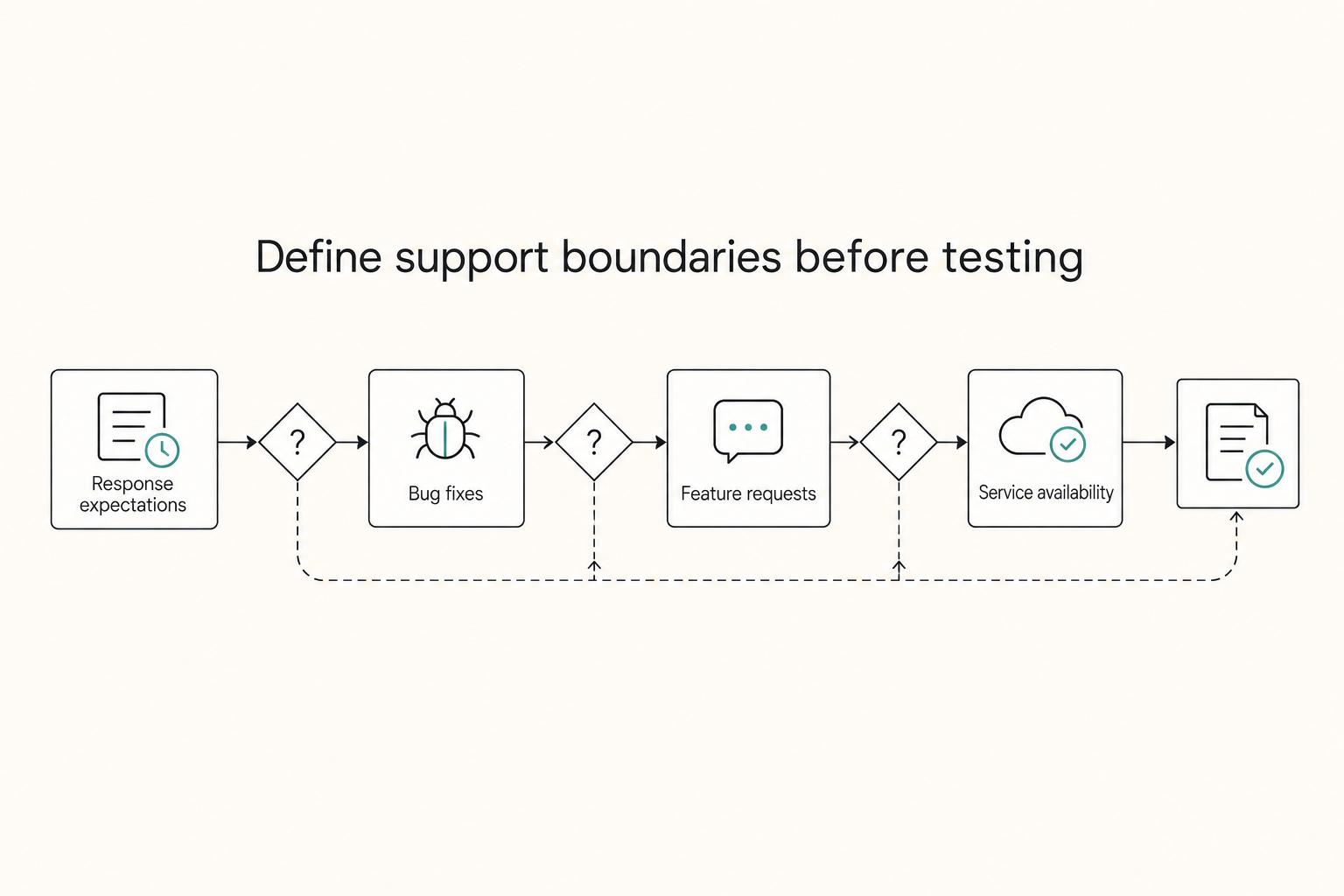
Step 3 Define support boundaries before testing starts#
Unclear support language can turn beta into open-ended service work. Set boundaries in the agreement before anyone gets access.
| Area | Agreement point |
|---|---|
| Response expectations | Identify one support channel and state responses are best effort. |
| Bug-fix commitments | Confirm reports are reviewed, with no guaranteed fix deadline. |
| Feature requests | Clarify suggestions are welcome but not promised. |
| Service availability | State that access, features, or environments may change, pause, or be removed during beta. |
Then make sure day-to-day operations match the agreement so your actual support behavior does not expand the scope by accident.
For a step-by-step walkthrough, see How to Structure a 'Testing and Acceptance' Clause in a Software Development Contract.
Pillar 3: Architecting a Professional Feedback System#
Once IP and financial terms are set, the next failure point is often operational. Your agreement should route feedback into approved paths, use consistent reports, and let you remove testers who add risk without adding signal.
Assign one program owner first#
Assign one program owner before you draft process terms. That person should own the tester roster, approved channels, version notes, and final decisions on who stays in the beta.
Then align product, support, privacy, and legal early so testers see one coherent operating model. Your minimum checkpoint is simple: every approved feedback path needs a named owner and an archive tied to tester, date, and build or version. If you use any public website form, state clearly that it is for technical or site feedback only and not for confidential information or personal data.
Step 1 Define one tester operating model#
The agreement should tell testers exactly where to report and how to report. That is what keeps feedback useful.
Limit reports to one or two approved channels, such as a dedicated inbox, ticket portal, or private group. State that bug reports, feature requests, and access issues must stay in those channels, not personal DMs, sales inboxes, or public forms.
Use a report format in the agreement or tester guide so issues are easier to reproduce:
- product area, feature, and build or version
- steps taken
- expected result and actual result
- device, browser, environment, and relevant date or time
- screenshots, logs, or recordings with personal data redacted where possible
If you set participation cadence by program design, such as check-ins, assigned scenarios, or milestone-based feedback, only commit to cadence you can actually track.
Step 2 Build lifecycle flow into term and termination#
If onboarding and offboarding are not written down, they can break in practice. Build the beta lifecycle into the contract: onboarding, active testing, and offboarding.
| Phase | What it should cover |
|---|---|
| Onboarding | Acceptance of terms, confidentiality, approved channels, privacy notice, and any no-publicity rule before access starts. |
| Active testing | Your cadence, report format, and conduct rules. |
| Offboarding | Access revocation, material return or deletion steps, open-ticket closure, and handling of test data and credentials. |
Use that lifecycle as the contract flow. Tie individual suspension or termination to observable behavior, such as repeated off-channel reporting after notice, confidentiality violations, abusive conduct, or ignored program instructions. Also keep a program-level right to pause or end the beta. Back this up with operations: maintain an access roster and offboarding checklist so you can verify who had access and when it ended.
Step 3 Separate private beta communication from public disclosure#
This line should be bright, not implied. Private beta communication happens only in your approved channels. Public disclosure is everything else.
Define public disclosure broadly: social posts, screenshots, videos, reviews, talks, demos, portfolio mentions, app store comments, and press discussions. If your program requires prior written approval for external mentions, state that clearly. Make the approval path explicit: who can approve, whether a written request is required, and how approval is limited to specific content, assets, audience, and timing.
Treat approved external mentions as narrow exceptions, not defaults, so you keep control of the product narrative during beta.
Step 4 Disclose privacy handling in plain language#
Privacy language should be readable and usable, not buried. State what you collect, why you collect it, where the full notice lives, and what happens when testing ends. California Attorney General guidance emphasizes considering privacy early in development. It also points to a practical checkpoint for app distribution: make the privacy policy visible in the app store before download.
| Privacy item | What to disclose |
|---|---|
| Data categories collected | Account details, usage analytics, crash reports, device or browser info, screenshots, logs, and support messages. |
| Purpose limitation | Operate beta, diagnose bugs, improve product, communicate with testers. |
| Retention or deletion approach after offboarding | What is deleted, anonymized, or retained for records. |
| Privacy notice link | Link to the product privacy notice and, where relevant, cross-border transfer terms after jurisdiction-specific verification. |
| Channel restrictions | Public web forms are not for confidential information or personal data unless you provide a secure intake route. |
Use that table as the short disclosure checklist in the agreement or linked notice.
Keep this readable on small screens. Dense text and buried links weaken meaningful notice, so use a clear summary, link the full notice, and archive the onboarding version shown to testers.
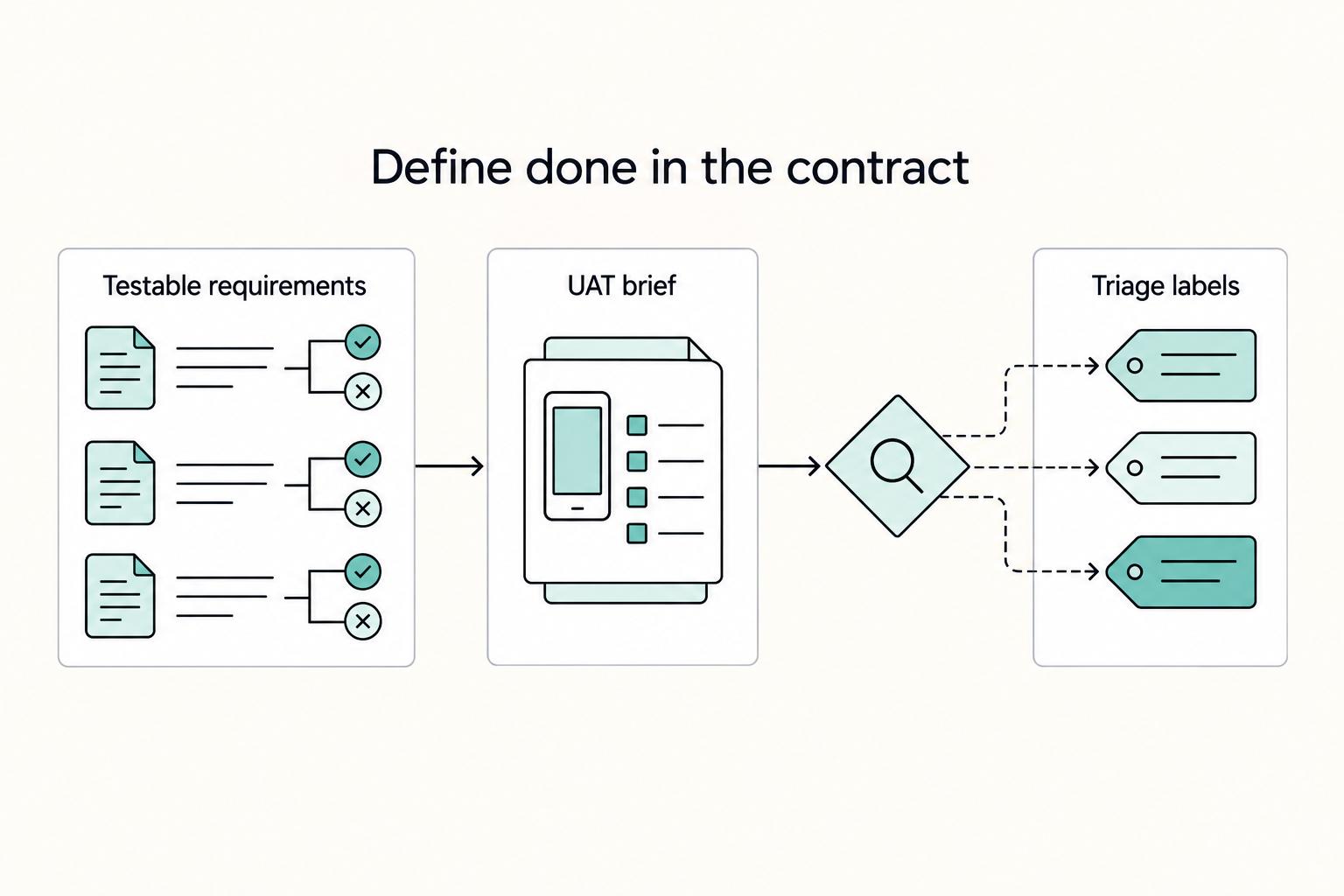
You might also find this useful: How to Perform User Acceptance Testing (UAT) for a Mobile App.
Bonus: What to Look For When You Are the Beta Tester#
If you are the one clicking agree, focus on three things first: indemnity, feedback rights, and time commitment. Those clauses can turn early access into unpaid exposure if you do not set boundaries up front.
Read the full terms before you agree#
Read the full terms page or PDF, not just the signup screen, and confirm the document date. Beta and preview obligations can be published in separate terms and may change over time.
| Clause area | Acceptable wording pattern | Red flag wording pattern | Your response |
|---|---|---|---|
| Indemnity | Narrow, tied to your breach or misuse | You must indemnify, defend, and hold the vendor harmless for broad losses or claims | Ask to delete it or narrow it to your intentional misuse or clear breach |
| Feedback rights | Broad use of routine bug/UI/product feedback | Perpetual, irrevocable rights over all submissions with no boundary for strategic input | Set boundaries before you agree; carve out your pre-existing methods and strategic consulting input |
| Time commitment | Specific duties with clear benefit in return | Open-ended coordination or reporting duties with unclear scope | Convert duties to hours and confirm the benefit is worth the workload |
Step 1 Check for tester indemnity#
Start here, because indemnity can shift real claim risk onto you. If terms say you must "indemnify, defend, and hold harmless" the provider, you may be taking on losses tied to your use.
Why it matters: some beta terms put this burden on the tester, so it is not harmless boilerplate. What to do: search for "indemnify," "defend," and "hold harmless." Then read the trigger language and ask for a narrower clause tied only to your own clear breach, misuse, or unlawful conduct. If the provider will not move and access is nonessential, decline.
Step 2 Separate routine feedback from strategic input#
Broad feedback rights are common, but you should not assume all of your input belongs in the same bucket. Terms can let the provider use and commercialize submissions, sometimes on a perpetual and irrevocable basis, which is usually workable for bug reports, reproduction steps, and UI notes.
Why it matters: the same wording can also capture higher-value strategic input you would normally treat as paid consulting. What to do: if terms cover "any feedback" or "submissions" without limits, assume routine and strategic input are treated the same. Use a boundary like: "I can provide bug reports and usability feedback, but not product strategy, proprietary methods, or consulting recommendations unless we agree separate terms."
Step 3 Map duties to real workload and value#
Time commitment is where a beta can quietly become work. Participation may be voluntary and unpaid, while the provider can still change or end access. Some preview programs also provide no SLA, no technical support, and no service credits, and some require ongoing coordination and reporting.
Why it matters: "participation" can become recurring operational work. What to do: map every duty to time, including testing, coordination, reporting, and confidentiality constraints, then compare that cost to the actual benefit you will receive. If obligations are open-ended and the benefit is vague, ask for limits or walk away.
Before you click agree: reject broad indemnity first, set feedback boundaries second, then confirm time obligations match real value. We covered this in detail in How to Structure a 'Statement of Work' for a Penetration Testing Engagement.
Conclusion: From Legal Document to Strategic Asset#
A clear beta agreement gives you more control before access goes live. It can help protect your IP and confidential information, narrow warranty and liability exposure, and set explicit feedback rules instead of leaving you to improvise after problems appear.
Use it as a release gate, not a formality. If confidentiality is vague, feedback ownership is implied instead of stated clearly, or your disclaimer, liability, and communication terms are unclear, you are carrying avoidable risk into launch. If remedies or duties are hard to apply to a real tester scenario, tighten them now.
When the agreement is strong, launch execution can be cleaner because the same terms define who can test, how they report, what they can disclose, and when access ends. Before launch, do one final pass: review clause clarity, align tester duties to the actual test, confirm remedy and ownership terms, and finalize confidentiality and communication rules.
Frequently Asked Questions
How do I protect my idea during beta testing?
Protect it by defining confidential information clearly and pairing that with clear ownership language for tester feedback and submissions. Make sure the agreement also restricts unauthorized sharing and disclosure, not just copying. If the draft only says “keep this confidential” without clear scope or ownership language, revise it before you invite testers.
Can a beta tester sue me for data loss?
Use the contract terms to reduce exposure if issues happen during beta use. Check for warranty disclaimers and a limitation-of-liability clause, since beta terms often use fewer warranties and stricter liability limits than standard licenses. Keep a retrievable signed or logged record of accepted terms.
What is the most important clause in a beta agreement?
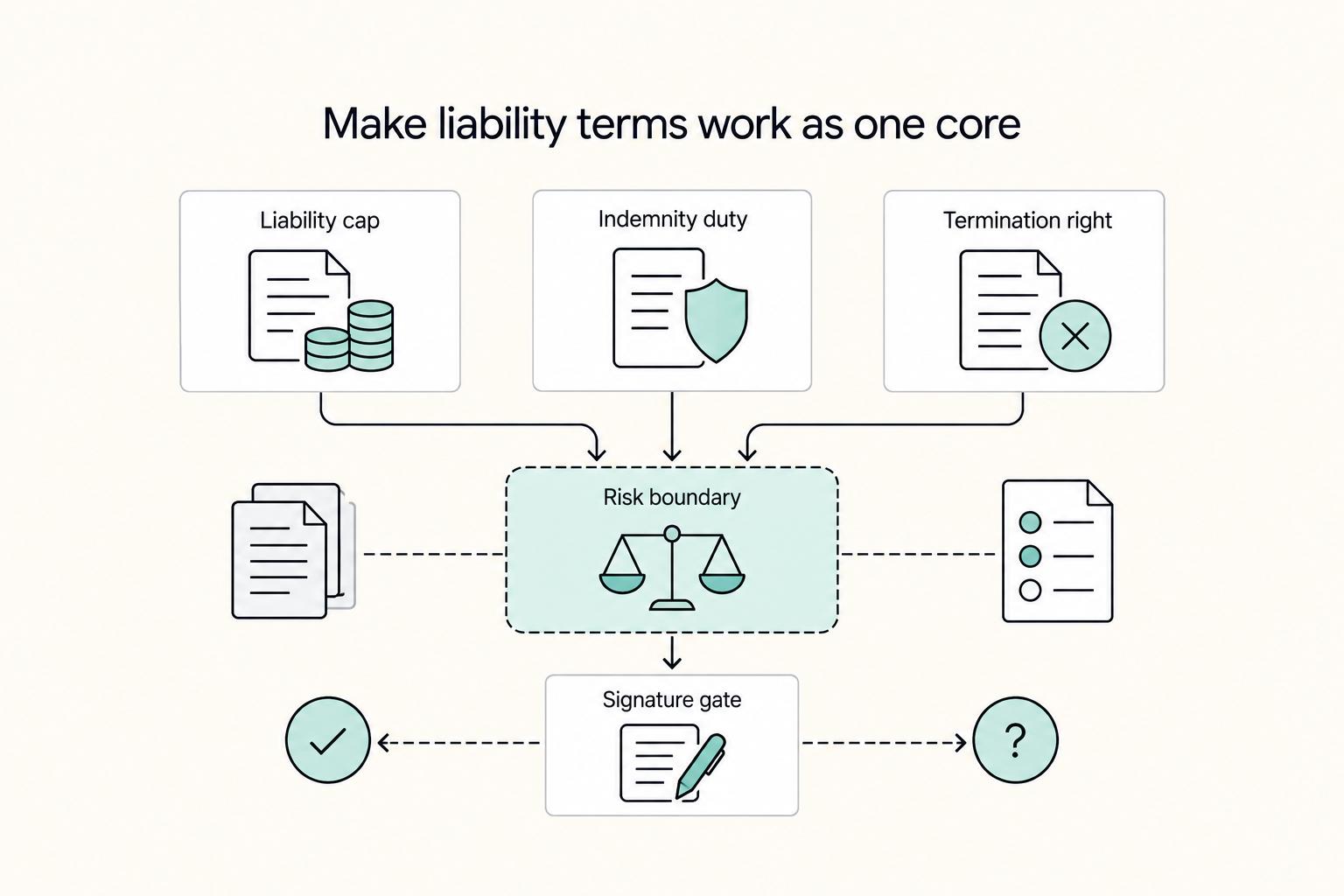
Do not rely on one clause alone. For pre-release access outside your organization, treat confidentiality, liability limits, and feedback ownership as the core set because they address different risks. Then confirm the agreement also states test duration, participant duties, feedback requirements, party roles, and termination conditions.
Is a simple NDA enough for beta testing?
Usually no. An NDA focuses on confidentiality, while a beta agreement should also define duration, responsibilities, feedback process, and termination. If access will run for a few weeks to several months, put those operating terms in writing.
Why shouldn’t I just use a free template I found online?
A free template can be a starting point, but it is risky if you do not verify the key terms. Review scope definitions, user duties, feedback ownership language, signatures, party roles, and feedback requirements before you use it. If those pieces are missing, edit the template or get legal review before launch.
Do I have to pay my beta testers?
Compensation terms should be stated explicitly in the agreement. Before signing, read the terms carefully to understand rights and obligations, and seek legal advice if payment obligations are unclear. In your final read, confirm scope, confidentiality, liability limits, feedback ownership, duty boundaries, duration, and termination.
Try a related tool
Researched and edited by the Gruv editorial team. Gruv builds cross-border billing, payouts, and finance-operations software for global businesses.
Sources
- cms.gov/medicare/quality-initiatives-patient-assessm...trusted
- consumer.ftc.gov/hiring-lawyertrusted
- ecfr.gov/current/title-16/chapter-I/subchapter-B/part...trusted
- ecfr.gov/current/title-15/subtitle-B/chapter-VII/subc...trusted
- ftc.gov/business-guidance/resources/consumer-reviews...trusted
- law.cornell.edu/uscode/text/18/1839trusted
- law.cornell.edu/uscode/text/17/204trusted
- oag.ca.gov/sites/all/files/agweb/pdfs/privacy/privacy_o...trusted
Educational content only. Not legal, tax, or financial advice.
Related Posts

Germany Freelance Visa Application Path for Freiberufler and Gewerbe
Choose your track before you collect documents. That first decision determines what your file needs to prove and which label should appear everywhere: `Freiberufler` for liberal-profession services, or `Selbständiger/Gewerbetreibender` for business and trade activity.
How to Create a Service Agreement for a SaaS Product
**Use a SaaS service agreement that locks payment, scope, and data duties early so you can close fast without absorbing hidden risk.**
How to Perform User Acceptance Testing (UAT) for a Mobile App
Use this escalation path: