
Quick Answer
An Agile SOW should control change by requiring every request to be logged, assessed for impact, and approved in writing before work starts. To reduce scope creep, define request, impact, and approval ownership up front, keep one shared change log and risk log, and align your clauses, pricing route, acceptance criteria, and signature method with the same recorded process.
Keep requests in writing and make approval ownership explicit#
Use this practical approach for change control in agile sow: keep requests in writing, record impact, and make approval ownership explicit before work starts. Think of it as an operational control to reduce confusion, not a legal standard.
| Role | Responsibility |
|---|---|
| Request owner | Logs the request and business intent. |
| Impact owner | Assesses delivery and transition impact. |
| Approval owner | Confirms the commercial or timeline decision in writing. |
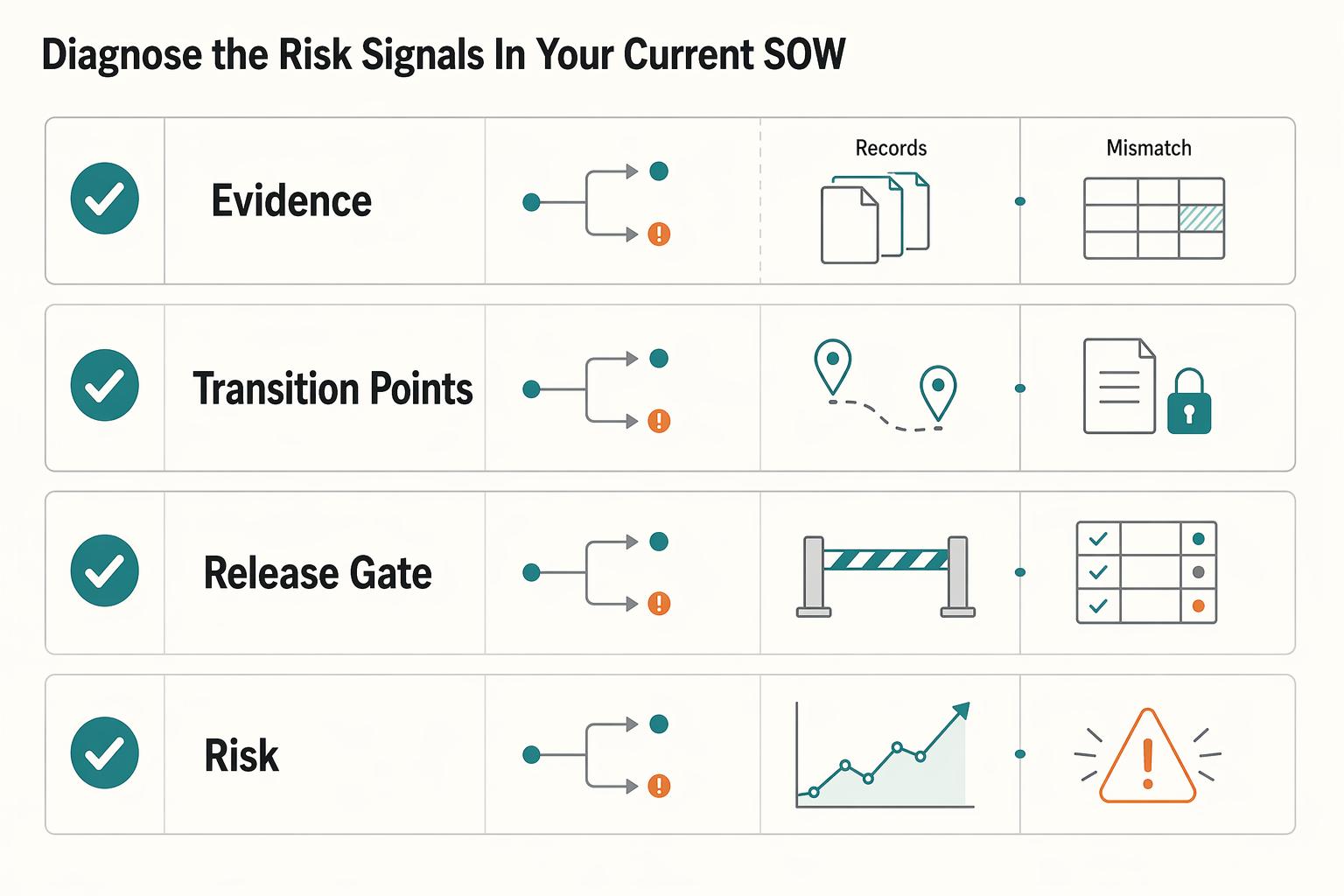
Step 1: Diagnose the risk signals in your current SOW#
If your current process shows these patterns, treat them as warning signs and tighten controls early.
| Risk signal in the SOW or workflow | Why it matters | Immediate contract/process action |
|---|---|---|
| Requests come through chat or email with no central record | Decisions and scope impact are hard to track later | Start a written risk/request log with requestor, date, impact summary, and status |
| Transition points are vague | Handoffs can create ownership gaps | Add a transition management checklist or template to your delivery process |
| Responsibility for request, assessment, and approval is unclear | Teams stall or make inconsistent decisions | Define these responsibilities in a simple RACI and keep it current |
| Risks are discussed only after work is under pressure | Management becomes reactive instead of early | Review the risk log regularly and escalate earlier |
Quick checkpoint: pull the last three "small asks" from a live project. If you cannot show where each one was recorded and resolved, your controls are probably too weak.
Step 2: Assign authority before the first disputed request arrives#
Role clarity is where many SOWs break down. A simple RACI matrix is usually enough if it is attached to the statement of work and maintained over time.
- Request owner: logs the request and business intent.
- Impact owner: assesses delivery and transition impact.
- Approval owner: confirms the commercial or timeline decision in writing.
If one person holds two roles, state that explicitly. Keep a risk log alongside the backlog so disputed items surface earlier, including when the project is already under stress.
Step 3: Process each request with a simple recorded check#
Use a lightweight internal check your team can apply consistently:
- Record the request. Capture what changed, who asked, and when.
- Record the impact. Note likely effects on timeline, budget, scope, and handoffs.
- Record the decision. Mark owner, status, and next action before work starts.
The core guardrails are simple: a maintained risk log, clear transition planning, and current role clarity in RACI.
If you want a deeper dive, read Germany Freelance Visa: A Step-by-Step Application Guide.
How to Build Your Contractual Shield: 4 Clauses Your SOW Must Have#
Do not paste a generic agile template into your SOW. Use four short clauses that match how requests are actually handled on this engagement. Agile models often describe ideal conditions; your contract should reflect the process you actually expect people to follow, with management-level support so it still holds under delivery pressure.
| Clause | What it should do | Key detail |
|---|---|---|
| Classification test | Use a working decision aid teams can apply consistently. | Test labels on recent requests and tighten any row that creates disagreement. |
| Formal change request clause | Keep the sequence explicit and auditable. | Changed work does not start from chat alone. |
| Commercial clause | Fit how the work really runs. | If changes are irregular and each spend decision needs explicit review, use a change-budget route; if the client buys fixed delivery capacity and accepts tradeoffs, use a capacity-based route. |
| Exclusions | Tie out-of-scope items to daily workflow. | If an excluded item is later requested, it must be logged, assessed, and accepted in writing before it becomes billable add-on work. |
- Define the classification test in a decision table.
Make this a working decision aid, not a vague "flexibility" paragraph. Use labels your team can apply consistently, then test them on recent requests and tighten any row that creates disagreement.
| Working label | Use when this is true | Evidence to attach | Approval field to complete | Commercial route to state | Example |
|---|---|---|---|---|---|
| Change candidate | Request appears to add outcome, dependency, or effort beyond what was already agreed | Request text, affected item, short impact note | Named approver field from your SOW | State the agreed path (for example: separate approval or reprioritization) | "Add CSV export for admin users." |
| Refinement candidate | Request appears to clarify an agreed item without changing outcome or effort | Existing item reference, clarification note | Named operational owner field | State it stays in current scope only if impact remains unchanged | "Confirm the text shown after a successful export." |
| Defect or rework candidate | Delivered result appears not to meet agreed acceptance | Failed test/issue link, acceptance reference | Named acceptance owner field | Route through the agreed defect/rework path | "Export file omits fields listed in acceptance criteria." |
- Write the formal change request clause as a checklist.
State clearly that changed work does not start from chat alone. Keep the sequence explicit and auditable:
- log intake (requestor, date, requested outcome, linked record)
- prepare impact assessment (scope, delivery effect, dependency/acceptance impact)
- route for approval, including any escalation point tied to an approval threshold set in the signed SOW
- record decision path (added budget or reprioritization)
- capture written acceptance using the engagement's signature method
- Choose the commercial clause that fits how the work really runs.
Pick the model based on operating reality, not theory. If changes are irregular and each spend decision needs explicit review, use a change-budget route; if the client buys fixed delivery capacity and accepts tradeoffs, use a capacity-based route. The key is to avoid a dogmatic model that looks agile on paper but fails in practice.
- Group exclusions and tie them to daily workflow.
Keep out-of-scope exclusions organized in a structure the team can use during delivery. Apply one rule consistently: if an excluded item is later requested, it must be logged, assessed, and accepted in writing before it becomes billable add-on work.
Final check: all four clauses should align with the same acceptance criteria, tracking records, and signature mechanics used across the SOW. If those systems do not align, commercial control usually fails during execution.
You might also find this useful: How Cloud Architects Structure an SOW for Multi-Cloud Migration.
Want a quick next step? Try the SOW generator.
The Commercial Engine: How to Price and Charge for Change#
Set the charging logic before signature, or change control becomes unpaid overflow. In practice, every new request should route to one of three outcomes: added budget, a formal reset, or a scope swap inside fixed capacity.
Step 1: Pick one primary model and name the approver#
Pick one primary model based on client behavior and decision speed, then name the approver and billing event in the SOW.
| Model | Best fit | Trigger condition | Estimation method | Approval step | Billing event | Client trade-off |
|---|---|---|---|---|---|---|
| Change budget | Requests are irregular and the client wants explicit spend decisions | Request is classified as a change and fits remaining budget | Use the same estimation method used in delivery | Named commercial approver accepts the impact note | Bill against pre-agreed budget; rate/pricing basis pending signed SOW confirmation | More control, more approval friction |
| Re-baselining | Approved changes are stacking up and the current baseline is no longer useful | Approval threshold set in the signed SOW is reached for single or cumulative approved changes | Re-estimate remaining backlog and assumptions | Formal written sign-off on revised baseline | Bill under revised SOW, change order, or updated milestone plan | More admin, cleaner reset |
| Capacity-based | Client buys fixed delivery capacity and can actively prioritize | New work is requested during fixed sprint or iteration capacity | Relative estimate tied to current capacity planning method | Product/backlog owner proposes swap; commercial approver confirms if capacity increases | Bill per sprint, iteration, or retained capacity block | Faster decisions, less scope certainty |
Step 2: Run re-baselining as an escalation workflow#
Run re-baselining as an escalation workflow, not a vague "review right." Until the approval threshold is verified against the signed SOW, mark the trigger as approval threshold pending contract verification; once confirmed, use that trigger to pause discretionary new change work, re-estimate remaining scope, issue a versioned baseline summary, and resume only after written sign-off. Keep one running log of approved adds, swaps, and withdrawals against the active baseline so disputes can be resolved from the same record.
Step 3: Protect margin by hardening backlog governance#
In capacity-based delivery, protect margin by hardening backlog governance. A new item enters only if comparable estimated effort exits, carryover handling is stated in advance, and sprint acceptance is limited to the committed sprint scope.
| Model | Predictability | Admin overhead | Margin protection | Client maturity required |
|---|---|---|---|---|
| Change budget | Medium | Medium | Medium | Low to medium |
| Re-baselining | High after reset | High | High | Medium |
| Capacity-based | High for your time, variable for scope | Medium | High if swap rules hold | High |
Red flag: if the client expects unlimited reprioritization but rejects both swaps and re-baselining, the issue is commercial terms, not agile process. Fix that before work starts.
Related: The Best Bank Accounts for Freelancers in Spain.
End every request as a visible decision with a named owner#
Communication is the control layer for your change process. Every request should end as a visible decision, with a named owner, recorded impact, and written confirmation before it moves into committed work.
| Phase | What to include |
|---|---|
| Pre-read | Current change-log snapshot; running total of approved adds, swaps, and withdrawn items against the current baseline; items nearing the escalation threshold set in the signed SOW; requests that need a client decision now. |
| Decision checkpoints | Confirm completed work and acceptance status; review pending and approved changes; confirm next priorities under the agreed commercial model. |
| Post-meeting confirmation | Send a short decision memo with what changed, commercial impact, acceptance impact, next action owner, approval state, and evidence link. |
Agile is a spectrum, not a free pass. If outputs are already clear and requirements are expected to stay stable, repeated "we're being agile" requests usually signal that you need tighter decision controls, not looser ones.
Step 1: Use one shared change log as an audit trail#
Use one shared change log as an audit trail, not a notes doc. Keep the format consistent so decisions are easy to verify later.
| Field | Why it exists |
|---|---|
| Request ID | Prevents ambiguity across threads and meetings |
| Date raised | Preserves sequence and timing |
| Requester | Shows who initiated the change |
| Change summary | States what is being asked |
| Affected scope item | Ties the request to backlog/acceptance scope |
| Impact note | Captures expected delivery/commercial effect |
| Decision owner | Names who must decide |
| Evidence link | Points to ticket/email/message confirming the decision |
| Current status | Shows where the request is in the flow |
| Final disposition | Records the outcome |
Use explicit status transitions so everyone reads the log the same way. Example set: raised, under review, approved, approved with swap, deferred, declined, withdrawn.
Step 2: Run sprint review as a decision cadence#
Run sprint review as a decision cadence, not just a demo.
Pre-read (sent before meeting):
- Current change-log snapshot
- Running total of approved adds, swaps, and withdrawn items against the current baseline
- Items nearing the escalation threshold set in the signed SOW
- Requests that need a client decision now
Decision checkpoints in meeting:
- Confirm completed work and acceptance status.
- Review pending and approved changes.
- Confirm next priorities under the agreed commercial model.
Post-meeting confirmation:
- Send a short decision memo with:
- what changed * commercial impact * acceptance impact * next action owner * approval state and evidence link
House rule: only written approvals move scope into committed work. Verbal alignment stays pending until confirmed in writing.
Step 3: Use consistent response scripts for each request size#
Use consistent response scripts so you stay collaborative without losing control.
| Request size | Recommended response | Tradeoff made explicit |
|---|---|---|
| Minor | "We can review this as refinement. If it does not change acceptance, timeline, or displace committed work, I'll log it and confirm whether it stays in current scope." | No automatic promise to build |
| Moderate | "We can include this by swapping an item of similar effort, or queue it for next planning cycle. Please choose which priority moves." | Scope stays fixed unless something leaves |
| Major | "This changes scope enough that we should re-estimate before starting. Let's confirm the escalation threshold in the signed SOW before re-baselining." | Speed holds only if baseline/budget/timeline is adjusted |
One risk to call out early: some agile projects have real employee or customer impact without a dedicated change manager. If that applies, name who owns rollout communication, training, and stakeholder handling in your memo. If no owner is named, do not let delivery absorb that work by default.
For a step-by-step walkthrough, see How to Write a Freelance Change Order That Holds Up in Practice.
Conclusion: Take Control of the Change#
If your clauses, charging model, and log are already live, the last job is disciplined execution. The point of change control in agile sow is not to make delivery rigid. It is to turn new requests into visible decisions so flexibility does not quietly become unpriced work, disputed scope, or weak records later.
A useful operating lens:
- Contractual Baseline: define what is currently in scope and how changes are reviewed.
- Commercial Logic: clarify what happens financially when work is absorbed, swapped, deferred, or priced separately.
- Communication Habit: log requests consistently and tie decisions to a named approver and written record.
That direction is also consistent with the available evidence. A March 2022 qualitative study based on 30 expert interviews in Germany found that agility can help in dynamic environments, especially through iteration, experimentation, and self-organisation. It also notes agile change management can make sense in more conventional, hierarchical organizations. The key caution is that fit is context-specific, so avoid copying another team's process without checking your own constraints.
Use a simple triage heuristic at the point of request. Treat it as refinement when it appears to stay within what was agreed. Route it to a formal change discussion when it appears to affect scope, assumptions, dependencies, timing, or commercial impact. If classification is unclear and impact could be material, align in writing before you proceed with high-impact implementation.
| Trigger | Suggested Action | Evidence to Record |
|---|---|---|
| Clarification appears within agreed scope | Treat as refinement | Short note on why it stayed in scope |
| Request appears to affect scope, timing, or cost | Open a formal change request/discussion | Impact note, estimate, named approver |
| Classification unclear and impact may be material | Scope first; hold high-impact implementation until alignment is documented | Decision note, message trail, current status |
Done well, this is what makes you a strategic partner rather than a reactive vendor. You protect delivery by keeping decisions traceable and reducing avoidable scope disputes.
We covered this in detail in A Guide to the Statement of Work (SOW) for a SaaS Development Project.
Frequently Asked Questions
Draft the rule so decisions are repeatable
How do you write a change control clause for an Agile SOW?
Write the change process clearly in the SOW so decisions can be made from the document, not memory. The grounding supports clarity, completeness, and enforceability as the core standard. What should be included in an Agile SOW?
At minimum, treat the SOW as a formal project document with clearly defined scope and change handling. Practical drafting checklists can help; the source includes a 12-step framework for writing an effective SOW. How do you prevent scope creep without slowing delivery?
Make changes explicit and documented, and avoid ad hoc handling. The source flags common SOW mistakes and fixes, which is a good signal to formalize how change requests are captured and resolved.
Match the charging model to the kind of uncertainty
How do you charge for changes in an Agile project?
Keep the commercial handling explicit in the SOW so approvals and outcomes are clear before work proceeds. Agile SOW vs fixed price SOW: which is safer?
Safety depends on how clear and enforceable the SOW is and how well change handling is defined.
Classify disputes with evidence, not opinion
How do I tell a bug from a change?
Do not assume a legal or universal definition applies to that distinction. Use the definitions and acceptance language written in your own contract set, and apply them consistently. What makes an Agile SOW safer in cross-border work?
Do not assume jurisdiction-specific legal guidance applies. For cross-border risk, use local legal review rather than assuming one template applies everywhere. What should I verify before implementing this process?
Use this short checkpoint list before kickoff: Clarity: The SOW is clear enough that decisions are document-based, not memory-based.. Completeness: Scope and change handling are written as part of a formal project document.. Enforceability: Drafting aims for a clear, complete, and enforceable SOW.. Quality control: You run a checklist-based review (the source references a 12-step approach) and check for common SOW mistakes.
Try a related tool
Researched and edited by the Gruv editorial team. Gruv builds cross-border billing, payouts, and finance-operations software for global businesses.
Sources
Includes 2 external sources outside the trusted-domain allowlist.
- commerce.gov/sites/default/files/2024-09/DOC-OAM%20Agile%...trusted
- gao.gov/assets/d24105506.pdftrusted
- michigan.gov/-/media/Project/Websites/dtmb/Procurement/Co...trusted
- michigan.gov/dtmb/-/media/Project/Websites/dtmb/Procureme...trusted
- minds.wisconsin.edu/bitstream/handle/1793/95296/2025Hedges%2C%20...trusted
- pmc.ncbi.nlm.nih.gov/articles/PMC8021201trusted
- agilealliance.org/wp-content/uploads/2018/12/08.031.17-Agile-P...external
- agileengine.com/how-to-build-and-manage-a-dedicated-software...external
Educational content only. Not legal, tax, or financial advice.
Related Posts

Germany Freelance Visa Application Path for Freiberufler and Gewerbe
Choose your track before you collect documents. That first decision determines what your file needs to prove and which label should appear everywhere: `Freiberufler` for liberal-profession services, or `Selbständiger/Gewerbetreibender` for business and trade activity.
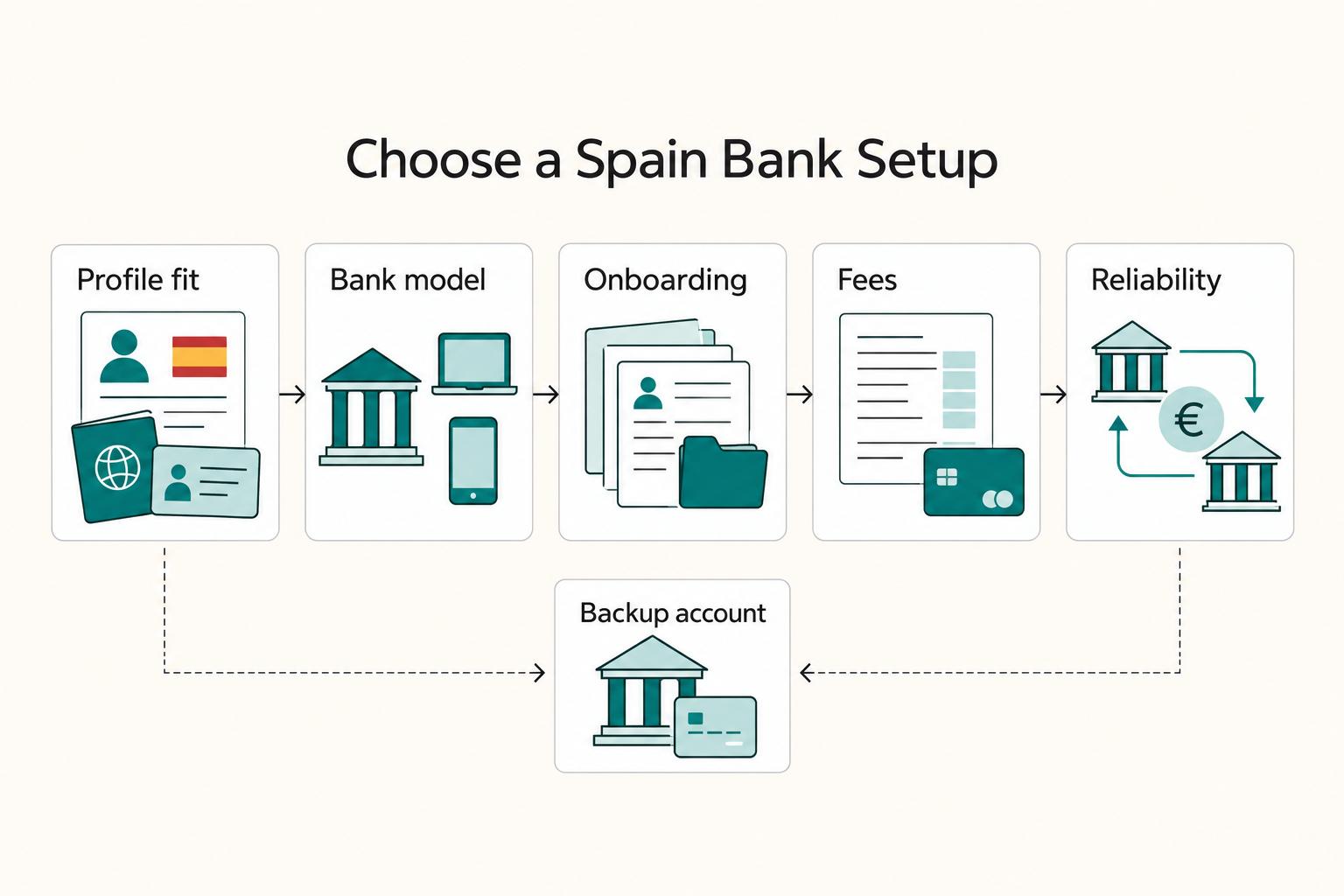
Freelancer Bank Accounts in Spain: Choosing a Primary and Backup Setup
Choose your setup as a risk decision, not a brand ranking. Pick one primary account for daily inflows and keep one backup account active in the same planning session.

The Freelance Payment Penalty: A Modeled Audit of Platform Fees, FX Spreads, and Payout Delays
The money rarely disappears through a single, easy-to-spot fee. The real loss is stacked. A marketplace takes its commission, a processor adds a charge for international cards, a bank or payment company converts the currency at a spread, a platform holds the funds before release, and a wire sheds a little to intermediaries on the way in. Each layer looks defensible on its own, but the worker feels the combined result as a smaller deposit and a later payday.