
Quick Answer
Use a fixed operating sequence: set 1-3 daily goals, assign dated calendar blocks, and end with a shutdown check that records visible proof of done. Keep the to-do list as backlog, not as your schedule. Then run a weekly review with one evidence pack so misses are caught early. When carryover repeats, reduce scope first and tighten accountability before adding new tactics.
Freelance motivation is an operations problem, not a personality test#
Step 1. Reframe the problem as business continuity. If you work for yourself, the goal is not to feel inspired every morning. The goal is to keep delivery quality steady when your energy, focus, or mood drops. For a freelancer or solopreneur, that means protecting core business outcomes: output consistent enough to ship, clear commitments you can meet, and client confidence that your work habits are dependable.
That framing matters because freelancing does not come with the built-in oversight of a normal employee setup. One research definition describes it as self-employed work "not committed to a specific employer for a long term," often organized around projects or tasks. Another study of online freelancing describes careers built through "project or task based engagements across multiple organizations." When work is structured that way, motivation stops being only a private feelings issue. It affects whether the work gets finished, delivered, and paid.
Verification point: if you judge your week by how motivated you felt, you are measuring the wrong thing. A better check is simpler: what did you commit to, what shipped, and what slipped?
Step 2. Accept the overhead that replaces a manager. Once external oversight disappears, you have to replace it with deliberate self-discipline and visible operating habits. The December 2020 CMU longitudinal paper is useful here because it does not treat freelance consistency as a personality trait. It describes "financial, emotional, relational and reputational burdens" as part of the overhead of maintaining a freelancing career, and notes that this overhead shaped how freelancers participated over time.
That is why waiting to "want to work" is a weak control method. In project-based work, payment may be tied to completing the task or project. If your process depends on motivation showing up first, low-energy days create delivery and communication risk. The failure mode is not laziness. It is having no replacement for the structure a manager, office cadence, or team deadline used to provide.
Step 3. Define success as repeatable habits, not heroic effort. The shift is simple: self-motivation can start the work, but explicit structure keeps it moving. You are building routines that make action more likely even when enthusiasm is missing. That includes clear commitments, a visible calendar, and a way to confirm what got done at the end of the day.
A practical rule for the rest of this guide: do not design around your best days. Design around ordinary days and rough days. If a habit only works when you feel sharp and excited, it is not reliable enough for client work. If a habit still produces a finished draft, sent invoice, or delivered revision on a flat day, keep it.
Checkpoint: write down one sentence before you continue: "My job is to produce reliable client outcomes, not to pass a personality test." That is the standard the rest of this article builds on.
You might also find this useful: How to Deal with Imposter Syndrome as a Freelancer.
What to prepare before you change your routine#
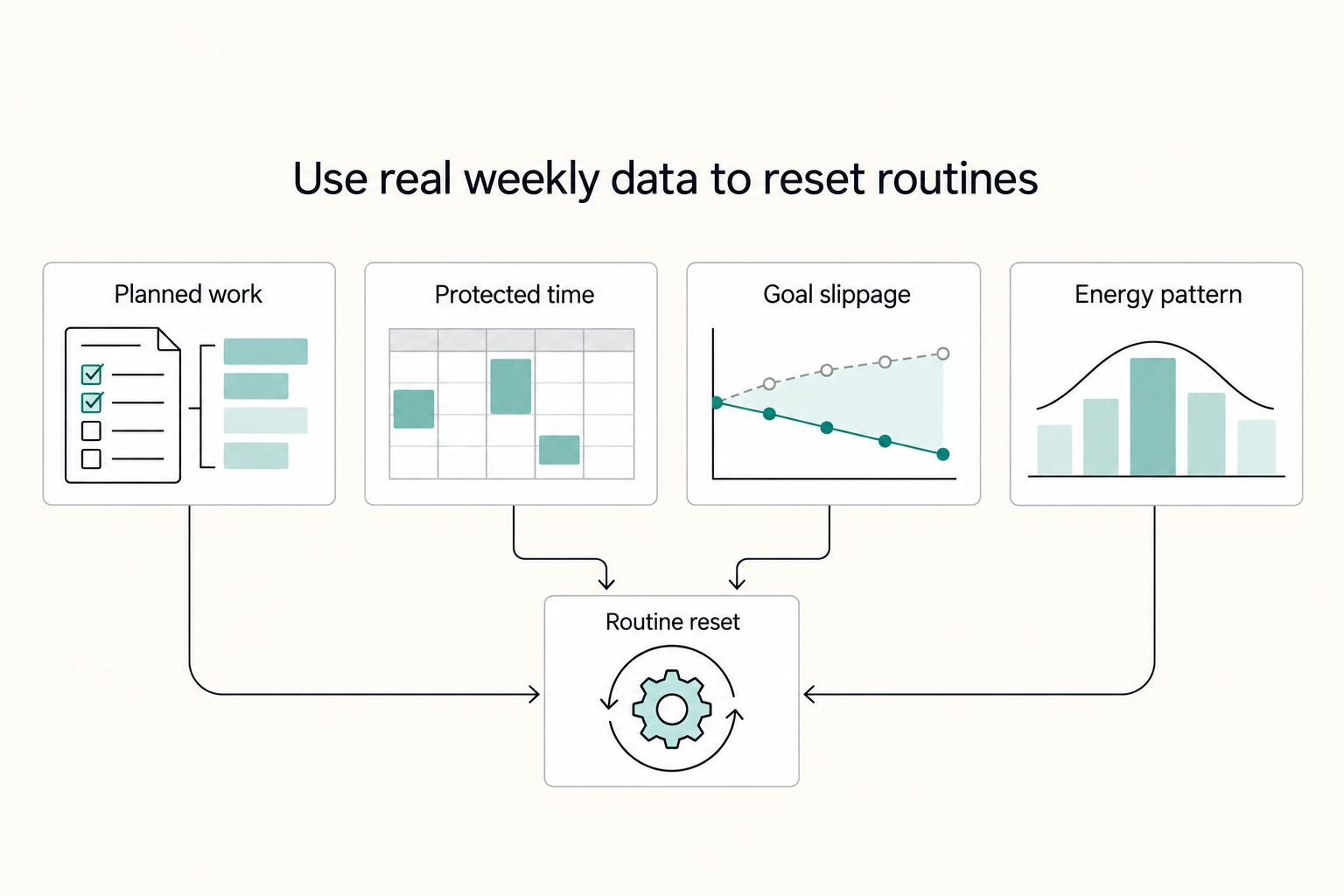
Start with one week of real data before you change anything. Do not redesign from memory or from one bad day. Compare what you planned, what your calendar actually protected, and where daily goals slipped.
| Preparation item | What to use | Purpose |
|---|---|---|
| Reality data | Current to-do list, calendar, and a short log of missed daily goals | Compare what you planned, what your calendar protected, and where daily goals slipped |
| Primary planning surface | Calendar for real commitments; to-do list as backlog only | Separate ideas from committed work |
| Accountability protocol | A peer check-in, end-of-day proof of work, or a public commitment | Set external accountability before motivation drops |
Step 1. Gather one week of reality data. Put three items side by side: your current to-do list, your calendar, and a short log of missed daily goals. Look for mismatch, not perfection. If tasks stayed on the list without calendar time, or blocks passed without clear output, you have a concrete planning problem to fix.
Step 2. Choose one primary planning surface. Use your calendar for real commitments and keep your to-do list as backlog only. This is not a claim that calendar blocking is always superior; it is a way to separate ideas from committed work. If a task matters this week, give it protected calendar time and treat that block as non-negotiable.
Step 3. Lock one accountability protocol before you optimize. Pick one now: a peer check-in, end-of-day proof of work, or a public commitment. Set external accountability before motivation drops, not after. Keep the check concrete, such as a sent draft, delivered revision, invoice, or screenshot of completed blocks.
This pairs well with our guide on Performance Reviews for Remote Employees When You Work as a Contractor.
Turn intrinsic drive into hard commitments#
Treat motivation as a planning input, not a feeling to wait for. In freelance work, you often have less day-to-day external pressure, so execution improves when you pair intrinsic and extrinsic motivators on purpose.
Step 1 Attach two reasons to each priority task#
Attach two reasons to each priority task: one internal, one external. Intrinsic motivators are your interests and what you enjoy; extrinsic motivators come from outside you, like deadlines, financial pressure, or recognition.
Use both on the same task. Meaning without a deadline often drifts, and pressure without a personal reason usually creates more resistance.
Step 2 Set non-negotiable weekly outcomes and date them#
Set exactly 3 non-negotiable weekly outcomes, then place them as dated daily goals in your calendar. Keep each one outcome-based, not effort-based: "Send homepage draft to client" is stronger than "Work on homepage."
For each outcome, define:
- calendar block(s)
- a due date inside the week
- proof of done
Make proof visible and binary, such as a sent draft, delivered revision, uploaded file, or issued invoice.
Step 3 Give every task an owner, deadline, and proof of done#
Apply one rule to every task: if it has no owner, deadline, and proof of done, it is not a commitment yet. In a solo business, the owner is usually you, but naming it still keeps vague work from hiding responsibility.
Items like "research ideas," "improve portfolio," or "make progress" stay in backlog form until you convert them into a real commitment.
Need the full breakdown? Read Why High-Earners Choose Freelancing for the Autonomy Premium.
Build a daily execution system that still works on low-motivation days#
Treat daily execution as a system, not a mood. Once weekly outcomes are set, use the same order every day: pick 1 to 3 priorities, calendar-block them, execute in protected focus time, then close with a short shutdown review.
Step 1: Set 1 to 3 daily goals before reactive work. Pull them from your weekly outcomes and define proof of done for each one: sent draft, delivered files, submitted revision, issued invoice. If a goal does not have a clear end product, it is not ready for today.
Step 2: Put priorities on the calendar, not only on a to-do list. Use the to-do list as storage, and use your calendar as commitment. Protect work blocks the way you protect client calls.
Use one Focus window for deep work that ships output, and group calls and admin into a Buffer block so fragmented tasks do not consume the whole day.
| Decision point | Calendar blocking | To-do list |
|---|---|---|
| Commitment clarity | Work is tied to a specific time slot | Tasks are captured, but timing stays ambiguous |
| Overbooking risk | Time conflicts show up quickly | Work can pile up without time limits |
| Completion evidence | You can compare planned blocks vs shipped work | You mostly see intent, not protected execution time |
Step 3: Run two day modes. Use standard mode on normal days (full plan), and low-energy mode on rough days (one core deliverable, minimum viable progress). The goal is to avoid zero-output days when your motivation drops.
At midday, mark the day as on track or off track. If you are off track, cut secondary tasks and protect one remaining deliverable.
Step 4: End with a shutdown review and strict carryover. Log what shipped, what slipped, and what moves forward. Keep carryover tight: one priority rolls to tomorrow, and the rest returns to backlog or gets explicitly rescheduled.
If you catch yourself overplanning without shipping, recover with one rule: send or publish one completed deliverable before reorganizing tomorrow. Consistency is what makes the system work.
Run a weekly review that replaces a manager#
Run your weekly review like a performance review: compare what you planned, what shipped, what slipped, and why. The goal is to make schedule reliability visible so you can correct it early.
Step 1. Build a small evidence pack. Review the week you actually ran, not the one you intended. Keep proof you can verify quickly:
- planned calendar blocks
- completed outputs sent
- misses with one root cause each
- next-week priorities
If you cannot show what was committed and what was delivered without relying on memory, you are reviewing impressions, not performance.
| Indicator you score | What to count | What it tells you |
|---|---|---|
| Planned blocks completed | Blocks you actually used as planned | Whether your calendar is realistic |
| Deliverables sent | Drafts, revisions, files, proposals, invoices, published work | Whether time became client-visible output |
| Accountability protocol followed | Required check-ins or proof-of-work updates completed | Whether your oversight system is actually enforced |
Step 2. Score only what you control. Grade leading indicators, not mood or how busy you felt: blocks completed, deliverables sent, and protocol adherence. In the remote-freelancer example with 15-20 part-time contributors, the operational issue was timeliness, not effort; planning depended on predictable delivery.
If your commitment has a known workload, verify that your calendar contains that capacity. In the same example, one monthly output was estimated at about 20 hours, so missed delivery can start with planning, not just execution.
Step 3. Use strict decision rules. Apply the same rules every week:
- if the same item carries over for two weeks, reduce scope
- if overload persists, cut commitments before adding tools
- if a deadline slips, log one primary cause, not a long defense
Treat repeated carryover as an early warning, not something to explain away after work is already two weeks late.
Step 4. Tighten accountability when timing slips. When deadlines keep moving, strengthen consequences, incentives, or both. The core principle is simple: on-time work improves when timing has real stakes. Even a clear deadline incentive (for example, a bonus tied to delivery by the 20th of the month) works better than vague intentions.
Step 5. Leave with a next-week brief you can run. Your review is done only when Monday is clear at a glance: what matters first, what must ship, and what changed based on last week's misses. If that brief is practical, your weekly review is replacing the manager effectively.
For a step-by-step walkthrough, see How to Conduct a Weekly Review for Your Freelance Business.
Choose accountability and support structures that fit your work style#
Choose one primary support structure that matches your main failure pattern, then run it consistently: one scheduled weekly accountability touchpoint plus one midweek progress check.
Step 1 Match the structure to the real risk#
Start with the pattern, not the tool.
- Isolation risk: use social cadence (for example, a peer call, small creator group, or recurring coworking session).
- Procrastination risk: use deadline accountability with a clear date for visible progress.
- Perfectionism risk: use shipping pressure where "draft sent" beats "still polishing."
This match matters. If the support does not fit the risk, it turns into activity without output. Isolation can also build slowly: one freelancer anecdote describes loneliness becoming noticeable after about 6 months of working alone.
Step 2 Choose one primary format#
Use one main format first so you can tell what is helping.
| Primary structure | Best fit when | Watch out for |
|---|---|---|
| Peer partner | You want direct accountability with low overhead | Check-ins that do not require proof of work |
| Small creator group | You want social momentum | Discussion replacing shipping |
| Structured coworking cadence | You want a consistent external work session | Session time drifting away from planned work |
If you need more structure, accountability coaching is positioned around clarity, consistency, and follow-through, and facilitated accountability groups are the group-based alternative. These formats are presented for entrepreneurs and freelancers who need structure and focus.
Step 3 Put cadence and proof in writing#
A support structure works when cadence and evidence are explicit.
- Weekly touchpoint: what shipped, what slipped, and next commitments.
- Midweek check: on track or off track, one blocker, next visible deliverable.
- Proof standard: sent draft, link, screenshot, file, or short progress note.
Use one adjustment rule: if you keep missing deadlines alone, increase external accountability. If meetings are consuming build time, reduce live touchpoints and protect deep-work blocks.
We covered this in detail in How to Manage Multiple Freelance Projects Without Losing Your Mind.
Balance workload to protect motivation over months, not days#
Protect long-term motivation by controlling workload, not by extending your hours. If quality slips, reduce active commitments first. Over-demanding work and poor work-life balance are both linked to burnout risk.
Step 1. Block three workload bands into your calendar. Use calendar blocking to protect all three bands each week: committed client work, growth and admin work, and recovery time.
- Committed client work: deadlines, revisions, calls, and delivery
- Growth/admin work: proposals, invoicing, portfolio updates, outreach, and skill-building
- Recovery time: real breaks, lighter days, or a clear stop time
Check your calendar during your weekly review. If one band is missing, rebalance before the week starts. A cited 2022 finding reported that 74% of freelancers said freelancing gave them greater life control and improved work-life balance, but that control depends on boundaries you actually protect.
Step 2. Reduce commitments when quality drops. When output quality falls, treat it as a capacity signal. Pause new outreach, defer nonessential admin, or reduce concurrent projects before adding more hours. This protects delivery reliability and self-motivation better than trying to push through with longer days.
Step 3. Tie rewards and growth to shipped work. Use a reward loop tied to shipped outcomes, not busywork. Reward concrete progress such as a delivered draft, sent invoice, submitted proposal, or completed revision. Keep a recurring skill-growth block as well. Work that stays aligned with your values is more likely to support motivation over time, which helps keep intrinsic motivation active.
Related reading: Building a Portfolio Career With Multiple Freelance Income Streams.
Common motivation failure modes and how to recover fast#
When motivation drops, treat it as an operating problem first. Freelancers are described as just as vulnerable to burnout as office workers, and pressure often comes from long workdays, weak work-life balance, unstable income, and lack of structure.
| Failure mode | Immediate move | Grounded detail |
|---|---|---|
| Endless planning in the to-do list | Move priorities into dated blocks | Keep the to-do list as storage and move only top priorities into dated calendar blocks for the next few days |
| Isolation spiral for the solopreneur | Add contact within 48 hours | Book one coworking space session and one support call within 48 hours |
| Daily goals keep rolling over | Cut scope by half for one week | Rebuild only after a clean weekly review shows you finished what you planned |
| Accountability drift | Require visible proof at a fixed time | Use concrete outputs such as a sent draft, submitted proposal, invoice, published update, or finished deliverable screenshot |
- Endless planning in the to-do list: move priorities into dated blocks.
If your backlog is doing the job of a schedule, motivation usually falls. Keep the to-do list as storage, move only top priorities into dated calendar blocks for the next few days, and defer or delete the rest. If a task has no date, it is not competing for today.
- Isolation spiral for the solopreneur: add contact within 48 hours.
When you work alone, delay can turn into drift quickly. Book one coworking space session and one support call within 48 hours to restore momentum and perspective. Treat this as a practical intervention, not a research-backed threshold.
- Daily goals keep rolling over: cut scope by half for one week.
Repeated rollover is usually a load or planning issue, not a character flaw. Cut scope by half for one week, then rebuild only after a clean weekly review shows you finished what you planned. If completion does not improve, remove optional admin and low-value extras before touching client delivery.
- Accountability drift: require visible proof at a fixed time.
If check-ins are vague or late, tighten your accountability protocol until proof is unavoidable. Use concrete outputs at a fixed time: sent draft, submitted proposal, invoice, published update, or a finished deliverable screenshot. When 43% report fatigue from overly long workdays and 64% report work-life balance strain, weak structure is a risk signal, not just a bad day.
Your copy-paste checklist for the next 14 days#
Use this as a practical operating template for the next two weeks: keep routines clear, keep scope realistic, and make output visible so work does not drift into long days with little to show.
| Checklist item | Core action | Check or flag |
|---|---|---|
| Define three weekly outcomes | Turn each into dated daily goals with clear proof of done | By Monday morning, each outcome appears in at least one dated block |
| Block commitments, not backlog | Put time-specific commitments on your calendar and keep your to-do list as backlog storage | Red flag: your list grows while your calendar stays vague |
| Run a noon check every workday | Ask what has started, what can still ship today, and what should be cut | Recovery move: use one 30-minute reset block to finish or send one concrete piece of work |
| Run a shutdown check every workday | Log what shipped, what rolled over, and why, with one visible proof of done | Failure mode: ending with "I worked all day" but no clear output |
| Hold one weekly review with a short performance note | Compare planned calendar blocks vs. completed outputs | Decision rule: if the same carryover repeats, reduce scope before adding more tactics |
| Keep one accountability protocol and one support touchpoint active | Choose one way to stay accountable and one recurring support check-in, then schedule both now | Check: both are on your calendar, not just intentions |
| Use low-energy mode instead of zero-output days | Keep one must-do block, one admin block, and one shutdown note on rough days | If misses stack up: adjust the system and commitments early |
- Define three weekly outcomes. Pick three results for the week, then turn each into dated daily goals with clear proof of done, for example: sent draft, submitted proposal, or invoice sent.
Check: by Monday morning, each outcome appears in at least one dated block.
- Block commitments, not backlog. Put time-specific commitments on your calendar, and keep your to-do list as backlog storage.
Red flag: your list grows while your calendar stays vague.
- Run a noon check every workday. Ask: What has started? What can still ship today? What should be cut? If the plan is slipping, reduce scope early.
Recovery move: use one 30-minute reset block to finish or send one concrete piece of work.
- Run a shutdown check every workday. Log what shipped, what rolled over, and why, with one visible proof of done.
Failure mode: ending with "I worked all day" but no clear output.
- Hold one weekly review with a short performance note. Compare planned calendar blocks vs. completed outputs, then note what you planned, what shipped, what slipped, and the main reason.
Decision rule: if the same carryover repeats, reduce scope before adding more tactics.
- Keep one accountability protocol and one support touchpoint active. Choose one way to stay accountable and one recurring support check-in, then schedule both now.
Check: both are on your calendar, not just intentions.
- Use low-energy mode instead of zero-output days. On rough days, keep one must-do block, one admin block, and one shutdown note so momentum continues without overload.
If misses stack up: adjust the system and commitments early.
Bottom line: treat motivation like an operating system, not a mood. Start with three weekly outcomes, run your daily blocks, and review weekly using visible proof. For your next step, pair this checklist with How to Conduct a Weekly Review for Your Freelance Business and Create a Quarterly CEO Day for Your Freelance Business.
Frequently Asked Questions
How do I stay motivated as a freelancer every day?
Set one dated work block and one concrete definition of done before the day starts. Treat motivation as a system input and ship at least one visible output.
What usually causes motivation loss when you work for yourself?
The common failure mode is weak structure: no real schedule, vague priorities, and no shipping checkpoint. Fix structure before treating this as a discipline-only problem.
What is the difference between intrinsic and extrinsic motivation in freelance work?
Intrinsic motivation comes from meaning and interest. Extrinsic motivation comes from deadlines, payment timing, and consequences. Reliable output usually needs both.
Is calendar blocking better than a to-do list for freelancers?
They serve different jobs: calendar blocks protect committed execution time, while a to-do list holds backlog. Problems start when backlog is mistaken for a schedule.
Try a related tool
Researched and edited by the Gruv editorial team. Gruv builds cross-border billing, payouts, and finance-operations software for global businesses.
Sources
- commons.lib.jmu.edu/cgi/viewcontent.cgitrusted
- cs.arizona.edu/~mercer/Projects/BoggleWordstrusted
- cs.cmu.edu/~chinmayk/assets/pdfs/Careers_online_freelan...trusted
- govinfo.gov/content/pkg/GPO-CRECB-1970-pt24/pdf/GPO-CREC...trusted
- grants-neubauercollegium.uchicago.edu/About/uploaded-files/HomePages/Freelancing%2...trusted
- pmc.ncbi.nlm.nih.gov/articles/PMC10019407trusted
- pmc.ncbi.nlm.nih.gov/articles/PMC9086129trusted
- sites.uab.edu/richter/files/2026/03/SPSP-2026-Convention-P...trusted
Educational content only. Not legal, tax, or financial advice.
Related Posts

How to Learn a New Language as a Digital Nomad
If you want to **learn language while traveling** without winging it, aim for reliability before fluency. Your first job is not to sound impressive. It is to get through early daily interactions when the conversation speeds up and reading skills stop helping.

The Freelance Payment Penalty: A Modeled Audit of Platform Fees, FX Spreads, and Payout Delays
The money rarely disappears through a single, easy-to-spot fee. The real loss is stacked. A marketplace takes its commission, a processor adds a charge for international cards, a bank or payment company converts the currency at a spread, a platform holds the funds before release, and a wire sheds a little to intermediaries on the way in. Each layer looks defensible on its own, but the worker feels the combined result as a smaller deposit and a later payday.

How to Respond to a Subpoena for Business Records
Move fast, but do not produce records on instinct. If you need to **respond to a subpoena for business records**, your immediate job is to control deadlines, preserve records, and make any later production defensible.