
Quick Answer
Yes. Start by writing a one-page offer and agreeing a prepaid launch sequence: scope approved, agreement signed, invoice or deposit paid, then kickoff. In the U.S., net self-employment earnings of $400 can trigger filing, so keep invoices, receipts, and payment confirmations from your first project. If you are a minor, verify signer authority in your state and involve a parent or guardian when required before contracts, banking, or entity filings.
Run Your Week in Three Lanes: Strategy, Cash, and Execution#
Operate like a CEO by running your week in three lanes: strategy, cash control, and documented execution, all tied to a profit goal. If you are figuring out how to start a business as a teenager, this is the first shift that matters. Treat your work as a business asset, not a casual project.
Step 1. Set profit intent and a simple operating plan. The IRS distinguishes a business from a hobby by profit intent, and no single factor decides the outcome. Write a one-page plan you can use this week: what you sell, who it helps, how you deliver it, and how it makes money. Checkpoint: you can explain your offer in one sentence and show that plan.
Step 2. Run CEO, CFO, and COO roles every week. Even if you are the only person in the business, those three jobs still need attention. Role clarity keeps decision-making, money tracking, and delivery from slipping.
| Role | What you decide or do |
|---|---|
| CEO | Define service scope, target customer, pricing, and what you will not do. |
| CFO | Use a recordkeeping system that clearly shows income and expenses, and log transactions consistently. |
| COO | Document onboarding, delivery, revisions/approvals, and final handoff. |
Use an asset test on tasks: does this build repeatability, brand trust, or transferable process value? If not, it is probably busywork.
Step 3. Lock scope and communication before work starts. Set scope before work begins: goals, deadlines, deliverables, and what is out of scope. Share a simple scope statement early. For external work, convert it into a short SOW when needed. Plan communication early too: where updates happen, when they happen, and which decisions are documented in writing. Red flag: if "one more thing" falls outside scope, pause and update scope before continuing.
Step 4. Keep a fixed finance-and-decisions review routine. A weekly review is not legally required, but it is one of the simplest ways to stay in control. Review money in, money out, and whether your records are current enough to produce totals quickly. If net self-employment earnings are approaching $400, flag tax follow-up early. If estimated tax applies in your case, the usual U.S. calendar-year dates are April 15, June 15, Sept. 15, and Jan. 15 of the following year, adjusted for weekends and holidays. Checkpoint: you can pull current income and expense totals quickly, and your decisions live in one running log.
Define Your High-Value Offer#
Define your offer as one clear result for a specific buyer, not vague help for anyone. That makes demand, pricing, and buyer fit easier to judge.
Before You Start#
Write down your business goal and your assumptions first. Your goal can be as simple as getting your first paid client for a repeatable service. Your assumptions are what you still need to test, especially buyer need, pricing, and business model.
Step 1. Audit your usable skills#
Start with skills you can deliver now, with a clear handoff, without learning on the client's time. Focus on concrete tasks, not broad labels.
Instead of "marketing" or "design," define specific work such as:
- editing short testimonial videos
- improving product listings
- building a simple intake form
- formatting a sales deck
- turning meeting notes into clear summaries
- creating a basic monthly content calendar
Then connect each skill to a client problem. Clients usually care more about outcomes than broad task labels. Checkpoint: keep only the skills you can deliver consistently and tie to a business result.
Step 2. Frame value before price#
Do not lead with price if the value is still fuzzy. First, write a short value proposition that explains what you do and how you differ from alternatives. Include:
| Item | What to define |
|---|---|
| Problem | the problem you address |
| Buyer | the buyer you serve |
| Work | the work you deliver |
| Outcome | the outcome that should improve |
| Trust | why someone should trust you |
If your statement sounds like many other freelancers, narrow the buyer or the problem until it becomes specific.
Step 3. Validate a Minimum Viable Offer in the real world#
Validate early so you do not spend time building an offer that misses the market. Keep your Minimum Viable Offer narrow and specific.
Talk to people you can actually reach and who can give practical feedback, such as local business owners, creators, coaches, or other operators. Ask about one specific problem, how they handle it today, what is frustrating, and what would make your offer feel unclear or risky.
Collect feedback on:
- whether the problem is frequent
- how they solve it now
- what they dislike about current options
- whether your deliverable is useful
- whether your pricing and business model assumptions feel workable
After your first paid project, refine the offer using what actually happened: scope notes, client questions, revision patterns, time spent, final deliverables, and proof of outcome.
Step 4. Package the offer so clients can choose#
Package your service after early validation, once scope is clearer and delivery is easier to repeat.
| Package | Scope boundary | Revision expectation | Delivery cadence | Ideal client fit |
|---|---|---|---|---|
| Starter project | A defined problem with a clear endpoint | A limited feedback loop on the agreed deliverable | Single-project delivery on an agreed timeline | First-time buyers testing fit |
| Ongoing support | Repeatable work in a focused service area | Feedback handled in a recurring review routine | Recurring delivery on an agreed cadence | Clients with steady repeat needs |
| Premium build | Larger project with multiple parts and approvals | Revisions tied to milestones, not open-ended changes | Milestone-based delivery from kickoff to handoff | Clients needing broader coordination |
Use plain-English boundaries for every package: what is included, what is excluded, what counts as a revision, and what triggers a new quote. That is what keeps delivery predictable and protects your time as demand grows.
Run Operations So Every Payment and Deadline Has an Owner#
Once your offer is clear, your operations should make delivery predictable. Keep the setup short and repeatable so each payment, file, approval, and deadline has an owner and a record.
Step 1. Set up your minimum control layer#
Keep business transactions separate in your records and, when eligible, in an account the bank permits for your business activity. Before opening it, confirm the provider’s minimum age, account-holder and adult-authority requirements. A parent or guardian may need to participate, but the account and business records should identify who owns the business and earns the income.
Use any recordkeeping method that clearly shows income and expenses. A spreadsheet is fine if you keep it current. Record transactions daily where possible, and keep supporting documents such as invoices, receipts, paid bills, deposit slips, and proof of payment. Each record should show payee, amount, proof of payment, and date incurred.
Use a simple four-bucket money flow:
- Income in: client payments enter the approved account and are logged against the invoice.
- Expenses out: only business costs leave that account.
- Reserves: hold a buffer for refunds, slow pay, or renewals.
- Tax set-aside: move money from each payment so quarterly dates are funded.
If net self-employment earnings reach $400, filing is generally required. Estimated taxes may apply if you expect to owe at least $1,000 after withholding and credits. For U.S. calendar-year taxpayers, dates are typically April 15, June 15, September 15, and January 15 (of the following year). Check the current tax-year schedule for weekend and holiday adjustments; other filing requirements can apply below $400. For deeper tax workflow, see How to Handle Taxes for a Side Hustle.
Protect accounts and client data with passwords of at least 12 characters and multifactor authentication on email, storage, invoicing, and client portals.
| Setup | Invoicing method | Task tracking method | Client communication method | Best for | Main risk | What to verify |
|---|---|---|---|---|---|---|
| Lightweight | PDF invoices | Simple checklist | Email thread | First clients, low volume | Missed reminders and version drift | Daily records are current and files are backed up |
| Standard | Invoicing app | Task board | Email with status cadence | Ongoing recurring work | Data split across tools | Invoice status matches task status before work starts |
| Structured | Portal billing | Structured tracker | Shared portal + written updates | Larger projects, multiple stakeholders | Setup overhead | Access rules, MFA, and file naming are enforced |
Step 2. Move each client from inquiry to paid kickoff#
Run the same intake sequence every time. That consistency prevents a common failure mode: starting work before scope, payment, or access is settled.
| Stage | You own | Client owns | Exit rule |
|---|---|---|---|
| Inquiry | Qualify problem, outcome, and timeline | Share goals and constraints | Fit is confirmed |
| Scope | Send one deliverable, one timeline, one price, one revision rule | Approve scope | Written approval received |
| Agreement + invoice | Send agreement and first invoice | Sign and pay | Signed agreement + agreed kickoff payment received, or documented credit terms |
| Kickoff readiness | Confirm required files, access, and main contact | Provide assets/access and contact | All required assets are in hand |
| Kickoff | Confirm start and delivery rhythm | Attend kickoff and approvals | Work begins |
For a prepaid kickoff, complete four items before starting: signed agreement, agreed payment or deposit, required files or access, and one named client contact. If you agree to start on credit, record that arrangement and its due date in the agreement.
Step 3. Send invoices that can survive scrutiny#
Your invoice should work as both a payment request and a business record. Under the prepaid kickoff model above, agree and collect the kickoff payment or deposit before scheduling work. Net terms can apply to later milestone or balance invoices when agreed with the client. If you instead agree to start on credit, document that exception and its due date before kickoff. Set follow-up timing for each invoice’s actual terms:
| Payment term | Follow-up timing |
|---|---|
| Due upon receipt | Check the next business day |
| Net 30 | Send reminders before the due date, on the due date, and after the invoice becomes overdue |
| Net 60 | Send reminders before the due date, on the due date, and after the invoice becomes overdue |
| Net 90 | Send reminders before the due date, on the due date, and after the invoice becomes overdue |
Then make sure each invoice includes:
- client/payee identification
- amount due
- due date
- payment terms, for example due upon receipt or net 30 / net 60 / net 90
- accepted payment methods
- late-fee language if used, only after you verify the rate and enforceability
Set follow-up triggers in advance. For due-upon-receipt invoices, check the next business day. For net terms, send reminders before the due date, on the due date, and after the invoice becomes overdue. If your agreement allows it, pause new work on overdue invoices.
Step 4. Protect margin with scope boundaries and handoff rules#
Margin disappears when scope is loose. Define what is included, what is excluded, how many revision rounds are included, and what counts as a change request.
Compare requested changes with the agreed deliverables and revision allowance. Complete included revisions and corrections; quote and agree work beyond that allowance before doing it. Record any timing changes, then send final files, confirm receipt, and archive the agreement, invoices and payment proof.
For more on this, see How the Trust-to-Transaction Business Model Wins Client Approval.
Your Professional Shield: Mastering Legal and Tax Essentials#
Before you add more clients, get the legal and tax basics in one place. Teen rules on signing authority, entity filings, and tax duties can vary by jurisdiction, so keep records clean enough to verify decisions later. Set up one folder now for entity documents, signed agreements, invoices, payment proof, and tax records.
Step 1. Choose your starting structure#
Treat this as a local compliance decision, not a default startup move. In some places, you may be able to start under an individual or default structure. In others, a separate entity may make more sense, but only after local verification.
| Decision point | Individual/default structure | LLC | What you must verify locally |
|---|---|---|---|
| Liability exposure | No separate legal entity for a U.S. sole proprietor; personal liability can remain | A separate entity can limit some business liabilities; it does not cover every act or guarantee | What protection, if any, applies to your activities |
| Setup and admin burden | Usually simpler, but local registration, tax and permit rules still apply | State formation and ongoing filing/fee requirements | Formation steps, renewals, and recordkeeping duties |
| Parent or guardian involvement | May be needed for banking, contracts, or registrations, depending on local rules | May be needed for filing or signing, depending on local rules | Who can legally sign, file, or consent |
| When usually practical | Case-specific; avoid defaults without local verification | Case-specific; avoid defaults without local verification | Whether your current risk and volume support the added structure |
Before you move on, write down your current structure, who can legally sign, and which local office or portal governs your filings.
Step 2. Verify tax duties from official sources#
Do not rely on generic tax summaries. Start with the thresholds, forms, and filing dates that apply in your jurisdiction, then confirm them from official sources.
Before accepting paid work, identify who is legally providing the service, who can sign the agreement, and who may open or administer the payment account. Ask the relevant state filing office and chosen bank or payment provider about minor eligibility. Adult involvement does not by itself resolve every contract-capacity rule.
Step 3. Use contracts that are signable and enforceable#
For teen founders, signer authority is a core enforceability check, not just a project-scope issue. Use this checklist before paid work begins. If you cannot clearly answer who is bound by the agreement, fix that before kickoff:
| Contract check | What to confirm |
|---|---|
| Signer roles | your legal or business name, the client's legal name, and any required parent or guardian signer |
| Scope and payment | deliverables, timeline, revision limits, price, and payment timing |
| Change and dispute terms | how scope changes are approved, how pauses are handled, and dispute language only after local verification |
| Records kept together | signed agreement, invoice, payment proof, approvals, and delivery confirmation |
Step 4. Keep a simple compliance rhythm#
Compliance is easier as a routine than as a scramble. Use a regular operations cadence, for example monthly, to reconcile business transactions, update bookkeeping, and file new invoices, receipts, agreements, and notices. Then, at least annually or on your local renewal cycle, review entity records, confirm registrations, and prepare a clean handoff package for tax prep or local legal and tax review. Include bookkeeping exports, entity documents, contracts, and year-end income and expense records. Treat this as an organization checklist, and verify actual legal deadlines locally.
If a rule is unclear for your situation, get local legal guidance. Jurisdiction-specific details matter here. We covered this in detail in How LLC Owners Separate Business and Personal Finances.
Before you onboard your next client, draft a clear agreement you can review with a parent or guardian using the Freelance Contract Generator.
The Growth Engine: From First Client to Waitlist#
Grow in sequence: close one clear offer, document proof, then scale demand. If you try to add demand before proof, you create noise instead of momentum.
Step 1. Pick a low-risk first offer#
Your first offer should be easy to scope and easy to finish. Start with one project that solves one problem and has a clear finish line. If open-ended retainers make scope unclear early on, defer them until you understand your delivery time, scope, and client needs.
Write your offer so a client can say yes without guessing:
- problem you solve
- deliverable
- what you need from the client
- what is not included
If you cannot answer "What does done look like?" in plain language, tighten scope before pricing.
Step 2. Choose your first client channel on purpose#
Use one channel at a time so you can learn who buys, what they buy, and how they found you.
| Channel | Lead-quality check | Control over pitch | Speed to first conversation | Main downside |
|---|---|---|---|---|
| Warm network | Are you speaking to someone with the exact problem you solve? | Depends on how clearly expectations are set upfront | Varies by relationship and availability | Discount pressure or blurred boundaries |
| Referrals | Did the referrer describe your offer accurately? | Depends on how the referrer frames you | Varies | Mismatched expectations |
| Local outreach | Can you point to a visible issue you can fix? | You set the message directly, but fit still determines response | Varies by outreach quality and follow-up | Requires tailored outreach |
| Online platforms | Can you filter for good-fit leads before a call? | Limited by platform structure and listing format | Varies by platform and competition | Fee pressure and weaker relationship control |
Track the source for every inquiry. If you do not track source, you cannot improve channel quality.
Step 3. Turn finished work into reusable proof#
Finished work should become sales proof, not just a closed file. After client approval and payment, ask for a short testimonial while results are fresh:
- What problem were you solving?
- What changed?
- Would you recommend this service?
Also confirm what details you can publish, including name, role, business, and result details.
Then convert the project into a one-page case study with the same format every time: problem, scope, what you changed, result, and evidence. Keep that with the signed agreement, invoice, payment proof, final deliverable, and approval note in one folder.
Step 4. Use a waitlist to protect capacity and validate demand#
If you adjust pricing, test changes on new inquiries with similar scope so you can tell whether pricing or packaging needs work.
When demand repeats, productize the offer with fixed inputs, fixed deliverables, a set timeline, and revision limits. If custom work starts causing unpredictable turnaround or communication delays, pause new custom intake and open a waitlist for the next window or productized offer.
Keep the waitlist simple, name + email, and treat it as demand validation, not a vanity metric. Track signup source, engagement, referral activity, and conversion, because each signup is a hypothesis to test. If signups increase but replies, referrals, or conversions stay weak, adjust the offer or audience before reopening intake.
Related: How to Choose the Right Business Structure for Your Freelance Business.
Your Questions, Answered#
Once money starts repeating, stay clean on taxes, structure, pricing, and contracts so early wins do not turn into preventable problems.
Do you have to pay taxes on a teen business?#
Yes. Your age does not automatically remove tax obligations. In the U.S., you usually must pay self-employment tax if your net earnings from self-employment are $400 or more. Keep records from day one, including invoices, payment confirmations, receipts, and an income and expense log, so you can verify what to file federally and in your state.
Should you stay a sole proprietor or form an LLC?#
For a U.S. business owned by one person, operating without forming another entity generally means sole proprietorship. That is simpler, but it does not separate business and personal liability. An LLC adds state filings and ongoing administration and can limit some liabilities. Before choosing, confirm minor ownership and signer rules, local permits, and the bank’s requirements; repeat client work alone does not require an LLC.
| Option | Setup complexity | Liability separation | Parent or guardian role | Admin load | Usually appropriate when |
|---|---|---|---|---|---|
| Sole proprietorship | Low | No separate entity | May be needed for contracts or banking, depending on state and provider | Low | You are testing a low-risk offer with simple operations |
| LLC | Moderate, state-specific | Designed to separate business and personal liability, but not automatic in all situations | May involve more parent or guardian participation for filings, signatures, or banking, depending on state and provider | Higher | Your liability exposure or ownership needs justify the added administration; repeat work alone does not require it |
How should you price your services?#
Price based on delivery cost and client outcome. List fixed costs for the period, variable cost per project, your delivery time and included revisions. Break-even projects = fixed costs ÷ (price per project − variable cost per project), provided that difference is positive. Include a realistic allowance for your own work so a quote covers more than purchased materials.
Can you legally sign a client contract as a minor?#
Sometimes, but do not assume enforceability works the same way in every state. Minor-related contracts can be voidable under state law, meaning a protected party may be able to affirm or reject the agreement. Age of majority is often 18 in the U.S., but some states set it higher. Use the same contract sequence every time: written scope, timeline, price, revision limits, any required parent or guardian involvement, signed agreement, invoice or deposit, then kickoff.
How do you know if this is a hobby or a business?#
There is no single-rule test. IRS guidance uses multiple factors, including whether you operate in a businesslike way and keep complete, accurate records. To show clear profit intent, keep an evidence pack with contracts, invoices, marketing activity, pricing notes, a calendar, and year-end totals.
If you want a deeper dive, read Sole Proprietorship vs. LLC: The Definitive Guide for Global Freelancers.
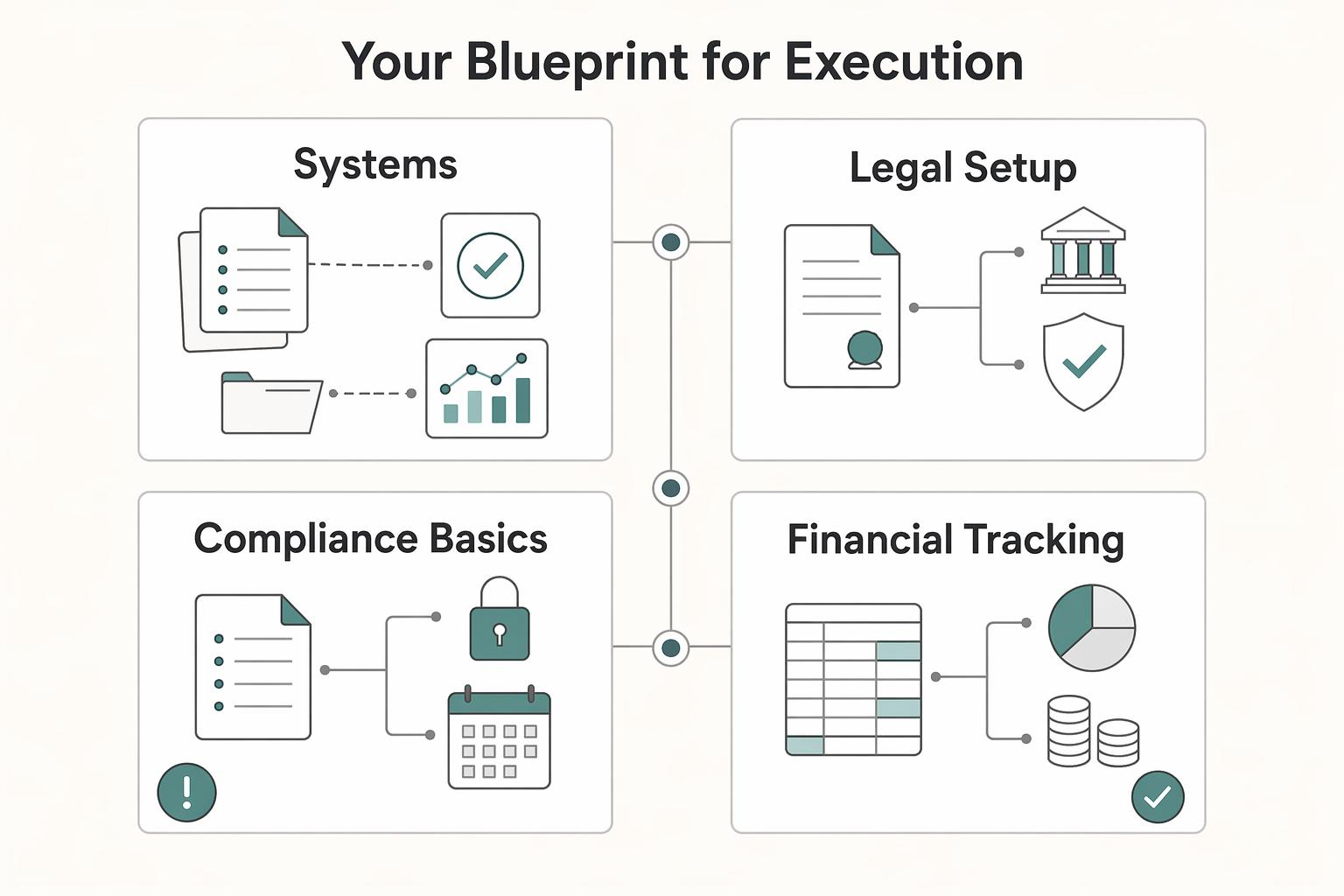
Four Setup Tasks to Finish in Your First Week#
By this point, the pattern is simple: write down decisions, handle the legal and compliance basics, and keep business money separate.
1. Systems Principle: do not run from memory. Do now: pick the plan format that fits your needs. Start with a lean startup plan for speed, and use a traditional plan when you need lender or investor depth. Done when: you have a written plan with financial projections, including budget and cash flow.
2. Legal setup Principle: choose structure before filing. Do now: for a U.S. business, compare a sole proprietorship with an LLC; elsewhere, check the local structures available to you. A sole proprietorship does not separate personal liability, while an LLC can limit some liabilities and adds filing and administration. Check minor ownership and signer rules before choosing. Done when: your decision is documented and required filings are submitted.
3. Compliance basics Principle: requirements depend on your industry and location. Do now: verify applicable licenses and permits, and get an EIN if your setup needs one for taxes, banking, or hiring. Done when: required registrations are complete and compliance tasks are tracked in one place.
4. Financial tracking Principle: keep business and personal money separate from day one. Do now: set up a business ledger and a receipt-and-invoice workflow. Done when: each payment, expense, invoice, and receipt is captured in one system, with no personal spending mixed in.
| Pillar | Do now | Common mistake | Artifact to keep |
|---|---|---|---|
| Systems | Choose lean or traditional plan based on your needs | Keeping the plan in your head | Written plan with financial projections |
| Legal setup | Decide structure, then handle required filings | Filing first and deciding structure later | Structure decision record, filing records |
| Compliance basics | Verify license/permit requirements and EIN need | Assuming one checklist applies everywhere | License/permit checklist, EIN record if needed, compliance tracker |
| Financial tracking | Use one ledger plus invoice and receipt workflow | Rebuilding records later | Ledger, invoices, receipt folder |
For your first week, finish the written plan with financial projections, finalize your structure decision and required filings, confirm your license/permit and EIN requirements, and set up your ledger plus receipt workflow. That gives you a workable operating baseline.
For the full breakdown, read How to Choose a Niche for Your Freelance Business.
When you are ready to run your first projects with cleaner admin, create a client-ready billing document with the Free Invoice Generator.
Frequently Asked Questions
Do you have to pay taxes on a teen business?
Yes. Your age does not automatically remove tax obligations. In the U.S., you usually must pay self-employment tax if your net earnings from self-employment are $400 or more. Keep records from day one, including invoices, payment confirmations, receipts, and an income and expense log, so you can verify what to file federally and in your state.
Should you stay a sole proprietor or form an LLC?
For a U.S. business owned by one person, operating without forming another entity generally means sole proprietorship. That is simpler, but it does not separate business and personal liability. An LLC adds state filings and ongoing administration and can limit some liabilities. Before choosing, confirm minor ownership and signer rules, local permits, and the bank’s requirements; repeat client work alone does not require an LLC.
How should you price your services?
Price based on delivery cost and client outcome. List fixed costs for the period, variable cost per project, your delivery time and included revisions. Break-even projects = fixed costs ÷ (price per project − variable cost per project), provided that difference is positive. Include a realistic allowance for your own work so a quote covers more than purchased materials.
Can you legally sign a client contract as a minor?
Sometimes, but do not assume enforceability works the same way in every state. Minor-related contracts can be voidable under state law, meaning a protected party may be able to affirm or reject the agreement. Age of majority is often 18 in the U.S., but some states set it higher. Use the same contract sequence every time: written scope, timeline, price, revision limits, any required parent or guardian involvement, signed agreement, invoice or deposit, then kickoff.
How do you know if this is a hobby or a business?
There is no single-rule test. IRS guidance uses multiple factors, including whether you operate in a businesslike way and keep complete, accurate records. To show clear profit intent, keep an evidence pack with contracts, invoices, marketing activity, pricing notes, a calendar, and year-end totals.
Try a related tool
Researched and edited by the Gruv editorial team. Gruv builds cross-border billing, payouts, and finance-operations software for global businesses.
Sources
- cisa.gov/audiences/small-and-medium-businesses/secure...trusted
- courtswv.gov/sites/default/pubfilesmnt/2024-04/22-928%20m...trusted
- irs.gov/businesses/small-businesses-self-employed/re...trusted
- irs.gov/faqs/estimated-tax/individuals/individuals-2trusted
- sba.gov/business-guide/plan-your-business/write-your...trusted
- sba.gov/business-guide/launch-your-business/choose-b...trusted
Educational content only. Not legal, tax, or financial advice.
Related Posts

Sole Proprietorship vs LLC for Global Freelancers in 2026
For most freelancers in 2026, the practical default is still simple: use the simplest structure you can run cleanly, then formalize when risk actually rises. If your work is still in validation mode and the downside is contained, a sole proprietorship is often the practical starting point. When contract exposure, delivery stakes, or dispute risk starts climbing, forming an LLC deserves earlier attention.
Choose a Freelance Business Structure: Liability, Tax and Costs
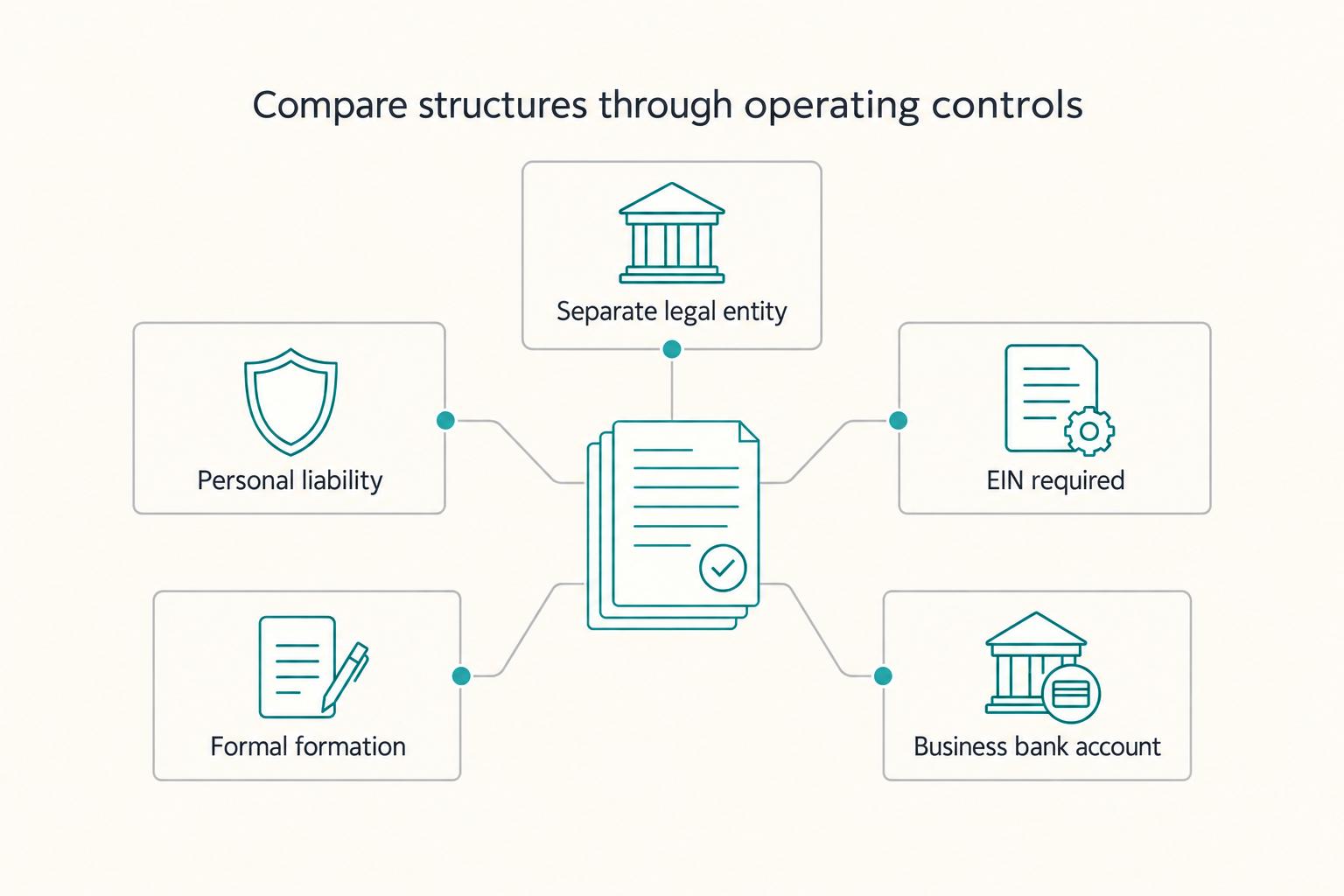
For a US freelance business, compare the work’s liability exposure, ownership, expected profit and the ongoing administration you can support. A sole proprietorship is often a practical starting point for one owner. An LLC can provide a separate legal entity, while an S corporation election changes the federal tax treatment of an eligible entity. Neither forming an LLC nor making a tax election is an automatic requirement when you gain a large client or hire help.

How to Handle Taxes for a Side Hustle
If you want less stress at filing time, use sequence instead of shortcuts. When one year includes payroll income, contractor income, and time in more than one country, the order of operations matters. This guide gives you a defensible path so you can make each decision once, document it, and avoid rebuilding the return later.