
Quick Answer
Set a budget-capped assumptions file first, then compare only quotes that use the same lane, shipment basis, pickup window, and service boundary. To ship belongings internationally cheap, triage items into carry now, ship now, or later/never, and convert mixed terms like port-only, FOB, or CIF into one door-to-door total before ranking providers. Keep customs and admin lines separate from base transport, mark unresolved charges as confirmed, pending, or unknown, and lock a primary option plus fallback triggers before booking.
You can ship internationally on a budget without gambling on bad advice#
There is no universal cheapest option. The lower-cost move usually comes from matching the decision to your own assumptions, then rejecting anything that fails a basic value test before you ask for final quotes.
Start with one hard rule: do not compare options until you set a pre-trip budget. A spending limit gives you a filter for every later decision and makes it easier to pass on things that feel useful but are not worth moving.
| Decision gate | Do this now | Verify before moving on | Budget failure if you skip it |
|---|---|---|---|
| Volume | Separate true essentials from everything else | You can explain why each shipped item must cross borders now | You pay to move things you could replace or live without |
| Urgency | Mark what you need immediately after arrival | Your first-week items are clearly separated from later items | A late item turns into an expensive rush problem |
| Route | Keep all comparisons on the same origin to destination lane | Every quote request uses the same pickup city, destination city, and timing assumptions | A cheap quote wins only because it priced a different move |
| Stay type | Decide whether this is a temporary setup or a longer relocation | Your item list matches that decision | You over-ship for a trial stay or under-plan for a long move |
Step 1. Test ship vs. buy with a value check#
Use a blunt screen. If an item is low value, generic, and easy to replace, it is often not worth shipping. Cheap generic furniture is the clearest example of where people burn money for no real gain.
The logic changes when an item has higher monetary value or real sentimental value. Shipping may still be expensive, but it can be rational when the item matters more than the transport cost. Your stay type can shift the decision, so run the same value check against what you truly need.
Step 2. Turn advice into lane-specific decisions#
Treat blogs, forums, and friend advice as prompts, not proof. If a tip does not fit your route, timing, or stay type, drop it. The decision you need is not "what is cheapest in general" but "what is cheapest for this exact move under these assumptions."
Keep one assumptions file as your baseline. Use the same item scope, lane, timing window, and stay type throughout. That file is what you will use in the next sections to scope items, build the timeline, and normalize quotes.
Step 3. Get quote-ready before you request final pricing#
Do not ask for final quotes until these are locked:
- Your spending cap is set and you know what is definitely not worth shipping.
- Your assumptions are fixed: item list, lane, timing, and whether this is a short stay or full relocation.
- Your fallback trigger is written down, such as "if housing is not confirmed by booking time, delay nonessential items" or "if the scope grows beyond budget, cut replaceable goods first."
If those conditions are not true yet, you are still planning, not buying. That pause is what keeps a budget move from turning into a series of expensive corrections.
What should you prepare before you compare any shipping quotes?#
Do not request final quotes until you can hand every carrier the same pre-quote packet. If the inputs differ, you are not comparing prices for the same move.
Step 1. Build one command file with required fields#
Use one short file and treat every field as required:
| Field | Details |
|---|---|
| Lane definition | origin city, destination city, and delivery location type (home, building, or storage) |
| Shipment basis | item count, box count, and expected load size; air and sea are the common baseline methods to compare, with air typically faster but costlier and sea slower but often better for larger loads |
| Service scope | pickup model, terminal or door delivery, and whether packing is included |
| Timing window | earliest pickup date and latest acceptable delivery window |
| Stay-type assumptions | temporary stay, longer stay, or full relocation, plus housing status |
Quick check: if multiple carriers read this file, they should describe the same move back to you. If they cannot, fix the file before you ask for pricing.
Step 2. Track compliance assumptions with status labels#
Create a separate assumptions note for customs and related clearance unknowns before quoting. Destination customs rules are part of quote risk, so unresolved items still need to appear in quote requests.
Label each assumption as confirmed, pending, or unknown. Do not let unresolved lines disappear from quote requests.
If you use legal/regulatory references, keep official artifacts. For U.S. legal research, verify FederalRegister.gov results against an official edition and keep the linked printed PDF when relevant.
Step 3. Capture costs in separate buckets before collecting quotes#
Use one worksheet so a low transport headline does not hide total cost.
| Cost bucket | Capture now | Uncertainty rule |
|---|---|---|
| Transport | Base transport quote and stated pickup/delivery scope | Mark provisional if method or volume may change |
| Compliance/admin | Customs handling, documentation, clearance support, and quarantine-related lines if applicable | Mark as pending/unknown, never zeroed out |
| Financial transfer costs | Payment processing, transfer route, and FX-related line items | Keep payment route and FX costs pending until the route is confirmed |
| Contingency | Delay, rebooking, and last-mile risk buffer | Keep as a separate visible line |
Pre-quote gate: ready vs not ready#
You are ready only when missing assumptions are documented and uncertainty lines are priced as provisional. You are not ready if a carrier still has to guess lane details, shipment basis, service scope, timing, or compliance exposure.
Which shipping method is actually cheapest for your exact move?#
The cheapest method for your move is the one that gives you the lowest total landed cost for your exact lane with acceptable reliability, not the lowest headline freight rate.
Step 1. Filter by shipment profile before you compare prices#
Use one like-for-like baseline first: same lane, same inventory, same shipment basis, and same service scope, including door-to-door vs terminal. If those inputs differ, the quotes are not comparable.
| Method | Ideal use case | Pricing basis to lock before comparing | Likely hidden cost category | Failure risk if assumptions are wrong |
|---|---|---|---|---|
| Air freight | Smaller or urgent shipments | Weight vs volume basis, plus exact service scope | Packing, customs handling, delivery add-ons | You pay for speed you do not need, or miss last-mile costs |
| Sea freight FCL | Larger household loads using a full container | Container use and volume assumptions (for example full-container sizing) | Port, packing, customs, destination handling | You pay for unused capacity if inventory is overstated |
| Sea freight LCL | Smaller loads that do not justify a full container | Shared volume and consolidation assumptions | Consolidation, unpacking, customs, terminal charges | Delays from shared-load consolidation and deconsolidation |
Quick control check: ask each provider to restate your shipment basis in writing before you rank any quote.
Step 2. Check lane complexity and documentation readiness#
After a method fits your shipment profile, test whether it still fits your route and border complexity. Sea freight is often cost-effective for larger volumes, but it can stop being cheapest if documentation readiness is still pending or unknown.
Keep these fields explicit in every quote:
- Service scope (door-to-door vs terminal handoffs)
- Incoterms responsibility split (as quoted, not assumed)
- Customs documentation readiness state (
confirmed,pending, orunknown) - Timing window (pending provider schedule verification)
If admin support is weak on a paperwork-heavy lane, treat that as both a cost risk and a delivery risk.
Step 3. Choose one primary method and one fallback#
Pick one primary method and one fallback, then score both against the same four checks:
- Quote comparability: Same lane, inventory, shipment basis, and scope
- Route fit: Timing window is realistic after verification
- Compliance clarity: Packing, freight, customs, and tax assumptions are stated clearly
- Disruption recovery speed: You can switch quickly if pickup, consolidation, or clearance changes
If your inventory is stable, paperwork is confirmed, and timing is flexible, sea freight often remains the lead option. If timing is less flexible, keep air as your fallback so you can recover without rebuilding your whole plan.
Step 1 scope what you ship now, later, or never#
Ship less first. Your lowest-cost plan usually comes from stricter item triage, not a lower headline quote.
Step 1A. Decide each item by necessity, replaceability, and arrival criticality#
Review items one by one and ask, in order: Do I need this early?, How hard is it to replace?, and What happens if it is delayed? Then place each item into one bucket only.
| Bucket | Put items here when | Why this crosses a border now | Better fit by shipping mode |
|---|---|---|---|
| Carry now | You need it immediately and delay would cause real disruption | You need it to start work or settle in right away | Keep with you first; if it must be shipped and is parcel-sized, express courier is usually the best fit |
| Ship now | You need it soon and replacement is costly or impractical | It supports your first stretch abroad and still justifies shipping risk | Parcel-sized loads can fit express; heavier or high-volume loads usually fit sea freight, with air freight when speed matters more |
| Later or never | Need is uncertain, replacement is easier, or timing is tied to later stability | No strong reason to move it across the border now | Defer, store, sell, or review in phase two |
Add one sentence for each shipped item: Why does this cross a border now? If the answer is vague, move it to Later or never.
Keep first-week essentials out of lanes with higher delay exposure. Sea freight can be the right fit for heavy or high-volume loads, but congestion can add about a week of waiting and, in some periods, longer delays plus canceled sailings.
Step 1B. Tag risk so quote and insurance decisions use the same logic#
After bucket assignment, tag each shipped item Low, Medium, or High on:
- Delay impact: how disruptive late arrival would be.
- Replacement difficulty: how hard local replacement would be.
- Value concentration: how much value sits in one item or small group.
Use the same tagging when you compare quotes and when you make insurance decisions so high-impact or high-value items do not get treated like routine cargo.
Step 1C. Hold phase two until the move is stable enough#
Keep a separate phase-two list and release it only when all three are true:
- Housing is confirmed at your destination.
- Your visa status is stable enough to commit.
- Your storage runway covers the wait before phase two.
Before moving any phase-two item into Ship now, verify destination serviceability on your actual address and service basis. Some destinations can show limited or no shipping options at checkout, so do not assume your second shipment will route like your first.
Finally, budget each bucket by landed cost, not freight alone: track shipping, compliance/admin, and money movement as separate lines.
Step 2 build a backward timeline from move date to delivery date#
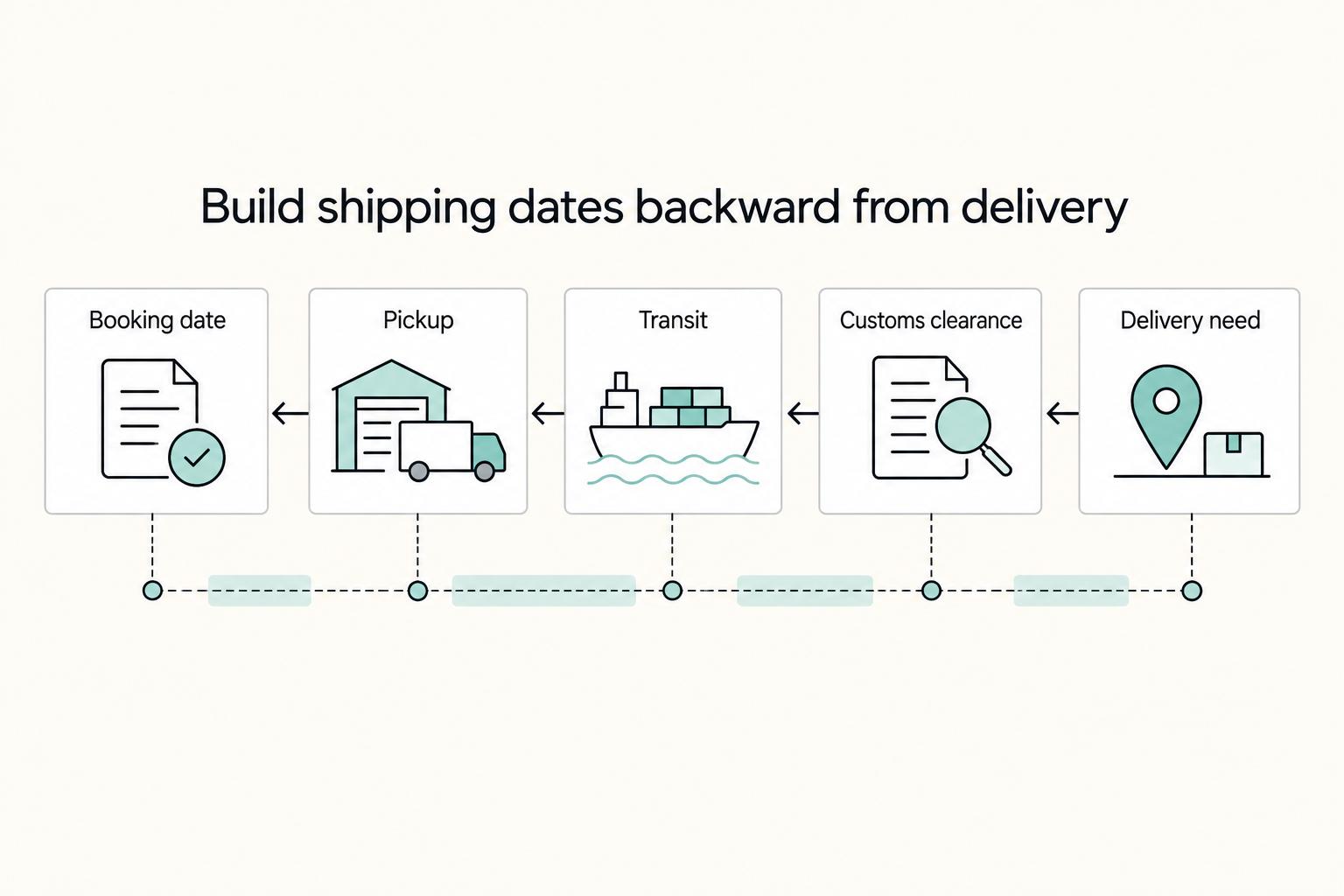
Start with the date your priority items must be in hand, then sequence every dependency backward: final delivery, clearance, transit, pickup, packing, and booking. This keeps your plan anchored to the only date that matters, because transit time can shift with location, shipment size, season, weather, and market conditions.
If your primary lane is ocean, lock the exact lane in writing. LCL adds origin consolidation and destination deconsolidation, so it can run a few days longer than FCL.
| Stage | Owner | Pass/fail check |
|---|---|---|
| Booking | You + provider | Pass if mode, route, service scope, and target delivery window are documented and confirmed |
| Packing | You | Pass if packed contents match your inventory and each carton is identifiable |
| Pickup | You + provider | Pass if address, contact, access details, and handoff date are confirmed |
| Transit | Provider | Pass if the booked lane still supports your required arrival window |
| Clearance | You + broker or provider | Pass if required paperwork is submitted and unresolved items are logged |
| Final delivery | Provider + you | Pass if delivery address, contact, and receiving window are confirmed |
Add a paperwork-readiness gate before pickup. At that gate, confirm the document set is complete for your destination and carrier, declared contents match what is packed, and every unresolved item has an owner and follow-up date. If your shipment is U.S.-bound, recheck current import-fee treatment before final booking instead of assuming the older $800 de minimis treatment still applies.
Define one fallback framework beside your primary lane:
- Primary lane: pending route confirmation
- Fallback lane: pending route confirmation
- Trigger condition: booking confirmation cutoff, pickup deadline, and clearance-question cutoff are pending provider/source verification
Before final booking, confirm this execution checklist is complete:
- timeline is locked from in-home date backward
- checkpoint dates are set
- each checkpoint has an owner
- paperwork-readiness gate is scheduled
- fallback lane and trigger conditions are written
- escalation contacts and decision dates are set
Step 3 normalize quotes so cheap really means cheap#
After you lock your timeline, stop comparing headline totals. A quote is only decision-ready after you convert every option to the same door-to-door responsibility baseline.
A low number often means responsibility shifted to you. If a quote is port-only and another is door-to-door, translate both into one total-cost view before you rank anything.
Lock one comparison baseline#
Build one worksheet and force every provider into the same scope from Step 2.
| Field | Lock this for every quote | Verify this before ranking |
|---|---|---|
| Lane | Same origin city, destination city, and route variant | No one is pricing a different lane or terminal pair |
| Shipment basis | One basis only (cartons, volume, or weight) | You are not mixing different shipment assumptions |
| Service boundary | One door-to-door total-cost view | Port-only/depot offers are translated into added line items |
| Pickup window | Same collection date range | It still fits your Step 2 timeline |
| Quote validity | Stated validity/review condition | Market-sensitive rule pending provider/source verification |
| Exclusions | All excluded services and customer conditions | Quote is actually applicable to your shipment |
| Responsibility handoff | Owner at origin, customs, destination handling, and final delivery | No ownership gap at any handoff |
If terms are mixed, map them directly into your baseline. Example: a $4,200 FOB Shanghai quote and a $5,100 CIF Los Angeles quote are not comparable until missing responsibilities are added as line items. If you cannot show who owns each handoff, the quote is not normalized yet.
Verify hidden costs line by line#
Split each quote into buckets: base transport, admin/customs, and accessorials. If a line is missing, mark it Unknown or To Be Quoted, not zero.
| Unknown area | Follow-up to send |
|---|---|
| Base transport unknown | Please confirm the quoted transport charge for the full route and whether fuel, terminal, and destination handling are included or billed separately. |
| Customs/brokerage unknown | Please confirm whether destination customs clearance and brokerage are included; if excluded, please mark them excluded. |
| Accessorials unknown | Please list possible extra charges for stairs, long carry, elevator limits, storage, reattempted delivery, or restricted access. |
| Applicability unknown | Please confirm this quote applies to my shipment type and customer category, and list any service exclusions or segment restrictions. |
Use the follow-ups in the table for anything that is still missing.
Only after normalization should you pull more candidates from The Best International Moving Companies for Digital Nomads. Use it to source options, not to validate price comparability.
Keep primary or switch to fallback#
Keep your primary option when scope is normalized, unknown lines are resolved, and responsibility handoffs are executable on your timeline. Switch to fallback when unknowns are still open at your paperwork gate, exclusions change real scope, or pickup slips past your Step 2 trigger date, which is pending provider/source verification.
For broader relocation planning context, see The 2026 Global Digital Nomad Visa Index for 50+ Countries.
What can go wrong and how do you recover without blowing your budget?#
After you normalize quotes, the biggest budget risks are usually unvetted advice, hidden non-transport exposure, and late fallback switches. You can control all three with a short validation check, visible risk buckets, and prewritten recovery actions.
Step 1. Validate advice before you change your plan#
Before you change provider, mode, or service level, run a fast fit check. Freight shipping can be complex, and the main tradeoff is usually urgency versus cost, so only use advice that matches your exact move.
| Check | What to confirm |
|---|---|
| Lane match | The advice is for your exact origin-destination lane, not a different route or port pair. |
| Shipment profile match | It fits your shipment class and size; in the UPS guide, 150 pounds or less is small package, and over 150 pounds up to 15,000 pounds is freight. |
| Service-level match | It is based on the same responsibility boundary priced in Step 3, for example door-to-door vs. port-only. |
| Timeline fit | You can still meet pickup, paperwork, and in-home timing if you apply it. |
If you cannot explain in one sentence why a tip passes all four checks, do not rebuild your plan around it.
Step 2. Keep non-transport risk in visible cost buckets#
Do not hide exposure under "miscellaneous." Keep separate lines for customs and compliance, documentation, insurance, storage, admin, and contingency. If any item is unresolved, keep it marked Unknown until you have written confirmation.
Save the current quote version, exclusions, and written confirmations on what is included or excluded. If tariff-related guidance is still pending, keep contingency funds instead of forcing a precise number into the worksheet.
Your worksheet should always separate base transport from compliance and contingency exposure. Missing is not zero.
Step 3. Prewrite the recovery move before you need it#
When a slip happens, your response speed protects your budget. Assign ownership now so you know who acts first and what cost you are protecting.
| Trigger | Owner | First action | Fallback action | Budget protection intent |
|---|---|---|---|---|
| Pickup delay | You and origin provider | Get the next confirmed pickup slot in writing and confirm whether quote validity changes | Move essentials through backup; keep non-essentials on slower booking | Avoid full-shipment rush pricing |
| Clearance friction | You plus broker or destination handler | Request the exact missing document/clarification in writing and submit against the same case reference | Pause delivery planning, escalate to backup contact, and track storage time actively | Limit storage, rebooking, and admin creep |
| Delivery timing conflict with work or housing | You | Reconfirm the earliest realistic delivery window and access conditions | Route essentials via fallback or delay final delivery instead of replacing everything locally | Protect work continuity without duplicating total shipment cost |
Keep this table next to your normalized quote worksheet. If a trigger fires, update the worksheet first, then apply your Step 3 fallback rules instead of improvising.
Freeze your options, verify the booking controls, then execute#
When your quotes are normalized and your documents reconcile, stop researching and move to execution. Freeze new options, lock one primary path plus one fallback, and run everything from your normalized worksheet.
Step 1. Lock your execution window#
Use a fixed decision protocol before booking:
- Freeze option intake after a clear cutoff date.
- Confirm one primary provider and one fallback.
- Record switch triggers in writing before anything changes.
Use only two trigger types:
- Timeline trigger: switch if pickup, handoff, or delivery timing slips beyond the buffer from Step 2.
- Quote-confidence trigger: switch if quote scope changes, a material surcharge appears, or customs paperwork is still incomplete at booking.
This keeps you from reactive recalculation when conditions shift.
Step 2. Verify one booking control sheet#
Keep the checks mechanical. If you want an optional shortlist refresh before final quote requests, use The Best International Moving Companies for Digital Nomads, then return to the same worksheet.
| Control point | What you verify | Pass condition |
|---|---|---|
| Matched quote scope | Same lane, shipment basis, service level, and to-door basis across options | Like-for-like comparison still holds |
| Full cost visibility | Base transport, surcharges, customs-related admin, insurance, storage, and contingency are separated | No lump-sum blind spot |
| Customs-document readiness | Labels, item counts, shipment description, names, and address match paperwork | Documents and boxes reconcile |
| Fallback activation readiness | Backup provider, contact path, and switch triggers are already recorded | You can switch without rebuilding the plan |
Step 3. Run the final checklist and execute#
- Freeze scope: carry, ship, store, or sell decisions are final.
- Confirm timeline: your in-hand date drives booking.
- Normalize quotes: same assumptions, same delivery basis, same exclusions check.
- Stress-test risk: if your winner fails under higher freight or surcharge conditions, treat it as unstable.
- Save proof: quote version, exclusions, document set, and written confirmations in one folder.
Execute now from your normalized worksheet, not from memory.
Frequently Asked Questions
How do you tell if a quote is actually the cheapest?
Match the pricing inputs first, then compare totals. Check actual weight, box dimensions, service speed, route distance, packaging type, and surcharges, because a low base rate is not the same as a low final cost. Treat “affordable” as predictable and reliable too, not just the lowest number on page one. | Input to match | Why it changes total cost | | --- | --- | | Actual weight and dimensions | Carriers may price on actual weight or dimensional weight, so light but bulky boxes can bill higher than you expect | | Service speed | Faster services usually cost more, so urgency needs to be priced on purpose | | Packaging type | Non-standard packaging can raise billed size and DIM weight | | Route distance | Longer routes can increase transport cost even when the box stays the same | | Surcharges | Residential, fuel, or Saturday delivery fees can push the real total above the quoted base rate |
What hidden costs should you check before you book?
Ask for non-base charges in writing before you approve anything. Keep surcharges separate from customs/compliance documentation charges and other add-on fees so you can see what is fixed and what is still unknown. Red flag: if a provider gives you one lump total with no exclusions list, you do not yet have a clean comparison.
How early should you book?
Work backward from the day you need your belongings in hand, not the day you want them picked up. Leave time for quote comparison, paperwork, pickup coordination, and a fallback if your first option slips. If your timeline is tight, price slower and faster services side by side early, because speed is one of the clearest ways cost jumps.
When should you ship, sell, or store instead of sending everything?
Sort each item into carry now, ship now, or do not move yet before you request final quotes. If something is bulky, low value, or easy to replace, compare the shipping total against the cost of rebuying it later or storing it where you are. Shipping everything first can backfire if volume and packaging push the billed cost above the original estimate.
Is a small parcel rate always the cheapest option?
Check whether your shipment still fits a true small-package profile before assuming parcel pricing will win. In one common pricing model, that can mean up to 10 lbs and less than 1 cubic foot, but that marker is not universal, so you still need the provider’s own rules. Once your boxes get bigger or oddly shaped, dimensional weight can erase the apparent savings.
What should you confirm to avoid customs delays?
Match the boxes to the paperwork before pickup, not after. Recheck the shipment description, customs forms, harmonized codes, and delivery address so the documents and labels stay aligned. If any destination requirement is unclear, stop and get the exact rule in writing rather than copying a generic example from another lane.
What is the last check you should run before you pay?
Do one final pre-booking pass. Compare the full estimated total, confirm matched inputs, verify the address, and make sure your document set is ready before checkout. Save the quote version, exclusions, and written confirmations in one folder so you can prove what was included if the booking changes later. For a broader final validation before you commit, run through Digital Nomad Pre-Travel Checklist for Long-Stay Moves.
Try a related tool
Researched and edited by the Gruv editorial team. Gruv builds cross-border billing, payouts, and finance-operations software for global businesses.
Sources
- brookings.edu/wp-content/uploads/2021/10/Breakthrough_PDF.pdftrusted
- enforcement.trade.gov/sunset/97-12201.htmltrusted
- federalregister.gov/documents/2020/05/18/2020-09370/interpretive...trusted
- federalregister.gov/documents/2025/01/08/2024-31486/preventing-a...trusted
- gsa.gov/buy-through-us/purchasing-programs/multiple-...trusted
- le.fbi.gov/file-repository/cjis_security_policy_v5-9-4_...trusted
- medpac.gov/wp-content/uploads/2025/06/Jun25_MedPAC_Repo...trusted
- ndupress.ndu.edu/Media/News/article/2031922/mercenaries-and-w...trusted
Educational content only. Not legal, tax, or financial advice.
Related Posts

The 2026 Global Digital Nomad Visa Index for 50+ Countries
Start with legal fit, not lifestyle filters. The practical order is simple: choose a route you can actually document, then decide where you want to live. That single change cuts a lot of wasted comparison work and stops you from falling in love with places that were never a real filing option.

The Best International Moving Companies for Digital Nomads
Treat this as an execution decision, not a brand popularity contest. You are not picking from a generic pool of movers. You are testing whether a provider can explain your route, show who owns the risky steps, and put that in writing before you commit.

Digital Nomad Pre-Travel Checklist for Long-Stay Moves
Set your departure dates first. Long-term travel planning breaks down when timing stays vague. Vague timing usually turns into rushed paperwork, rushed bookings, or unresolved home obligations.