
Quick Answer
Identify whether you are applying for a Singapore company with foreign owners or an overseas entity. OCBC publishes a remote foreign-company route; DBS directs these profiles to relationship-manager assistance. Confirm your exact entity’s eligibility, documents and signing process before applying.
Start with the legal entity that will hold the account. A foreign founder, a Singapore-incorporated subsidiary and an overseas company are different applicants. Choosing the right application path prevents a generic online form from becoming a dead end.
Identify the applicant#
| Applicant | What to establish | Next step |
|---|---|---|
| Singapore company with foreign owners | Singapore registration and the actual ownership and control chain. | Use the bank’s foreign-ownership route where required. |
| Company incorporated outside Singapore | Home jurisdiction, legal existence and authorised signers. | Ask for the foreign-incorporated account route and any local business requirements. |
| Registered Singapore branch of a foreign company | Branch registration, parent company and local authorised representative. | Confirm the account holder and signing mandate with the bank. |
| Business needing only SGD client receipts | Whether a nonbank payment account fits the actual use. | Check supported business jurisdiction, receiving rails and protections. |
ACRA distinguishes a foreign-company branch from a subsidiary and requires a locally resident authorised representative for a branch. A Singapore-incorporated company must have at least one ordinarily resident director. Those registration responsibilities are separate from a bank’s account approval; do not incorporate solely on a promise of guaranteed banking.
Two actual bank application routes#
These published routes were checked on October 3, 2026. They establish a way to apply, not a commitment to accept every jurisdiction, industry or ownership structure.
| Bank | Published foreign-component route | What to confirm for your application |
|---|---|---|
| OCBC | Dedicated remote account-opening route covers foreign-owned Singapore companies, foreign corporate shareholders and companies registered outside Singapore. | Exact entity/product eligibility, requested evidence and remote identification and signing steps. |
| DBS | Foreign-incorporated entities, foreign corporate shareholders and owners with non-local residency require relationship-manager assistance. | Manager-led checklist, verification arrangements, product and applicable charges. |
OCBC’s dedicated foreign-company page advertises end-to-end online support without a branch visit. Its standard Business Growth instant-opening criteria are narrower: a first OCBC account for a Singapore-registered business wholly owned by Singapore citizens or permanent residents. Do not apply the instant-opening claim to a foreign-owned profile.
DBS explicitly directs the listed foreign profiles through a relationship manager. It does not follow that every applicant must visit Singapore, or that every applicant can complete verification remotely. Obtain the actual procedure before booking travel or relying on a launch date.
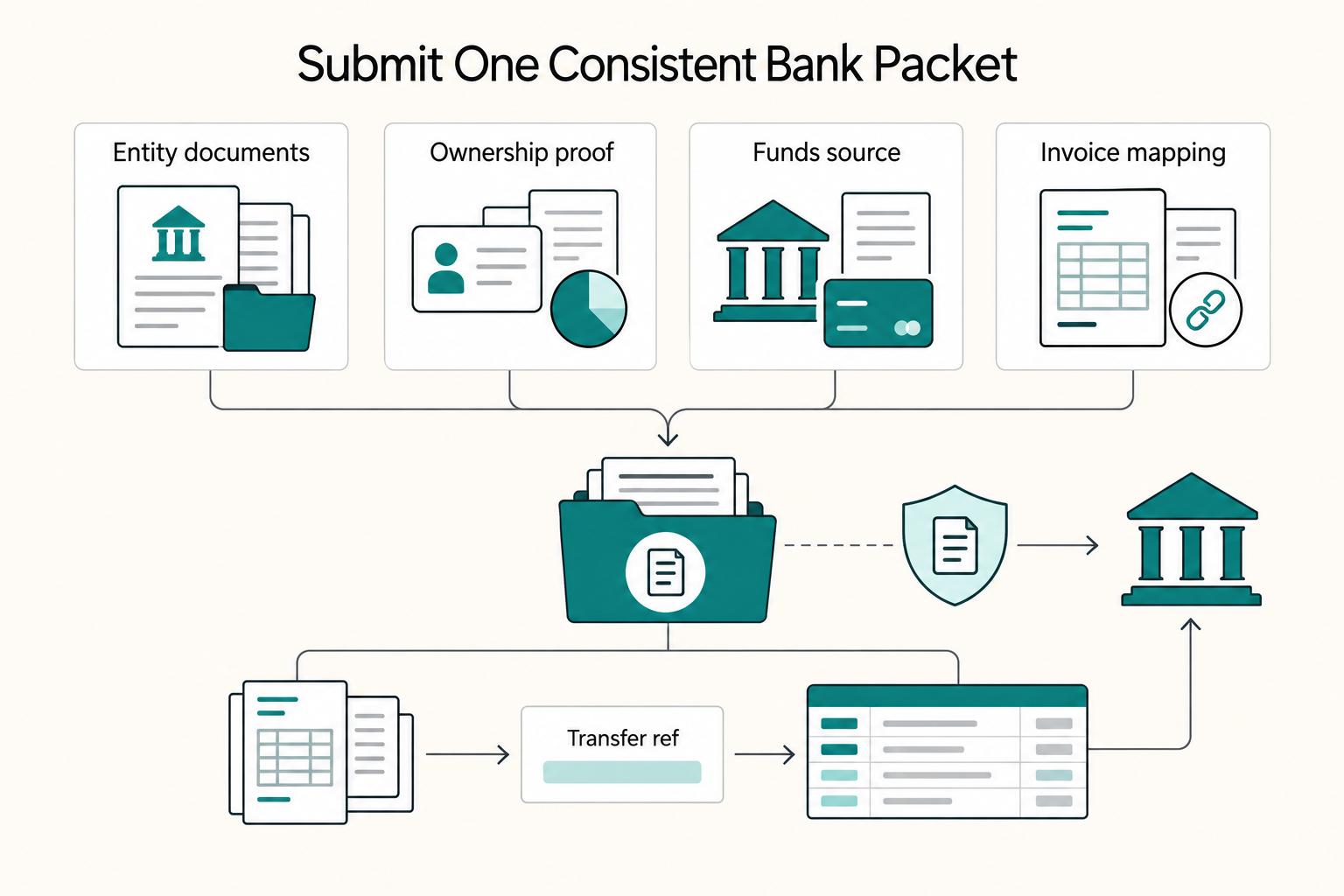
Prepare one coherent evidence packet#
Ask the bank for the checklist matching your legal form and jurisdiction. The following preparation list helps you answer the review; it does not replace that checklist.
- Entity registration, constitutional documents and current business profile or home registry evidence.
- Board resolution or equivalent mandate naming signers and their permitted authority.
- Direct and indirect ownership chart through to the individuals who own or control the business.
- Identity and address evidence for the people the bank must verify.
- Actual operating address, business activities, main counterparties and expected payment volumes.
- Contracts, invoices, financial records and source-of-funds evidence requested to explain the activity.
For example, if an overseas parent owns 60% of the applicant and a founder owns 40%, show both links and the people behind the parent. Do not stop the chart at the parent’s company name. Let the bank identify its required beneficial-owner and control evidence rather than treating an invented percentage cutoff as universal.
Keep registered address, operating location, residence and tax residence distinct. If facts change during onboarding, update the application and supporting documents instead of submitting conflicting versions through several channels.
Agree the account terms before signing#
- Which legal entity holds the account and which currencies can be held.
- Initial funding, account fees, minimum balances and fall-below charges.
- Local receiving and paying rails needed by your customers and suppliers.
- International transfer, intermediary-bank and FX charges.
- Who can create, approve and release payments, with appropriate limits.
- Statement exports and accounting access for reconciliation.
Ask for a quote for your actual foreign-owned or foreign-incorporated profile. A domestic startup offer may exclude it. Compare the cost of a realistic month, including low-balance periods, rather than a single headline transfer fee.
Understand the deposit-protection boundary#
SDIC covers eligible Singapore-dollar deposits of non-bank depositors, including companies, at Deposit Insurance Scheme members, ordinarily up to S$100,000 aggregated per depositor per member. Foreign-currency deposits, structured deposits and investment products are excluded. Request the bank’s insured-deposit register for the product you choose.
A multicurrency account can contain both covered SGD deposits and excluded foreign-currency balances. Holding two ordinary accounts with the same scheme member does not double the aggregate limit. Check the named bank and deposit product, not just whether the provider’s app uses SGD.
When SGD receiving details may be enough#
Wise Business is a payment-account route for eligible businesses, subject to supported countries, activities and a physical trading address. Its SGD guidance distinguishes FAST receiving details from business GIRO/MEPS details and says the product is not a bank account. Use the details appropriate to the sender’s rail.
For example, a customer making a FAST transfer and a platform paying through GIRO can require different receiving instructions. Copy the account-specific instructions from the provider. Do not infer that a bank name displayed by the sender means your business has a direct deposit account at that partner bank.
Wise’s Singapore site identifies Wise Asia-Pacific as a MAS-regulated Major Payment Institution. That licence is different from a bank licence or SDIC membership. Establish your contracting entity and the applicable funds-protection terms; an SGD receiving number is not proof of insured deposits, credit facilities or trade finance.
Validate the first payment workflow#
- Confirm that identification and signing are complete and the account is active.
- Set authorised users, payment limits and approval responsibilities.
- Get receiving instructions for the exact currency and rail.
- Test a small permitted receipt and outgoing payment.
- Match the amounts, references, fees and statement entries.
- Change customer instructions through an established channel only after the test works.
The payer is the customer sending money; the beneficiary is the account holder receiving it. Use the correct legal beneficiary name in instructions. When a receipt is delayed, trace its reference and outcome before requesting another payment, and answer any verification request through the bank’s secure channel.
A usable account is one that the correct entity can operate with the needed permissions and payment rails. Treat account approval, bank funding and the first successful business payment as separate milestones.
Frequently Asked Questions
Can a foreign-incorporated company apply for a Singapore account?
OCBC and DBS both publish application routes for foreign-incorporated companies. Confirm the exact jurisdiction, legal form and business activity with the bank; application access does not guarantee approval.
Must I travel to Singapore to open the account?
OCBC publishes a remote foreign-company route. DBS uses relationship-manager assistance for specified foreign profiles. Confirm your bank’s actual identification and signing requirements before making travel plans.
Is SGD in a multicurrency account always insured?
Only eligible deposits at SDIC scheme members fall within the scheme. Covered SGD deposits are ordinarily aggregated up to S$100,000 per depositor per member; foreign-currency deposits and excluded products are not covered.
Are Wise SGD details a Singapore corporate bank account?
No. They are receiving details for an eligible Wise payment account. Check the applicable entity, payment rail and protection terms before deciding whether they satisfy your business need.
Try a related tool
Researched and edited by the Gruv editorial team. Gruv builds cross-border billing, payouts, and finance-operations software for global businesses.
Sources
Includes 4 external sources outside the trusted-domain allowlist.
- acra.gov.sg/register/foreign-business/foreign-company-br...trusted
- acra.gov.sg/news-events/news-announcements/balancing-dir...trusted
- wise.com/help/articles/2977974/can-my-business-use-wisetrusted
- wise.com/help/articles/2969315/how-does-wise-verify-m...trusted
- dbs.com.sg/sme/day-to-day/accounts/foreign-owned-companiesexternal
- ocbc.com/business-banking/smes/accounts/account-openi...external
- ocbc.com/business-banking/smes/accounts/business-grow...external
- sdic.org.sg/di_faqexternal
Educational content only. Not legal, tax, or financial advice.
Related Posts

The Freelance Payment Penalty: A Modeled Audit of Platform Fees, FX Spreads, and Payout Delays
The money rarely disappears through a single, easy-to-spot fee. The real loss is stacked. A marketplace takes its commission, a processor adds a charge for international cards, a bank or payment company converts the currency at a spread, a platform holds the funds before release, and a wire sheds a little to intermediaries on the way in. Each layer looks defensible on its own, but the worker feels the combined result as a smaller deposit and a later payday.

How to Respond to a Subpoena for Business Records
Move fast, but do not produce records on instinct. If you need to **respond to a subpoena for business records**, your immediate job is to control deadlines, preserve records, and make any later production defensible.

A US Expat's Guide to Investing in UCITS ETFs to Avoid PFIC Issues
The real problem is a two-system conflict. U.S. tax treatment can punish the wrong fund choice, while local product-access constraints can block the funds you want to buy in the first place. For **us expat ucits etfs**, the practical question is not "Which product is best?" It is "What can I access, report, and keep doing every year without guessing?" Use this four-part filter before any trade: