
Quick Answer
Yes, but only in a narrow case: use a liaison office in india when your activity is clearly limited, your evidence file is current, and your advisers and AD bank have confirmed your wording in writing. If your workflow includes revenue terms, delivery support, payment touchpoints, or local signing authority, treat that as a pivot signal. The practical path is to pause, verify unresolved items, and choose a structure that matches how you actually operate.
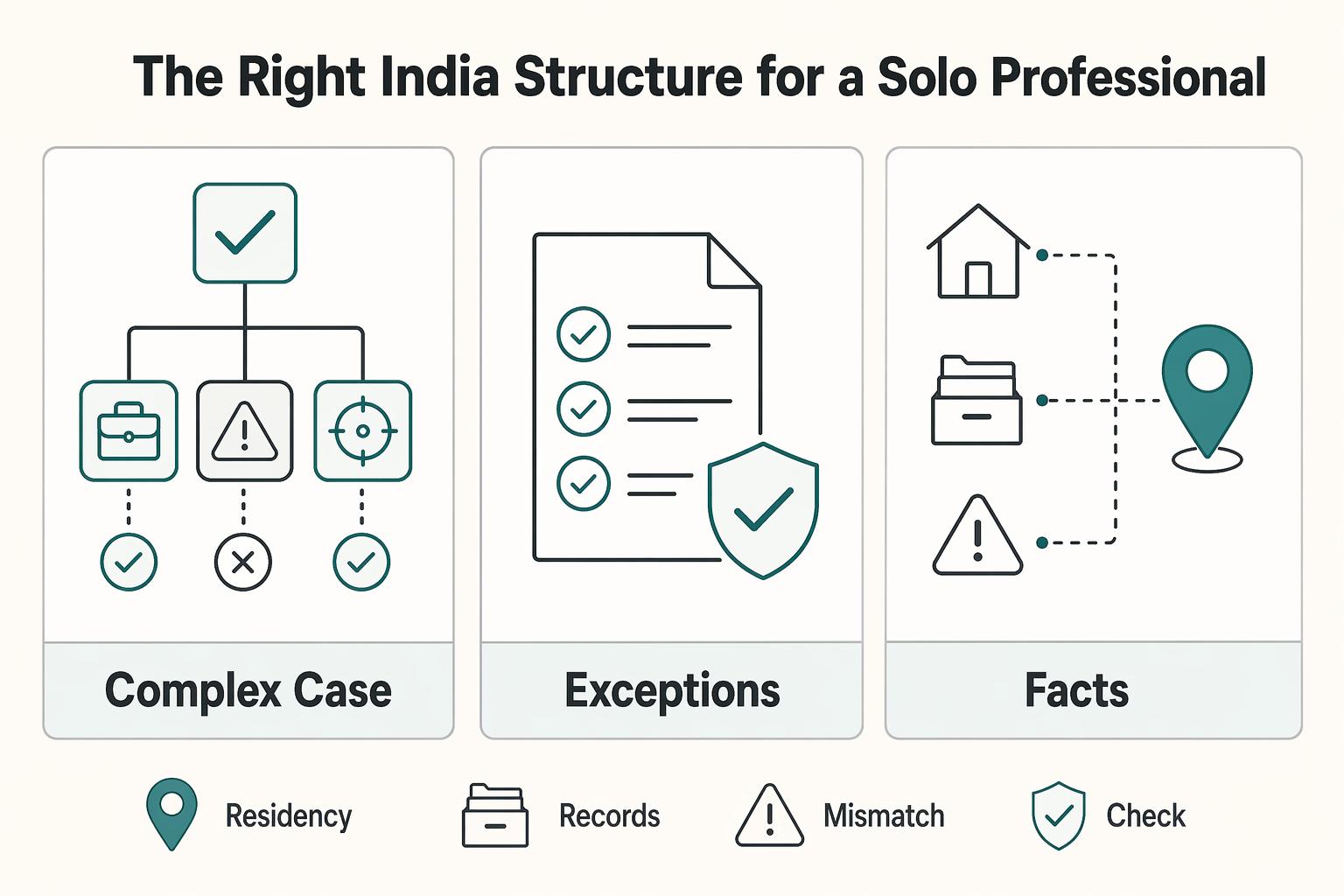
Three Checks Before You Commit to This Route#
For a solo operator, this is only a go if your plan is clearly documented and backed by current primary materials from India, plus written confirmation from the professionals you rely on. If your day-to-day work may include selling, delivery, contracting, or payment handling, treat this route as high-risk until those points are explicitly confirmed in writing. Re-scope the model before you go further if you cannot verify those boundaries.
| Check | Key setup | Escalate or stop when |
|---|---|---|
| 1. Build an evidence pack before you build a filing story | Dated working file with a primary India source register, activity statement, written confirmation log, open issues list, and source rejection log | A document does not clearly match both the jurisdiction and the topic |
| 2. Stress test your planned activities for commercial intent | List your next ten likely actions in India and run the same test across your website copy, first-call script, sample proposal, and any draft invoice language | Wording has to do too much work to make the plan fit, or commercial signals show up in your normal week |
| 3. Assign compliance ownership before you spend money | Keep one dated folder for source copies, written confirmations, draft activity language, and change history, and set a recurring review note once the cadence is confirmed | New document requests, a change in how work is sold or delivered, a request for local signing authority, different funding flows, or any source with an unclear current status |
That first screen matters because source quality is the hidden risk. In the research set behind this article, one page was a Kansas Department of Commerce page with "Business in Kansas" navigation and a March 23, 2026 news item about investing nearly $7.5M in radar manufacturing. Another was a FEMA biological incident annex. Another was a U.S. TSA hearing PDF. All can look official. None of them help you prove India structure rules.
1. Build an evidence pack before you build a filing story#
Start with a dated working file, not a polished memo. The goal is to separate verified facts from assumptions and make weak sources obvious before they shape your plan. Use a simple evidence pack with unresolved items like these:
| Evidence pack item | What to capture |
|---|---|
| Primary India source register | source title, URL, publisher, jurisdiction match, topic match, current version status, date checked, and what point you think it supports |
| Activity statement | one plain language paragraph describing what you will actually do in India, with verbs you would be comfortable showing to a bank or adviser |
| Written confirmation log | bank contact, legal or compliance adviser contact, exact question asked, written response received, date, and unresolved points |
| Open issues list | unconfirmed current trigger, source needing replacement, activity wording awaiting written confirmation |
| Source rejection log | a short note explaining why each non-India or non-topic source was excluded |
Keep the pack functional, not pretty. A dated folder structure, clear file names, and version notes are enough. If one source supports only part of your activity statement, mark the exact phrase it supports rather than treating the whole paragraph as verified. That makes it easier to see where your story is solid and where you are still leaning on inference.
Two hygiene rules keep this usable. First, tag every source as primary or secondary and note whether it is current or only a convenience copy. Second, do not rely on verbal reassurance. Get written confirmation from the bank or adviser you are using, then store that response with the exact question you asked.
Use this checkpoint: if a document does not clearly match both the jurisdiction and the topic, it is background at best. If it looks official but cannot answer your India structure question, reject it and move on.
2. Stress test your planned activities for commercial intent#
This is where most solo operators get the real answer. Do not ask whether your plan sounds modest. Ask whether your actual workflow can be defended as representation-only based on current India primary materials and written confirmation. If the wording has to do too much work to make the plan fit, pause.
| Planned activity in your workflow | What it can signal | What to do now |
|---|---|---|
| Intro meetings, relationship building, information sharing | May align with a representation-only hypothesis | Proceed only if current India primary materials and written confirmation support the exact wording |
| Proposals with pricing, fee negotiation, or revenue terms | Possible commercial-intent flag | Pause and re-scope until supported by current India sources and written confirmation |
| Service delivery, project management, or local execution support | Possible operating-activity flag | Stop and test a different structure or obtain clear written confirmation before proceeding |
| Payment collection, billing touchpoints, or local contract execution | Possible commercial-execution flag | Treat as a pivot trigger unless current India sources and written confirmation clearly support your approach |
These are not legal conclusions. They are screening filters when your source set is still incomplete. If any of those commercial signals show up in your normal week, pause and get current India-specific confirmation in writing before you move forward.
A practical self-check is to list your next ten likely actions in India. If several look like revenue work rather than presence or representation, treat that as a signal to validate your structure before proceeding. Run the same test across your website copy, first-call script, sample proposal, and any draft invoice language. A mismatch there is useful because it shows where your real business model no longer matches the wording in your application file.
3. Assign compliance ownership before you spend money#
If this route still makes sense after the activity check, assign ownership before you file. Even if the team is just you, someone must own the records, periodic review, and escalation. For a business of one, that may all be you, but write it down anyway because unwritten ownership disappears fast.
| Trigger | What to do |
|---|---|
| Wording changes | Note what changed, why it changed, and whether you got updated written confirmation |
| New document requests | Escalate |
| A change in how work is sold or delivered | Escalate |
| A request for local signing authority | Escalate |
| Funding flows differ from your original description | Escalate |
| Any source has an unclear current status | Escalate |
| A rule-based threshold may matter later | Record the unresolved threshold and get current written confirmation before relying on it. |
Keep one dated folder for source copies, written confirmations, draft activity language, and change history. Set a recurring review note in your calendar once the review cadence is confirmed and check whether your actual activity still matches your documented plan.
If wording changes, note what changed, why it changed, and whether you got updated written confirmation. For the other triggers in the table, escalate as soon as they appear. Where a rule-based threshold may matter later, leave that threshold unresolved until current written confirmation is in the file.
If any one of these three checks fails, do not file and hope the facts sort themselves out later. Pivot early to a structure that matches your real operating model, such as a local entity route. If that is where your facts point, start with A Guide to Incorporating a Private Limited Company in India as a Foreigner.
Related: How to Choose a Jurisdiction for Your European Subsidiary.
The Strategic Pivot: The Right India Structure for a Solo Professional#
Choose based on your operating facts, ownership capacity, and risk tolerance, not by entity label. If your planned work in India includes commercial delivery, local signing, billing, or payment handling, treat a liaison office as unproven for your case until current primary India materials confirm fit in writing. In that situation, review routes that can support revenue first.
| Route | Choose this when | Stop sign | Control | Ownership boundary | Risk exposure and current check |
|---|---|---|---|---|---|
| Local entity | India is becoming part of your core operating model | No one can own recurring books, filings, and adviser follow-up | Highest | Mostly you, with local adviser support | Ongoing local compliance work; current compliance obligations still need verification |
| EOR | You need in-country people support and want provider-managed employment administration defined by contract | You are assuming the provider also owns your full business-side tax/compliance position | Medium to high over daily work, lower over employment administration | Provider manages agreed employment tasks; you still own scope control, contract review, and adviser coordination | Boundary confusion if scope is vague; handoff and exception checks still need current verification |
| Direct invoicing from abroad | Your fact pattern is narrow and you can keep it narrow | Local receivables, advances, or on-ground execution start becoming normal | High | You own contracts, invoicing, records, and adviser coordination | Business-side tax/compliance review remains with you; India tax position still needs current verification |
After you choose a route, run one more source-quality filter: reject materials that are current but out of scope for India structure decisions. For example, U.S. Title 22 and FAR Part 52 are not India company-structure guidance, even when they carry recent edition dates or effective-date stamps that make them look authoritative.
Use this readiness checklist before spending more time:
- Local entity: name one owner for records, one owner for escalations, and one owner for adviser follow-ups.
- EOR: map provider promises to contract language, log exclusions, and assign an owner for boundary disputes.
- Direct invoicing: keep a dated activity log, assign contract/invoice ownership, and set an escalation trigger for scope drift.
Build a Pre-Filing Working Pack Before the First AD Bank Call#
Before you book that call, force the file into a working pack that someone else can review in ten minutes. We would keep it operational rather than polished: a one-page activity summary, a note on why the model is limited in scope, a dated list of unresolved rule questions, and a clear owner for every follow-up. Our goal here is consistency, not presentation.
You should be able to open the folder and give the same answer every time. Check your draft narrative, your expected payment touchpoints, your proposed signatory setup, and your escalation point if commercial activity starts creeping in. We treat changing answers as a stop sign rather than a drafting problem.
- A one-page operating summary that states what the India presence will and will not do.
- A dated adviser question log covering unresolved RBI, tax, banking, and activity-scope issues.
- An AD bank prep note listing the approvals, remittance story, and record set you expect to discuss.
- A signatory map showing who can speak, sign, approve spending, and escalate scope questions.
- A source register with the exact pages you are relying on, the retrieval date, and why each page is relevant.
- A pivot trigger list naming the facts that would move you toward a private company, EOR, or another revenue-capable route.
- A weekly owner check so someone reviews new proposals, invoices, and client requests for scope drift.
If you cannot assemble that pack quickly, slow down before you file. The operational gap is usually the real issue. A cleaner memo will not fix a model that no one can explain consistently across the application, the bank conversation, and your day-to-day work.
If your facts already point to a company route, start with A Guide to Incorporating a Private Limited Company in India as a Foreigner.
Conclusion: Choose Your Structure, Master Your Compliance#
Make the final call on operating facts, not on how simple the label sounds. If your India plan is genuinely limited in scope and your file supports that story, a liaison office may be workable. If your real goal includes broader commercial activity, validate structure fit early with current legal and banking advice instead of trying to fix a mismatch after launch.
A good closeout test is intentionally boring: can you show the same story in your application papers, your bank discussions, and your actual day-to-day work? If those three versions do not match, pause. Scope drift usually starts there. Once your records, emails, and account activity point in different directions, risk increases quickly. Use this as a last pre-launch control sheet.
| Control | What you should verify now | Escalate when |
|---|---|---|
| Activity scope | Freeze a written list of planned India activities and compare it against current India primary materials and written advice | Any task starts to move beyond the limited-operations story in your file |
| AD bank setup | Confirm which AD bank will handle the file, what narrative they expect, and whether your banking plan involves more than one account | The bank asks for justification you cannot support with evidence, or multiple accounts are needed because prior RBI approval is required via the AD bank |
| AAC ownership | Name the internal owner and external support, if any, for the Annual Activity Certificate and related records | You do not know who prepares it, or the auditor may make adverse remarks, because the AD bank must immediately report those issues to RBI |
| Property and premises | Check whether you are planning to lease or acquire space, and align that plan to the office type | Anyone assumes the office can buy property, but LOs cannot acquire property; verify current lease conditions before signing |
| Live rule check | List every unresolved legal or banking point and keep it open until the current filing trigger is confirmed in writing | You are relying on a 2025 secondary summary in 2026 without confirming the current RBI or FEMA position |
The practical checklist is short. First, disqualify fast: if your facts no longer fit a limited-operations setup, stop spending time on this route. Second, choose the structure that matches the work as you will actually do it. Third, assign owners before launch, including who speaks to the AD bank, who keeps the evidence pack, and who has authority to escalate when facts change.
Keep one dated file with the approval materials, bank correspondence, activity description, remittance trail, lease notes if relevant, and every open verification item. Before launch, do one final reconciliation between paperwork, banking narrative, and actual operations. It helps to read those three versions line by line and circle any verb that implies activity beyond your approved scope. If they do not line up cleanly, the answer is not better drafting. It is a different structure.
You might also find this useful: How to Get a German Tax ID (Steuernummer and Identifikationsnummer).
Frequently Asked Questions
What is the core difference between a liaison office and a branch office?
Do not treat those labels as interchangeable without current primary-text verification. RBI navigation labels are not necessarily operative rule text, so mark the legal distinction as unconfirmed until your adviser cites the current RBI source directly.
Can a liaison office in India earn income?
This article does not establish whether income is allowed or prohibited for a liaison office. Treat that as unknown until current RBI primary text and written professional advice confirm your exact fact pattern.
Is this suitable for freelancers or individual consultants?
This guide does not establish suitability for freelancers or individual consultants, and it does not establish application prerequisites. Treat suitability as case-specific and verify it against current RBI primary materials with adviser review.
What activities should you treat as fit signals versus stop signs?
Do not build allowed-versus-prohibited activity lists without consulting current, relevant primary text. Rely only on authoritative primary sources before classifying any activity as in-scope or out-of-scope.
How long is the approval valid, and can it be renewed?
Treat validity and renewal as live-rule items only. This research set does not establish a current period, renewal condition, or sequence. Do not build a lease, hiring plan, or launch date around an old article or someone else's past approval. Keep the renewal item open in your compliance file until you have current written confirmation.
What compliance mistake do people miss after approval?
A key failure mode is relying on materials that are current-looking but not actually on-point for India liaison-office rules. Verify that what you rely on is from an official domain and a secure connection, then confirm it is substantively relevant. Keep a dated verification log and pause any go/no-go decision until current RBI primary text is confirmed. If any answer above would materially drive your structure decision, pause and verify against current RBI primary text before proceeding.
Try a related tool
Researched and edited by the Gruv editorial team. Gruv builds cross-border billing, payouts, and finance-operations software for global businesses.
Sources
- fema.gov/sites/default/files/documents/fema_incident-...trusted
- irs.gov/irm/part4/irm_04-070-014rtrusted
- kansascommerce.gov/officeofbroadbanddevelopment/__trashed/digit...trusted
- state.gov/global-community-liaison-office/education-an...trusted
- state.gov/wp-content/uploads/2025/06/FY-2026-State-CBJ...trusted
- uscode.house.gov/view.xhtml;jsessionid=4C7DB2D958D90441EC313E...trusted
Educational content only. Not legal, tax, or financial advice.
Related Posts

Sole Proprietorship vs LLC for Global Freelancers in 2026
For most freelancers in 2026, the practical default is still simple: use the simplest structure you can run cleanly, then formalize when risk actually rises. If your work is still in validation mode and the downside is contained, a sole proprietorship is often the practical starting point. When contract exposure, delivery stakes, or dispute risk starts climbing, forming an LLC deserves earlier attention.

How to Choose a Jurisdiction for Your European Subsidiary
Pick your European subsidiary jurisdiction as an operating decision first, then map VAT administration around that choice. The aim is simple: one primary incorporation country and one fallback you can activate without restarting discovery. If your fallback depends on Estonia setup speed, map banking steps in [How to Open a Business Bank Account for Your Estonian Company](/blog/estonian-company-bank-account).
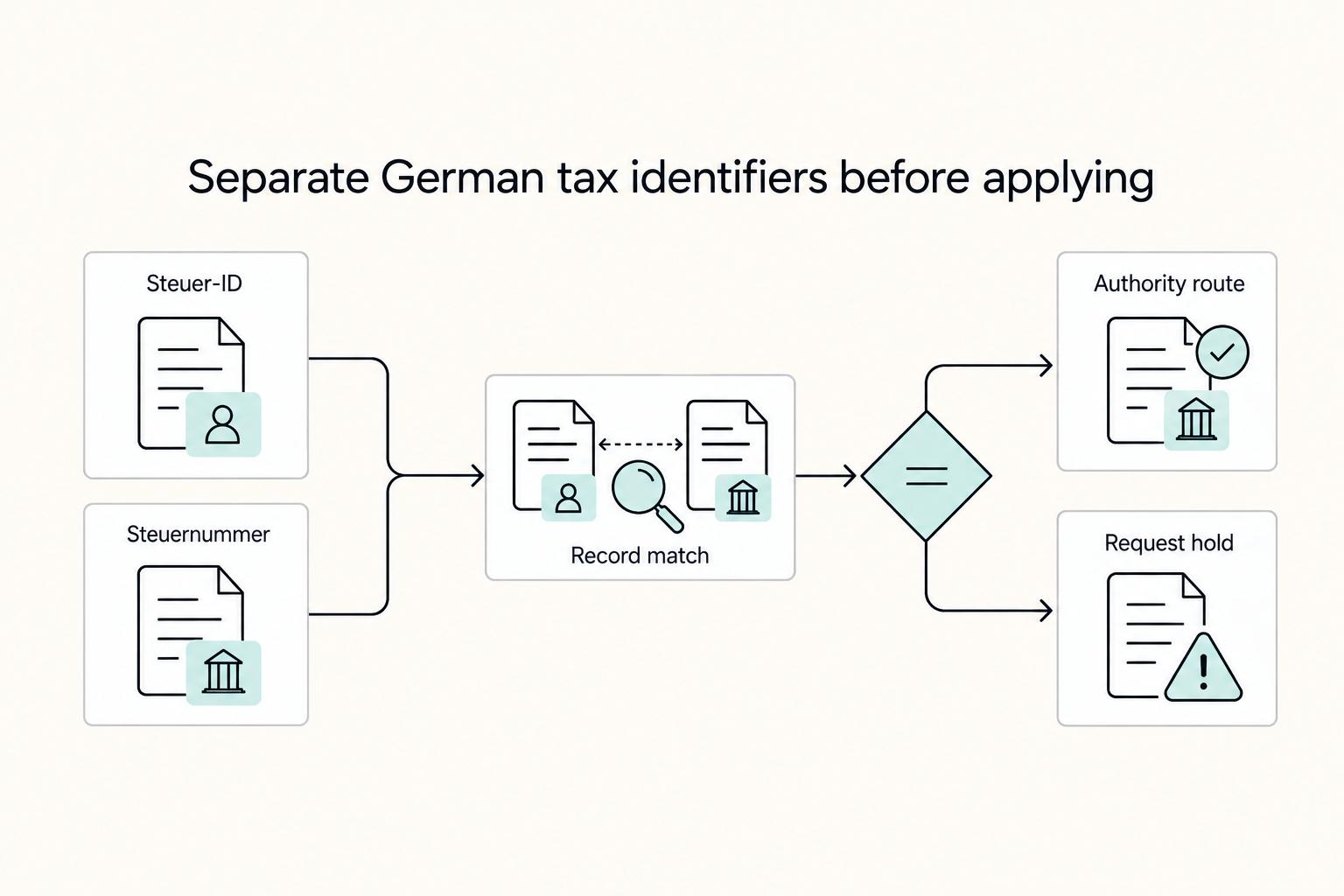
How to Get a German Tax ID as a Freelancer Without Mix-Ups
Define the task before you open any form. In Germany, mix-ups usually start when a request goes out for the wrong number type or to the wrong office.