
Quick Answer
Start with a net-first quota built in three layers: Survival Baseline, Stability Target, and Growth Goal. For how to set sales quotas in a SaaS team or solo operation, first cover non-negotiable costs and known leakage, then add planned buffer and future-you contributions, and only then set expansion targets. Manage the plan with activity signals you control, like qualified opportunities and proposals, instead of relying on gross revenue alone.
Why Corporate Quota-Setting Fails a Solo Business#
If you are figuring out your quota for a solo business, do not start with standard corporate quota logic. Corporate quota setting is built to allocate a company revenue goal across business units, teams, and sellers. As a solo operator, you still need to test whether that logic fits your own cashflow, capacity, and downside risk.
| Corporate quota assumption | Business-of-One reality |
|---|---|
| Ownership model: top-down targets across teams and sellers | You own both revenue and the consequences |
| Metric focus: attainment against assigned revenue goals | Net cash left after real costs may matter more |
| Planning horizon: often reset from prior performance | Your target should reflect current demand and your actual capacity |
| Risk handling: historical methods can create a performance-penalty cycle | A miss can affect your personal cashflow directly |
| Accountability loop: formal scorecards and reviews | You need a simple self-review you will actually maintain |
Step 1: Reject team math that ignores your current conditions. Corporate methods often begin with top-down allocation and historical performance. Even the common "last year plus 10 percent" reset can become a trap. If your target rises just because you had one strong period, you can recreate a performance-penalty cycle in your own plan. Checkpoint: if you cannot explain why the number fits your current pipeline, offer mix, and capacity, it is not your number yet.
Step 2: Replace gross targets with targets you can actually keep. A gross goal can miss real operating costs and non-billable workload. That failure mode is simple: you can "hit quota" and still come up short on cash.
Step 3: Protect capacity before you chase stretch. A solo quota that assumes constant maximum output can turn normal variability into burnout risk. If a target requires peak pace every month, lower it or split it into baseline and growth layers.
Step 4: Use your quota as a risk-control tool first. In companies, quota design is tied to performance tracking and growth planning, and one approach does not fit all situations. For a solo business, prioritize controllability and reliable cashflow first, then growth.
If you want a deeper dive, read How to Calculate Your Billable Rate as a Freelancer. Want a quick next step? Try the free invoice generator.
Tier 1: Calculate Your Survival Baseline From Net Needs#
Your Tier 1 quota is your minimum monthly revenue to stay operational. Set it from net needs, not gross revenue, so essentials, operating costs, and known leakage are covered in cash.
Before you start#
Collect your last 3 months of bank statements, card statements, accounting reports, invoicing reports, and payment-processor summaries. If any input is estimated or pending, label it as an assumption and add a review date.
Step 1: Map costs into three buckets#
| Bucket | What belongs here |
|---|---|
| Personal essentials | rent or mortgage, utilities, groceries, transport, insurance, minimum debt payments, and other non-optional household costs |
| Business operating costs | software, bookkeeping, legal/accounting support, business insurance, hosting, CRM, workspace, and contractor support required to deliver work |
| Revenue leakage costs | tax reserve, payment-processor fees, currency conversion losses, transfer fees, and other deductions removed from incoming revenue before you can use it |
If you invoice internationally, use payment processors, or pay subcontractors from project income, this third bucket is mandatory. If you cannot tie a line item to a statement, invoice, or processor report, keep it marked as an assumption.
| Target type | Decision quality | Cashflow reliability | Risk exposure |
|---|---|---|---|
| Gross revenue target | Can look simple but hides what leaves your account later | Lower: you can hit target and still miss cash needs | Higher: fees, taxes, and true-ups show up after planning |
| Survival baseline target | Built from obligations you must actually cover | Higher: reflects what you need to keep operating | Lower: known deductions are included upfront |
Step 2: Adjust for overhead you do not fully control#
Update assumptions with current conditions, not old rules of thumb. Recheck any recent changes in tax position, insurance, processor pricing, or cross-border costs before finalizing this tier.
Step 3: Calculate and verify#
Survival Baseline = Personal essentials + Business operating costs + Verified monthly revenue leakage costs
Only move to Tier 2 when all are true:
- every line item has source support or is clearly marked as an assumption with a review date
- you know which costs are fixed and which vary with revenue
- the total covers what must be funded before stability buffers or growth spend
Related: How to Create a Sales Playbook for Your SaaS Team.
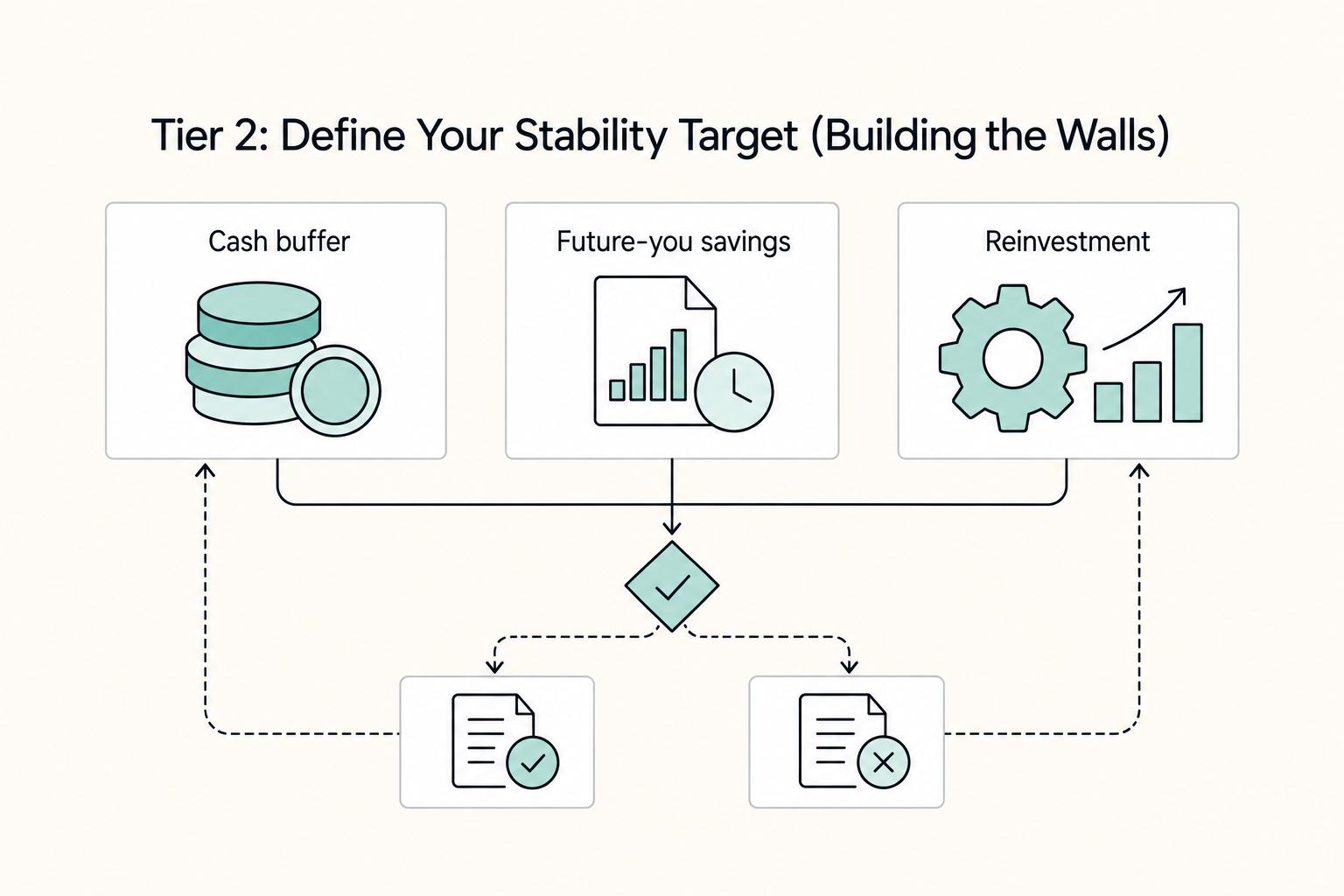
Tier 2: Define Your Stability Target (Building the Walls)#
Once your survival baseline is stable, the next move is to make resilience a monthly policy, not a hope. Your stability target adds three non-negotiable line items so routine disruption does not force reactive decisions.
| Line item | What to add | Rule |
|---|---|---|
| Cash buffer | Confirm the current reserve target from finance records, converted into a monthly contribution from collected revenue | Keep this separate from day-to-day operating cash so it is not accidentally spent |
| Future-you savings | Confirm the current future-you savings target from source records, then add it as its own monthly line item | Treat it as a required transfer |
| Reinvestment | Confirm the current reinvestment allocation from policy records | Define what counts as reinvestment, what does not, and who approves it |
At this tier, a net-profit-based quota is more useful than a gross target. You are deciding what must be funded every month before you set growth goals.
Step 1: Set a monthly cash-buffer rule. Verify the current reserve target from finance records, then convert it into a monthly contribution from collected revenue. Keep this separate from day-to-day operating cash so it is not accidentally spent.
Verification check: one dedicated account, one current target amount, and one monthly transfer rule. If Tier 1 still includes major assumptions, keep this contribution provisional and review it after those numbers are verified.
Step 2: Make future-you savings required. Verify the current future-you savings target from source records before adding it as its own monthly line item. Do not leave this to whatever remains at month-end.
If this stays optional, it will usually be skipped when collections are late or scope expands. Treat it as a required transfer.
Step 3: Define reinvestment in advance. Verify the current reinvestment allocation guidance from policy records so capacity upgrades are planned, not improvised. The key decision is policy clarity: what counts as reinvestment, what does not, and who approves it.
These non-negotiables keep month-to-month performance comparable instead of resetting your rules each cycle.
| Target model | Cashflow shock readiness | Decision flexibility | Growth capacity |
|---|---|---|---|
| Survival Baseline only | Covers known obligations, with limited room for delays or surprise costs | Lower. Cash pressure can force poor-fit decisions | Limited because upgrades compete with essentials |
| Stability Target | Adds planned buffers on top of baseline coverage | Higher. You have room to absorb slow collections and say no to risky work | Stronger because reinvestment is pre-funded |
Use this worksheet formula:
Stability Target = Survival Baseline + reserve-target contribution verified from finance records + future-you savings target verified from source records + reinvestment allocation verified from policy records
Use this implementation checklist:
- fund in order: survival baseline, then cash buffer, then future-you savings, then reinvestment
- automate transfers for amounts you have already verified
- review monthly against collections, balances, and missed transfers
- if one category is repeatedly skipped, lower the target or re-sequence before treating the quota as reliable
Once this number is working in practice, you can set growth goals without turning growth into a rescue plan.
We covered this in detail in How to Calculate and Manage Churn for a Subscription Business.
Tier 3: Set Your Growth Goal (Expanding Your Territory)#
Set growth goals only after Tier 1 and Tier 2 are reliably funded. That order keeps growth from creating more sales activity while leaving the same cashflow risk in place.
Anchor the growth goal in capacity you can verify#
Define a measurable quota for a specific period, then pressure-test it against real operating limits. Build your growth goal from the core inputs you already track in your CRM or pipeline:
| Input | Verify from your last period |
|---|---|
| Deal value | your typical closed deal value |
| Cycle pace | your sales cycle from qualified conversation to signed work |
| Win rate | what share of qualified opportunities closes |
| Delivery capacity | how much new work you can deliver without harming timelines, quality, or collections |
Use one consistent historical view, and verify the current lookback window from source records before labeling it in the quota model. Avoid using a single standout period as your baseline, and avoid a fixed uplift on last year's number when your account mix, motion, or delivery load has changed.
Verification check: can you answer these from your last verified period? What is your typical closed deal value? How long is your sales cycle from qualified conversation to signed work? What share of qualified opportunities closes? How much new work can you deliver without harming timelines, quality, or collections?
If the goal depends on cycle timing that cannot close in-period, or on capacity you do not have, reduce the goal or extend the period.
Convert the outcome goal into activity quotas you control#
Treat revenue as the lagging result, then manage the leading actions in your pipeline. Translate the growth outcome into weekly activity quotas you can influence:
- pipeline coverage based on your verified conversion path
- qualified conversations, not raw lead volume
- proposals sent
- follow-up cadence for open opportunities
Make qualification explicit in your CRM so "qualified" means the same thing every week. If conversations rise but qualified opportunities do not, fix qualification criteria or sourcing before increasing volume.
Run a weekly review against your in-period quota: stage counts, deal age, proposal output, and stalled follow-ups. If attainment risk appears mid-period, correct early instead of waiting for month-end.
If you want a practical review structure, How to Set and Track KPIs for Your Freelance Business is a useful companion.
Set commit, target, and stretch ranges from verified variance#
Use commit, target, and stretch as operating ranges based on verified historical variance, not fixed uplift percentages. Each tier should define workload, risk, and when to intervene.
| Goal tier | Required activity level | Capacity risk | Trigger for correction |
|---|---|---|---|
| Commit | Activity pace you have already sustained in normal periods | Low when current delivery load is stable | Weekly activity pace misses or qualified conversations slip |
| Target | Strong execution across coverage, proposals, and follow-up | Moderate when delivery or collections are tight | Proposal pace or win-rate trend drops below verified norm for the review period |
| Stretch | Sustained high activity plus exceptional conversion | High unless spare capacity or support is already in place | Backlog grows, cycle pace slows, or follow-up quality declines |
Plan operations around commit. Treat target as a strong but controlled result. Use stretch only when pipeline quality and delivery capacity are both verified.
If stretch behavior starts causing skipped stability transfers, delayed invoicing, or poor-fit client acceptance, step back to target or commit so growth does not weaken cashflow.
You might also find this useful: How to set up 'Stripe Tax' for automatic sales tax calculation.
Conclusion: Your Quota Isn't a Target; It's Your Autonomy, Codified#
The FAQ covers edge cases. The core rule is simpler. Your quota should cover non-negotiable costs first, then fund stability, then support growth you can actually deliver. If you remember one thing from this guide, make it this: start net-first, not gross.
Step 1 Protect what you cannot miss#
Set Tier 1 around your net profit quota, meaning what you keep after taxes, fees, and core business costs. This is your non-negotiable floor. If your results are not covering that floor, treat it as an immediate warning, even if your top-line number looks healthy.
Step 2 Fund stability on purpose#
Add Tier 2 only after the baseline is real. This is where you fund reserves, retirement, or similar buffers as planned costs, not leftovers. Keep one simple plan document with your assumptions. Then compare it against your quota report, payout statements, and a short KPI view of qualified opportunities, proposals sent, and close results.
Step 3 Set growth from evidence, not mood#
Tier 3 is where ambition belongs, but only if your own pipeline and results support it. Use an Activity Quota for controllable inputs like proposals sent or qualified opportunities created, then recalibrate from updated performance data. If a pricing change, new offer, or team change turns your spreadsheet into a month-end scramble, your target is not stable enough yet.
| Decision lens | Gross revenue target only | Net profit quota | Activity quota |
|---|---|---|---|
| Metric used | Headline revenue | Revenue kept after taxes and fees | Proposals sent, qualified opportunities |
| Primary focus | Top-line target | Survival first, then Stability, then Growth | Controllable execution inputs |
| Review artifacts | Revenue totals | Plan document, quota report, payout statements | KPI view of activities and outcomes |
| Failure mode to watch | Misleading confidence from top-line numbers | Disputed figures and low trust if calculations are unclear | Fire drills and weak behavior signals when tracking breaks |
Next, put your three-tier quota in writing and review it against your planning period. Keep the number, the assumptions, and the activity signals visible, then adjust from your own results.
For a step-by-step walkthrough, see How SaaS Teams Set Pricing and Packaging for International Markets.
Frequently Asked Questions
How do I set a quota for myself or a tiny SaaS team that invoices clients?
Start here when you need one operating number for a monthly, quarterly, or yearly period. Define whether that number is revenue- or profit-based, then set it at a challenging but attainable level using your own historical data and current capacity. Track pipeline health, qualified opportunities, follow-up activity, and delivery capacity each week. Avoid copying last period’s number by default, especially if it came from incomplete data or one-size-fits-all assumptions.
How do I calculate a realistic quota for consulting, services, or a small client-facing SaaS motion?
Use this when your revenue comes from signed deals, retainers, onboarding fees, or service packages rather than pure self-serve volume. Start with required closed revenue for the period, divide by your verified average deal value to estimate deals needed, then work backward through your own close pace to estimate qualified opportunities needed. Review new qualified opportunities, stage movement, average deal value drift, and deal age in CRM each week. Keep assumptions tied to a consistent historical lookback, not memory.
How do I account for taxes, payment fees, and cash reserves in the quota?
Use this when billed revenue and usable cash can diverge. Build the quota from the money you actually need to keep, then add your verified business expenses, payment fees, tax reserve, and planned cash-buffer contribution only after the current fee and tax-reserve assumptions have been verified from processor and finance records. Check collected cash versus invoiced revenue, payment fees by processor, overdue invoices, and whether reserve transfers are actually happening each week. A quota that works only on paper can fail at collections.
What counts as a good quota for a solo operator or a small SaaS team?
A good quota covers current obligations and stays achievable with your actual capacity and sales motion. “Challenging but attainable” is the useful test, not social proof from another founder, rep, or agency. Each week, look for slippage in close pace, average deal value, follow-up quality, and delivery load. If hitting the number requires delaying invoicing, skipping your tax reserve, or overloading delivery, lower it or extend the period.
How do I set goals without a manager, or across a very small team?
Use this when you need accountability but do not have a sales leader building targets for you. Break the larger goal into monthly targets, then assign quotas at the person level if roles, territories, or deal types differ. Review each person’s qualified pipeline, activity quota, and close pace against the same definitions, not vague effort. If one rep has a longer cycle, lower average deal value, or a different territory, identical quotas can hide a design problem rather than a performance problem.
Should I use a revenue quota or a profit quota?
Use revenue when you need a simple top-line production number. Use profit when selling expenses, fees, and cash retention materially affect whether the work is worth winning. For revenue quotas, track closed revenue and other relevant KPIs; for profit quotas, track profit as revenue minus selling expenses plus cash collection quality. If your unit economics vary meaningfully across clients, plans, or service packages, use profit as the decision number and revenue as a supporting view. | Quota type | When to use | How to calculate | What to track weekly | | --- | --- | --- | --- | | Revenue quota | When top-line bookings or billings are the main constraint | Sum the closed revenue required for the period | Closed revenue and the leading KPIs you use to forecast delivery | | Profit quota | When selling expenses or delivery costs can make revenue misleading | Start with revenue, then subtract selling expenses and verified cost lines | Profit (revenue minus selling expenses), collected cash, and cost drift |
Try a related tool
Researched and edited by the Gruv editorial team. Gruv builds cross-border billing, payouts, and finance-operations software for global businesses.
Sources
Includes 1 external source outside the trusted-domain allowlist.
- bis.gov/regulations/ear/774trusted
- ftc.gov/sites/default/files/documents/reports/aggreg...trusted
- parks.wa.gov/sites/default/files/2026-03/SW-C2023A%20Twan...trusted
- pmc.ncbi.nlm.nih.gov/articles/PMC5426327trusted
- repository.upenn.edu/server/api/core/bitstreams/26068db8-01ad-422...trusted
- scholar.smu.edu/cgi/viewcontent.cgitrusted
- sec.gov/Archives/edgar/data/1500435/0001500435250000...trusted
- business.kaiserpermanente.org/content/dam/kp/ccp/documents/health-plans/gu...external
Educational content only. Not legal, tax, or financial advice.
Related Posts
How to Calculate a Freelance Rate You Can Actually Get Paid On
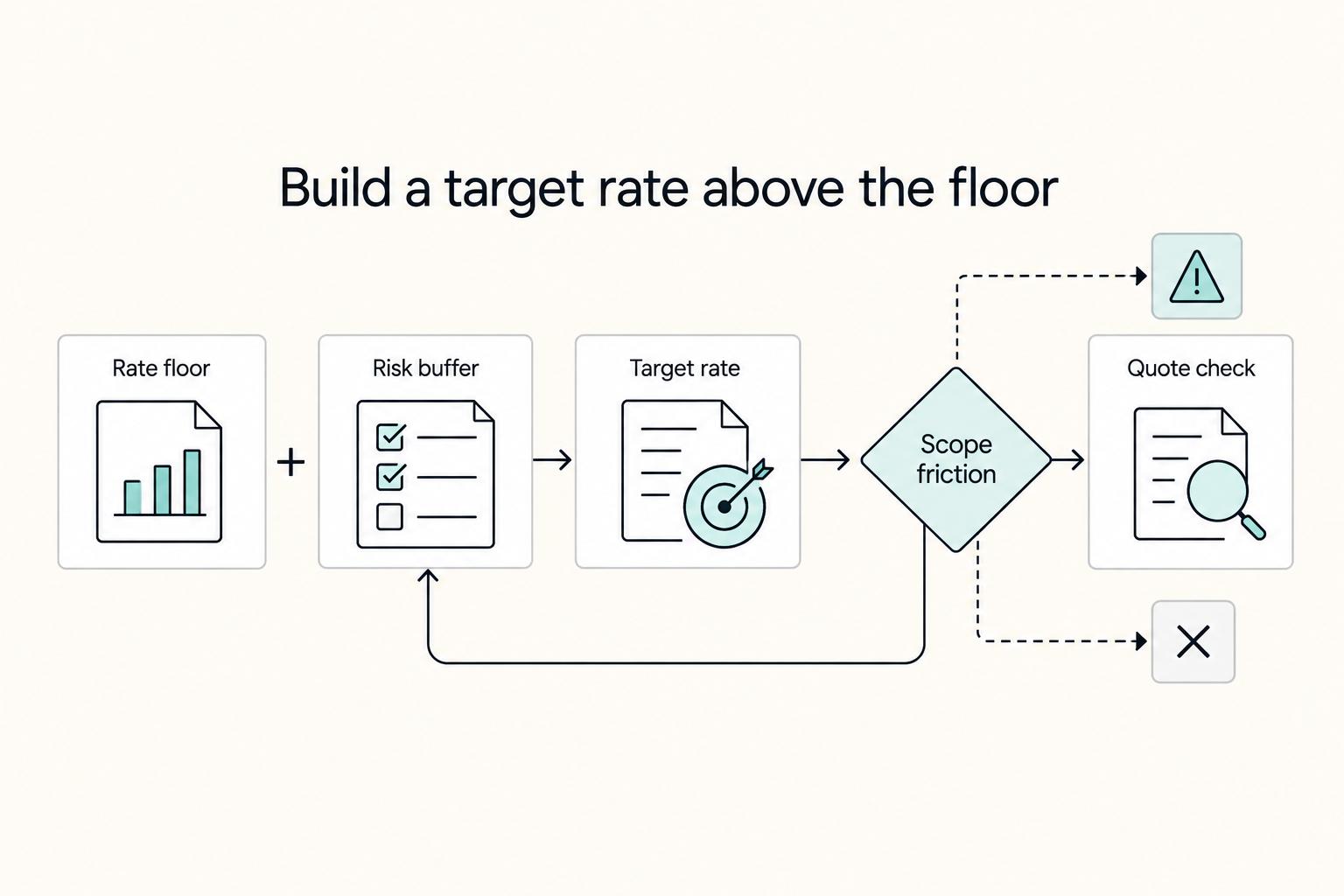
A workable rate is not the neat number a calculator produces. It is the number that still works after you account for real billable capacity, non-client time, scope drift, and the gap between sending an invoice and receiving cleared cash. Start with hourly math even if you do not plan to bill hourly, then turn that number into a quote with clear `payment terms`.

How to Set and Track KPIs for Your Freelance Business
Better decisions matter more than more metrics. The practical goal is to finish each review knowing what to change next, who owns that change, and when you will verify whether it worked.
How to Create a Sales Playbook for Your SaaS Team
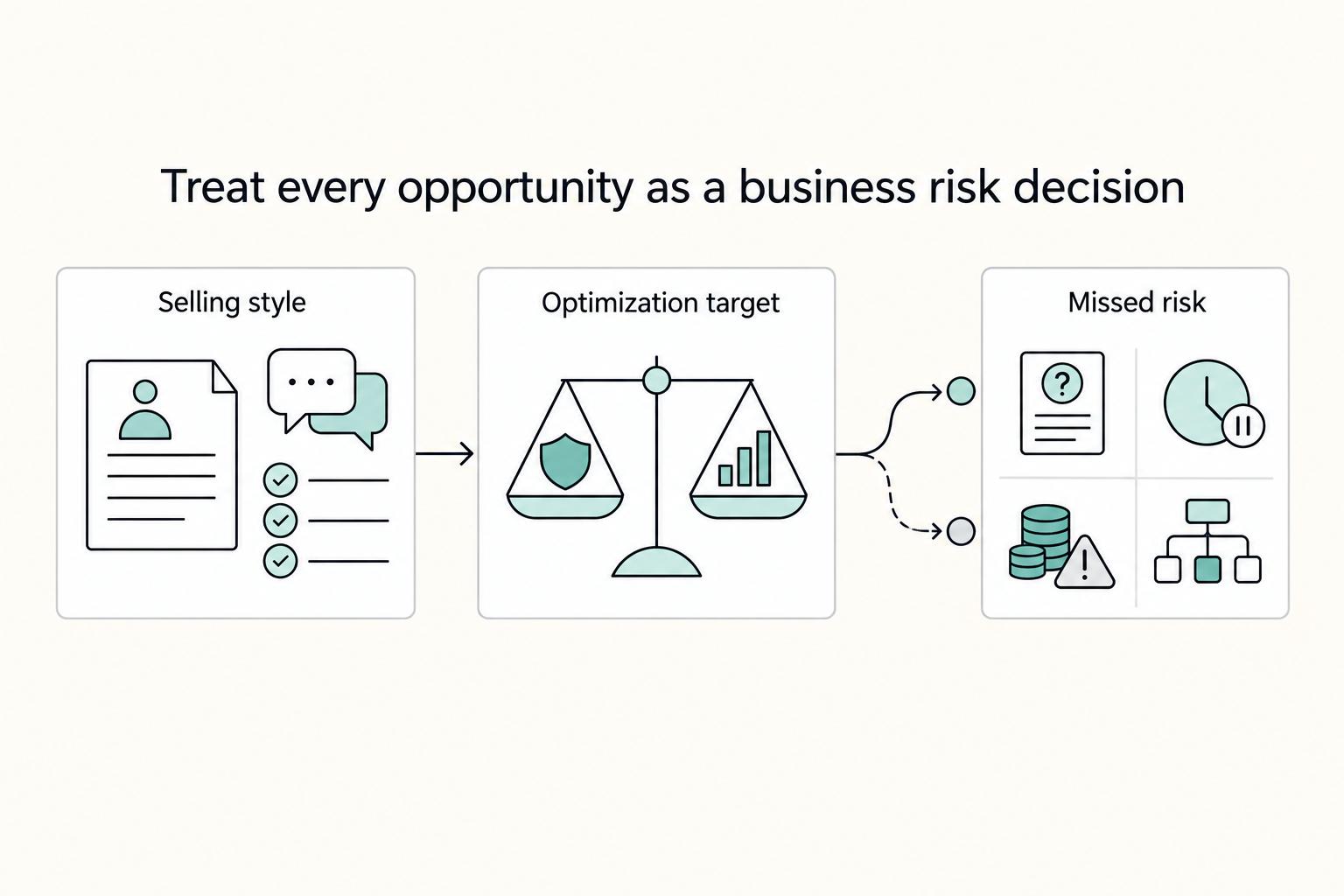
A sales playbook can help you avoid the wrong deal, not just win the right one. Treat each opportunity as a business risk decision first and a sales opportunity second. If you take on a prospect who is wrong for your offer, the impact often shows up later: unclear expectations, slower payment, rushed delivery, and product decisions shaped by the wrong customer.