
Quick Answer
Set freelance financial goals by building a repeatable get-paid system, not just setting bigger revenue targets. Start with protective policies (tax reserve, low-month buffer, account separation), then run a weekly cashflow scorecard and a pre-client risk check on every project. Use deposits, milestone terms, and a consistent invoice follow-up ladder so payment timing and risk are controlled before problems escalate.
Set financial targets and the routines that support them#
Set a measurable target and the quoting, spending and collection habits that support it. Build a plan you can use when delivery is busy and income arrives unevenly.
A solid system tells you what to say yes to, what "done" means, and how you handle the admin that keeps money moving.
Step 1: Turn "goals" into purpose, then into policies#
Write the purpose of the business in one sentence, then choose outcomes that support it. Connect revenue targets to the time, costs and cash timing required to deliver the work.
Do this in order, so you end up with rules you can execute:
- Write your purpose in one sentence. Example: "I deliver high-quality client work without wrecking my capacity."
- Choose targets you can measure weekly. Keep it tight: revenue you bill, what you keep after costs, and a couple of operational targets, like how much time you spend on delivery vs admin.
- Convert each target into a practical policy. Define the action, timing and exceptions, such as reviewing due invoices on Monday and limiting new commitments when forecast cash is below your minimum.
Here's the translation layer you'll use as you set targets:
| Goal category | Track weekly | Policy that makes it real |
|---|---|---|
| Revenue targets | Work billed/sent | Decide your quoting and scope boundaries before you commit |
| Profit goals | Key business costs | Set a simple spending rule you can stick to |
| Capacity | Delivery hours vs admin | Block non-negotiable time for admin and recovery |
| Predictability | What slipped and why | Add one "prevent this next time" rule after each miss |
Step 2: Install a simple client loop (with a quick sanity check)#
Run this loop on every client. Make it your default.
| Loop step | Focus | Article detail |
|---|---|---|
| Gate the start | Get clarity in writing | What you're doing, what "done" means, who signs off, and what happens when the work changes |
| Sanity-check the risk | Ask the same fast questions | Is the work clear enough to start? Is the timeline realistic? Do you trust the communication? Are your start conditions accepted? |
| Execute the workflow | Use the same trigger each time | Handle billing, reminders, and tracking what was agreed; keep the essentials in one place |
Step 1: Gate the start. Before you begin, get basic clarity in writing: what you're doing, what "done" means, who signs off, and what happens when the work changes.
Step 2: Sanity-check the risk. Ask a few fast questions you can answer consistently: Is the work clear enough to start? Is the timeline realistic? Do you trust the communication? Are your start conditions accepted?
Step 3: Execute the workflow. Use the same trigger each time to handle the admin you tend to avoid: billing, reminders, and tracking what was agreed. Keep the essentials in one place so you're not reconstructing history from memory.
Hypothetical scenario: a new client wants to "start Monday" but won't confirm deliverables in writing. Your system makes the call for you: no clarity, no kickoff. You do not second-guess it.
Before you start: prep your inputs (so your goals aren't fiction)#
Collect a clean baseline of real cash movement, then organize it so you can measure, repeat, and defend your decisions.
If your inputs are messy, your goals turn into wishful thinking. Your targets drift away from what your bank balance can actually support.
Step 1: Gather your "money truth" (a recent, representative window)#
Pull a recent slice of your finances that reflects how you actually operate, not your best month ever. You are building a usable starting line, not a perfect audit.
Use this data map to pull what you need and capture it consistently:
| What you need | Where to pull it | What to capture |
|---|---|---|
| Invoices sent | Invoicing tool | invoice ID, issue date, due date, amount, client |
| Payments received | Business bank statements | deposit date, amount, payer name, reference/memo |
| Platform income | Platform exports (often labeled Payouts) | payout ID, settlement date, net amount, fees |
| Fee leakage | Processor/platform reports | processing fees, FX charges, refunds |
| Refunds/chargebacks | Processor/platform logs | date, reason code (if shown), amount |
Allocate payments to invoices using transaction detail. A receipt can cover multiple invoices; an invoice can receive partial payments; a payout can combine receipts less fees and refunds. Reconcile those allocations rather than requiring one bank line per invoice.
Step 2: Separate accounts and paperwork so you can operate weekly (not scramble yearly)#
If it fits your situation, separate your money flows, for example one account for operating cash and another you treat as a tax reserve. This keeps planning simpler, reduces missed transfers, and gives you cleaner records when someone asks, "What happened here?"
Next, create a client folder template, one folder per client, and drop in the docs you actually rely on to prevent scope and payment disputes.
Finally, choose your year-end tax paperwork stance early. If you are an employee, employers use Form W-2 (Wage and Tax Statement) to report wages paid and furnish it to you and the Social Security Administration, which shares the information with the IRS. If you are an independent contractor, payers may use Form 1099-NEC (Nonemployee Compensation) to report certain payments, including when payments total $600 (and $2,000 for payments made after December 31, 2025). Track which forms you expect from payers, and keep your records organized so year-end paperwork does not turn into a reconstruction project.
5-minute practical check: Can you answer, from records, "Which three clients paid slowest, and what terms did I agree to?" If not, set your first goals to visibility before growth.
Hypothetical scenario: you feel tempted to set aggressive revenue targets, but you cannot tell whether late payers cluster around net-30 terms. You pause goal-setting, standardize your invoice naming, and rebuild your baseline. That move prevents you from scaling chaos.
Step 1: Lock in the non-negotiables (tax reserve, buffer, and clean separation)#
Treat your goals as protective policies first: taxes, a buffer for volatility, and hard separation between business cash and personal spending.
These guardrails keep your plan intact the first time a client pays late or a tax bill lands.
1) Set a tax reserve policy you can execute#
Pick a repeatable reserve rule, then refine it to your jurisdiction and your real tax situation. You will see people throw around simple rules of thumb online. Use those only as a temporary placeholder if you lack a better number.
Replace it with a figure based on your own situation, and professional advice where needed.
Verification point: before you take owner pay, you can show that you already moved money into a dedicated tax reserve bucket.
2) Write a low-income-month buffer policy (with triggers)#
Plan for low-income months using your own receipts and known client concentration. Billed revenue can look healthy while a large unpaid invoice leaves cash tight.
Define:
- Buffer minimum: your baseline bills and commitments, using the period that fits your risk tolerance.
- Trigger rule: if the buffer drops below your minimum, you pause optional spend and tighten terms, for example by requiring deposits on new work until you rebuild.
Hypothetical: a reliable client slips payment timing by a few weeks. Your buffer trigger activates, you stop discretionary tooling upgrades, and you require a deposit for any new scope. You stay calm because the policy already made the decision.
3) Separate accounts to contain risk and stop "phantom profitability"#
Separate business transactions from personal spending so costs, tax allocations and owner withdrawals are visible.
For French micro-entrepreneurs, Service Public distinguishes a dedicated account from a professional-account package. The general micro rule applies when annual turnover exceeds €10,000 for two consecutive years; commercial activity has a separate dedicated-account obligation regardless of that threshold. Check your activity and the bank’s account terms.
Either way, separation stops you from confusing "cash that arrived" with "cash you can spend."
| Bucket | Purpose | Default rule |
|---|---|---|
| Business account | Collect client payments, pay business expenses | No personal spending here |
| Tax reserve | Hold money you do not touch | Fund it before owner pay |
| Owner pay (personal) | Your living costs | Pay yourself on a set cadence |
Verification point: you can explain every transfer in one sentence: what it was, why you moved it.
4) Make retirement and benefits a cashflow goal#
If US retirement rules apply, compare a SEP and one-participant 401(k) with your earnings, employee status and cash needs. Use current-year rules rather than past-year headline limits.
Two examples the IRS highlights:
- SEP, US 2026: the dollar ceiling is $72,000, subject to compensation and plan rules. Self-employed owners need the special calculation, commonly a reduced 20% rate rather than simply 25% of Schedule C profit.
- 401(k), US 2026: the basic elective-deferral limit is $24,500, with age/plan-specific catch-up provisions and separate combined limits. Use IRS Publication 560 for the actual calculation.
And if you choose a SEP, the IRS also notes you can set it up for a year as late as the due date, including extensions, of the income tax return for that year.
Plan retirement transfers subject to available cash, eligibility and the actual annual contribution calculation. A percentage of receipts is a budgeting habit, not the tax-law contribution formula.
Step 2: Turn "financial goals" into a cashflow scorecard you can actually run weekly#
Turn your goals into a weekly scorecard that makes the next decision obvious. At its core, this is cash flow: understanding how much money comes in and where it goes so you can plan realistically and avoid the paycheck-to-paycheck scramble.
Each metric should point to a decision: reduce optional spending, follow up on a due invoice, adjust a new quote or rebuild reserves.
1) Define the goal categories (so "growth" doesn't hide risk)#
It is easy to over-focus on revenue and profit. Those matter, but they do not always show whether your timing is tight or whether you are about to run into a cash pinch. One simple way to keep yourself honest is to separate "how much" from "when."
| Goal category | Definition | Weekly question it answers |
|---|---|---|
| Revenue goal | What you bill | "Did I ship billable work?" |
| Cost/profit goal | What you keep after business costs | "Did costs creep up?" |
| Cash flow goal | What comes in and what goes out | "What changed in the way money moved this week?" |
| Timing goal | Whether cash arrives before expenses hit | "Do I have enough cash on hand before the next bills are due?" |
Operator move: note any friction that can slow cash, like approval steps, new client setup, or extra admin. The goal is not perfect labeling. It is to stop treating preventable blockers like "random delays."
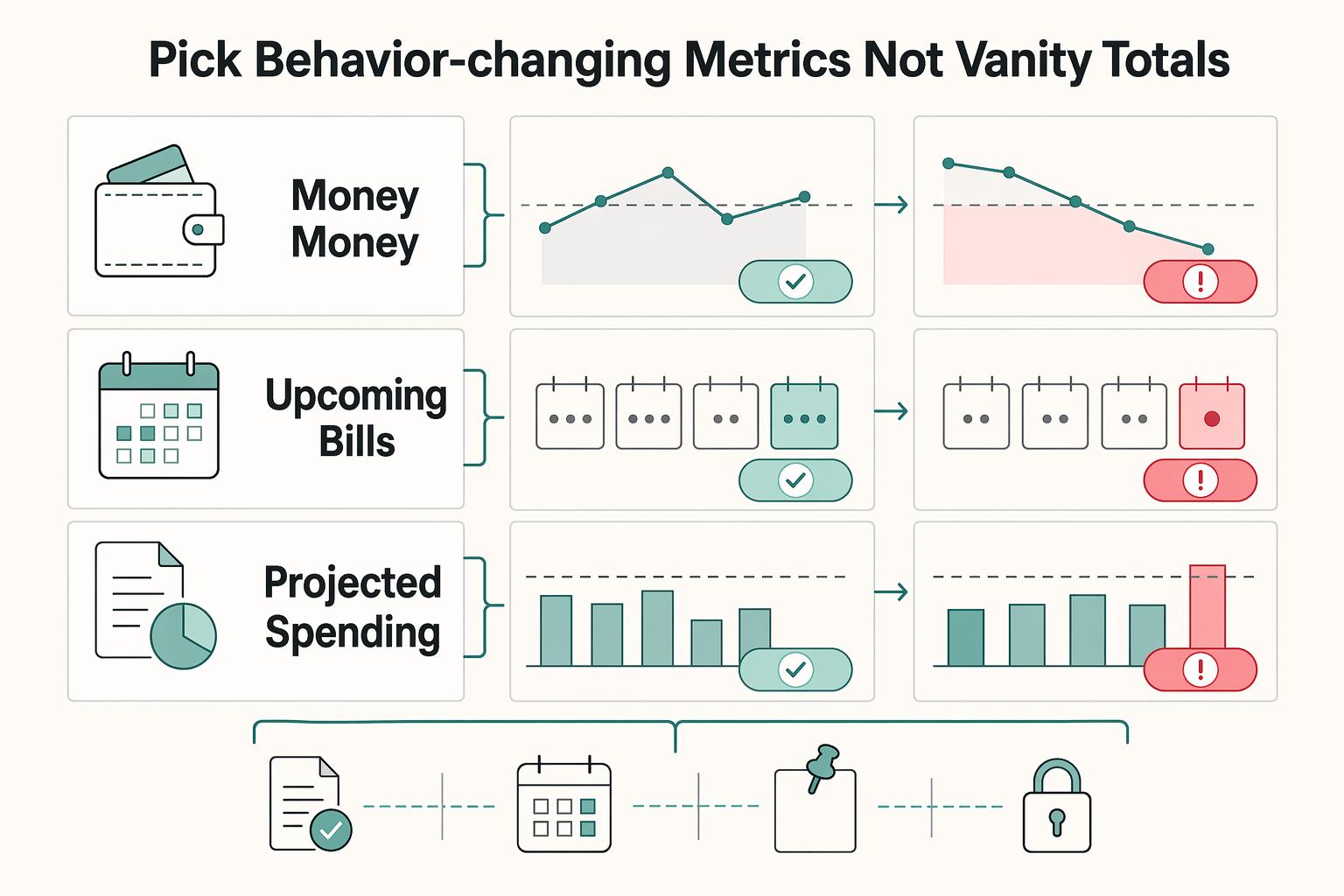
2) Pick behavior-changing metrics (not vanity totals)#
Totals hide the truth. Weekly metrics force action. Keep the list short, then standardize definitions so you can compare week to week.
| Metric | What it tracks | Why it matters |
|---|---|---|
| Money in vs. money out (cash flow) | What came in and where it went | Plan realistically instead of guessing |
| Upcoming bills and expected income | What is due soon and what you expect to receive | So nothing surprises you |
| Projected spending-account balance | How your spending-account total changes over time | A forward-looking estimate based on entered bills and expected income |
If the forecast falls below your minimum, reduce optional spending and follow up on due receipts. Change milestone timing only where the contract permits it or the client agrees; do not unilaterally invoice early.
Verification point: explain each metric in one sentence and identify the action it informs.
Practical check: if you cannot update the scorecard quickly on Monday, simplify. The scorecard should help you fix cash flow, not create more work hunting for numbers.
Calculate a target and test cash timing#
Hypothetical monthly plan: $3,000 owner pay, $1,000 business costs, $1,000 tax reserve and $500 buffer rebuilding require $5,500 usable cash. These are planning allocations, not a tax calculation. With 3% collection costs and no other deductions, required gross collections are about $5,670 ($5,500 ÷ 0.97). At 80 available billable hours, that implies about $71 per hour; confirm pricing and workload can support it.
| Next two weeks | Expected case | Late-payment case |
|---|---|---|
| Opening usable cash | $4,000 | $4,000 |
| Client receipt | $3,000 | $0 |
| Bills and owner draw | −$4,500 | −$4,500 |
| Closing usable cash | $2,500 | −$500 |
With a $2,000 minimum usable-cash target, the expected case passes. The late-payment case needs $2,500 of funding or agreed spending/timing changes. Follow up and defer optional spending before adding commitments. Do not treat protected tax reserves as freely spendable or assume taxes and subcontractor bills can wait. Update the forecast when cash arrives.
What financial goals should you prioritize first (so you don't build on sand)?#
Prioritize known obligations, a reliable cash forecast and clean payout records. Track US information returns where applicable before expanding subcontracting; these forms do not apply to every freelancer worldwide.
If you want a simple operator rule: clean up the paperwork first, then turn up the volume.
Track the forms that map to how you pay people#
- If you pay employees, employers use Form W-2 (Wage and Tax Statement) to report wages paid to an employee. Employers furnish Form W-2 to the employee and the Social Security Administration (SSA), and the SSA shares that information with the IRS.
- If you pay nonemployees in your business, the IRS notes that payers use Form 1099-MISC and/or Form 1099-NEC to report certain payments and to report any amount of federal income tax withheld under the backup withholding rules.
If you subcontract, make recordkeeping part of the goal#
Add targets for: (1) clear payment timing, (2) signed agreements, and (3) audit-ready payout records. Keep clean Payouts logs and track whether you may need Form 1099 reporting.
For US business reporting, identify the payment type and year before applying a threshold. Check IRS instructions for corporate-payee and payment-settlement exceptions.
| Threshold | Payment type | Article note |
|---|---|---|
| $10 or more | 1099-MISC royalties and specified substitute payments | Not an ordinary service-fee threshold |
| $2,000 or more in 2026 | Generally reportable NEC service payments and specified MISC categories | Check payment type, payer/payee and settlement exceptions |
| $600 or more | 1099-MISC gross proceeds paid to an attorney | Distinct from attorney service fees; not universally $2,000 |
For a step-by-step operator playbook, use Hiring Your First Subcontractor: Legal and Financial Steps.
Practical check: if one large client pays late, can you still cover taxes plus baseline bills from your buffer? If not, your next move is stability, buffer and tighter terms, not lead gen.
How do you decide if a client is financially safe to work with? (10-minute go/no-go scorecard)#
Run the same short risk scorecard before every kickoff, and let the scorecard decide your terms or your "no," not your excitement.
This is how you protect cash timing and payment certainty before you get emotionally committed.
Step 1: Run the pre-engagement risk check (before you feel committed)#
Open a doc, set a 10-minute timer, and check these four boxes. If you can't check them, don't "hope it works out." Tighten the terms or walk.
| Scorecard item | What you want to see | If it's missing, do this |
|---|---|---|
| Contract readiness | A signed SOW (or equivalent) that states scope, milestones, and acceptance criteria | Convert "verbal yes" into written milestones. Don't schedule kickoff until they sign. |
| Legal clarity | Clear agreement on the basics of how disputes would be handled (whatever you and the client decide to document) | Ask directly: "If there's a dispute, where does it get handled?" Write down the answer in the contract or SOW if that's how you're operating. |
| Payment protection | Terms that cap your "max exposure" (upfront payment and/or smaller paid milestones) | Break work into smaller, paid checkpoints. Tie each checkpoint to a deliverable and acceptance. |
| Payment method | A supported method with understood fees, settlement timing and applicable dispute/return rules | Offer two options and state the fee and confirmation details upfront. |
Hypothetical: a new brand wants a fast turnaround, but they also want to "sort paperwork later." Your scorecard fails on SOW and payment protection. You respond with a smaller first milestone plus upfront payment to book the slot. If they resist, you just learned what month two will feel like.
Step 2: Lock in compliance and tax basics early (so money doesn't stall later)#
Treat onboarding paperwork as part of getting paid.
- US-based clients: collect whatever vendor onboarding details and tax paperwork they require before they can pay you.
- Cross-border: ask what documentation they require before they can pay, and who handles any relevant indirect taxes, where applicable. If a client asks for proof of U.S. residency certification, know that the IRS ties that request to Form 8802 ("Application for United States Residency Certification"). If the client mentions Form 6166, see: Form 6166 and IRS residency certification paperwork.
Practical check: if the client fails 2+ items, default to "tighten terms" - higher upfront payment, smaller milestones, shorter net terms, clearer acceptance - or decline. This one policy protects every other goal in your business planning.
Build subcontractor costs and due dates into the forecast before accepting the client project.
If you need a quick next step, try the free invoice generator.
Step 3: Design payment terms that hit your goals (deposits, milestones, and leverage points)#
Agree a payment schedule that fits delivery and collection timing, with clear invoice triggers, due dates and review steps. Deposits and smaller milestones can reduce exposure but do not eliminate every dispute.
The goal is not to sound "tough." It is to make payment routine.
1) Build a milestone ladder that caps exposure (deposit, checkpoints)#
For new work, consider a deposit, named milestones or periodic billing. Agree the schedule before kickoff and connect invoices to the actual triggers.
Run this ladder like an operator:
- If agreed, collect the deposit before reserving the slot or starting affected work. Record the actual start condition.
- Break the project into milestones you can prove. Tie each milestone to a concrete deliverable inside the SOW so it's easy to see what was delivered and what triggers the invoice.
- Keep money moving with a cadence. Bill at milestones, or on a regular cadence like every two weeks, instead of waiting for "the big finish."
- Make it easy to pay. Offer supported methods that fit the parties’ countries, currency and fee arrangements.
Hypothetical: a client wants "one big delivery at the end." You counter with a deposit plus smaller milestones tied to tangible outputs. If they push back, you just found the leverage point that would have turned into month-two cash stress.
2) Reduce ambiguity (revisions, scope, inputs, due dates, follow-up)#
Disputes usually start with fuzziness. Fix it up front.
- Define revision rounds and scope edges. Write what counts as a revision, what counts as "out of scope," and how you quote add-ons.
- Assign responsibilities for inputs. List what the client must supply, access, copy, approvals, and what happens when they stall.
- Set payment due dates as a policy so you stop renegotiating every project. Choose due dates that match your cash-flow goals and the client's risk profile.
- Only include enforcement you'll actually execute. If you name a consequence or follow-up process for late payment, make sure it's something you'll do consistently.
| Lever in your terms | What it protects | What "clear" looks like |
|---|---|---|
| Deposit + milestones | Cash timing, reduced exposure | Payment tied to named deliverables (and/or a recurring billing cadence) |
| Milestone definitions in SOW | Fewer disputes | What "done" means for each checkpoint |
| Scope + revisions | Profit goals, fewer disputes | Included rounds, change process, add-on pricing method |
| Payment methods (ACH + card) | Faster collections | How the client pays, with friction removed |
Practical check: after reading your invoice plus SOW, a third party must answer, without guessing: What triggers payment, when does it come due, and what happens if it runs late?
How do you run an invoice + collections workflow that reduces late payments (without awkwardness)?#
Run a simple, repeatable invoice-to-cash workflow with clear triggers, a pre-written follow-up ladder, and clean records so you never have to wing it in your inbox.
Terms only work if you execute them the same way every time.
Step 1: Set invoice timing rules that remove decision fatigue#
Invoice when the agreed billing trigger occurs, with correct payer details and supporting material. Incomplete or late invoices can delay payment even when delivery is finished.
Apply the billing rules agreed for this client:
- Milestone rule: when you complete a billable milestone, as defined in the SOW, send the invoice promptly as part of your closeout process.
- Deposit rule, where agreed: issue the deposit invoice at its agreed trigger. Follow the recorded start condition and due date; signature alone does not create a deposit obligation.
Operator move: write the trigger into your checklist so you never renegotiate with yourself.
Step 2: Use a calm escalation ladder (firm, not emotional)#
You do not need awkwardness. You need a script and a timeline tied to your terms.
| Stage | When you send it | What you say (keep it boring) | Outcome you want |
|---|---|---|---|
| Invoice + next steps | When the invoice goes out | Confirm due date, payment method, and what you will deliver next | No confusion about "what happens now" |
| Friendly reminder | A few business days later (or near due date) | Reshare the link and ask if AP needs anything | Remove friction, prompt action |
| Firm reminder + consequence | Shortly after due date | Point to the SOW and any agreed work-pause policy (if included) | Create urgency without threats |
| Enforce the gate | If your contract allows and your policy says "stop" | Pause work, resume after payment, escalate per contract and jurisdiction if needed | Protect profit goals and time |
Hypothetical: a client says, "We're processing it." You reply with the same template, reshare the link, and restate what your SOW says. Calm tone, hard boundary.
Reduce friction, not just reminders: double-check invoice accuracy, include a clear way to pay, and offer the payment methods you can support.
Automation can prepare invoices, reminders and status reports. Review amounts, payer details, tax treatment and triggers before sending, and reconcile receipts before marking invoices paid.
Keep invoice status, balance, due date, last follow-up and any dispute together so the next collection action is clear.
Practical check: you should be able to answer "Which invoices are at risk this week?" from one list, invoice status, due date, last touch, not from scattered email threads.
When things go wrong: triage holds, disputes, FX shortfalls, and non-payment#
Define exception triggers and a proportionate response. Check the actual contract and transaction status while preserving scope and supporting records.
If you plan for exceptions, they stay annoying instead of becoming existential.
Before you start (so exceptions stay small)#
Set two policies in advance and you will move faster when something breaks:
- Time-to-cash buffer: forecast receipts separately from invoices and test a downside case. Taxes and subcontractor amounts still fall due under law and contract when your client is late; plan funding rather than automatically postponing obligations.
- Payee clarity: identify the supplier, trading name and authorized receiving account. Explain legitimate aliases or provider collection arrangements and verify changed instructions independently.
Step-by-step: run the exception workflow#
Step 1: Triage the exception and pick the right lane. Tag the issue and choose one next action. Do not mix lanes.
| Exception | What it usually looks like | Your safe next action |
|---|---|---|
| Payout delay or "on hold" status | Funds show as sent, but you do not see cash | Request the transaction reference and actual status; avoid a duplicate payment request while investigating |
| Dispute about scope or acceptance | "This isn't what we wanted" or "we need more rounds" | Distinguish correction from new scope and use agreed change control and any permitted pause |
| FX or cross-border shortfall | "Why is it less than the invoice?" | Ask which rail they used and what currency they sent. Keep proof of conversion or settlement in your reconciliation notes |
| Non-payment | Due date passes with vague replies | Follow reminders and any permitted contractual pause, then the applicable escalation route |
Step 2: Contain disputes with documentation, not debate. A clean paper trail helps: signed SOW, acceptance evidence (email approval, delivered files, recorded walkthrough), and a simple change log. If escalation becomes necessary, your contract terms, including things like governing law or arbitration language when present, can shape the path, so read them while you still feel calm.
Step 3: Design an "FX exposure" rule for every cross-border quote. Define three items in writing: quote validity window, who pays conversion and wire costs, and what happens if the client pays using an unexpected currency or payment path.
For a USD invoice funded from CAD, confirm the sent currency, rate and deducted fees. Canadian EFT and US ACH are different arrangements; neither name guarantees a supported cross-border route or fee-free receipt.
Step 4: Recover fast from the three operator mistakes.
- Started without an agreed deposit: check current terms. Negotiate a deposit or smaller milestones for future work rather than imposing a new gate unilaterally.
- Vague scope: document the agreed interpretation and use a change order for genuine additions.
- Mixed personal and business funds: separate accounts immediately, rebuild your records for tax time, and document every transfer with a memo you can defend later.
If a tweak expands scope, quote the additional work and obtain approval under change control. Require advance payment only if agreed in the new terms. Correct defects owed under existing scope without relabelling them as extras.
Review your targets and operating rules together#
Protect yourself with repeatable decisions, especially around client risk. When things get messy, what saves you is having a default way to respond.
Step 1: Write down the decisions you want to make the same way every time#
Turn fuzzy intentions into plain-language "if this, then that" rules you can actually follow under pressure.
A clearly hypothetical example: you feel excited about a new client, but they keep "forgetting" to confirm how payment will work. Your rule kicks in, and you do not move forward until you get a clear commitment.
Step 2: Treat client risk like a real part of the job#
Look for unclear payer identity, refusal to confirm scope, unrealistic dates or an unusable payment route before committing. Tighten new terms or decline. On an existing contract, follow notice and termination provisions rather than abandoning obligations.
Step 3: Keep growing (without breaking the machine)#
Review retirement funding alongside taxes, operating cash and personal needs using the applicable plan and earnings calculation.
Revisit the plan after income changes or hiring employees. A headline retirement limit is a conditional ceiling, not a required contribution.
If you want one next read, use: Hiring Your First Subcontractor. Other deep dives: Form 6166 and IRS residency certification paperwork and How to Set Up a US LLC from Australia.
Copy/paste checklist (run this on every new client):
- I looked for red flags and decided whether this client is a fit
- If I see clear red flags, I am willing to walk away quickly
- I reviewed my retirement options for self-employment (SEP, 401(k)) and noted my next step
Frequently Asked Questions
How do I set financial goals as a freelancer without overcomplicating it?
Keep it simple: start with your must-pay monthly costs, your cash on hand, and what clients currently owe you. Then decide ahead of time what you will pause or reduce when cash is tight, so you are not making decisions in a panic.
What financial goals should a freelancer prioritize first?
Start with goals that help you stay financially afloat when income is uneven: visibility into cash coming in, cash going out, and what is still outstanding. From there, add goals that make the business sturdier over time, like planning for taxes and building a bit of breathing room for gaps between payments, where possible.
How much should freelancers set aside for taxes?
There is no "universal" percentage that is safe to apply to everyone. A more reliable approach is to build a consistent tax-reserve habit and confirm what makes sense with a qualified tax professional, since rules vary by jurisdiction and your income mix.
How do freelancers manage irregular income during low months?
Some freelancers deal with sporadic paychecks, get paid in lump sums, and can have long stretches between paychecks, so it helps to plan for that reality. Practical approach: make commitments based on cash you have, not just invoices you sent, and set a clear personal rule for when you cut back optional spending.
Should freelancers separate business and personal accounts even if they're just starting?
Yes, because it makes your money clearer fast: what you earned, what it cost to earn it, and what you actually keep. It can also reduce the end-of-year scramble because you are not reconstructing everything from one mixed statement.
How can freelancers reduce late payments and payment risk?
Treat payment clarity as part of the job: use clear written agreements, clear payment terms, and consistent invoicing. If payment slips, follow a consistent process so you are not renegotiating your boundaries every time.
What should I track weekly vs monthly to stay on top of cashflow?
Weekly, track usable cash, expected receipts, bills due, open invoice balances and collection actions. Monthly, compare billed revenue, costs and cash receipts separately, review reserves and pricing, and revise the forecast.
Try a related tool
Researched and edited by the Gruv editorial team. Gruv builds cross-border billing, payouts, and finance-operations software for global businesses.
Sources
Includes 1 external source outside the trusted-domain allowlist.
Educational content only. Not legal, tax, or financial advice.
Related Posts

Hiring a Subcontractor for the First Time Without Costly Surprises
Hiring your first subcontractor works best when you can describe the job, review the result and afford the coordination time. Agree on scope, authority and payment terms before handing over client work, then pay according to those terms.

How to Get a Certificate of Residence (Form 6166) from the IRS
Start with purpose, not paperwork. Before anyone opens Form 8802, get clear on why the foreign payer or tax authority wants a U.S. residency certificate. That answer drives almost everything that follows: whether you should file at all, how the request should be framed, what tax period matters, and how much lead time you really need. If the reason stays vague, the rest of the process gets expensive fast.

How to Set Up a US LLC from Australia
**Treat a US LLC from Australia as a system, not a one-time filing.** Forming the LLC is only the first milestone. What matters after that is how you handle the ongoing obligations in Australia and the United States.