
Quick Answer
To revoke an S-corp election, freeze one ownership snapshot, confirm consent from shareholders owning more than 50% of issued and outstanding stock, prepare one final revocation statement under Section 1362(a), verify routing to the IRS service center where you file your annual return, and lock the effective date before mailing. After filing, confirm post-revocation classification before changing payroll, bookkeeping, or return-path treatment.
The Decision Matrix: When Revoking Your S-Corp Becomes a Strategic Imperative#
Proceed only when you have a documented trigger and a scheduled operating cutover. If the file still depends on drafts, planning notes, or unresolved ownership records, pause rather than file early.
A revocation package can look complete on the surface and still be wrong. That usually happens when the trigger is not final, the ownership record changes midstream, or the post-revocation treatment is still being guessed at. The practical rule is simple: if you cannot point to one stable fact pattern and one operational date that every team can use, the file is not ready yet.
Step 1. Separate the decisions you are making#
Keep these three decisions separate before signatures or filing begins.
| Decision area | What you need to decide | Common confusion |
|---|---|---|
| Eligibility posture | Whether your current facts support continuing the current S status | Jumping to outcomes before the facts are final |
| Revocation filing procedure | Whether your submission package is procedurally complete, including Consent, Filed status, signature requirements, duplicate filing, and where to file copy | Assuming filing can fix a weak record set later |
| Post-revocation entity classification | What federal tax classification applies after the election ends | Assuming ending S status automatically decides classification |
These decisions often get collapsed into one conversation because they affect each other, but they are not the same call. You can have a real business trigger and still have a file that is procedurally unready. You can also have a polished filing package that still rest on unresolved facts. If you blend those decisions together, people start approving the package for different reasons and on different assumptions.
The practical way to keep them separate is to give each review pass one question. First, confirm the facts that created the trigger. Second, test whether the filing package is complete on its own terms. Third, confirm the expected classification result after the election ends. If the answer to any one of those is still "we think so," the file is not ready. You want a file where each decision has a named owner, a document trail, and a date when that point was locked. That same review file should link the current cap-table assumptions to any salary and owner-pay changes, especially if your next step depends on reasonable salary rules for an S-corp.
If your classification history is unclear, treat that as a pre-filing blocker and resolve it first. Do not assume you can clean it up after mailing.
Step 2. Use a strict go, pause, no-go matrix#
Use procedural evidence, not the tax goal, to decide whether the file is ready.
| Trigger type | Filing-ready evidence | What disqualifies the file | Action |
|---|---|---|---|
| Core procedural checks | Consent documented, signature requirements met, duplicate filing handled, where-to-file copy verified, and Filed status documented | Missing or inconsistent procedural items | Go |
| Scope constraints apply | Confirmed status as under examination, before an appeals office, or before a federal court, with handling steps identified | Treating this as routine filing without checking the stated constraints, including 90-day and 120-day window references | Pause |
| Protection risk signal | Review confirms the change will be made correctly and completely | Signs the change may be not made or made improperly | Pause |
| Revocation-specific timing/consent details | Current IRS timing and consent rules independently verified before submission | Timing or consent assumptions are still unresolved | No-go |
The matrix matters because it forces you to test the evidence instead of the preference. Teams often want the filing to be ready because the objective is settled internally, but that is not the same thing as having a completed file. A good matrix does not ask whether revocation would be useful. It asks whether the file can survive later review on procedure and record quality.
For a true Go, the procedural record should tell one story without extra explanation from the people involved. If you need a long oral explanation for why consent is unclear, why required signatures are incomplete, or why routing is still uncertain, that is usually a Pause, not a Go.
For a Pause, be precise about what has to change before the file can move. Vague pauses create drifting files that never quite become ready. State the missing item, the owner of that item, and the event that turns the file back on.
Use this evidence-quality order: final signed and dated records first, filed or accepted records second, board-approved final versions third, drafts and planning notes last. If your best support is still in the bottom category, the file is telling you something important: it is not ready.
Filing Readiness Checks Before You Revoke an S-Corp Election#
Step 3. Run a mandatory pre-filing gate#
Before you file, build one verification pack that captures the exact trigger, the controlling signed records, the expected post-revocation classification analysis, and the named reviewer for each point.
| Gate item | What to verify | Source note |
|---|---|---|
| Consent | Include and verify it before submission | Procedural check called out in Rev. Proc. 99-49 materials |
| Filed status | Document and verify it before submission | Procedural check called out in Rev. Proc. 99-49 materials |
| Signature requirements | Include and verify them before submission | Procedural check called out in Rev. Proc. 99-49 materials |
| Duplicate filing | Include and verify it before submission | Procedural check called out in Rev. Proc. 99-49 materials |
| Where to file copy | Include and verify it before submission | Procedural check called out in Rev. Proc. 99-49 materials |
| Effective-date timing rule for revocation | Verify it against current IRS guidance | Not established by this pack |
| Consent threshold for revocation | Verify it against current IRS guidance | Not established by this pack |
The verification pack should work as both a review file and a handoff file. It should show which document controls each issue, which date is being used, and who signed off on that point. Anyone picking up the file mid-process should be able to identify the trigger record, the procedural checks, the approved effective date assumption, and the reviewer assigned to each item.
Include the procedural checks explicitly called out in Rev. Proc. 99-49 materials: Consent, Filed, signature requirements, duplicate filing, and where to file copy. Then add and verify these before submission:
- Effective-date timing rule for revocation, verified against current IRS guidance (not established)
- Consent threshold for revocation, verified against current IRS guidance (not established)
Treat this as a gate, not a checklist. A checklist can be initialed mechanically. A gate means the file does not move until open items are actually resolved. If consent analysis still references an outdated ownership record, the gate stays closed. If the effective-date assumption in the draft does not match the transition file, the gate stays closed. If routing for where to file copy has not been verified, the gate stays closed.
This gate helps prevent an improper change and reduces retroactive-change risk caused by assumptions. It also gives you a cleaner record if questions come up later.
Step 4. Hand off one reconciled operator record#
Once you have a true Go, issue one shared record so every team is working from the same facts. It should include:
- Legal and tax: trigger summary, source records, effective-date assumption used, classification conclusion, filing owner
- Payroll: cutover date, treatment changes, named settings owner
- Bookkeeping: cutover date, post-change account treatment, owner for opening entries and reconciliations
- Return path: owner for the next federal and state filing path using that same approved date
The operator record is the bridge between filing and execution. Without it, each team tends to translate the filing into its own working assumptions. Legal may focus on signatures. Payroll may focus on settings changes. Bookkeeping may focus on account treatment. Return prep may focus on year-end reporting. If those assumptions are not all anchored to one reconciled record, you do not really have a transition.
Keep the operator record short enough to use and specific enough to control behavior. It should identify the approved effective-date assumption, the locked filed copy, the current classification conclusion, and the owner for each downstream action. If a team needs more detail, the operator record should point them to the supporting file rather than invite a side file.
If teams work from different dates or classification assumptions, the cleanup cost shows up later. The goal is one reconciled record, not parallel interpretations.
Related: A Guide to Converting an LLC to an S-Corp.
Run Revocation as a Controlled Process From One Record Snapshot#
Treat revocation as a controlled process, not a filing sprint. If your ownership ledger, consent math, and revocation statement do not reconcile to one as-of record snapshot, pause. Filing errors often come from process slippage: a ledger update after signatures start, a draft statement lingering in circulation, or someone mailing the package from a version that was never fully tied out.
Step 1. Freeze one ownership snapshot before you collect any signatures#
Freeze the record first. You need one snapshot where every share count matches across the cap table, stock ledger, consent calculation, and draft statement.
Use issued and outstanding stock for consent math, including voting and non-voting shares, and confirm that consenting shareholders collectively own more than 50% of that stock. Keep signer-authority support in that same file. If a transfer, redemption, conversion, or late ledger update appears during signature collection, stop and rebuild from a new snapshot.
Before you collect the first signature, tie out these three items line by line:
- ownership ledger
- share counts used to test the more-than-50% consent threshold
- shareholder lines in the statement of revocation
If any one item comes from a different draft or date, do not proceed.
This freeze point helps prevent a common problem: a file that was accurate when the draft was prepared but not when the signatures were gathered. Signature collection often stretches over time, and that time gap is where ownership drift can appear. Even a small mismatch can make the consent math or shareholder listing unreliable. The discipline here is to treat the snapshot date as part of the filing record, not just an internal convenience.
It also helps to assemble the signer-authority support before outreach starts. If you wait until signatures are already coming in, you create pressure to explain gaps away. A cleaner process is to have the authority support, the ownership snapshot, and the final draft assembled before the first request goes out. Then, if something changes, you know immediately that you are no longer collecting signatures against the same record you approved.
Shareholder Consent and Statement Controls#
Step 2. Draft one final statement and quality-check required fields#
Accuracy matters more than style here. The statement has to match IRS-required content and trace back to the frozen snapshot. Confirm it states that the corporation revokes the election under Section 1362(a), includes the intended effective date or prospective date, includes shareholder taxpayer identification details and shares owned, and includes required signatures under penalties of perjury.
| Required field | Failure signal | Exact pre-send check |
|---|---|---|
| Revocation statement under Section 1362(a) | Language is unclear or incomplete | Confirm the statement plainly says the corporation revokes the election under Section 1362(a) |
| Effective date or prospective date | Date is missing or does not match your transition record | Match to your approved transition file and verify the filing deadline rule tied to that date |
| Shareholder details and shares owned | Missing taxpayer ID detail, stale details, or share mismatch | Tie each shareholder line to the frozen snapshot and initial the tie-out |
| Return signer and shareholder signatures under penalties of perjury | Wrong signer, incomplete signatures, or signatures on the wrong draft | Verify signer authority and confirm signatures are on the locked final-file version |
A useful quality check is to read the statement as if you had never seen the file before. Can you tell what is being revoked, when it is intended to take effect, who the shareholders are, and which version was actually signed? If the answer depends on cross-referencing informal emails or an earlier draft, the package is still too loose.
Watch for version creep at this stage. The failure mode is subtle. Someone corrects a name, updates a share figure, or revises a date in what looks like an administrative cleanup, but the signatures were collected on the prior version. That can leave you with a filed package that no longer matches the version that was reviewed and approved. To avoid that, lock the file before signatures, then treat any later edit as a new draft that requires a fresh comparison and, if needed, a fresh signature cycle.
To prevent version drift, lock the final file before signatures, then compare the signed package to that locked version before submission. The goal is not just to have signatures. It is to have signatures on the right document.
Step 3. Verify routing and control the handoff through mailing#
Routing errors are avoidable, but only if you treat mailing as a controlled handoff. Send the statement of revocation to the IRS service center where you file your annual return, and verify routing again at submission time.
| Control point | Required action | Control note |
|---|---|---|
| Service-center routing | Confirm current routing tied to your annual return filing location | Verify routing again at submission time |
| Filed copy | Lock one final-file version as the filed copy and block edits | Keep one exact version as the filed package |
| Responsibility log | Log who prepared, reviewed, signed, assembled, and mailed the package | Document the chain of custody through mailing |
| Delivery proof | Store delivery proof with the exact filed copy | Keep proof tied to the same package that was sent |
| Requested effective date | Record it on the same control sheet used for version lock | Keep the requested date tied to the filed version |
Your goal is a complete chain of custody from preparation through mailing so you can prove exactly what was filed. Use this submission control checklist:
- confirm current service-center routing tied to your annual return filing location
- lock one final-file version as the filed copy and block edits
- log who prepared, reviewed, signed, assembled, and mailed the package
- store delivery proof with the exact filed copy
- record the requested effective date on the same control sheet used for version lock
The handoff through mailing is where a lot of otherwise good files go soft. A package gets reprinted from the wrong folder, the filed copy is not the same one the reviewers saw, or delivery proof is saved without the exact version that was sent. None of those errors changes the underlying business decision, but all of them make later verification harder than it needs to be.
Keep the assembly process boring and visible. Use one final-file copy, one control sheet, and one storage location for the filed package and delivery proof. If the package is mailed by someone other than the person who prepared it, the handoff should still be documented clearly enough that you can trace who touched the file at each stage. That is what turns "we believe this is what went out" into "this is the exact package that was sent."
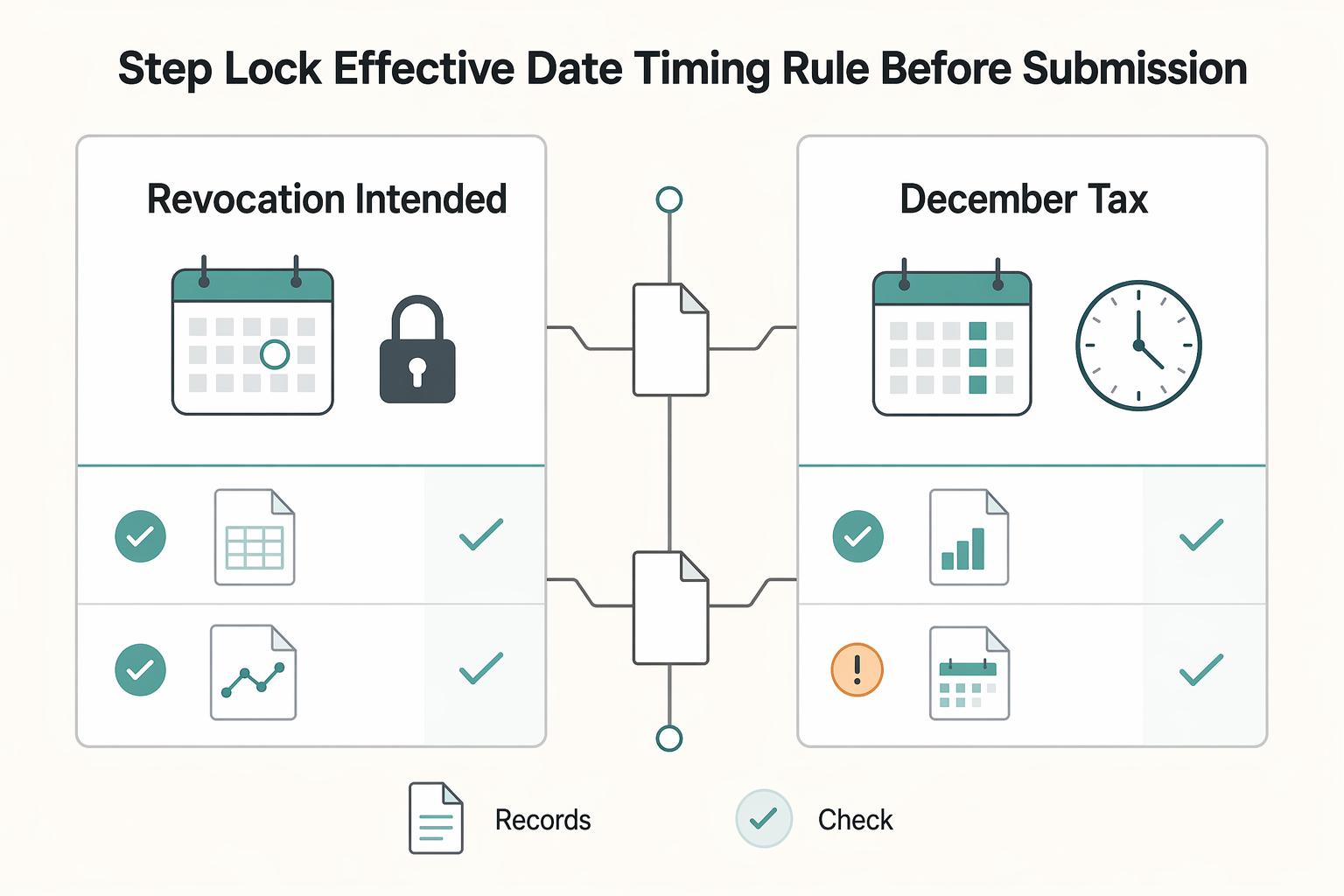
Step 4. Lock the effective date and timing rule before submission#
Timing is a key control point. The statement should include the intended effective date (or prospective date), and IRS receipt timing depends on that date.
| Scenario | Requested effective date | Receipt rule |
|---|---|---|
| Revocation intended for the first day of the tax year | First day of the tax year | Due by the 15th day of the third month of that tax year |
| Revocation intended for a different day | A day other than the first day of the tax year | IRS must receive it by the requested effective date |
| December 31 tax-year-end S corporation example | January 1 | Due March 15 |
| December 31 tax-year-end S corporation example | February 14 | Due February 14 |
Before submission, confirm these timing checks:
- if revocation is intended to be effective on the first day of the tax year, it is due by the 15th day of the third month of that tax year
- if revocation is intended to be effective on a different day, IRS must receive it by the requested effective date
- for a December 31 tax-year-end S corporation, IRS examples include January 1 effective date due March 15, and February 14 effective date due February 14
- make sure the requested effective date in the statement matches your internal transition record before mailing
If you want a deeper dive, read Sole Proprietorship vs. LLC: The Definitive Guide for Global Freelancers.
Before you lock signatures and timing, pressure-test your owner-pay treatment with the W-2 vs 1099 calculator.
The Transition: Your First 90 Days After Revocation#
The main transition risk is operational mismatch, not mailing error. Keep the sequence strict: confirm classification, then update payroll and bookkeeping, then close return-path documentation from one shared record. That order matters because each downstream action bakes the earlier assumption into a live system. If the classification point is wrong or unresolved, the error will repeat in payroll runs, ledger entries, and filing preparation until someone stops the process and rebuilds it.
Step 1. Confirm classification before any owner-pay change#
Treat classification as a gate. Do not change payroll settings, owner-pay routing, or bookkeeping labels until you have a written memo tied to the same effective date as your filed record. Before cutover, reconcile the same core checkpoints across your file: Item A. Employer Identification Number (EIN), Item E. Effective Date of Election, signature, and the locked filed copy.
| Record status | Working rule | What you do now |
|---|---|---|
File has matching Item A. Employer Identification Number (EIN), Item E. Effective Date of Election, signature, and locked filed copy | Use one shared effective date and one controlled record | Move to implementation planning with the same packet for every owner |
| Consent documentation is present on the form, continuation sheet, or separate consent statement | Treat consent pages as required tracked artifacts | Attach them under Column K. Shareholder's Consent Statement in the same packet |
Filing route is documented (Where To File / private delivery path) | Keep routing details and delivery proof in the controlled file | Record route details before handoff so teams are not working from memory |
| Any checkpoint is missing or conflicting | You do not have a reliable implementation packet yet | Freeze owner-pay and bookkeeping changes until the file is reconciled |
The memo is not just a technical file note. It is the operating authorization for every downstream team. Without it, payroll may change treatment based on habit, bookkeeping may relabel owner payments based on prior-period logic, and return prep may start building the next filing path around an assumption no one formally approved. The memo closes that gap by tying the classification conclusion to the same effective date used in the filed record.
Use the memo as a gate in a literal sense. No owner-pay change should be implemented until the memo exists, is dated, and points back to the locked filed copy. If someone asks for an operational change before then, the answer should be that the record is not yet authorized for implementation. That may feel slow in the moment, but it is usually the cleanest way to avoid mixed treatment during the first live period after revocation.
The First 90 Days After an S-Corp Revocation#
Step 2. Change payroll and bookkeeping from one transition file#
Use one transition file as the record for every handoff. At minimum, keep the locked filed copy, delivery proof, classification memo, shareholder consent support tracked under Column K. Shareholder's Consent Statement, including any continuation or separate consent page, and downstream implementation notes.
| Owner | Required artifacts | Version-control rule |
|---|---|---|
| Tax/legal owner | Locked filed copy, classification memo, EIN/effective-date/signature checks, delivery proof | Lock v1 at handoff; any change is a new dated version |
| Payroll owner | Current memo, dated implementation note, setup confirmation, first-run review record | Work only from the latest dated memo version |
| Bookkeeping owner | Same effective date, account-mapping note, first-entry review record | No alternate cutover date from bank timing |
| Return-prep owner | Same memo, same effective-date record, same IRS correspondence file | No side file with competing assumptions |
If payroll, bookkeeping, and return prep are using different files, stop and reissue one controlled packet.
The transition file should be practical, not theoretical. The payroll owner needs the approved date and treatment direction. The bookkeeping owner needs the same date and the related account mapping. The return-prep owner needs the same date, the same memo, and the same correspondence record. If any of those people are handed slightly different packets, the transition is already fragmenting.
Version control matters most when implementation starts. Once payroll has updated settings or bookkeeping has entered the first post-cutover items, people tend to rely on whatever copy they saved locally. That is why the handoff packet should state clearly which version is live and where any later revision will appear. If there is a revised memo or corrected correspondence file, it should replace the old one through the same controlled channel, not through scattered email threads or verbal updates.
Step 3. Route payments only after treatment and risk are mapped#
Do not let payment handling get ahead of classification. Once classification is confirmed, map each payment type to one approved treatment and block anything outside that map.
| Memo status | Post this now | Route through payroll | Pause to avoid misclassification |
|---|---|---|---|
| Memo-approved treatment is documented and dated | Use only memo-designated accounts and labels | Only pay items explicitly kept in payroll by the memo | Any coding pattern not authorized in the memo |
| Memo calls for non-payroll handling of owner cash movements | Post those movements only to memo-designated non-payroll accounts | None unless the memo explicitly requires payroll routing | Legacy payroll defaults until shutdown/review is confirmed |
| Memo calls for payroll handling for specific pay items | Post non-payroll items only as separately documented | Route only memo-specified items through payroll | Parallel non-payroll coding for the same payment stream |
| Classification unresolved or correspondence conflict remains open | Only mandatory baseline entries | None until resolved | Discretionary owner-pay changes |
A payment map helps because owner-pay errors usually start with good intentions. Someone is trying to keep cash moving, clear a reimbursement, or run a familiar payroll process. But once a payment is coded under the wrong treatment, that coding tends to repeat. The point of the map is to remove improvisation from the first live period after revocation.
Be especially careful with legacy settings. Systems and providers often keep using prior-period defaults unless someone actively shuts them down or changes them. That is why the memo outcome should be translated into a specific do-now, route-through-payroll, and pause list. People doing day-to-day work do better with a short action map than with a broad statement that "treatment has changed."
Use the first live post-cutover transaction as your control test. Compare register and ledger treatment to the memo before treating it as standard. If the first live item does not post the way the memo contemplates, stop there and fix the setup before more transactions pile on. One controlled test is much easier to repair than a month of repeated postings built on the same wrong assumption.
Step 4. Close the return path before the next filing cycle starts#
Do not treat the transition as complete until every team is using the same effective-date record, the same classification memo, and the same return-path assumptions. Your closeout file should also capture IRS correspondence and reconcile it against the filed record under the acceptance/nonacceptance path, Acceptance or Nonacceptance of Election.
If IRS correspondence shows mismatched entity data, resolve that record issue before normalizing payroll or bookkeeping treatment. Where IRS business-entity posting issues appear, keep IRM 3.13.222 BMF Entity Unpostable Correction Procedures as the documented correction path. Re-verify the current Form 2553 instructions before execution, since the referenced instructions snapshot may be dated.
The return path is where unresolved issues become visible again. Even if payroll and bookkeeping seem stable, the next filing cycle forces the business to state formally what happened, when it happened, and which treatment applied after the change. If the closeout file is weak, teams will rebuild the story from memory, partial correspondence, and whichever copy of the memo they can find. That is avoidable if you close the file properly now.
A strong closeout file does three things. First, it confirms that all teams used the same effective date. Second, it confirms that the classification memo in use is the same one tied to the filed record. Third, it ties any IRS correspondence back to that same file so later preparers do not have to guess whether a mismatch was already identified and addressed. That is what turns the transition from a filing event into a completed operating change.
Before you call the process finished, ask one last practical question. If the current owners, payroll contact, bookkeeper, or return preparer changed tomorrow, could the replacement team understand exactly what happened from the transition file alone? If the answer is yes, the process is probably closed. If the answer is no, you still have cleanup to do.
You might also find this useful: How to Structure an S-Corp for a Husband and Wife Partnership. As you close the transition file, keep your next compliance tasks centralized with Gruv tools.
Researched and edited by the Gruv editorial team. Gruv builds cross-border billing, payouts, and finance-operations software for global businesses.
Sources
- dca.ca.gov/cba/outreach/sunset_review_2018.pdftrusted
- ecfr.gov/current/title-47/chapter-I/subchapter-A/part-1trusted
- ecfr.gov/current/title-26/chapter-I/subchapter-A/part...trusted
- irs.gov/forms-pubs/revoking-a-subchapter-s-electiontrusted
- irs.gov/pub/irs-drop/rp-99-49.pdftrusted
- leginfo.legislature.ca.gov/faces/billTextClient.xhtmltrusted
- lis.virginia.gov/bill-details/20261/SB609/text/SB609H1trusted
- sec.gov/Archives/edgar/data/800240/00011931252207843...trusted
Educational content only. Not legal, tax, or financial advice.
Related Posts

Sole Proprietorship vs LLC for Global Freelancers in 2026
For most freelancers in 2026, the practical default is still simple: use the simplest structure you can run cleanly, then formalize when risk actually rises. If your work is still in validation mode and the downside is contained, a sole proprietorship is often the practical starting point. When contract exposure, delivery stakes, or dispute risk starts climbing, forming an LLC deserves earlier attention.
Convert an LLC to an S-Corp Without Invalidating the Election
Converting an LLC to S-corp status is a tax and operations decision, not a one-form upgrade. If the entity is eligible and you handle the filing sequence correctly, the election can work cleanly. If not, you can end up with an invalid election and corrective work.

The Freelance Payment Penalty: A Modeled Audit of Platform Fees, FX Spreads, and Payout Delays
The money rarely disappears through a single, easy-to-spot fee. The real loss is stacked. A marketplace takes its commission, a processor adds a charge for international cards, a bank or payment company converts the currency at a spread, a platform holds the funds before release, and a wire sheds a little to intermediaries on the way in. Each layer looks defensible on its own, but the worker feels the combined result as a smaller deposit and a later payday.