

Quick Answer
Route your complaint by harm: for unpaid minimum wage or overtime, start with the U.S. Department of Labor Wage and Hour Division; for federal worker-status tax treatment, use Form SS-8. Then build one evidence packet with contracts, pay records, hour logs, and direction-related communications, and split labor facts from tax facts before filing. Keep the same dates, role description, and document labels across every submission so follow-up requests do not create contradictions.
Start here if you need to report misclassification now#
Start with one sequence: pick the right agency lane, prepare one consistent evidence pack, and reuse the same facts in each submission. That order can cut avoidable delays and help you avoid conflicting statements across filings. This article is U.S.-focused and centered on the U.S. Department of Labor Wage and Hour Division, the Internal Revenue Service, and state agencies.
Under the FLSA, treating an employee as an independent contractor can deny minimum wage or overtime protections where coverage applies. Federal wage status, IRS employment-tax status and state classification rules answer different questions; one agency’s determination does not settle every right.
Use the sections to organize your next steps, without treating them as a required filing order. Contact the appropriate agency early, especially if a deadline is approaching, and add supporting records as instructed.
Before you file#
-
Route by harm first. If your immediate issue is unpaid minimum wage or overtime, start with the Wage and Hour Division. Add an IRS lane when the issue includes federal tax handling, and add a state lane based on your state process (for example, California directs group misclassification reports to the Bureau of Field Enforcement). This keeps each filing tied to one clear question instead of mixing issues in one submission.
-
Build one record, then organize it by question. Keep one core packet and separate labor-related facts from tax-related facts so each filing stays clear. A single master record also makes it easier to answer follow-up requests without changing your core narrative.
-
Use official intake channels and keep a contact log. Save submission dates, confirmation details, contact names, and follow-up requests in one place. When offices ask for clarification later, your log can help you answer quickly with consistent wording.
-
Set expectations early. Misclassification often overlaps with labor and tax issues, but outcomes still depend on agency review of your facts. Use this as filing guidance, not legal advice for your full dispute.
Describe the relationship and the harm#
Start here: if your day-to-day relationship looks like employment under the Fair Labor Standards Act but you are treated as an independent contractor, you likely have a misclassification issue. Getting that call right up front makes every later filing cleaner.
-
Ask WHD about the framework used for your complaint. Its May 2025 enforcement guidance directs investigators away from the 2024 rule’s analysis while that rule is reconsidered. A proposed replacement is not itself a final rule. Describe the working facts rather than trying to settle the legal test before intake.
-
Treat common signals as clues, not conclusions. A Form 1099, a contractor agreement, cash pay, or offsite work does not, by itself, prove correct classification. Those facts can appear in compliant and noncompliant relationships. Keep these items in your evidence file, but do not let them replace relationship-level analysis.
-
Separate wage harm from tax handling before you file. Under the FLSA, minimum wage and overtime protections depend on an employment relationship and coverage. IRS treatment also depends on the relationship. If your main harm is unpaid minimum wage or overtime, document those FLSA wage issues first and assess tax-handling issues separately.
-
Check the state rules that apply to your work. California’s ABC test generally presumes employment unless all three conditions are met, but statutory exceptions can use a different test. Identify the occupation, work dates and claim type before applying it.
Use this go-or-no-go rule: if your facts show employee-type work plus denied wage protections, you likely have a misclassification issue. Build one record and use it to evaluate labor and tax paths based on the same facts. For a deeper self-screen, use Are You an Employee or a Contractor? A Self-Assessment Checklist.
If you want a deeper dive, read What to Do If You've Been Misclassified as an Independent Contractor.
Build an evidence record alongside agency intake#
Collect the records you already have and organize them as the case proceeds. You do not need a perfect packet to contact an agency. WHD advises filing promptly because FLSA back-pay claims generally have a two-year limit, extended to three years for willful violations; ask about the deadlines affecting your case.
| Packet item | What to include | Use |
|---|---|---|
| Issue statement | You were treated as an independent contractor, but the relationship may be employment under the FLSA | Set the legal frame first |
| Intake details | Your contact details, employer identity and location, and how and when you were paid | Keep the first intake conversation focused |
| Contracts and statements of work | Copies of contracts and statements of work | Add proof, not labels |
| Pay and hour records | Pay stubs, pay records, and personal hour logs | Pair each claim sentence with at least one document you can point to quickly |
| Work-direction records | Communications or written instructions that show direction over schedule, assignments, or work method | Show direction over schedule, assignments, or work method |
| Timeline | Engagement start, role changes, pay method changes, and complaint-related events | Separate wage and overtime facts from other records |
| Index | File name, date, and why each item matters | Makes repeat requests easier |
-
Open with the relationship facts and the harm: who directed the work, how hours and pay were set, and which payments or protections are disputed. Let the agency apply the legal framework.
-
Capture intake details up front. Include your contact details, employer identity and location, and how and when you were paid. Use concrete wording so your first intake conversation stays focused. Keep phrasing simple enough to paste into phone intake notes, portal text boxes, and follow-up emails.
-
Add proof, not labels. Group contracts and statements of work first, then include copies of pay stubs, pay records, and personal hour logs. Add communications or written instructions that show direction over schedule, assignments, or work method. When possible, pair each claim sentence with at least one document you can point to quickly.
-
Build a timeline and split it by issue. List engagement start, role changes, pay method changes, and complaint-related events. Then separate wage and overtime facts from other records so intake discussions stay focused.
-
Clean and index for reuse. Add a simple index with file name, date, and why each item matters. This is an organization step, not a legal filing requirement, but it makes repeat requests easier. Consistent file names and date formats also reduce mistakes when you update the packet later.
Close with a short cover note summarizing the work performed, how pay was handled, and which protections were denied. Lead with wage and overtime facts if wage harm is central, keep a post-filing contact log, and remember that WHD states complaint services are confidential and employers cannot lawfully retaliate for filing.
Choose the right reporting channel on the first try#
Choose the channel by the exact question you need answered. Keep worker-status determinations separate from tax noncompliance reporting so each submission has one clear purpose.
| Channel | Primary use | Key note |
|---|---|---|
| Form SS-8 | Worker-status determination for federal employment taxes and income tax withholding | Requests a federal employment-tax and withholding status determination |
| Form 8919 | Report a worker's share of uncollected Social Security and Medicare taxes | Use only if a listed reason code applies; a pending SS-8 request can qualify |
| VCSP / Form 8952 | Prospective reclassification by taxpayers | Employer-side compliance route, not a worker remedy channel |
| IRS Whistleblower Office | Award claim with specific, timely, and credible information about tax-law noncompliance | Keep separate from SS-8 so each filing has one objective |
-
Start by naming the tax question. Keep two lanes: worker-status determination and tax noncompliance reporting. Reuse the same core facts, dates, and role description in every submission. If you cannot state the question in one sentence, tighten it before filing.
-
Use Form SS-8 to request a federal employment-tax and income-tax-withholding status determination. Follow its instructions and supply relationship facts. The IRS normally seeks information from both parties; this is not an anonymous employer report.
-
Check Form 8919 separately when preparing your return. It reports the worker’s share of uncollected Social Security and Medicare taxes when its conditions and a listed reason code apply. Code G covers a filed SS-8 request with no reply, so a completed IRS determination is not always required. Do not wait for SS-8 to resolve before addressing return deadlines.
-
Do not use VCSP/Form 8952 as a worker complaint path. The Voluntary Classification Settlement Program (VCSP) is for taxpayers who want to prospectively reclassify workers. It uses Form 8952 and a closing agreement with the IRS, so it is an employer-side compliance route, not a worker remedy channel.
-
Treat whistleblower reporting as its own path. The IRS Whistleblower Office handles award claims tied to specific, timely, and credible information about tax-law noncompliance. Keep this separate from SS-8 so each filing has one objective.
If the issue is federal tax status, SS-8 is the determination route. It does not recover unpaid wages or decide state benefits. Keep tax-return deadlines separate from the agency review.
Contact the U.S. Department of Labor about wage harm#
For a Wage and Hour Division complaint, stay focused: lead with work-control facts, tie them to denied protections, and preserve retaliation records from day one.
Step 1 Document process details when you contact WHD#
To start a wage complaint, call WHD at 1-866-487-9243 or contact your local office. Give the employer’s details, how and when you worked, and the pay issue. Save the date, office and instructions you receive.
WHD treats complaints as confidential. Its worker FAQ describes narrow disclosure exceptions when needed to pursue an allegation with your permission, or when required by court order. Ask how that process applies to your case. IRS SS-8 is different: the IRS normally seeks information from the other party.
Step 2 Write a tight narrative on control, pay, and denied rights#
Write a short timeline showing who directed your work, how pay was set, and what happened when pay or hour issues surfaced. Then connect those facts to denied employee protections, such as minimum wage or overtime where applicable.
Do not rely on labels alone. A 1099 or an independent contractor agreement, by itself, does not settle worker status. A clear narrative usually reads this way: relationship facts first, pay facts second, denied protections third.
Step 3 Submit evidence that maps to each claim#
Send a focused packet that matches your timeline: records on pay practices, time and hours, and work direction. Tie each file to a specific fact so a reviewer can follow it quickly.
Avoid both extremes: too little evidence can make review harder, while an unstructured document dump can bury your core wage issues. A useful checkpoint is whether a reviewer could reconstruct your timeline from the first page and index alone.
Step 4 Preserve retaliation evidence from the day you report#
Start a dated retaliation log as soon as you file and keep it current through each employer response. Track concrete changes in assignments, pay handling, access, communications, or threats linked to your complaint, and keep originals where possible.
If treatment shifts after filing, this log helps you report specific events instead of broad impressions. Update it the same day when possible so details stay accurate if they are challenged later. For current rule context, see the Department of Labor's independent contractor rule.
Use IRS paths correctly and avoid channel confusion#
Use the IRS lane by objective, not by form name. Define the tax outcome you need, verify the exact path, and keep separate tracks for anything that is not yet confirmed.
Step 1 Define the IRS objective before choosing any form#
Write one sentence stating your IRS objective and whether you are pursuing a whistleblower award claim. Keep your records organized by objective so the narrative stays consistent.
SS-8 requests a worker-status determination for federal employment taxes and withholding. Form 3949-A reports alleged tax-law violations; it does not substitute for a status determination or a wage complaint.
Step 2 Use the IRS Whistleblower Office only for award-claim conditions#
Use this path when you have specific, timely, and credible information about tax-law noncompliance and you are submitting an award claim. This is an award-focused channel, not a general intake lane.
An award claim has separate eligibility and submission requirements. It is not a promise of compensation or an expedited route to your own wage or tax-status decision.
Pre-submit check:
- Identify the noncompliance facts clearly.
- Show why the information is specific, timely, and credible.
- State how the IRS can verify the issue from your records.
Step 3 Keep employer settlement programs separate#
VCSP and its Form 8952 are employer-side prospective reclassification procedures, not worker complaint forms. They do not replace your wage claim or SS-8 request.
Failure mode to avoid: filing material that is not tied to your chosen objective and delaying the channel you actually need. If a document is not tied to your objective, keep it in a separate reference folder and out of the filing packet.
Step 4 Log unknowns before submission#
Add a short preflight note with three lines: confirmed facts, unresolved assumptions, and where you will verify each assumption. Include unknowns such as form purpose, privacy expectations, and response mechanics when they are not confirmed in your evidence pack.
A brief verification pass now is usually faster than fixing a misrouted filing later. It also keeps your future updates cleaner because you can trace why each filing decision was made.
Use state agencies when wages are not the only harm#
Use state paths by harm type instead of assuming one combined complaint covers everything. Keep the same dates and core facts across filings so your record stays consistent.
Step 1 Map each harm to the right state path#
In California, an individual wage claim goes to the Labor Commissioner; a Report of Labor Law Violation addresses widespread violations affecting a group. Unemployment and workers’ compensation have separate processes. These are state-specific routes: confirm the right agency for your location and issue.
A practical format is one row per harm with four columns: agency lane, filing channel, confirmation field, and next follow-up date. That keeps action steps visible without repeating the same notes across multiple documents.
Step 2 Match your filing to the state's classification framework#
California generally uses the ABC test subject to statutory exceptions, some of which use the Borello test. Other states may apply different rules. Keep the underlying facts consistent while explaining the issue under the test used for that claim.
Filings can drift when the facts stay constant but wording changes too much between agencies. Keep your factual baseline identical and only adjust test-specific framing.
Step 3 Coordinate multiple filings without changing facts#
If facts overlap across filings, use one consistent record and avoid changing core details between submissions. The priority is consistency: use the same timeline, role description, and pay facts in every submission.
If one agency asks for an expanded explanation, update your master notes first, then reuse that language across all active lanes. That helps prevent contradictions caused by ad hoc edits.
Step 4 Treat cross-border jurisdiction as a verification step#
If you worked across jurisdictions, confirm intake jurisdiction with the relevant agency before you file rather than guessing which state has the strongest employment connection. Then keep one log for each case with:
- Confirmation number or receipt ID
- Intake email or portal acknowledgment
- Case contact details and date of contact
Review those logs weekly while cases are active. Missing a follow-up date can slow progress in multistate matters.
Check your contract before filing and after filing#
Review contractual pressure points alongside the complaint, without delaying agency intake. A contractor label does not decide status; actual relationship facts and the applicable law matter.
| Clause | What to pull | What to note |
|---|---|---|
| Termination | Exact language; mark notice periods | Aggressive termination language that appears after you raise a classification concern |
| Limitation of Liability | Exact language | Keep short notes on potential filing friction |
| Indemnification | Exact language | Broad indemnification demands that appear to shift most company claims to you |
| Governing Law | Exact language | Keep short notes on potential filing friction |
| Jurisdiction | Exact language; mark venue terms | Keep short notes on potential filing friction |
| Dispute Resolution | Exact language; mark arbitration triggers and fee-shifting clauses | Forum or dispute terms framed in ways that may discourage agency intake |
- Build a one-page clause sheet. Pull exact language for Termination, Limitation of Liability, Indemnification, Governing Law, Jurisdiction, and Dispute Resolution. Mark notice periods, venue terms, arbitration triggers, and fee-shifting clauses. Keep a short note beside each clause describing potential filing friction.
- Keep filing timing on track. If arbitration or venue terms look hostile, treat that as a parallel private-dispute issue and do not delay agency intake while you sort out contract concerns.
- Use contract text as one evidence input. Pair each clause with what happened in practice, since written terms are only one part of status analysis. This side-by-side check keeps your position grounded in conduct, not labels.
- Document pressure after filing. Save clause-heavy warnings, log dates, and keep the same core facts across submissions. If pressure language changes over time, keep those versions in chronological order.
Flag these early:
- Broad indemnification demands that appear to shift most company claims to you.
- Aggressive termination language that appears after you raise a classification concern.
- Forum or dispute terms framed in ways that may discourage agency intake.
- Contract terms can be relevant evidence, but they do not by themselves decide worker status.
Protect your income and records while the case moves#
Protect cash flow and records in parallel while the case is active. Long gaps in either track can create avoidable pressure.
Create two live documents and update them daily: a receivables tracker and an evidence log. These answer two practical questions under stress: what money is still collectible, and what changed after you filed.
- Step 1: Map immediate income risk. List every open invoice with amount, due date, contact owner, and last follow-up date. Split entries into
due now,due in 7 days, andoverdue. Add a short backup client list you can activate if one account freezes work. - Step 2: Keep filings and collections on separate tracks. If you decide to file a misclassification complaint, do not pause filing actions while chasing late payments. Handle payment follow-up and classification actions in parallel, including Form SS-8 when relevant.
- Step 3: Preserve a complete post-filing trail. Log assignment changes, access revocations, payment-method shifts, and communication changes with date, time, sender, and attachment. Save originals such as email headers, portal notices, and invoice exports.
- Step 4: Document potential retaliation signals promptly. If work access, assignments, hours, or communications change after filing, record each event in sequence and update your case record promptly. Keep wording factual and consistent with earlier submissions.
An avoidable failure mode is having to rebuild events from memory later. Note key filing milestones in the same log so your timeline stays complete. Another useful checkpoint is a weekly review: make sure your receivables tracker and case log tell the same story about dates and account activity.
Know what happens next and where uncertainty remains#
After you file, expect some uncertainty. There is no single timeline or guaranteed outcome across U.S. Department of Labor, IRS, and state processes.
Keep one master case log, one evidence index, and one fact baseline, then reuse the same core facts in every update. Include role description, pay method, control-related facts, and key dates, and keep wording consistent across submissions.
- Set expectations with ranges, not promises. Track agency name, submission date, confirmation ID, latest contact, requested documents, and next follow-up date. Use neutral statuses like
submitted,acknowledged,request received, andunder reviewonly when you have direct proof. - Treat process steps as possible, not universal. Post-filing intake and review can vary by agency and office. When asked for clarification, respond with the same fact baseline you already used elsewhere.
- Plan escalation with caution. If instructions conflict or the dispute materially expands, consider legal advice, and supplement the record only with dated, material evidence.
- State rules and exceptions vary. Check the occupation, claim type and work dates under the current state guidance rather than assuming a federal test applies everywhere.
Do not infer outcomes from silence. Keep your facts fixed, log every contact, and follow your check-in schedule across any filings you have made. If new information appears, update the master baseline first, then propagate that update to active filings.
Copy-paste checklist and your next move#
Contact the appropriate agency, organize your evidence and track follow-up. You can improve the record while the case progresses; do not delay time-sensitive intake to complete this checklist.
- Describe the work relationship and the wage, tax or state-rights issue.
Start with who set the schedule and work method, how you were paid and the protection or payment you believe was denied. WHD, the IRS and state agencies apply their respective rules; you do not need to obtain one determination before asking another agency for help.
- Build and index the evidence you have alongside intake.
Index each document by date range, source and what it supports. If you cite a rule, confirm that it applies to the forum and work period involved; WHD enforcement guidance, litigation and state claims can use different frameworks.
- Keep facts consistent across any submissions.
When you file, start with a narrow factual summary tied to your confirmed issue. If you submit in more than one place, reuse the same timeline, dates, and core statements so your record does not conflict.
- Keep contract-risk review separate from status analysis.
Review termination, indemnification, governing law and dispute terms for practical pressure points alongside intake. Labels or clauses alone do not decide FLSA status, although relevant agreement terms and what happened in practice may inform the applicable analysis.
- Maintain one case log until resolution.
Track submission dates, confirmations, contacts, requests and deadlines. Federal classification policy is changing: use WHD’s enforcement guidance and ask the office about the rules used for your matter, rather than treating an old rule or pending proposal as the answer to every case.
Completion signal: you are done with this checklist when each active submission has a confirmation record, a scheduled follow-up date, and a matching fact baseline.
For future engagements, consider documenting scope, control, and payment terms in writing: Create a freelance contract draft.
Frequently Asked Questions
How do I report worker misclassification quickly if I need action this week?
Contact WHD now if federal minimum wage or overtime is the issue; do not expect a guaranteed one-week outcome. Use SS-8 for federal employment-tax status and check Form 8919 eligibility separately, including the pending-request reason code where applicable. Keep dates and facts consistent across filings.
Is a Wage and Hour Division complaint confidential?
WHD treats complaints as confidential, with narrow exceptions described in its worker FAQ: disclosure with your permission when needed to pursue an allegation, or as required by court order. Ask how this applies to your case. SS-8 generally involves obtaining information from the other party, so do not assume the same privacy process.
Can my employer retaliate after I file with the U.S. Department of Labor?
Retaliation for exercising rights, filing a WHD complaint or cooperating with an investigation is prohibited under the applicable laws. Record threats or changes in hours, access, assignments or pay, and contact WHD promptly about possible retaliation.
If I received a Form 1099 and signed a contractor agreement, am I still possibly an employee?
Yes. That is still possible. IRS says classification depends on the working relationship across three categories, including whether the company controls what you do and how you do it, not just labels. Indiana UI guidance also states that forms like a 1099 or W-9 are not conclusive by themselves.
Is the Voluntary Classification Settlement Program a worker complaint option?
No. VCSP is an employer-side prospective reclassification program using Form 8952. A worker seeking unpaid wages or a federal tax-status determination uses the relevant complaint or SS-8 process instead.
What is the difference between Form SS-8 and Form 3949-A?
SS-8 requests a determination of worker status for federal employment taxes and income-tax withholding. Form 3949-A reports alleged tax-law violations. Neither is a wage-recovery filing, and Form 8919 eligibility for your return is a separate question.
How long does a misclassification complaint usually take?
Timelines vary. The IRS says an SS-8 decision can take at least six months. Keep your filing and tax-return deadlines separate from that review, and record agency contacts and document requests as they arrive.
Try a related tool
Researched and edited by the Gruv editorial team. Gruv builds cross-border billing, payouts, and finance-operations software for global businesses.
Sources
Educational content only. Not legal, tax, or financial advice.
Related Posts

What to Do If You've Been Misclassified as an Independent Contractor
If a business calls you an independent contractor but directs your work like an employee, check the rules for the rights you need to recover. A contract label, LLC or Form 1099 does not decide every legal status. Federal wage law, federal employment taxes and state employment laws can use different tests and provide different remedies.
Are You an Employee or a Contractor? A Self-Assessment Checklist
Forget the label. Classification turns on the relationship you actually run, not the title you typed into the contract. It is also much easier to fix before you sign.
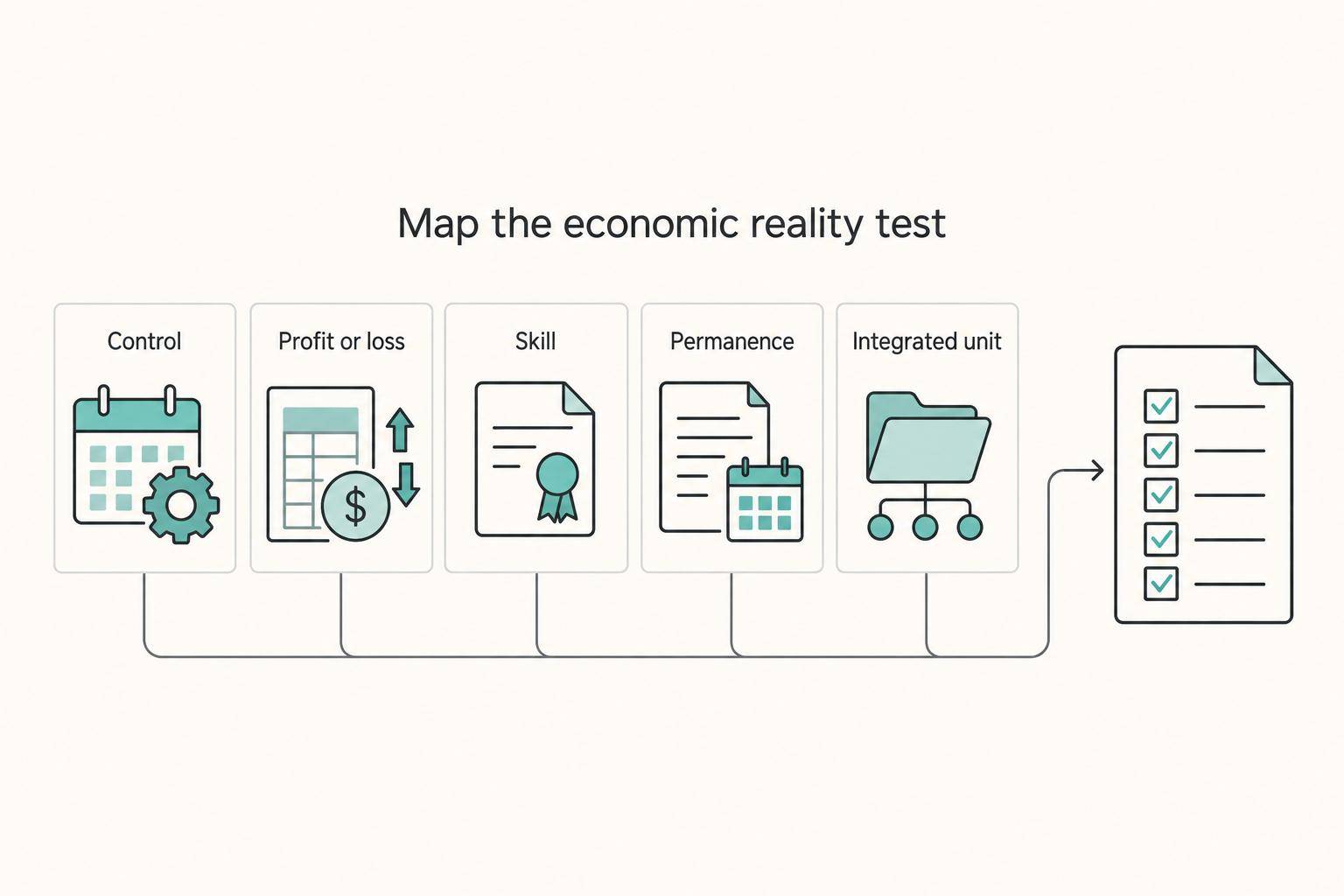
DOL Independent Contractor Rule in 2026: Proposal and Current Standards
**Status checked 5 October 2026:** DOL’s official page still identifies the February 2026 action as a proposal, and says its comment period **closed on 28 April 2026**. The NPRM, published 27 February under RIN 1235-AA46, proposes replacing the 2024 FLSA interpretation with a modified 2021-style analysis and using the analysis for FMLA and MSPA. A proposal is not a final rule with an effective date.