
Quick Answer
First distinguish commercial trade reporting, consumer furnishing and debt collection. Reporting needs an accepted bureau/partner relationship and eligible account scope; it does not guarantee payment. Verify debtor identity, balance, delivery and communications, then use documented reminders/demand and an evidence-based external handoff decision.
The silence after you send an invoice creates a specific kind of anxiety for any independent professional. A relationship that felt mutual suddenly turns into a chase, and it drains time and attention from work that actually moves your business forward. That anxiety is not inevitable. It usually comes from handling non-payment reactively instead of designing for it up front.
The people who handle this well do not treat non-payment as a personal insult. They treat it as a business variable. They set up a system that makes missed payment the exception instead of a recurring fire drill. That system has three parts: a strong foundation that prevents avoidable problems, a controlled protocol for overdue invoices, and a clear decision process for the last resort.
Build a documented payment-recovery process with clear balance, contract and dispute records. Choose collection and reporting routes from the actual account type and legal/partner scope, rather than frustration.
Stage 1: Set Contract and Onboarding Terms Before the Project Begins#
If you want non-payment to be rare, prevention has to start before the work does. Your best protection is a contract and onboarding record that make payment, disputes, and default clear before the project begins. Before kickoff, gather your current contract template, vendor onboarding requirements, billing contact details, and a governing-law review note.
Step 1. Define the contract mechanics that control risk#
Your terms need to hold up when payment slips. Start with the governing law clause, because it affects whether fee-shifting, late charges, and remedies are likely to be enforceable as written. Each term should do a distinct job:
| Term | What the section says |
|---|---|
| Governing law clause | Affects whether fee-shifting, late charges, and remedies are likely to be enforceable as written |
| Collections clause | Assigns who bears enforcement or collection costs if escalation happens, often through prevailing-party language |
| Late-payment clause | Sets a reasonable late charge; treat it like liquidated damages, not a penalty |
| Dispute/cure window | Sets the period to contest an invoice or fix a defect before stronger remedies apply |
| Default | Failure to perform an obligation, including nonpayment after the due date and any cure window; tie default to named remedies, not vague warnings |
- Collections clause: assigns who bears enforcement or collection costs if escalation happens, often through prevailing-party language. Because treatment varies by jurisdiction, keep fee-shifting wording pending until governing-law review is complete.
- Late-payment clause: sets a reasonable late charge. Treat it like liquidated damages, not a penalty. Keep late-charge wording pending until a jurisdiction check confirms what can be used.
- Dispute/cure window: sets the period to contest an invoice or fix a defect before stronger remedies apply. Specify the notice channel, required dispute details, and what counts as cure.
- Default: a failure to perform an obligation, including nonpayment after the due date and any cure window. Tie default to named remedies, not vague warnings.
Confirm the actual contracting debtor and authorized billing/procurement path. Tax forms or payee onboarding records are relevant only where actually required and do not establish bureau-reporting eligibility.
Step 2. Replace ambiguous payment terms with enforceable wording#
Ambiguous payment language can create delay and interpretation risk. Your terms should say exactly what triggers payment, what counts as delivery or approval, how payment must be made, where invoices go, and how disputes must be raised. This protects cash flow, not just collections hygiene. For the broader margin angle, see The Silent Profit Killer: How to Stop Margin Erosion in Your Freelance Business.
| Ambiguous term | Better wording |
|---|---|
| "Net terms apply" | "Invoice is due within the payment period stated in the contract after receipt at the agreed billing email or portal, payable by an approved method." |
| "Final payment on completion" | "Final invoice is issued upon the delivery or approval event defined in the scope." |
| "Late fees may apply" | "If payment remains unpaid after the due date and any cure period, the contract's reviewed late-charge language applies." |
| "Client must raise issues quickly" | "Any invoice dispute must be sent to the contract notice address within the contract-defined period and include the invoice number, disputed amount, and reason." |
| "We may send to collections" | "If the account is in default, provider may pursue contractual remedies, including third-party collection or enforcement, subject to applicable law and the contract." |
Before kickoff, verify where invoices must be submitted, who approves them, and whether a purchase order or portal upload is required.
Step 3. Run a short pre-engagement client check#
A quick client check can catch payment problems before they become yours. Before you commit capacity, confirm the operational basics:
- Legal entity identity and business details
- Contracting debtor and invoice/billing entity aligned, with documented authority for any different payer
- Exact billing contact, accounts payable inbox, and submission path
- Procurement path, including vendor onboarding, PO requirements, and approval steps
- Basic reputation or risk check, for example company name plus "complaint" or "scam"
Verify the debtor’s actual contracting entity, billing authority and procurement path. IRS TIN Matching is for eligible payers/authorized agents preparing information returns; it does not prove a client’s identity, ownership, creditworthiness or reporting authority. Do not use it as a general debtor-screening tool.
If this check is messy, raise payment protection before kickoff. Ask for a larger advance, milestone billing before final delivery, written pause rights for nonpayment, and completed procurement before work starts.
Stage 2: The Controlled Protocol#
Once an invoice goes overdue, stop improvising. Use a repeatable escalation SOP so you can pursue payment without creating gaps in the record you may need later.
| Stage | When used | What to include |
|---|---|---|
| Verify the debt | Before you send any escalation message | Open one payment file; confirm the debtor name matches the contracting entity, the invoice went to the correct billing contact or required portal, the due date matches contract terms, and the ledger reflects credits, deposits, and partial payments correctly |
| Courtesy reminder | When payment is overdue and the contract timing window has elapsed | Invoice number, amount due, original due date, payment method/instructions, direct request for payment status and expected payment date, invoice copy, and portal submission reference if applicable |
| Delinquency notice | If the reminder does not produce payment, a firm payment date, or a meaningful response after the contract timing window | Clear statement that the invoice is now past due, outstanding balance and contract payment/cure term, response/payment deadline, operational next step if unresolved, invoice, prior reminder thread, and relevant contract excerpt |
| Final demand | When a promised payment date is missed, responses stay vague, or communication goes silent | Debtor entity, total balance, invoice IDs, the breached payment or default term, and a final deadline tied to the contract timing window or any jurisdiction-specific rule relevant to your matter |
| Handoff file | Before you involve anyone outside your business | Verified debtor identity and billing details, signed scope if available or an equivalent written approval trail, accurate invoice and ledger record, delivery, acceptance, and submission evidence, and the full dated communication log |
Step 1. Verify the debt before you escalate#
Before you send any escalation message, make sure the debt is clean on your side. Open one payment file for the account and keep everything in it: contract, scope, invoice, proof of submission, delivery or approval evidence, and the full communication thread. Then confirm:
- Debtor name matches the contracting entity
- Invoice went to the correct billing contact or required portal
- Due date matches contract terms
- Ledger reflects credits, deposits, and partial payments correctly
Correct wrong-entity or submission errors and document their effect on the due date under the actual contract. Do not automatically restart a payment clock unless the terms and facts require it.
Step 2. Send the courtesy reminder#
Start with a courtesy reminder once payment is overdue and the contract timing window has elapsed. The goal is simple: clear an administrative delay before it turns into a collections problem. Use this framework:
| Requirement | What to include |
|---|---|
| Core facts | Invoice number, amount due, original due date, payment method/instructions |
| Ask | Direct request for payment status and expected payment date |
| Attachments/proof | Invoice copy, and portal submission reference if applicable |
| Tone guardrail | Neutral and professional; assume oversight, not bad faith |
Keep this first message free of default, collections, or credit-reporting language. Send it from the contracting or billing address, and keep all follow-ups in the same thread.
Step 3. Issue the delinquency notice#
If the reminder does not produce payment, a firm payment date, or a meaningful response after the contract timing window, move to a delinquency notice. At this point, you are no longer just nudging. You are documenting delinquency. Use this framework:
| Requirement | What to include |
|---|---|
| Status | Clear statement that the invoice is now past due |
| Amount and basis | Outstanding balance and contract payment/cure term |
| Deadline | Response/payment deadline tied to contract timing |
| Consequence | Operational next step if unresolved, for example pause rights if your contract allows |
| Attachments/proof | Invoice, prior reminder thread, relevant contract excerpt |
If your contract permits it, this is the point to state that new work, revisions, or further delivery may pause until the account is current.
| Client response pattern | Your next action |
|---|---|
| "Sorry, missed this, paying now" | Confirm payment date and method; hold escalation if payment arrives as promised. |
| "We never got the invoice" | Resend in the same thread with prior submission proof; reset timing only if your contract/process requires it. |
| Specific dispute (amount/deliverable) | Require written dispute with invoice number, disputed amount, and reason; route through contract dispute/cure process. |
| Vague delay ("soon," "AP is working on it") | Ask for named payer, firm date, and blocker details; if still vague, move to final demand after the contract timing window. |
| Installment request | Offer only if debt is not genuinely disputed and terms are accepted in writing (amount, dates, missed-installment consequence). |
| Silence | Pause work if your contract allows, then send final demand. |
Step 4. Send the final demand#
Use a final demand when a promised payment date is missed, responses stay vague, or communication goes silent. This is your last internal step before outside recovery.
Write it as a business record, not a threat. Include the debtor entity, total balance, invoice IDs, the breached payment or default term, and a final deadline tied to the contract timing window or any jurisdiction-specific rule relevant to your matter. If you offer a plan, require written balance acknowledgment and a first installment date.
Separate commercial trade reporting from consumer furnishing. Each requires an accepted bureau/partner relationship and an ongoing accuracy/dispute process; a one-off invoice is not automatically eligible. Do not threaten reporting you cannot lawfully perform. Consumer furnishers have applicable FCRA accuracy/integrity duties, while commercial paths have their own contracts and rules.
Step 5. Build the handoff file before Stage 3#
Before you involve anyone outside your business, make sure the file is complete. This is where sloppy records stop recovery cold. Confirm that you have:
- Verified debtor identity and billing details
- Signed scope, if available, or an equivalent written approval trail
- Accurate invoice/ledger record, including credits and partial payments
- Delivery, acceptance, and submission evidence
- Full dated communication log with attachments
First classify the debt and collector role. FDCPA/Regulation F concern covered collection of primarily personal/family/household debts, not ordinary business debts or every original creditor collecting in its own name. Covered consumer collectors have validation and pre-furnishing contact rules; one mail/electronic path generally waits 14 days for nondelivery notices. That is not a universal creditor/commercial-bureau waiting period.
If this checklist passes, move to Stage 3 and choose the external path that fits the amount, facts, and risk. For agency options, use The Best Collection Agencies for Small Businesses.
You might also find this useful: How to Calculate Client Lifetime Value (CLV) for Your Agency.
Stage 3: The Last Resort - A Decision Matrix for Escalation#
Escalate only after your Stage 2 documentation is complete, verified, and internally consistent. If your goal is to see whether credit reporting is even an option, treat escalation as a partner-choice and risk-control decision, not a frustration-driven move. Legal and operational requirements can vary by jurisdiction, account type, and partner policy, so verify specifics before action.
Before you proceed#
Step 1. Confirm handoff readiness first.
| Readiness item | What to verify |
|---|---|
| Contract chain | Signed agreement, approved scope, change orders, and written payment terms tied to this invoice |
| Delivery proof | Dated submission, approval, milestone acceptance, or equivalent evidence |
| Invoice ledger | Original invoice, credits, deposits, partial payments, and current balance reconciled across all records |
| Identity match | Debtor legal name and billing details match the contracting entity |
| Communication log | Courtesy reminder, delinquency notice, final demand, and responses in one dated thread |
| Assignment authority | Your contract and the partner intake terms allow placement, assignment, or processing |
| Partner cutoff | Current amount, account-age, and eligibility gates from the partner are confirmed in writing before handoff |
Use that table as a hard gate, not a suggestion. Do not contact an outside partner until your file can support a potential dispute or accuracy review. A weak file can increase dispute, accuracy, and reputational risk.
Quick gate: reconcile the contracting debtor, invoice entity and payment-thread identity. A different payer needs documented relationship and authority; unresolved identity or authority requires a pause before escalation.
Step 2. Choose the path that matches your objective#
Pick the channel that fits what you are actually trying to do and how much operational responsibility you can carry.
- Data furnisher: for this framework, a party with an established relationship and process to submit account data, where permitted
- Collection agency: partner focused on pursuing payment
- Third-party reporting service: service layer that may route reporting through an existing furnishing relationship, subject to provider rules
- Debt validation: substantiating the debt when challenged or when required for that account type
- Dispute handling: intake, review, evidence exchange, correction, and response workflow
| Path | Control level | Documentation burden | Dispute workflow | Expected recovery path | Reputational exposure |
|---|---|---|---|---|---|
| Collection agency | Lower once placed | High | Shared workflow; confirm who receives disputes, pause triggers, and evidence requirements | Payment collection first; reporting depends on provider model | High |
| Third-party reporting service | Medium | High | Confirm intake, correction, and removal flow before use | Reporting pressure; payment path depends on provider terms | Medium to high |
| Direct furnishing (only if you already have a qualified relationship) | Highest control, highest responsibility | Highest | You need a defined internal correction/dispute process before submission | Reporting only within your existing relationship scope | High |
Step 3. Reduce avoidable risk before handoff#
Escalations can fail because of preventable admin mistakes as well as legal or policy issues. Common risk triggers can include the wrong entity, a stale balance, a missing credit, an unresolved scope disagreement, or weak delivery proof. Use strict controls before you send anything:
- Freeze one final ledger version
- Separate disputed vs. undisputed amounts
- Save the exact handoff file set with timestamps
- Require written partner workflow for disputes, pauses, corrections, and withdrawals
- Confirm any unresolved partner policy thresholds in writing before handoff
If the core issue is a performance dispute and you cannot show delivery or acceptance evidence, treat it as a contract dispute first, not a collections workflow.
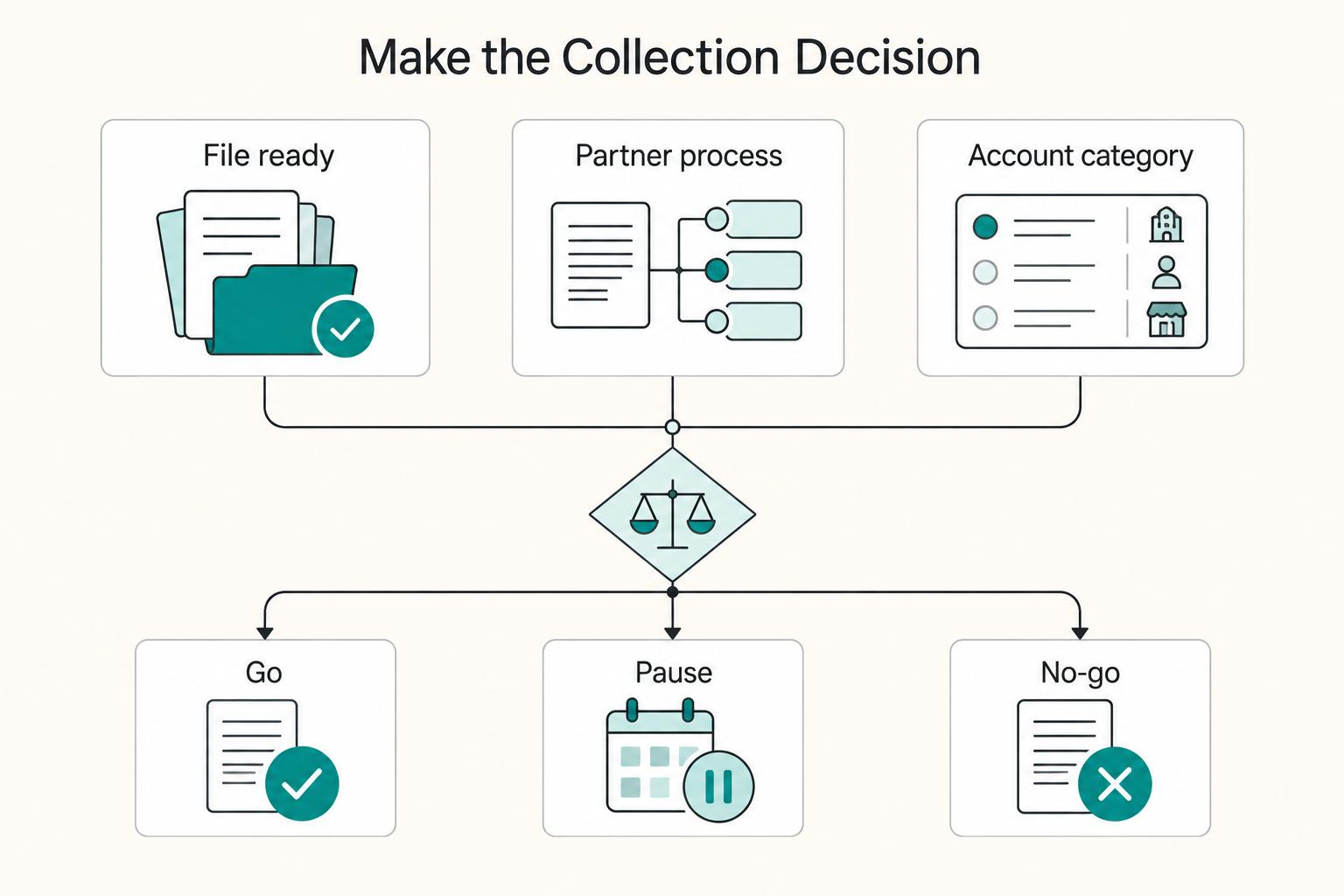
Step 4. Make the go/no-go call#
Make the decision only after the file, the partner process, and the account category are all clear.
| Decision | Use when |
|---|---|
| Go | Entity verified, balance reconciled, delivery documented, no active service dispute, and partner intake/dispute process is clear in writing |
| No-go | Identity unclear, amount unsupported, contract position weak, assignment authority unclear, or compliance category not confirmed |
| Pause and verify | Only a partner policy cutoff, acceptance rule, or dispute-handling detail remains unconfirmed |
Proceed only after the file, legal scope and partner process pass this case-specific gate. For agency options, compare Collection Agencies for Small Businesses.
If your escalation matrix says "stop chasing and tighten the system," review Gruv for freelancers to reduce direct payment-collection risk in future client engagements.
Conclusion: Treat Non-Payment as an Operating Decision#
The practical shift is simple. Treat non-payment as an operating decision, not a personal chase.
- Business cost: include partner fees, administration, dispute handling and ongoing accuracy/correction responsibilities for the actual path.
- Recovery path: move from contract prevention to documented follow-up and eligible third-party handoff. Consumer collector pre-furnishing rules are not universal commercial-creditor rules.
- Escalation trigger: verify identity, balance, delivery and account/partner scope; pause to fix missing evidence before deciding whether recovery or write-off fits.
Escalate only when the file and legal/partner scope support it and recovery economics justify the effort. Missing identity or balance evidence calls for pause and remediation, not automatic write-off. A deliberate close/write-off decision should document the facts, recovery options, costs and accounting treatment.
Prevent avoidable disputes with clear terms, use controlled follow-up and choose an eligible outside recovery path only after scope and evidence checks. Reporting does not guarantee payment or a particular credit-score effect. Compare partner processes in Collection Agencies for Small Businesses and improve future billing controls.
Turn this policy into a repeatable workflow by standardizing your next invoice with Gruv's Free Invoice Generator.
Frequently Asked Questions
Can you report a client to a credit bureau yourself?
Direct reporting requires an accepted relationship and the applicable account category, eligibility and ongoing accuracy/dispute processes. Commercial trade data and consumer information are distinct paths. A collection or reporting partner may be available if it accepts the verified file and role; no one-off reporting or score effect is guaranteed.
What is the best way to handle a client who will not pay?
Keep it internal while the issue still looks administrative and the client is responding in writing. Escalate when your file is complete, the legal entity and balance reconcile across records, and the amount is clearly undisputed. Write it off when likely recovery is lower than the time, fees, and reputational drag, especially if this pattern is already causing margin erosion.
What is a dispute, and why does it matter?
An invoice/service dispute concerns the contract and balance; a consumer-reporting dispute challenges furnished information. Covered consumer disputes can go through the reporting company or directly to a furnisher within the applicable scope. Preserve current balances, disputed status and investigation/correction records, and follow the actual channel/deadline rules.
What is debt validation, and does it apply to your case?
Debt validation is the process a consumer uses to confirm whether a debt is actually theirs. In covered consumer collections, debt collectors must provide validation information, but you should not assume those rules automatically govern business-purpose debt. Before placement, confirm with your partner which debt category applies and what process they will use.
What should you prepare before escalation?
Prepare one handoff file before you escalate: signed contract, scope and change records, invoice ledger, delivery proof, payment terms, and your full communication thread. Verify the debtor legal name plus account-level details like amount due, open date, and status so your records are internally consistent. If the core disagreement is about service quality, resolve that contract dispute first before using a collections path.
What will it cost, and how long can the reporting effect last?
Obtain current fees, acceptance thresholds and ongoing responsibilities from the partner. Consumer and commercial reporting periods differ and can have exceptions; verify the exact account, bureau path and applicable law rather than importing bankruptcy rules into a business-invoice recovery decision.
Try a related tool
Researched and edited by the Gruv editorial team. Gruv builds cross-border billing, payouts, and finance-operations software for global businesses.
Sources
- consumer.ftc.gov/articles/debt-collection-faqstrusted
- consumer.ftc.gov/articles/sample-letter-credit-bureaus-disput...trusted
- consumerfinance.gov/ask-cfpb/when-can-a-debt-collector-report-to...trusted
- consumerfinance.gov/ask-cfpb/what-laws-limit-what-debt-collector...trusted
- ecfr.gov/current/title-12/part-1022/section-1022.42trusted
- ecfr.gov/current/title-12/chapter-X/part-1006/subpart...trusted
- ftc.gov/business-guidance/resources/consumer-reports...trusted
- ftc.gov/business-guidance/resources/scams-your-small...trusted
Educational content only. Not legal, tax, or financial advice.
Related Posts

Stop Freelance Profit Margin Erosion Before It Hits Cashflow
Revenue can hold steady while the business underneath it gets weaker. What comes in matters, but what you keep after the work is delivered is the clearer signal of health.
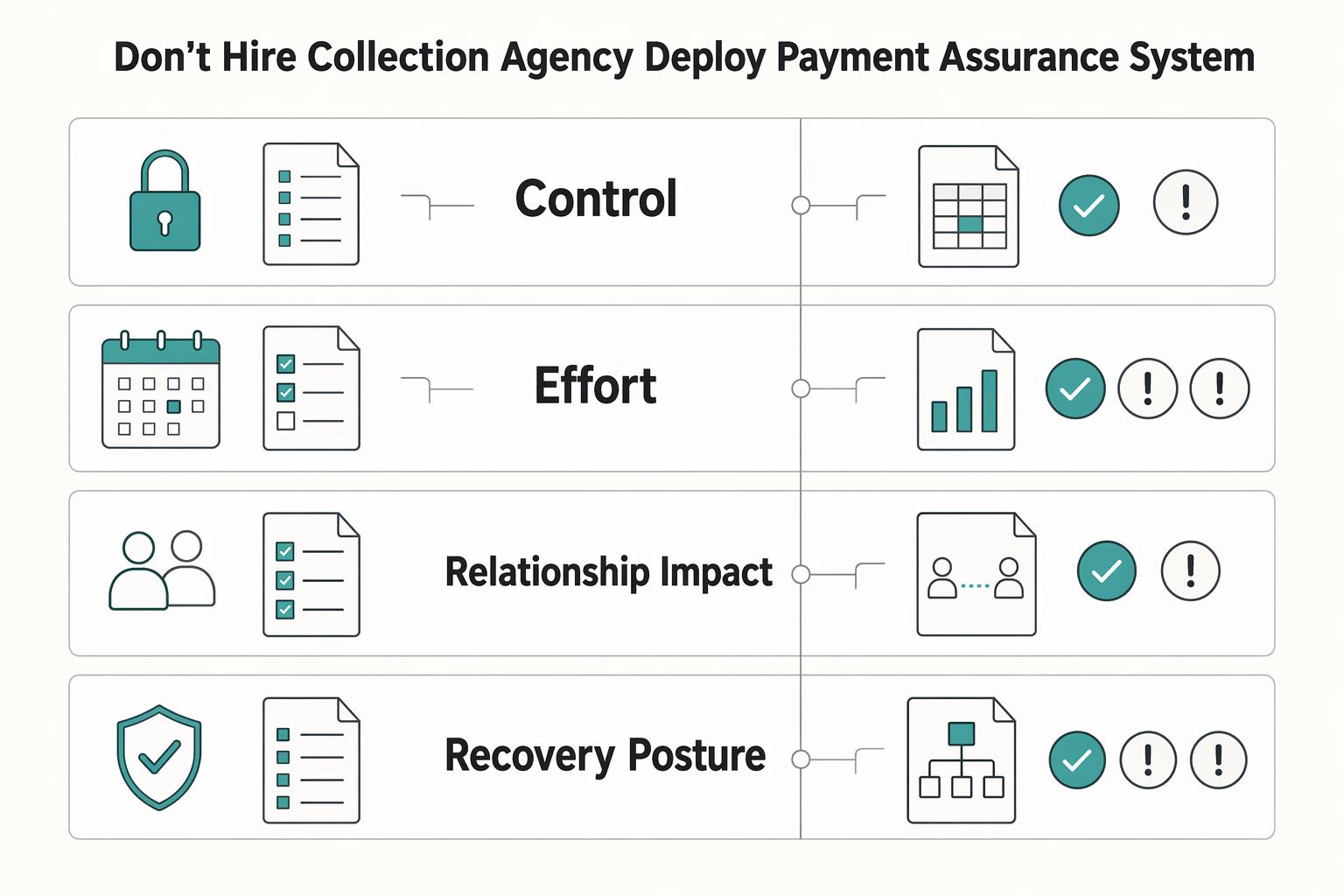
Collection Agencies for Small Businesses: Use a Payment Assurance System First
If you're searching for the **best collection agencies for small business**, the short answer is this: a collection agency is a later-stage tool, not your default operating model. Start with a payment assurance system that protects cash flow, keeps client relationships workable, and gives you a clear escalation path when invoices go past due.

The Freelance Payment Penalty: A Modeled Audit of Platform Fees, FX Spreads, and Payout Delays
The money rarely disappears through a single, easy-to-spot fee. The real loss is stacked. A marketplace takes its commission, a processor adds a charge for international cards, a bank or payment company converts the currency at a spread, a platform holds the funds before release, and a wire sheds a little to intermediaries on the way in. Each layer looks defensible on its own, but the worker feels the combined result as a smaller deposit and a later payday.