
Quick Answer
Start by ring-fencing 3 to 6 months of essential cash, then rebalance investment portfolio weights back toward your written target mix. Compare current percentages to policy, use contributions first, and sell overweight holdings only when taxable-account friction is acceptable. After trades settle, verify broad buckets and sub-allocations, log before-and-after weights, and schedule your next checkpoint so the process stays consistent.
Start with a cashflow-aware rebalancing plan#
Start with cash, then rebalance. Protect near-term needs first, and only then bring long-term investments back toward your target allocation. That can help keep portfolio risk where you intended it without creating avoidable liquidity pressure.
This section covers investment accounts, portfolio drift, trade decisions, and review rules. It does not cover day-to-day invoicing or collections.
Get your starting point clear#
If your cash position is unclear, pause before you change holdings. A practical starting point is to keep 3 to 6 months of essential expenses in cash. Treat that reserve as separate from rebalancing decisions, and rebalance the rest through trades or by directing new contributions and withdrawals.
- Ring-fence cash before you touch the portfolio.
Check upcoming cash needs first. Separate what must stay available for essentials from what is truly long-term capital. Rebalancing should restore risk discipline, not create liquidity stress.
- Set the target allocation before reviewing positions.
Rebalancing only works if you know the mix you are trying to restore. Anchor the target to your objectives, risk tolerance, time horizon, and overall financial plan. If that target is not defined yet, start with A Guide to Asset Allocation for Your Investment Portfolio.
- Pick a review rhythm you can sustain.
A time-based approach is often the simplest place to start. Common cadences are quarterly, semi-annually, or annually. Pick one that fits your schedule, understanding, and objectives.
- Apply two checks before placing trades.
First, compare current allocation to target allocation. For example, a 60% equities / 40% fixed income target drifting to 70/30 signals a meaningful change in risk. Second, account for tradeoffs. Selling can create taxes and transaction costs, especially in taxable accounts, and frequent rebalancing can increase that friction. Rebalancing can also lag in strongly trending markets, so use a consistent decision process rather than short-term prediction.
By the end, you should have a usable process. You should know when to act, what to do first, and how to handle cash or tax friction when the ideal move is not practical. You should also have a checklist you can reuse. Where evidence is limited, this guide says so directly.
You might also find this useful: How Freelancers Can Build a Diversified Investment Portfolio Without Breaking Cashflow.
Know exactly what rebalancing is solving#
Rebalancing solves a core problem: drift away from your target allocation and intended risk level. It is a maintenance decision, not a market call.
Start by measuring the portfolio you have against the portfolio you meant to hold. If your plan was 60% equities and 40% fixed income or cash, a meaningful move away from that mix means your risk profile changed whether you chose it or not.
That matters because drift is not cosmetic. A portfolio that began around 50/50 can end up closer to 75/25 over time, which changes the amount of risk you are actually carrying. You can also end up with less growth exposure than planned if the mix shifts the other way.
The corrective action is straightforward: trim what is overweight and add to what is underweight so you move back toward target. If the decision is driven by where you think markets go next, you are not rebalancing. You are timing.
One practical caution: in taxable accounts, rebalancing can conflict with tax-loss harvesting, so aim for sensible progress back toward target rather than forcing exact decimals. For a related cashflow angle, read Build a Freelancer Payment Portfolio That Protects Cashflow.
Prepare inputs before you place a single trade#
Do not start with tickets. Start with a one-page view of the decision: account types, current allocation, target allocation, risk tolerance, and time horizon. If you cannot show those inputs clearly, wait to trade.
| Input | What to capture | Why it matters |
|---|---|---|
| Account types | Each account and its value | Lets you review holdings by account type before trading |
| Taxable status | Which accounts are taxable | Taxable-account sales can have tax implications |
| Current allocation | The current mix | Lets you compare current allocation with target allocation |
| Target allocation | The mix you are trying to restore | Lets you measure drift against target |
| Risk tolerance | A plain-language note on comfort with risk | Allocation should reflect your comfort with risk |
| Time horizon | How long the money stays invested | If it changed, update the target allocation before you rebalance to it |
- Pull holdings by account type.
List each account, its value, and its current mix, and mark which accounts are taxable. Then compare current allocation with your target allocation. If closing the gap would require taxable-account sales, surface that constraint before execution because rebalancing in taxable accounts can have tax implications.
- Write your risk tolerance and investment horizon in plain language.
Do this before you review tickers. Your allocation should reflect your goals, timeline, and comfort with risk, so those inputs need to be explicit first. Keep it short and usable: what this money is for, how long it stays invested, and how much drift you are willing to accept. If your goals or timeline changed, update the target allocation before you rebalance to it.
- Check the baseline mix in two passes.
Look at broad buckets first, then review where the biggest drift sits. Start with stocks versus bonds. This is how you catch silent risk creep. A mix that started at 60% stocks and 40% bonds can drift toward 80% stocks and 20% bonds without any deliberate choice, which can become too aggressive for some investors. If you need a refresher on setting those buckets, A Guide to Asset Allocation for Your Investment Portfolio is the right companion read.
- Check taxable-account impact before choosing trades.
Before placing rebalance trades, review the potential tax impact in taxable accounts and factor that into what you execute first. If two trade paths both move you toward target, prefer the one with lower tax friction when it still fits your allocation plan. For a tax-focused workflow in a different context, see How to Do a 1031 Exchange for Investment Property.
Set allocation guardrails you can defend later#
Write the guardrails before you trade. You need clear target percentages, a repeatable trigger, and a review checkpoint you can apply the same way next time.
- Write your target asset allocation as explicit percentages.
Start with top-level weights such as stocks, fixed income, and cash. Then define the equity split you actually monitor, such as US versus international exposure. Use the same verification flow every time: compare current versus target at the stock, bond, and cash level first, then within equities. This keeps drift visible. A 60/40 mix left unchecked for a decade can drift toward 80% stocks.
- Choose one rebalance method and use it consistently.
- Calendar-based: review on a fixed cadence, such as quarterly, semi-annually, or annually. - Threshold-based: review when an asset class moves outside a set band, such as 5% above or below target.
Either method can work. The value is consistency, so the portfolio stays tied to the risk profile you intended instead of drifting into timing bets.
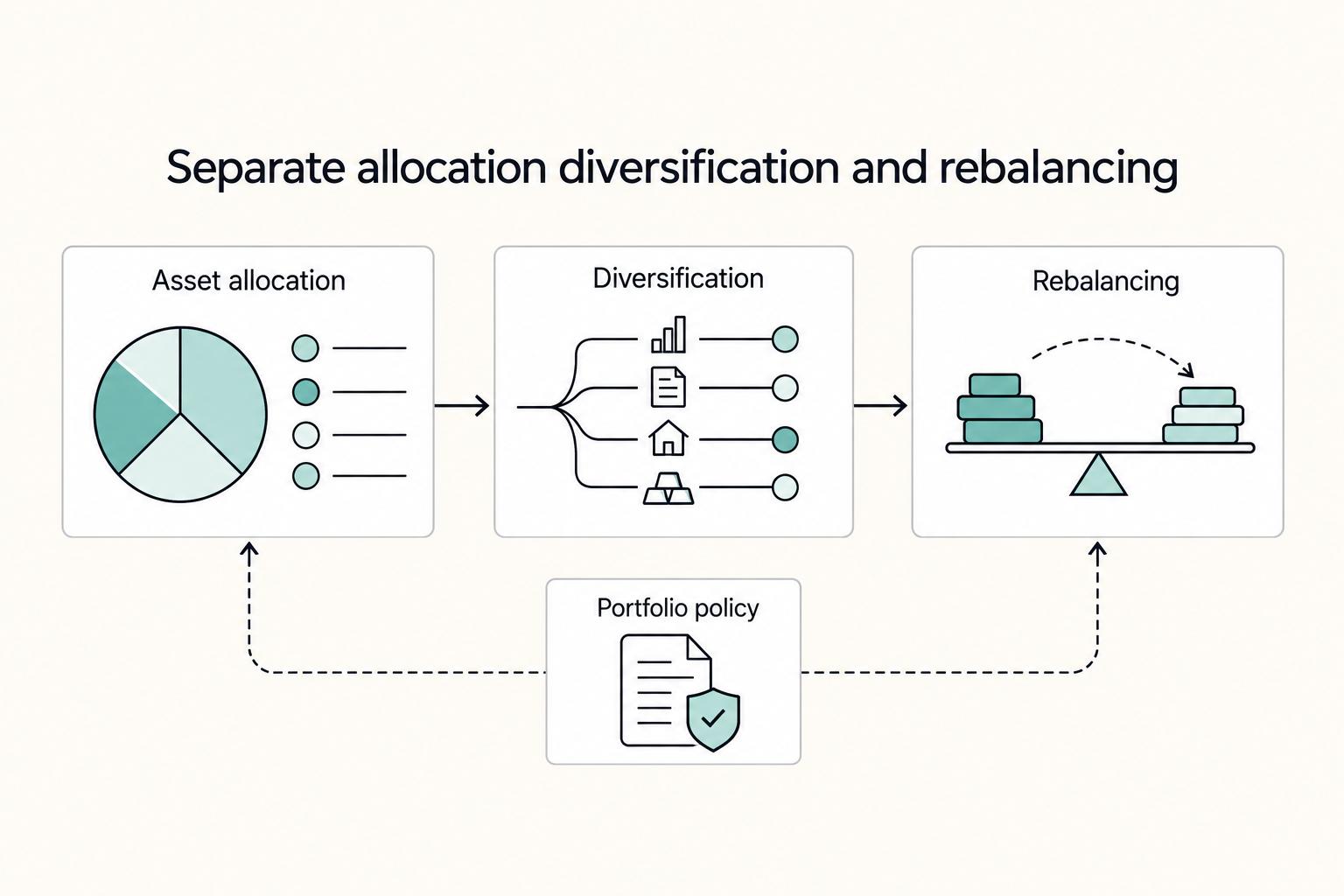
- Keep policy decisions separate from maintenance trades.
When you change the target mix, treat that as a policy decision and record why. Keep routine rebalancing focused on moving current weights back toward the existing target. This distinction reduces ad hoc changes driven by recent market moves and gives you a cleaner decision record.
- Keep the policy concise enough to use.
Include the practical items you will check each time.
- target top-level allocation - key equity split targets you monitor (for example, US vs. international) - chosen rebalance method and review cadence
At each checkpoint, record current versus target and a brief note: either no policy change or policy updated with reason. If you cannot explain the target mix in plain language, tighten it before you execute trades.
Choose your trigger method and resolve conflicts#
Use a simple default: pick a calendar review you will actually complete, then add a drift override if allocation can move meaningfully between review dates.
- Choose calendar-based rebalancing when consistency is your main risk.
A time-based trigger can be easier to sustain when client work gets busy. On each review date, measure current weights against your original or preferred allocation and then decide whether action is needed. Annual review is a solid baseline. The point is not to trade on schedule. The point is to run the review on schedule.
- Choose drift-based rebalancing when responsiveness is your main risk.
This method uses movement away from target allocation as the trigger, so it can help catch outsized weights between scheduled dates. It works best when someone will actually monitor drift between review dates. If no one will check consistently, drift logic may look precise on paper but fail in practice.
| Method | Trigger logic | Main strengths | Main tradeoff | Best fit |
|---|---|---|---|---|
| Calendar-based rebalancing | Review on a fixed schedule, with annual as a common baseline | Simple, repeatable, easy to document | Can miss larger moves between dates | Solo freelancer who needs a low-maintenance process |
| Drift-based rebalancing | Review when allocation drifts from target | More responsive to market moves and can catch outsized weights between reviews | Requires ongoing monitoring and more decisions | Small team finance owner with regular oversight |
| Calendar + drift override | Keep scheduled reviews, but act earlier when drift is clearly larger before the next date | Balances discipline and responsiveness | Needs one written override rule to avoid improvising | Busy operators who want structure without rigidity |
- Resolve trigger conflicts with one rule and use it every time.
One practical rule: if the calendar review arrives and drift is minor, defer trading and log the decision; if drift grows clearly larger before the next review date, act earlier instead of waiting. Keep the checkpoint the same each time: compare current allocation to target before any trade, and confirm whether your preferred allocation or risk tolerance changed. If those inputs did not change, you are doing maintenance, not rewriting policy.
- Run a tax-friction check before turning a trigger into a sale.
A trigger is not automatically a sell order, especially in a taxable account where rebalancing can conflict with tax-loss-harvesting plans. When possible, use new contributions to close gaps before selling. Practitioner commentary suggests many investors can rebalance this way, especially in the first decade of saving. That can reduce the need to sell appreciated taxable holdings just to get back to target. Related reading: Maximizing Your Retirement Contributions as a Freelancer.
Run the rebalance in the right order#
Once your trigger says to act, use a consistent process: compare current weights to target, trade from overweight positions to underweight positions, then verify the result.
- Start with a current allocation snapshot.
Review current weights across the portfolio and compare them with your target allocation. This shows where drift has occurred and whether adjustments are needed.
- Trade to restore target allocation.
The core action is to sell positions that are overweight and buy positions that are underweight relative to target. Focus on meaningful drift so you avoid unnecessary trading.
- Check tax impact before you sell in a taxable account.
Potential tax implications are part of the execution decision. Rebalance deliberately so you balance getting back to target with avoiding unnecessary tax costs from overtrading.
- Recalculate after orders fill.
Confirm the actual post-trade mix is back in line with your target allocation. Keep monitoring allocations regularly, and rebalance again when drift is meaningful. If you want a deeper dive, read Japan Digital Nomad Visa 2026: Six-Month Planning Runbook.
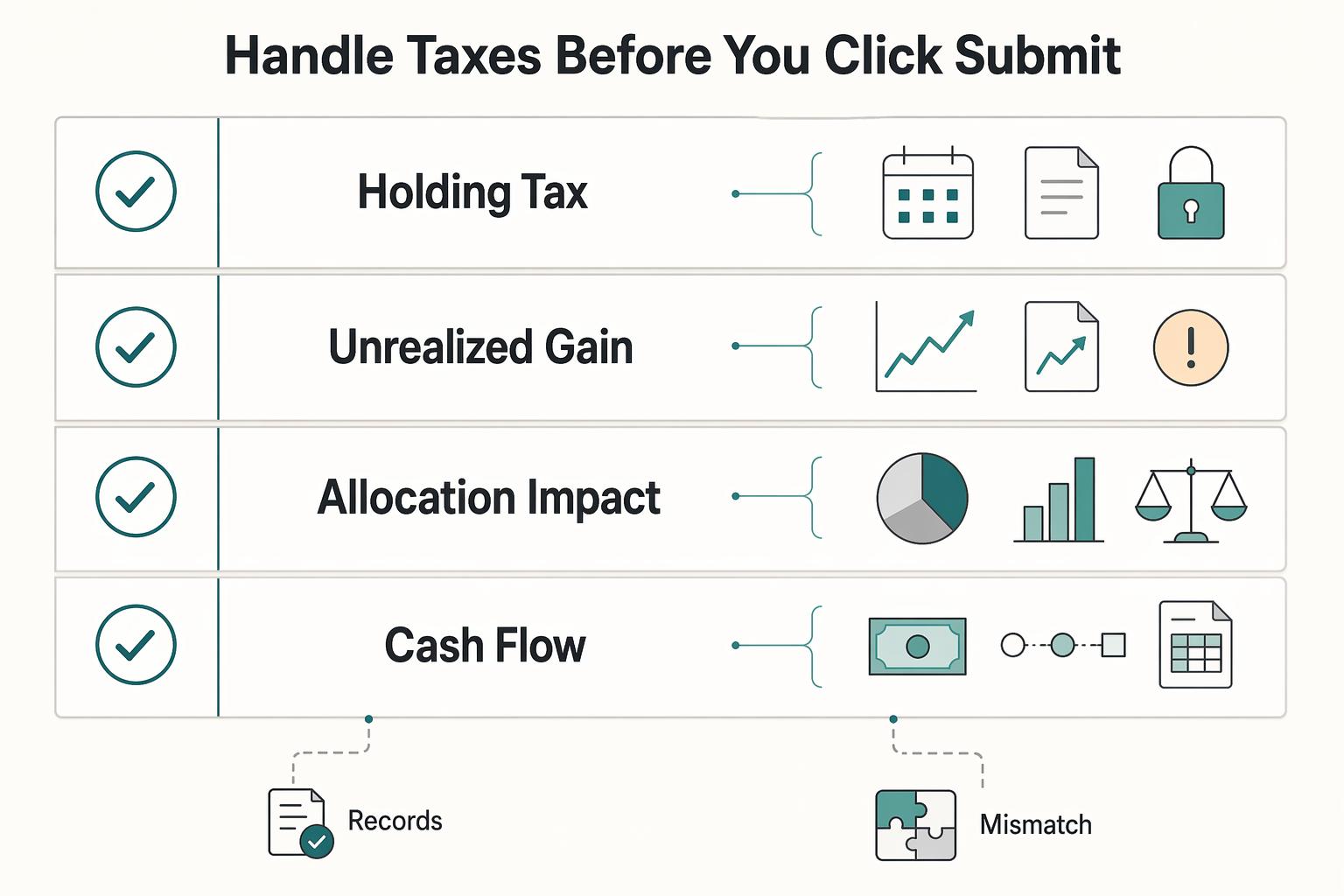
Handle taxes before you click submit#
In a taxable account, the decision is not just how much to trade. It is whether realizing tax now is worth the risk reduction from moving back toward your target asset allocation.
| Sell factor | What to note | Use in decision |
|---|---|---|
| Holding or tax lot | Identify the candidate sell | Helps compare potential sells in a written order of preference |
| Unrealized gain, loss, or near flat | Note the tax position | Shows which path has lower tax friction |
| Allocation impact | Note how much it closes the broad allocation gap | Helps restore allocation with the least after-tax disruption |
| Cash flow or new contributions | Note whether they can reduce the need to sell | Supports using the lowest-friction path first |
- Treat rebalancing as an after-tax decision.
Do not treat it as a pure percentage reset. A useful checkpoint is "Tax Deferral vs. Tax Realization." If you skip that step, you can improve the dashboard view of allocation while adding tax drag that affects long-term compounding. This tradeoff can be difficult when drift is meaningful. A 60/40 mix drifting to 75/25 clearly raises risk exposure, but selling to fix it may also create tax friction. Weigh both sides before you act.
- Compare potential sells by tax friction.
You do not need a complex model, but it helps to use a written order of preference that restores allocation with the least after-tax disruption. For each candidate sell, note: - the holding or tax lot - whether it is at an unrealized gain, loss, or near flat - how much it closes the broad allocation gap - whether cash flow or new contributions could reduce the need to sell
If you cannot explain why one path is lower-friction than another, pause before you submit.
- Use the lowest-friction path first.
That can still mean the rebalance happens in stages. In practice, that can mean directing future buys or new contributions to underweight areas before selling appreciated positions. If tax cost still looks high, do not force a perfect same-day reset. Move the broad stock-versus-bond mix closer to target now, document the remaining drift, and close more of the gap with future buys. If drift is severe, selling may still be reasonable, but make it an explicit tradeoff.
- Use broker documentation for mechanics, then document your own tax assumptions.
Broker materials can help with account and order workflow, but they do not replace your tax decision process. For example, a SEC-filed E*TRADE Trust prospectus says those fund shares can only be purchased through a self-directed E*TRADE account. That is a platform constraint, not a rule for when a taxable rebalance makes sense. Before you submit, add one line to your log: why you chose this sell path, which tax assumptions you used, and why you did not choose the obvious alternative.
Verify that your rebalance actually worked#
A rebalance worked only if the final weights are back inside your target allocation range, the action matched your trigger policy, and your notes make the next review easier.
- Recalculate final weights from current market value.
Check every level in your policy. Start with broad asset allocation, such as stocks versus bonds, then verify each sub-bucket you track. Drift can hide below the top line, so a headline split that looks close is not enough. Do not judge from a single market move in isolation. A 10% move in stocks alone does not confirm either a trigger or a successful reset. Export positions, total each bucket, divide by total portfolio value, and compare each result with your target ranges.
- Validate the reason for action against your written rule.
For calendar-based rebalancing, confirm you acted on your chosen schedule. For drift-based rebalancing, confirm weights moved away from target enough to trigger action under your own policy. Also keep maintenance separate from policy change. You may be rebalancing because the portfolio drifted, or because your target allocation changed. Log those as different events so future decisions stay clear.
- Record whether this was routine maintenance or a plan change.
Do this while the details are still fresh. Keep the note short and specific so future-you can tell whether this was a routine reset or a policy update. Include before and after weights, trade date, and reason code. That record is what keeps future reviews disciplined.
- Run a final control for residual drift.
If any post-trade weight is still outside your target ranges, fix it now or document exactly why you are staging it. In a taxable account, include tax impact in that decision. Do not assume fund-level rebalancing solves investor-level drift. Funds may rebalance internally while your portfolio mix still changes based on how much of each fund you hold. The final test is simple: did the portfolio end where your plan says it should? We covered this in detail in How to build a 'Portfolio of Small Bets' to diversify your freelance income.
Know when to delay or skip a rebalance#
Sometimes the right move is to wait. If the real issue is plan fit rather than portfolio drift, rebalancing back to old weights can be the wrong answer.
- Reconfirm goals before trading.
If a major life or financial goal changed, pause and review whether the current portfolio still fits. A trade that restores old weights can still be the wrong move if the goal changed first.
- Recheck risk tolerance and time horizon.
Before you rebalance, verify whether your risk tolerance or investment time horizon changed. If either changed, revisit your target asset allocation first, then decide whether trades are still necessary.
- Use a review checkpoint, not autopilot.
Treat rebalancing as part of a documented review process. A practical cadence is a quarterly check-in with at least one in-depth annual review to confirm your allocation still matches your goals and risk profile.
- If you delay, set the next review date now.
Skipping a rebalance can be reasonable if you set the next review date right away. Unchecked drift can push you into more risk than intended or leave you too conservative for your goals. This pairs well with our guide on A Guide to Real Estate Investment Trusts (REITs).
Avoid the mistakes that cause most rebalance regret#
Most regret comes from abandoning your process under pressure. Keep the target mix stable between review points, execute in a tax-aware order, and use one trigger method consistently.
- Lock policy changes to review points.
Rewriting your allocation after every market headline turns rebalancing into performance chasing. That is a form of herd behavior, and it can push you toward recent winners instead of your plan. In one historical comparison, a chase approach based on the prior year's best segment had a lower Sharpe ratio than almost all annually rebalanced portfolios. It also did not add enough return to justify its higher risk. Use a simple recovery rule: only change policy on a scheduled review date, and only when your objectives or constraints clearly changed.
- Check the whole portfolio first.
Start at the total-portfolio level instead of moving account by account. That gives you the clearest view of whether overall asset allocation drifted from plan. Then make adjustments according to your written allocation policy so decisions stay consistent.
- Rebalance taxable accounts in a tax-aware order.
In a taxable account, trade order matters. Before selling, review whether contributions can correct underweights first. For many early-career savers, contribution-led rebalancing reduces how often they need to sell appreciated taxable assets. If you do need to sell, document which trades you prioritized or deferred for tax reasons so the plan stays consistent.
- Avoid overtrading.
Rebalancing is a discipline, not a reason to trade constantly. Overconfident investors may trade too much and hurt performance. Once your trigger says "rebalance," make the needed moves and avoid extra discretionary trades.
- Pick one primary trigger and one override rule.
Choose one main method: calendar-based rebalancing or percentage-of-portfolio rebalancing. Then define one override rule for exceptions and apply it consistently. Switching methods after the fact creates avoidable trades and weakens discipline. A stable method plus a prewritten override keeps decisions repeatable when markets move. Related: ITIN vs. EIN vs. SSN: What's the Difference?.
Copy and use this monthly and quarterly checklist#
A light monthly check and a fuller quarterly review can be a useful cadence, but choose a frequency that fits your goals, risk tolerance, and time horizon.
| Stage | Focus | Key actions |
|---|---|---|
| Monthly check | Current weights and cash needs | Update balances, compare current weights with target allocation, note drift, confirm near-term cash needs, and record changes to goals, risk tolerance, or time horizon |
| Quarterly review | Full rebalancing review | Run a full review against target allocation and sub-allocations, start at the total-portfolio level, and keep a current worksheet or summary tab |
| Before trading | Plan the execution | Reconfirm alignment with goals, risk tolerance, and time horizon, then choose and document the execution approach |
| After trading | Verify and schedule | Verify final weights against intended targets, log what changed and why, and schedule the next checkpoint |
Monthly check#
- Update balances across all investing accounts and compare current weights with your target allocation.
- Note drift. Holdings can grow at different rates, and market moves can shift risk away from your original intent.
- Confirm near-term cash needs before making trade decisions.
- Record any changes to goals, risk tolerance, or time horizon.
Quarterly review#
- Run a full rebalancing review against your target allocation and any sub-allocations you track.
- Start at the total-portfolio level, then review sub-allocations so additional drift is visible.
- Keep one current worksheet or summary tab that shows current versus target weights and your execution notes.
Before trading#
- Reconfirm that planned changes still align with your goals, risk tolerance, and time horizon.
- Choose your execution approach and document it before placing trades.
After trading#
- Verify final weights against the targets you intended to hit, including sub-allocations.
- Log what changed and why.
- Schedule your next rebalancing checkpoint (monthly, quarterly, or another cadence you chose).
If inconsistent client payments keep disrupting your schedule, you can also simplify billing with the free invoice generator.
Use discipline over prediction#
The through line here is simple: treat rebalancing as a policy, not a reaction. The job is to keep your risk aligned with your target allocation as holdings drift at different rates, not to predict what wins next.
- Write the policy before you trade.
Write a short policy page before placing any trade. Include your target allocation and why it fits your goals, risk tolerance, and time horizon. For solo management, keep it simple: target mix, trigger rule, account list, and any standing constraints. For a team, define who monitors, who proposes trades, who approves, and what evidence must exist. That operating clarity supports cleaner execution and review. If you need to reset your mix first, use A Guide to Asset Allocation for Your Investment Portfolio before you rebalance.
- Choose a trigger you will actually follow.
Pick a trigger and then stick to it. Changing the rule every time markets feel unusual pulls you back into prediction. The tradeoff is practical: more monitoring can increase monitoring and trading costs, along with tax implications. Consistency matters more than perfect timing.
- Execute in tax-aware order.
Use the same sequence each cycle: update current weights, measure drift versus target, then decide what to trim and what to add. In taxable accounts, use the framing that matters: control risk drift with minimal taxable turnover. If a full correction creates too much tax, liquidity, or settlement friction, document a partial correction and keep moving toward target through subsequent cycles.
- Verify and document exceptions.
After execution, confirm post-trade weights against policy instead of assuming the portfolio is close enough. If taxes, liquidity, or settlement constraints block a full rebalance, record the exception and the follow-up plan. A partial rebalance can be defensible when the reason is explicit.
- Log the cycle for auditability.
Keep a simple log: date, trigger, before and after weights, actions taken, and rationale. Also note whether goals, risk tolerance, or time horizon changed. That record turns rebalancing into a repeatable operating habit instead of a series of one-off reactions. If you want a manageable starting point, run one full review cycle and keep the notes.
If you want a cleaner cross-border money workflow behind this discipline, review Gruv's freelancer path for collecting and moving funds with clearer operational controls, where supported: See Gruv for freelancers
Frequently Asked Questions
What is portfolio rebalancing in one sentence?
Portfolio rebalancing is moving money between investments to restore your target allocation after market drift. The point is to stay aligned with your long-term plan, not to create a new one because markets moved.
How do I figure out what to sell and buy?
Start by checking your current allocation in your statements or account tools before making transfers. Then move money from investments above target to investments below target based on the percentages you originally set. Use your target allocation as the reference point, not recent market momentum.
How often should I rebalance: calendar based or drift based?
Start with a calendar baseline you will actually follow, with at least one review per year. If markets are moving significantly, quarterly reviews can be reasonable. You can also use a drift trigger, with 5% to 10% from original allocation often used as a practical action range.
When should I skip or delay a rebalance?
Pause before trading if your objectives, time horizon, or personal circumstances changed substantially. In that case, confirm the target allocation is still right before you rebalance back to it. In taxable accounts, also account for tax impact before acting.
What should trigger a rebalance besides market moves?
Changes in goals, risk tolerance, and time horizon are valid triggers because they shape your target allocation. If those inputs change, revisit the target first and then rebalance to the updated plan.
What tax issue matters most in a taxable account?
One key issue is the tax impact of the trades used to rebalance. Thoughtful rebalancing in taxable accounts should account for tax consequences, not just percentage gaps on a dashboard.
Can I run this as a simple recurring routine?
Yes. Keep it simple and repeatable. Review on a set schedule, check current weights before transfers, and use a tolerance band to define meaningful drift. If your plan offers automatic rebalancing, it can help with consistency, but still review at least annually to confirm the target still fits.
What does drift actually look like in practice?
Drift can materially change portfolio risk when one asset class outperforms for a while. For example, a mix can move toward 80% stocks and 20% bonds over time if no adjustments are made.
Try a related tool
Researched and edited by the Gruv editorial team. Gruv builds cross-border billing, payouts, and finance-operations software for global businesses.
Sources
Includes 1 external source outside the trusted-domain allowlist.
- bcf.princeton.edu/wp-content/uploads/2022/08/Choukhmane-DeSilv...trusted
- checkout.columbiacollege.edu/uploaded-files/6bn7EK/7FE130/fidelity-guided...trusted
- ers.ehawaii.gov/wp-content/uploads/2012/10/ERS-Investment-Po...trusted
- investor.gov/additional-resources/spotlight/formerdirecto...trusted
- scholar.smu.edu/cgi/viewcontent.cgitrusted
- sec.gov/Archives/edgar/data/935070/00011931251504367...trusted
- sec.gov/Archives/edgar/data/2048903/0001133228240112...trusted
- bankrate.com/investing/portfolio-rebalancingexternal
Educational content only. Not legal, tax, or financial advice.
Related Posts

Japan Digital Nomad Visa 2026: Six-Month Planning Runbook
Treat this as your operating model: identify the right mission first, commit to one route, and keep dated records before you make irreversible plans. That is what keeps the rest of your timeline, paperwork, and decisions coherent.

ITIN vs. EIN vs. SSN: What's the Difference?
As the CEO of your business-of-one, you are not here for vibes. You need a repeatable system you can run.
Asset Allocation for Freelancers With Uneven Income
Start here: keep money you may need in the near term separate, and invest only money that can stay invested. Your portfolio should serve long-term goals, not compete with short-term needs. That is the job of [asset allocation](https://www.investor.gov/additional-resources/general-resources/publications-research/info-sheets/beginners-guide-asset): set target percentages across major asset classes like stocks, bonds, and cash, then maintain that mix with rebalancing from time to time instead of reacting to headlines.