
Quick Answer
Start with a period-based P&L and read it in order: revenue, cost of revenue, operating expenses, then net income, using Revenue - Expenses = Net Income (Loss) as your control check. In practice, how to read an income statement for a service business means separating delivery costs from overhead, reviewing margin and trend shifts across comparable periods, and testing client-loss, downtime, and pricing scenarios before changing rates or terms.
How to Read Your Income Statement as an Operating Decision Tool#
Your income statement is an operating decision tool first. Use it to confirm that your pricing covers delivery costs, catch overhead creep early, and see whether profit is holding up before timing gaps turn into cash flow pressure.
Pull a report for a defined period#
Start with a monthly income statement, also called a profit and loss statement or P&L. It shows what your business made and spent over a specific period, not a general snapshot. The anchor formula is Revenue - Expenses = Net Income (Loss).
| Term | Definition |
|---|---|
| Income statement | A profit and loss statement or P&L that shows what your business made and spent over a specific period |
| Revenue | The value of services sold in that period |
| Expenses | Costs incurred to run and deliver the work, such as labor, rent, taxes, and other business costs |
| Net income (or loss) | What remains after all period expenses are subtracted from period revenue |
For a solo operator or small team, read it this way:
- Revenue: the value of services sold in that period
- Expenses: costs incurred to run and deliver the work, such as labor, rent, taxes, and other business costs
- Net income (or loss): what remains after all period expenses are subtracted from period revenue
Checkpoint: confirm the date range. If you cannot tell whether the report is monthly, quarterly, or year-to-date, it is hard to use reliably for decisions.
Use it for decisions, not cash-position guesses#
A P&L is not a cash report. Under accrual accounting, income is generally recorded when earned and expenses when incurred, even if payment has not moved yet.
| Use your income statement for | Do not use it alone for |
|---|---|
| Testing whether pricing supports your cost structure | Checking cash on hand or bank balance |
| Spotting overspending patterns over time | Confirming when cash actually moved |
| Measuring profitability by month or quarter | Managing collections timing by itself |
| Tracking performance period by period | Treating it as only a tax record |
If profit looks healthy but cash is tight, check unpaid invoices and then review your cash flow statement.
Read it as a recurring management habit#
You do not need accountant-level training to use this well. You need a clean period-based report, consistent categories, and a regular review. Did revenue rise? Did expenses rise faster? Did net income improve or weaken?
That review only works if your costs are classified cleanly. Before you analyze margins or set pricing with confidence, separate direct delivery costs from general overhead. Related: How to Get a Certificate of Residence (Form 6166) from the IRS.
What Does 'Cost of Goods Sold' Mean When You Are the Service?#
For many service businesses, a practical approach is to use this line as cost of revenue: costs directly tied to delivering invoiced client work. If a cost exists only because you took a specific client project, classify it here. If you would pay it anyway to run the business, keep it in operating expenses, or OpEx.
Reporting treatment can vary by business type and use case, so treat this as a working classification rule, not a universal requirement.
On many income statements, this line sits directly below revenue and may be labeled COGS or cost of sales. The label matters less than the classification, because it drives gross profit: revenue minus direct delivery costs.
Use one decision rule for every expense#
Use this test: If this client job did not exist, would you still have this cost?
- If no: include it as cost of revenue.
- If yes: keep it in OpEx.
This keeps direct costs tied to delivery volume and indirect costs in the overhead bucket. It also helps you avoid overstating direct costs and understating gross profit by pushing general overhead into COGS.
For mixed-use costs, split and document#
Mixed-use costs may need a split, not a guess. If a cost supports both client delivery and general operations, do not force the full amount into one bucket.
- Allocate the part you can tie to a named client, project, or statement of work to cost of revenue.
- Keep the remaining share in OpEx.
- If you cannot explain or support the split clearly, keep it in OpEx until you can.
Checkpoint: every amount booked as direct should map to a client, project code, or engagement file.
| Expense example | Include as Cost of Revenue | Keep in OpEx | Why it matters for pricing |
|---|---|---|---|
| Subcontractor paid for one client engagement | Often yes, when tied to that project | Yes, for general admin/business support work | Shows the true delivery cost of that service |
| Travel required to deliver client work | Often yes, when project-required | Yes, for networking or business development travel | Reveals whether travel-heavy work still supports margin |
| Assets/materials/licenses purchased for one client deliverable | Often yes, when bought for that job | Yes, for general library or broad-use purchases | Prevents underpricing work with project-specific inputs |
| General marketing or promotion | No | Yes | Supports the whole business, not one invoice |
| Office expenses, admin help, bookkeeping tools | No | Yes | Separates delivery economics from overhead |
| Software used for both delivery and operations | Sometimes, with supportable project share | Yes, for general-use share | Produces cleaner project margin signals |
Tag first, roll up second at month-end#
A simple month-end habit: tag direct costs by client or project before you review the full P&L.
- Export monthly expense detail.
- Classify each line as direct cost or OpEx.
- Add client/project tags to direct-cost lines.
- Total direct costs by client, then for the month.
- Subtract monthly direct costs from monthly revenue to get gross profit.
Then verify that your tagged direct-cost total matches the cost-of-revenue line on the income statement. If it does not, recheck tagging, split logic, and duplicate or misposted entries.
Watch for direct costs rising faster than revenue. That pattern can signal issues like rising input prices, delivery inefficiency, or quality-control problems. Once classification is clean, gross profit becomes more reliable, and you are ready to read the full P&L waterfall. For a step-by-step walkthrough, see How to Read a Balance Sheet.
The Anatomy of Your P&L: From Gross Revenue to Your Real Bottom Line#
Read your P&L as a waterfall: top to bottom, one decision per subtotal. In a common two-step view, if a subtotal does not support a clear decision, you likely have a classification problem.
Start with revenue#
Start with revenue: the total money generated from selling your services in the period. You may see labels like service revenue or revenues from services.
Use this line as your demand signal before costs enter the picture. First check whether this total matches your period revenue support, such as your invoiced or earned-service report.
Subtract service-delivery costs and read gross profit#
Gross profit tells you whether the work you sell leaves enough room to fund overhead and profit. In two-step presentations, you get it by subtracting service-delivery costs from revenue.
Keep the boundary tight: direct, client-delivery costs in service-delivery costs (often labeled cost of services or cost of revenue), and business-running costs in operating expenses. If your statement is presented by expense nature instead of function, gross margin may not be determinable, so use a supporting schedule to separate delivery costs from overhead.
Subtract operating expenses and test operations#
In this common layout, operating income is a useful measure of core operating performance before non-operating items and taxes. To get there, subtract operating expenses from gross profit.
| Line item | What belongs here | What this signals |
|---|---|---|
| Revenue | Service sales for the period | Demand and pricing traction |
| Cost of Services / Cost of Revenue | Direct costs tied to delivering billed work | Delivery cost control and pricing fit |
| Gross Profit | Revenue minus service-delivery costs | Margin available before overhead |
| Operating Expenses | Costs to run the business not tied to one project | Overhead pressure |
| Operating Income | Gross profit minus operating expenses | Core operations performance |
| Net Income | Profit after all expenses and taxes | What you actually kept |
Separate non-operating items before judging the bottom line#
Do not jump straight to net income. First understand operating income, then look at what sits outside core operations.
Net income is profit after all expenses and taxes are deducted from revenue, but some items are non-operating. SEC line-item guidance presents non-operating income separately, with examples like dividends, interest on securities, and profits on securities. Use the same principle in your review: keep operating and non-operating effects distinct, then confirm final classification under your local accounting and tax rules.
Read in order before deeper analysis#
Use this quick monthly sequence:
| Order | What to review | Why it matters |
|---|---|---|
| 1 | Revenue agrees to your period revenue support | Confirms revenue before deeper analysis |
| 2 | Whether service-delivery costs are rising faster than revenue | Flags delivery-cost pressure |
| 3 | Gross profit compared with operating expenses | Helps locate pressure in delivery or overhead |
| 4 | Non-operating items and taxes last | Keeps them from masking operating performance |
- Confirm revenue agrees to your period revenue support.
- Check whether service-delivery costs are rising faster than revenue.
- Compare gross profit with operating expenses to locate pressure, whether in delivery or overhead.
- Review non-operating items and taxes last so they do not mask operating performance.
That order helps you locate margin pressure before you move into pricing, trend, or risk analysis.
Funding Your Freedom: How to Account for the "Autonomy Premium"#
Treat Autonomy Premium as an internal management label, not a formal GAAP/IFRS line item. Verify any accounting treatment before you rely on it for books, taxes, or formal reporting.
Define one category and keep it consistent#
If you use this framework internally, keep one category in management reporting called Autonomy Premium, or another label you apply consistently at close. You can track recurring planning items such as:
- health coverage
- retirement funding
- downtime buffer
Map each item to a recurring P&L line#
Assign each item to a consistent internal reporting line so month-to-month tracking is comparable. Final statutory classification should be verified separately.
| Autonomy Premium item | Where it sits in your P&L | Why it protects cashflow |
|---|---|---|
| Health coverage | Internal management line under your Autonomy Premium category (classification to be verified) | Keeps the item visible in planning |
| Retirement funding | Internal management line under the same category (classification to be verified) | Keeps the item visible in planning |
| Downtime buffer | Internal reserve-planning line in your internal view (classification to be verified) | Keeps the item visible in planning |
Use it in pricing and monthly close#
Use this category in pricing and close as an internal method, then verify treatment before finalizing books. Current thresholds, limits, or required minimums should be checked against finance, plan, or adviser records before use.
Each line should tie to current support, such as a bill, transfer record, or reserve entry. If a line depends on plan rules, premiums, or contribution limits, verify the current figure against finance, plan, or adviser records before finalizing.
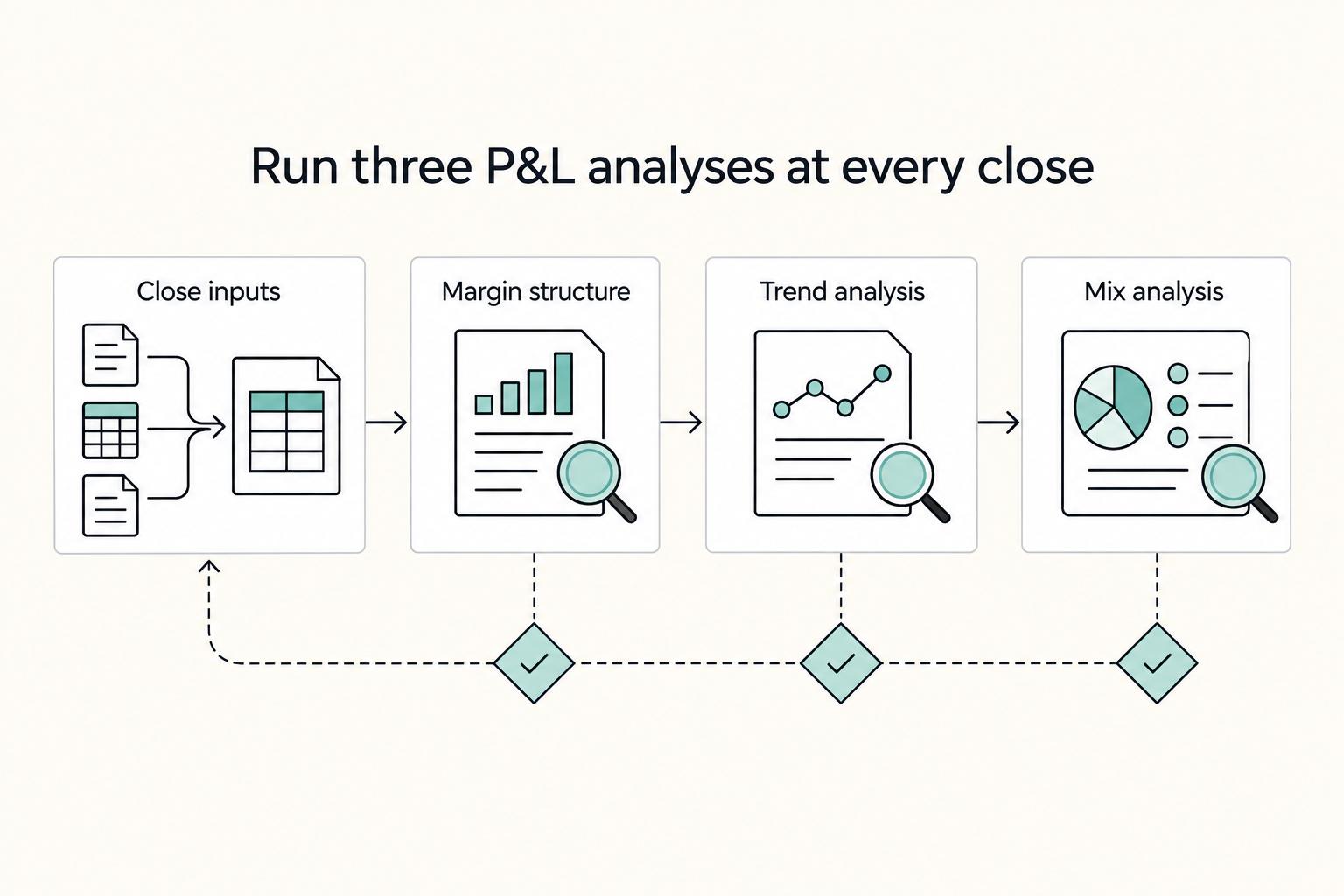
Three P&L Analyses to Run at Each Close#
At each close, use your P&L to answer three questions. Is pricing strong enough? Are trends improving or slipping? Is risk too concentrated in one client or service line? If one check flags a problem, act in the same period instead of waiting for year-end.
| Analysis | Focus | Decision rule |
|---|---|---|
| Margin analysis | Revenue, cost of revenue or COGS, operating expenses, and final profit or loss | Weak gross profit points to service economics; solid gross profit with weak operating income points to overhead pressure |
| Horizontal analysis | Revenue, gross profit, operating expenses, operating income, and average revenue per client across like-for-like periods | Do not reset strategy on one odd month; act on repeated patterns |
| Vertical analysis | Major expense categories and client or service-line revenue mix in the current period | If about 60% of revenue comes from one client or one service line, treat that as a risk signal |
Before you start#
Use your internal management P&L, not a tax-return view. Taxable income and income-statement income often differ, and this check is for operating decisions.
Pull your current monthly or quarterly P&L, matching reports for at least the prior three to six months or the same quarter last year, client revenue or invoice detail, and expense detail for unusually large lines.
Quick verification: confirm major expenses were actually posted for the period and tie to real records.
Margin analysis for the current structure#
Start with margin analysis when you need to know whether the current period works at all. Review, in order, revenue, cost of revenue or COGS, operating expenses, and final profit or loss.
- Gross profit = revenue minus COGS.
- Operating income = gross profit minus operating expenses.
- Net profit = what remains after all expenses.
| Margin type | Purpose | What it tells you | Common misread | Immediate action |
|---|---|---|---|---|
| Gross profit margin | Test delivery economics | Whether pricing covers direct project costs | "Revenue is up, so delivery is healthy." | Reprice work, tighten scope, or review direct inputs, for example subcontractors or project software. |
| Operating profit margin | Test core business viability | Whether overhead fits your revenue base | "If gross profit is positive, operations must be profitable." | Audit overhead, cut low-value spend, and adjust baseline pricing if delivery is fine but operations are thin. |
| Net profit margin | Test all-in result | Whether the business leaves room after every expense | "Busy month means healthy business." | Stop or rework low-margin engagements, fix pricing, and remove costs that do not support profitable delivery. |
Decision rule: weak gross profit points to service economics. Solid gross profit with weak operating income points to overhead pressure.
Horizontal analysis for trend over time#
A single month can mislead you. Horizontal analysis works better because it compares the same lines across periods and shows direction, not noise.
Review revenue, gross profit, operating expenses, operating income, and average revenue per client across like-for-like periods: monthly with monthly, quarterly with quarterly, annually with annually. Use three to six months before acting on a single-period move.
- Example: a 15% monthly drop can still sit inside a 20% year-over-year increase.
- Strong warning: total revenue is flat while average revenue per client declines.
Decision rule: do not reset strategy on one odd month. Do act on repeated patterns by tightening discounting, raising minimum engagement size, repricing, or replacing low-value work.
Vertical analysis for mix and concentration this period#
Vertical analysis tells you where the current period is being carried and where it is getting fragile. Look at where revenue is going by major expense category and where revenue is coming from by client or service line.
Review the largest current-period expense categories and the current client and service-line revenue mix.
Look for categories taking a larger share of revenue without supporting profitable delivery. Also check concentration risk: if about 60% of revenue comes from one client or one service line, treat that as a risk signal.
Decision rule: if concentration is high, reduce dependence before performance is hit. Practical moves are to cap additional work from the dominant source, build pipeline in other accounts, or expand into another service line. Verify concentration with invoice or client-revenue reports, not memory.
We covered this in detail in How to Build a 3-Statement Financial Model.
Run Monthly Scenarios on a Copy of Your Current P&L#
Run this monthly on a copy of your current P&L, not as a one-time exercise. Scenario planning is useful because it helps you see where results weaken before cash pressure forces a rushed move.
Because an income statement is period-based, you can reuse the same monthly report each cycle. Keep it practical: change one assumption, recalculate operating income and net income, and decide what you will do next period if results weaken.
| Scenario | What You Change | What to Watch | Decision If Weak |
|---|---|---|---|
| Biggest client lost | Reduce revenue by that client's share and remove only direct costs that would actually disappear | Operating income, net income, and whether fixed overhead still fits | Diversify pipeline, trim discretionary spend, or tighten terms |
| Downtime test | Set revenue to zero or reduced levels for your planned downtime period | Fixed-cost burn and cash coverage | Build buffer, defer nonessential spend, or change contract structure |
| Pricing path test | Model rate, scope, and service-mix changes separately | Gross profit, operating income, and net income | Raise rates, tighten scope, or shift sales toward stronger-margin work |
Before you start#
Pull your current monthly income statement, client or invoice detail for the same period, and current cash balance. Keep your full recurring operating expense base in the model so the test reflects real operating conditions.
Verify two inputs first: top-client revenue share and usable cash balance. If either is off, every scenario result will be misleading.
Model the loss of your biggest client#
Start by calculating your largest client's share of period revenue. In public-company reporting, revenue from one customer at 10% or more triggers major-customer disclosure. Use that as a concentration signal, not a legal rule for your business.
On a copy of the P&L, remove that client's revenue. Remove only direct delivery costs tied to that work, for example subcontractors or project-specific software. Leave fixed overhead and most operating expenses in place, then recalculate to net income (Revenue - Expenses = Net Income (Loss)).
If this creates an operating loss, set your trigger now: diversify pipeline, cut discretionary spend that does not protect delivery, or adjust terms to pull cash in sooner while you replace revenue.
Test downtime and cash runway#
Downtime can expose whether current income-statement performance is resilient, so model it directly. Set revenue to zero or reduced levels for your planned downtime window. Verify the target downtime window from finance, operating, or adviser records before using the model.
Classify costs by behavior for this period: fixed, variable, or mixed. Then test how long current cash covers the fixed base plus variable costs that would still continue during downtime.
If runway is thin, change structure instead of waiting: defer optional spend, reduce nonessential recurring tools, or shift contract terms toward prepayment or retainer coverage.
Compare pricing paths, not just one rate increase#
Do not rely on a single pricing assumption. Run three separate P&L versions for next period: one for rate change, one for scope change, and one for service-mix change.
Keep them separate so you can see which lever actually improves results. Review gross profit, operating income, and net income in each version. Then choose the path that improves operating and net results, and do not assume costs stay flat if delivery mix changes.
Use Your P&L as a Monthly Operating Review#
Use your P&L as a monthly operating review, not a tax-season recap. The point is to catch risk early enough to protect cashflow, then adjust pricing, terms, or costs before one weak month becomes a weak quarter.
Lock the period and verify inputs#
Start with one month and keep the cutoff clean. An income statement reflects performance over a defined period, so confirm every revenue and expense line belongs to that same month. Also confirm whether you are reading cash-method or accrual-method results, because timing differences change what appears in the period.
Before interpretation, verify the statement includes revenue, cost of revenue, operating expenses, and net income for that month only. If a major invoice or subcontractor bill posted late, flag it so you do not force a false comparison.
Ask better questions line by line#
Once the period is clean, the value comes from better questions, not more formulas. Use the core equation each month: revenue minus expenses equals net income. Then run this checklist:
- Split revenue by source. Review client, offer, or channel segments instead of total sales alone. If one client drives an outsized share, treat it as concentration risk. The 10 percent public-company threshold is a useful reference point here, not a freelancer rule.
- Separate direct delivery costs from overhead. If subcontractor spend rises, check whether gross profit still holds after delivery-tied subcontractor costs are included in cost of revenue.
- Scan operating expenses for creep. Review recurring overhead, such as subscriptions, admin tools, and ongoing services, separately from delivery costs. Small increases across months can become baseline overhead.
- Check recurring-cost coverage. If net income is not covering your recurring business obligations, your current pricing may not be carrying the full cost structure.
| Habit | P&L lines used | Warning signal | Next action |
|---|---|---|---|
| Reactive | Net income only | "Profit" on paper but tight cash | Check accounting method timing, then review money-in vs money-out |
| CFO-style | Revenue by client/segment | One client dominates revenue mix | Tighten terms, reduce exposure, build replacement pipeline |
| CFO-style | Cost of revenue + operating expenses | Subcontractor or overhead creep | Reprice, rescope work, or cut recurring costs |
Decide while signals are still small#
The final discipline is simple: make one decision while the signal is still small. Keep support detail next to the report each month, including major invoices, subcontractor bills, and your recurring expense list. Then choose one explicit move based on what changed: adjust terms, adjust rates, or adjust cost structure.
Run the same sequence every month: review, diagnose, decide, and adjust before problems compound. Need the full breakdown? Read How to Run a Profit & Loss Report in QuickBooks.
Once your review cadence is in place, explore Gruv for freelancers to handle invoicing and payouts with clearer status tracking and audit-ready records where supported.
Frequently Asked Questions
How do I create an income statement for my business?
Start by choosing one reporting period and using it consistently, because a P&L summarizes performance over a period, not at a single point in time. Then build the statement in order: revenue, cost of goods sold, gross profit, operating expenses, operating income, non-operating items, and net income. Before you use it for decisions, confirm every line belongs to that same period. A template-based worksheet is enough if period cutoffs are clean.
How do I use my P&L to set rates?
Use your P&L to understand whether revenue is covering cost of goods sold and operating expenses, and where gross profit or operating income is getting squeezed. Treat that as decision support, not a fixed pricing formula from the statement alone. Before committing to pricing changes, check the cash-flow impact alongside profitability.
Why does net income not match cash in my bank account?
Net income is an accounting result, so it does not equal available cash. Revenue and expenses can be recognized in a period even when cash has not moved yet. Use the P&L for profitability, then check cash flow before hiring, adding recurring spend, or increasing draws, starting with How to Read a Cash Flow Statement.
How can I analyze a potential client’s financial health?
Treat this as a scope check, not a P&L output. Your income statement shows performance over a period, while a balance sheet is the point-in-time view of assets, liabilities, and equity. Your P&L alone cannot confirm whether a client will pay on time, so use separate client diligence.
Try a related tool
Researched and edited by the Gruv editorial team. Gruv builds cross-border billing, payouts, and finance-operations software for global businesses.
Sources
- ecfr.gov/current/title-17/chapter-II/part-210/subject...trusted
- federalreserve.gov/publications/2025-stress-test-scenarios.htmtrusted
- gao.gov/assets/a236068.htmltrusted
- investor.gov/introduction-investing/investing-basics/glos...trusted
- investor.gov/introduction-investing/investing-basics/glos...trusted
- irs.gov/publications/p538trusted
- online.hbs.edu/blog/post/income-statement-analysistrusted
- sba.gov/business-guide/plan-your-business/calculate-...trusted
Educational content only. Not legal, tax, or financial advice.
Related Posts

Hiring a Subcontractor for the First Time Without Costly Surprises
**Start with a risk-control sequence, not an ad hoc handoff.** As the Contractor, your goal is simple: deliver cleanly, control scope, and release payment only when the work and file are complete.

How to Get a Certificate of Residence (Form 6166) from the IRS
Start with purpose, not paperwork. Before anyone opens Form 8802, get clear on why the foreign payer or tax authority wants a U.S. residency certificate. That answer drives almost everything that follows: whether you should file at all, how the request should be framed, what tax period matters, and how much lead time you really need. If the reason stays vague, the rest of the process gets expensive fast.
The Best Bank Accounts for Freelancers in Germany
Pick the account that protects cashflow and keeps records clean when client behavior gets messy, not the one with the nicest app.