
Quick Answer
To properly document LLC meetings and decisions, keep dated written minutes or consents that show what was approved, who approved it, when it was approved, and the business purpose behind it. For higher-stakes actions, confirm authority under the operating agreement, record the decision the same day if practical, and store the signed record with matching support such as contracts, invoices, bank forms, or filing confirmations.
Why Your 'Meeting Minutes' Are Actually an Impenetrable Shield for Your Assets#
Your records show that you and your LLC are separate. If that separation is challenged by a court, creditor, auditor, or opposing counsel, clear documentation helps you defend it. Weak records make alter-ego arguments easier.
Use written records to prove entity separation#
Under LLC statutes such as Delaware's, an LLC is a separate legal entity. The corporate veil is the boundary between company liability and your personal assets. Veil-piercing is when a court sets that boundary aside and looks through the entity to the owner.
Courts do not pierce lightly, and standards vary by state. Across jurisdictions, serious misconduct, weak formalities, and signs that business and personal activity were treated as one can all matter. Consistent written records help show that the company acted as a company.
Make your file answer one core question#
Your file should answer a simple question: was this a real company making real company decisions? Your records should let you quickly show:
- what was approved
- who approved it
- when it was approved
- what business purpose it served
- what documents and payment trail match that decision
That same discipline matters in an audit because you may be asked to produce documents supporting items reported on returns.
Remove alter-ego and commingling signals#
Alter ego arguments focus on whether the LLC had a genuinely separate identity. Commingling is a warning sign, especially mixed funds and poor separation of accounts.
Routine informality can still create exposure. Personal expenses paid from business accounts, undocumented owner draws, major contracts signed without clear company authority records, or missing records for major obligations all create avoidable exposure. Each gap gives someone else more room to challenge separateness.
Choose defensible practice over minimum habit#
The goal is not ceremonial meetings. In some states, action by written consent is enough. You need a reliable written decision trail.
| Approach | What it looks like | Likely outcome when questioned |
|---|---|---|
| Minimal legal requirement mindset | Scattered approvals, incomplete records, unclear authority trail | You may need to reconstruct intent and authority after the fact |
| Defensible documentation practice | Dated written consents or minutes, clear signer, business rationale, linked contracts and payment records | You can show who approved what, when, and why with less room for dispute |
Use this rule: when money, authority, ownership, or risk changes, create the record while the facts are fresh. The next sections turn "meeting minutes" into a practical decision-record habit you can actually maintain. Related: A Guide to Corporate Governance for Solopreneur LLCs.
The System, Step 1: The Once-a-Year Strategic Ratification#
If you use an annual written consent as an internal governance habit, start with one dated record as your anchor for the year. Its job is practical: tie prior actions to current decision authority, then set a clean baseline for the next year.
Create one annual consent with a clear header#
Keep the format simple. Use a title such as "Annual Action by Written Consent of the Member/Manager," then include the full LLC name and date. If you held an actual meeting, also record the time and location. Number the checkpoints so the document reads like an ordered record, not scattered notes.
A quick quality check is whether a reviewer can tell who approved the actions, when they were approved, and what period the consent covers.
Ratify the four core items#
Your annual record can cover the decisions most likely to matter later:
- Management authority: State who is serving in operating roles under your company documents, and who can approve key actions.
- Major actions already taken: List significant prior-year decisions, such as major contracts, financing, account setup, or major purchases, and point to the related records.
- Compensation approach: Record how owner pay, draws, reimbursements, or similar payments will be handled for the year.
- Forward strategy: Capture the coming year's direction in plain business terms so your intent is documented.
| Annual ratification status | Record quality | Review readiness | Risk posture |
|---|---|---|---|
| Done | One yearly anchor document with linked decisions | Can be faster to verify authority and decision history | Often fewer documentation gaps to explain later |
| Skipped | Decisions remain spread across emails, contracts, and memory | Can require slower reconstruction of approvals | More room for disputes about authority and separation |
Check before filing#
Before you file it away, make sure the document includes:
| Check | What to confirm |
|---|---|
| Name and execution | Full LLC name, document title, date, and signer |
| Approval language | Clear approval language for the four items above |
| Supporting records | References to supporting records |
| Signature and storage | Signature block and storage location |
| State-specific rules | Any state-specific requirement that applies |
| Operating agreement rules | Any operating-agreement-specific requirement that applies |
If you want a deeper dive, read Sole Proprietorship vs. LLC: The Definitive Guide for Global Freelancers.
The System, Step 2: The "As-Needed" Decision Log for High-Stakes Actions#
Use this step between annual records. When a decision could be questioned later, create a written record when you make it. That preserves evidence of who approved what and why, instead of reconstructing intent later from scattered emails. Annual member meetings are generally a good practice (even when not required), and this as-needed log keeps your records current between those checkpoints.
Confirm authority before you draft#
Check the operating agreement first. Confirm who can approve the action and whether the agreement sets approval or signature rules.
Do not rely on copied language that does not fit how your company is actually set up. If provisions conflict, resolve that before you use the agreement for an important approval. If state-law fit is unclear, have an attorney familiar with your state's laws review updates before you finalize.
Use trigger categories to decide when to document#
A practical rule is to document actions that materially affect company money, outside commitments, financing access, or people/vendor spend.
| Decision category | What to document | Business rationale pattern | Example filing location in your records system |
|---|---|---|---|
| Money movement | Date, amount, payee, purpose, transfer type (distribution, reimbursement, contribution, other), and supporting records | "Approved because funds are available and the transfer matches the company's documented payment treatment." | Year folder > Decisions > Money Movement |
| External commitments | Counterparty, agreement name, effective date, signer title, key terms, renewal/termination points, and the signed agreement | "Approved because this commitment supports company operations or delivery on reviewed terms." | Year folder > Decisions > Contracts |
| Financing actions | Bank/lender, account or credit action, authorized signers, limits, collateral (if any), and related forms | "Approved to support company banking or liquidity needs through company channels." | Year folder > Decisions > Banking and Financing |
| Workforce/vendor commitments | Party, scope, start date, payment terms, approver, and the SOW or service agreement | "Approved because the company needs defined services or capacity for a business purpose." | Year folder > Decisions > People and Vendors |
Use any consistent folder naming in your own system; the paths above are examples.
Use neutral language that separates roles#
Even if one person wears multiple hats, label the role clearly in the record. That makes later review less ambiguous.
- Member approval template
"The member of [LLC name] approves the following company action: [action]. This is approved because [short business reason]."
- Manager execution template
"The manager of [LLC name] is authorized to carry out this approved action, including signing related routine documents as allowed by the operating agreement."
- Record template
"Actions already taken consistent with this approval are ratified. This written record will be stored with the Company's decision records and supporting documents."
If one person holds both roles, you can still label both roles in writing.
Verify and file the same day#
If practical, file the record the same day so you do not create gaps in the paper trail. Before storing it, confirm the LLC legal name, date, signer name, signer title, and short business reason. Then store it with matching support, such as the contract, invoice, bank form, reimbursement detail, or engagement document. Place it in your chosen storage system from Step 3 right away.
Instead of treating every routine choice like a formal meeting record, focus on a reliable written trail for decisions that could matter if questioned later. You might also find this useful: A Guide to the Best States for Forming an Anonymous LLC.
When you log a major client decision, you can create the agreement first, then attach it to your written decision record using the Freelance Contract Generator.
The System, Step 3: Store records so you can retrieve them quickly#
If you cannot retrieve a signed record quickly, treat that as a storage failure. Step 1 and Step 2 create the decision trail. This step makes that trail usable for tax prep and compliance review.
Create one annual structure and keep it unchanged#
Consistency matters more than clever organization. Use one secure master folder, then one folder per year:
| Folder | What it covers |
|---|---|
01_Foundation | Formation, Operating_Agreement_and_Amendments, Member_Records, and Manager_Records |
02_Annual_Ratification | Annual ratification |
03_Written_Consents | Written consents and the supporting file beside each one |
04_State_Filings | Filed documents, confirmation artifacts, and any payment record you receive |
LLC_Records/2026/01_FoundationLLC_Records/2026/02_Annual_RatificationLLC_Records/2026/03_Written_ConsentsLLC_Records/2026/04_State_Filings
This four-pillar layout is a practical default if you use it the same way every year. Digital storage can work if your records can be converted into written form and your jurisdiction permits that approach. Keep a duplicate backup in a separate location, and protect access with secure passwords and authentication.
Separate governance records by type and role#
Inside 01_Foundation, keep these subfolders distinct:
FormationOperating_Agreement_and_AmendmentsMember_RecordsManager_Records
In Formation, store Articles of Organization plus amendments or restatements. Include merger, conversion, domestication, or similar formation-change records when they apply. In Operating_Agreement_and_Amendments, keep the current operating agreement and signed amendments together. Add any jurisdiction-specific formation document that applies.
Keep member and manager records separate even if one person holds both roles. That makes authority checks and record review much clearer.
Use one filename pattern so retrieval is automatic#
One naming rule makes the file usable under pressure: YYYY-MM-DD_DocumentType_Subject_Role_Status.pdf.
For example:
2026-01-10_AnnualConsent_2026Plan_Member-signed.pdf2026-03-02_WrittenConsent_BankSignerUpdate_Manager-signed.pdf2026-04-15_StateFiling_FLAnnualReport_Confirmation.pdf
Save each signed consent in 03_Written_Consents with its supporting file beside it, such as a contract, invoice, bank form, reimbursement backup, or filing receipt. Make sure signed consents include signature dates. For New York written consents, dated signatures and timing matter.
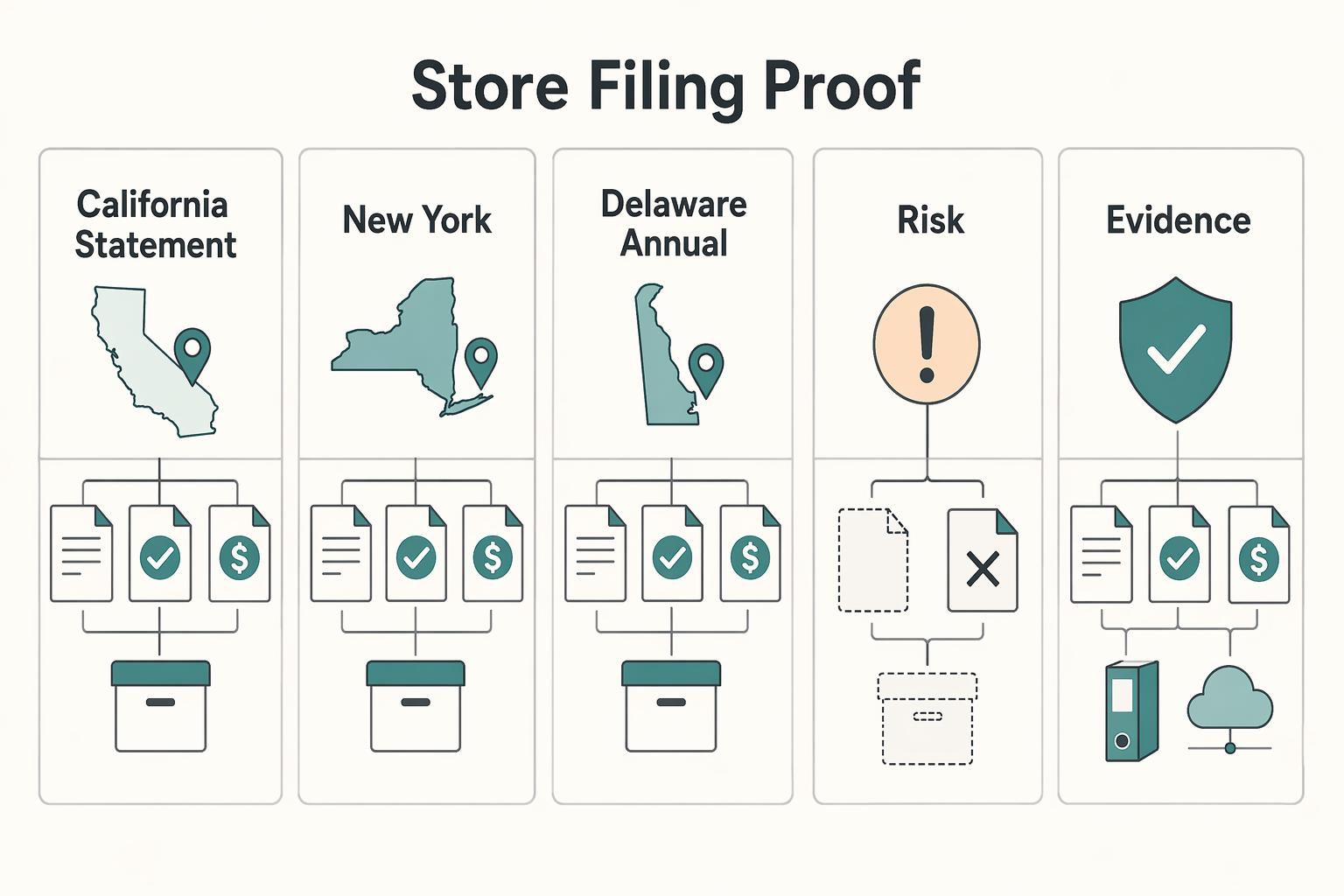
Store filing proof, not only the filed form#
Do not stop at the submitted form. In 04_State_Filings, keep the filed document and confirmation artifact, plus any payment record you receive. Confirmation proof can be one of the fastest ways to show acceptance.
| Jurisdiction | What to track |
|---|---|
| California | Statement of Information cadence (first 90 days, then every 2 years) |
| New York | Biennial Statement cycle and fee |
| Delaware | Annual tax requirement with no annual report |
| Florida | Annual report window and late-fee risk |
Label filings by jurisdiction and cycle because requirements differ.
| Review point | Organized vault | Scattered records |
|---|---|---|
| Response speed | Signed records and support are retrievable quickly | Time lost across inboxes, downloads, and chats |
| Audit and tax readiness | Easier return prep and examination response | Higher chance of delays and missing backup |
| External review readiness | Governance docs, consents, and filing proof are ready to share | Reviews stall while versions and signatures are chased |
| Error risk | Lower risk from clear member/manager/state separation | Higher risk of wrong drafts or missing amendments |
Use this maintenance routine every time you create a record. Step 1 and Step 2 create the evidence. This storage approach keeps that evidence ready when you need it:
- Capture the signed document and support the same day.
- File it under the correct year and pillar using the naming rule.
- Verify completeness: legal name, date, signer title, attachments, and filing confirmation.
- Secure access and maintain the off-site duplicate.
For a step-by-step walkthrough, see Can I Use a US-Based P.O. Box for My Foreign-Owned LLC?.
Make documentation part of operating the company#
The shift is straightforward: stop treating documentation as catch-up work and start treating it as part of operating the company. That is what makes the file usable when questions come up in an audit, financing process, tax review, or legal challenge.
Schedule a recurring governance review#
Put a recurring governance review on your compliance calendar and set reminders. Use it to review major actions already taken, confirm current authority, and verify that governing documents and ownership terms still match how the LLC is actually run.
Before finalizing records, confirm the legal name, date, and attached or cross-referenced governing documents are correct. If your state or operating agreement adds specific requirements, check them before finalizing.
Capture high-stakes actions when they happen#
Document material decisions when they are made using written records. Focus on actions that change money flow, authority, ownership, or governance terms.
Delay is a common risk point. If you wait until year-end, effective dates, rationale, or supporting documents are easier to miss. Keep each record usable by identifying the approver or approvers, the decision, the effective date, and the related attachment.
Keep a digital vault you can actually use#
The filing system only works if retrieval is easy. Store governance records in one organized location. A simple structure is annual folders plus a permanent folder for core governing documents.
Review it quarterly as part of your recurring compliance cycle. If you cannot quickly retrieve the latest signed record and support file, tighten the filing system now.
| Habit | Defensible outcome |
|---|---|
| Recurring governance review | More complete trail for recurring governance decisions |
| As-needed written records | Clearer record of who approved significant actions and when |
| Organized digital vault | Faster retrieval and stronger readiness for audits or investor questions |
Complete your next written record, file it in your vault, and keep the process repeatable. We covered this in detail in Choosing a Registered Agent for Your Wyoming LLC: A Comparison of Top Services.
If you want your compliance habits and payment operations to stay aligned as you grow, review Gruv for Freelancer Businesses.
Frequently Asked Questions
Do I need minutes if I am the only member?
You may not need an initial meeting as a single-member LLC. Even so, keep dated records of major decisions. Those records can support your compliance posture and help if legal questions come up later.
Do I need a formal meeting, or can I use a written consent?
Your operating agreement and state-specific rules control. Annual meetings are not universally required by law for LLCs, and members can add meeting requirements in the operating agreement. Whether you use minutes or written consent, record the date, participants or approvers, the voting result or consent statement, and the major decision or change.
What should I document?
Document major decisions and changes, especially in multi-member LLCs where clear records can reduce later disputes. Start with formation records, early member approval records, ongoing major decisions or changes, and any annual meeting requirement set by the operating agreement. For each item, keep a dated approval record that shows what was decided and who approved it.
What needs to go into each record?
At minimum, include the date, participants or approving member(s), the voting result or consent statement, and the decision made. Add enough detail to make the decision clear later. Check any state-specific documentation requirements before finalizing the record.
Are these records public?
There is no clear-cut rule that LLC minutes must be filed publicly. State filing requirements are handled through each state's business-entity authority. Confirm what your state requires.
How long should I keep LLC records?
There is no universal retention period stated here, so do not rely on one fixed timeline. Keep formation records, the operating agreement and amendments, and major decision records in your long-term files. Verify any state-specific retention rules before setting your policy.
Try a related tool
Researched and edited by the Gruv editorial team. Gruv builds cross-border billing, payouts, and finance-operations software for global businesses.
Sources
- arcadiaca.gov/Document%20Center/Government/City%20Clerk/Ag...trusted
- arcadiaca.gov/Document%20Center/Government/City%20Clerk/Ag...trusted
- bpd.cdn.sos.ca.gov/bizfile/welcome-letter-llc.pdftrusted
- corp.delaware.gov/alt-entitytaxinstructionstrusted
- delcode.delaware.gov/title6/c018/sc04/index.htmltrusted
- delcode.delaware.gov/title6/c018/sc02/index.htmltrusted
- dos.ny.gov/biennial-statements-business-corporations-an...trusted
- flsenate.gov/Laws/Statutes/2024/0605.04073trusted
Educational content only. Not legal, tax, or financial advice.
Related Posts

Sole Proprietorship vs LLC for Global Freelancers in 2026
For most freelancers in 2026, the practical default is still simple: use the simplest structure you can run cleanly, then formalize when risk actually rises. If your work is still in validation mode and the downside is contained, a sole proprietorship is often the practical starting point. When contract exposure, delivery stakes, or dispute risk starts climbing, forming an LLC deserves earlier attention.
Corporate Governance for Solopreneur LLCs That Holds Up Under Review
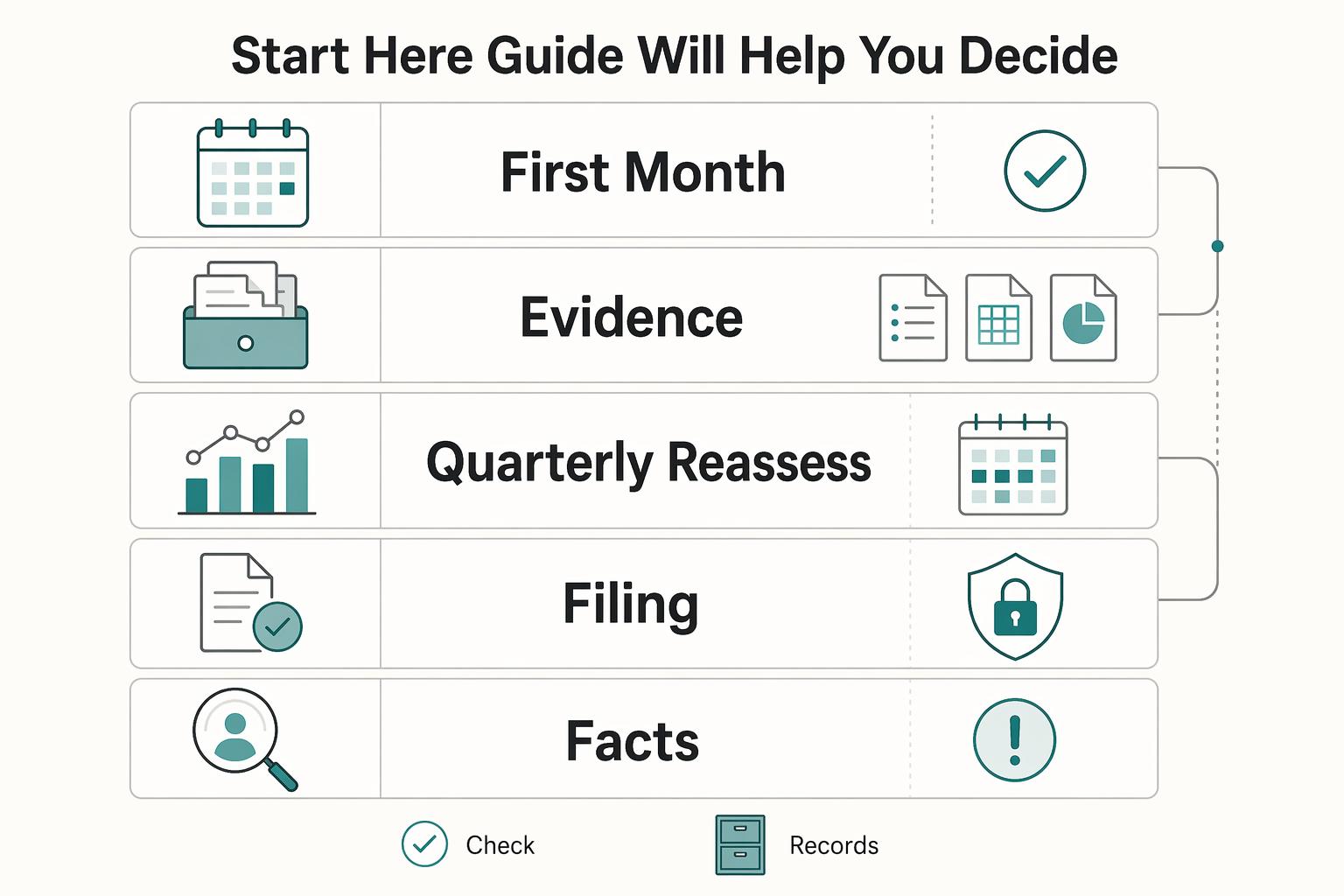
Treat this as a decision map for running a single-member LLC as an ongoing business, not a one-time filing checklist.
Best States for Anonymous LLCs for Solo Professionals
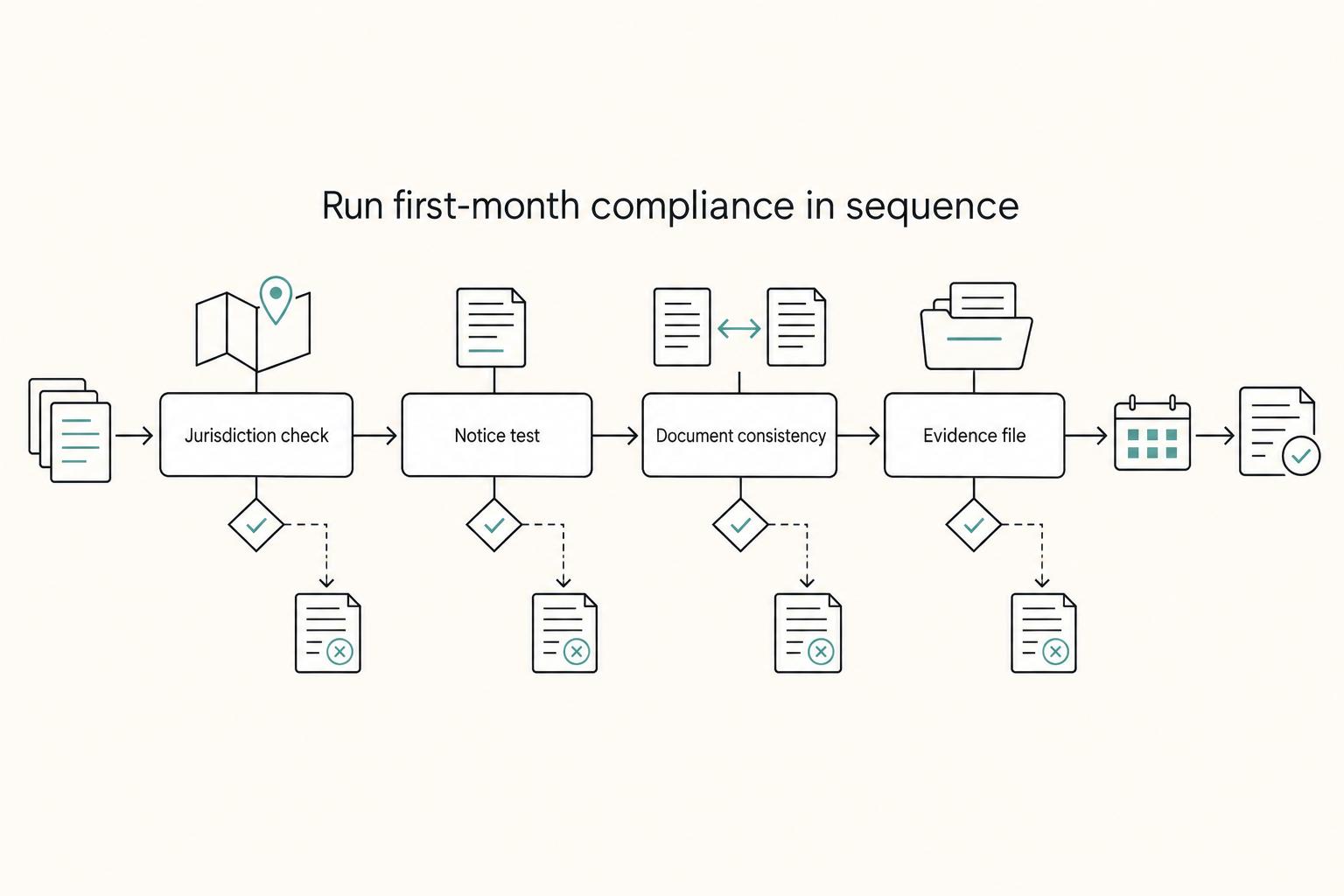
Start with compliance durability, then use privacy as a tie-breaker. If you are looking for the **best states for anonymous llc**, ask a simpler question first: which setup can you keep clean, current, and defensible while you run the business?