
Quick Answer
To break New York residency, first classify whether domicile or statutory residency still applies, then document a dated move timeline, and only then file based on those facts. New York domicile does not change until you show you abandoned it and established a new domicile elsewhere. Staying under 184 days alone is not enough if you still maintain a New York permanent place of abode.
You can break New York residency without guessing if you do it in the right order#
You can break New York residency without guessing, but only if you work in New York's order: classify status first, document the facts, then file. For mobile freelancers and consultants, this is about reducing audit risk, not finding loopholes.
Before you start. This guide is focused on New York State personal income tax first. New York's own filing guidance starts by classifying you as a resident, nonresident, or part-year resident before deciding how to file.
That is the sequence here. You will start with classification, build the record, and then match the filing to the facts. The standard is practical. Your position should fit New York's definitions and hold up on documents, not just intent.
Step 1. Classify the risk before you optimize anything. Start with the two separate residency paths:
Domicile: your permanent home, and the place you intend to return to.Resident day-count + abode path: you may still be treated as a resident if you maintain a New York permanent place of abode for substantially all of the year and spend 184 days or more in New York.
Do not treat the second path as a technicality. A permanent place of abode can be a residence you maintain whether you own it or not, as long as it is suitable for year-round use. You can still be maintaining it even if you stay there only occasionally, and you can have more than one permanent place of abode.
Step 2. Build proof in a clear order. Your first proof point is not a statement of intent. It is whether you can show that you abandoned New York domicile and established a new domicile outside New York. Under New York's framework, domicile does not change until you can prove both.
At minimum, keep these facts clean and dated:
- your claimed domicile-change date
- the status of any New York housing after that date
- when your new home became your actual base
If those three points are fuzzy, pause before filing. Day count alone is not enough. If you still maintain a New York place suitable for year-round use for more than eleven months, risk can remain, and any part of a day counts toward the 184-day rule.
Step 3. Keep city overlays in view. Even though this guide is state-first, New York City and Yonkers residency issues can still matter. New York's permanent-place-of-abode analysis also applies when determining whether you are maintaining a permanent place of abode inside or outside New York City or Yonkers.
Use a simple escalation rule. If your facts include kept-available New York housing, a mixed move year, or a residence tied to NYC or Yonkers, treat that as a review point. From here, the order stays the same: classify, document, then file from the facts.
Start with the two tests that can keep you taxable#
Step 1 Separate the two gates#
Treat New York residency as two independent gates, because clearing one does not cancel the other. New York says you determine whether you are a resident, nonresident, or part-year resident before deciding whether you need to file.
Gate one is domicile. It is your permanent home, and it does not change until you can demonstrate you abandoned New York domicile and established a new one outside New York. Gate two is statutory residency under Section 605(b) of Article 22 of the Tax Law. Even if you are no longer domiciled in New York, you can still be a resident if you maintain a New York permanent place of abode for substantially all of the year and spend 184 days or more in New York.
For that second gate, details matter. Maintaining a place for more than eleven months can meet the "substantially all year" benchmark. Also, any part of a day counts toward the 184-day total.
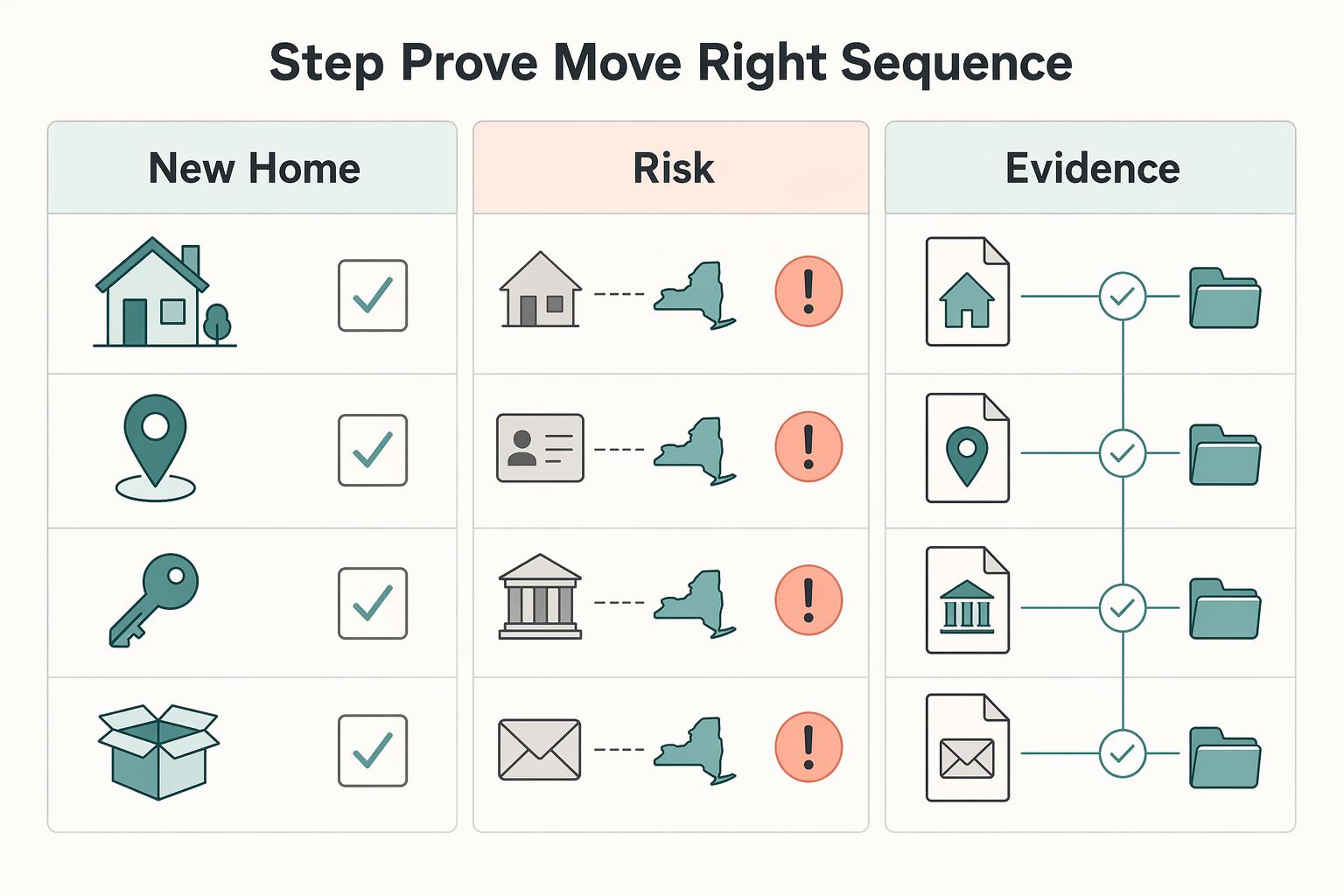
Step 2 Prove the move in the right sequence#
Use a practical checklist and keep the sequence clear: show that the New York domicile was abandoned and the new domicile was established.
| Proof point | What to document | Why it matters |
|---|---|---|
| New home became your real base | The date your new home became your real base | Helps show the new domicile was established |
| New York dwelling after that date | The status of any New York dwelling after that date | Continued access to a year-round New York dwelling can keep residency risk alive |
| Day-count records | Your day-count records, since partial days count | Supports the 184-day analysis because any part of a day counts |
Keep the proof simple and dated:
- the date your new home became your real base
- the status of any New York dwelling after that date
- your day-count records, since partial days count
Do not rely on intent statements alone. If your records still show continued access to a year-round New York dwelling, residency risk can remain even with occasional use. Section 605(b) sets the statutory frame, so keep the two tests separate and document each one directly. If you want a deeper dive, read Digital Nomad Taxes in 2026 With a Defensible Filing Plan.
Prepare before you move so your timeline is defensible#
A defensible move starts with one clean timeline. The goal is to support both parts of the New York analysis: you abandoned New York domicile and established a new domicile outside New York, while also managing statutory residency risk.
Step 1 Anchor your timeline to one effective date#
Pick the date you will treat as the move, then test whether your facts consistently support it. Build a practical checklist around that date for housing availability, where daily life is centered, and day-count tracking. Use ordinary records from daily life, not a New York-required master checklist.
Watch for overlap risk. If a New York home stays available whenever you want it, New York can still treat it as a permanent place of abode even if you use it only occasionally.
Step 2 Map filing posture before you change behavior#
Before making move-related changes, classify your likely status as resident, nonresident, or part-year resident. New York says to determine that classification first, then decide filing obligations.
For a midyear move, part-year status is one path to test first. If you also expect federal filing, map your New York filing path now so your filing position matches your timeline.
Step 3 Establish the new base early and document it#
If your new base is Florida or another state, the label is not enough. What matters is whether your records show the new place became your permanent home on the date you claim.
Use early records that show where daily life actually shifted. Keep day-count discipline too. Any part of a day counts, and 184 days or more can still trigger resident treatment if you maintain a New York permanent place of abode.
Step 4 Pause when facts are mixed#
If your facts point in two directions, pause and get advisor input before locking in behavior. Common mixed-fact patterns are ongoing New York housing availability, a weakly established new base, or heavy New York day counts.
That pause matters even more if New York City or Yonkers rules may apply. The goal is one defensible move timeline and a filing path your records can support.
Need the full breakdown? Read A Guide to Tax Residency in Malaysia for Digital Nomads.
Step 1 Establish your new domicile before cutting New York ties#
The safer sequence is straightforward: establish the new permanent home first, then unwind New York ties. New York domicile does not change until you can show both that you abandoned New York domicile and established a new one outside New York.
Step 1 Land the new home first#
Under the domicile test, you're judged on where you intend to have your permanent home and where you return after being away. New York defines domicile as your permanent home, and you can have only one domicile at a time.
Use a simple sequence: land first, leave second. Set up and use the new home before you fully shut down New York facts. In most cases, that means owning or leasing the place where you live outside New York. Verification point: identify one date when the new place became your default home base, not a backup address.
Step 2 Move your return point and daily base#
Ask one direct question: after travel or work trips, where do you return? If the honest answer is still New York, the domicile change is not complete.
A weak pattern is signing a lease elsewhere while still treating New York as the automatic fallback. A stronger pattern is consistent behavior showing the new location is your return point and operating base. If-then rule: if you still rely on New York as your default base, treat the domicile change as incomplete.
Step 3 Unwind New York only after the new base is real#
Once the new base is clearly functioning, then reduce New York ties. "I left" alone is not enough. New York domicile continues until both parts are true: the old domicile was abandoned and the new one was established elsewhere.
Be careful with New York housing availability. You may still be treated as maintaining a permanent place of abode if the residence is suitable for year-round use, even if you stay there only occasionally. If you maintain that New York abode for more than eleven months and spend 184 days or more in New York, with any part of a day counting as a day, you can still be treated as a resident for New York State income tax purposes.
Step 4 Judge your proof by objective sequence#
A defensible domicile claim usually has dated records that match the story: new home established first, New York downgraded second.
| Question | Weak proof | Stronger proof |
|---|---|---|
| Where do you live now? | Mailing address or short-stay pattern | Home outside New York that you own or lease and actually use |
| Where do you return after being away? | You still return to New York by default | Records show regular returns to the new home |
| What happened to the New York home? | Fully available whenever you want it | Availability and use reduced after the new home is clearly established |
Build the new-home evidence first, then unwind New York. That sequence is what makes the position defensible.
You might also find this useful: How to Properly Sever Ties with a 'Sticky' Tax State Like California or New York.
Step 2 Reduce statutory residency exposure without accidental triggers#
Even after your domicile facts improve, statutory residency can still keep you taxable. A non-domiciliary can still be treated as a New York resident if both facts are true: you maintain a New York permanent place of abode for substantially all of the year, and you spend 184 days or more in New York.
Step 1 Manage the Day Count Test and housing access together#
Manage this as a two-part control, not a day-count-only exercise. For this test, any part of a day counts as a full New York day. A permanent place of abode is a residence you maintain, owned or not, that is suitable for year-round use.
If a New York place is available for you to use whenever you want, it can still count even with occasional stays. You can also be treated as maintaining it through household contributions, including money, services, or other support. Practical rule: if New York housing remains available to you, manage day count tightly all year.
Step 2 Run a recurring day-log routine#
Run this on a regular cadence so records stay clean instead of waiting until year-end.
- Reconcile each day against calendar and travel records.
- Count every New York presence as a New York day, including partial days.
- Note the purpose of each New York entry and where you stayed.
- Store supporting records in one folder.
- Update your year-to-date New York count.
Verification point: at each review point, every day should be accounted for with no blanks.
Step 3 Judge the apartment tradeoff honestly#
Keeping access to a New York apartment may preserve convenience, but it can also increase statutory residency exposure. The same facts that make access easy can support a finding that you maintain a permanent place of abode.
Occasional use does not neutralize that risk if the place is suitable for year-round use and available to you. Lack of ownership or a lease in your name is also not a clean shield if you still contribute to the household. If you keep the apartment, assume your day count and record quality have to stay disciplined.
Step 4 Verify your position every quarter#
A quarterly check can help catch problems while there is still time to change course.
| Quarterly check | What to confirm | Red flag |
|---|---|---|
| New York housing | Is there still a residence suitable for year-round use that you maintain? | You can still use it whenever you want |
| Time threshold | What is your year-to-date New York count, with partial days included? | You are moving toward 184 days or more |
| Duration of access | Has the New York place been maintained, or likely to be maintained, for more than eleven months? | The arrangement remains in place most of the year |
| Household support | Are you still paying, servicing, or otherwise supporting the New York household? | Formal ties changed, but practical support continued |
If a check turns unfavorable, adjust travel patterns, housing facts, or both before year-end.
This pairs well with our guide on A Guide to Andorra's Low-Tax Residency Program.
Step 3 File correctly after the move and avoid classification errors#
Once housing access and day count are under control, the next risk is filing under the wrong status. Before you file, classify first: resident, nonresident, or part-year resident.
Step 1 Choose status from facts, not the outcome you prefer#
Pick your filing posture from the facts, then follow the return path that matches it. If your facts still support New York resident status, New York generally expects a New York State resident income tax return when filing conditions are met. Resident status can still apply after a domicile change if you maintained a New York permanent place of abode for substantially all of the year and spent 184 days or more in New York.
If your move split the year, also test whether New York State part-year resident status applies. Keep this check in mind: your move date, housing pattern, and day-count pattern should all tell the same story.
Step 2 Check the IT-201 vs IT-203 path early#
For post-move filings that are not clearly full-year resident, review the Form IT-201 / Form IT-203 instruction path early instead of guessing. New York's definitions guidance points filers to those instructions for added domicile-related detail.
For a nonresident or part-year position, keep records that tie income timing to location facts around the move. Use documentation that consistently supports timing and where you were living.
Step 3 Recheck New York City and Yonkers separately#
Do not assume city treatment matches your state conclusion. New York guidance notes that permanent place of abode determinations can also matter for New York City and Yonkers personal income tax analysis.
If you kept access to housing in NYC or Yonkers, or still contributed to a household there, run a separate local check before filing.
Step 4 Escalate if move timing and income story do not align cleanly#
Use a hard stop here. If your move date, housing facts, and income sourcing do not line up cleanly, escalate before filing. A common risk pattern is claiming a midyear move while New York housing stayed available for more than eleven months, or when New York day presence may still trigger resident treatment.
Sort out classification first, then file from a position your records can support.
Related reading: A guide to the 'trailing tax liability' when leaving a high-tax state like California.
Build an audit-ready evidence pack before anyone asks#
Do this before anyone asks. Reconstructing the file later can leave gaps you could have fixed earlier.
Step 1 Create two folders by test#
Set up two master folders for the tax year: one for domicile and one for day count. For domicile, your file should support both sides of the move: that you abandoned New York domicile and established a new domicile outside New York.
Prioritize records that show housing control and household support. Keep ownership or lease records, and keep records of household contributions, because those facts can support whether you were still maintaining a place of abode.
Step 2 Build day-count records for strict counting#
Treat day count as strict from the start. For this test, any part of a day counts as a full day. A non-domiciliary can still be treated as a resident if they maintain a permanent place of abode for substantially all of the year and spend 184 days or more in New York.
Keep a day log and the records that support it. Do not assume occasional use of a New York home is harmless. If you can stay there whenever you want, it can still be treated as maintained, and you can have more than one permanent place of abode.
Step 3 Add a one-page index so the file is usable#
A good file is not just complete, it is easy to review. Add a one-page index that lists what each document is, the date range, which test it supports, and the fact it proves.
Use a consistent naming pattern so records sort cleanly over time. Recheck the file during the year, especially if New York housing stayed available for more than eleven months or remained freely accessible.
Turn your document folder into a repeatable control by tracking days, housing access, and move milestones in one place with the Tax Residency Tracker.
Operate weekly controls if you are a traveling freelancer#
If you travel often, a weekly control keeps a good theory from turning into a messy record. One short review each week can help reconcile travel, work location, and your current New York filing posture before gaps become year-end risk.
Step 1 Reconcile the week against your current filing posture#
Start with classification, because New York filing analysis begins with whether you are a resident, nonresident, or part-year resident. Each week, review where you were, where you worked, and whether those facts still support your current position.
Keep it simple: update the travel log, note any New York workdays, and add one line on whether the week still fits your domicile and day-count picture.
Step 2 Count New York days strictly and pair that with abode access#
Count New York days conservatively. Any part of a day in New York counts as a full day. Do not estimate or round.
Pair that with a weekly check on whether you still maintain a New York permanent place of abode. A person domiciled outside New York can still be treated as a resident when they maintain a New York permanent place of abode for substantially all of the year and spend 184 days or more in the state. Housing that remains suitable for year-round use and is maintained for more than eleven months is a clear risk signal. Occasional stays do not remove that risk if you are still maintaining that abode.
Step 3 Flag remote-work weeks for deliberate review#
Remote-work weeks deserve a separate look when a New York primary-office setup may be involved. New York explicitly flags telecommuting from outside the state when the primary office is in New York as a tax question.
Do not force a legal conclusion during the weekly check. Preserve the facts for later review: contract terms, work-location expectations, and records for that period.
Step 4 Treat incomplete months as a risk signal and reconstruct promptly#
If any month is incomplete, flag it and reconstruct it promptly from hard records. Label reconstructed entries as reconstructed, and do not assume the version that helps you most when key days cannot be verified.
Step 5 Keep the control lightweight enough to sustain#
Use a format you will actually keep up with every week, such as one page or one spreadsheet tab. Track date, location, New York presence, work location, housing access, and open ambiguities.
Consistency is the real control. It improves evidence quality over time and helps catch drifting facts and missing records early.
Know the red flags that mean talk to a professional now#
Some fact patterns are escalation points, not DIY fixes. If any of these apply, get professional advice before you file or claim nonresident status.
| Escalation point | Relevant facts | Why escalate |
|---|---|---|
| Maintained New York abode | Residence suitable for year-round use; you can stay there whenever you want; even occasional stays; can include a residence your spouse owns or leases | Creates statutory resident risk, especially if you are near 184 days or more in New York because any part of a day counts |
| No clear new domicile | You cannot point to one place as the home you intend to return to, with records that align to that story | New York says you can have only one domicile, and it does not change until you abandoned it and established a new one outside New York |
| Forum tactics instead of records | The plan relies on forum tactics or anecdotal shortcuts, and you cannot produce a clean, contemporaneous package of housing records, travel records, and filing support | Your position should be based on documented facts and compliance with New York residency rules |
| Audit or residency contact | You expect a New York tax residency audit, or you have already received contact about residency facts; housing access, spouse-housing facts, or day-count history is not clean | Get help before you respond |
Step 1 Check whether you still maintain a New York abode#
A likely permanent place of abode in New York is an immediate red flag. New York treats an abode as maintained if it is suitable for year-round use and you can stay there whenever you want, even if you stay there only occasionally. That can include a residence your spouse owns or leases.
Use a blunt test: can you access the place on demand, and is it usable as a real home? If yes, you have statutory resident risk, especially if you are near 184 days or more in New York, because any part of a day counts as a day.
Step 2 Test whether you actually landed somewhere else#
If your domicile facts are split, escalate now. New York says you can have only one domicile, and your New York domicile does not change until you can show both that you abandoned it and established a new one outside New York.
If you cannot point to one place as the home you intend to return to, with records that align to that story, do not argue this alone.
Step 3 Replace internet tactics with document-backed compliance#
If your plan relies on forum tactics or anecdotal shortcuts, treat that as a red flag. Your position should be based on documented facts and compliance with New York residency rules, not informal online playbooks.
Practical check: could you produce a clean, contemporaneous package of housing records, travel records, and filing support today? If not, fix that with professional guidance before you proceed.
Step 4 Escalate immediately if scrutiny is already in play#
If you expect a New York tax residency audit, or you have already received contact about residency facts, escalate immediately. Not every contact means a formal audit has started, but it does mean your records, day counts, and abode facts need to be internally consistent now.
Get help before you respond if your New York housing access, spouse-housing facts, or day-count history is not clean.
Common mistakes and how to recover quickly#
If the last section described your facts, do not try to fix this with a cleaner story on the return. The fastest recovery is to recheck the tests and your filing posture before you file, amend, or respond to New York.
| Mistake pattern | Why it creates risk | Recovery step |
|---|---|---|
| Treating day count as decisive | You can still be a resident if your domicile is New York, and a non-domiciliary can still be treated as a resident if they maintain a permanent place of abode and spend 184 days or more in New York | Re-test both residency gates side by side |
| Picking a return posture first | New York says you first determine whether you are a resident, nonresident, or part-year resident before deciding how to file | Re-match your filing status to the facts |
| Using weak or reconstructed records | Each date that matters should map to a contemporaneous record, not reconstructed later | Rebuild a dated evidence timeline |
| Skipping the local overlay | The permanent place of abode analysis also applies for New York City and Yonkers personal income tax treatment | Re-check New York City and Yonkers before you finalize |
Step 1 Re-test both residency gates#
The most common mistake is treating day count as decisive. It is not. You can still be a New York resident if your domicile is New York, even if you stay under 184 days. A non-domiciliary can still be treated as a resident if they maintain a permanent place of abode in New York for substantially all of the year and spend 184 days or more in the state.
Run both tests side by side:
- Domicile test: Did you actually abandon New York as the place you intend to have as your permanent home, and establish a new one elsewhere?
- Statutory residency test: Did you maintain a New York abode suitable for year-round use for more than eleven months, and did you spend 184 days or more in New York?
Verification point: recheck your day log using New York's rule that any part of a day counts as a day. Also recheck housing access, because an abode can still be treated as maintained even if you stayed there only occasionally.
Step 2 Re-match your filing status to the facts#
A filing mismatch creates avoidable risk. New York says you first determine whether you are a resident, nonresident, or part-year resident before deciding how to file. If you picked a return posture first and justified it later, back up and redo this step.
For move-year cases, the instructions for Form IT-201 and Form IT-203 are a practical place to recheck domicile-change and classification details. That does not mean IT-203 is always required. It means your facts should drive whether part-year, nonresident, or full-year resident treatment applies, and then your form instructions should match that result.
Practical check: can you point to one move date and show documents that align with your income reporting and return classification? If not, get support before filing or amending.
Step 3 Rebuild a dated evidence timeline#
Weak records are easier to review when you turn them into a dated timeline instead of a pile of PDFs.
Use one timeline with three columns: date, event, and proof. At minimum, tie each key fact to a contemporaneous record, such as:
- start or end of housing access in New York
- start of housing outside New York
- travel logs for disputed dates
- the return filed and the status claimed
Verification point: each date that matters should map to a record created at the time, not reconstructed later.
Step 4 Re-check New York City and Yonkers before you finalize#
A common miss is fixing the state analysis but skipping the local overlay. The permanent place of abode analysis also applies for New York City and Yonkers personal income tax treatment.
Before final filing, ask: did you keep or maintain housing inside New York City or the City of Yonkers while claiming you left New York? If yes, rerun the abode analysis there too. Do not assume local exposure disappears just because your state classification changed.
Compare New York State and New York City residency exposure side by side#
The clean way to run this is as a two-lane check: state classification first, then a separate New York City or Yonkers review before filing. The state and local residency checks are related, but they are not the same checkpoint.
State lane vs local lane. At the New York State level, test both gates together: domicile, and the resident rule tied to maintaining a New York permanent place of abode plus 184 days or more in New York. A permanent place of abode can include a place you maintain even if you stay there only occasionally, and you can have more than one. Also remember that domicile does not change until you can show you abandoned New York domicile and established a new one elsewhere.
For NYC and Yonkers, do not assume the state answer automatically carries over. New York treats those residency topics separately, and the permanent-place-of-abode analysis applies there too.
| Facts pattern | New York State check | NYC/Yonkers check | Filing checkpoint |
|---|---|---|---|
| You changed domicile, ended New York housing access, and stayed below 184 days | Stronger nonresident or part-year classification, depending on move timing | Confirm no maintained abode tied to NYC or Yonkers | Recheck classification before choosing forms |
| You changed domicile but kept a New York abode suitable for year-round use | Resident risk still depends on abode and day count | Local exposure can remain if that abode is in NYC or Yonkers | Do not file as nonresident without rerunning both tests |
| Travel records are incomplete | Day-count risk increases because any part of a day counts | Local position is weaker if location records are inconsistent | Rebuild timeline before filing |
| Move date, housing dates, and return posture do not align | Domicile-change position is weak on these facts | The same mismatch can undermine the local residency position | Fix facts first, then file |
Final checkpoint before filing. Use one dated fact set for both lanes: new-home start date, New York housing access changes, a complete New York day log, and whether any maintained abode was in NYC or Yonkers. Then confirm your resident, nonresident, or part-year classification from that fact set before you choose the return posture.
Copy-paste closing checklist for your next move#
Before you file, confirm each item below is true based on your records.
Step 1 Handle both residency tests separately#
Test domicile and statutory residency as separate questions. For domicile, confirm New York is no longer your permanent home and intended return location, since you can only have one domicile. For statutory residency, if you are domiciled outside New York, check both triggers together: you maintained a New York permanent place of abode for substantially all of the year, and you spent 184 days or more in New York; any part of a day is a day. If your move date, housing access, and day log do not point in the same direction, stop and resolve that first.
Step 2 Map status before you pick a return#
Classify yourself first: resident, nonresident, or part-year resident. Then match the return path to that classification. New York points to the instructions for Form IT-201 and Form IT-203 for additional domicile guidance.
Step 3 Make your evidence file complete#
Your file should stand on its own without reconstruction from memory. Keep one dated timeline covering your new-home start date, New York housing-access changes, and a complete New York day log for the year. Include key housing records and related tax documents so your classification is easy to explain from documents.
Step 4 Recheck New York City and Yonkers exposure#
Do not assume the state conclusion ends the analysis. Permanent-place-of-abode analysis also applies to New York City and Yonkers residency determinations. If any maintained abode was in NYC or Yonkers, flag that clearly and review it before filing.
Step 5 Run one final consistency check#
Do a final pass before submission and escalate if facts are still unclear. Escalate when your domicile timeline is weak, your day log has gaps, your New York abode remained available, or your state and NYC or Yonkers positions do not align cleanly.
Related: Moving From Hourly to Project-Based Rates.
If your domicile and filing signals still conflict after this checklist, get a second set of eyes before filing through Gruv's contact team.
Frequently Asked Questions
Is staying under day-count limits enough to break New York residency?
No. New York uses two separate tests: domicile and statutory residency. Even if you stay under 184 days, domicile can still keep you a resident. And if you maintain a New York permanent place of abode and reach 184 days or more, any part of a day counts.
Do I need to establish new domicile before cutting New York ties?
You need both steps, and the safer sequence is to establish the new permanent home first. New York says your domicile does not change until you abandon New York domicile and establish a new one elsewhere. You can have only one domicile at a time.
What documents are the minimum for defending a residency change?
The article does not give one fixed minimum document list. Keep dated records showing when you abandoned New York domicile and established a new one, what changed with any New York housing access, and a complete New York day log. If NYC or Yonkers is involved, include whether any maintained abode was there.
Should I file as part-year resident or nonresident after moving?
Start with classification, not form choice. New York says you first determine whether you are a resident, nonresident, or part-year resident before deciding filing obligations. For domicile details, recheck the instructions for Form IT-201 and Form IT-203.
What happens if I keep a New York apartment after I move?
Keeping it can preserve statutory residency risk. If the apartment is suitable for year-round use and available to you, it can still count as a New York permanent place of abode even if you use it only occasionally. If that condition is met and you spend 184 days or more in New York, resident treatment can still apply. The same framework also matters for NYC and Yonkers.
Does remote work change my risk under New York rules?
It may, but it does not replace residency classification. New York's nonresident FAQs address telecommuting when a primary office is in New York and work is performed outside the state. If that matches your facts, preserve the records and review the issue before self-filing.
When should I escalate to a tax professional instead of self-filing?
Escalate if your domicile timeline is unclear, your day log is incomplete, or your housing facts could still support a permanent place of abode position. Also get help if your state classification and any NYC or Yonkers exposure do not point to the same filing posture. If scrutiny or contact about residency facts has already started, get help before you respond.
Researched and edited by the Gruv editorial team. Gruv builds cross-border billing, payouts, and finance-operations software for global businesses.
Sources
- budget.ny.gov/pubs/archive/fy0910archive/eBudget0910/fy091...trusted
- dos.ny.gov/july-20-2022vol-xliv-issue-29trusted
- dta.ny.gov/pdf/archive/determinations/818499.det.pdftrusted
- huduser.gov/publications/pdf/def.pdftrusted
- irs.gov/pub/irs-access/p2104_accessible.pdftrusted
- irs.gov/newsroom/tax-obligations-of-us-individuals-l...trusted
- nyc.gov/site/finance/property/landlords-sche.pagetrusted
- nycourts.gov/reporter//files/bv/42NY3d.pdftrusted
Educational content only. Not legal, tax, or financial advice.
Related Posts

Digital Nomad Taxes in 2026 With a Defensible Filing Plan
With digital nomad taxes, the first move is not optimization. It is figuring out where you may be taxable, where filings may be required, and what proof supports that position.
Moving From Hourly to Project Rates Without Hurting Cashflow
The right pricing model matches uncertainty and cashflow risk. It should fit how clearly the work can be defined, approved, and defended, not just what you are used to selling. Hourly billing gives you room to work while requirements are still moving. Fixed project pricing gives the client stronger budget clarity once deliverables are stable enough to pin down.
Convenience of the Employer Rule for New York and Other Sticky States
Take cross-state tax exposure seriously, even if your work is fully remote. This is not about finding a loophole. It is about tightening your records before filing pressure starts.