

Quick Answer
To price SEO services, estimate delivery hours, account-specific costs and realistic billable capacity. Calculate the fee as budgeted costs divided by one minus the chosen operating margin. Use hourly terms for bounded advice, project fees for defined deliverables and retainers for ongoing work. Document exclusions, client implementation duties and payment terms, and present business-impact estimates as scenarios rather than guarantees.
Choose an SEO pricing model that fits the work#
If you are working out how to price SEO services, choose the pricing model before you choose the fee. In practice, the right fit usually comes down to what is clear at the start: scope, whether the work is ongoing or one-time, client needs, budget, and market context.
Use a monthly retainer when the work is ongoing and priorities will shift. Define the capacity or deliverables it buys; a recurring invoice alone does not make an engagement profitable.
Use project-based pricing when the outcome has a clear start and end with defined deliverables.
Use hourly consulting when the scope is still unclear or the client mainly needs advice. It is often a practical first step for paid discovery before a larger engagement. The tradeoff is that total cost depends on how many hours are used.
| Decision point | Hourly consulting | Project-based fees | Monthly retainer |
|---|---|---|---|
| Best fit | Advice, discovery | Defined deliverable | Ongoing SEO work |
| Ideal client profile | Needs targeted expert input | Wants one contained outcome | Needs continuous support |
| What should be clear upfront | Expected hours and goals | Scope and deliverables | Ongoing priorities and goals |
Pressure-test the model before kickoff. Do not treat one model as a universal default. The most cost-effective option depends on the client's needs and budget. Before kickoff, pressure-test whether the model fits the work you are actually being asked to do.
Build your fee from the work and your available capacity before comparing other offers. A small local site, a multilingual store and a migration can require different expertise, approvals and implementation effort. Compare quotes only after checking what each includes: strategy, content, development, tools, meetings and reporting. The worked figures below are illustrative USD examples, not market averages.
Cheap work is a real quality risk. If the fee structure forces you to cut analysis, skip reporting, or rush implementation, it is the wrong structure.
Choose your model now. Use this quick check before moving to client-risk protection:
- If scope is unclear, start hourly and turn discovery into a proposal.
- If scope is clear and finite, use a project with clear deliverables.
- If the client needs ongoing work, use a retainer.
- If budget or scope assumptions are still moving, reassess after an initial phase.
If two models still look possible, pick the one that best matches current needs and budget.
If you want a deeper dive, read How to Use SEO to Attract High-Quality Freelance Clients.
Calculate a fee floor from billable capacity#
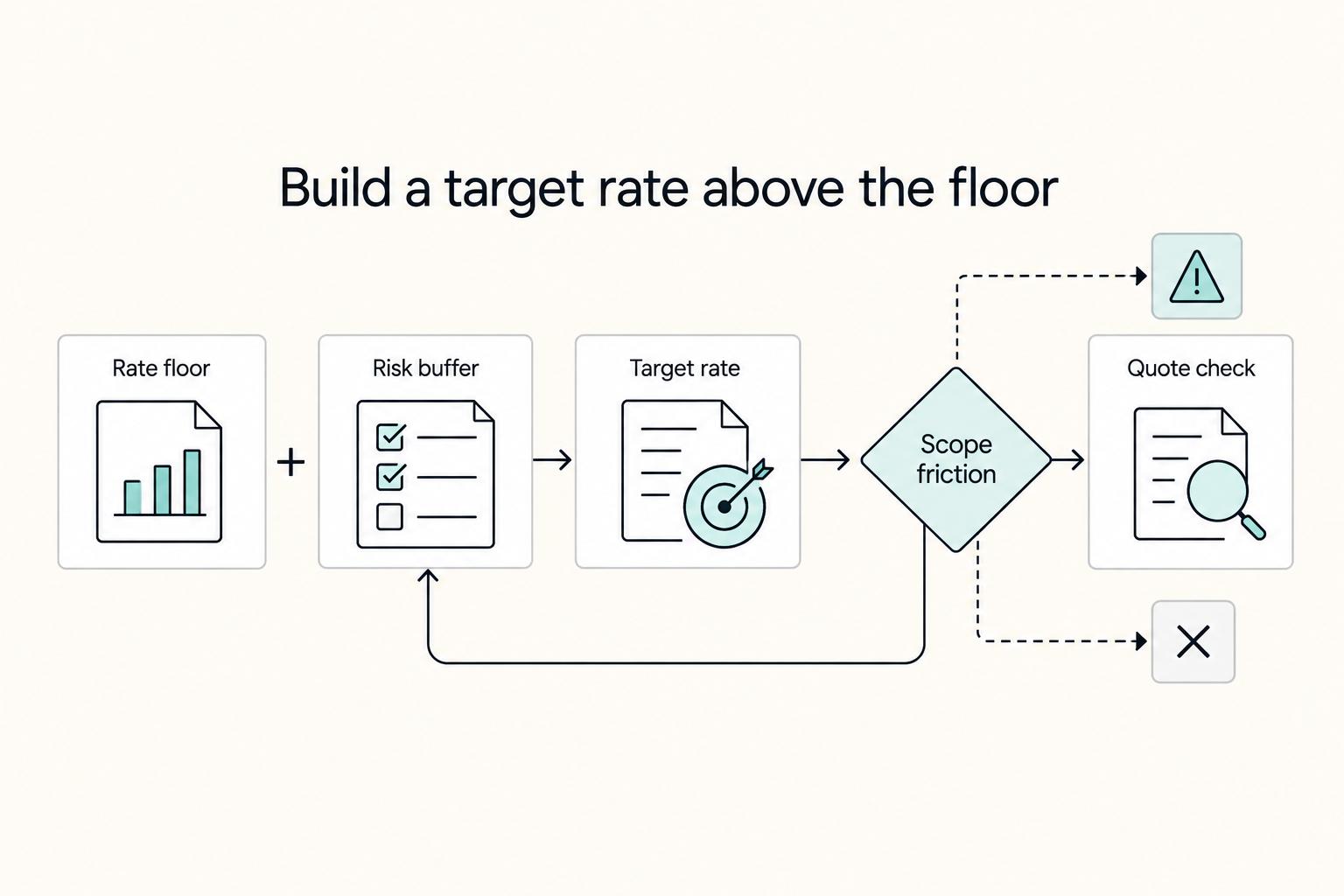
Start with a monthly cost requirement and realistic billable hours. In this illustrative USD example, owner compensation is $4,800 and business overhead is $1,200, so the business needs $6,000 before an additional operating margin. Of 160 available hours, reserve 80 for sales, administration, learning and unbooked time. The remaining 80 billable hours require a cost rate of $6,000 ÷ 80 = $75 per hour. Owner compensation belongs in the cost base here; any taxes, benefits or costs it excludes must also be budgeted.
| Audit task | Estimated hours |
|---|---|
| Access, kickoff and baseline checks | 2 |
| Crawl and technical analysis | 7 |
| Content and search-intent review | 4 |
| Prioritized report and recommendations | 4 |
| Handoff, questions and one revision round | 3 |
| Total | 20 |
The audit has 20 estimated hours at $75, plus $100 of project-specific tools: a $1,600 cost base. Add a clearly defined 10% contingency on estimated costs ($160), giving $1,760. To target a 20% operating margin on the fee, divide by 1 − 0.20: $1,760 ÷ 0.80 = $2,200. Adding 20% to cost would be a markup and would produce a different margin. This price is an illustrative cost-based floor under these assumptions, not proof a buyer will pay it.
Quote the audit as recommendations and one revision round, with implementation and extra meetings excluded unless priced separately. Check the estimate against similar past jobs and revise future quotes when actual hours differ. If the client cannot fund the floor, reduce deliverables or choose a paid discovery phase rather than silently removing compensation or reporting time from your costs.
Set contract controls for each pricing model#
Each model exposes you to a different kind of uncertainty. An hourly engagement can be predictable when the client commits to a funded block of hours; a retainer can be unreliable when invoices are overdue or one client dominates revenue. Use the table to choose controls for the actual terms rather than rank models as inherently safer.
| Model | Cash-flow volatility | Scope-creep exposure | Payment-delay exposure | Churn exposure | Admin overhead | Best-fit cue |
|---|---|---|---|---|---|---|
| Hourly | Varies with committed hours and collections | Time cap and approval for extra hours | Depends on invoice timing, not the hourly label | Client can stop buying hours under agreed terms | Time logs and billing review | Advice, discovery or ongoing bounded consulting |
| Project-based | Depends on milestone timing | Written scope and priced change requests | Deposit, milestone terms and signoff affect exposure | Work ends at the agreed handoff | Milestone tracking and acceptance records | Defined deliverables and handoff |
| Monthly retainer | More predictable when collected on schedule | Capacity limits and extra-request handling | Advance billing helps only when paid | Notice terms and client concentration matter | Recurring billing plus scope review | Ongoing work with defined priorities |
Use hourly pricing for bounded advice or discovery#
Hourly pricing is most useful when you need paid discovery, diagnosis, or consulting before you can price a defined outcome. Your core risk is unstable revenue and constant scrutiny of time, and it can also be harder to sell when clients want predictable costs.
Agree on a time cap, logging rules, what is billable and who approves extra hours. At the review point, choose whether to continue bounded consulting, quote a fixed project or propose ongoing support. Conversion into another model is optional; the important control is permission before exceeding the agreed budget.
Treat the SOW as your project risk-control system#
Project pricing protects you only when scope is tightly defined in writing. Because project fees are typically built from estimated hours and your hourly rate, margin drops quickly when scope boundaries are weak.
Use project fees when you can clearly define deliverables, exclusions, and handoff. Then make the SOW do real work: set scope boundaries, define how change requests are handled, name who approves work, state payment triggers, and specify how out-of-scope work is priced (for example, via a rate card or add-on pricing). If approval rights or dependencies are vague, fixed-fee work is where revision loops and delayed signoff usually show up.
Run retainers with explicit operating rules#
A retainer can make revenue more predictable when the client needs ongoing work and pays on schedule. Define priorities, capacity and response expectations so the account does not become unlimited support at a fixed price.
To protect margin, define what is included each month and what is billed separately. Agree on any minimum commitment, review rhythm, pause/exit conditions and responsibility for approvals, access, content and development. If recurring deliverables and extra-request handling are unclear, an account can look stable while becoming unprofitable.
For a step-by-step walkthrough, see How to price a 'Branding Package' for a new business.
Plan recurring revenue and cash separately#
Committed retainers can help you plan capacity, while projects add revenue around available delivery time. Keep three totals separate: signed fees, invoices due and money collected. Advance billing supports cash flow only when payment arrives; a signed recurring fee is neither cash in the bank nor profit.
Set your recurring floor before you count pipeline#
Count signed recurring fees as a revenue forecast only after checking the contract period, termination rights and likely collection date. Use collected funds and a dated receipts/outgoings forecast for cash decisions. Keep unsigned proposals in a separate pipeline rather than relying on them to pay next month’s bills.
| Revenue mix scenario | Baseline recurring revenue | Variable project revenue | Pipeline risk | Downside exposure |
|---|---|---|---|---|
| Project-heavy | Signed recurring fees, if any | Signed milestones shown separately from unsigned proposals | Approvals and close dates can slip | One delayed collection can leave a cash gap |
| Balanced mix | Signed monthly fees subject to renewal and collection | Projects within spare delivery capacity | Some growth depends on project flow | Check whether collected recurring fees cover fixed costs |
| Retainer-led | Signed monthly fees with notice and concentration checks | Separately scoped advisory or implementation work | Renewal and payment delays still matter | Losing one large client can erase the apparent floor |
A practical red flag: your forecast only works if multiple unsigned projects close on time.
Convert completed projects with evidence, not hype#
When ongoing work is useful to the client, use a repeatable closeout-to-retainer sequence. A completed project does not automatically justify a retainer. Run the same handoff each time:
- Closeout review: hand over baseline findings, completed changes, unresolved items, client-side dependencies, and the success metric you both agreed to track.
- Outcomes recap: summarize what changed in business terms, not just task lists.
- Next-phase roadmap: propose the next priorities with a clear scope, not an open-ended backlog.
- Transition offer: present ongoing scope, communication cadence, and a decision deadline so capacity is explicit.
Before offering ongoing work, confirm stakeholder alignment: who approves, who implements, and how success will be evaluated.
Standardize one retainer, then tier by depth and controls#
Start with one productized retainer: clear scope, defined process, fixed monthly price. Add tiers only when service depth and operating controls actually change.
- Entry tier: maintenance-focused work, fixed review cadence, tight deliverable boundaries, all extras via change request.
- Middle tier: active growth scope, more frequent communication, limited priority shifts within defined boundaries.
- Highest tier: deeper strategic access and faster response expectations, with workload controls (for example, one major initiative at a time) to prevent overload.
Price each tier from its own workload estimate. In the illustrative cost model below, 10 hours of delivery and reporting at $75 per hour plus $50 of account-specific tools cost $800. At a 20% operating margin on the fee, the monthly price is $800 ÷ 0.80 = $1,000. A 16-hour tier with the same tools costs $1,250 and requires $1,562.50 at that margin. Confirm that those hours fit your monthly capacity before selling either tier.
Keep the same scope, currency and payment schedule in your proposal and invoice. Try the free invoice generator when you are ready to bill the agreed work.
Before moving on, complete this checklist:
- Forecast signed monthly fees separately from collections, fixed costs and unsigned pipeline.
- Choose one project-to-retainer trigger tied to closeout evidence and a documented success metric.
- Standardize one retainer offer with written scope boundaries, cadence, change-request handling, and response expectations.
How to Grow Revenue Without Growing Your Workload and Costs#
You scale only when revenue can grow without your workload and costs rising at the same rate. If every sale, scope decision, delivery task, report, and rescue still depends on you, you are still under a time-for-money ceiling.
| Level | How you operate now | Revenue model | Main risk | Required systems | Next transition trigger |
|---|---|---|---|---|---|
| Technician | You personally handle scoping, delivery, and client communication | Hourly or project-based | Income is tied to your calendar | Clear SOW, delivery checklist, basic QA, cash-collected tracking | Delivery and onboarding are consistent enough to repeat |
| Strategist | You run ongoing work through a repeatable monthly cadence | Monthly retainer | Scope drift and custom reporting erode margin | SOPs, onboarding template, monthly reporting template tied to agreed success metrics, written change-request path | Margins stay stable and you enforce client-fit discipline |
| CEO | You manage offers and quality controls, not every task | Productized services plus selective value/performance-based structures where metrics are clearly trackable | Quality slips when work is delegated without controls | Delegation boundaries, approval rules, documented scope controls, outcome tracking, packaged offer definitions | You can step out of day-to-day delivery without delivery quality dropping |
Level 1: Technician#
Operate here until repetition is real, not assumed. Your goal is to prove you can onboard similar clients the same way, deliver the same core outputs reliably, and track cash collected instead of relying on expected receivables.
Level 2: Strategist#
Move up when recurring work is stable enough to systematize. For each retainer, document how onboarding runs, what gets reviewed each month, what is explicitly out of scope, and how extra requests are approved. Use one reporting template tied to the success metric you agreed with the client so reporting stays comparable across accounts and does not turn into custom work each month.
Level 3: Define the operating frame before delegating delivery#
Before delegating delivery, define the operating frame. For each productized offer, document package scope, required inputs, exclusions, and approval checkpoints. For value or performance-based structures, only quote after you document the outcome hypothesis, success metric definition, pricing guardrails, and client responsibilities needed for measurement; if those are unclear, keep the work in retainer or scoped-project format.
Next rung checklist:
- Write one SOP for onboarding or monthly reporting.
- Add one written scope-exclusion section to your proposal template.
- Define one success metric for every retainer before work starts.
This pairs well with our guide on How to Price a UI/UX Audit for a SaaS Company.
How to Justify a Premium Rate: Make the Business Case Explicit#
A premium rate is defensible when you make the business case explicit. Finance-minded buyers want traceable assumptions, clear downside risk, and a realistic range of outcomes, not activity lists.
Reframe your offer in the client's language#
If you sell tasks, clients can compare you on price more easily. On calls, in proposals, and in follow-ups, position your work around the business objective and the constraint blocking it.
Use language like:
- "You are not buying blog posts and audits. You are buying a prioritized plan to improve [business objective] by fixing [diagnosed constraint]."
- "Organic traffic is reaching the site, but [key page or funnel step] is underperforming. My job is to remove that bottleneck so search drives more [qualified leads, demos, sales]."
- "This investment is to solve [specific pain point], not add marketing activity for its own sake."
Before quoting on business impact, check conversion tracking and a usable contribution-per-customer estimate from the client. Revenue per sale and lifetime revenue are not the same as contribution after serving the customer. If the inputs are missing, offer a paid measurement or discovery phase, or quote defined deliverables without a quantified ROI claim.
Build a scenario model you can defend#
Use low, middle and high assumptions over the same evaluation period. The following is a sensitivity example, not a forecast or a promise that SEO will produce these lifts. Assume a comparable three-month baseline of 30,000 qualified organic visits, a 2% visit-to-lead rate, a 20% lead-to-customer close rate and $500 contribution per acquired customer after fulfillment costs.
| Illustrative traffic lift | Additional visits over three months | Additional customers at unchanged conversion rates | Incremental contribution | Total campaign cost | Net contribution / ROI |
|---|---|---|---|---|---|
| 10% | 3,000 | 3,000 × 2% × 20% = 12 | $6,000 | $6,000 | $0 / 0% |
| 20% | 6,000 | 6,000 × 2% × 20% = 24 | $12,000 | $6,000 | $6,000 / 100% |
| 30% | 9,000 | 9,000 × 2% × 20% = 36 | $18,000 | $6,000 | $12,000 / 200% |
Campaign cost here is three monthly fees of $1,500 plus $1,500 of client implementation costs: $6,000. Additional customers = baseline visits × assumed lift × lead rate × close rate. Incremental contribution = additional customers × contribution per customer; ROI = (incremental contribution − campaign cost) ÷ campaign cost. Include other incremental costs and use the same time horizon for costs and benefits. The calculation assumes extra traffic is equally qualified and conversion rates stay unchanged; neither is assured.
Use Search Console for search clicks, impressions and visibility trends, then analytics and CRM records for qualified visits, leads, sales and contribution. Search clicks are not customers. Record seasonality, brand demand, paid campaigns and implementation dates; a before/after increase alone does not establish that SEO caused it. Google’s starter guide explains that changes can take hours to months to show effects and may produce no noticeable change. Agree on a reporting period and client implementation responsibilities before treating a three-month scenario as a delivery expectation.
Present the evidence chain and handle pushback without discounting outcomes#
Structure your proposal as an evidence chain:
- Business objective: what the client is trying to improve
- Diagnosed constraints: what is blocking that objective
- Prioritized actions: what you will do first and why
- Expected impact: scenario range with assumptions shown
- Pricing rationale: why the investment matches the risk and opportunity
When the budget is lower, show which scope, response time or reporting depth you can reduce and how that affects the delivery plan. Explain an evidenced risk of delay without inventing urgency or guaranteed losses. Offer a measurement phase or a smaller implementation package when that is useful; do not promise the same results for a lower fee.
Premium-rate readiness checklist:
- Verified conversion tracking
- Contribution per customer and its measurement period documented
- Current benchmark documented
- Low, middle and high assumptions labeled as scenarios, with total costs and the same evaluation period
- Proposal follows the evidence chain
- Price covers capacity and costs; business-impact claims show assumptions
- Phased option prepared for real budget constraints
Related: How to Price a Technical SEO Audit for an Enterprise Website.
Check the quote before sending it#
Choose the model that fits your constraints first. The wrong pricing model can hurt both client retention and your ability to scale, so do not pick by habit. Use the model that best matches the engagement and budget: monthly retainer for ongoing work, per-project fees for clearly defined scope, and hourly consulting for narrow advisory support.
Check costs and scope together. The fee should cover the estimated delivery effort, account costs and chosen margin. Show deliverables, exclusions and who implements the recommendations. Explain potential value with transparent assumptions, without promising results you do not control.
Build scalability by repeating what you can deliver cleanly. Work scales better when execution and review patterns are consistent, and when scope changes are treated as separate work instead of unpaid extras. The practical result is fewer custom exceptions and less overextended delivery as projects vary by site size, complexity, and audience.
Qualify the client before you defend the price. Do not chase vague "good clients." Focus on whether there is a clear decision process and whether both scope and budget fit are realistic. If those signals are weak in discovery, tighten terms or reduce scope before you send the proposal.
Use this checklist on the next opportunity:
- Select the pricing model based on project needs and budget fit
- Set clear deliverables, boundaries, and exclusions
- Define how scope changes will be handled
- Confirm pricing and approval checkpoints in the proposal
- Set a review cadence for approvals, reporting, and renewal decisions
Before accepting another recurring client, total the hours already committed across accounts, including meetings, reporting and review. Leave room for sales, administration and delivery overruns; revenue that requires more capacity than you have is a scheduling problem.
For cross-border billing and payout operations, Talk to Gruv.
Frequently Asked Questions
What pricing model should you use for predictable income?
SEO pricing is often grouped into three or four models, so do not get stuck on taxonomy. Use a monthly retainer when the client needs ongoing execution. Use project-based pricing for a defined task such as an audit. Use hourly work for narrow advisory needs. Treat results-based deals carefully when the buyer expects guaranteed rankings, because that shifts uncontrollable risk onto you.
How do you create an SEO proposal that protects scope?
Write the proposal as a diagnosis and a delivery agreement. Verify site size and decision-making workflow before quoting: a 10-page site and a store with thousands of pages require different work. Include the goal, deliverables, exclusions, client dependencies, approval checkpoints and payment schedule.
How should you price a small business vs an enterprise client?
Price by site complexity, implementation effort, stakeholder load and reporting needs rather than the company label alone. Build a workload and cost estimate for each scope; compare other quotes only when their inclusions and responsibilities are comparable.
How do you calculate ROI without overselling it?
Use a comparable baseline, an explicit evaluation period and contribution after serving each new customer. Model additional visits through lead and close rates, then subtract all campaign costs. Present assumptions as sensitivities rather than guaranteed outcomes; fix missing measurement before making quantified claims.
Should you show prices on your website?
Show pricing when the offer is truly productized and the scope is fixed enough that buyers can self-qualify. For custom retainers or complex project work, use a starting point or hold pricing until discovery so you can assess complexity first. If you still need a pricing floor, calculate your cost base with How to Calculate Your Billable Rate as a Freelancer.
How do you respond when a client says your price is too high?
Ask which scope and outcome the client is comparing. If the budget is lower, offer fewer deliverables, slower response or a phased plan and explain the tradeoffs. Google cautions against guaranteed first-place rankings; do not match a guarantee you cannot control.
How do you reduce payment risk on SEO work?
Use clear invoice timing, written scope checkpoints, and explicit dependency notes for client inputs like content, access, and feedback. Keep the proposal, contract, and invoice schedule aligned so expectations stay consistent and disputes are less likely.
Try a related tool
Researched and edited by the Gruv editorial team. Gruv builds cross-border billing, payouts, and finance-operations software for global businesses.
Sources
Includes 3 external sources outside the trusted-domain allowlist.
Educational content only. Not legal, tax, or financial advice.
Related Posts
How to Calculate a Freelance Rate You Can Actually Get Paid On
A workable rate is not the neat number a calculator produces. It is the number that still works after you account for real billable capacity, non-client time, scope drift, and the gap between sending an invoice and receiving cleared cash. Start with hourly math even if you do not plan to bill hourly, then turn that number into a quote with clear `payment terms`.

How to Use SEO to Attract High-Quality Freelance Clients
**Build your *seo for freelancers* around qualified leads, not raw traffic: tighten who you target, what you prove, and how you gate inquiries.** You're the CEO of a business-of-one. Your marketing job isn't "get more attention." It's "get the right work, predictably, without turning your calendar into a sorting machine."

The Freelance Payment Penalty: A Modeled Audit of Platform Fees, FX Spreads, and Payout Delays
The money rarely disappears through a single, easy-to-spot fee. The real loss is stacked. A marketplace takes its commission, a processor adds a charge for international cards, a bank or payment company converts the currency at a spread, a platform holds the funds before release, and a wire sheds a little to intermediaries on the way in. Each layer looks defensible on its own, but the worker feels the combined result as a smaller deposit and a later payday.