
Quick Answer
For IT staff augmentation pricing, multiply each role’s billable units by its rate and divide total charges by total hours for the weighted blend. Compare revenue with loaded paid-capacity costs and overhead, then test utilization and receipt timing. Agree whether billing follows time, reserved capacity or delivery acceptance; define changes, due dates and FX responsibility before committing people.
What Drives IT Staff Augmentation Pricing#
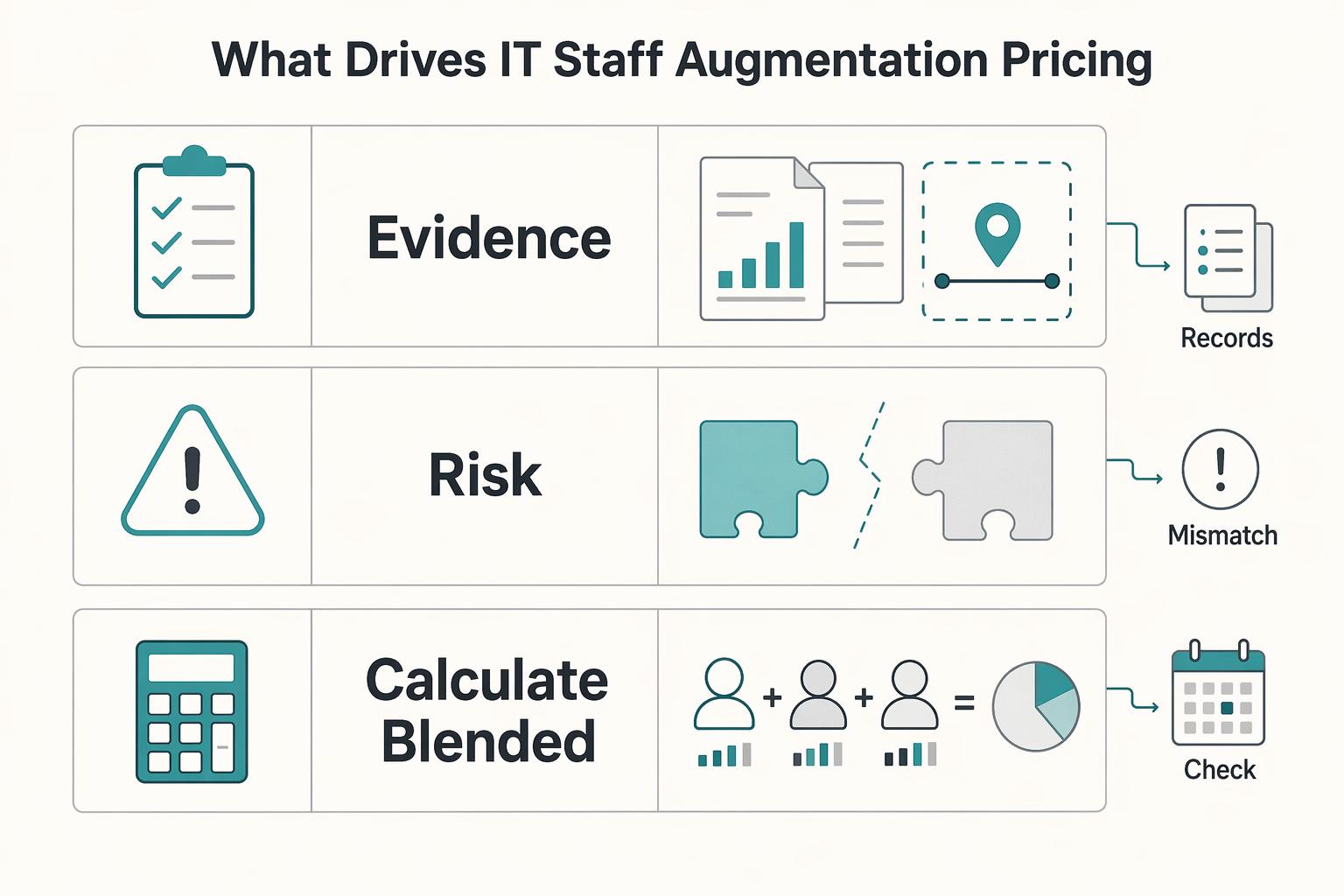
IT staff augmentation pricing depends on the roles, billed units, available capacity and responsibilities you are selling. Start with a staffing and cost model. Broad provider ranges mix periods, roles and inclusions, so they cannot establish a defensible quote for your engagement.
Use comparable, dated supplier quotes only after calculating your own staffing plan. Check currency, seniority, billed hours, location, taxes, vendor overhead and notice obligations before treating two figures as comparable.
Staff augmentation usually adds people to a client-led team; a managed project sells a delivery commitment. State which arrangement applies, who employs or contracts with each person, who directs work, and which party bears delivery risk. The legal employment or labor-supply model needs its own applicable-country check; the billing label does not resolve it.
- Define what is bought. For augmentation, list roles, skills, capacity, work hours and client direction; for a delivery phase, list outcomes, dependencies and acceptance criteria. Make the distinction explicit before pricing.
- Choose the pricing model for change risk. If requirements are likely to move, use a model that can absorb change; if demand is steady, use a structure that improves planning. Decide this before rate negotiation so model drift does not happen under pressure.
- Calculate a blended rate and set a floor. Build from your staffing plan and expected effort so pricing reflects delivery reality. Use your own rate logic first, then compare it against market context as a final check.
- Turn the quote into payment terms that can be enforced. Confirm billing cadence, approval flow, and change handling before work starts. If approval timing is unclear at signature, cashflow risk is already priced too low.
Used consistently, this sequence shifts negotiation away from headline ranges and toward documented scope, explicit assumptions, and clean payment discipline. It also gives finance and delivery a shared baseline before execution starts.
What to prepare before you price anything#
Most quote failures start with missing inputs, not bad math. Do the prep first.
| Prep block | Include | Check / note |
|---|---|---|
| Engagement evidence | Roles, capacity, direction, dependencies, approvers and dates; deliverables where promised | Hours/capacity and outcome acceptance have separate billing rules |
| Rate card | Role, seniority, unit price, expected usage, and fixed vs variable roles | If two teammates get very different totals, role definitions are still too loose |
| Contract structure | Single project, rolling support, or a hybrid | Choose before model details; this drives billing cadence, effort framing, and change handling |
| Commercial terms draft | Non-negotiable commercial language as a prep draft, not final legal text | Each clause should be specific enough to test against a real scenario |
Keep one working file with four blocks: scope evidence, rate card, contract structure choice, and non-negotiable terms draft. If one block is empty, pause pricing. Sending a partial quote often feels faster in the moment, but you can pay for that speed later in revision cycles and approval disputes.
Run a simple internal readiness test. Ask whether someone not involved in the deal can open the file and explain what is being sold, how it will be accepted, and when it can be invoiced. If the answer is no, keep drafting.
- Draft the engagement evidence. Capture roles, skills, capacity, client direction, dependencies and contract dates. If you promise a delivery phase, attach inspectable outputs and acceptance criteria. Record exclusions and distinguish a resource commitment from a project-result guarantee.
- Build the rate card and tag fixed vs variable roles. List role, seniority, unit price, and expected usage, then mark each role as fixed or variable. This reduces underpricing risk in mixed delivery. A labor-hours worksheet can force early role-to-hours mapping. Red flag: if two teammates get very different totals from the same card, role definitions are still too loose. Clean up naming before you discuss money with the client.
- Choose contract structure before discussing model details. Decide whether the engagement is a single project, rolling support, or a hybrid. That choice drives billing cadence, effort framing, and change handling. If scope is still moving, split what is committed now from what can be triggered later. This keeps near-term delivery moving without pretending uncertain work is fully priced.
- Prewrite non-negotiable commercial language. Draft key commercial terms before the first pricing call. This is a prep draft, not final legal text. Verification check: each clause is specific enough to test against a real scenario. If a clause cannot be tested against a real scenario, rewrite it until it can.
Set a market baseline without copying weak benchmarks#
Use public commentary to calibrate risk, not to generate your number. External ranges help only after you run the cost analysis in your own scope and staffing plan.
A common framing compares freelancer flexibility with managed staff-augmentation stability. Use that comparison only if you tie it to uncertainty: decide what risk you can absorb and what has to be priced or controlled in the terms. Treat outside commentary as directional context, not as quote inputs.
When an external range disagrees with your model, check both assumptions rather than automatically trusting either. A copied benchmark may be unsuitable, but your own utilization, loaded cost or billable-hour estimate may also be wrong. Revise scope or staffing before using a price the model cannot support.
You can also record a short baseline note for the file: market range observed, key difference from your delivery plan, and reason your quote sits where it does. That gives sales, finance, and delivery one answer when procurement asks why your number differs from a blog headline.
Choose the pricing model that fits how work will actually change#
Match the model to change behavior, not to headline rates. The right structure makes variance visible early.
| Model | Best fit | Main tradeoff |
|---|---|---|
| Hourly / T&M | Evolving tasks and actual billed time | Define authorized hours, rate, expenses and any budget cap; hourly charging can be part of T&M |
| Monthly capacity fee | Agreed ongoing access or reserved capacity | State included hours, availability, leave, overages, rollover and notice; do not assume unlimited work |
| Fixed delivery fee | Separately defined output with acceptance | Provider carries agreed delivery-cost risk; distinguish this from client-directed staffing |
If team location, role mix or required availability changes, check legal eligibility and cost assumptions. Rate changes follow an agreed contractual mechanism or authorized amendment; a location change does not automatically permit unilateral repricing.
A practical check is to ask what usually changes first on your deal: requirements, workload, or timeline. If requirements move first, use a model that tolerates discovery. If workload is sporadic, hourly pricing can fit, but total cost is less predictable. If demand is steady, a monthly retainer can be easier to plan around.
Model choice is commercial risk control, not just billing preference. The wrong fit may not fail immediately; it can show up later as budget surprises and review friction.
After agreeing the rate, billed units and terms, use the invoice generator to carry those labels into billing. A draft invoice is not a substitute for the staffing quote or contract.
Build your blended rate and your no-go floor#
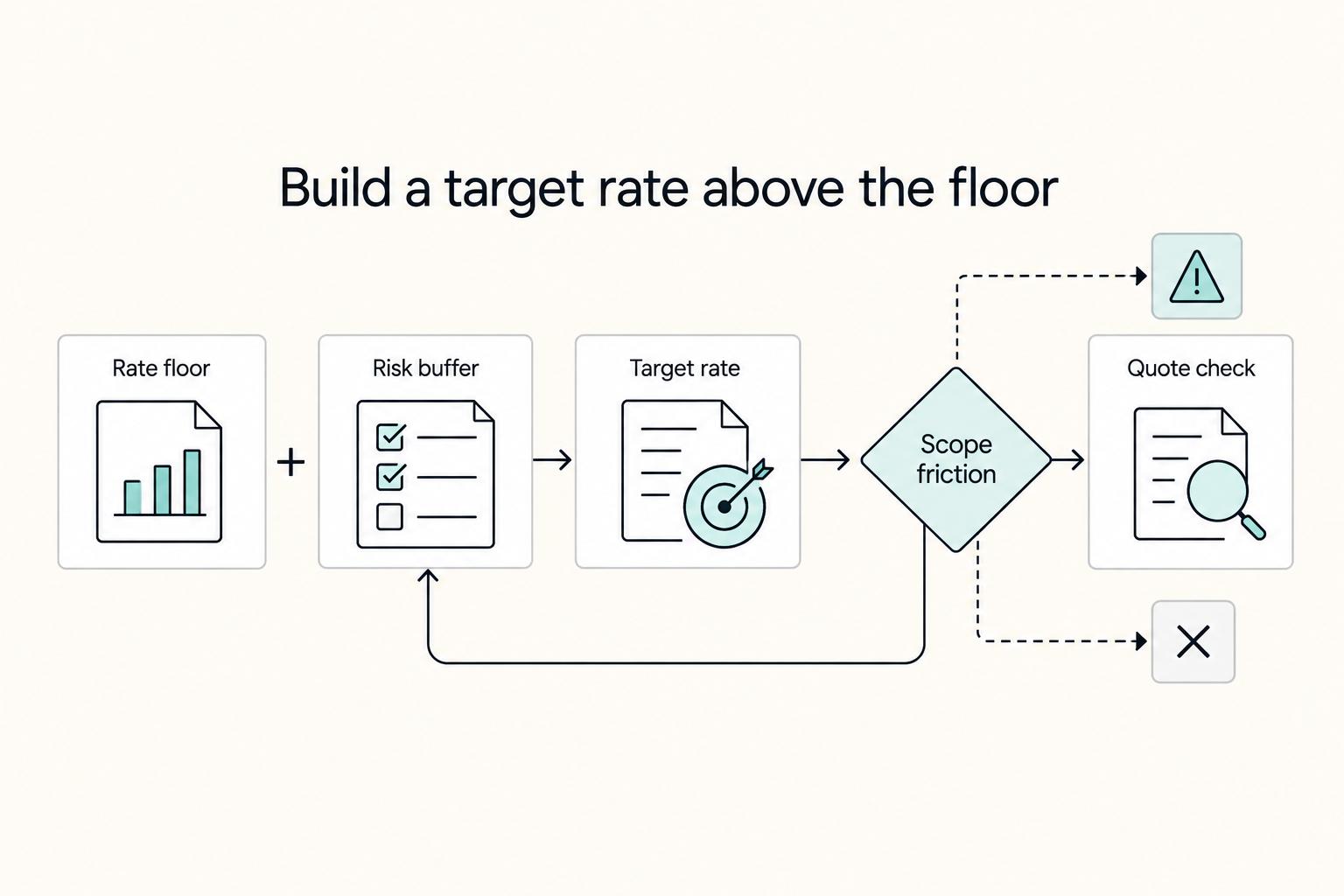
Set guardrails before negotiation starts: a blended working rate, a target rate, and a hard floor. This keeps commercial decisions more consistent when scope shifts or approvals slow down.
Use hours as the common unit before blending role rates. In an assumed monthly plan, 80 developer hours at $100 plus 40 QA hours at $60 produce $10,400 over 120 billable hours. The weighted blended selling rate is $10,400 / 120 = $86.67 per hour. A simple average of $100 and $60 would give $80 and understate this mix. All figures below are planning examples, excluding tax.
Cost the capacity you must pay for, not just the time you expect to bill. Assume 100 paid developer hours at a loaded $55 and 50 paid QA hours at $35, plus $1,000 allocated overhead: total cost is $8,250. Billing 120 of those 150 paid hours implies 80% utilization. At $10,400 revenue, contribution after that allocation is $2,150, or about 20.7% of revenue. To target 30% margin, required revenue is $8,250 / (1 − 0.30) = $11,785.71, about $98.22 per billable hour rounded upward. A negotiated price must reflect that target or a revised cost plan; 30% markup would not produce 30% margin.
For an illustrative 20% minimum margin on the same assumptions, the revenue floor is $8,250 / 0.80 = $10,312.50, about $85.94 per billable hour. That floor is conditional on 120 billable hours and the modeled cost; it is not a universal safe rate. State prospective adjustment triggers such as new roles, capacity or approved overtime. Delayed internal approval alone does not authorize an extra fee.
Keep one clean calculation sheet and one client-facing summary. The detailed sheet supports internal decisions, and the summary keeps external conversations focused on approved assumptions and outcomes. For the full rate-calculation method, read How to Calculate Your Billable Rate as a Freelancer.
Turn scope into milestones clients can approve quickly#
Use milestones to monitor progress, and link them to payment only when the commercial model makes acceptance a trigger. Client-directed hourly augmentation generally bills the agreed time; a capacity retainer bills the agreed reserved capacity. Neither should silently become an outcome guarantee. For a separately fixed delivery phase, define inspectable outputs and acceptance.
Milestones reduce decision friction when approvers can open the evidence, compare it with the agreed checklist, and respond without chasing context across emails or chat threads.
Step 1. Define milestones as inspectable outcomes#
For a fixed delivery milestone, name the output and objective acceptance criteria. For an hourly period, instead specify the person, dates, authorized hours and time record. Keep any project-progress review separate from the invoice condition unless the contract explicitly connects them.
Make the acceptance artifact concrete. If the milestone is a build output, name what is being reviewed and where the review record lives. If it is documentation, state the sections that must be present and complete. Ambiguous artifacts can lead to subjective rejections.
Step 2. Resolve uncertainty early in the sequence#
Put the biggest unknowns early. In fixed-scope work with evolving requirements, uncertainty left for later can turn into scope creep and change-order friction, where execution questions become commercial negotiations.
A simple ordering rule helps: earliest milestones should answer the highest-risk questions, not just the easiest tasks. That gives both sides more room to adjust before later decisions harden.
Step 3. Tie billing events to acceptance decisions#
If billing depends on milestone acceptance, define who can approve or reject and what acceptance criteria apply. Keep rejection reasons tied to unmet checklist items so feedback stays specific and practical.
Use consistent wording across delivery notes, acceptance criteria, and invoices to reduce avoidable interpretation disputes between delivery, procurement, and finance.
Step 4. Match milestone language to what is being bought#
Match the checkpoint to the buying mode. Client direction and a time record can support augmentation billing without guaranteeing a completed feature. A delivery milestone should identify its own acceptance process. The agreement must say who remains responsible for defects, direction, working time and employment obligations.
For example, invoice an agreed 80 developer hours and 40 QA hours with dated records, rates and the contractual review process. A missed client product-release milestone does not by itself erase otherwise payable time. Capacity fees also need a rule for availability shortfalls and substitution.
Write payment terms that protect cashflow and reduce disputes#
Cashflow can improve when the contract converts approvals into clear, date-bound payment obligations. The target is simple: avoid silent stalls, vague rejections, and out-of-scope work that never gets priced.
| Area | Include | Reason |
|---|---|---|
| Billing mechanics | Invoice cadence, due-date rules, accepted payment channels, approver roles, and a complete invoice packet | Required support should be identified in advance; an internal approval queue cannot add new conditions to already-due amounts |
| Approval SLA | How approvals and rejections are submitted, rejections mapped to unmet acceptance criteria, and what happens when no response arrives | Invoicing does not stall on inaction |
| Overdue consequences | Negotiated late fee and suspension basis, with applicable limits, notice and cure requirements | Both sides understand the timeline before any invoice ages |
| Change orders | Written approval before extra work starts, plus scope change, price impact, and timeline impact | Creates an agreed record for invoice disputes |
Payment language should be readable by delivery, finance, and procurement without translation. If each team reads a clause differently, delay risk can rise even when the scope is clear.
Step 1. Define billing mechanics in the contract#
Put invoice cadence, due-date rules, accepted payment channels, and approver roles in the contract text. Tie each billing trigger to a named milestone or capacity period so delivery, finance, and procurement use the same rule set.
Specify the support records prospectively. Record when a complete submission was received and any actual deficiency. An internal request for extra paperwork does not automatically reset a contractual or statutory due date. Identify the disputed part and handle other amounts as required by the operative terms and law.
Step 2. Add an approval SLA with a silence fallback#
State how approvals and rejections must be submitted, and require rejections to map to unmet acceptance criteria. Define what happens when no response arrives in the agreed window so invoicing does not stall on inaction.
Define the review start, deadline and permitted extensions. An example is review within five business days of a complete time submission, with itemized objections and escalation on silence. Automatic or deemed acceptance needs an expressly agreed, legally valid rule; silence does not create one by itself. Preserve the distinction between time approval and delivery acceptance.
Step 3. Define overdue consequences clearly#
Treat interest and suspension as negotiated rights subject to applicable law. Specify due date, rate or fee basis, notice, cure period and what work can be paused. For example, if a valid contract allows suspension five business days after an overdue notice, record the invoice due date, notice receipt and cure deadline before acting. This is a drafting example, not a universal right or legal deadline.
The goal is predictability, not escalation. Clear overdue language can reduce conflict risk because each side understands the timeline before any invoice ages.
Step 4. Require written change orders before extra work#
Obtain authorized written agreement for an addition that changes price or commitment. A new 20-hour QA allocation at the agreed $60 rate adds $1,200, bringing the example bill from $10,400 to $11,600 if authorized and billable. A task reprioritized within the existing authorized hours may not change the fee. Correction of a failure within a fixed delivery promise is not automatically extra scope.
Define where signed change orders are stored and who can authorize them. If that ownership is unclear, teams may proceed on verbal alignment that procurement cannot process later.
Reprice safely when scope moves mid-project#
Payment terms create guardrails, and repricing helps protect margin when scope changes. Classify the change first, then pick the pricing path that matches the real constraint before extra work starts.
Repricing should feel like a controlled update, not a negotiation reset. You get there by using pre-agreed categories, evidence standards, and approval paths.
Step 1. Classify the change before you quote#
Use internal categories, for example minor tweak, material change, and scope reset. Map each category to a clear change-order path so decisions are consistent during delivery.
For each category, define:
- who approves
- what evidence is required
- whether price, timeline, or both must be reopened
If reviewers classify the same request differently, tighten the definitions before pricing. Add examples from your own project language for each category so teams can match a request to a known pattern instead of debating labels.
Step 2. Match model choice to the real constraint#
Start from the constraint, not from a preferred model. In staff augmentation, specific skills are added to a client-led team while day-to-day management stays in-house.
Choose the billing structure for the commitment. T&M charges agreed time and allowable expenses; fixed-price delivery charges a defined fee; cost-plus charges defined reimbursable costs plus an agreed fee or markup. For cost-plus, define allowable costs, records, approvals and any cap. None of these labels establishes employment, labor-supply or regulatory eligibility.
When scope is partly stable and partly exploratory, consider splitting the work path. Keep uncertain components variable and lock only the parts with clear acceptance.
Step 3. Resolve scope-versus-timeline conflicts explicitly#
When requested scope grows and the date stays fixed, check whether existing authorized capacity can absorb it. If it cannot, obtain agreement on extra capacity, priorities, price or dates. Internal cost overruns on a fixed promise do not automatically entitle you to a higher fee.
Use one of these options in the change order:
- agree added billable hours, capacity or an amended fee where appropriate
- reduce deliverables to protect the date
- split work into phases so critical outcomes ship first
If none is accepted, pause new out-of-scope work until there is a signed decision. This protects both sides: clients keep control of priorities, and your team avoids implicit commitments that cannot be billed.
Step 4. Keep a dated decision log tied to project scope#
Maintain a dated repricing log for each change request. Record request date, category, model chosen, reopened assumptions, approval record, and signed change-order reference. Keep it linked to the original project scope so invoice lines remain traceable.
Before invoicing, confirm each billed amount maps to either the original scope baseline or an approved change record. Use the same identifiers across scope docs, change orders, and invoices to reduce finance-review friction.
Handle cross-border payments and FX before they become margin leaks#
Cross-border terms are pricing terms. If settlement currency, FX ownership, and payout controls are vague, margin can erode after delivery.
Treat cross-border setup as part of quote readiness, not post-signature admin. The commercial impact shows up at settlement, but the risk is created at contracting.
Step 1. Lock settlement currency and FX responsibility in the contract#
Distinguish the invoice obligation currency from the currency credited to the receiving account and any collaborator payment currency. State whether the client owes the original invoice amount or a defined converted amount, who bears fees and FX movement, and which conversion rule applies. A provider quote controls its conversion execution; it does not independently rewrite the client’s debt.
If contract language and invoice language differ on currency terms, reconcile that before kickoff. Small wording mismatches can create reconciliation delays later.
Step 2. Keep invoicing and payouts in one traceable flow#
Where supported, use Gruv invoicing with Virtual Accounts and Payouts so status and reconciliation stay visible from invoice through payout. This makes it easier to connect invoice records, payment movement, conversion, and payout actions. Before first release, verify beneficiary data consistency; beneficiary or compliance mismatches can increase payout-failure risk.
Keep invoice issuance, gross payment credit, net bank receipt, conversion and outgoing payments traceable. If a $10,400 invoice settles with an assumed $100 provider fee, gross credit can be $10,400 while cash available for conversion is $10,300. Record the fee separately; do not create a second sale or charge the client the fee again unless the agreement actually assigns it.
Step 3. Separate indicative FX from executable quotes#
Use indicative FX for planning and valid executable quotes for conversion. With assumed $10,300 available after fees, a 0.90 EUR-per-USD quote yields €9,270; 0.88 yields €9,064, a €206 difference before any further charge. Against a €9,500 obligation, funding shortfalls are €230 and €436 respectively. Neither rate is a live quote. If a quote expires, obtain a fresh valid quote and any required authorization rather than claiming the old rate is guaranteed.
When a re-quote is required, document the reason in the payment record. That single note can reduce recurring questions during month-end reconciliation.
Step 4. Add a pre-payout verification checkpoint#
Confirm beneficiary, receiving currency and provider-required checks before executing an outgoing payment. Keep the collaborator’s actual due date in the funding plan; internal verification does not automatically postpone it. If transfer status is unknown, trace it with the provider before issuing a replacement, including one on a different rail.
Run a pre-send risk check on every quote#
Check model fit, actual invoice triggers, cost and utilization assumptions, FX funding and traceability before sending. GAO’s cost-estimating guide is a useful public-program reference for explicit assumptions and risk analysis, not a private staffing rate formula or governing contract.
A good pre-send check is short enough to run every time and strict enough to stop weak drafts. If the check cannot produce a clear pass or fail, tighten the criteria.
Step 1. Test model fit against requirement volatility#
Confirm the pricing model matches how fast requirements can change. IT staff augmentation is temporary external hiring, so change pressure can stay high during delivery. Pick the model that fits current volatility, then define the trigger that forces a change order.
Add one sentence explaining why the model fits now and what trigger forces a change order. Then ask what would make the model wrong within the first phase of delivery. If the team cannot answer, the model rationale is too thin.
Step 2. Tighten payment controls before legal review#
Check the actual billing basis first. Time/capacity review should state its evidence and deadline; a delivery milestone needs its acceptance criteria. Due dates and overdue remedies must be explicit, with required notices and lawful limits. Internal review is not a general right to defer payroll or supplier payment.
If terms rely on vague words with no measurable event, approval and billing disputes can increase. Run a wording pass for ambiguous verbs such as review, confirm, or complete, then replace them with observable actions and record locations.
Step 3. Stress test blended rate under downside conditions#
Stress-test utilization as well as coordination cost. At an assumed $100 blended rate and only 90 billable hours, revenue is $9,000 against the same $8,250 cost, leaving $750, about 8.3% margin. The $100 rate exceeds the base-case target but fails the illustrative 20% floor under this lower utilization. If costs also rise, rerun the model before quoting; a higher rate alone may not solve a weak commitment.
Model notice and handover exposure directly. An illustrative 60-day notice clause may keep paid capacity committed after demand falls; identify whether the client owes a capacity fee during notice, what replacement work is realistic, and what employment or contractor commitments survive. The 60 days are an example, not a standard notice period.
Capture downside assumptions beside the base case in the same file. That keeps approval conversations grounded in the same numbers.
Step 4. Verify quote traceability line by line#
Make each billed amount defensible from scope to invoice.
- Link each line-item ID to the approved scope baseline.
- Link each hourly/capacity bill to its period and records, or each acceptance-based bill to the required deliverable evidence.
- Link each approval event to the approval SLA record.
- Link each invoice trigger to delivery proof and change-order ID when relevant.
Confirm the source and applicability of any clause you reuse. Government procurement clauses do not automatically govern a private staffing deal. Check the actual contract, governing law and current version, then ask someone outside the deal team to recalculate the quote and follow its invoice triggers.
Common pricing mistakes and how to recover fast#
Most pricing failures trace back to a few recurring gaps. If you leave them alone, they tend to show up later as delays, budget overruns, and failed initiatives.
| Mistake | Why it causes trouble | Recovery move |
|---|---|---|
| Relying on public averages | Public compensation data can be incomplete or inaccurate for a specific employer context | Rebuild from your own rate card and planned role allocation, then show the quote math in one place |
| Vague acceptance before fixed scope starts | Fixed scope is weak from day one | Rewrite acceptance as observable outcomes tied to specific deliverables and clear review owners before kickoff |
| Unsanctioned scope creep | Added work starts informally and pricing drift becomes harder to control | Pause non-critical additions, log what changed, and rebaseline scope, timeline, and price in writing |
| Overdue approvals and invoices | Commercial risk can increase | Apply the agreed commercial process consistently, keep one commercial owner accountable, and document each decision as it happens |
These issues are usually easier to recover when you address them early and document the correction path in writing.
Step 1. Rebuild quotes that rely on public averages#
Do not use public rate headlines as your baseline. Public compensation data can be incomplete or inaccurate for a specific employer context, so copied averages should be treated as directional, not final. Recovery move: rebuild from your own rate card and planned role allocation, then show the quote math in one place.
Keep the old and new versions for auditability. Comparing them makes it easier to explain the reprice without reopening every commercial term.
Step 2. Replace vague acceptance before fixed scope starts#
If acceptance is vague, fixed scope is weak from day one. Recovery move: rewrite acceptance as observable outcomes tied to specific deliverables and clear review owners before kickoff.
Confirm that reviewers have the artifacts they need before the clock starts. Missing evidence can delay decisions and create avoidable pricing disputes.
Step 3. Stop unsanctioned scope creep the same day#
Do not start extra work before scope, timeline, and price changes are documented. When added work starts informally, pricing drift can become harder to control. Recovery move: pause non-critical additions, log what changed, and rebaseline scope, timeline, and price in writing.
When pausing work, communicate impact in concrete terms: what continues, what pauses, and what decision is needed to resume the new request.
Step 4. Address overdue approvals and invoices immediately#
If approvals or invoices age without action, commercial risk can increase. Recovery move: apply your agreed commercial process consistently, keep one commercial owner accountable, and document each decision as it happens.
Consistent enforcement matters. If you apply terms selectively, deadlines may start to be treated as optional.
Use this copy-paste checklist before you send the proposal#
Use this as a final send or no-send check. If any item is unclear or missing, revise before sending. Treat each line as testable: if you cannot point to where the proof lives, the item is not complete yet.
- Choose the pricing model and state why. Confirm the deal's pricing model, for example a T&M task order, and add one plain-language sentence that explains how scope changes will be handled.
- Make the quote defensible. Include your rate basis and quote assumptions so the total can be recalculated from your own sheet.
- Lock payment and change controls in writing. Include clear payment terms, such as Net 30, and a documented change-control process, with defined trigger, owner, and record location for each.
- Make submission checkpoints explicit. If a required submission channel applies, submit through that channel and keep proof of submission.
- Map every billed line to approved scope and evidence. Tie each line item to approved scope and keep supporting records, such as an SOW or equivalent brief, approvals, and line-item mapping. Before sending, confirm you are using current clause and version text.
If one check fails, pause and send a revised draft. For account-security hygiene while handling proposal and payment records, see How to Use a YubiKey for Maximum Account Security. If you need country/program confirmation before signature, Talk to Gruv.
Frequently Asked Questions
What does IT staff augmentation cost in 2026?
There is no single 2026 price. Build the quote from roles, billed units, paid capacity, overhead and commercial risk. The assumed example totals $10,400 for 80 developer hours at $100 and 40 QA hours at $60; it is a worked calculation, not a current market rate or regional benchmark.
How do I choose between T&M, hourly, retainer, and fixed price?
Start with requirement volatility, then check budget predictability. T&M is often used for complex work with evolving requirements, hourly pricing fits short-term or sporadic demand, and monthly retainers use a fixed monthly fee for dedicated talent or a defined block of hours. For fixed or project pricing, make scope assumptions explicit before you compare options.
How do I calculate a safe blended rate?
Use the weighted formula: total quoted role charges divided by total billable hours. The example $10,400 / 120 gives $86.67. Then test loaded costs and utilization: $8,250 cost needs $11,785.71 revenue for an illustrative 30% margin. A rate is only as reliable as its billed-hour and cost assumptions.
How do I prevent cashflow issues before work starts?
Agree the billing basis, review process, invoice trigger and due dates, then map cash receipts against payroll and supplier commitments. Fund those payments by their actual due dates; client acceptance delays do not automatically postpone them. Test slower receipts and FX movement before committing new capacity.
What hidden costs are most commonly missed?
Check paid but unbilled capacity, onboarding, leave and cover, coordination, tools, taxes, provider charges, FX and notice/handover exposure. Establish which costs are already included to avoid adding them twice. A monthly fee does not mean every possible task or expense is included.
Why do published pricing ranges conflict so much?
Most ranges are not directly comparable. Publishers mix hourly, monthly, and project pricing, and geography, seniority, and bundled scope vary. When ranges conflict, tighten assumptions and exclusions before you set the quote.
When should I walk away from a deal?
Decline new work when corrected cost and utilization assumptions still miss your floor, funding is unavailable, responsibilities are unclear or the client will not agree workable terms. Existing work requires its own termination or suspension process; an internal no-go decision cannot cancel obligations already undertaken.
Try a related tool
Researched and edited by the Gruv editorial team. Gruv builds cross-border billing, payouts, and finance-operations software for global businesses.
Sources
Includes 1 external source outside the trusted-domain allowlist.
Educational content only. Not legal, tax, or financial advice.
Related Posts
How to Calculate a Freelance Rate You Can Actually Get Paid On
A workable rate is not the neat number a calculator produces. It is the number that still works after you account for real billable capacity, non-client time, scope drift, and the gap between sending an invoice and receiving cleared cash. Start with hourly math even if you do not plan to bill hourly, then turn that number into a quote with clear `payment terms`.
How to Use a YubiKey for Maximum Account Security
Treat setup as a repeatable sequence, not a one-time device task. Start with one account, verify a real sign-in with the key, then repeat that same order account by account.

The Freelance Payment Penalty: A Modeled Audit of Platform Fees, FX Spreads, and Payout Delays
The money rarely disappears through a single, easy-to-spot fee. The real loss is stacked. A marketplace takes its commission, a processor adds a charge for international cards, a bank or payment company converts the currency at a spread, a platform holds the funds before release, and a wire sheds a little to intermediaries on the way in. Each layer looks defensible on its own, but the worker feels the combined result as a smaller deposit and a later payday.