
Quick Answer
Start by scoping the work in writing, then price technical seo audit engagements from delivery burden and approval risk, not headline market ranges. For enterprise requests, confirm SOW details, Acceptance Criteria, review ownership, and whether MSA or SLA alignment adds overhead before you choose fixed, hourly, or hybrid terms. If those inputs are still unclear, quote discovery first and finalize the full fee after scope and signoff path are defined.
Start With Scope and Delivery Risk, Not Market Benchmarks#
If you need to price technical SEO audit work for an enterprise site, do not start with headline market comparisons. Start with scope, delivery risk, and how you will avoid getting trapped in long review cycles.
| Audit format | Output mentioned | Article note |
|---|---|---|
| Tool-led scan | Crawler output | May produce limited insight |
| Manual technical review | Manual findings report | Not the same product as a tool-led scan or enterprise review |
| Enterprise review | Dashboards or dev-ready recommendations | Can require issue validation, prioritization, stakeholder readouts, and broader review |
Public benchmarks can orient you, but they are not a quoting method. One published source puts technical SEO audits at $500 to $15,000, while another shows £500 to £10,000. That spread is only useful after you verify the date, currency, market, and what the provider actually includes. A tool-led scan, a manual findings report, and an enterprise review with dashboards or dev-ready recommendations are not the same product, even if all three are called an "audit."
At base, a technical SEO audit is an infrastructure review meant to uncover issues that affect crawling, indexing, and rankings. The pricing problem starts when the label stays the same but the expected output changes. A lightweight automated scan may produce limited insight. A manual enterprise audit can require issue validation, prioritization, stakeholder readouts, and broader review. That review load is often what breaks a quote, not just the size of the site.
Step 1. Verify what kind of audit the client is buying#
Verify what kind of audit the client is actually buying. Ask for one concrete description of the deliverable, not just the phrase "full audit." You are trying to separate a low-cost scan, a manual technical review, and a broader enterprise engagement before you put a number in writing.
Use a simple check: can the prospect clearly confirm the website scope, the expected output, and who will review it? If they cannot tell you whether the work covers one site or multiple subdomains, one market or international targeting, and whether they expect a report, dashboard, or dev-ready recommendations, you do not have enough to quote a reliable fixed fee.
This is where public ranges mislead people. One source shows basic audits for sites under 100 pages at £500 to £1,500, while enterprise websites with multiple subdomains or international targeting can reach £3,000 to £10,000+. Useful context, yes. A price card, no.
Step 2. Write a draft scope before you write the number#
Write a draft scope before you write the number. Even a short scope note or early Statement of Work should say what is included, what is excluded, and what "done" looks like.
Before you send the quote, reread that draft as if you were the client. Ask whether the deliverables and review burden are obvious. If "audit" could still mean crawler output, issue validation, implementation guidance, dev-ready recommendations, or several stakeholder meetings, the scope is still too loose.
This is where acceptance expectations need to be named. A single findings deck reviewed by one marketing lead is very different from an audit that must go through broader cross-functional comments. If you need a broader pricing method once that scope is written, How to Price SEO Services: A Guide for Freelancers is a useful companion.
Step 3. Screen for delivery and approval risk before quoting#
Screen for delivery and approval risk before you finalize the quote. The key question is not only how much analysis is needed. It is also what the client will treat as acceptable delivery, and how long that approval can take.
Ask what must be handed over for the project to be considered complete. If the answer includes dashboards, prioritized remediation, follow-up walkthroughs, or cross-functional review rounds, you are no longer pricing a simple scan. You are pricing a more exposed engagement with a higher chance of extra review rounds or delayed signoff.
The common failure mode is category confusion. A prospect points to a $99 automated audit and expects enterprise judgment, stakeholder alignment, and practical prioritization at the same price. You do not need to argue about who is cheaper. You need to explain that an automated scan may be limited and may miss the practical insight the client expects.
That is the lens for the rest of this guide. Qualify first, verify second, quote third. In that order, your numbers stay tied to actual work when enterprise expectations show up after the call.
What to gather before you price an enterprise technical SEO audit#
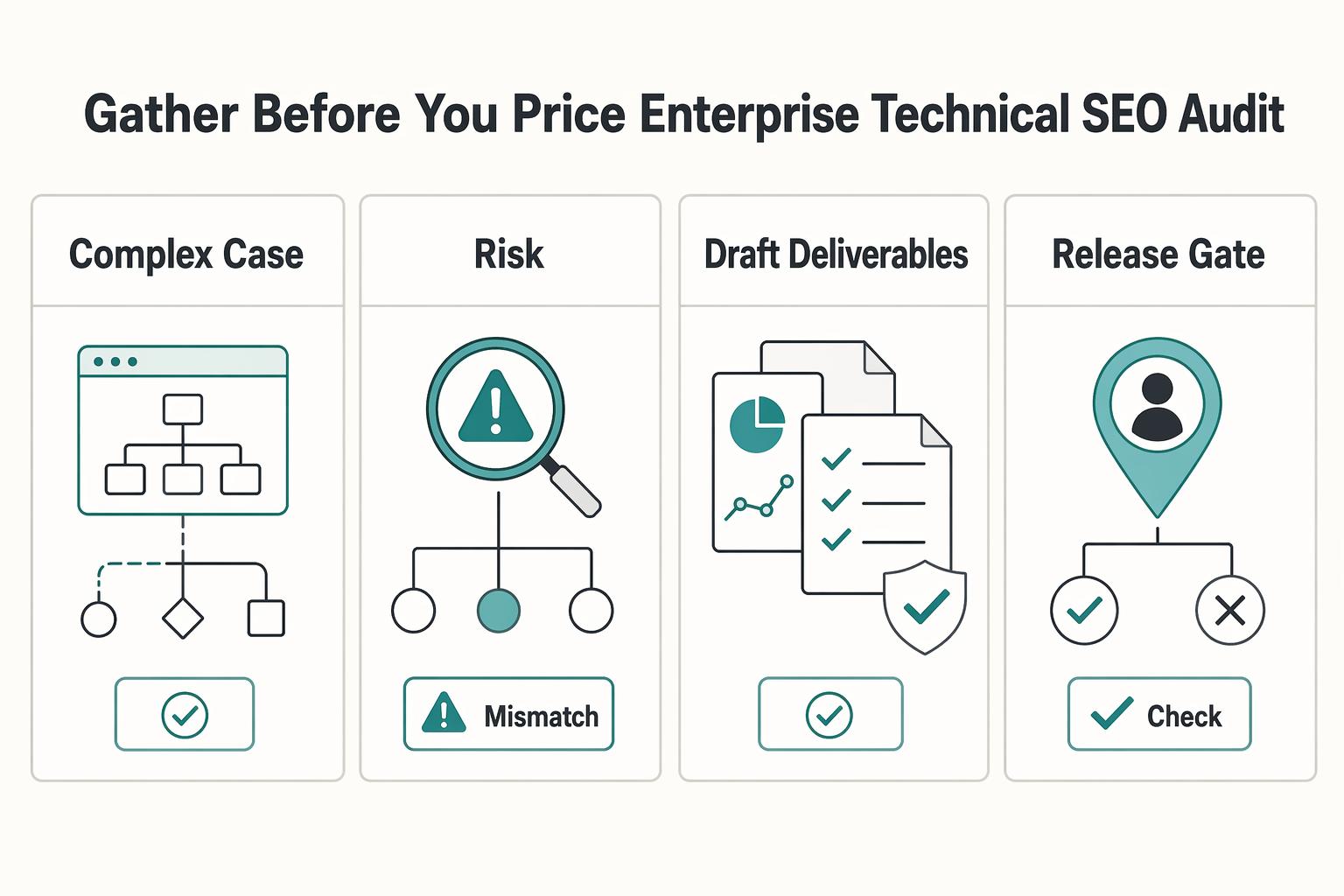
Before you set a fee, get four inputs in writing: scope complexity, technical risk signals, draft deliverables with acceptance standards, and a clear decision owner. If any are missing, price discovery first instead of a full fixed project.
| Input | Confirm in writing | Pricing note |
|---|---|---|
| Scope complexity | Site size and structure, expected audit depth, review load, and reporting format | Site size and complexity are major cost drivers, so define what is in scope, out of scope, and what the final output is |
| Technical risk signals | Whether key pages are crawled/indexed, whether important pages are buried too deep, and whether rendering setup may affect crawlability | Enterprise audits need more than a checklist; these signals change investigation depth and review effort |
| Draft deliverables and acceptance standard | Provisional SOW-style bullets for deliverables, exclusions, and what counts as complete | Clear completion criteria prevent pricing a shallow scan when the client expects validation and prioritization |
| Decision owner and approval timing | Who gives final approval and when decisions happen | If ownership or timing is unclear, avoid a fixed quote and offer discovery first |
Step 1. Collect scope signals that change effort#
Confirm site size and complexity, expected audit depth, stakeholder review load, and reporting expectations. Before you quote, you should be able to say what is included, what is excluded, and what the final output will look like.
"Enterprise site" alone is not enough. A focused review with one approver is different from a multi-property engagement with broader stakeholder review and implementation-ready outputs.
Step 2. Check technical risk early, not after pricing#
Gather concrete pre-pricing checks: are key pages being crawled and indexed, are important pages buried deep in the site, and are there rendering patterns that can reduce crawlability. At enterprise scale, small development issues can create site-wide SEO impact, so these checks directly affect effort.
Use manual spot checks alongside tooling when needed, especially for high-impact templates and key page types.
Step 3. Draft deliverables and acceptance before final pricing#
Turn "technical audit" into explicit deliverables and exclusions, plus a clear acceptance standard. If the work includes issue validation, prioritization, or walkthroughs, write that into the draft scope before you finalize price.
This keeps the quote tied to the real engagement, not just the audit label.
Step 4. Use a no-quote rule when ownership is unclear#
If the final decision owner, timeline, or approval path is still unclear, do not issue a fixed project fee yet. Offer a discovery estimate first so you do not absorb unpriced expansion later.
Set your first number using market anchors without copying them blindly#
Use outside numbers to set a pricing corridor, not the final fee. Your actual quote should come from written scope, review burden, and delivery expectations.
| Market signal type | Example source | Figure status | How to use it |
|---|---|---|---|
| Benchmark context (commercial) | Neil Patel pricing page | Verify current range | Use for expectation bracketing only. It is commercial context, not a neutral benchmark. |
| Benchmark context (buyer urgency) | GTM 80/20 technical SEO article | Verify current range | Not a fee source. Use it to understand why teams may treat technical SEO as foundational and expect checkpoints like Core Web Vitals and crawl budget analysis. |
| Practitioner anecdote | Your own recent, comparable proposals | Verify current range | Use only when review load, deliverables, and acceptance conditions match. |
| Forum sentiment | Independently verified community threads | Verify current range | Treat as a weak signal. Do not match a number unless scope and stakeholder burden are clearly described. |
Step 1. Use anchors to set a corridor, then classify enterprise scope#
Set a provisional corridor first, then classify the deal before choosing a number. If you see multi-stakeholder review, procurement or legal friction, or an implementation expectation beyond findings, move it into an enterprise scope bucket before pricing.
A practical check: does the audit end at findings, or does the team expect prioritization workshops, remediation guidance, or follow-up? If the engagement does not resemble the work behind the public anchor, treat that anchor as weak.
Step 2. Build a worksheet that ties every adjustment to written scope#
Do not price from gut feel. Map each cost driver to one SOW line and one matching Acceptance Criteria line so every increase has a written basis.
- Technical depth: if Core Web Vitals, crawl budget, indexation, or template-level analysis affects price, include it explicitly in scope.
- Review load: define stakeholder groups, review rounds, and feedback format required for acceptance.
- Procurement overhead: price onboarding/security steps or exclude them in writing.
- Implementation expectation: if remediation is not included, state that clearly.
If a driver is not written into SOW or Acceptance Criteria, either add it or remove it from fee logic.
Step 3. Separate internal confidence scoring from client-facing caveats#
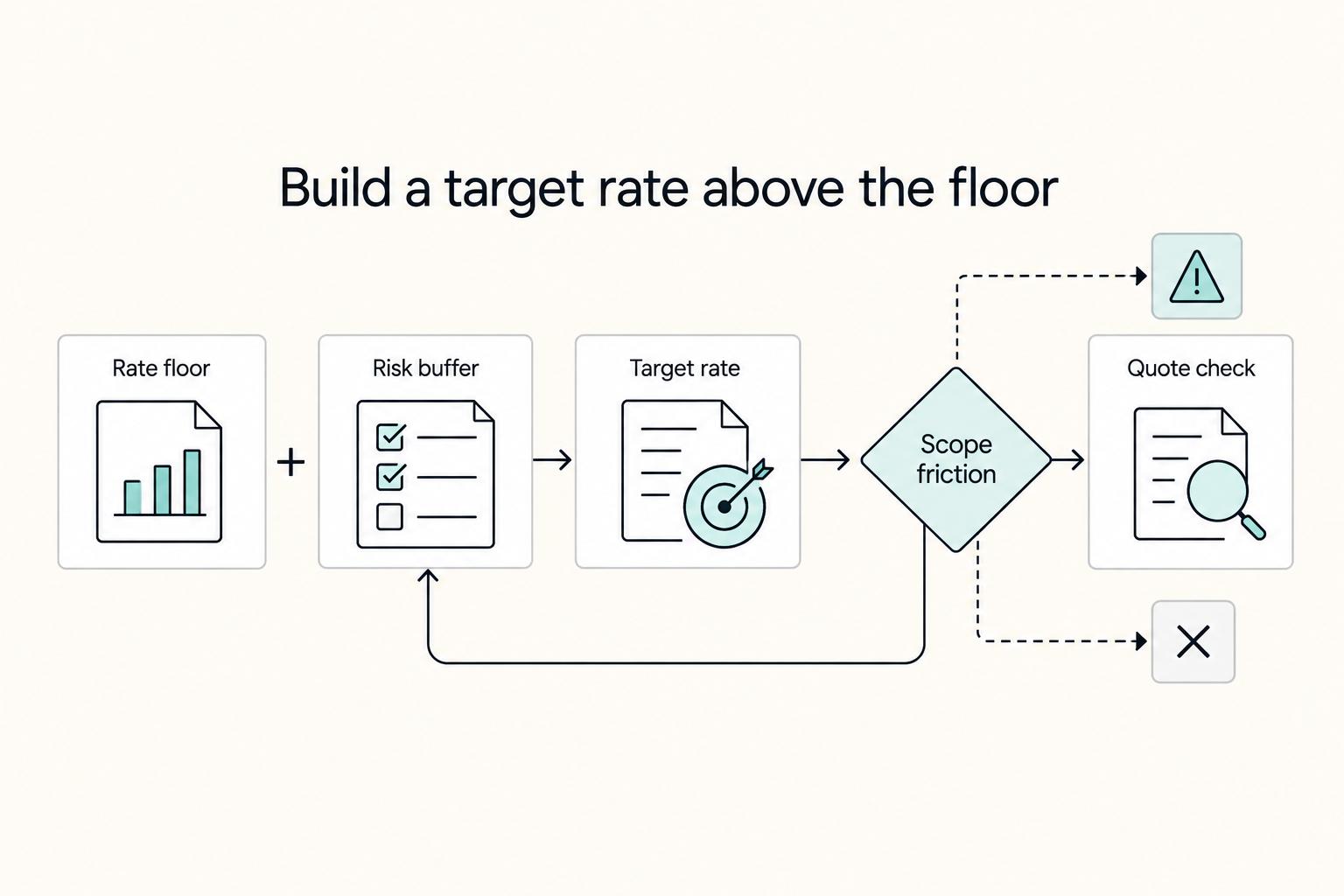
Internally, score scope clarity, review certainty, and procurement certainty as high, medium, or low. If two or more are low, use a discovery estimate and do not issue a fixed quote yet.
Externally, keep it short: market pricing is directional, and this fee reflects this scope, this deliverable, and this approval path.
Choose fixed fee or hourly based on scope risk#
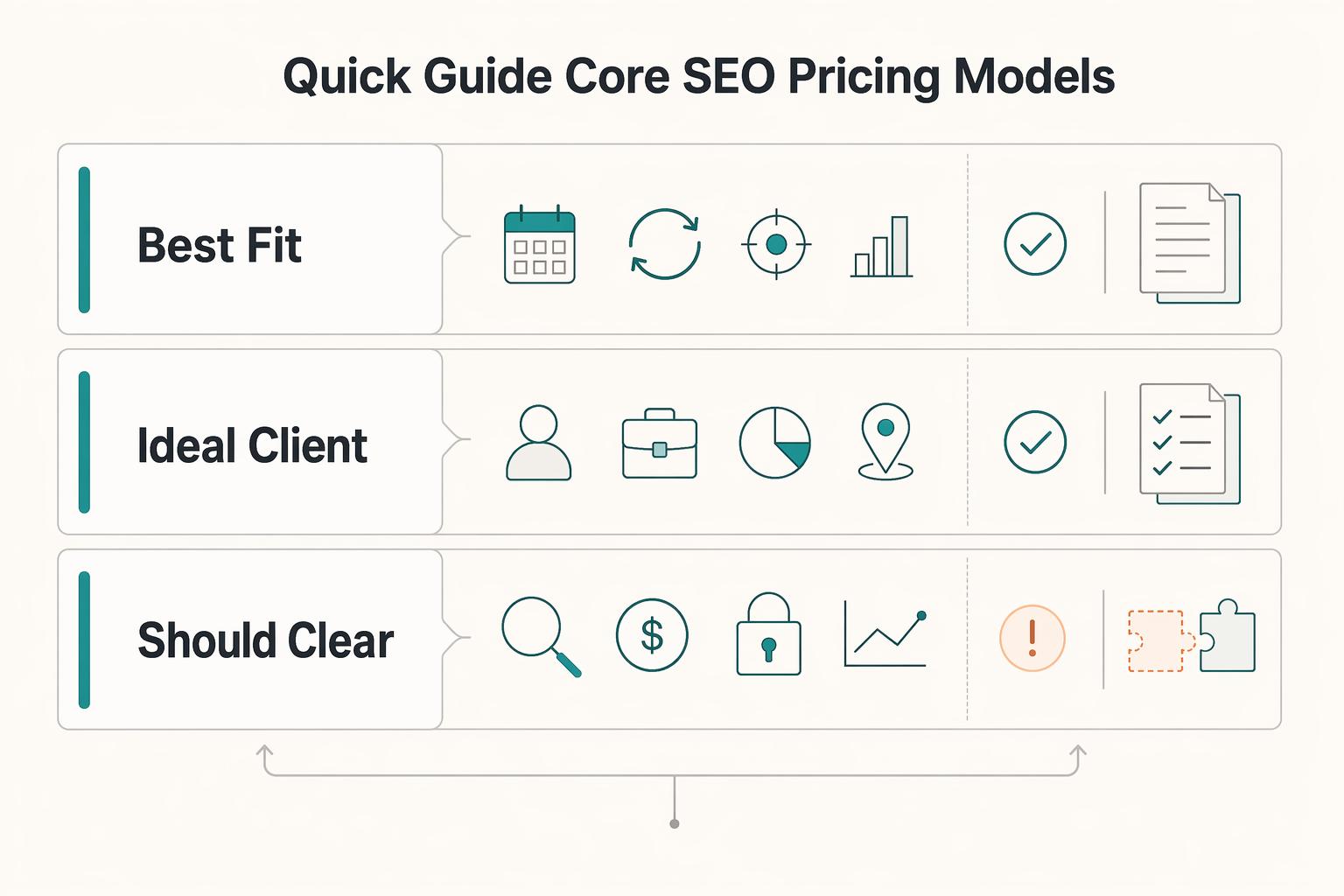
Choose the pricing model by uncertainty, not preference: fixed fee for stable scope, hourly for open investigation, and hybrid for defined outputs with unclear effort.
| Model | Choose it when | Main benefit | Main risk | Change-control behavior |
|---|---|---|---|---|
| Fixed fee | Scope, acceptance, and approval path are clear in writing | Strong budget predictability | Under-scoped work erodes margin | Treat added domains, workshops, or remediation requests as Change Order items before continuing |
| Hourly discovery | Access, issue depth, or review load is still unclear | You are paid for real investigation time | Client has less cost certainty | Log new requests as they appear and convert them into scoped follow-on work |
| Hybrid | Core deliverable is defined, but investigation depth may expand | Predictable base plus flexibility | Vague conversion rules create pricing friction | Define in advance when discovery ends, when fixed pricing starts, and who can approve scope additions |
Step 1. Use a practical gate before fixed fee#
Before recommending fixed fee, get written scope, written acceptance criteria, and clear approval ownership. If one of those is still unclear, start with hourly discovery or hybrid.
This keeps the quote tied to actual delivery conditions instead of assumptions. It also helps you avoid pricing enterprise review complexity as if it were a simple report handoff.
Step 2. Match the unknowns to hourly or hybrid first#
If you see missing URLs in Google Search Console, slow pages, ranking decline, or crawler-access uncertainty, default to hourly discovery first. A robots.txt block on a key folder like /blog/ can quickly expand investigation depth, which is where fixed pricing often breaks.
Use fixed fee once the unknowns are reduced and the likely effort is clearer. If you need a baseline for structuring this decision, see How to Price SEO Services: A Guide for Freelancers.
Step 3. Make hybrid conversion triggers explicit#
For hybrid, write the conversion triggers in plain language: discovery outputs completed, unknowns reduced, and acceptance path confirmed.
Then define your process triggers for Change Orders, for example added domains, extra workshops, or new remediation requests, and name the client-side approver in writing.
Define scope boundaries in the contract before discussing discounts#
Do not discuss discounts until your contract defines what is being bought, how it is accepted, and who can approve changes in writing. If those fields are still open, a discount usually reduces your margin without reducing delivery risk.
That sequencing is practical, not rigid. Price should follow what is actually being bought, and contract detail should deepen as scope and review load increase.
| Contract decision | What must be written | Decision gate |
|---|---|---|
| Scope definition | Exact domains, subdomains, locales, environments, and explicit inclusions/exclusions | No property lock, no final price |
| Acceptance | Deliverable-level Acceptance Criteria, format, required contents, and sign-off method | No testable acceptance, no fixed scope |
| Approval authority | Named client role authorized to approve scope, acceptance, and additions | No authorized approver, no scope change approval |
| Revision limits | Included review rounds and what counts as a revision request | No revision limit, review can become rework |
| Change-control trigger | Written events that require a Change Order before work continues | No trigger, expansion is unmanaged |
Step 1. Lock the property list#
Lock the exact properties before any price-flexibility conversation. If domains, locales, or environments are still being added, treat the quote as provisional.
Step 2. Define deliverable-level acceptance#
Write acceptance so it can be checked, not argued. State what is delivered, in what format, with what required components, and how approval is recorded.
Step 3. Reconcile MSA and SOW terms#
Confirm your MSA and SOW do not conflict on scope, approvals, revisions, or change handling. If they conflict, resolve that first so one document does not quietly expand obligations from the other.
Step 4. Pre-approve Change Order rules#
Define the exact events that trigger a Change Order and the role authorized to approve it. Include added properties, extra workshops, and new remediation asks as explicit trigger categories if they apply.
Discount gate#
No discount discussion until scope, acceptance, approval authority, revision limits, and change-control triggers are confirmed in writing by authorized stakeholders. Once that gate is cleared, price concessions are attached to a stable package, not a moving target.
Build payment terms that protect cashflow#
Your fee only protects cashflow if the contract turns delivery progress into billable events. Set payment terms so money moves at kickoff, at named milestones, and at final acceptance, instead of waiting on open-ended review cycles.
| Payment term block | Contract language to write | Risk controlled |
|---|---|---|
| Kickoff gate | Work starts only after Deposit Invoice is marked Paid. Include the verified amount/structure in the SOW. | Prevents unpaid project starts |
| Milestone invoices | Each Milestone Invoice is triggered by delivery of the agreed deliverable and submitted to the designated approver. | Keeps billing tied to completed work, not informal updates |
| Final invoice trigger | Final Invoice is issued when written Acceptance Criteria are met and acceptance is confirmed by the designated approving role. | Avoids "done but not payable" ambiguity |
| Scope expansion control | Requests outside defined scope require a written Change Order before work continues. | Stops silent scope growth from becoming unpaid labor |
| Fee/terms clarity | List add-ons, SLA/service terms, and cancellation terms explicitly in the MSA/SOW package. | Reduces hidden-fee and contract-surprise exposure |
Operational workflow#
- Confirm the deposit is cleared before kickoff.
- Send milestone invoices against named deliverables already defined in the SOW.
- Tie the final invoice to written Acceptance Criteria plus confirmation from the named payment approver.
- If review comments become new work, pause and route through Change Order before continuing.
Shift commercial exposure earlier when stakeholder reviews are slow#
If stakeholder reviews are slow, shift commercial exposure earlier without changing scope: keep kickoff gated by cleared deposit, use tighter milestone definitions, and require acceptance confirmation from the named approver role, not only the project sponsor. This keeps the delivery plan intact while reducing time-to-cash risk.
Cross-border payment checklist for the MSA/SOW package#
- Confirm the legal paying entity name.
- Confirm invoice currency.
- Confirm remittance details and required invoice fields.
- Confirm who owns reconciliation on the client side (team/role) and how acceptance is communicated into the payment path.
Use change control when the audit expands mid-project#
When scope expands mid-project, use change control immediately so you do not absorb extra work by default. In enterprise technical SEO audits, that is how you keep scope, timeline, and pricing aligned to what was actually agreed.
Step 1. Define what triggers a Change Order#
Set written triggers for scope movement before it happens. If a request adds deliverables, review burden, or implementation follow-up beyond the agreed audit package, route it through a Change Order rather than treating it as a casual add-on.
Step 2. Reconfirm the current scope before pricing the addition#
Start by restating what the SOW already includes, then separate the new request. After that, document the impact on fee, timeline, acceptance, or a combination.
Use a short written note:
- original scope
- requested addition
- delivery or review impact
- required approver
This keeps the conversation factual and avoids scope drift.
Step 3. Use the approval path named in the agreement#
Only process expansion requests through the client role that can authorize scope and budget changes. Verbal agreement from other stakeholders may be helpful, but it is not contract approval.
Step 4. Treat added review load as real scope expansion#
Mid-project growth is often review expansion, not just technical depth. If the audit now requires more walkthroughs, revisions, or acceptance handling than originally defined, that is added scope and should be repriced accordingly.
Know when to price above mid-market and how to justify it#
Price above mid-market when the work carries enterprise operating risk, not just small-business execution scope. In practice, your quote should reflect complexity, review burden, and approval overhead, not a generic market average.
Step 1. Identify enterprise operating signals and set the engagement level#
Use signals, not labels, to classify the project. If the engagement requires a detailed SOW, alignment with MSA/SLA terms, procurement review, and a formal acceptance workflow, you are pricing a higher-burden delivery model.
Common signals include:
- multi-property or international scope
- deeper validation and prioritization beyond issue export
- cross-functional readouts and signoff steps
- procurement, legal, or security review gates
- expectation of post-audit support in execution planning
Outcome: decide early whether this is a report-only audit or a review-heavy enterprise engagement, then price the right one.
Step 2. Map named cost drivers to the fee and explain them plainly#
Use documented drivers to justify the fee instead of leaning on positioning language. Published averages can help frame expectations, but they are not enough without the specific drivers behind your scope.
| Cost driver | What it changes |
|---|---|
| Property and environment coverage | Analysis depth and coordination effort |
| Deliverable format (report vs acceptance-ready package) | Production time and revision load |
| Review path (teams, approvals, meetings) | Timeline risk and communication overhead |
Contract path (SOW + MSA/SLA alignment) | Negotiation and delivery constraints |
| Acceptance workflow | Rework exposure before signoff |
Step 3. Explain budget tradeoffs as scope choices, not fee arguments#
If budget is constrained, keep trust by trading scope, depth, or workflow burden instead of quietly absorbing risk. You can narrow properties, reduce outputs, or phase the work, but keep the acceptance path explicit so price, timeline, and responsibilities stay aligned.
Conclusion#
Pricing an enterprise technical SEO audit well is less about finding one public benchmark and more about shaping the scope before you name the fee.
Start by identifying what the client is actually buying. Gather the inputs that change effort: site size, technical complexity, and how deep the deliverable needs to go. Use outside pricing as a corridor, not a substitute for scoping. Then choose the pricing model that fits the work and budget, since there is no one-size default.
From there, confirm concrete checkpoints before you finalize the quote. Be explicit about what is in scope and what the audit should surface, including crawl errors, duplicate content, site speed, and mobile compatibility. If the website changes frequently, factor in whether ongoing monitoring is more cost-effective than a one-off audit.
The core principle is simple: scope first, benchmark second, quote third. If you follow that order, your number stays attached to real work and is less likely to drift as complexity becomes clearer.
Frequently Asked Questions
Can I price an enterprise technical SEO audit from page count alone?
No. Page count is a useful checkpoint, but it is not enough on its own. Pricing is usually scope-dependent and should reflect factors like architecture complexity, audit depth, and provider expertise. Before you quote a fixed fee, confirm site complexity and the exact audit output.
Should I match cheap public audit prices if a client brings them up?
Usually no. Public ranges are useful for orientation, but offers with very different depth can share the same label. A low-cost “comprehensive” audit can still miss critical technical issues, so compare scope and deliverables before matching price.
When should I offer discovery instead of a fixed fee?
Offer discovery when key scoping inputs are still unclear. Since audit pricing depends on scope and depth, a fixed fee is harder to defend before those details are defined. A scoped discovery phase can reduce pricing risk for both sides.
What belongs in Acceptance Criteria for this kind of audit?
Keep acceptance criteria specific and testable: what the audit delivers, in what format, and what is excluded. Technical audits focus on infrastructure issues, so it should be clear whether implementation is included or separate. Clear boundaries help avoid confusion after findings are delivered.
How many review rounds should I include?
There is no universal number to point to. Define the number of review rounds in advance and state what counts as a revision. The key is to set expectations before work begins.
Should I discuss discounts early to win the deal?
Prefer to clarify scope first. Discounts can change price, but they do not reduce uncertainty around what is being delivered. Define scope and depth, then decide whether a discount still makes sense.
What if the client asks for implementation help after the audit starts?
Treat implementation help as separate from the audit unless it was included from the start. An audit identifies issues; it does not automatically include remediation work. If implementation is added, re-scope it before proceeding.
How do I justify pricing above mid-market without sounding defensive?
Anchor the conversation in scope. Explain the concrete drivers: site complexity, audit depth, architecture (including multiple subdomains or international targeting), and provider expertise. That keeps pricing tied to work required, not generic positioning.
Try a related tool
Researched and edited by the Gruv editorial team. Gruv builds cross-border billing, payouts, and finance-operations software for global businesses.
Sources
- acquisition.gov/far/subpart-15.4trusted
- benedict.edu/wp-content/uploads/2026/01/2025-2026-Benedic...trusted
- brewster-ma.gov/sites/g/files/vyhlif16031/f/events/select_bo...trusted
- fac.gov/assets/compliance/2025-Compliance-Supplement...trusted
- fam.state.gov/fam/14fah02/14fah020360.htmltrusted
- florenceaz.gov/wp-content/uploads/2020/09/September-8-2020-...trusted
- pmc.ncbi.nlm.nih.gov/articles/PMC12241508trusted
- procurement.sc.gov/files/cpo/Decision%20File%202024-216%20Prote...trusted
Educational content only. Not legal, tax, or financial advice.
Related Posts
How to Calculate a Freelance Rate You Can Actually Get Paid On
A workable rate is not the neat number a calculator produces. It is the number that still works after you account for real billable capacity, non-client time, scope drift, and the gap between sending an invoice and receiving cleared cash. Start with hourly math even if you do not plan to bill hourly, then turn that number into a quote with clear `payment terms`.
How to Price SEO Services for Freelancers
If you are working out how to price SEO services, choose the pricing model before you choose the fee. In practice, the right fit usually comes down to what is clear at the start: scope, whether the work is ongoing or one-time, client needs, budget, and market context.

The Freelance Payment Penalty: A Modeled Audit of Platform Fees, FX Spreads, and Payout Delays
The money rarely disappears through a single, easy-to-spot fee. The real loss is stacked. A marketplace takes its commission, a processor adds a charge for international cards, a bank or payment company converts the currency at a spread, a platform holds the funds before release, and a wire sheds a little to intermediaries on the way in. Each layer looks defensible on its own, but the worker feels the combined result as a smaller deposit and a later payday.