
Quick Answer
Start by tying price productized consulting to a verifiable client outcome, then quote a fixed fee for defined work products instead of hours. Build the offer around clear deliverables, acceptance criteria, and a written process for handling new requests. Use tiered packages to guide buyer fit, and treat cross-border projects as a separate pricing case by confirming currency, transfer costs, and invoice requirements before you send terms.
If your pricing still starts with hours, you are making your work harder to sell and easier to erode. The billable hour does not just cap upside. It invites scope creep, shifts attention to effort instead of results, and keeps you trading time for money.
To charge well and build a durable practice, you need a tighter way to price, scope, and package your work. The goal is not to sound more strategic. It is to make your fees easier to defend, your scope easier to protect, and your best engagements easier for the right clients to buy.
This guide walks through that in order. First, anchor your price to business value the client can verify. Then tighten scope, shape a clear set of offers, and handle the extra risk that comes with international work. Done well, this is how you move from selling effort to running a real consulting business.
Part 1: The Value Equation - How to Confidently Name Your Price#
If you want to price productized consulting with confidence, do not start from hours. Start from the business effect your work is meant to create. If you cannot name that effect in operational terms, you may not be ready to quote a fixed fee.
Changing the label on the price does not fix a weak offer. Value pricing can make a broken model worse, not better. So your first job is simple: define value in a way a buyer can verify.
Before you start: have a documented baseline and a clear problem statement. If the client cannot tell you what is happening now or how success will be recognized, keep the engagement in paid discovery instead of forcing a fixed proposal.
Step 1. Define value in business-impact categories#
Start with the business-impact category the client already tracks, for example revenue, cost, or risk. Your work may touch more than one category, but lead with the one the client already uses to evaluate progress.
Ask questions that produce evidence, not opinions. What is the current baseline? What happens if nothing changes? What metric will move if the work succeeds? If the answer is vague, do not turn it into a hard pricing claim until the benchmark is verified from source records.
A good checkpoint is whether you can finish this sentence without padding: "This engagement is intended to improve ___." "It currently sits at ___." "The client considers success to be ___ within ___." If you cannot fill that in, you are still selling tasks.
Step 2. Collect the evidence before you quote#
Discovery is not just a briefing call. It is evidence gathering for the price you are about to defend. Collect these inputs before you name a number:
| Input | What to collect | Note |
|---|---|---|
| Current metric | The current metric and where it comes from | Have a documented baseline |
| Financial impact | The client's estimate of the financial impact if the issue is solved or ignored | Collect before you name a number |
| Time window | The time window that matters to them | Collect before you name a number |
| Approvals | Who must approve changes internally | Collect before you name a number |
| Client responsibilities | What the client team must do for your work to succeed | Capture in writing before you move to a project fee |
| Benchmark | Any benchmark you plan to reference | Confirm the benchmark against your source records before citing it |
One risk is pricing against a headline outcome when the client owns key dependencies you do not control. If the client team must implement, approve, or provide inputs for the result to happen, capture that in writing before you move to a project fee.
Step 3. Translate the evidence into a pricing rationale#
Turn your discovery notes into a short business case. Do not say, "My fee is based on experience." Say, "Your price is tied to the defined project, the importance of the target outcome, the implementation responsibility included, and the risk I am taking on inside this scope."
This is where project-based fees help. A project-based fee is one fixed amount for a defined project, so you know what you will be paid when the work is complete. Hourly fees give the buyer a clear verification point because they can compare billed hours to work performed, but they also pull attention toward time spent rather than results achieved.
| Buyer criterion | Question to answer before pricing | What your proposal should show |
|---|---|---|
| Speed to outcome | How quickly does the client need a visible result? | Timeline, decision points, and what could delay progress |
| Implementation burden | What must the client team do versus what you will do? | Named client responsibilities and dependencies |
| Risk ownership | Are you advising, executing, or both? | Where your responsibility starts and stops |
| Total cost profile | What alternatives is the buyer comparing you against? | The full project cost, not just a line item or hourly rate |
Step 4. Rewrite deliverables as outcome statements#
In the proposal, every deliverable should point to a measurable business effect. Replace "50-page audit" with "audit that identifies the sources of margin leakage for review by the operations lead." Replace "stakeholder workshop" with "decision session to confirm priorities and reduce rework before implementation."
Use one simple test. Does each line item answer two questions: what changes for the client, and how will they know it changed? If a deliverable cannot be tied to a business effect, it is probably padding. Cut it, narrow it, or move it into a separate paid discovery or advisory option.
That is the real advantage. You are no longer defending effort alone. You are defending a defined outcome, backed by evidence, with clear limits on what your fee does and does not buy. Once that logic is solid, the next job is protecting it in scope. Related: How to Create a Productized Service for Your Freelance Business. If you need a quick next step, try the free invoice generator.
Part 2: How to Make Scope Explicit Before Work Starts#
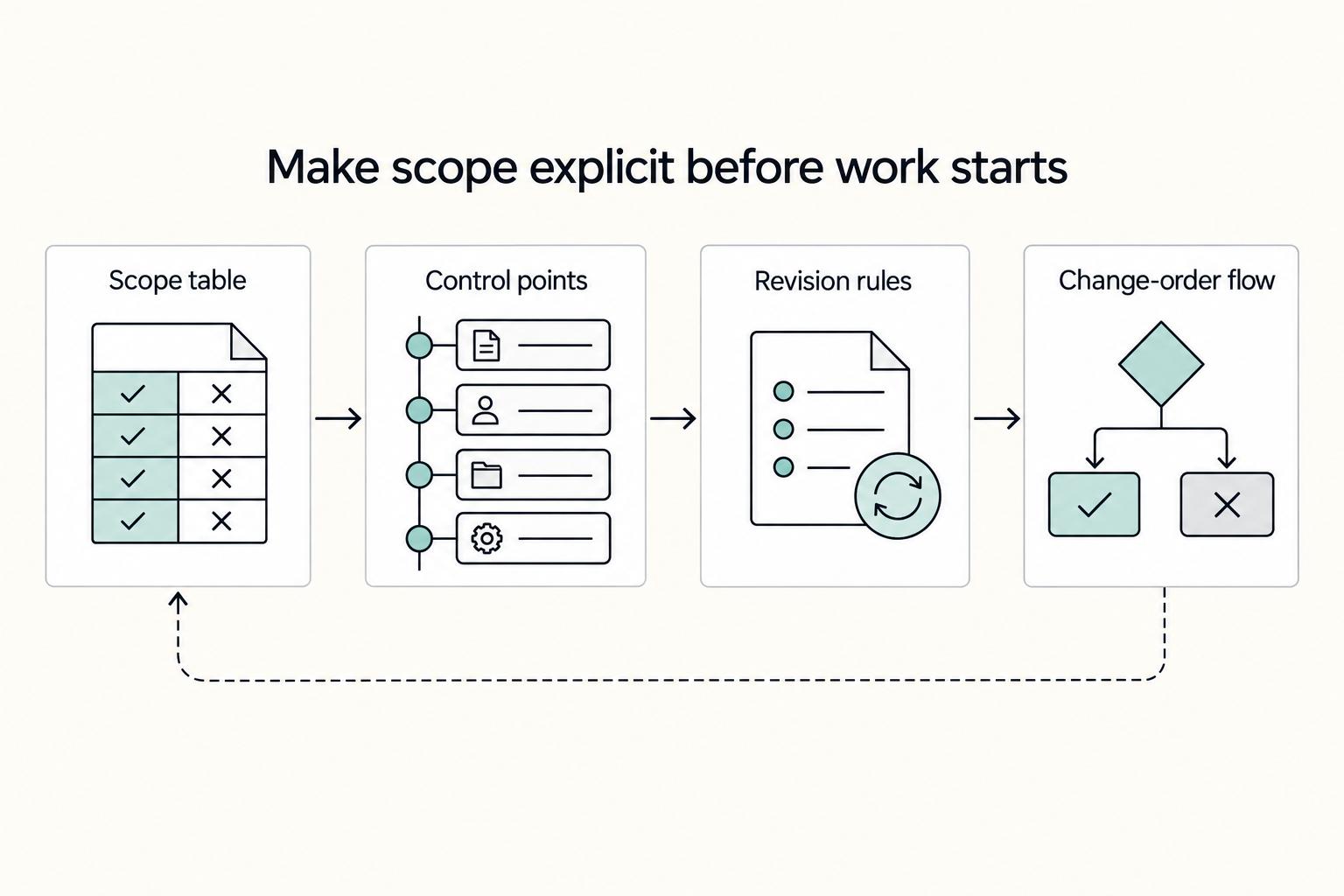
Protect cashflow by making scope explicit before work starts: what is included, what is excluded, who owns inputs, and how new requests are handled. In a fixed-fee model, unclear boundaries are where unpaid work usually starts. This matters even more when delivery gets faster, because clients may push for lower fees or more scope for the same spend unless you change how value is captured.
Build a scope table first#
Use one table per package so both sides can verify what your fee buys. Tie each deliverable to the baseline/KPI/tier logic you defined in Part 1, and avoid language that blends strategy, execution, and stakeholder management into one vague promise.
| Deliverable | Included | Excluded | Client responsibility |
|---|---|---|---|
| Discovery workshop | One facilitated session, agenda, summary notes | Extra workshops, team training, implementation support | Provide attendee list, business context, and decision-maker |
| Audit report | Final report with findings tied to agreed KPI baseline | Raw research files, ongoing monitoring, unrelated departments | Grant access to source materials and confirm baseline data |
| Recommendation deck | Prioritized recommendations and decision-ready slides | Board presentation, design polish beyond standard template, execution | Consolidated written feedback from approval owner |
Lock control points before kickoff#
Set these in the agreement or SOW before kickoff, and verify each variable against the client's contract and source records before use:
| Control point | Set before kickoff |
|---|---|
| Acceptance criteria | Deliverable is accepted when it meets the agreed KPI, milestone, or review criteria |
| Feedback format | Client feedback is submitted as one consolidated written response in the approved channel |
| Response windows | Client responses, approvals, and materials are due within the window; otherwise the timeline shifts |
| Approval owner | Final approval authority sits with the named person or role |
Write revision and communication rules as policy#
Treat revisions and overages as operating rules, not ad hoc favors:
- "Project includes the SOW-verified number of revision rounds tied to defined deliverables."
- "Requests beyond included revisions, additional meetings, or new outputs trigger an overage."
- "Overages are billed at the verified current rate or quoted as a separate add-on."
- "Work outside the agreed communication cadence is scheduled separately."
Use the same change-order flow every time#
- Intake the request in writing.
- Assess impact on scope, timeline, and dependencies.
- Requote the added work or overage.
- Get written approval before starting.
- Reschedule milestones if added work changes delivery.
If you cannot answer "Is this included?" in one minute, pause and run the change-order flow first. That pause often protects both your margin and your delivery calendar. If you want a deeper dive, read How to Calculate Your Billable Rate as a Freelancer.
Part 3: The Offer Architecture - How to Guide Clients to Your Premium Tier#
Once scope is locked, make the buying path obvious: use three tiers that represent three levels of involvement, not three versions of the same work.
Define each tier by buyer stage and support depth#
Define each tier by buyer stage, delivery depth, decision owner, and expected outcome. This keeps your offer architecture clear and repeatable. Do not publish a pricing anchor for a tier until effort, support load, and fit have been verified from source records.
| Tier | Problem fit | Implementation effort | Support level | Handoff quality | Upsell trigger |
|---|---|---|---|---|---|
| Diagnostic | Unclear problem, needs direction | Low | Light touch | Findings summary only | Gaps or risks are clear enough to prioritize |
| Core | Defined problem, wants a real fix | Moderate | Structured support | Decision-ready plan plus delivery | Client wants more speed, more ownership, or broader coverage |
| Premium | Complex stakes, multiple stakeholders | High | High touch, faster response | Deeper transfer, closer follow-through | Chosen when the buyer needs heavier involvement from you |
Use one checkpoint before publishing your offer: if a client cannot explain why each tier exists, your tiers are still too similar.
Make your premium tier create context, not pressure#
Use the premium tier to set context, not to pressure a decision. For most qualified buyers, the core tier is usually the default recommendation, while premium is for higher-support situations.
Differentiate tiers by support format and responsiveness, not just meeting count. For example: 1 zoom call + response in 4 days, 2 zoom calls + 3 days, and 3 zoom calls + 2 days. This makes the tradeoff visible and keeps positioning grounded in delivery reality.
Build a clear handoff from diagnostic to core#
Make the move from diagnostic to core operational and easy to follow. A simple internal handoff checklist is:
- Send a short findings summary tied to the agreed baseline.
- Convert findings into a clear priority sequence.
- Share one proposal path for the core engagement.
- Confirm an acceptance checkpoint for scope, owner, and next decision.
Test it once or twice before you scale the structure. The common failure mode is over-standardizing and losing client-specific fit, so keep the offer repeatable while still confirming dependencies before moving a buyer up a tier. You might also find this useful: How to Create a Freelance Service Package.
Part 4: Pricing for the Global Arena - How to Manage Cross-Border Complexity#
For international work, lock four decisions before you send a proposal: billing currency, fee ownership, tax-review path, and invoice controls. If you defer those choices to billing, payment friction and margin drift become more likely.
Decide your cross-border risk budget before the proposal#
Price cross-border work as a separate risk case, not as your domestic package plus a generic uplift. Split exposure into four buckets before you quote:
- Transfer costs for the payment rail you expect to use. Confirm current transfer costs against your provider's records.
- FX exposure when quote currency and settlement currency differ. Confirm current FX rates against source records.
- Compliance admin time for onboarding, invoice-field requirements, tax review coordination, and payment tracing.
- Collection delay risk when invoices move through procurement or unfamiliar cross-border rails.
Use one checkpoint before pricing: confirm the payment path the client actually wants to use, and confirm it is current. Cross-border payment businesses are evolving quickly, and platform firms are making substantial inroads. That shift has implications for smaller enterprises. If a client proposes a wallet or partner platform, verify support status and reconciliation workflow. In the Alipay+ example, the research includes a partner-platform list with an as-of date of June 2025 and an Appendix III Alipay+ work flow; use that type of dated artifact as your model for validation.
Choose a billing currency and assign the risk in the contract#
There is no universally best billing currency. Use the option that puts FX risk, client friction, and reconciliation effort where you can manage it.
| Billing choice | Who carries FX risk | Client experience impact | Reconciliation workload | When to use protective terms |
|---|---|---|---|---|
| Your home currency | Mostly the client | Can be harder if the client budgets in local currency | Lower for you | Use when payout predictability and simpler books are priorities |
| Client's currency | Mostly you | Usually easier for client approval | Higher for you if settlement differs from invoice currency | Use when client-side ease is worth the extra FX/admin exposure |
| Client currency quoted, settlement rules fixed in contract | Shared or pre-assigned | Usually smoother than home-currency-only quoting | Moderate | Use for larger or longer engagements where FX moves and fee deductions can materially affect outcomes |
At contract stage, write the operational rules explicitly: invoice currency, payment rail, who pays transfer charges, what happens when net received is short due to deductions or conversion, and whether procurement changes require reissue steps. Avoid "we will sort currency later"; that shifts risk to whatever accounts-payable process and intermediary rails appear after delivery.
Check tax treatment and invoice controls before you bill#
For tax handling, the practical move is an advisor-backed checklist by transaction type:
| Transaction type | What to confirm | Invoice note |
|---|---|---|
| Domestic sale | Whether local tax applies and which registration details are required | Required invoice language pending advisor/source-record verification |
| Cross-border B2B sale | Treatment in seller and buyer jurisdictions, required client tax identifiers, and evidence to retain | Required invoice language pending advisor/source-record verification |
| Other cases | Who is responsible for collection and reporting | Confirm before you quote |
Before sending any invoice, run a pre-send control check:
- Your entity details match the contract: legal name, address, registration details, tax identifiers.
- Client procurement details match onboarding records: registered entity, billing address, supplier number, procurement contact, tax identifiers.
- Payment rail details are complete and consistent: bank/provider identifiers, account references, remittance instructions.
- Invoice fields match the existing PO/procurement record exactly to reduce manual review risk.
Done well, cross-border pricing is not about padding fees. It is about deciding in advance which risks you carry and which terms you make explicit.
For a step-by-step walkthrough, see How to Price a Clinical Trial Data Analysis Project.
Conclusion: From Price Tag to Professional Shield#
If you want to price your productized consulting with less guesswork, treat price as part of delivery control, not as a number you tack on at the end. The job is straightforward: sell outcomes, define the work products, and make it obvious where the engagement starts, ends, and gets accepted.
Anchor your fee to value you can repeat#
You need one business result, one defined outcome, and one clear work product before you quote. That is what makes the price easier to defend, especially in work where getting faster should not mean earning less.
Verification point: in your next proposal, repeat the client's own success metric in plain language and pair it with the exact deliverable they will receive.
Lock scope before you lock the price#
A fixed offer only protects you if the boundaries are visible. For a packaged service, use explicit deliverables and acceptance criteria, and keep the engagement finite, often in a 4-12 week window rather than an open-ended block of time.
The main failure mode is still scope creep: extra asks that feel small but pile into unpriced work. If a request changes the output, timeline, or review burden, stop and reprice it before doing the work.
| Practice area | Old approach | Shielded approach |
|---|---|---|
| Pricing basis | Hours sold reactively | Fixed-scope, fixed-price outcome |
| Offer shape | Open-ended work | Finite package with defined work products |
| Scope control | Handled in calls and chat | Deliverables plus acceptance criteria in writing |
| Pipeline | Custom proposal for each lead | Entry, core, and premium tiers |
Build offers that qualify buyers early#
Tiered offers can make buyer-fit decisions easier because buyers can choose a level instead of forcing a custom quote. That matters before the proposal stage. Even with a 50% close rate, custom proposal effort can still be expensive in time.
For your next proposal and invoice cycle, apply three checks only: replace hours with the client result, list the deliverables and acceptance point, and invoice against the agreed package or milestone wording. That can help protect cashflow by tying invoices to agreed scope and milestones. For a fuller walkthrough, see Day Rate or Project Rate for Consulting Engagements.
Frequently Asked Questions
How do you calculate value for value-based pricing?
Start discovery by documenting the client’s current baseline, the result they want, and why timing matters. Put that context in writing before you send the proposal, then anchor pricing to the clearest value driver instead of defaulting to hours. Your proposal should repeat the client’s own metric and wording so the price has a clear business anchor if procurement or finance asks questions later.
What are the biggest risks of fixed-price projects?
Scope creep is the first risk, and slipping back into blank-page customization is another. Protect yourself with an “Is/Is Not” deliverable list, a named approver for changes, and a rule that extra work starts only after written approval. If you absorb “small extras” over chat or calls, it can erode margin and increase payment friction.
How should you structure pricing tiers for a consulting service?
Use three levels of involvement so buyers can choose without forcing you into a custom quote every time. A smaller diagnostic can filter weak leads, your core package should solve the main problem with defined inputs and outputs, and a higher-touch option should add speed, access, or implementation support. If your service menu is sprawling, build the core offer around the 20% of work that solves 80% of client problems, because that is easier to explain, scope, and invoice. | Model | Best fit | Cashflow effect | Main risk to control | What to define in writing | | --- | --- | --- | --- | --- | | Productized service | Clear start and finish | Depends on payment terms; often clearer with defined milestones | Scope creep | Deliverables, revision limits, acceptance point | | Retainer | Ongoing advisory need | Can be steadier when boundaries are explicit | Blurred access and “can you just” requests | Response times, meeting limits, exclusions | | Hybrid | Project first, support after | Varies based on handoff clarity | Client assumes ongoing support starts early | Handoff date, renewal trigger, separate invoice cadence |
How do you price productized consulting for international clients?
Treat the cross-border version as its own risk case, not as a domestic package with a quick uplift. Before you quote, confirm billing currency, payment rail, fee ownership, and the exact invoice details the client’s accounts payable team needs. If any cost input is unclear, verify it before quoting. If the client says “we can sort out currency later,” pause until that point is settled in writing.
Should you list prices publicly on your website?
Yes for a standardized entry offer, especially when your sales page answers common buyer questions early and removes first-step hesitation. For higher-touch packages, publish a starting point or qualification rule only if the page also makes the process, boundaries, and buyer fit obvious. If the page is vague, public pricing can create friction instead of improving readiness.
What’s the difference between a productized service and a retainer?
Productized consulting is sold as a fixed-price, value-based offer with a pre-defined process, while a retainer is typically ongoing access over time. Choose the fixed package when you need cleaner scope and clearer acceptance points. Choose the retainer when the client has a real recurring need. Keep them separate in the contract and on the invoice so one-time delivery does not quietly turn into open-ended support.
Try a related tool
Researched and edited by the Gruv editorial team. Gruv builds cross-border billing, payouts, and finance-operations software for global businesses.
Sources
Includes 3 external sources outside the trusted-domain allowlist.
- dspace.mit.edu/bitstream/handle/1721.1/39479/173849545-MIT....trusted
- hbsp.harvard.edu/product/H054IX-PDF-ENGtrusted
- scholars.law.unlv.edu/cgi/viewcontent.cgitrusted
- sec.gov/Archives/edgar/data/1321655/0001193125202300...trusted
- sec.gov/Archives/edgar/data/1836981/0001193125220937...trusted
- aaltodoc.aalto.fi/bitstreams/cffb7f50-7437-4eea-b016-755f7ad03...external
- bravenewgeek.com/category/consultingexternal
- chaosmap.com/how-to-start-consulting-businessexternal
Educational content only. Not legal, tax, or financial advice.
Related Posts
How to Calculate a Freelance Rate You Can Actually Get Paid On
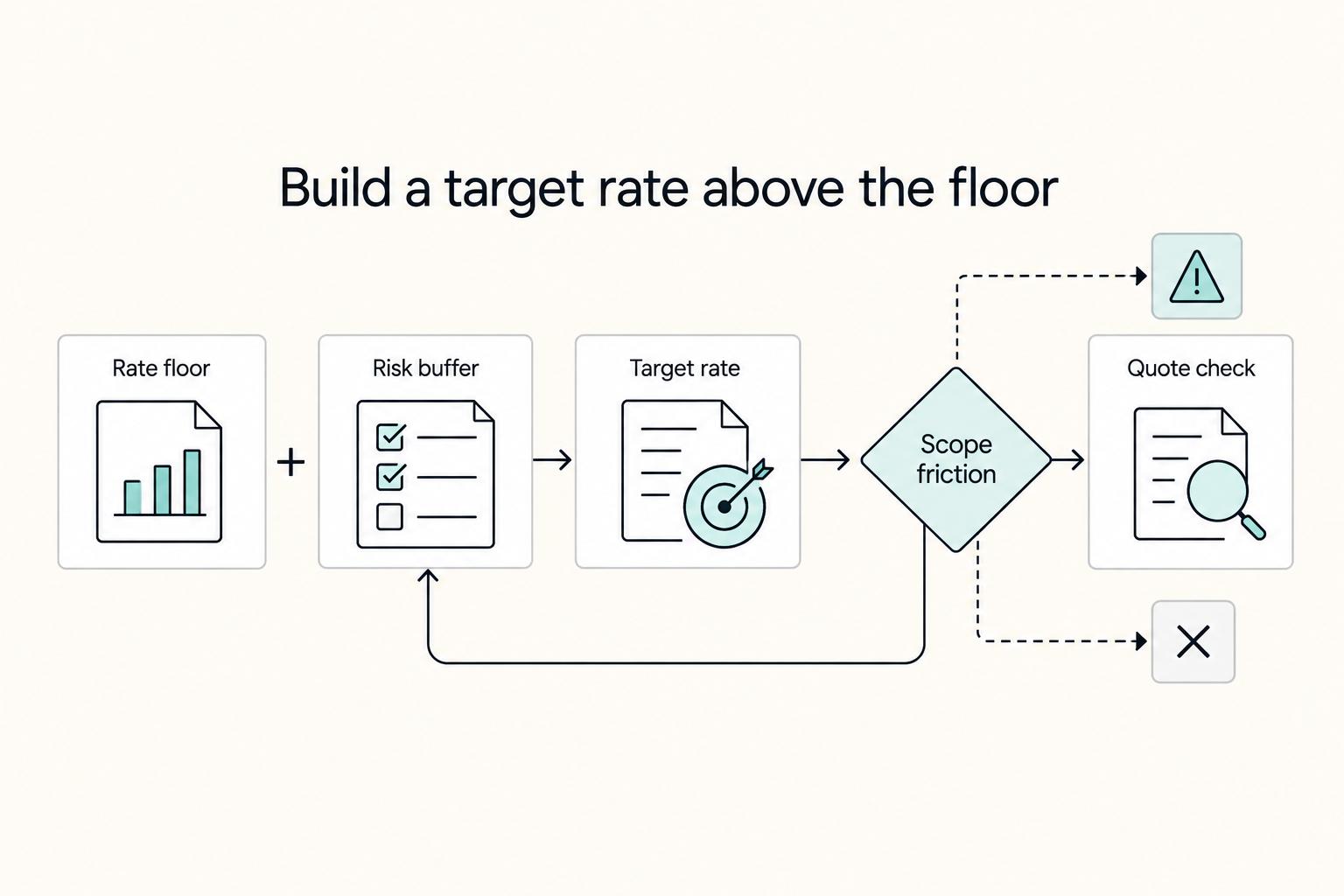
A workable rate is not the neat number a calculator produces. It is the number that still works after you account for real billable capacity, non-client time, scope drift, and the gap between sending an invoice and receiving cleared cash. Start with hourly math even if you do not plan to bill hourly, then turn that number into a quote with clear `payment terms`.

How to Create a Productized Service for Your Freelance Business
If your recent client work produces similar results from similar inputs, you may be ready to turn it into a defined offer. The shift is operational, not cosmetic. You are deciding what you sell, what the client gets, what it costs, and how delivery happens, instead of rebuilding every job from scratch.
How to Create a Freelance Service Package
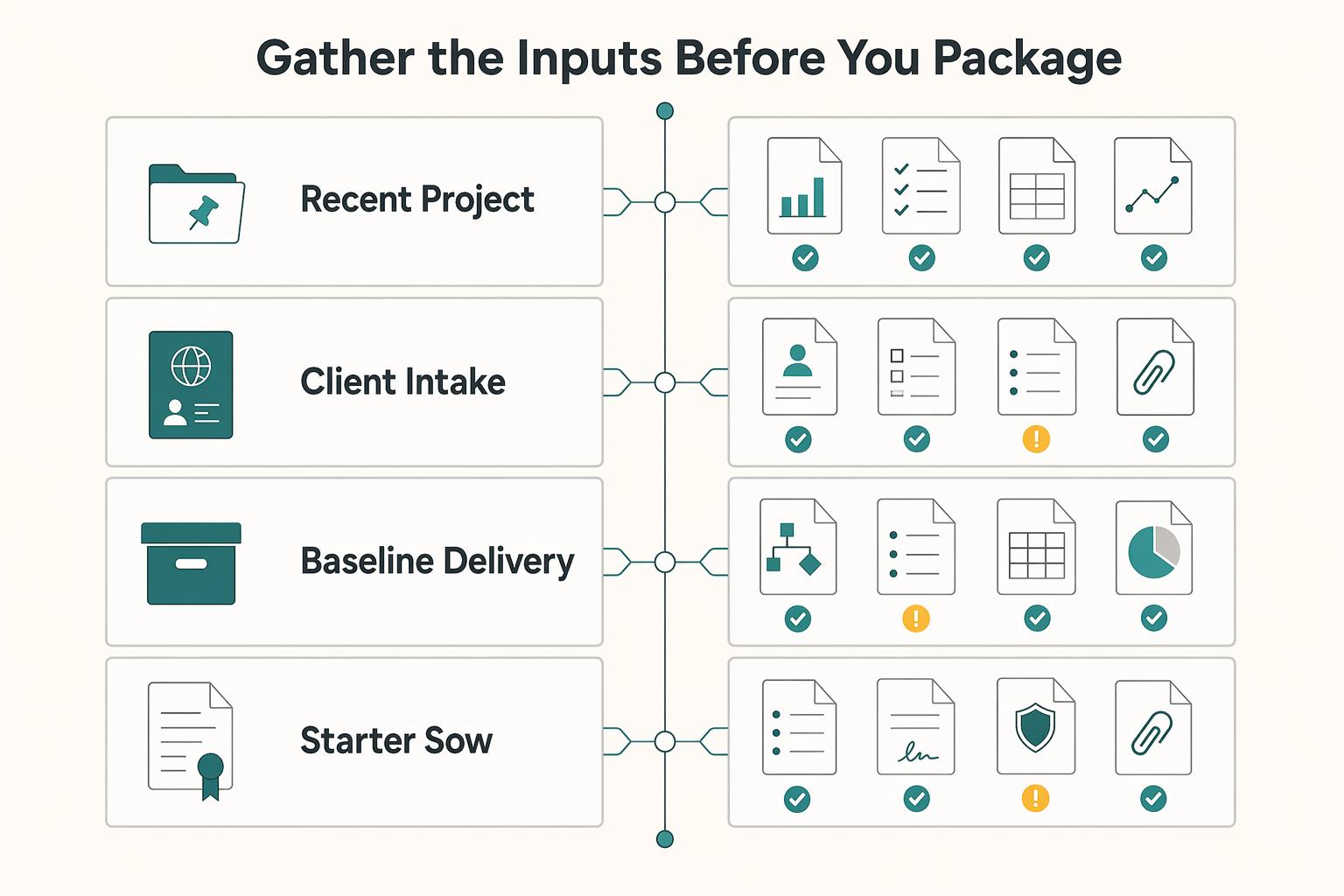
How you start a project shapes the rest of the engagement. Packages work best when you treat them as written delivery terms, not just a pricing format. If scope, change handling, and payment timing are clear early, you reduce late-stage confusion and stalled invoices.