
Quick Answer
Start by treating price podcast production as an ROI decision, not a flat editing expense. Set one objective, total your internal effort, and compare that against vendor scope and spend. The article’s framework uses DIY, editing-only, and full-service paths, with examples ranging from lower-cost editing support to broader monthly retainers. Before signing, confirm deliverables, ownership language, revision rules, and invoicing triggers so you are paying for outcomes you can verify.
Stop Asking "How Much?" Start Asking "What's the ROI?"#
Before you try to price podcast production, define the job the podcast needs to do. If you cannot say whether it is meant to generate leads, build authority, or retain clients, it is hard to judge whether a quote is fair.
Step 1: Define the business job. Pick one primary outcome for this season, not three. Lead generation might mean booked discovery calls. Authority building might mean more qualified inbound inquiries or a shorter sales cycle. Client retention might mean better renewals or warmer upsell conversations. Your check is simple: you should be able to name the one action that proves the show worked.
Step 2: Map the ROI inputs. Use a short worksheet with four lines: internal time cost, external production cost, expected business impact, and a payback window estimate. For internal time cost, multiply the hours you or your team will spend by your real billable rate. If that number is fuzzy, calculate it first with How to Calculate Your Billable Rate as a Freelancer. For expected impact, record the lead, retention, repurposing, and timeline targets you can verify from your pipeline, finance, and publishing records.
Step 3: Compare the production models before you buy.
| Model | Time load | Cash outlay | Quality control burden | Cashflow risk | Likely return path |
|---|---|---|---|---|---|
| DIY | High | Low | High | Low immediate cash risk, high opportunity cost | Can be slower and depends on consistency |
| Hybrid | Medium | Medium | Medium | Balanced | Can improve output speed with owner oversight |
| Outsourced | Low | High | Low to medium | Higher upfront spend | Can be faster when tied to sales, authority, or repurposing goals |
Step 4: Install a tracking check before episode one. Do not wait until the season ends. Set a tracking mechanism for performance and conversion rates now, then review it after each batch of episodes. One practical red flag: audience reaction can swing hard after a single 45 minute session, so weak conversations and inconsistent follow-through can lead to podfade. If repurposing is part of the return path, document exactly what should come out of one recording and by when.
Once your ROI assumptions are written down, you can choose a production model that fits your time and cash constraints instead of buying on instinct.
If you want a deeper dive, read How to Launch a Podcast for Your Freelance Business.
Want a quick next step for "price podcast production"? Try the free invoice generator.
The Investment Matrix: Choosing Your Production Model#
Choose the model that protects consistent delivery under your current workload and cashflow, not the one that only looks cheapest upfront.
| Model | Watch-outs | Exit trigger |
|---|---|---|
| Sweat Equity | Backlog creep, missed reviews, and release slippage | Client work or publishing consistency starts to slip |
| Executive | Unclear scope, unclear revision flow, and weak process discipline | You are still managing avoidable fixes every week |
| Hybrid Control | Messy handoffs, unclear approvals, and unclear publishing ownership | Management overhead grows so much that delegation no longer saves time |
| Risk Zone | Missed deadlines, rework, unclear ownership, and weak workflows | No credible proof of process before payment |
Use this quick workflow before you decide:
- Clarify your primary objective for this season.
- Estimate internal capacity for recording, review, approvals, publishing, and follow-through.
- Set an investment budget and test whether it is resilient across the full season.
- Pick the model with the lowest operational risk for that objective.
Before comparing vendors or tools, list your current production problems in order of importance. If your top issue is missed release dates, prioritize a model that reduces coordination failure. If your top issue is lost billable time, treat "low cash, high time" options with caution.
If you use a recurring monthly arrangement, treat it like subscription pricing and pressure-test whether you can sustain it beyond the first invoices. A smaller commitment you can maintain is usually safer than a low entry price that breaks your schedule after a few episodes.
| Model | Best fit | Control level | Coordination burden | Delivery risk | Quality consistency | Payment-risk exposure |
|---|---|---|---|---|---|---|
| Sweat Equity | You have real capacity and need to limit cash outflow | High | High | Can rise quickly when your schedule tightens | Variable | Lower vendor risk, higher internal time risk |
| Executive | Your time is expensive and you need reliable delegation | Low to medium | Low | Lower when the provider process is clear and repeatable | Usually steadier | Higher if scope and workflow are vague |
| Hybrid Control | You want editorial control without owning technical execution | High on editorial, lower on production | Medium to high | Medium, depends on handoff quality | Stronger than DIY when process is defined | Shared between your time and vendor spend |
| Risk Zone | You are trying to minimize both cash and time at once | Low in practice | Often unclear until work starts | High | Inconsistent | High when you pay before process proof |
Sweat Equity Best fit: you can protect production time each cycle and want to conserve cash. Watch-outs: backlog creep, missed reviews, and release slippage. Exit trigger: client work or publishing consistency starts to slip.
Executive Best fit: you want to focus on preparation, recording, and high-level review. Watch-outs: unclear scope, unclear revision flow, and weak process discipline. Exit trigger: you are still managing avoidable fixes every week.
Hybrid Control Best fit: your standards are specific, and you want final editorial control with delegated production. Watch-outs: messy handoffs, unclear approvals, and unclear publishing ownership. Exit trigger: management overhead grows so much that delegation no longer saves time.
Risk Zone Best fit: only for narrow-scope work after screening process quality early. Watch-outs: missed deadlines, rework, unclear ownership, and weak workflows. Exit trigger: no credible proof of process before payment. Screen early by requesting client references, checking satisfaction, and reviewing one finished sample plus one documented handoff process.
Your decision here is a risk decision first: choose the model least likely to fail under your real constraints. Once that is set, move to the next step: what each spend level should include.
For a step-by-step walkthrough, see How to Price a Bookkeeping Service for Small Businesses.
What's the Difference Between a $500 and a $5,000 Episode?#
The main difference is scope ownership, not just editing time. As spend increases, you usually move from file cleanup to broader execution across repurposing and publishing.
Step 1 Compare what each tier actually buys#
Treat these as packaging patterns, not fixed market truth. Pricing and scope vary across providers, so verify current quotes before you sign.
| Spend level | Typical scope | Included deliverables | Revision depth | Turnaround reliability | Expected business impact | What is usually excluded |
|---|---|---|---|---|---|---|
| Basic | Often a per-episode flat rate focused on post-production cleanup; confirm current rates with providers. | Dead-air/cough/mistake removal, basic mix/master, final audio file | Light, mostly correction-based | Queue-dependent and provider-dependent | Better listenability and baseline brand protection | Strategy, transcripts, stronger show notes, repurposing assets, and distribution management. In many low-cost packages, you may receive only audio files. |
| Mid | Often a recurring retainer with editing plus ongoing support; confirm current rates with providers. | Basic deliverables plus transcripts, stronger show notes, and some repurposing | More collaborative polish across episode elements | More stable when production runs on a recurring schedule | More usable output from each recording with less internal follow-up | Full campaign strategy, broad distribution support, guest booking, and heavy video execution may still stay in-house. |
| Premium | Often a higher-touch retainer or custom package; confirm current rates with providers. | Editing, repurposing, metadata handling, and in some cases provider-led platform publishing | Highest-touch coordination across assets | Usually strongest when the provider owns final publishing steps | One recording can support a wider content and relationship-building workflow | Ownership terms and work-for-hire language are not automatic; specialized repair or narrative-heavy edits may be billed hourly. |
Step 2 Pick the tier by goal and internal capacity#
Choose Basic if your main gap is technical audio cleanup. Move up if your team keeps missing notes, transcripts, metadata, or publishing, because the bottleneck is follow-through, not raw editing. If repurposing matters, require an exact asset list in the scope: transcript, show notes, clips, captions, metadata entry, upload, and publishing are separate deliverables. For unusual needs such as severe repair or narrative-heavy edits, ask for an explicit hourly line item instead of assuming package coverage.
Step 3 Validate package fit before signing#
Use this buyer checklist before contracting:
| Check | What to confirm |
|---|---|
| Deliverables list | Whether you get only audio files or also transcripts, show notes, clips, metadata, and publishing support |
| Ownership terms | Do not assume rights to raw files or derivative assets |
| Revision process | What counts as a correction versus new scope |
| Payment workflow | Deposit, invoice timing, late fees, and whether publishing is paused until payment clears |
- Confirm the full deliverables list in writing, including whether you get only audio files or also transcripts, show notes, clips, metadata, and publishing support.
- Confirm ownership terms in contract language; do not assume rights to raw files or derivative assets.
- Confirm the revision process, including what counts as a correction versus new scope.
- Confirm the payment workflow: deposit, invoice timing, late fees, and whether publishing is paused until payment clears.
We covered this in detail in How to Price a White-Label Service for another Agency.
Due Diligence & Asset Protection: How to Mitigate Your Outsourcing Risk#
Before you outsource, protect payment, delivery, and ownership in writing and in workflow design. The biggest failures are usually not technical editing mistakes. They are scope drift, delayed handoffs, unclear approvals, and asset lock-in when one supplier or subcontractor becomes a bottleneck.
Start here: map your process flow from raw recording to published episode. List every handoff, who touches files, where approvals happen, and where a failure would hurt operations, confidentiality, continuity, or compliance.
Step 1 Screen the provider like an operator, not a fan#
A good reel is not enough. You need evidence of portfolio fit, process maturity, communication quality, and reliability.
| Screening area | What to check | Verification point | Red flag |
|---|---|---|---|
| Portfolio relevance | Samples close to your format, tone, and complexity | Review recent full episodes, not only highlight clips | Strong demo quality but no comparable episode type |
| Process maturity | Clear intake, edit, review, and delivery flow | Ask for step-by-step file and approval path | "We handle everything" with no concrete handoff detail |
| Communication quality | Direct answers, explicit assumptions, realistic timelines | Send a scoped question and check whether gaps are clarified | Slow replies, missed questions, or changing promises |
| Reliability signals | Coverage, subcontracting, fallback plan, continuity | Ask who does the work, who backs them up, and what is outsourced | One-person dependency with no backup or undisclosed subcontractors |
Also test dependency risk early:
Concentration risk: over-reliance on one person or one small supplier group.Fourth-party dependencies: your vendor and other vendors may depend on the same subcontractor, which can create shared failure points.
If delays and quality slippage are already visible in discussions or trial work, treat that as a disqualifying signal unless the provider shows a clear control plan.
Step 2 Lock the agreement to enforceable outcomes#
If this work is material to your revenue, brand, or sensitive information, generic terms are not enough. In regulated contexts, material outsourcing agreements are expected to include specific clauses; outside that context, verify local requirements before signing.
Use this risk register in your contract and kickoff plan:
| Failure mode | Prevention control in agreement | Prevention control at kickoff |
|---|---|---|
| Scope drift | Deliverables schedule with formats, counts, and owner of each input | Confirm final scope checklist and ownership of each task |
| Delayed delivery | Milestones, dependency deadlines, and defined consequences for misses | Publish working calendar with named owners and due dates |
| Quality mismatch | Acceptance criteria and benchmark sample episode/style reference | Align on review rubric before first full episode |
| Asset lock-in | Clear IP ownership, license boundaries, and handover obligations | Confirm transfer format, location, and handover trigger |
| Payment disputes | Milestone-linked invoicing and approval evidence requirements | Confirm approval path and billing event for each milestone |
For IP, do not rely on one phrase alone. State ownership and license boundaries directly, and include exit/handover obligations with required assets, format, and timing. If a legal or policy threshold may apply in your jurisdiction, verify the current threshold from legal, policy, or source records before using it.
Step 3 Control execution from day one#
Keep operations simple so issues surface early and can be fixed fast: one source of truth for files, one feedback channel, one approval path, and one escalation route.
| Check | Requirement |
|---|---|
| Current file version | Obvious to both sides |
| Open notes and decision status | Visible in one place |
| Next milestone owner and due date | Explicit |
| Escalation path | Known and active |
Use one shared location for raw audio, active edits, final masters, transcripts, and publishing assets. Keep revision notes in one written channel. Name one approver on each side and one escalation owner if deadlines or quality slip.
Use this first-episode control check:
- Current file version is obvious to both sides.
- Open notes and decision status are visible in one place.
- Next milestone owner and due date are explicit.
- Escalation path is known and active.
Before you commit, run this pre-sign checklist:
- Process flow mapped from recording to publish
- Deliverables and acceptance criteria attached
- Ownership, license boundaries, and handover obligations written clearly
- Payment milestones tied to explicit approvals
- Backup coverage and subcontractor use disclosed
- Legal or policy thresholds verified from jurisdiction-specific legal, policy, or source records
Related: How to Write a Scope of Work for a Podcast Production Series.
Define the Outcome, Match Scope, and Protect Cashflow#
Use this as an operating framework: define the outcome, match scope to that outcome, and protect your cashflow before work begins.
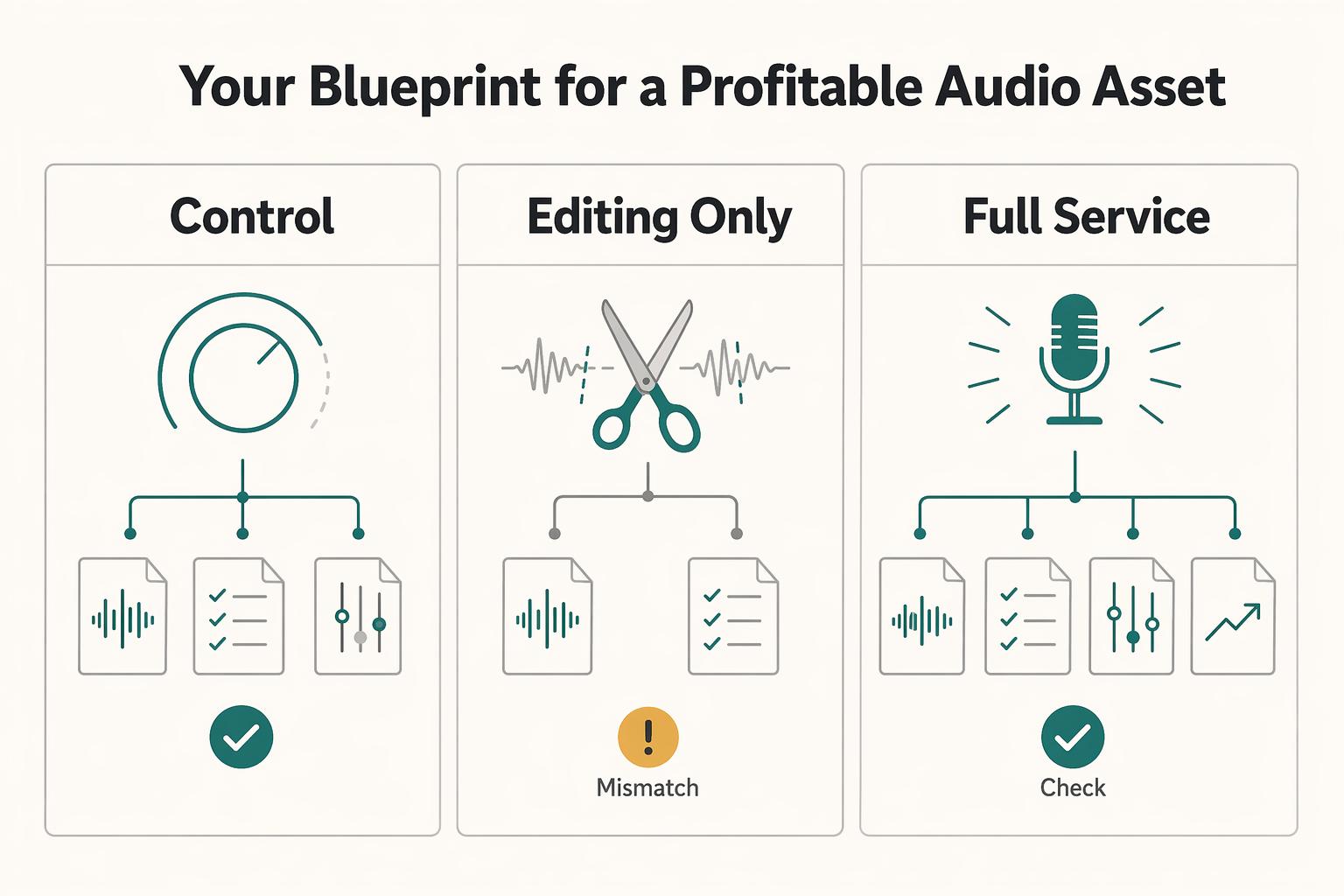
| Approach | Time demand on you | Upfront spend profile | Payment-risk exposure | Control of deliverables/IP | Best-fit stage |
|---|---|---|---|---|---|
| DIY production | High, often 4 to 8 hours per episode | Lower cash spend, higher internal time cost | Lower vendor-payment exposure, higher self-management load | Highest practical control when you keep source files and publishing access | Testing format or working within tight budget |
| Editing-only provider | Moderate | Mid-range, scope-dependent | Moderate, because you still manage part of the workflow | Varies by handover terms and contract language | You mainly need post-production help |
| Full-service provider | Lower day-to-day production time | Higher, and can extend to broader monthly retainers | Higher if spend and vendor dependency both increase | Must be defined explicitly before signing | You have clear business goals and want broader delegation |
Step 1: Define the objective. Decide whether this is a test, a lead-generation channel, or a client-nurture channel. If the objective is unclear, keep scope smaller until it is clear.
Step 2: Estimate your internal effort cost. Start with the 4 to 8 hours per episode DIY workload, then add related tasks. For example, one guide notes guest booking alone can take 10 to 200 hours monthly, so use your real recent workload, not a rough guess.
Step 3: Choose package level by bottleneck, not label. Price alone is not enough because providers can sell very different scopes. If you only need cleaner audio, editing may be enough; if your real bottleneck is coordination, publishing, and promotion, editing-only can leave that workload with you.
Step 4: Set payment terms and protections before kickoff. Put terms in writing, including who owns what, how revisions are handled, what counts as accepted delivery, how invoicing is timed, and how risk events are handled.
Step 5: Review after the first delivery cycle. Check whether delivery matched scope, timing, and workload reduction. Then keep, tighten, expand, or stop based on observed results.
Execution handoff checklist
- Ownership language for final assets and source files.
- Revision boundaries (what is included vs. extra-billed).
- Deliverable acceptance criteria and approval flow.
- Invoicing cadence tied to clear milestones or approvals.
- Risk controls for delays, disputes, and file handover at exit.
You might also find this useful: How to Price a 'Productized' Consulting Service.
Try a related tool
Researched and edited by the Gruv editorial team. Gruv builds cross-border billing, payouts, and finance-operations software for global businesses.
Sources
Includes 4 external sources outside the trusted-domain allowlist.
- admissions.yale.edu/podcast-transcriptstrusted
- cmu.edu/ai-sdm/research/human-ai-workshop/2025-progr...trusted
- lawsonstate.edu/learn_at_lawson/academic_catalog/Catalog2025...trusted
- ucop.edu/operating-budget/_files/rbudget/2025-26-budg...trusted
- 80000hours.orgexternal
- agencymanagementinstitute.com/podcasts/podcast-guest-roiexternal
- deloitte.wsj.com/cio/4-it-outsourcing-risks-and-how-to-mitiga...external
- financialmodelslab.com/blogs/operating-costs/podcast-productionexternal
Educational content only. Not legal, tax, or financial advice.
Related Posts
How to Calculate a Freelance Rate You Can Actually Get Paid On
A workable rate is not the neat number a calculator produces. It is the number that still works after you account for real billable capacity, non-client time, scope drift, and the gap between sending an invoice and receiving cleared cash. Start with hourly math even if you do not plan to bill hourly, then turn that number into a quote with clear `payment terms`.

How to Launch a Podcast for Your Freelance Business
Treat your podcast like a documented operating process that compounds your positioning over time. You're running a business of one, and the job is to build a machine you can run without chaos. Once you decide this is a business move rather than a weekend experiment, you need structure that protects your time and keeps shipping predictable.

The Freelance Payment Penalty: A Modeled Audit of Platform Fees, FX Spreads, and Payout Delays
The money rarely disappears through a single, easy-to-spot fee. The real loss is stacked. A marketplace takes its commission, a processor adds a charge for international cards, a bank or payment company converts the currency at a spread, a platform holds the funds before release, and a wire sheds a little to intermediaries on the way in. Each layer looks defensible on its own, but the worker feels the combined result as a smaller deposit and a later payday.