
Quick Answer
Price the engagement by establishing your internal floor and then linking fees to business outcomes the startup already tracks. For a Series A client, package around authority and accountability rather than open-ended access, then pick hourly, project, or retainer based on scope clarity and continuity needs. Keep equity separate from base cash compensation, and make invoicing operational with contract-matched details so payment is processed without avoidable delays.
Quantify Your Value, Not Just Your Time#
Start with a private floor, then move up to an outcome-based price. If your number does not hold up to both your own math and the buyer's scrutiny, it is not ready for a Series A company.
Build your private floor first#
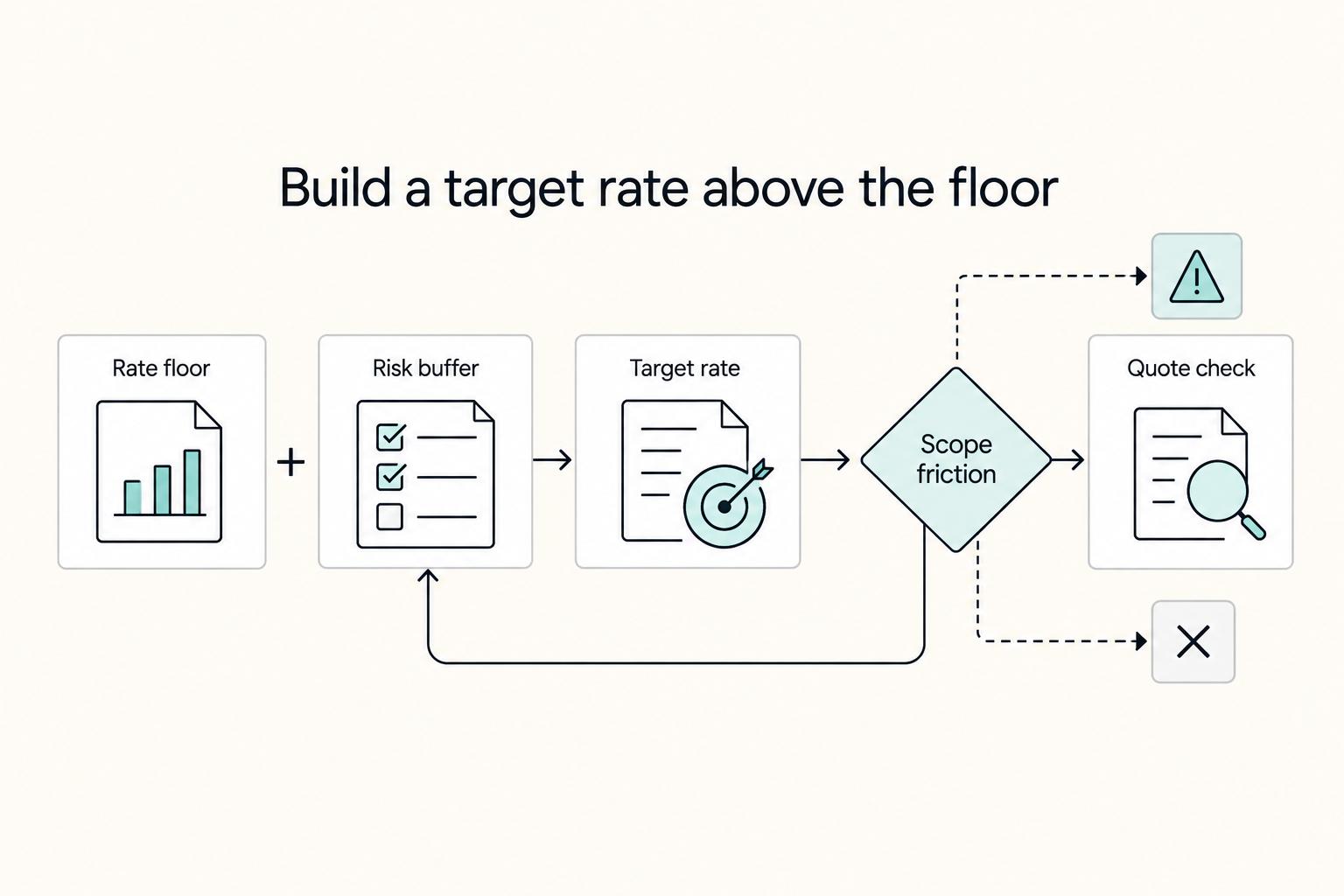
Before you price on value, calculate the lowest number that still makes the engagement commercially sane. Keep the math simple. Use a checklist like this:
| Checklist item | Included detail |
|---|---|
| Compensation target for the year | Annual compensation target |
| Annual overhead | Software, insurance, accounting, tax prep, and subcontractor support |
| Realistic billable hours | After sales, admin, proposal work, and internal planning |
| Risk buffer | Ambiguity, urgent founder requests, and partial ownership without full authority |
The result is your internal floor, not your sales pitch. Then sanity-check it against a current market reference you have verified separately. That check matters because there is no single standard rate, and published pricing varies widely by experience, location, scope, demand, and engagement length.
Public guides show broad hourly ranges such as $100 to $500+ per hour, and monthly retainers such as $5,000 to $15,000+, but those are only market signals. They are not a rate card to copy.
Checkpoint: if your floor already sits above what your target buyer can plausibly support, do not discount first. Narrow the scope, reduce access, or move to a better-fit client. If you need help calculating billable capacity cleanly, use How to Calculate Your Billable Rate as a Freelancer before you quote.
Tie your fee to buyer outcomes#
At this stage, buyers often are not purchasing "senior technical advice" in the abstract. They are buying faster delivery, fewer expensive mistakes, cleaner spend, and a stronger story for the next raise. Your proposal gets much sharper when each claim maps to a KPI they already track and to proof you can actually produce.
| Outcome category | Buyer KPI | Proof artifact | Pricing implication |
|---|---|---|---|
| Delivery velocity | Roadmap milestones hit, release predictability, time lost to blockers | Current roadmap, architecture review, hiring plan, weekly check-ins with blockers and decisions logged | Price above your floor when you are expected to unblock execution, not just advise |
| Reliability and risk reduction | Incident frequency, severity, audit readiness, key-person risk | Risk register, incident review notes, dependency map, security gap list | Charge more when you are taking responsibility for prevention and escalation boundaries need to be explicit |
| Cost efficiency | Cloud spend, vendor waste, engineering time lost to rework | Infrastructure cost snapshot, vendor inventory, before-and-after optimization memo | Keep a cash retainer; treat any savings-based upside as extra, not as your base fee |
| Fundraising readiness | Quality of technical diligence responses, architecture clarity, hiring credibility | Diligence memo, architecture deck, team capability map, data room checklist | Price as high-stakes preparation work, not as generic advisory hours |
Verification rule: if you cannot name the KPI and show the proof artifact you will update, your claim is too vague. Keep the scope smaller until it becomes auditable.
Package around decision rights, not just hours#
This is where scope drift starts. Once you can tie the work to business outcomes, turn it into a package with clear boundaries around authority, access, and failure modes.
| Package | Scope | Wrong fit |
|---|---|---|
| Advisor | Guidance without day-to-day ownership; review roadmap choices, pressure-test architecture, help with investor or board narratives, and join regular check-ins | Client expects you to manage engineers, run incidents, or own recruiting decisions |
| Team and tech lead | Hands-on technical leadership without full executive control; set standards, mentor leads, participate in senior hiring, and help keep delivery on track through recurring check-ins | Company needs one person to own budget, org design, vendor choices, and executive escalation |
| Interim executive | Temporary continuity coverage, often 3 to 6 months; closer to a full-time CTO substitute, with hiring, budget, delivery commitments, and critical escalations depending on mandate | Company really needs a longer-term fractional relationship that can scale up and down over time |
Titles do not stop scope drift; decision rights do. If the buyer expects management, incidents, budget ownership, or recruiting authority, write that into the package and price it there.
For ongoing work, a monthly retainer model can be easier to defend than loose hourly billing, but only if access is bounded. Published provider packages such as 20 hours per month for $2,999, 40 hours for $5,999, or 80 hours for $9,999 are packaging examples, not industry benchmarks. If a package includes something like 24/7 emergency support, treat that as a separate risk and price it accordingly.
Once you can defend the outcome, the KPI, and the package boundary, you are ready to structure the engagement so margin and payment risk do not disappear in the deal terms. You might also find this useful: How to Price a Technical SEO Audit for an Enterprise Website.
Structure Your Engagements for Profit and Protection#
A defensible fee is only half the job; the structure is what protects margin and payment reliability. After you set outcomes and boundaries, choose a model based on scope clarity, urgency, and how much cashflow risk you are willing to carry.
Step 1: Use a retainer for ongoing leadership. Choose a retainer when decisions are continuous and the company needs recurring CTO judgment, not a one-off deliverable. Fractional CTO work is commonly structured as ongoing part-time leadership that can scale over time, so a monthly structure is usually cleaner than open-ended hourly billing. If they want continuity without a permanent executive at 40+ hours per week, this is typically the right lane.
Put these clauses in writing:
- Assumptions: expected availability, meeting load, client responsiveness, and required access
- Decision rights: what you advise on, what you can approve, what you escalate, and what you do not own
- Communication cadence: who attends, how often, and where decisions are logged
- Out-of-scope handling: what happens when requests expand into unpriced ownership or execution
- Review/reset point: scheduled commercial review at the interval named in the agreement
If you cannot point to a decision log, a meeting cadence, and a named client owner, the retainer is likely to drift.
Step 2: Use a project fee only when "done" is testable. Project pricing works when the endpoint is observable; it fails when success depends on undefined ongoing behavior. It is appropriate for bounded work with clear artifacts and acceptance points. As scope expands, especially in transformation-heavy work, price should rise with that uncertainty.
Your SOW should define four items:
- Definition of done: concrete deliverables and decisions produced
- Acceptance criteria: observable acceptance events, not vague satisfaction language
- Dependency assumptions: required access, people, and inputs from the client
- Change-order path: formal scope-change route with the pricing method stated in the SOW
If acceptance can only be decided by debate, tighten the SOW before work starts.
Step 3: Keep hourly as a bounded diagnostic lane. Use hourly for discovery, incident response, or narrow advisory when scope is still unclear. Do not let it become the default operating mode for ongoing leadership.
Set guardrails up front:
- Time box: max hours or end date
- Scope box: specific questions to answer
- Handoff: required deliverable (for example, diagnosis memo, incident summary, or prioritized next steps)
- Conversion triggers: move to retainer for recurring leadership; move to project fee when endpoint and artifacts are clear
Step 4: Reframe against full-time, then protect cash events. When a client compares your fee to salary alone, shift the discussion to the real decision: full-time vs fractional vs interim.
| Decision point | Full-time CTO | Fractional CTO | What you should verify |
|---|---|---|---|
| Cash cost buckets | Salary plus employer costs, recruiting, onboarding, and tools, using current benchmarks verified for the role and market | Contract fee with your overhead embedded, compared against verified market references | Which costs are missing from their comparison |
| Time commitment | Permanent executive, often 40+ hours a week | Part-time or contract basis, fixed hours or project basis | Whether they truly need full-week coverage |
| Speed to start | Hiring cycle and ramp-up time, based on a benchmark you trust before quoting | Start after scope and terms are signed, with timing confirmed in the SOW | How urgent the leadership gap is |
| Flexibility | Harder to scale down after hiring | Can scale up or down with needs | Whether demand is ongoing, seasonal, or transitional |
| Risk transfer | More internal management load | External expertise within contract boundaries | Which decisions and outcomes you actually own |
If they need temporary full-time gap coverage after a sudden departure, treat it as interim CTO work, commonly described as three to six months, rather than a standard fractional retainer.
For deal protection, tie invoices to defined events: kickoff/deposit for project starts, milestone invoices tied to named deliverables or acceptance points, and clear monthly triggers for retainers. Then carry exact payment and pause-language decisions into the compliance/invoicing section that follows.
If you want a deeper dive, read How to price a 'Branding Package' for a new business.
The Equity Equation: When to Become an Owner#
Equity should be optional upside, not a replacement for your cash compensation. In a Series A context, protect your paid engagement first, then decide whether ownership risk is worth taking.
Protect cash before you discuss upside#
Start from a cash-first agreement. Post-Series A technical leadership is commonly framed as cash plus equity, and fractional CTO structures are also presented as equity plus monthly fees, not equity-only compensation.
If the company asks you to reduce cash (for example, a reduced-fee-plus-equity structure), treat that as an investment decision and price the tradeoff explicitly. Your MSA, SOW, or retainer should be viable on cash terms before any equity grant is added.
Audit the offer like an investor#
Before you accept ownership, run a focused diligence check so you understand the risk you are taking:
| Check | What to confirm |
|---|---|
| Cap table transparency | Request the current cap table and the basis for the percentage offered |
| Valuation basis | Ask how the grant is being valued and what assumptions support it |
| Dilution exposure | Confirm how future fundraising could change your ownership |
| Vesting terms | Require written vesting and a cliff; one benchmark shown is 4-year vesting with a 1-year cliff |
| Information rights | Clarify what updates or metrics you will receive as a holder |
| Founder pressure signals | Treat urgency, verbal-only promises, or resistance to written terms as red flags |
Poorly structured vesting is a known failure mode. If you exit after 6 months and the terms are vague, disputes are predictable.
Clean up the paperwork before you sign#
Do not accept verbal percentages. Get the governing equity plan, grant notice or award agreement, and the service agreement (or equivalent) that ties vesting to your role. If the company references a legal co-founder agreement, review the signed legal document.
Confirm these points in writing before acceptance: document type, grant terms, vesting schedule, cliff, exercise or purchase mechanics, transfer/liquidity constraints, and information rights. If any term is unresolved, keep the equity component out of the accepted package until the missing term is documented.
| Instrument | Cash outlay risk | Tax timing risk | Downside scenario | Admin complexity |
|---|---|---|---|---|
| Cash fee only | None beyond standard collection risk | Generally more predictable than equity instruments | No ownership upside | Low |
| Stock options | Can require cash to exercise | Timing and exposure are unclear until advisor review | May become economically unattractive or worthless | Medium to high |
| RSUs | Usually lower upfront purchase risk than options | Timing and exposure still require advisor review | Value may exist on paper without near-term liquidity | Medium |
Decision rule: either you end up with a written offer you can evaluate, or you keep the deal cash-only. Before signing any grant, have startup counsel and your tax advisor review it, then move to invoicing and compliance terms to protect your cashflow.
For a step-by-step walkthrough, see How to Price a UI/UX Audit for a SaaS Company.
The Compliance-First Invoice: How to Get Paid#
Your invoice is a cashflow control system, not admin. Once your cash fee is agreed, your goal is simple: send an invoice accounts payable can approve without back-and-forth.
Step 1: Issue an invoice AP can accept on first pass. Use an invoice acceptance checklist tied to your contract and the client's vendor setup:
- Legal entity name matches the signed agreement.
- PO number or vendor reference is included, if required.
- Service period is clear and time-bounded.
- Bank details match the remittance record on file.
- Tax fields are completed for the jurisdictions involved.
- Remittance instructions are clear for the finance team.
If AP cannot match the invoice to the contract, service period, and payee record, treat it as not ready yet.
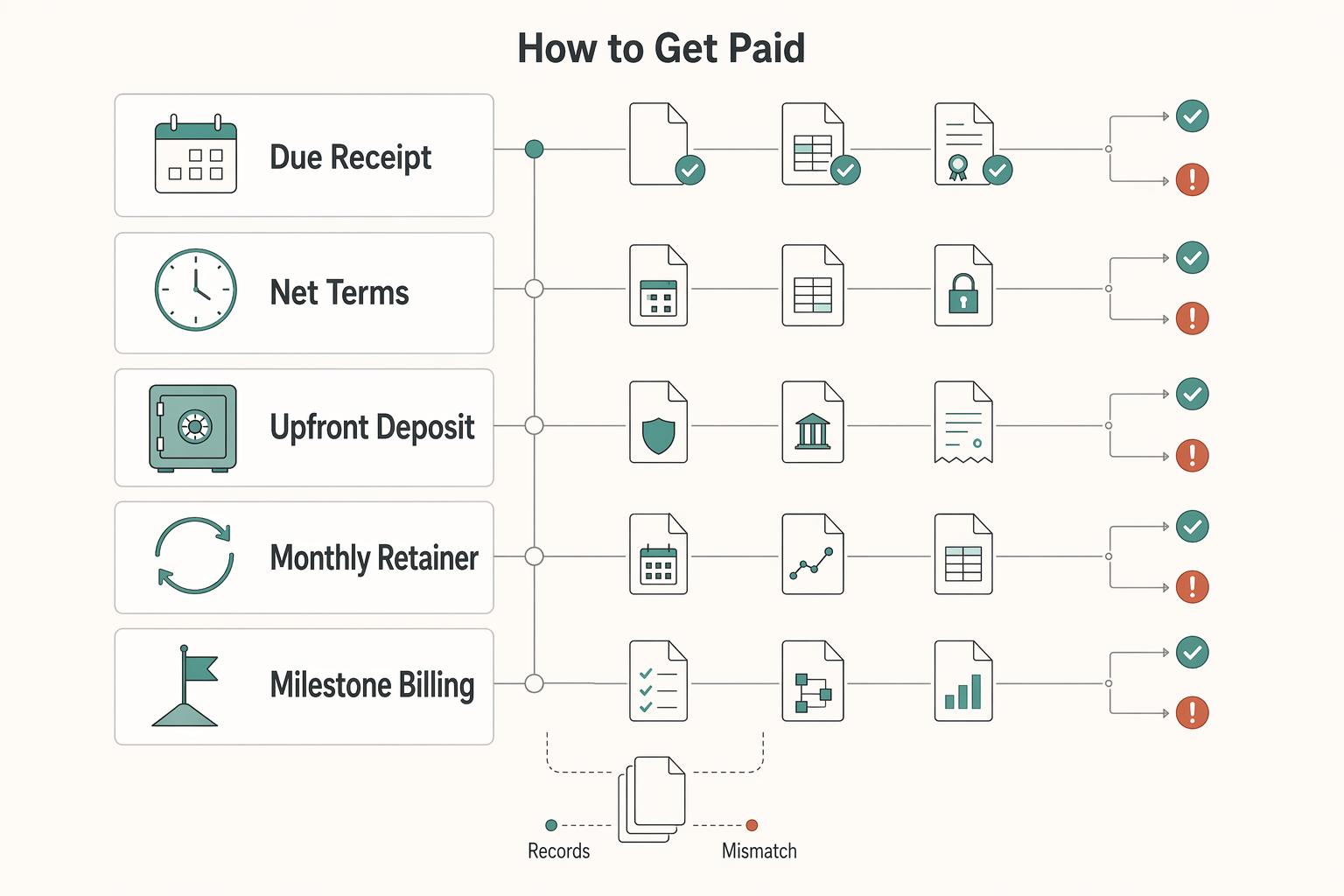
| Term type | Risk profile | Cashflow impact | When to use |
|---|---|---|---|
| Due on receipt | Higher collection pressure with new clients | Fastest if paid promptly | Small one-off work or first invoice |
| Net terms | More float risk for you | Predictable but slower | Established clients with reliable AP |
| Upfront deposit | Reduces non-payment exposure early | Improves working capital before delivery | New engagements, large projects, or setup-heavy work; confirm the deposit amount in the signed terms |
| Monthly retainer billed in advance | Better protection for ongoing scope | Smooth monthly cashflow | Ongoing advisory or retainer work |
| Milestone billing | Risk depends on milestone clarity | Better than end-loaded billing | Projects with clearly defined deliverables |
Step 2: Validate tax treatment before sending cross-border invoices. Do not guess. Use a verification flow:
- Determine place-of-supply under the relevant rules.
- Validate the client's tax status.
- Apply reverse-charge logic where eligible.
- Use only invoice wording confirmed for the applicable tax treatment and jurisdiction.
If VAT treatment is complex and the transaction is still planned, you can request an advance EU VAT Cross-border Ruling (CBR). Submit it under the national VAT ruling conditions of the EU country where you file.
If you use an EU VAT scheme, name the exact scheme and follow its rules. OSS is optional, but if you opt in, you must declare all supplies covered by that scheme through OSS returns (quarterly for Union/non-Union, monthly for import). For the cross-border SME scheme, confirm eligibility (including the EUR 100 000 Union turnover cap for the current and previous calendar year), complete prior notification, and use the exemption only after the EX number is granted and confirmed for use. Registration is expected within 35 working days, but it can take longer in anti-evasion review cases.
Step 3: Send and confirm acceptance. Send the invoice through the client's required channel and confirm AP receipt quickly. Ask one direct question: "Is this accepted for processing, or what is missing?" This catches preventable holds before the due date.
Step 4: Track, follow up, and escalate using contract terms. Run a follow-up cadence from send date to due date: receipt confirmed, processing status checked, payment status checked on due date, then formal late notice if unpaid. If there is a dispute, require the reason in writing within your contract's dispute-response window. If payment risk continues, shift back to contract enforcement language that cites the signed section, the contracted late-fee rate, and the service-pause trigger already agreed in writing.
Related: How to Price a Bookkeeping Service for Small Businesses. Want a quick next step on pricing? Try the free invoice generator.
Conclusion: You Are the Architect of Your Value#
Pricing this work is not just math. Your model tells the client whether they are hiring spare capacity or senior judgment tied to risk, timing, and business stakes.
Keep the stance simple. Start from a value anchor, then choose the engagement structure that matches the decision load. Use hourly only when the need is narrow or diagnostic, monthly retainers when the company needs ongoing leadership, and project fees when deliverables are clear. Published examples like $100 to $500+ per hour or $5,000 to $15,000+ per month are useful context, not a market rule, because rates vary by experience, specialization, and company size.
Your main checkpoint is clarity. Before you send anything, verify that your scope, expected involvement, and pricing model all align.
The common strategic miss is timing. Too early, and the company is paying executive overhead before product-market fit. Too late, and you inherit scaling problems, technical debt, and investor credibility issues. If the client cannot explain why they need a fractional CTO now, pressure-test the timing before you proceed.
| Selling posture | Before | After |
|---|---|---|
| Price anchor | Hourly rate card | Business risk and outcome anchor |
| Engagement shape | Open-ended access | Hourly, retainer, or project fee matched to need |
| Timing signal | Hire by default | Hire at clear inflection points |
- Anchor the fee. Write the business problem, the decision stakes, and why your involvement matters now.
- Choose the structure. Match the engagement to the real need, not the client's default ask.
- Pressure-test timing. If the need is vague, reassess whether this is actually an inflection-point moment.
We covered this in detail in How to Price SEO Services: A Guide for Freelancers.
Frequently Asked Questions
How should you price fractional CTO services?
Start with the job, not the label. Set a floor that covers your economics, then build a range from scope, decision authority, delivery risk, and the business outcome you are protecting or accelerating. Sanity-check your number against published provider benchmarks (for example, one 2026 guide lists $2,500-$5,000/month, while another lists $2,999-$9,999/month), but do not treat any single benchmark as a universal market rate.
Should you take equity?
Treat equity as optional upside on top of cash you would accept anyway. If equity is part of the package, make sure the exact grant terms are documented before you count it in your pricing decision.
Retainer or hourly: which should you use?
Choose a monthly retainer when the client needs ongoing leadership, recurring decisions, and predictable access. Hourly works for discovery, audits, or specific consultations because at least some providers still use hourly for scoped needs. If the client really needs 40+ hours a week, you are likely looking at a full-time role, not a fractional one.
What should your retainer agreement include?
Start with the SOW: what is included, what is excluded, and what happens when requests spill past the agreed lane. Good operator detail matters here, so define expected availability such as 10-30 hours per month, communication channels, and an async response checkpoint like 24-48hr where that fits the engagement. Also define a clear escalation trigger if demand keeps exceeding the agreed scope; if the need moves toward 40+ hours/week, it is likely no longer a fractional engagement.
How do you know your fee is defensible?
Check whether your proposal matches responsibility and risk on paper. Keep your contract and invoicing details aligned to reduce avoidable collection friction. If you want a deeper pricing method, revisit the value section or see Value-Based Pricing for Strategic Consultants: A How-To Guide.
Try a related tool
Researched and edited by the Gruv editorial team. Gruv builds cross-border billing, payouts, and finance-operations software for global businesses.
Sources
- env.nm.gov/wp-content/uploads/sites/2/2017/09/App_5322-...trusted
- epa.gov/sites/default/files/2017-03/documents/sampli...trusted
- fullsail.edu/about/faculty-pactrusted
- health.hawaii.gov/ust/files/2024/01/Encl-1-Site-Characterizati...trusted
- public-inspection.federalregister.gov/2025-22289.pdftrusted
- sec.gov/Archives/edgar/data/1524566/0001628280250545...trusted
- sec.gov/Archives/edgar/data/1970622/0001213900260115...trusted
- sme-vat-rules.ec.europa.eu/sme-scheme/cross-border-sme-scheme_entrusted
Educational content only. Not legal, tax, or financial advice.
Related Posts
How to Calculate a Freelance Rate You Can Actually Get Paid On
A workable rate is not the neat number a calculator produces. It is the number that still works after you account for real billable capacity, non-client time, scope drift, and the gap between sending an invoice and receiving cleared cash. Start with hourly math even if you do not plan to bill hourly, then turn that number into a quote with clear `payment terms`.

Value-Based Pricing for Strategic Consultants Under Real Payment Risk
Undercharging usually starts before the invoice: when you send one attractive number without clear pricing logic, ownership, or controls for scope or rate changes. In value-based consulting, your price and payment structure are one decision, so you need to build them that way.

The Freelance Payment Penalty: A Modeled Audit of Platform Fees, FX Spreads, and Payout Delays
The money rarely disappears through a single, easy-to-spot fee. The real loss is stacked. A marketplace takes its commission, a processor adds a charge for international cards, a bank or payment company converts the currency at a spread, a platform holds the funds before release, and a wire sheds a little to intermediaries on the way in. Each layer looks defensible on its own, but the worker feels the combined result as a smaller deposit and a later payday.