
Quick Answer
Define the buyer, product and license first, estimate per-sale contribution after costs, then compare alternatives and test a small set of prices. Include expected support, refunds and acquisition costs; a digital copy is not cost-free. For subscriptions, check retention and recurring delivery cost. Quote custom implementation separately and resolve applicable tax and currency treatment before checkout.
Start Where Your Pricing Method Is Most Likely to Break#
If you are figuring out how to price a digital product, do not start with a random number. Start with where your pricing method and implementation are most likely to break.
- Step 1: Name the real decision behind the price.
Choose a pricing method that fits the offer: use costs to establish a floor, comparable alternatives to position it and buyer value to test a plausible ceiling. No single method guarantees profitability. A template with one-time access and a supported software subscription can deliver similar outcomes with very different ongoing costs.
- Step 2: Separate method design from execution risk.
A strong method can still fail during implementation. Before launch, define the core assumptions that must hold for the price to work in practice, so the discussion stays focused on execution risk rather than only the headline number.
- Step 3: Fix method selection before you tweak the edges.
Small pricing experiments can help, but if the core offer and pricing method are unclear, those gains can be short lived.
| Focus area | What to check | Expected outcome |
|---|---|---|
| Method selection | The pricing method matches the offer's value logic | A clearer, more defensible pricing approach |
| Implementation readiness | The method can be applied consistently in execution | Fewer breakdowns between price design and delivery |
| Incremental experiments | Tests refine the approach instead of replacing the core method | Improvements that are more likely to stick |
Those checks run through the rest of the article.
If you want a deeper dive, read How to Calculate Your Billable Rate as a Freelancer.
Before generating an invoice, write a one-page pricing worksheet: buyer, package, license, price, tax presentation, channel fees, expected support and contribution per sale. Use the worked example below to check it.
Why Most Pricing Advice Fails a Solo Business#
Most pricing advice fails for a business of one because it treats pricing as a single number, not an operating decision. Your method has to hold up across cashflow timing, margin protection, and who carries risk after purchase.
Check whether the advice fits your offer type#
Test the fit before you copy any model. Much public guidance is context-specific, and even Stripe frames its examples with "your mileage may vary," with many examples centered on low-touch SaaS.
That context does not map cleanly to every offer you may run. A custom client service, a course, a template, and an e-book can look similar on the surface but create very different delivery and post-sale workloads. If a method cannot tell you what happens after checkout or after signature, it is incomplete for your business.
| Pricing model | When useful | What it helps you do | Hidden risk for a business of one |
|---|---|---|---|
| Value-based | When buyer outcomes are clear and you can explain them plainly | Keeps price tied to outcomes, not just time | Breaks down if value is hard to defend or delivery boundaries are unclear |
| Competitor-based | When you need a market-position check | Prevents pricing in a vacuum | Encourages copying businesses with different support load, audience, or payment setup |
| Cost-based | When you need a minimum viable floor | Shows when an offer is too cheap to sustain | Can miss buyer outcome and underprice high-impact offers |
Use each model as a partial tool#
Use these as partial tools, not complete systems. Generic advice often flattens important differences between offer types, especially in digital products.
Separate one-time and recurring commitments. A subscription needs a reason to renew and enough recurring contribution to fund hosting, updates and support. A one-time course or template needs a clear access/update promise; lifetime support can create costs long after the sale.
Review your price on purpose#
Schedule pricing reviews around useful evidence, such as a quarterly check or a completed launch cohort. Review support time, refunds, acquisition cost, buyer feedback and retention where relevant. Avoid reacting to one lost sale or changing the terms already promised to existing buyers without a lawful agreed process.
For you, that review is not about constant changes. It is a practical check on whether effort, support demands, and payment friction still match the current price.
This is why the rest of this article uses a hybrid system, not one formula: defend value, control scope, and run compliance with discipline.
For an automated download, set product and license terms that buyers can understand at checkout. For a product sold with consulting or implementation, quote that work separately and use the contract controls later in this guide.
Calculate unit economics and test a product price#
| Offer | Possible pricing unit | Boundary to state |
|---|---|---|
| E-book or template | One-time individual or team license | Permitted users/use, redistribution limits, updates and support |
| Course | One-time access or a defined cohort | Recorded versus live teaching, access period, feedback and sessions |
| Software or membership | Subscription, seat or usage unit | Included usage, renewal/cancellation, hosting and recurring support |
| Product plus implementation | License plus separately scoped service fee | Product rights versus bespoke deliverables, revisions and acceptance |
Start with net sales excluding applicable sales tax, then subtract expected refunds, processor/platform costs and variable fulfillment, support and acquisition cost. The remainder is contribution toward fixed costs and profit; it is not net profit. Allocate development and launch costs separately. For subscriptions, measure realized contribution and retention by cohort instead of treating a first-month purchase as lifetime revenue.
Worked example: a template priced at $49#
Assume an illustrative $49 sale excluding any sales tax, no refunds, an all-in transaction/channel fee of 8% plus $0.30, $4 of variable delivery/support cost and $10 acquisition cost. These fee assumptions are not a provider quote. Fees are $4.22; contribution is $49 − $4.22 − $4 − $10 = $30.78, or 62.82% of sales. With $1,200 fixed development/launch cost and no other fixed costs, recovery needs ceil($1,200 ÷ $30.78) = 39 sales. At $39 under the same assumptions, fees are $3.42, contribution $21.58 and recovery needs 56 sales. Add real refunds, overhead and tax effects before interpreting either as profit.
For a simple floor, with an 8% fee, $0.30 fixed fee, $4 variable cost, $10 acquisition cost and a desired $20 contribution, P × 0.92 − $14.30 = $20, so P = $34.30 ÷ 0.92 ≈ $37.28 before tax. This floor does not prove buyers will pay it or that $20 covers all fixed costs. Value and demand still set practical limits.
Test willingness to pay without mistaking conversion for success#
Hypothetical comparable cohorts each have 1,000 relevant visitors. At $49, a 2% paid conversion rate gives 20 sales and $615.60 contribution using the assumptions above. At $39, 3% gives 30 sales and $647.40. The lower price produces $31.80 more contribution in this scenario despite less contribution per sale. The acquisition assumptions must fit the actual campaigns; random variation, audience mix, refunds and support can reverse that result. Collect buyer objections and use enough exposure before concluding that price caused the difference.
- Choose one buyer segment and keep the offer/license meaning stable.
- Record price, traffic source, paid conversions, refunds, support time and contribution for each test.
- For subscriptions, compare renewal and recurring costs as well as first-payment conversion.
- Select a price that buyers accept and the business can sustain; repeat the review when evidence or costs change.
For covered EU consumer downloads or streams, immediate delivery does not automatically remove withdrawal rights. Your Europe guidance requires the relevant express agreement and acknowledgment of losing the withdrawal right, plus confirmation. That exception does not erase other mandatory consumer remedies. Build lawful checkout and defect/refund handling into both the customer experience and cost assumptions.
Pillar 1: Justifying a Premium Price to a Corporate Client#
To justify a premium price, position your fee as an investment in a defined business outcome, not a payment for effort. In practice, you lead with the cost of the current problem, then the likely impact of solving it, then your fee.
Step 1: Build the price around the cost of the problem#
Corporate buyers usually approve premium pricing when they can explain the cost of doing nothing. Start there, then connect your offer to financial impact, then present your fee range.
| Element | Use |
|---|---|
| Cost of current problem or missed opportunity | Lead with the cost of the current problem |
| Expected business improvement, risk reduction, or avoided waste from your offer | Connect your offer to financial impact |
| Your proposed fee | Present your fee range |
| Investment case | Show expected impact minus fee range |
Cost of current problem or missed opportunity: verify the impact estimate from source or business records before using it in the pricing case.
Expected business improvement, risk reduction, or avoided waste from your offer: verify the impact range from source or business records before using it in the pricing case.
Your proposed fee: verify the fee range from your business data before using it in the pricing case.
Investment case: calculate expected impact minus fee range only after both inputs are verified.
Use this whether you sell services or digital-product offers (license, implementation support, enablement). Describe the operational change the buyer can defend internally, such as less manual work, stronger consistency, or clearer promotional planning, instead of describing your offer as access alone.
Before you send a premium proposal, confirm three inputs: the pain point, the budget range stakeholders typically use, and the metric they will review internally. If one is missing, validate it before final pricing. Price too low and you lose profit; price too high and you can lose buyer approval.
Step 2: Map your deliverable to a metric the buyer can defend#
Your champion may agree with your proposal, but finance or operations still needs evidence. Tie each deliverable to a recognized metric and a proof artifact they can inspect.
| Deliverable type | Business metric to tie it to | Proof artifact the client can review |
|---|---|---|
| Enterprise license for a pricing, content, or decision tool | Inventory turnover, promotional planning, or assortment decisions | Current inventory turnover report, promotional calendar, assortment review deck |
| Implementation support | Time lost in manual processes, spreadsheet dependency, approval delays | Existing spreadsheet model, current approval path, process map, handoff notes |
| Enablement, training, or internal rollout package | Adoption risk, execution consistency, decision speed | Training attendance plan, usage checklist, pilot results, internal SOP draft |
Do not promise guaranteed percentage gains. Show a credible path from deliverable to business measure using current-state evidence the buyer already trusts.
If your proposal lists features but no proof pack, your premium is harder to defend internally even when the offer is strong.
Step 3: Package options so the client can justify differences internally#
Give the buyer a small set of options tied to outcomes, decision fit, and implementation risk. This helps them choose based on business context, not just headline price.
| Offer option | Business outcome | Decision fit | Implementation risk |
|---|---|---|---|
| Diagnostic or pilot | Confirms the problem, baseline, and likely impact | Best when budget or stakeholder alignment is still forming | Lower delivery risk, but may delay full value realization |
| Core implementation | Solves the primary business issue with clear adoption support | Best when the buyer has a defined owner, budget, and timeline | Moderate risk if internal participation slips |
| Expanded license plus enablement | Broader operational change across teams or regions | Best when leadership wants wider rollout and internal standardization | Highest change-management risk, but easier to justify if governance is in place |
State your recommendation directly. If ownership is not validated, recommend the pilot. If ownership, budget tolerance, and rollout path are clear, recommend core or expanded and explain why.
For a self-service product, useful options might be an individual license, a team license and a license with implementation support. Price the extra rights and support transparently; do not add a confusing tier just to make another look cheaper.
Protect the price with clear product and service terms#
After a client accepts your price, your main risk is scope drift. Your contract should convert the sold offer into project-specific scope that both sides can review, approve, and update in writing.
A standard product usually needs clear access, license, support, update and refund terms. A hybrid offer with bespoke implementation also needs a defined scope and acceptance process. The diagram and SOW checklist below apply to that custom work; they are not a requirement to negotiate a separate SOW for every e-book buyer.
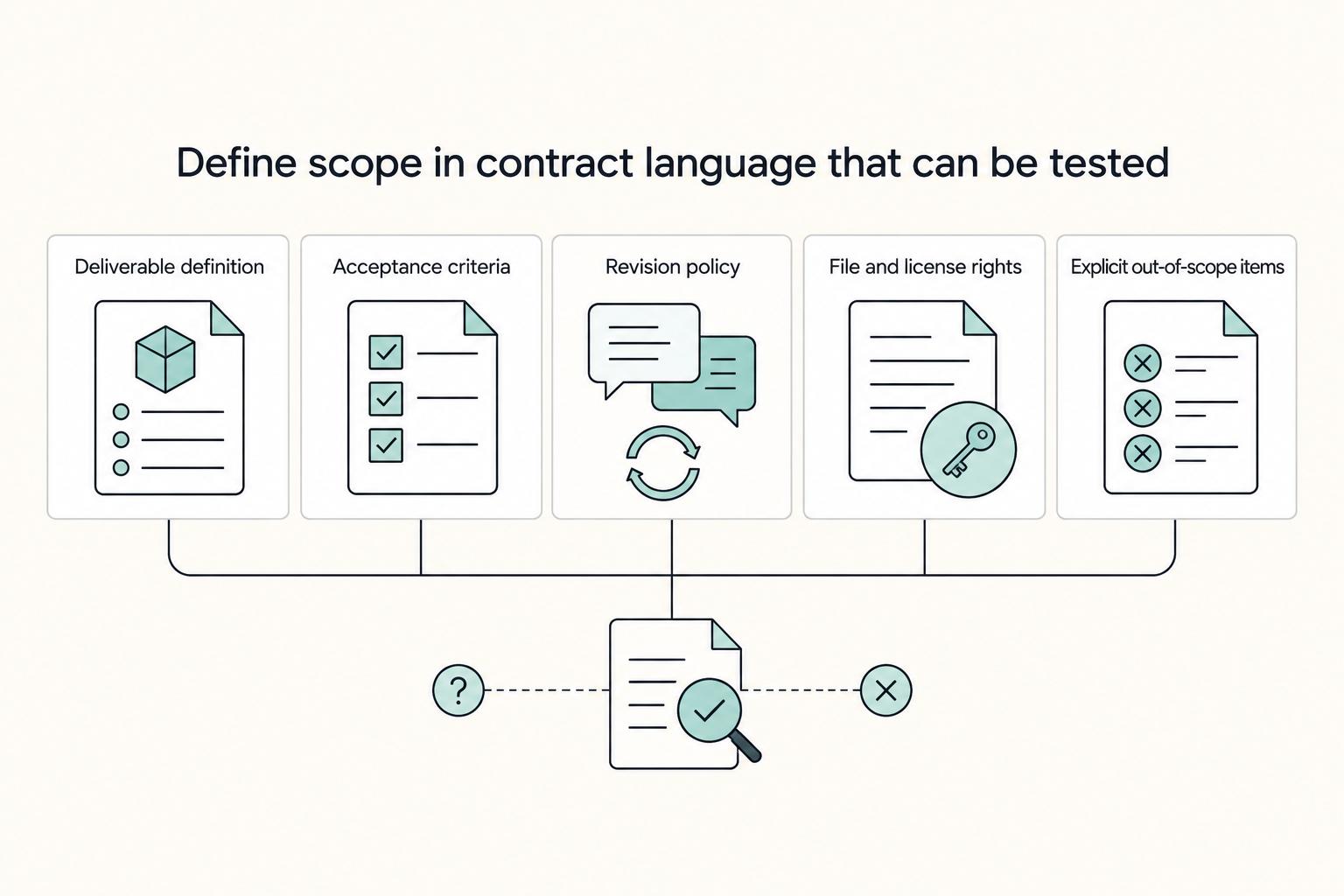
Step 1 Define scope in contract language that can be tested#
Move exact promises from your proposal and discovery notes into the contract or attached SOW. If a promise affects price, write it so a third party can verify what "done" means.
| Contract checkpoint | Write this into the SOW | Verify before signing |
|---|---|---|
| Deliverable definition | "Name the deliverable, audience or use case, included assets, and volume cap before signing." | Do you both agree on asset list and volume cap? |
| Acceptance criteria | "Define submitted files or materials, delivery format and location, approved checklist, and review window before signing." | Is there one observable completion test? |
| Revision policy | "State the verified revision count or rule, scope of edits, and what counts as a new concept, reset, or post-approval change." | Is "revision" defined clearly enough to close loops? |
| File and license rights | "State the usage, license, right, purpose, channel, territory, and duration that transfer; say whether working or source files are included." | Have you named what transfers and what does not? |
| Explicit out-of-scope items | "List excluded items and require written approval before adding them." | Could someone reasonably infer extra work from current wording? |
Step 2 Use milestone checklists for acceptance and revisions#
For custom implementation milestones, state what is submitted, how review works and what counts as approval. For a repeatable product, specify delivery/access and supported uses instead. Keep defect handling and mandatory consumer remedies separate from paid bespoke revisions.
If your language is vague (for example, "strategy delivered" or "design complete"), review cycles tend to expand. A short milestone checklist keeps decisions testable and reduces soft scope creep.
Step 3 Run all out-of-scope work through one written change-order workflow#
When a client asks for work outside the signed scope, use the same sequence every time:
| Step | Action | Detail |
|---|---|---|
| 1 | Capture the request | Use an agreed channel and restate it in writing |
| 2 | Summarize impact | Cover deliverables, timeline, dependencies, and displaced work |
| 3 | Send revised fee and schedule | Use the same scope labels as the original SOW |
| 4 | Start work | Only after written approval |
- Capture the request in an agreed channel and restate it in writing.
- Summarize impact on deliverables, timeline, dependencies, and displaced work.
- Send revised fee and schedule using the same scope labels as the original SOW.
- Start only after written approval.
This is a practical control flow, not a universal legal standard.
Step 4 Set service-level communication terms and tie them to payment flow#
Define service terms that support delivery quality: primary channels, response windows, meeting cadence, and escalation path. Verify each response window from business records before finalizing it. Then align payment milestones with those terms so approval delays do not force unpaid extra work or unplanned schedule risk.
For a step-by-step walkthrough, see How to Price AI-Assisted Freelance Services.
Pillar 3: Navigating Cross-Border Compliance and Currency Risk#
A clear SOW protects scope, but cross-border tax and currency choices still affect what you keep. Set these rules before you send the price so you are not renegotiating after invoicing starts.
Step 1 Verify the VAT path before you invoice#
Decide the VAT treatment before each invoice, not after. For every cross-border sale, record the buyer's legal name, billing country, B2B or B2C status, and any tax details provided, so you can show why you applied a specific treatment.
| Scenario | Check | Note |
|---|---|---|
| Every cross-border sale | Identify product/service type, buyer location/status, seller establishment and the actual platform or merchant role | Show why you applied a specific treatment |
| EU B2B sale where reverse charge may apply | Verify buyer business status and tax details, confirm reverse-charge eligibility for that specific sale, and add the required invoice note | Required wording must be confirmed before use |
| Direct EU consumer sale | Classify the supply and buyer location; assess the appropriate OSS or domestic registration route | There is no universal €10,000 allowance for all digital products or non-EU sellers |
For EU B2B sales where reverse charge may apply, run this checklist:
- Verify buyer business status and tax details using your current approved method.
- Confirm reverse-charge eligibility for that specific sale after jurisdiction-specific verification.
- Add the required invoice note only after jurisdiction-specific wording has been confirmed.
For EU consumer sales, classify the supply first: electronically supplied services are essentially automated with minimal human intervention, so a live taught course is not automatically in that category. The OSS guidance limits the €10,000 place-of-supply threshold to qualifying cross-border B2C TBE services and intra-EU distance goods sales, aggregating the relevant categories within each calendar year and testing the current and preceding years separately, for a supplier established only in one Member State. Non-EU sellers cannot assume this allowance. OSS is an optional reporting simplification, not a tax exemption; choose the scheme that fits the actual establishment and supplies. OSS returns are additional to applicable domestic VAT returns; they do not replace them.
Step 2 Choose your invoicing currency on purpose#
Your invoicing currency is a risk setting, not just invoice formatting. Choose the option that matches your cashflow tolerance, then write it into your contract terms.
| Currency approach | Predictability for you | Buyer and reconciliation tradeoff | Terms to agree |
|---|---|---|---|
| Home-currency invoice | Less invoice FX exposure when costs use the same currency | Buyer may face conversion charges; provider fees can still affect your net | Currency, who pays charges and required net amount |
| Client-currency invoice | Your home-currency net can change before conversion | Can suit procurement; does not guarantee fewer disputes | Conversion timing, rate source and fee treatment |
| Agreed FX adjustment | Depends on the reference and trigger | Adds calculation and reconciliation work | Reference rate, fixing date, trigger and late-payment treatment |
A practical default is your home currency unless the client has a clear procurement constraint. If you use a hybrid clause, define the reference rate source, fixing date, and late-payment handling so the clause reduces risk instead of creating a new dispute.
Step 3 Monitor footprint and act when a trigger appears#
Track cross-border activity continuously so compliance changes do not surprise you. If you sell courses, templates, or e-books, separate marketplace sales from direct sales and verify responsibilities by product type and jurisdiction.
Use this trigger-to-action sequence:
- Monitor sales footprint by buyer country, product type, channel, and B2B versus B2C.
- Detect possible tax registration or treatment changes and verify the rules for the actual product, seller location and buyer/channel. Do not reuse a threshold from a different supply category.
- Resolve unclear treatment with the relevant tax authority or adviser before implementing it. A marketplace or merchant-of-record arrangement changes responsibilities only within its documented scope.
- Update checkout and invoicing workflows as soon as treatment changes are confirmed.
Keep relevant buyer location/status evidence, platform responsibility terms, registrations and checkout/invoice treatment current, with appropriate privacy controls. Reconcile gross sales, refunds, taxes, fees and net payouts by channel so the margin worksheet uses actual costs.
Your Price Is Your Strategy: A Final Thought#
Your price should protect cash flow, scope, and execution risk at the same time. If the number sounds persuasive but fails under real delivery conditions, it is not ready.
-
Value articulation protects cash flow. Use competitor research as context, not as your pricing formula. Show the value logic behind your number so buyers can see why your offer is priced the way it is.
-
Offer boundaries protect scope. Check fees and expenses before you finalize price, then make clear what the offer includes and what it does not. If those boundaries are vague, margin erosion usually shows up after the sale.
-
Price tests refine the offer. Test transparent options or price points with comparable buyer groups and sufficient exposure. Compare paid contribution, not conversion alone. Charm pricing such as $19.99 versus $20 is a hypothesis to test, not a guaranteed improvement or a compliance step.
Before you send any proposal or invoice, run this checklist:
- Confirm your pricing logic is visible and defensible.
- Confirm scope boundaries are explicit.
- Confirm invoice details and any cross-border checks already required for that sale.
That is the practical answer to how to price a digital product: build a repeatable get-paid system, not a one-time number.
Related: How to Create Your Own Online Course.
Frequently Asked Questions
How should you handle EU VAT for a cross-border sale?
Identify the actual supply, buyer location/status, seller establishment and channel responsibilities. Check reverse-charge conditions for a B2B transaction; for consumer sales, assess the place-of-supply rules and appropriate OSS or registration route. The €10,000 rule is conditional and does not apply to all digital sales or non-EU sellers.
When should you use digital product pricing instead of custom service pricing?
Use product pricing when buyers receive a repeatable file, license or access package under standard terms. Use custom service pricing for bespoke delivery, research or implementation. If both are sold together, separate the product rights from scoped service work so support and revisions do not become unlimited.
How do you justify a premium without sounding inflated?
Name the buyer’s problem, comparable alternatives and the specific rights or support included. For a B2B license, quantify a credible business case using the client’s baseline and explicit assumptions. Use pilots or observed results where available, and do not promise a guaranteed percentage return.
How do you stop scope creep before it eats the margin?
Define license, access, support and updates for the product. For bespoke work, use deliverables, acceptance, revision limits and written change approval. Fix genuine defects and honor applicable consumer rights; do not label every product problem a paid scope change.
Should you invoice in your currency or the client's?
Choose the currency that fits your buyer and cost base, then state fee and conversion treatment. Home-currency billing reduces one FX exposure for you, but does not remove processor charges or the buyer’s conversion cost. Client-currency billing can suit procurement while leaving your converted net uncertain.
Try a related tool
Researched and edited by the Gruv editorial team. Gruv builds cross-border billing, payouts, and finance-operations software for global businesses.
Sources
Educational content only. Not legal, tax, or financial advice.
Related Posts
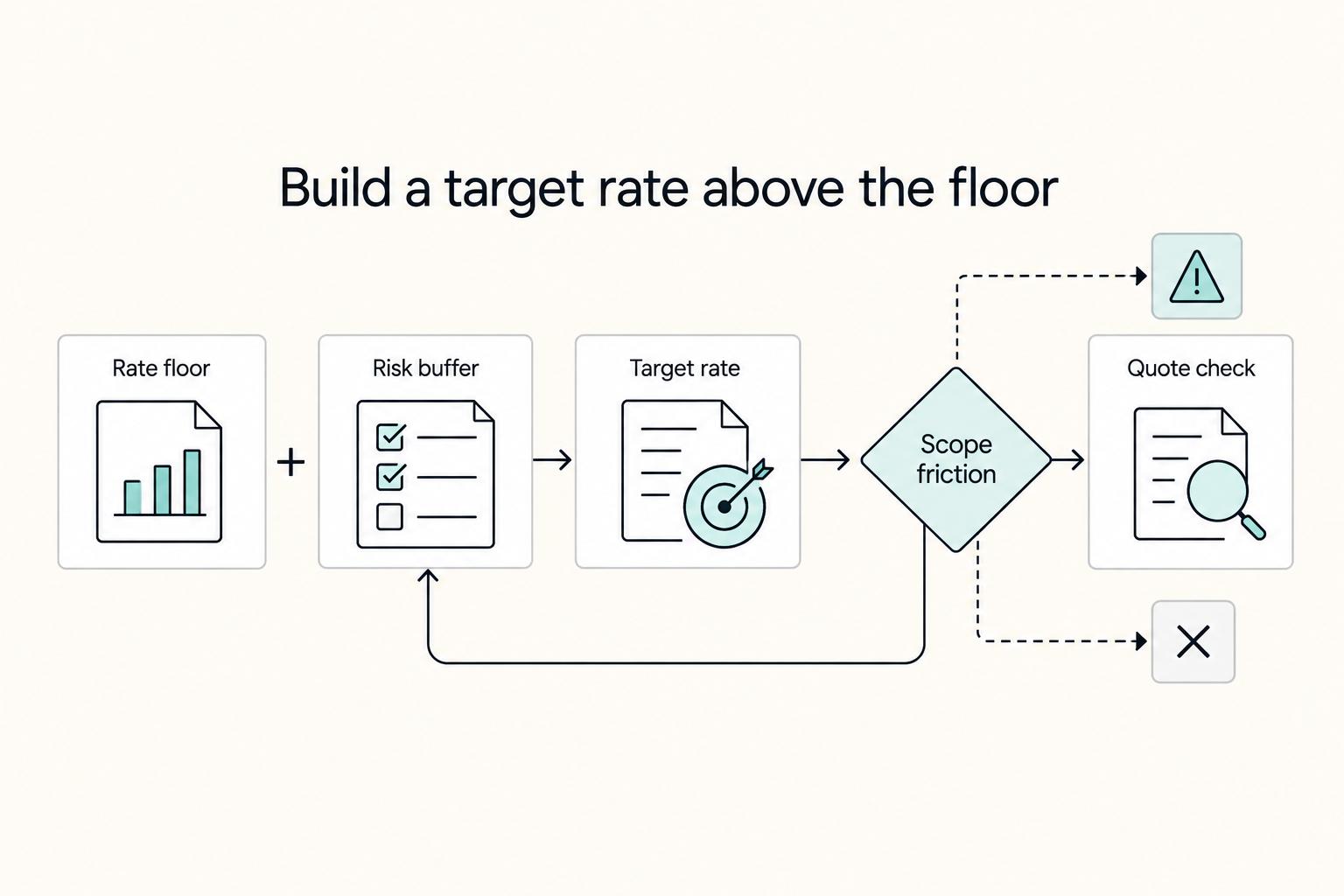
How to Calculate a Freelance Rate You Can Actually Get Paid On
A workable rate is not the neat number a calculator produces. It is the number that still works after you account for real billable capacity, non-client time, scope drift, and the gap between sending an invoice and receiving cleared cash. Start with hourly math even if you do not plan to bill hourly, then turn that number into a quote with clear `payment terms`.

How to Create Your Own Online Course
If you want this to become a real revenue line, treat it like a product decision, not a content project. This guide helps you make the important calls in the right order: define the offer, choose the platform that fits it, and move from outline to published course without avoidable rework.

The Freelance Payment Penalty: A Modeled Audit of Platform Fees, FX Spreads, and Payout Delays
The money rarely disappears through a single, easy-to-spot fee. The real loss is stacked. A marketplace takes its commission, a processor adds a charge for international cards, a bank or payment company converts the currency at a spread, a platform holds the funds before release, and a wire sheds a little to intermediaries on the way in. Each layer looks defensible on its own, but the worker feels the combined result as a smaller deposit and a later payday.