
Quick Answer
Treat the meeting as an approval workflow, then present creative concept options against shared criteria. Start with a pre-read that defines decision owners, constraints, and open risks, and run the pitch around tradeoffs rather than personal preference. Capture each outcome in a Decision Log, mirror approved direction into SOW language, and confirm Legal, Procurement, and AP dependencies before kickoff so scope, timeline, and billing stay aligned.
Present Your Creative Concept Like an Enterprise Operator#
Treat the meeting as a decision checkpoint, not a taste review. Your job is to move the concept through clear questions, decision ownership, and risk ownership before execution starts.
A common failure mode is early enthusiasm without clear risk ownership. Creative work is often funded before its value is fully knowable, so run explicit checkpoint questions before anyone reacts to visuals. A simple test is this: are you answering the most important questions, or only the urgent ones?
| Stage | What you do | Output you leave behind | Who owns the next move | Common failure if skipped |
|---|---|---|---|---|
| Step 1 Build the pre-read | Frame the decision, assumptions, open risks, and exact asks | Pre-read with decision questions and key constraints | You send it, sponsor confirms reviewers | People react to surfaces without shared criteria |
| Step 2 Run the pitch | Walk the concept through tradeoffs, not preference language | Live notes on decisions, conditions, and blockers | Decision owner assigns follow-ups | Buy-in sounds positive, but nothing is actually approved |
| Step 3 Capture decisions | Record yes, no, conditional yes, and unresolved items | Decision Log | Named owner per open item | Feedback turns into memory-based rework |
| Step 4 Apply post-pitch controls | Lock scope edges and revision triggers | Recap with approved direction and change triggers | You and project owner confirm next steps | Late concerns restart the whole concept |
One practical check matters. If any rationale, market example, or AI-assisted summary appears in your deck, verify it before the meeting. Confident false outputs can undermine trust fast.
If a late blocker appears after the room already likes the direction, do not automatically restart the concept. Route the blocker to the risk owner, isolate whether it changes the idea or only the execution conditions, and update the Decision Log with one owner and one deadline. If the issue only changes delivery constraints, keep the concept intact and revise the operating terms around it.
The easiest place to prevent confusion is the pre-read, so start there. For a step-by-step walkthrough, see How to Handle a Client Who is Micromanaging Your Project.
What Should You Prepare Before You Present Anything?#
Prepare a review packet that makes one thing clear: these are concept drafts anchored to the brief, not final deliverables.
Start from your creative brief and communication strategy, then package options so reviewers can compare ideas, not just react to style.
| Artifact | What to assemble | Pass or fail check | If missing, what breaks |
|---|---|---|---|
| Brief anchor | A short recap of audience, objective, message, and key constraints from the brief | Can each concept be traced to the brief in one sentence? | Feedback shifts to personal preference instead of fit |
| Concept set | Multiple distinct routes, each shown with a headline, tagline, and key visual | Does each route represent a different big idea, not a cosmetic variation? | Reviewers compare design tweaks instead of direction |
| Review controls | A stakeholder map (decision rights), approval checklist (by function), and decision log (owner + disposition) | Is every open item assigned to one owner with a clear status? | Notes pile up, but no one can close decisions |
| Testing status note | What has been tested, what is still untested, and where pretesting is needed (including colors/fonts) | Can you clearly label confidence vs. assumptions for each route? | Untested ideas get treated as validated choices |
Before sharing, run this quick gate:
- Are you presenting concepts as rough drafts rather than finished executions?
- Are the routes genuinely different concepts, not color/font swaps?
- Have you clearly marked tested vs. untested assumptions?
If you need to tighten how you frame boundaries before review, use A Freelancer's Guide to Negotiating with Enterprise Clients. Next, map exactly who can approve, influence, or block the concept decision.
Who Actually Decides and Who Can Block Your Concept?#
Treat approval as a shared decision system, not a single-person sign-off. If you do not map decision influence before review, a concept can get positive reactions and still stall later.
Build a project-specific matrix before you circulate the pre-read. Use approver, recommender, blocker, and observer as working labels for this account, not universal titles. For each decision, assign one owner in your process so comments end with a clear disposition: approved, blocked, or open.
| Project role | Your label for this project | What they need to trust first | First document or artifact to review | What happens if this role is skipped |
|---|---|---|---|---|
| Business sponsor | Approver or recommender | The direction fits objective and timing | Brief summary plus SOW or scope note | You get positive feedback without a usable decision |
| Brand or creative reviewer | Recommender or blocker | The route matches intended message and direction | Concept narrative with headline, tagline, and key visual | Feedback shifts into execution details or late brand objections |
| Commercial owner (if assigned) | Approver or blocker | The concept does not imply out-of-scope commitments | SOW, commercial terms, and service commitments | The idea is liked, then paused over scope or delivery terms |
| Risk, legal, privacy, or compliance reviewer (if assigned) | Blocker or observer | Circulation and next steps do not create avoidable risk | NDA, privacy/data terms, and risk clauses | Review pauses after the meeting while objections are triaged |
Then match likely objections to the first artifact each reviewer needs. Do not lead with slides by default. Start with the brief, scope, or risk terms when that is the real blocker, and present concept routes as concept-stage work: headline, tagline, and key visual. A creative concept is a big idea and a rough draft, not a final product.
Run risk triage before you ask for a direction call:
- If unresolved liability, usage-rights, delivery, or indemnity concerns appear, escalate to the commercial or legal owner named for this project.
- If confidential or personal data handling is unclear, escalate to the privacy or security owner before wider circulation.
- If regulated or sensitive claims are in play, escalate to the relevant compliance or brand owner and keep the issue open until resolved.
Use a simple routing sequence: brief your champion first, circulate the pre-read with role labels and the specific decision needed, then collect feedback through one channel. Do not let the concept be socialized without context. Before live review, each comment should have an owner and a disposition.
Related: How a UK-Based Creative Director Can Optimize Taxes with a US LLC.
How Should You Structure Concept Options So Approval Is Easy?#
Structure your options as a decision package, not a taste test. Use the same criteria for every route so stakeholders can compare like-for-like and choose with less friction.
Step 1 Build one comparable decision package#
Present each route against the same fields: strategic fit, delivery impact, revision handling, approval risk, best fit when, and likely blocker. You can share your recommendation, but keep the final choice explicitly with the client.
| Route | Strategic fit | Delivery impact | Revision handling | Approval risk | Best fit when | Likely blocker |
|---|---|---|---|---|---|---|
| Bold | Strong differentiation and a sharper message shift | Higher proofing and coordination load | Broader comment rounds unless tightly scoped | Highest | The client wants a clear repositioning | Brand or risk concerns |
| Balanced | Clear change without resetting core assumptions | Moderate production and review load | Standard refinement if feedback stays in scope | Medium | The team wants progress with controlled change | Pressure to move faster than review allows |
| Risk-contained | Closest to current direction and easiest to align internally | Lowest disruption to timeline and downstream work | Narrow revision window with fewer interpretive edits | Lowest | The account prioritizes stability and low-friction approval | Stakeholders pushing for a bigger leap |
Do not ask non-designers to judge isolated visuals alone. Show each route in practical mockups, then use short bullet-point commentary so the rationale is easier to digest.
Verification point: if a reviewer cannot explain each route in one sentence, the options are still too vague.
Step 2 Run pre-pitch checks for each route#
Before the meeting, confirm each route is decision-ready:
- Acceptance criteria: Is "approved" written in plain, observable terms instead of taste language?
- SOW linkage: Can you show what fits current scope and what would require a formal change?
- Revision history: Are changes logged by date, requester, and whether they are refinement or scope shift?
- Evidence pack: Do mockups and notes show real use, not just isolated slides?
Failure mode: a route gets early enthusiasm, then stalls when feedback cannot be separated from scope change.
Step 3 Close rights and dispute-sensitive gaps before calling it final#
If concept selection triggers production, usage, or ownership terms, treat unresolved contract points as open risk. In practice, that includes ownership language, governing law, and jurisdiction when those items are still unsettled. You can keep those details out of the main pitch discussion, but do not label the decision final while they remain open.
Verification point: if the selected route cannot move forward without reopening rights or dispute terms, you have a preferred direction, not final approval.
With your routes packaged this way, the next call is review format: live, async, or hybrid for final decision closure. Related reading: Thailand's Long-Term Resident (LTR) Visa for Professionals.
Should You Pitch Live or Async for This Enterprise Client?#
Use a mixed workflow by default: gather written input first, then use live time for decisions that need same-time discussion.
| Mode | Speed | Record quality | Blocker handling | Rework risk |
|---|---|---|---|---|
| Live | Best when key reviewers can join at the same time | Reliable only if someone captures decisions as they happen | Useful for conflicts that need real-time tradeoff discussion | Higher if agreements stay verbal |
| Async | Fits distributed teams and time-zone differences | Written comments are built in, but versions still need consolidation | Good for independent review; unresolved conflicts may carry forward | Higher when feedback is split across files or rounds |
| Hybrid | Async first pass, live closure on open decisions | Strong when written comments and live outcomes are merged in one record | Surfaces issues early, then resolves priority conflicts in real time | More controlled when one consolidated record is maintained |
Before review opens, align on four working rules: who consolidates feedback, where decisions are logged, how comments are labeled, and which comments trigger contract review.
Step 1 Send the async pack first#
Send a clear mandate before discussion: what the concept should include, what it should avoid, and the budget guardrails. Then share the options, comparison view, decision questions, and deadline so reviewers can respond in writing before the meeting.
Step 2 Use live time only for synchronous issues#
Use the meeting for points that require real-time participation, not for reading slides aloud. Keep it interactive; a short written pause, for example three minutes for idea capture and then group sharing, helps surface clear positions and avoids lecture-style drift.
Step 3 Capture outcomes and route unresolved items#
Record the selected route, open issues, owners, and next decision point immediately after the session. If feedback affects terms, rights, deliverables, timing, or revision load, route it through your formal change or legal path instead of treating it as routine edits.
This pairs well with our guide on How a UK Creative Director Should Invoice a US Client from their LTD Company to Optimize for Taxes.
How Do You Turn Feedback Into Decisions Instead of Endless Rework?#
Turn feedback into a decision pipeline, not a comment pile. Rework drops when each note is captured, classified, owned, and closed in one visible record.
Before you start#
Open two linked records before review begins: a Decision Log and a Revision History. Use the Decision Log for judgments and the Revision History for what changed, when, and why.
Use one shared link and consistent fields for each item: comment, source, owner, disposition, and next action. Strong starts usually fail at the finish when comments are collected but never clearly closed.
Step 1 Capture feedback as decisions#
Move feedback from email, chat, and deck comments into the log. For each item, record who raised it, what it refers to, and what decision is needed.
- Unclear input: rewrite it as a decision question and confirm intent.
- Subjective input: tie it to agreed acceptance criteria or concept rationale.
- Out-of-scope input: log it, then route it separately instead of folding it into current-round edits.
Step 2 Classify and route by type#
| Feedback type | Typical owner | Decision rule | System of record |
|---|---|---|---|
| Preference | Creative approver or client sponsor | Accept only if it improves the chosen route without breaking agreed criteria | Decision Log, then Revision History if changed |
| Defect against brief | Delivery owner or project owner | Fix when it misses the brief, approved concept, or acceptance criteria | Decision Log and Revision History |
| Scope change | Commercial owner with delivery input | Separate from current round when it changes deliverables, timing, or revision load | Decision Log and scope-change tracker |
| Contract-risk item | Legal, Procurement, Finance/AP, or delivery owner (as relevant) | Escalate when it touches rights, approvals language, payment terms, onboarding, or liability | Decision Log plus contract/approval record |
Step 3 Lock disposition and next action#
Close each item with one disposition: approved, declined, deferred, or escalated. Add the next action and owner immediately.
Use a simple control: if a change appears in Revision History without a matching decision entry, treat it as informal rework and pull it back into the log.
Step 4 Send a closure note#
After the round, send a short recap with the chosen direction, open items, and owner for each escalation. That closure note keeps feedback traceable and prevents another uncontrolled comment cycle.
You might also find this useful: How to Handle a Client Who Constantly Delays Providing Feedback.
What Post Pitch Controls Protect Scope Timeline and Payment Clarity?#
Use four controls immediately after the pitch: lock decisions in writing, mirror them into the SOW, map approvals to delivery and billing checkpoints, and clear cross-document conflicts before kickoff. If these records diverge, enterprise projects tend to drift through small assumption gaps.
Before You Start#
Gather your final recap, current scope of work (SOW), and named contacts in Legal, Procurement, AP, and delivery. In enterprise work, the SOW is your shared reference for what is included, who owns what, and when deliverables are due. Confirm every open item has an owner and every approved item is documented.
Step 1 Mirror recap decisions into the SOW#
Send a decision-locked recap, then update the SOW right away so both records say the same thing. Do not leave key approvals only in email or deck comments.
Match recap and SOW on:
- Acceptance criteria: what is approved and what "done" means in this phase.
- Milestone ownership: who provides inputs, who reviews, and who signs off.
- Unresolved items: what stays open, who owns it, and whether it blocks kickoff or sits outside this phase.
Use a direct cross-check: for each approved recap point, you should be able to show the corresponding SOW line.
Step 2 Map approvals to delivery gates and invoice checkpoints#
Bring Procurement and AP in early enough to align commercial handling with delivery flow. Keep one shared record that maps approval events, delivery gates, invoice support needed, and checkpoint owners.
This prevents a common mismatch: a concept may be approved, but start authorization, milestone acceptance, or invoice readiness may still need separate confirmation.
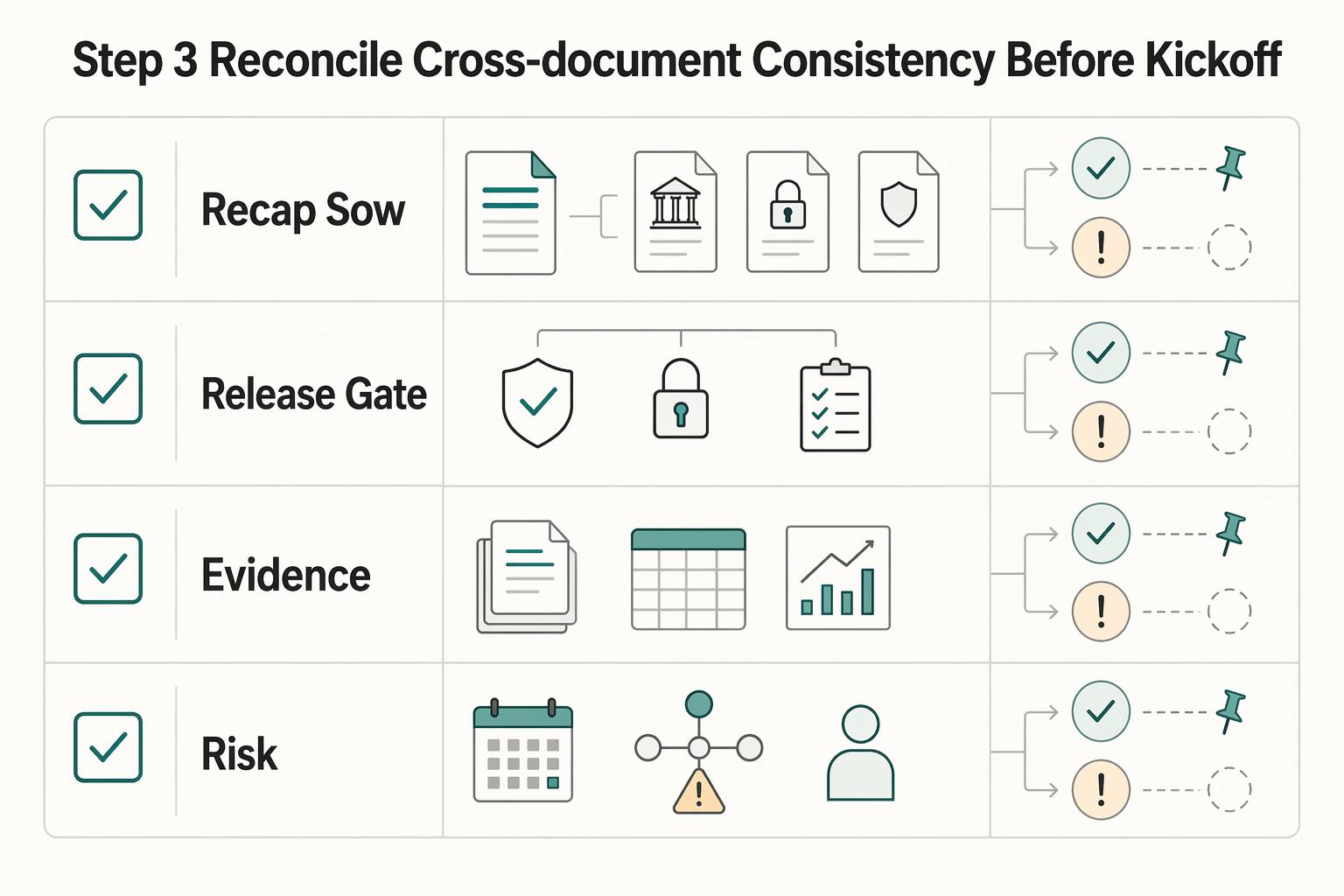
Step 3 Reconcile cross-document consistency before kickoff#
Before kickoff, compare the updated SOW with the other governing documents in play, including the master agreement, NDA, and any applicable data-handling instructions. You are checking for contradictions or gaps that would make execution unclear.
Set escalation ownership before work starts: route contract conflicts to Legal, purchasing or vendor-process issues to Procurement/AP, and delivery timing or dependency risks to the delivery or risk owner.
| Control area | Owner | Verification artifact | Release condition |
|---|---|---|---|
| Recap to SOW alignment | Delivery owner | Decision-locked recap plus updated SOW showing matching acceptance criteria, milestone ownership, and open items | Move to kickoff when recap and SOW match |
| Approval to delivery and billing alignment | Procurement and AP | Shared map of approval events, delivery gates, invoice support, and checkpoint owners | Release next stage when gate and billing evidence are clear |
| Cross-document consistency | Legal | Reviewed set of SOW, master agreement, NDA, and applicable data-handling instructions | Kickoff after conflicts are identified and routed |
| Open risks and dependencies | Delivery or risk owner | Live risk register with owner and next action per item | Start execution with unresolved items logged and assigned |
Related reading: How to Create a Social Media Report for a Client.
Run the One Cycle Framework and Move Forward With Fewer Surprises#
Run every enterprise concept review as one repeatable four-phase cycle: observe, orient, decide, act. This keeps your process consistent when conditions change and helps you rely on a clear decision framework, not improvisation.
- Observe with a pre-read packet.
You prepare the packet before review starts: brief summary, concept route(s), the decision requested, scope boundary, and known issues that may affect Legal, Procurement, AP, or delivery. Check: someone outside your creative team can identify what you are proposing, what it should achieve, and what decision you need.
- Orient the room with a decision-first pitch.
You open by restating the objective, your recommendation, and the tradeoff, then keep discussion at concept level before execution details take over. Ask each owner for one of two outcomes: approval or one open issue with an owner and due date. Check: if feedback drifts into taste, bring it back to brief fit, audience fit, and objective fit.
- Decide in writing immediately after the call.
You update the Decision Log and Revision History while details are still fresh: what was approved, what changed, what is open, who owns each open point, and whether any item affects scope, timeline, or terms. Check: if feedback changes deliverables, audience, channels, timing, or terms, treat it as a terms decision, not routine edits.
- Act only after post-pitch alignment is confirmed.
Before production, confirm your recap, current scope language, and owner list all match. If Legal, Procurement, or AP are in the path, confirm any dependency they still need cleared before work or billing proceeds. Check: do not start production on meeting momentum alone; start when decision, scope position, and operational handoffs are aligned.
Control matrix#
| Phase | Required artifact | Accountable owner | Release condition |
|---|---|---|---|
| Observe | Pre-read packet | You draft it; sponsor/project lead confirms reviewer list, including Legal, Procurement, AP, or delivery where relevant | Review starts when decision request and scope boundary are visible |
| Orient | Decision-first pitch deck or live review agenda | You lead; decision owner approves or assigns a dated open issue | Proceed when a decision or clearly owned open issue is recorded |
| Decide | Decision Log + Revision History | You record outcomes; sponsor validates | Work advances when approvals, open items, and scope impacts are written |
| Act | Post-pitch recap + updated scope/SOW language as needed | You issue recap; delivery owner confirms readiness; Legal/Procurement/AP confirm remaining dependencies | Production starts when approved direction and release conditions match |
Late gate example#
If your sponsor approves the concept in the meeting and Procurement adds a gate the next day, re-enter the cycle. Update the log, send a revised recap, assign the Procurement question owner, and pause production until timing, document, and billing impact are clear.
If that gate reopens scope, timeline, or payment terms, reopen terms in writing before work continues. For that conversation, use A Freelancer's Guide to Negotiating with Enterprise Clients. For broader workflow context, see How to Automate Client Reporting with Google Data Studio and Supermetrics, or Talk to Gruv to confirm support for your country/program.
Frequently Asked Questions
How do I present a creative concept to an enterprise client and not just a Creative Director?
Start by connecting the idea to the communication strategy and creative brief. Your concept is the big idea that should unify message, call to action, channel use, and audience fit, not just a set of polished visuals. Show enough to make the idea concrete, usually through a headline, tagline, and key visual, but keep reminding the room that this is still rough draft territory. If the discussion slips into colors, fonts, or other execution details too early, pull it back to whether the core idea fits the objective.
What should be included in a concept deck to satisfy Legal and Procurement review?
Specific Legal and Procurement requirements depend on the organization, so treat those as policy questions. For the concept itself, make the objective, audience, and channel context clear, and show the idea in a concrete way. Your check is simple: someone outside the creative team should be able to tell what the idea is, what it is meant to do, and how it ties back to the brief without guessing.
How many creative options should I present for faster enterprise approval?
There is no fixed number that always speeds approval. A practical checkpoint is to develop multiple meaningfully different options and test which one resonates best with the audience. Cut anything that is only a surface variation. If two routes differ mostly in color, type, or layout treatment, you are probably showing execution options, not separate concepts, and that usually creates noise rather than better decisions.
How do I guide feedback so it becomes decisions instead of subjective loops?
Ask people to react against the brief, not personal taste alone. You want comments tied to audience fit, message clarity, and whether the idea supports the stated objective. Then capture feedback in writing so concept decisions stay separate from execution comments. A common failure mode is letting execution comments overtake the bigger call on the concept itself before that bigger call is made.
When should I use live presentation versus async pre read review?
This guide does not establish live or async as universally better. Choose the format that helps stakeholders compare options against the brief and make clear decisions on the concept. A hybrid approach can help: share materials first, collect input, then use a meeting to resolve open decisions. Your checkpoint is whether participants know if they are there to comment, decide, or flag risks.
What should I do immediately after the pitch to protect scope timeline and payment clarity?
Immediately document what concept was approved, what is still rough-draft territory, and what needs testing or refinement next. Keep that record tied to the brief so the team does not drift into execution-level debates too early. Scope, timeline, and payment handling are organization-specific, so use your standard internal process for those steps. Your verification point is that everyone aligns on what was decided, what is still open, and the next decision needed.
When does feedback require a formal Change Order instead of simple revisions?
Use your contract and internal process to determine the threshold for formal change orders. From a concept standpoint, separate changes to the core idea from execution-level refinements like colors, fonts, or layout. Concepts are rough drafts, and execution refinements should not be mistaken for a new concept. If you need help handling that conversation, see A Freelancer's Guide to Negotiating with Enterprise Clients.
Try a related tool
Researched and edited by the Gruv editorial team. Gruv builds cross-border billing, payouts, and finance-operations software for global businesses.
Sources
Includes 3 external sources outside the trusted-domain allowlist.
- dau.edu/sites/default/files/2023-10/Approved%202023%...trusted
- hhs.texas.gov/sites/default/files/documents/pcs-procuremen...trusted
- insights.som.yale.edu/insights/how-do-you-create-the-space-for-cre...trusted
- pmc.ncbi.nlm.nih.gov/articles/PMC12511814trusted
- pmc.ncbi.nlm.nih.gov/articles/PMC5390700trusted
- blog.readymag.com/presenting-design-concepts-to-clientsexternal
- brandfolder.com/resources/creative-conceptexternal
- canva.com/docs/scope-of-workexternal
Educational content only. Not legal, tax, or financial advice.
Related Posts

Thailand's Long-Term Resident (LTR) Visa for Professionals
For a long stay in Thailand, the biggest avoidable risk is doing the right steps in the wrong order. Pick the LTR track first, build the evidence pack that matches it second, and verify live official checkpoints right before every submission or payment. That extra day of discipline usually saves far more time than it costs.

A Freelancer's Guide to Negotiating with Enterprise Clients
Enterprise deals can be good business, but only if you protect your margin, cash flow, and risk before the paper starts moving. The point is not to win every clause. It is to get a deal signed that you can deliver profitably, get paid for on time, and defend if the relationship gets strained.

The Freelance Payment Penalty: A Modeled Audit of Platform Fees, FX Spreads, and Payout Delays
The money rarely disappears through a single, easy-to-spot fee. The real loss is stacked. A marketplace takes its commission, a processor adds a charge for international cards, a bank or payment company converts the currency at a spread, a platform holds the funds before release, and a wire sheds a little to intermediaries on the way in. Each layer looks defensible on its own, but the worker feels the combined result as a smaller deposit and a later payday.