
Quick Answer
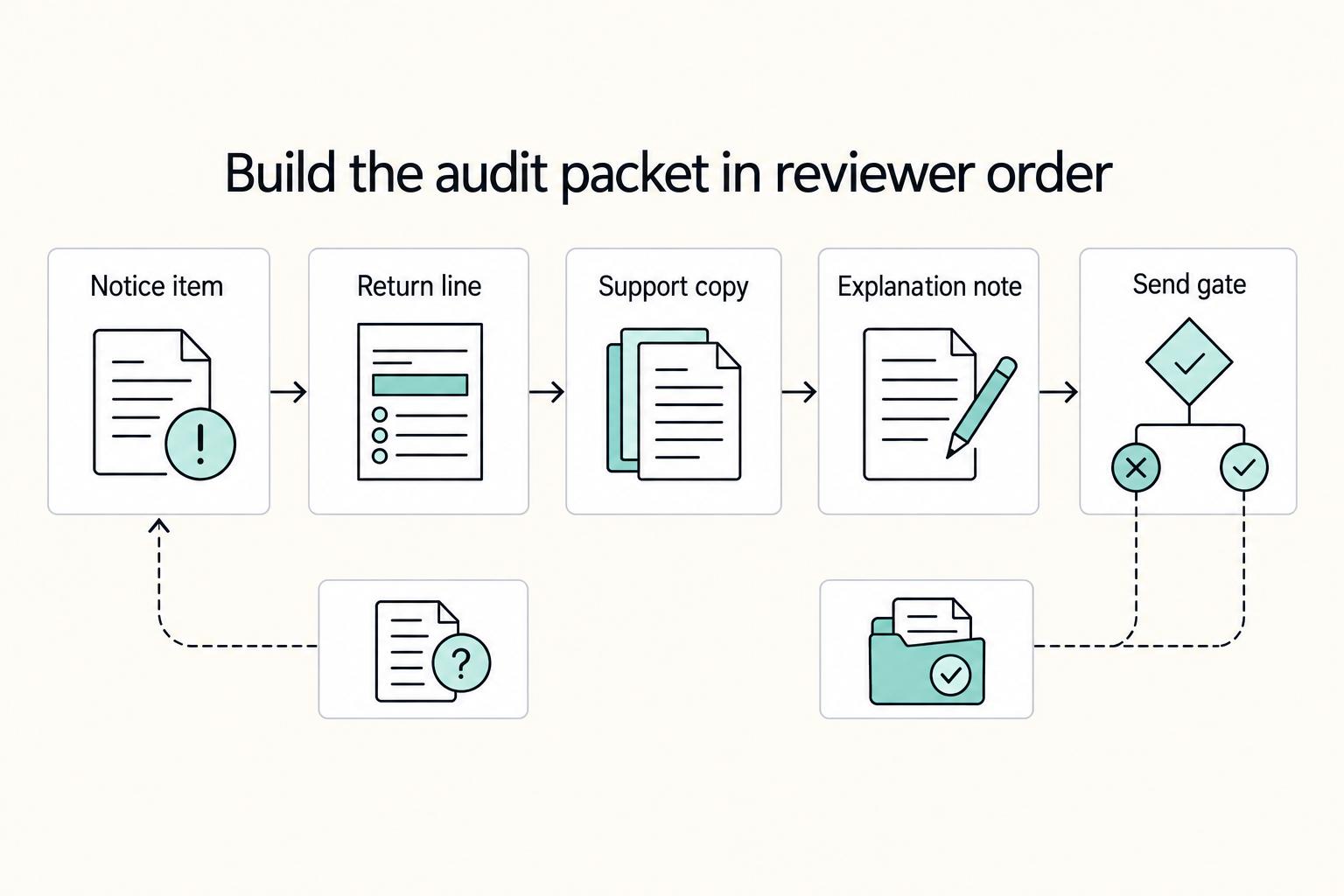
Start with the mailed notice, capture the tax year, reviewed items, response channel, and due date, then answer only what is listed. That is the practical core of how to prepare for irs audit: tie each issue to filing-era proof and label exhibits so a reviewer can verify your return without guesswork. Stop before sending if FEIE treatment, Form 2555 dates, Schedule SE posture, or Form 8938 reporting logic conflicts.
Treat an IRS audit as a records check, not a contest. Your job is to show, item by item, how what you filed ties back to the records behind it.
If you work across borders, your documents may be spread across different systems. The test is still the same: can the IRS verify what you reported from your books, accounts, and financial records? Start with records, not narrative.
Use these terms consistently throughout this article:
- Scope: the specific return items the notice says the IRS is auditing.
- Filing-era records: the documents you originally used to prepare the return. You generally should not need to create new records for the request.
- Claim-to-evidence trail: a clear path from each reported item to supporting records.
- IRS audit: an examination of books, accounts, and financial records to verify return reporting.
Keep two grounding facts in mind. Selection for audit does not automatically mean something is wrong. IRS audit contact starts by mail, not by phone. Audits are handled either by mail or in person, so your first move is to read the notice exactly and respond to what it puts in scope.
This article follows that order: define scope, assemble filing-era evidence, reconcile cross-border claims, follow the mail or in-person response path in your notice, and quality-check the final package.
Run a preflight check#
Run this preflight before drafting anything. If a step fails, fix that failure first.
| Step | Pass | Fail |
|---|---|---|
| Parse the notice literally | You can restate scope in one page using the notice language | You are answering issues not listed, or relying on phone guidance over the mailed notice |
| Collect filing-era records | Each questioned item has at least one filing-era record | You are substituting explanations for missing records or recreating most support now |
| Build the claim-to-evidence trail | Someone else can follow the chain without guessing | Records do not map cleanly, forms conflict, or support is ambiguous |
| Organize for reviewer speed | Another person can open the file and understand why each document is included | Unordered scans, unexplained screenshots, or duplicate-heavy packets |
| Lock deadline and copy control | You know the due date, channel, and exact location of your duplicate submission set | Originals are in the packet, no deadline buffer, or you cannot reproduce what you sent |
- Parse the notice literally.
Capture the items under review, response method, contact path, and any deadline exactly as written. In mail audits, the letter identifies the items under review, often things like income, expenses, or itemized deductions. Pass: you can restate scope in one page using the notice language. Fail: you are answering issues not listed, or relying on phone guidance over the mailed notice.
- Collect filing-era records.
Pull the records used to prepare the return and related financial records. Pass: each questioned item has at least one filing-era record. Fail: you are substituting explanations for missing records or recreating most support now.
- Build the claim-to-evidence trail.
Map each notice item to the return position and specific supporting documents. Pass: someone else can follow the chain without guessing. Fail: records do not map cleanly, forms conflict, or support is ambiguous. Pause before you draft any narrative and escalate as needed. You can write to the IRS for clarification, and you have the right to authorized representation.
- Organize for reviewer speed.
Group by year and issue, label exhibits consistently, and keep a simple index from notice item to pages. Organized records reduce errors and misunderstandings. Pass: another person can open the file and understand why each document is included. Fail: unordered scans, unexplained screenshots, or duplicate-heavy packets.
- Lock deadline and copy control.
Calendar the deadline with a buffer. If timing is tight, request an extension through the notice channels, but do not assume it is automatic. Send copies, not originals, and keep a full copy of everything submitted. Pass: you know the due date, channel, and exact location of your duplicate submission set. Fail: originals are in the packet, no deadline buffer, or you cannot reproduce what you sent.
One more guardrail: do not assume every case runs on a strict three-year timeline. The general assessment window is often three years. IRS rules also include six-year cases, including when unreported income is attributable to foreign financial assets over $5,000. There is no limit in cases like fraudulent or invalid returns. Keep a durable record trail before you respond.
If this preflight passes, the next step is to define scope and stay inside it. Need the full breakdown? Read How to Handle a Tax Audit When Your Income is Paid Through Deel or Remote.
Start with the IRS notice and define scope#
Start by turning the notice into a scope map before you draft any explanation. Scope control keeps a narrow review from turning into a broader response that creates new questions.
The notice is your controlling document because IRS audit contact starts by mail, not by a phone call. Review it carefully, keep it in your records, and work to the due date on that letter. If you need appeal rights later, replying by that due date matters.
Extract the notice literally#
Extract the notice literally, not from memory. Capture the tax year shown on the notice, the CP or LTR number in the right corner, each item the IRS says it is auditing, the response channel, and the deadline.
Use these terms consistently:
- Scope: the specific return items the IRS letter asks you to support.
- Item under review: one specific tax-return item the notice says is being audited.
- Technical issue: a disputed audit adjustment. If the exam proposes a change and you disagree, this is the disagreed item you must state and explain in an appeal.
A mail audit is often limited in scope at the start, so do not answer beyond what is requested. One failure mode is treating the whole return as open when the notice names only a few lines or schedules.
Verification point: someone else can read your one-page notice summary and restate the exact year and items in scope using the notice language.
Map each reviewed item to the return and records#
Next, map each reviewed item to the filed return and the records you already used to prepare it. IRS record requests should not require you to create something new, so point back to filing-era support, not fresh reconstruction.
| Notice item from letter | Return line or schedule | Claim type | Filing-era record status | Action owner |
|---|---|---|---|---|
| Copy verbatim from notice | Exact form, line, or schedule | Income, deduction, credit, exclusion, asset reporting | Complete / partial / missing / conflicting | You / bookkeeper / tax pro |
| If wording is broad, break into sub-items | Tie to the filed return, not your books only | Note factual vs technical | Name what you have and what is absent | Assign one person to close the gap |
| Keep one row per issue | Use the audited tax year only | Flag cross-border claims separately | Mark filing-era vs recreated | Set an internal deadline before the IRS due date |
This table should answer two questions quickly. Does the notice item tie to a filed position? Is the support a clean document match or a technical eligibility issue?
Checkpoint: can you go from notice item to exact return line to supporting invoice, statement, receipt, canceled check, legal paper, or related financial record without guessing? If not, that row is not ready.
Pause when the chain breaks#
Use a hard pause rule before drafting. If any item cannot be mapped cleanly to filed-return evidence, stop and route it to follow-up or professional review.
Classify the gap correctly:
- Record gap: the return position exists, but filing-era support is incomplete or hard to locate.
- Technical issue: records may exist, but the real question is whether the position was allowed under form or eligibility rules.
Do not try to write around either problem. Do not replace source records with reconstructed summaries unless you clearly label them as summaries backed by underlying documents. Every row should end in one status only: ready to support, needs follow-up, or needs review.
Give cross-border items a separate pass#
Cross-border items need a separate verification pass before you answer them. Here, form consistency matters as much as document quality.
| Cross-border item | Check | Article note |
|---|---|---|
| FEIE in scope | Confirm foreign earned income, foreign tax home, and the qualifying status used on the return | If you used the physical presence test, verify 330 full days in a 12-consecutive-month period from travel records |
| FEIE with self-employment income | Review Form 2555 treatment against Schedule SE | FEIE reduces regular income tax but does not reduce self-employment tax |
| Form 8938 in scope | Verify the threshold for the audited year and taxpayer type before explaining anything | IRS guidance includes a baseline $50,000 trigger for certain U.S. taxpayers |
| Specified domestic entities | Instructions include $50,000 on the last day of the tax year or $75,000 at any time | Verify the threshold for the audited year and taxpayer type before explaining anything |
| Form 8938 and FBAR | Confirm you did not treat Form 8938 as a substitute for FBAR | Form 8938 does not replace FinCEN Form 114 |
- If FEIE is in scope: confirm foreign earned income, foreign tax home, and the qualifying status used on the return. If you used the physical presence test, verify 330 full days in a 12-consecutive-month period from travel records. If the return also includes self-employment income, remember FEIE reduces regular income tax but does not reduce self-employment tax. A mismatch between Form 2555 treatment and Schedule SE can signal an issue that needs review.
- If Form 8938 is in scope: verify the threshold for the audited year and taxpayer type before explaining anything. IRS guidance includes a baseline $50,000 trigger for certain U.S. taxpayers, and instructions include $50,000 on the last day of the tax year or $75,000 at any time for specified domestic entities. Use the current IRS threshold table that matches your filing status and residence for that audited year. Also confirm you did not treat Form 8938 as a substitute for FBAR, because it does not replace FinCEN Form 114.
If FEIE qualification, Form 8938 thresholds, or multi-year cross-border facts are unclear, hand off before submission. If the matter moves toward appeal, you may represent yourself or have a tax professional represent you. If your issue centers on an exclusion claim, read What to Do if Your FEIE Claim is Audited by the IRS before you respond. Related: How to Keep Records for IRS Audits.
Build your audit evidence pack from filing-era records#
Build the packet for reviewer flow first, not your storage convenience. If a reviewer cannot move from notice item to return line to supporting document copy in one pass, stop and fix that before drafting any explanation.
Here is what belongs in scope:
- Filing-era records: documents you already used to prepare the filed return, such as receipts, bills, canceled checks, legal papers, statements, and related financial records.
- Claim-to-return-line mapping: a clear tie between each audited item and the relevant form, schedule, or line on the filed return.
- Exhibit index: an ordered list of support documents, grouped clearly (for example by claim, year, and type), with enough context so no file stands alone.
Collect only in-scope records#
Pull only records for the audited year and the notice items. The notice defines scope, and the documents you send should cover the year under audit.
Start with filing-era records. Do not lead with newly created spreadsheets or reconstructed summaries. If you create a summary, use it only to point to underlying records.
Pass checkpoint: every file ties to a notice item and the audited year. Fail checkpoint: you are collecting "maybe relevant" files from other years or files that do not support a filed position.
Classify by claim#
Group records so each claim is easy to review, not by folder location alone. Each claim group should clearly show:
- what was claimed,
- where it appears on the return,
- which records support it.
Remove or fix ambiguous standalone items. If a document needs context to be understood, pair it with that context before it goes into the packet.
Pass checkpoint: each claim group is understandable on its own. Fail checkpoint: you have unlabeled or unclear files that do not connect back to a claimed item.
Summarize each claim group#
Write a short transaction summary for each claim group: date, payer or vendor, amount, and return location. Keep it factual. Use a compact index so gaps are visible before drafting any narrative:
| Claim | Return location | Document label | What it shows | Support status |
|---|---|---|---|---|
| Notice item or short claim name | Form, schedule, or line | Exhibit A, A-1, A-2 | Invoice, payment proof, statement, legal paper | Complete / partial / missing / conflicting |
| One row per claim or sub-claim | Audited year only | Keep labels consistent | Add one plain-language context note | Mark follow-up needed before submission |
Pass checkpoint: another person can locate support from the index without your help. Fail checkpoint: the summary depends on your memory instead of labeled records.
Index and package the file#
Package in review order, aligned to the notice items. Keep one consistent exhibit naming scheme across your response and your retained copy set.
For mail audits, send copies, not originals, to the address listed on the notice. For in-person audits, bring the records using the same indexed set so retrieval is immediate. Keep copies of all IRS correspondence.
Pass checkpoint: packet order matches index order, and your retained copy matches what you send or bring. Fail checkpoint: exhibit names change across drafts or retained copies.
Apply the stop rule#
If the packet turns into an evidence dump, pause. Remove or relabel anything that does not clearly support a claim, covers the wrong year, or requires guesswork. Rebuild in index order before submission.
Do not miss the notice due date while overpacking. In correspondence audits, if the IRS does not receive a response by the due date, it will generally disallow the claimed item. A smaller, traceable packet is stronger than a late, messy one.
Map cross-border claims before you write a response#
Map first, explain second. If forms, date ranges, and status labels do not reconcile, pause and fix that before you draft your narrative.
Use these terms to keep the work concrete:
- Claims matrix: a working table for the audited year, organized by year, income, expense, or asset type, with a transaction summary.
- Form-to-form consistency: the same fact pattern leads to a consistent filing posture across the forms that apply, including Form 2555, Form 8938, FBAR, payer-status forms, 1099 reporting, and Schedule SE.
- Open issue: a specific disputed item you can name and resolve with support before submission.
Build one cross-border matrix#
Create one matrix for the audited year before writing your response letter. Include the notice item, return location, form, date range, key amount or status label, support documents, and open-issue status.
Add a verification column for criteria that may depend on the audited year or filing posture. For Form 2555 and Form 8938, keep the exact qualification criteria or reporting threshold unresolved until it has been checked against current official IRS/source records or qualified tax adviser records. Do that before using the number or rule in your response.
Verification point: every concrete claim you plan to make already exists as a matrix row. Failure mode: your draft introduces facts that were never mapped to records.
Link each claim to the return and evidence#
Each row should form a full chain: notice item to return line to form to document copy.
For FEIE, tie Form 2555 to the filed Form 1040 or 1040X. Then map the qualification fields to supporting records, including qualifying-period start and end dates and travel dates.
Run a timeline mapping check:
- Physical presence path: confirm support for 330 full days during any period of 12 consecutive months.
- Bona fide residence path: map start and end dates carefully when the qualifying period crosses tax years.
Run a form-to-form consistency pass#
Compare related filings side by side in the same matrix.
| Item to check | What should match | Red flag |
|---|---|---|
| Form 2555 | Qualification dates, return location, supporting records | Dates in the form do not match your dated records |
| FBAR and Form 8938 | Same account fact pattern where both may apply. FBAR is filed separately as FinCEN Form 114, and Form 8938 is attached to the annual return | You treated one filing as automatically covering the other |
| W-8BEN or W-9 with 1099 | Payer-status form aligns with how the payer reported you | Status form and payer reporting posture conflict |
| Schedule SE | Self-employment tax posture aligns with reported net earnings | Net self-employment earnings suggest Schedule SE may apply, but treatment is missing or inconsistent |
Be strict on FBAR and Form 8938 alignment. Filing Form 8938 does not remove FBAR obligations, and FBAR has its own trigger at $10,000 at any time during the calendar year. Keep Form 8938 thresholds in verification status until confirmed for your exact filing posture.
Apply the send or pause gate#
Send only when the full chain reconciles across forms, date ranges, and records. If any mismatch remains, mark it as an open issue and pause until resolved, or narrow your response to only what you can fully support.
Your readiness test is simple: can another person trace a claim from notice item to return line to form to evidence without asking follow-up questions? If not, do not try to explain the gap away in prose.
If your FEIE timeline is the fragile part of your file, run a quick check with the FEIE calculator before you lock your response.
Choose audit by mail or in-person strategy#
Choose the channel by proof burden, not comfort. Use mail when every notice item is a document-matching case, and consider in-person handling with representation when the result depends on technical interpretation, cross-border qualification, or disputed treatment.
Classify the case before you respond#
A document-matching case means each notice item is supported by existing filing-era records, with no new reconstruction. A technical interpretation case means the outcome depends on qualification tests or legal judgment, not just document presence. FEIE can become a technical case because bona fide residence is facts-and-circumstances based, and the physical presence test requires 330 full days during a 12 consecutive months period.
| Channel | Best-fit case type | Preparation standard | Communication risk | What goes wrong if the file is weak |
|---|---|---|---|---|
| Clean document matching for specific notice items | Each item maps to copies of records that supported the filed return, organized by year and type with transaction summaries | Your package must stand on its own in writing | You start explaining gaps, recreate records after the fact, or send disorganized support that triggers follow-up requests | |
| In-person | Technical interpretation, cross-border qualification, disputed treatment, or records too voluminous to mail | Same documentation standard as mail, plus fast retrieval and disciplined verbal answers tied to the file | Speculation, over-answering, or drifting beyond the record can expand the scope | A weak file turns the meeting into open-ended fact-finding, especially when dates, forms, and status labels conflict |
Verification point: if someone else can trace each notice item to a specific existing record copy, this is usually a mail case. If you must argue why a rule applies, treat it as technical.
Run a short self-check before you commit#
Before you choose a channel, answer these questions:
- Can each notice item be proven from records already in your evidence pack?
- Are you answering a records question or a qualification question?
- Would any answer require rebuilding travel days, account values, or filing logic after filing?
- Does FEIE qualification depend on tax home plus either proving 330 full days in a 12 consecutive months period or meeting a bona fide residence test?
- Is Form 8938 in scope, with threshold analysis that depends on filing status, residency context, and whether an income tax return was required?
Treat Form 8938 as a complexity screen. Do not rely on memory for thresholds. Keep the exact reporting threshold unresolved until it has been checked against current official IRS/source records or qualified tax adviser records for the audited year and filing posture. Thresholds depend on filing status and residency context, and Form 8938 is not required when no income tax return is required for that year.
If FEIE eligibility or travel-day support is still uncertain, pause before committing to a mail response. Review What to Do if Your FEIE Claim is Audited by the IRS. One risk is choosing mail because the notice looks narrow when the real issue is whether your filing position qualifies.
Hold both channels to the same documentation standard#
Documentation standards do not loosen in correspondence audits. The IRS is still asking for records that support return positions, and no single document stands on its own without context. Answer from records already in your evidence pack. If support is missing, pause instead of filling gaps with narrative.
For mail, send copies only, never originals. Use the address listed on the notice, keep a full copy set, and use delivery proof. If faxing, include your name and Social Security number on each page. For in-person handling, bring the same organized file and keep answers factual and document-tied. You can use a representative, and if you request to consult one during an interview, the interview is generally stopped and rescheduled in most cases.
Start a communication log now. Minimum fields: date, method, notice number, tax year, IRS contact or address, what was sent or requested, delivery or fax confirmation, and next action due.
You might also find this useful: How to Respond to an IRS Mail Audit Notice.
Draft your response package and quality-check it#
Build your packet so an IRS reviewer can verify each notice item without guessing. Use the notice as your scope and instructions document, then match every claim to filing-era records in a fixed order.
Draft a short response letter#
Keep the letter brief and directional. State the notice or letter number, tax year, the specific items you are answering, and what support is attached.
If you disagree with a proposed change, name the disputed item and your reason in one or two sentences, then point to the exhibit. Keep the proof in the exhibits, not the letter. If a sentence does not tie to a notice item, return line, or record copy, remove it. Every sentence in the letter should point to an exhibit, return line, or notice item.
Assemble the packet in one fixed order#
Use one sequence every time: response letter, scope map, claim-to-evidence index, then exhibits in matching label order. This format is your internal control, not an IRS-required template. Before sending, fill this packet blueprint:
| Notice item | Return line or form | Supporting document copy | Exhibit label | Status |
|---|---|---|---|---|
| Item 1 from notice | Exact line on filed return | Record that supported filing | Ex. A | Complete / missing / needs relabel |
| Item 2 from notice | Exact line on filed return | Record that supported filing | Ex. B | Complete / missing / needs summary |
| Item 3 from notice | Exact line on filed return or attached form | Record that supported filing | Ex. C | Complete / conflict to resolve |
Organize exhibits by tax year and income or expense type, and add a transaction summary where it helps the reviewer follow the numbers.
Apply a two-way go or no-go check#
Do not send until both checks pass: every claim points to evidence, and every exhibit has a clear purpose tied to a return line, form entry, or notice item.
Then run a neutral-reader test with someone who did not assemble the file. If they hesitate or need your verbal explanation to connect claims and documents, treat it as no-go. Fix the packet by relabeling exhibits, reordering them to match the notice, or removing unsupported narrative.
Send only what the notice requests and keep proof#
Follow the notice for method and due date, since response timing affects appeal-right protection. If you submit by mail, send copies only, never originals, and consider certified mail for delivery proof. If the notice allows the IRS Document Upload Tool, keep the uploaded set identical to the copy set you retain.
Keep the response narrow. Include what is needed to match the notice and support your filed position, but avoid extra records that expand scope. If FEIE or cross-border items still conflict, especially around Form 2555 attachment requirements or Form 8938 thresholds tied to filing profile, pause. Review What to Do if Your FEIE Claim is Audited by the IRS.
Related reading: How to Set Up an IRS Payment Plan for Back Taxes.
Decide when to handle it yourself and when to hire a pro#
Choose DIY when the issue is narrow, factual, and fully documented. If the risk comes from legal interpretation, cross-border eligibility, or missing support, consider escalating before you submit.
Once your packet is assembled, make one decision: are you matching records to a clear notice item, or defending a technical tax position? That split usually points to the right path.
Apply the document gate first#
Do not base this on confidence or stress. Base it on traceability: each major position should run cleanly from notice item to return line or form entry to exhibit, without extra narrative.
Verification: if a neutral reader can follow that chain without your verbal help, self-handling may be workable. If the chain breaks because support is missing, labels are unclear, or forms conflict, you are still in repair mode, not decision mode.
This matters even more for cross-border filings. FEIE is not just a travel log. It applies only if you are a qualifying individual with foreign earned income, a foreign tax home, and a filed U.S. return that reports that income. A common failure mode is treating excluded income as if it did not need to be reported. Another is missing that any foreign housing exclusion is computed first and reduces the FEIE base.
Use a compact DIY vs hire matrix#
| Check | DIY if this is true | Hire a pro if this is true |
|---|---|---|
| Scope clarity | One tax year, one notice, one factual issue | Multiple issues, widened scope, or unclear notice language |
| Record completeness | Filing-era records are complete and already tied to the return | You need reconstruction, substitute support, or narrative to fill gaps |
| International consistency | FEIE-related entries and supporting records are internally consistent | Eligibility support, travel-log consistency, foreign tax home support, or income-year treatment is inconsistent |
| Unresolved issue type | Remaining gaps are clerical, such as labeling, ordering, or attachment mismatch | Remaining gaps are technical, eligibility-based, or interpretive |
For FEIE claims, use a stricter gate. If your position depends on physical-presence day counts (330 full days in 12 consecutive months), foreign tax home support, or earned-year versus received-year treatment, treat it as technical unless fully supported.
If support is still shaky, pause before responding. Review What to Do if Your FEIE Claim is Audited by the IRS and Common and Costly Mistakes to Avoid When Claiming the FEIE.
Hand off when it becomes interpretation#
Use a practical handoff rule: if your response depends on what the law means, not just what records show, consider professional representation. A longer letter does not solve an interpretation dispute.
Ask any advisor for three items in writing:
- The exact notice scope they believe is under review
- Their submission strategy, including what to include and what to hold back
- Their appeal decision points if the IRS does not accept the response
If they cannot define scope, cannot explain filing strategy, or request documents before identifying disputed positions, treat that as a red flag. Final tie-breaker: clerical gaps are often DIY-fixable. Technical uncertainty often calls for escalation.
For a step-by-step walkthrough, see How to Handle an IRS CP2000 Notice (Underreported Income).
Common failure modes and recovery steps#
If your audit file is getting messy, stop improvising and recover in this order: regain document control, rebuild the claim-to-line map, reconcile form logic, then send one controlled follow-up through the notice channel.
| Failure mode | Why it causes risk | Recovery step |
|---|---|---|
| You sent originals | IRS guidance is to send copies, not originals. Losing originals can make reconstruction harder. | Pause new outreach, inventory exactly what was sent, and rebuild a full duplicate set from what you still have. From this point forward, keep copies of everything you send. |
| You sent an evidence dump | Mail audits request specific items tied to return entries. Unmapped records can create delay and misunderstanding. | Rebuild from filing-era records only, then map each exhibit to the exact notice item and return line. |
| Forms conflict with each other | Cross-form mismatches can weaken an otherwise solid response. | Before sending substantive explanations, make sure any in-scope W-9, 1099, Schedule SE, Form 2555, and Form 8938 entries are internally consistent. |
| You missed or may miss the deadline | Notice deadlines control process and can affect appeal rights. | Use a two-track rule: contact the notice channel first to protect process, then finish cleanup. If you need more time, request it before the due date. |
| You panic-resubmitted | Unfocused corrective packets can create new contradictions, and filing a second return while correspondence is pending can make recovery harder. | Send one narrow follow-up that clearly states what is new and whether it supplements or replaces your prior submission. |
Lock down chain of custody and the communication log#
Treat chain-of-custody and communication logging as standard for every contact and submission. Use at least these fields:
| Log field | What to include |
|---|---|
| Notice details | notice or letter number, tax year, date and time, channel, and IRS contact point |
| Taxpayer details | taxpayer name exactly as shown on the notice, plus SSN, ITIN, or EIN |
| Submission details | what you sent or requested, and whether it supplements or replaces a prior package |
| Proof fields | tracking number, certified mail receipt or upload confirmation, access code if used, and next deadline |
Check form logic before you reply#
Apply a pre-reply form-logic check. If a 1099 reflects self-employment income and net earnings are $400 or more, Schedule SE should align. If Form 2555 claims FEIE, remember FEIE does not remove self-employment tax on net profit, and physical presence support must match the 330-full-day test when that is your basis. If Form 8938 is involved, confirm the correct threshold for your filing status and location, and remember Form 8938 does not replace FBAR.
Send one controlled follow-up#
Send one controlled follow-up, not a broad rewrite. For mail packets, keep complete copies and use proof of delivery. In reconsideration-style recovery, the IRS may focus on information not previously considered.
If the breakdown includes FEIE eligibility support or travel-log inconsistency, stop the DIY loop and review Common and Costly Mistakes to Avoid When Claiming the FEIE before responding again.
This pairs well with our guide on How to Document 'Reasonable Cause' for IRS Penalty Abatement.
Final prep checklist you can copy and use#
Use this as your final send or no-send gate. Read the packet once in the order you want it reviewed.
- Step 1: Confirm scope from the notice
Pass if every sentence, exhibit, and attachment maps to a notice item, and the tax year, response method, and deadline match the notice exactly.
- Step 2: Build the evidence pack from filing-era records
Pass if you are sending records that support what you filed, and each document ties to the income, credit, or deduction under review.
- Step 3: Add context to every artifact
Pass if no record stands alone: receipts are in date order with business-purpose notes, and canceled checks are grouped with the bills they paid and any reimbursement support.
- Step 4: Organize for fast review
Pass if records are grouped by tax year and by income or expense type, and include a short transaction summary.
- Step 5: Verify cross-border consistency before sending
Pass if your return reports the income, your support matches the filed position, and any FEIE claim is supported by foreign earned income, a foreign tax home, and current-year eligibility and threshold checks.
- Step 6: Use the right submission channel and protect your records
Pass if you follow the notice instructions exactly, send copies and not originals for a mail audit, bring records for an in-person audit, and log the date, method, address or recipient, and confirmation details.
- Step 7: Stop if escalation conditions appear
Pass if no checklist item above is unresolved. If any item is incomplete or inconsistent, stop and resolve it before responding.
If any box fails, do not submit yet. If all boxes pass, send through the notice-required channel and keep a complete duplicate copy of everything.
Frequently Asked Questions
What records does the IRS usually request for an audit?
Pull only the records that support the exact notice items and the return lines you filed. In a correspondence audit, the IRS asks for additional information on specific items, and the request should not require you to create new records. Use a simple check: every document should map to one notice item and one filed return line.
Should you send original documents or copies?
Send copies and keep your originals. IRS guidance says not to mail original records, and your retained set should mirror the labeled exhibits you submit.
How should you organize receipts, bills, and canceled checks?
Organize records by tax year, then by income or expense type, and include a short transaction summary. Electronic records are acceptable if they meet normal recordkeeping requirements, so complete and readable digital files are usable. If your records are too extensive for a clean mail response, request a face-to-face audit.
What if your records do not fully match your tax return?
First classify the issue as either a clerical mismatch or a technical interpretation issue. A clerical mismatch is a data conflict, such as third-party income information not matching what you reported. A technical interpretation issue turns on tax law and how it applies to your facts. If FEIE qualification, Form 2555 dates, or excluded-income versus foreign-tax-credit treatment is in play, stop and review What to Do if Your FEIE Claim is Audited by the IRS before responding.
What if you need more time to respond?
Request more time before your due date using the method listed on your letter. For audits by mail, IRS guidance says to fax a written extension request to the number on the letter, or mail it if fax is not possible. The IRS can ordinarily grant a one-time automatic 30-day extension. Include key notice details so IRS can match your request.
What happens if you disagree with the audit findings?
Keep your disagreement itemized and follow the channel in your notice or appeal-rights letter. You can request a manager conference, mediation or other ADR, or an appeal, and appeal requests should go to the IRS address shown in the appeal-rights letter, not directly to Appeals. If you have new information not previously provided, audit reconsideration may apply, and you can use an authorized representative.
Try a related tool
Researched and edited by the Gruv editorial team. Gruv builds cross-border billing, payouts, and finance-operations software for global businesses.
Sources
Educational content only. Not legal, tax, or financial advice.
Related Posts

What to Do if Your FEIE Claim is Audited by the IRS
Treat the notice as a proof and calculation review, not a character judgment. Your job is to slow the process down, read the scope carefully, and respond with records that match what you already filed on Form 2555. You are not trying to guess what the IRS is thinking. You are trying to prove eligibility, support the numbers, and avoid creating new problems in the process.

Common FEIE Mistakes That Break Form 2555 Claims
Treat FEIE as a compliance decision, not a shortcut. It can reduce U.S. federal income tax only when you qualify and file correctly, and the bigger mistakes usually start when someone jumps straight to the tax savings before confirming the facts that make the claim possible.
What Happens If You Don't Pay Quarterly Taxes?
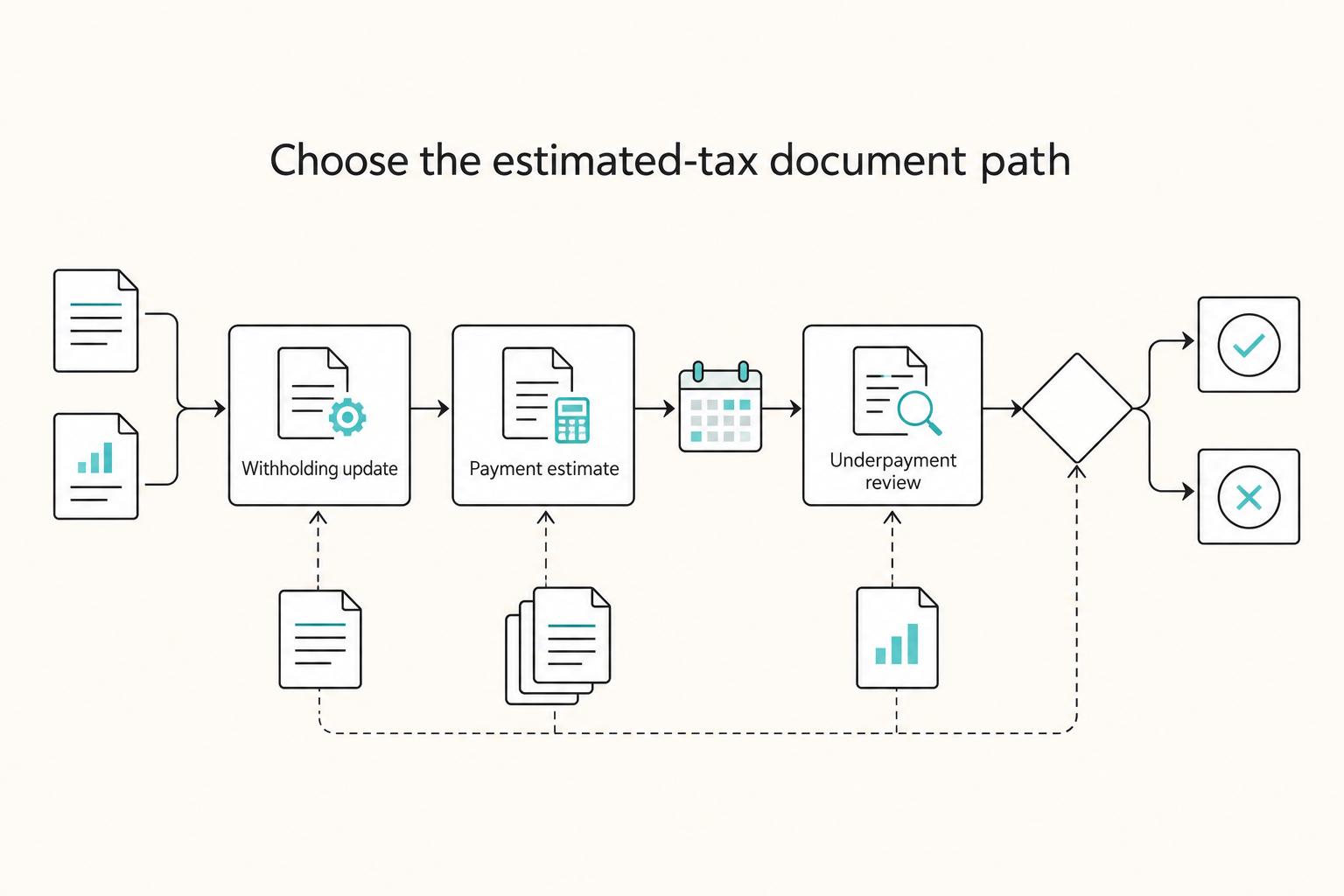
Missing a quarterly payment can trigger the IRS **Underpayment of Estimated Tax by Individuals Penalty**, and interest can keep increasing what you owe until paid in full. In the IRS pay-as-you-go model, timing matters as much as totals. If you are searching for **what happens if you do not pay quarterly taxes**, treat this as a timing problem first, then a planning problem.