
Quick Answer
Prepare a confidential information memorandum by building a detailed sell-side document that gives qualified buyers your operations, financials, management story, growth case, and key risks, while limiting every claim to what you can later prove in the virtual data room. Share it after an NDA, use it to frame buyer judgment early, and remove anything you cannot verify.
How to Prepare a Confidential Information Memorandum (CIM): A Founder's Framework for Maximizing Valuation and Mitigating Exit Risk#
You are not preparing a brochure. You are preparing the document set that helps you run a controlled sale process, shape first impressions, and reduce avoidable surprises once buyers start testing your story. In practice, the sequence is usually teaser, NDA, full CIM, then deeper review in the virtual data room for shortlisted bidders after IOI/LOI triage.
A few definitions matter up front because each artifact has a different job. A teaser is the short, usually anonymized document used to spark interest before the full memo. The NDA is the confidentiality gate you typically require before sharing the full memo. The CIM is the core sell-side document that presents the company's operations, financials, and value to potential buyers. Due diligence is the buyer's verification process, and the virtual data room is the secure digital platform where confidential transaction documents are shared for deeper review. The boundary is straightforward: the memo should support preliminary diligence, but it does not replace full diligence.
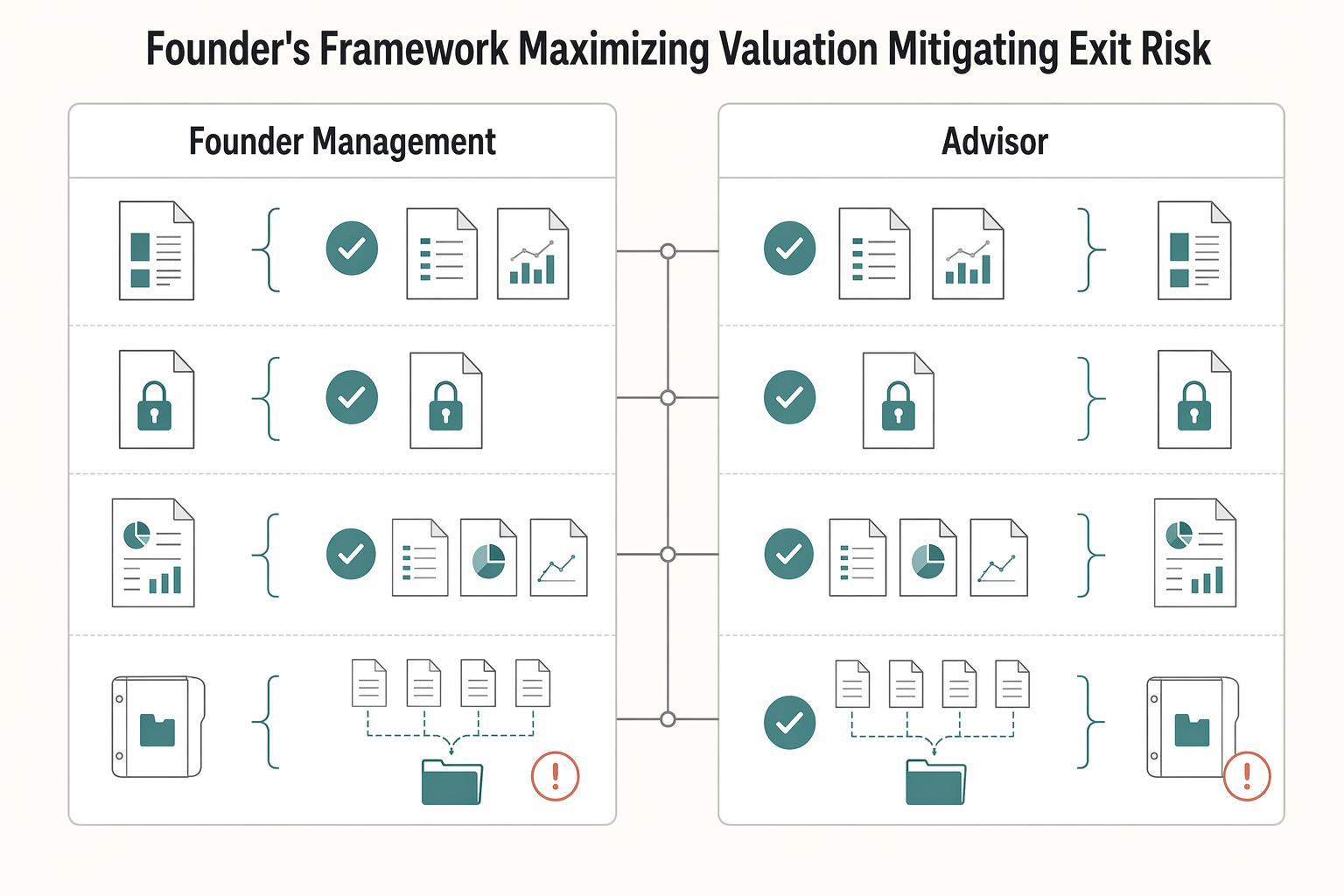
Ownership also needs to be clear from day one. The advisor usually prepares and distributes the memo, but you and your management team remain accountable for the facts, the narrative choices, and the evidence behind them. Use this checkpoint early: if a claim in the memo cannot be matched to a source document you can upload to the VDR, rewrite it or cut it. A common failure mode is letting a polished story get ahead of what your records can actually support.
| Role | Primary responsibility |
|---|---|
| Founder and management | Set the narrative, confirm facts, supply backup documents, decide what risks need context |
| Advisor | Draft, package, position, and distribute the memo through the sell-side process |
The next three pillars do three jobs:
- Pillar 1: a valuation narrative that helps you decide what belongs in the story and what weakens it.
- Pillar 2: a buyer-minded review that helps you decide which objections to answer before diligence starts.
- Pillar 3: a defensible document set that helps you decide what you can safely say, prove, and share.
What is a CIM? (And Why It's Your Primary Tool for Control)#
A confidential information memorandum (CIM) is the core sell-side document you use to give qualified buyers detailed information about the business. Your control does not come from legal force, because a CIM is not a binding contract. It comes from sequencing who sees what, when they see it, and keeping every memo claim aligned with what you can later verify in diligence.
| Document | Main job | When it is usually shared | What it should not do |
|---|---|---|---|
| Teaser | Test interest with an anonymized snapshot | First contact, often before any NDA | Reveal the company's identity or deep operating detail |
| CIM | Present operations, financials, management, and growth case so a buyer can evaluate and move toward an LOI | After NDA execution | Replace diligence or make claims you cannot support |
| Virtual data room | Hold the underlying files buyers use for verification and risk review | Often after initial bid filtering with shortlisted bidders | Serve as the buyer's first introduction to the business |
Use this shorthand: teaser opens the door, NDA controls entry, CIM shapes the first serious judgment, and the data room proves the claims. Also, do not confuse a CIM with a pitchbook. A pitchbook is a banker's marketing document to win advisory work, not the buyer-facing sale document for your company.
Use the memo to set scope before price discussions harden#
The CIM is where you define what buyers should understand early and what should wait for later-stage diligence. Buyers commonly use it to form an initial view and prepare an LOI. If a risk needs context, address it in the memo on your terms instead of letting it surface first as a data-room surprise.
Checkpoint: if a statement in the memo cannot be tied to a file you can produce later, rewrite or remove it now.
Gate sharing with the NDA and a short checklist#
Before you share the full CIM, confirm:
| Check | What to confirm |
|---|---|
| NDA and buyer qualification | The NDA is signed and the buyer is sufficiently qualified for deeper disclosure |
| CIM version control | The CIM version matches your current financials and other sale materials |
| Sensitive file timing | Highly sensitive detailed files are held for the intended later stage, not released too early |
Escalate to counsel if NDA terms become heavily negotiated, if a statement could be read as a factual representation beyond your intent, or if document requests exceed the stage you planned.
Split responsibilities clearly#
Your advisor usually drafts, packages, and distributes the CIM. You and management own the facts, narrative choices, and supporting documents behind each claim. Delegate process execution, but personally review the statements that define the business and its risk profile.
Related: A Guide to Selling Your Freelance Business or Agency.
Pillar 1: Architect a Narrative That Maximizes Valuation#
Your narrative should help a buyer make one decision fast: this business has credible future cash flow I can underwrite. Write each section to support that decision with evidence, limits, and a clear next-step implication for the buyer.
Build each financial section around future cash flow evidence#
In first-round screening, buyers test your assumptions against their investment criteria. For every financial claim, show what the history supports, what it does not, and what future cash-flow case a buyer could reasonably back.
| Topic | Source evidence you show | Conclusion you want the buyer to reach | Verification file |
|---|---|---|---|
| Revenue quality | Verified metric, contract term, renewal pattern, and retention definition | Revenue is repeatable enough to support forward expectations | Signed customer contracts, cohort report, billing data |
| Margin durability | Verified metric across multiple periods and the operational reason it held | Margins are stable over time, not a one-period spike | Historical margin schedules, pricing history, cost reports |
| Growth driver | Verified metric and validated expansion assumption | Growth has a practical execution path, not just a forecast | Pipeline report, customer expansion history, territory test results |
Keep your definitions precise and testable during diligence:
- Recurring revenue quality: state exactly how ARR is calculated and how you treat expansion, contraction, attrition, and new customers.
- Margin durability: show stability across periods, not a single strong year.
- Concentration risk: identify major-customer reliance directly; a 10 percent major-customer threshold is a useful reference point, not a private-sale safe harbor.
- Fit potential: tie claims to explicit assumptions and a timeline to realization, and state the execution burden required.
Do not present ARR as automatically equivalent to future revenue. Make limitations explicit so your framing survives contract and cohort testing.
Define valuation risks before the buyer does#
Address the risks that move price early and directly. If customer concentration, margin pressure, or fit timing is material, name it, quantify it with your own verified data, and show the mitigation plan. If a claim cannot be tied to a supporting file, rewrite it or narrow it.
Present team and market proof in execution terms#
For each leader, show three things: the growth lever they own, the dependency risk if they leave, and the continuity plan after closing. A buyer should be able to see whether execution capability is distributed or concentrated in one person.
Use the same structure in market analysis: define your ICP, identify your current segment wedge, then show the next expansion path only if evidence supports it. Keep market context that changes underwriting decisions, such as customer fit, win rates, pipeline momentum, and expansion evidence, and cut context that does not. If two segments look attractive, include both only when you can support a credible plan to execute both without adding avoidable complexity.
We covered this in detail in How to Negotiate an LOI in M&A Without Losing Leverage.
Pillar 2: Think Like a Buyer and Preempt the Interrogation#
Pressure-test your story the way a buyer will before diligence starts. Your objective is to remove avoidable surprises that can change deal structure, price, terms, or momentum.
Run a buyer-risk scan before you draft#
Start with a premortem: assume the deal failed, then list plausible causes. This gives you a buyer-grade risk list instead of a generic brainstorm.
| Step | What to do | Key details |
|---|---|---|
| Identify the vulnerability | Name it in buyer terms | Customer concentration, founder dependency, margin volatility, tech debt, contract transfer risk, regulatory exposure, or reputational risk |
| Collect proof | Link each risk to documents a buyer can verify in the virtual data room | Flag items that need interviews or investigative follow-up |
| Assign a mitigation owner | Set one accountable person, plus a date and deliverable | Accountable person, date, and deliverable |
| Choose disclosure timing | Mark whether to disclose in the CIM, management Q&A, or later confirmatory diligence | CIM, management Q&A, or later confirmatory diligence |
Work through each row for every material risk before you decide where it belongs in the memo.
Where thresholds vary by deal, verify the current concentration threshold from source records before finalizing. If you reference ASC 280's 10 percent major-customer trigger, treat it as context, not a private-sale rule.
For each risk, label the support type: documentary, interview-based, or investigative. That prevents overconfident claims when standard document review will not fully surface legal, regulatory, operational, or reputational exposure.
Reframe weaknesses only when you can prove the upside#
Reframing works only when it ties to buyer outcomes and is backed by evidence. If you cannot show proof, do not present it as upside.
| Identified weakness | Valuation-aware framing | Evidence required in data room |
|---|---|---|
| Customer concentration | A concentrated base can still support value if account durability and contract economics are clear | Customer list, contract terms, renewal history, cohort account growth, and the concentration threshold confirmed from source records |
| Founder dependency | Transition risk can be reduced when authority and know-how transfer are already documented | Org chart, role matrix, SOPs, delegated approvals, transition plan, employment or consulting arrangements if applicable |
| No formal sales team | Growth may indicate latent demand if lead flow and conversion are measurable | Pipeline reports, referral sources, win rates, sales cycle data, customer acquisition history |
If upside depends on heavy buyer reinvestment, major product changes, or team replacement, state that plainly. Buyers discount value when execution burden is high.
Prove your moat in an evidence hierarchy#
Moat claims are credible only when the evidence leads. Prioritize proof in this order:
| Evidence layer | What to use | What to verify |
|---|---|---|
| Legal protections | Patents, trademarks, brands, and regulatory licenses | For patents, include number, filing/grant status, term, and maintenance status |
| Contractual protections | Exclusivity, supply rights, and customer contract terms | Review assignment and change-of-control clauses directly |
| Operational barriers | Documented process, data, and execution barriers | Process maps, deployment timelines, quality metrics, and data provenance |
| Switching-cost signals | Implementation effort, retraining burden, workflow dependency, renewal behavior, and expansion patterns in existing accounts | Implementation effort, retraining burden, workflow dependency, renewal behavior, and expansion patterns in existing accounts |
1. Legal protections. Use patents, trademarks, brands, and regulatory licenses when they support barriers or pricing power. For patents, include number, filing/grant status, term, and maintenance status. In the U.S., utility and plant patents generally run 20 years from filing, with maintenance fees due at 3 1/2, 7 1/2, and 11 1/2 years after grant. Be precise: patents provide exclusion rights, not an automatic right to practice.
2. Contractual protections. Use exclusivity, supply rights, and customer contract terms where relevant. Review assignment and change-of-control clauses directly, since third-party consent requirements are common in M&A.
3. Operational barriers. Show documented process, data, and execution barriers with concrete records: process maps, deployment timelines, quality metrics, and data provenance.
4. Switching-cost signals. Support switching-cost claims with implementation effort, retraining burden, workflow dependency, renewal behavior, and expansion patterns in existing accounts.
For every moat claim, point to a file, clause, or measurable operating fact. That is what keeps your CIM defensible under diligence.
You might also find this useful: The Role of an 'Investment Banker' in a Mid-Market M&A Deal.
Pillar 3: Make Every Claim Provable and Limit Legal Exposure#
Your goal in this pillar is defensibility, not polish: if a statement cannot be proven, carefully qualified, or tied to a file in your data room, remove it. This is where a sale narrative can become a legal record, so loose wording can lead to repricing, tougher deal terms, or post-close disputes.
Before you circulate drafts, align counsel, finance, and your VDR admin on one draft, one index, and one definition set:
- Four corners: the document is interpreted from the written text itself.
- Material disclosure: information with a substantial likelihood of being important to a reasonable investor.
- Forward-looking statement: a projection about future revenue, income, earnings, or operating results.
- Virtual data room (VDR): a secure repository for privileged transaction documents.
Write only claims you can prove from the record#
Assume buyers, diligence teams, and possibly regulators will reread your CIM skeptically. A practical control point: FTC HSR guidance says that if a CIM was drafted within the last year for the transaction, it can be a required Item 4(d)(i) submission.
Use a simple rule: if a point is material enough to include, it must be supportable from your written record. Do not rely on memory or verbal caveats. Financial due diligence is specifically used to test whether CIM financials are accurate.
Build a claim-to-evidence workflow before sharing#
Create a working sheet for each factual or numeric statement in the CIM. This is an operating control, not a statutory format requirement. Track:
- CIM statement
- Supporting VDR file
- Owner
- Verification status
- Drafting note, confirming any cited threshold from source records
This is where preventable mistakes surface early. If you claim retention, make sure the exact retention definition and coverage match the source file. If you call contracts "sticky," verify assignment and change-of-control language first.
| Risk area | Typical buyer challenge | Required proof | Mitigation action |
|---|---|---|---|
| Financial metrics | "How do these numbers reconcile?" | Financial statements, metric definitions, model support | Tie each metric to source files and record verification status |
| Customer concentration and contracts | "Will key accounts survive a change of control?" | Customer list, contract terms, renewal history, consent analysis where needed | Avoid durability claims until clauses are checked |
| IP and proprietary assets | "Do you own and control this IP?" | Registration records, status records, assignment chain | Use exact asset identifiers and confirm ownership evidence |
| Projections and growth claims | "Are these forecasts being presented as promises?" | Assumptions, scenario notes, management basis | Identify as forward-looking and include meaningful cautionary language |
Keep memo language, deal language, and access controls separate#
Have counsel review any statement that could be material, including projections, contract-right summaries, regulatory exposure, and known issues that affect value. The CIM can describe the business and include forward-looking identification plus cautionary language. The purchase agreement is where representations, warranties, indemnity, and reliance allocation are finalized. Do not treat CIM disclaimer text as a substitute for transaction-document protection.
Also avoid presenting future performance, synergies, renewals, approvals, or closing timing as guaranteed outcomes.
Set VDR controls as an execution checklist:
- Access tiers: use group-based permissions and stage access by buyer progress.
- Redaction rules: redact PII in shareable files before release.
- Buyer-stage permissions: share anonymized or summarized content early; release sensitive named data later under tighter controls.
- Audit-log practice: preserve page-level activity logs where available and archive what was shared at each diligence stage.
If a dispute arises, your record of what was shared, with whom, and when is part of your defense posture.
For a step-by-step walkthrough, see How to Create a Due Diligence Data Room That Holds Up Under Review.
Conclusion: From Document to Deal Control#
Once the draft is in shape, stop treating it like a finished file and start treating it like a launch gate. Your memo should do two jobs at once: position the business well and give buyers enough support to begin preliminary diligence. If it cannot do both, do not send it yet.
Step 1. Test the narrative. Read the document like a buyer seeing the company for the first time. The story should be specific, internally consistent, and tied to real operating proof, not just polished language. Verification point: key charts and claims should be traceable to files in the data room or a seller diligence package. Failure mode: the story sounds strong, but a buyer cannot tie headline claims back to evidence.
Step 2. Check buyer-objection readiness. Before outreach, list the points buyers are likely to press on in your deal. Then confirm the memo addresses them fairly and that the backup is ready for Q&A after NDA-gated distribution. A practical market test is whether you are ready to send the document under NDA and support first-round IOIs without scrambling for missing files.
Step 3. Confirm legal defensibility. Have finance, counsel, and your advisor review the final text, forecasts, and disclaimer language. Some real-world memoranda state that information has not been independently verified, but disclaimer text is not a cure for material misstatements or omissions. If securities law issues are in play, ask counsel to review accuracy and omission risk under Rule 10b-5. Do not assume 15 U.S. Code § 78u-5 applies.
You are ready to launch when the narrative is coherent, objections are answerable, and support is available in the data room. You are not ready if any material claim lacks evidence, any known risk is buried, or disclaimer review is still open. Final handoff: complete your evidence map, confirm disclaimer and counsel review, resolve gaps, then move to buyer outreach and NDA-controlled distribution.
Frequently Asked Questions
What is the difference between a teaser, a pitch deck, and a confidential information memorandum cim?
A teaser is the first-look document used to generate interest with limited disclosure. A pitch deck is a concise overview that is more common in capital-raising or early discussion. A CIM is the detailed sell-side document shared with qualified buyers, often after an NDA, to drive evaluation and an IOI decision.
What red flags should you check before you send the memo?
Check consistency, evidence, projection assumptions, and risk disclosure before release. Numbers, narrative, and charts should match each other and the data room. Every material statement should have a source file and verification status, and known issues should be described fairly.
How should you present projections so a buyer takes them seriously?
Use a defensible base case and a clearly labeled upside case. The base case should follow historical performance and current operating realities. The upside case needs explicit assumptions, and those assumptions should line up with what the buyer will later see in the data room.
What legal exposure comes with a CIM?
Treat the memo as a commercial marketing document, not as a substitute for the purchase agreement. Buyers may compare it against later diligence materials, and disclaimers, NDAs, or anti-reliance language do not give blanket protection, especially for deliberate false statements. Have finance review the numbers, counsel review material disclosures and forward-looking statements, and confirm the cited support is available to the right buyer group.
How much does it cost to prepare one well?
There is no universal price you can rely on across markets or deal sizes. Pricing varies by advisor and process, and the memo may be bundled into broader sell-side work or scoped separately. For planning, treat the fee range as pending provider verification and confirm it for your sector, deal size, and advisor model.
Try a related tool
Researched and edited by the Gruv editorial team. Gruv builds cross-border billing, payouts, and finance-operations software for global businesses.
Sources
- ftc.gov/legal-library/browse/hsr-informal-interpreta...trusted
- ftc.gov/enforcement/premerger-notification-program/h...trusted
- hbs.edu/faculty/Pages/item.aspxtrusted
- law.cornell.edu/uscode/text/15/78u-5trusted
- law.cornell.edu/wex/non-disclosure_agreement_%28nda%29trusted
- sec.gov/Archives/edgar/data/1676238/0001676238260000...trusted
- sec.gov/Archives/edgar/data/1842731/0001842731250000...trusted
- uspto.gov/patents/basics/managetrusted
Educational content only. Not legal, tax, or financial advice.
Related Posts

Digital Nomad Health Insurance Comparison for Long-Stay Moves
Use focused time now to avoid expensive mistakes later. Start with a practical `digital nomad health insurance comparison`, then map your route in [Gruv's visa planner](/tools/visa-for-digital-nomads) so we anchor policy checks to your real plan before pricing pages pull you off course.
A Guide to Selling Your Freelance Business or Agency
**When you sell your freelance business, buyers are paying for a reliable asset they can verify, transfer, and run, not for your personal hustle.** A common mistake is mixing advice about winning clients with advice about closing an acquisition. Those are different jobs. This guide is a sellability-to-close playbook designed to reduce surprises before buyer conversations begin.
The Role of an Investment Banker in a Mid-Market M&A Deal
An investment banker in mergers and acquisitions matters before the first buyer is contacted because the job is more than making introductions. In a strong process, the banker acts as an advisor on a complex transaction, an intermediary between parties, and an execution partner who helps surface issues before they become bigger problems.