
Quick Answer
Start by running estimated taxes for an LLC as a repeatable cash process: project income, move a fixed reserve into a separate tax account as receipts clear, and submit payments through the correct IRS workflow with saved confirmations. Use your prior-year return as a baseline, verify live 1040-ES guidance before applying a safe-harbor target, and treat FEIE eligibility as a separate check from payment obligations. That structure reduces deadline surprises and makes your records easier to defend.
--- For a solo operator with global income, autonomy also means controlling your finances. U.S. estimated taxes are where that control often slips. When income is uneven, paid by multiple clients, and sometimes arrives in different currencies, tax compliance can feel reactive instead of managed.
The fix is not more worry. It is a process you can run the same way every cycle: Forecast, Fund, and File. This playbook is built for that reality, so you can turn compliance from a recurring source of anxiety into a steady routine.
Part 1: The Foundation - The Unbreakable Rules of the Game#
Before you forecast anything, lock down the rules. Treat every filing rule, threshold, and date as something to verify for the current year, not something to remember from last year.
Step 1. Lock down the pay-as-you-go rule#
Start from the assumption that in-year federal payment planning may matter, then verify the current-year trigger with current IRS guidance before you act.
Use this quick checkpoint:
- Is any federal tax being withheld from this income stream?
- Under my current tax setup, who remits during the year?
- Have I verified the current-year trigger instead of reusing last year's assumption?
Step 2. Confirm your LLC tax treatment before modeling cash flow#
Do not model from the label "LLC" alone. Confirm what was actually filed, what your prior return shows, and whether your bookkeeping matches that treatment.
| LLC tax treatment | How it works in plain English |
|---|---|
| Single-member LLC default | Confirm current federal treatment from filed records before planning |
| Multi-member LLC default | Confirm current federal treatment from filed records before planning |
| LLC taxed as S corp | Confirm election status and operating requirements from filed records before planning |
| LLC taxed as C corp | Confirm election status and reporting path from filed records before planning |
Step 3. Keep federal liability buckets separate in your plan#
Do not run your plan from one blended federal number. Keep liability categories separate in your model, then validate each one before you set payment targets.
Step 4. Add the global operator guardrail now#
If FTC planning is in scope, build your records to a Form 1116-ready standard from day one. Apply these rules:
| Situation | Required handling | Recordkeeping |
|---|---|---|
| Each income category | Use a separate Form 1116, with only one category box checked per form | Map each payment to the correct income category |
| Taxes paid to one country or territory | Use column A and line A | Keep country-by-country tax records |
| Taxes paid to more than one country or territory | Use separate country-level columns and lines | Keep country-by-country tax records |
| Amounts reported | Report amounts in U.S. dollars, except where Part II says otherwise | Build records to a Form 1116-ready standard from day one |
Keep country-by-country tax records and map each payment to the correct income category. If FEIE or FTC is part of your plan, confirm treatment with a cross-border CPA before you finalize your payment plan.
Step 5. Anchor your year to a verified deadline checklist#
Keep the checklist visible, and confirm each date against current-year IRS guidance before you rely on it:
| Filing checkpoint | Verified date |
|---|---|
| Federal checkpoint A | Confirm the current federal due date from the official IRS source |
| Federal checkpoint B | Confirm the current federal due date from the official IRS source |
| Federal checkpoint C | Confirm the current federal due date from the official IRS source |
| Federal checkpoint D | Confirm the current federal due date from the official IRS source |
Run two annual validations:
- Confirm each checkpoint date from current-year federal guidance before you execute.
- If state taxes are relevant, validate state obligations separately. If relevant, review Do I Have to Pay State Taxes While Living Abroad as a Digital Nomad?.
Once these five controls are in place, the forecast step becomes a repeatable task instead of guesswork. Related: How to Choose the Right Business Structure for Your Freelance Business.
Part 2: Forecast - Projecting Income in an Unpredictable World#
Pick one forecast model for the year and use it consistently. When income is variable, a simpler conservative approach is often easier to execute. Use annualizing only if your books can support it without guesswork.
Step 1. Choose your forecast model#
| Method | Best when | Tradeoff | Recordkeeping load | Penalty-risk profile |
|---|---|---|---|---|
| Conservative Percentage Method | Income is variable, multi-client, or multi-currency | You may hold more cash in reserve than you end up needing | Low to moderate | Operationally simpler for many owners, but penalty outcomes depend on filing facts not covered here |
| Annualized Income Method | Income is truly uneven across the year and records are current | More moving parts and tighter reconciliation discipline | High | Can improve forecast fit when records are timely and complete; penalty outcomes are not established |
If the choice is convenience versus precision, choose the method you can execute every period without fail.
Step 2. Set a conservative percentage and calibrate it#
Start with one fixed set-aside rule for every client payment, based on your records and advisor guidance. Apply it consistently, then recalibrate after each filing cycle.
Use this calibration loop:
- Compare the amount set aside with the amount actually needed.
- Identify where the gap came from, whether on the income tax side, the self-employment tax side, or in cross-border tracking.
- Update the percentage once, document the change, and keep it stable until the next review.
Your reserve rule should be visible from bank activity alone. If you repeatedly pull from the reserve for operations, revisit pricing, spending, or the set-aside rate.
Step 3. Use annualizing only if your books can keep up#
Annualizing generally depends on timely, reproducible records. If bookkeeping is delayed, this method can add complexity without improving reliability.
Use this checklist:
- Gather period-specific income, deductions, owner pay, and supporting tax records.
- Recompute the forecast with year-to-date actuals, not rough averages.
- Reconcile each update against payments already made.
- Confirm your year-end filing position can be supported by the same period-level records.
If you cannot reproduce the numbers from source documents and bookkeeping reports, stay on the conservative method.
Step 4. Add FX controls early#
For foreign-currency income, set one handling rule and document it every time. At a minimum, keep this record set:
| Control point | What to record |
|---|---|
| Invoice currency | Currency billed and invoice amount |
| Functional tracking currency | Internal tracking currency for cash-flow management |
| Conversion timing | Date used for internal conversion and the rate source used |
| Documentation | Invoice, payment proof, bank record, FX calculation, and foreign tax receipt (if applicable) |
If FTC may apply, keep the same Form 1116-ready discipline from Part 1 in view. Use separate forms by income category, check only one category box per form, report in U.S. dollars except where Part II says otherwise, and keep country-level separation when more than one country is involved.
Step 5. Run an FEIE/FTC checkpoint before lowering reserves#
Treat FEIE and FTC as a verification checkpoint, not an automatic reason to lower set-asides. Their impact depends on your actual facts and documentation, and FTC tracking requires strict Form 1116 category and country separation.
If FEIE or FTC is part of your plan, keep your current forecast model until a cross-border tax professional confirms the treatment from your records. FEIE thresholds and FEIE/self-employment-tax interactions are not established here. You might also find this useful: How to Handle Taxes for a Side Hustle.
Part 3: Fund - Keep committed tax cash in a separate account#
Fund the vault as money comes in, not later. This account holds cash that is already committed under pay-as-you-go rules, so treat it as restricted funds, not general savings.
Step 1. Set up the vault#
Create one separate account with one job: hold tax cash until you pay. Keep the boundaries strict. Business receipts flow in, tax transfers move over, and that money does not return to operations or personal spending.
| Account type | Liquidity | Protection | Operational friction | Best use case |
|---|---|---|---|---|
| Separate business checking | Very high | FDIC insurance at insured banks, up to $250,000 per depositor, per bank, per ownership category | Low | Fast access and simple payment workflow |
| High-yield savings at an insured bank | High | FDIC insurance, same limit structure | Low to moderate | Primary vault for owners who want separation plus yield |
| Savings at a federally insured credit union | High | NCUA insurance up to $250,000 on individual accounts | Low to moderate | Best when your core banking is at a credit union |
| Money market mutual fund | Varies by fund and broker | Not FDIC-guaranteed principal | Moderate | Usually a weaker fit for payment-ready tax cash |
Step 2. Automate funding#
Run one rule every time cash clears: transfer the tax portion from operating to vault immediately. Use the allocation you set in Part 2.
| Framework item | Rule |
|---|---|
| Trigger | Cleared client payment |
| Allocation logic | Fixed rule from your forecast model, applied consistently |
| Exceptions | If a refund or chargeback posts, match it to the original invoice and payment records first, then document either a reversal or a reduced next transfer |
| Internal checkpoint | Reconcile cleared income, transfers, and current vault balance against the next payment due on a consistent cadence |
Stay strict here for a reason. Schedule C treats sales returns and allowances as reductions to gross receipts, so your vault adjustments need clean support from source records.
For multi-currency inflows, set one internal conversion-timing policy and apply it consistently for cash management. For U.S. tax records, translate foreign-currency items into U.S. dollars using the rate when the item is received, paid, or accrued. Keep documentation tight: invoice currency, receipt date, rate source, bank settlement record, and any foreign tax receipt. If foreign-account balances exceed $10,000 in aggregate at any point in the year, FBAR may apply.
Step 3. Protect the vault#
Simple controls are usually enough, as long as you enforce them consistently:
| Control | Rule |
|---|---|
| Access limits | Owner-only or one designated approver |
| No-spend rule | Vault cash is never used for payroll, software, travel, or draws |
| Payment-ready buffer | Keep funds in an insured deposit account before the standard estimated-tax due dates (generally April 15, June 15, September 15, and January 15) |
| Review cadence | Check the vault monthly and after each submitted tax payment |
If cash pressure forces vault withdrawals, or if personal and business use are mixed, treat it as an escalation event. Pause discretionary outflows, restore account boundaries, and get professional help before the next due date. For a step-by-step walkthrough, see Quarterly Estimated Taxes for Freelancers Without Guesswork.
Part 4: File - Use the same submission sequence every time#
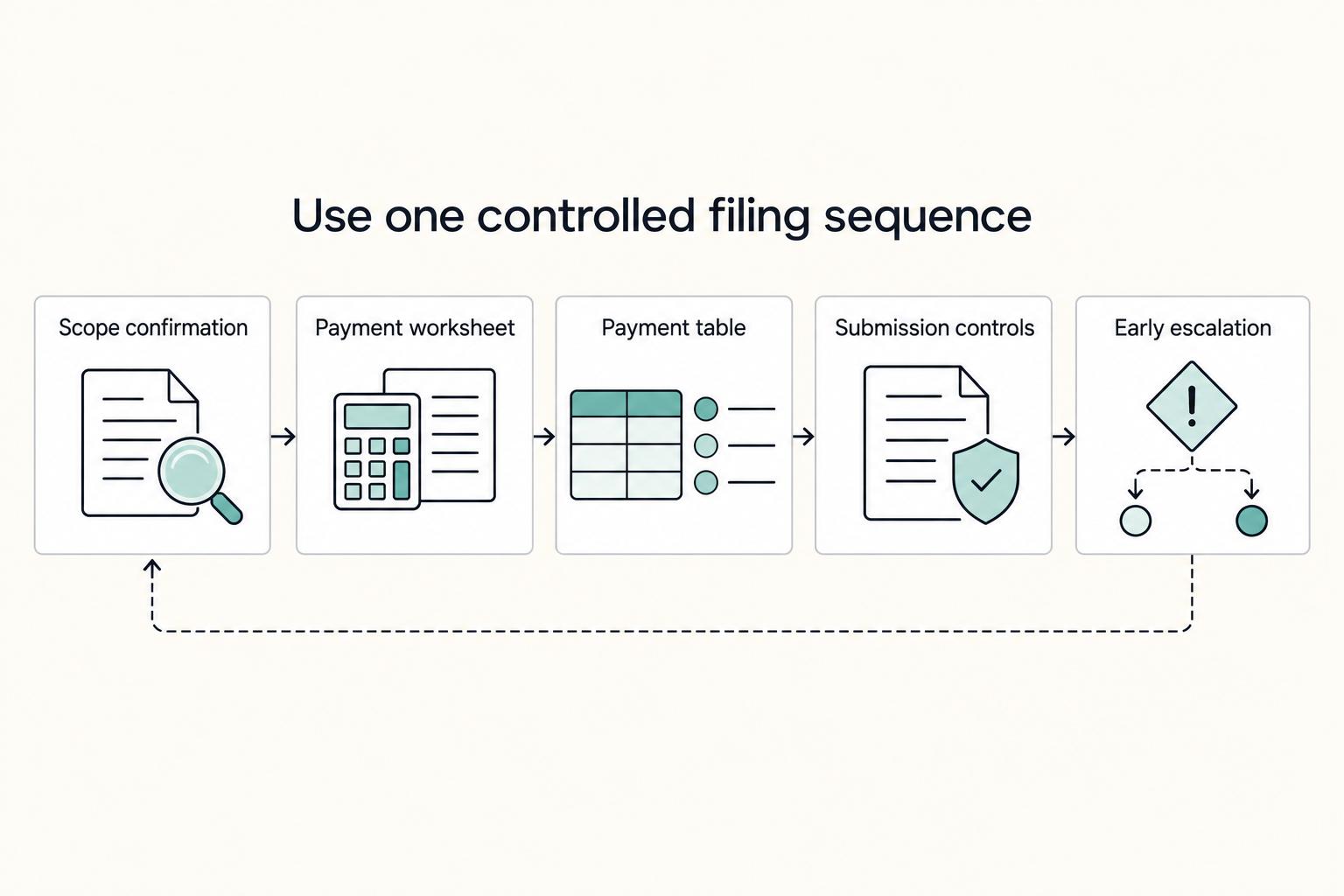
Filing stays low-stress when you use the same sequence every time: confirm the right IRS path, submit carefully, and keep proof you can review later.
Step 1. Confirm scope and choose the right IRS path#
Use the IRS Self-Employed Tax Center first. It confirms self-employment scope, including sole proprietors/independent contractors, partnership members, and people otherwise in business for themselves, and gives dedicated checkpoints for both quarterly payments and annual return filing.
If you need numeric method rules, verify them in current IRS instructions before you act.
Step 2. Run a reusable payment worksheet#
Use the same worksheet sequence every time:
- Record which IRS checkpoint/instruction you are following.
- Document your estimate and assumptions.
- Confirm the payment details in the IRS flow before submitting.
- Save a short audit note (date, amount, context).
Step 3. Build your payment table before you submit#
Keep a simple pre-submit table and update it each cycle.
| Record to capture | Verify now | Save as proof |
|---|---|---|
| IRS checkpoint used | You are on the correct IRS workflow | Page title or screenshot |
| Payment details | They match your worksheet | Final review screen |
| Submission proof | Confirmation appears after submit | Confirmation page and bank record |
Step 4. Apply submission controls every time#
- Re-check key fields on the final review screen before submit.
- Save confirmation records immediately after submit.
- If anything looks unclear, pause and verify through current IRS guidance before sending additional funds.
Step 5. Escalate early when facts are not straightforward#
When your situation is unclear or high-stakes, use the IRS "Considering a tax professional" path and get qualified tax advice before filing decisions.
If you want a deeper dive, read How to Prepare for an IRS Audit. Before you submit, run a final documentation check with Gruv tools to keep your quarterly tax workflow organized and traceable.
Conclusion: From Compliance to Command#
The point of this process is simple: run Forecast, Fund, File in that order, and tax compliance becomes a repeatable operating task instead of a scramble. Risk is managed with documented assumptions, verified records, and payment actions you can prove later.
Forecast from a known baseline. Use your prior-year return as a guide, then update for current-year income, withholding, and major timing shifts. If income is uneven, do not force equal payments just for simplicity. The annualized installment method may fit better when your books are current enough to support it.
Before using any safe-harbor target, verify current IRS rules in Form 1040-ES instructions and related guidance for your filing year. Confirm whether the comparison is 90% of current-year tax or 100%/110% of prior-year tax, and confirm whether the higher-AGI condition applies.
Fund before deadlines arrive. Keep tax cash separate from operating cash using your tax-vault discipline. Then align funding to the four payment periods and general due dates: April 15, June 15, September 15, and January 15 of the following year.
File and verify with proof. Pay through your chosen IRS method, keep each confirmation number, and then confirm clearing in your bank statement or IRS Online Account. Check at least 48 hours after the requested payment date. A Direct Pay confirmation shows submission, not completed withdrawal.
Decision-to-action checklist
- Do now: confirm your LLC's federal tax classification, pull your prior-year return, verify current Form 1040-ES safe-harbor rules, and choose a fixed-payment or annualized method.
- Monitor each cycle: update income and withholding, move funds into the tax vault, submit by the applicable due date, and retain the proof set: submission confirmation, confirmation number, debit evidence, and ledger entry.
- Escalate to a tax professional if: income swings materially, a payment appears failed or misapplied, you receive an IRS notice, special-rule treatment may apply, or entity classification or residency facts changed mid-year.
For a deeper walkthrough, see US Estimated Taxes for Freelancers Abroad With FEIE in the Mix.
If your travel pattern or home-base facts shift during the year, use the tax residency tracker to keep your estimated-tax assumptions consistent.
Frequently Asked Questions
What do these terms mean in plain English for estimated taxes for an LLC?
This section does not define estimated-tax terms, due dates, safe-harbor percentages, or self-employment-tax mechanics. Verify current IRS instructions before relying on any definition, threshold, percentage, or worksheet. | Term | Practical meaning | What to verify now | | --- | --- | --- | | Estimated tax | Common tax-planning term; exact IRS definition is not established in this section | Who must pay and current payment instructions | | Underpayment penalty | Potential charge term; this section does not establish current calculation rules | Current calculation rules, exceptions, and relief standards | | Safe harbor | Benchmark concept; exact percentages/thresholds are not established | Current safe-harbor percentage and high-income adjustment, confirmed from official IRS instructions | | Annualized income method | Method label; eligibility and worksheet mechanics are not established | Current worksheet mechanics and recordkeeping requirements | | Self-employment tax | Separate federal tax category term; rates, limits, and filing mechanics are not established | Current rates, limits, and filing rules |
How should I handle variable income without constant rework?
Use a process you can document consistently, then verify method eligibility and worksheet mechanics before filing. | Approach | Use this if... | Watch out for... | | --- | --- | --- | | Fixed set-aside | You want one repeatable process | Verify current IRS method rules before relying on it | | Annualized income approach | You want payments tied to income timing | Verify current worksheet mechanics and documentation requirements | | Hybrid | You want a fixed routine plus periodic recalculation | Verify how and when recalculations are handled under current rules |
Does FEIE automatically mean I can skip estimated payments?
Do not assume that by itself. FEIE physical-presence rules here are time-based and apply to U.S. citizens and U.S. residents, but this section does not establish estimated-payment exemptions or self-employment-tax outcomes. Treat FEIE eligibility and estimated-payment obligations as separate checks, and verify both under current IRS instructions.
What exactly counts as a day for the physical presence test?
A full day is 24 consecutive hours, from midnight to midnight, in a foreign country or countries. The 330 qualifying days do not have to be consecutive, but you still need at least 330 full days within a qualifying 12-month period. Keep a dated travel log and reconcile it to your records before filing.
What if I miss 330 days because of illness, family issues, or travel changes?
If you are below 330 full days, you do not meet the physical presence test, regardless of reason. A narrow waiver can apply when departure is caused by war, civil unrest, or similar adverse conditions in a country listed in the IRS annual Revenue Procedure. To use that waiver, you must be able to show you reasonably could have met the minimum-time requirement without the adverse condition and satisfy the waiver timing conditions.
Does an S corporation election change the answer?
Potentially, but this article does not establish the estimated-payment, payroll, or filing mechanics of an S-corp election. Treat any election or mid-year owner-pay change as a trigger for professional review before implementation.
What payment proof should I keep every time?
Keep comprehensive records for each payment attempt (for example, confirmations and account-debit evidence), and verify current IRS recordkeeping expectations.
What should I do if I think a payment failed or I missed a deadline?
Confirm payment status before taking action, document what happened, and verify the current IRS process or get professional help.
Do federal and state rules move together?
Do not assume state estimated-tax rules match federal treatment. Start with Do I Have to Pay State Taxes While Living Abroad as a Digital Nomad?, and escalate to a professional if you have more than one state connection, a mid-year move, FEIE day-count uncertainty, an S-corp election, or a tax notice.
Try a related tool
Researched and edited by the Gruv editorial team. Gruv builds cross-border billing, payouts, and finance-operations software for global businesses.
Sources
Educational content only. Not legal, tax, or financial advice.
Related Posts

Do I Have to Pay State Taxes While Living Abroad as a Digital Nomad?
Living abroad does not end `state income tax` exposure by itself. The first decision is practical: choose a filing position your facts can support, then build records that support the same story all year.
How to Prepare for an IRS Audit
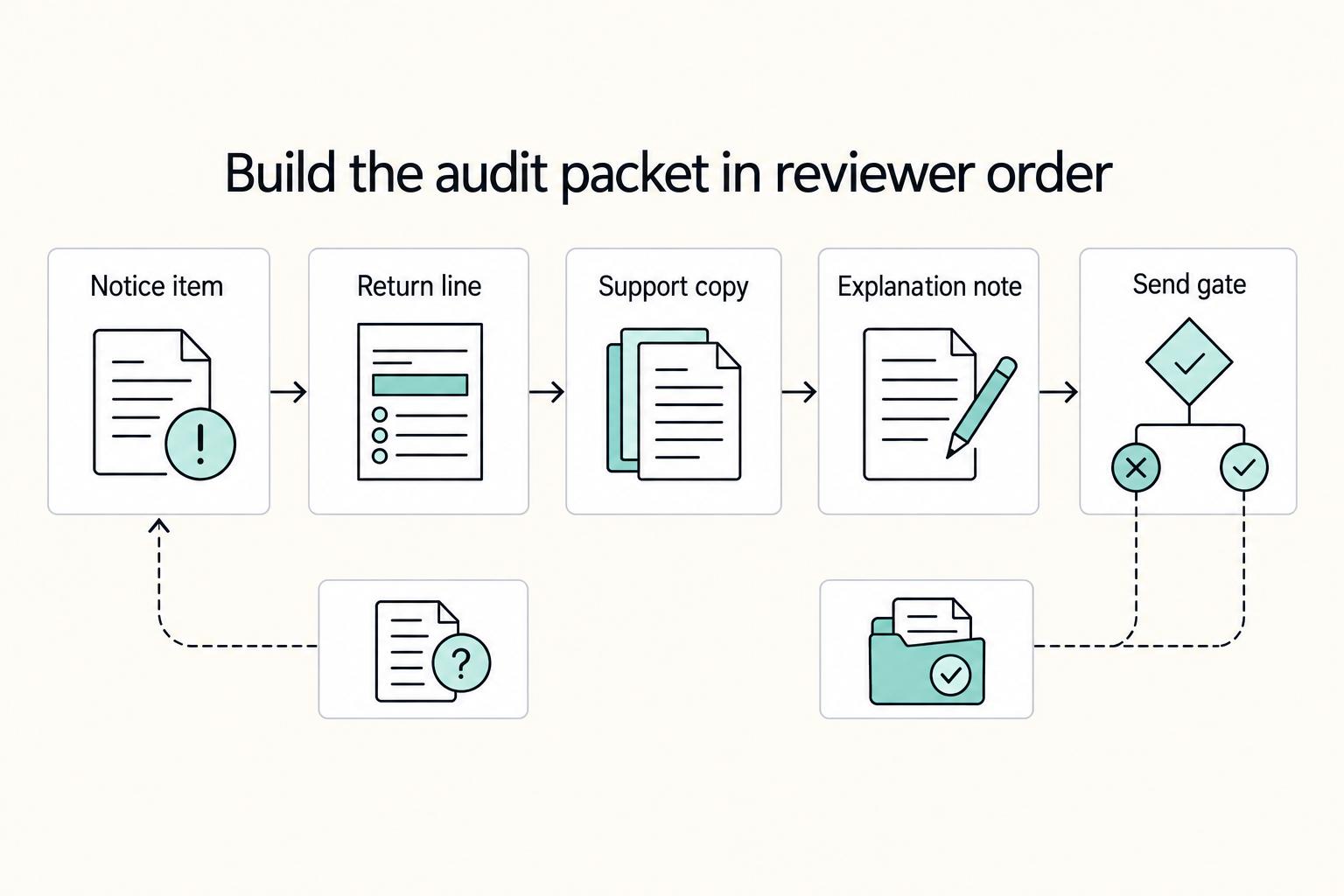
Treat an IRS audit as a records check, not a contest. Your job is to show, item by item, how what you filed ties back to the records behind it.
How to Choose the Right Business Structure for Your Freelance Business
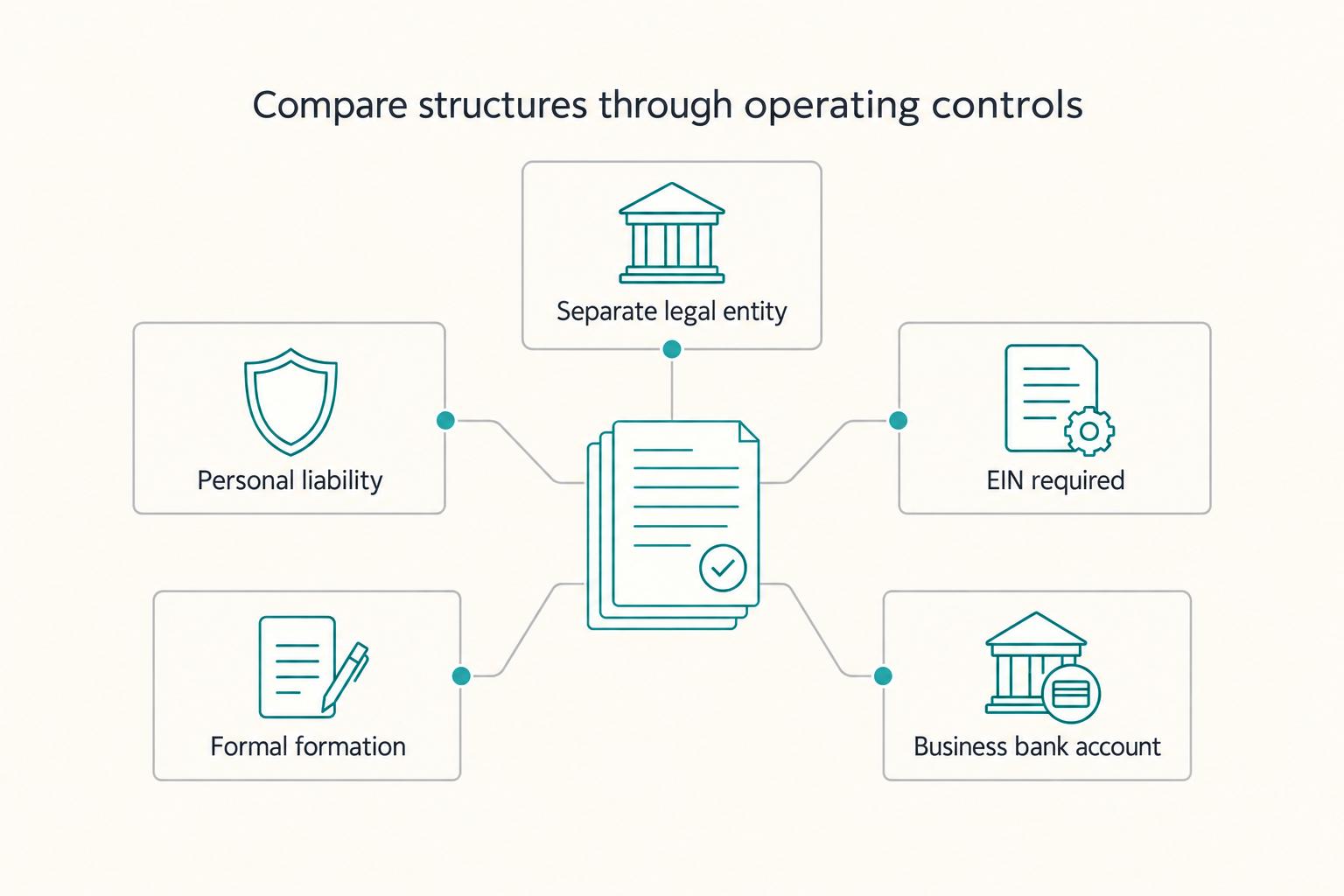
Most freelancers end up in a business structure by default rather than by design, but that accidental choice shapes taxes, personal liability, and payment operations in ways that compound over time. This guide walks independent professionals through four entity types — Sole Proprietorship, Single-Member LLC, S-Corp election, and Corporation — covering the tax treatment, liability exposure, and operational overhead of each. Rather than prescribing a single best answer, it provides a trigger-based framework: start with the structure that fits today, then upgrade when specific signals — indemnification clauses, enterprise KYB requirements, a first hire, or material net profit — make the switch worthwhile. The result is a deliberate, revisable foundation that keeps records clean, reduces onboarding friction, and avoids the expensive mismatches that come from letting structure lag behind business growth.