
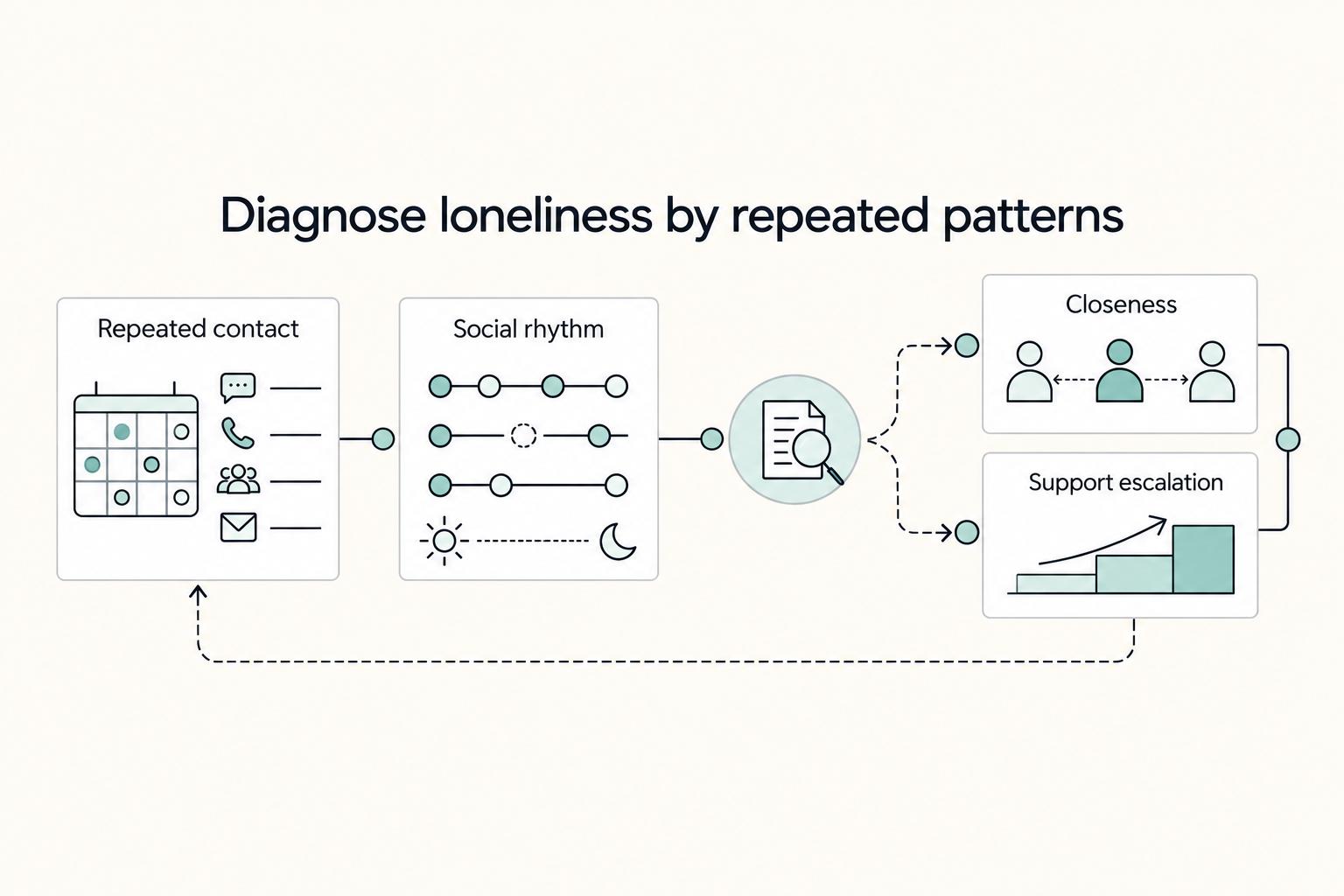
Quick Answer
To overcome digital nomad loneliness, stop chasing one-off social bursts and build a repeatable “Connection OS” centered on consistent routines, recurring places, and repeated encounters with the same people. Use your first week in a new city to plug into a few in-person events, then keep showing up on the same days and times so familiarity can compound into real friendships. If it feels overwhelming, seek professional support.
Digital nomad loneliness isn't a personality flaw - here's the Connection OS that fixes it#
If you run a business of one while moving city to city, treat connection as an operating issue, not a personality verdict. You do not need to become louder, more social, or permanently available. You need a repeatable way to move from unknown faces to familiar ones.
That framing matters because it changes the fix. Feeling disconnected is not the same as being bad with people. It can show up even when your calendar is full, your DMs are active, and you are technically in conversation all week. The gap is often fit: the contact you have is not the contact you need.
That mismatch is common on the road. You can be surrounded by events, group chats, and new people and still feel flat at the end of the day. It is not rare more broadly, either. Nearly one in six people globally report feeling lonely.
Keep two terms separate so your next move is accurate:
- Loneliness is how disconnected you feel.
- Social isolation is low relationship coverage, low contact, or weak support.
They overlap, but they are not the same. Keeping them separate helps you avoid bad fixes. Both are associated with meaningful mental and physical health risk, so this is worth treating as a real part of operations, not a side issue you deal with only if and when life slows down.
What helps most is usually simple and unglamorous. Closeness tends to grow through repeated contact with the same people and physical proximity over time. One-off hangs can be fun, but they rarely create enough repetition for trust to settle in. This is why a week full of novelty can still leave you feeling socially underfed.
It also helps to be precise about the goal. The target is not nonstop social activity. The target is steady connection that can survive workload spikes and location changes. You want something stable enough that a busy week or an upcoming move does not knock you back to zero.
That is what this Connection OS is for. It helps you diagnose the real root cause, choose better first moves in a new city, and decide when to stay, when to move, and when to set a base. Start with diagnosis, because different kinds of disconnection need different first moves.
If you want a separate deep dive on the admin side of this lifestyle, read Tax considerations for digital nomads.
The Loneliness Map: diagnose the real root cause in 10 minutes (not the symptom)#
Before you add another meetup to your calendar, figure out what is actually missing. The fastest way to stay stuck is to increase social volume before you identify what is broken. People tell themselves, "I should get out more," then stack random events and chats. If the actual issue is constant reset, no rhythm, or weak depth, more noise does not solve much.
| Bucket | What it looks like |
|---|---|
| Not enough repeated contact | You meet people, but mostly once. Each week starts from zero, so familiarity never compounds. |
| Around people, but no rhythm | You are in social environments, but nothing repeats. No recurring place, no predictable faces, no weekly cadence. |
| Plenty of contact, weak closeness | You have activity, but interactions stay shallow. You get volume without progression from acquaintance to friend. |
| The weight is getting hard to carry | When this feels hard to cope with, it is no longer just scheduling. Support from a counselor or health care provider becomes the right next step. |
Use this 10-minute map and place yourself in one primary bucket:
- Not enough repeated contact
You meet people, but mostly once. Each week starts from zero, so familiarity never compounds.
- Around people, but no rhythm
You are in social environments, but nothing repeats. No recurring place, no predictable faces, no weekly cadence.
- Plenty of contact, weak closeness
You have activity, but interactions stay shallow. You get volume without progression from acquaintance to friend.
- The weight is getting hard to carry
When this feels hard to cope with, it is no longer just scheduling. Support from a counselor or health care provider becomes the right next step.
If more than one bucket fits, pick the one creating the most friction right now and treat the second as a follow-up. That keeps you from changing everything at once and learning nothing from the experiment.
Then run a short self-check:
- Where am I likely to see the same people again next week?
- What recurring place do I have beyond home and work?
- Are my interactions mostly one-off, online-only, or low-depth?
- Do I actually need more people, or do I need deeper ties with fewer people?
- Is this starting to feel heavier than I can manage alone?
A common failure mode is assuming every version of disconnection needs the same fix. It does not. Sometimes the next move is a class, meetup, or coworking pass. Sometimes the next move is to stop white-knuckling it and talk to a professional. The point of this map is not to label yourself. It is to stop guessing.
Write your diagnosis in one plain sentence before you change your calendar. Example pattern: I have social volume but no repeat contact. That sentence makes the next step obvious and keeps you from drifting back into random activity.
Once your bucket is clear, execution gets easier. You are no longer trying to solve everything at once. The next section gives you the priority order so you are not re-deciding your whole social approach every week.
Connection OS, prioritized: the only stack that survives location changes#
The order matters more than the label. Prioritize repetition first, variety second. That is what survives frequent moves.
Friendship rarely forms from isolated high-energy moments. It grows when the same people keep crossing paths in contexts that are easy to repeat. Mobility punishes anything that depends on perfect timing, peak energy, or constant novelty. What holds up is simpler than that.
Three ideas anchor the whole approach:
- Repeated contact builds closeness. Familiar faces lower social friction and make second and third conversations natural.
- Repeated exposure increases liking. You do not need instant chemistry on day one for connection to improve.
- Recurring third places make repetition easier. A place beyond home and work gives you a stable contact surface.
From there, use this priority order:
1) Choose one recurring context first. Do not start with where can I meet the most people. Start with where can I reliably see the same people next week. That could be a class, language exchange, run club, meetup, cafe, or coworking space you can genuinely return to. The best option is not the one that looks most social online. It is the one you will actually revisit.
2) Lock a predictable rhythm. Mobility amplifies drift. Without routine, every city feels like a permanent first day. Showing up on similar days and times is what turns random encounters into recognition. Rhythm is what makes other people think, I saw you here last week.
3) Bridge online to offline. Online communities are useful for discovery and first contact. They work best when they lead to in-person repetition, not when they become the whole plan. Use them to find the room, then get into the room.
4) Keep an escalation path. If this starts feeling hard to cope with, treat that as a health signal, not a discipline failure. Talk to a health care provider or counselor. In the U.S., the CDC also points to the 988 Suicide & Crisis Lifeline as an option.
This priority order also gives you a weekly quality check. If your week had novelty but no continuity, expect weaker outcomes. If it had at least one repeated environment and one familiar face, you are moving in the right direction even if progress feels slow.
If a tactic does not improve continuity, rhythm, or depth, it is optional. That makes the next question practical: what should week one in a new city actually look like?
What should you do in the first 7 days in a new city?#
Treat week one as stabilization. The goal is not instant belonging. The goal is to make sure week two does not start from scratch.
Your first seven days should do two jobs in parallel: reduce social anonymity and lock safety habits before emotions or stress start making decisions for you. If you handle those two jobs early, most later choices get simpler. You are not trying to solve your whole social life in a week. You are trying to create traction.
By the end of week one, you want a default answer to, "What am I doing this week to stay connected?" Not a perfect plan. Just one repeatable path.
1) Get plugged in fast (reduce isolation)#
Early momentum matters, but precision matters more than volume. You do not need ten events. You need one or two environments you can repeat without draining yourself.
Start with quick exposure moves:
- Pick a few events or groups that fit your real energy level, not your idealized self.
- Show up in person instead of researching forever.
- Favor options you can revisit at a similar time next week.
- Use online communities to find local rooms, then move to offline contact quickly.
Then set a practical day-seven checkpoint:
- You know at least one route you can repeat without friction.
- You have at least one room where faces may become familiar.
- You already have one concrete return on next week's calendar.
That checkpoint matters because it makes a new city feel navigable instead of abstract. You are no longer searching from zero each day. You are building a small loop that can compound.
Before moving to the next step, decide which environment is your anchor for the coming week. Commitment to one anchor beats loose interest in five options.
2) Keep first-meet safety simple (and non-negotiable)#
Once new contacts start appearing, keep safety rules fixed and boring. The riskiest pattern is rewriting boundaries because you feel lonely, rushed, or overly optimistic after one good conversation.
Use the same first-meet standards every time:
- Meet in a populated public place.
- Tell a trusted friend or family member where you are going and when.
- Share live location with a trusted contact when possible.
- Be careful with personal details, especially your home address.
- Leave if anything feels off, even if leaving feels socially awkward.
These rules are basic by design. In a new city, consistency beats clever improvisation. When your safety baseline is stable, your attention can stay on evaluating people and building trust instead of managing avoidable risk.
This is also a connection strategy, not just a safety checklist. Clear boundaries make it easier to stay open, present, and selective over time. Once that baseline is set, you can focus on choosing the right environments instead of recovering from the wrong calls.
Are coworking spaces actually good for making friends? (Best environment plays)#
Coworking can help, but only when it creates repeated low-pressure contact. A desk alone is not a social plan.
Some spaces are strong community environments. Others are mostly quiet offices with better coffee and reliable internet. Neither is inherently wrong. The real question is whether the space gives you enough recurring overlap to become a familiar face without forcing interaction.
Use this filter before committing:
- Can you return consistently on a schedule you will actually keep?
- Do at least some members show up often enough for recognition to build?
- Is interaction light and optional, or does every conversation feel forced?
- Do you leave with a clear reason to come back, beyond internet speed?
In practice, one stable space usually beats constant sampling. If you rotate across many places, you lose the main advantage, which is continuity. Familiarity is the real product.
After a short trial, judge by carryover, not by day-one chemistry. Are greetings getting easier? Are conversations carrying from one day to the next? Do you feel less anonymous when you walk in? If yes, stay with it. If no, switch quickly and test a different environment.
Whether you label coworking as a third place or simply a practical anchor does not matter; sustainable repetition is what counts. Once you have a room worth returning to, the next challenge is using it in a way that fits your personality and energy.
How do I make friends as a digital nomad if I'm introverted? (Best people plays)#
If your social battery is limited, do less and repeat it more. You do not need high-energy charisma. You need enough continuity for familiarity to do the heavy lifting.
Friendship usually moves through stages: stranger, familiar person, acquaintance, friend. That progression is often shaped by proximity and repeated exposure, not just instant deep compatibility. For introverts, this is useful because it removes pressure from any single interaction. The first conversation does not need to be memorable. It just needs to make the second one easier.
Use people plays that protect energy while increasing continuity:
- Pick one recurring anchor and show up consistently.
- Choose contexts where conversation is possible but not mandatory.
- Use online groups to locate offline gatherings before arrival.
- Aim for next time, not perfect chemistry today.
- Keep early interactions short enough that returning feels easy.
Two tactical shifts make this much easier.
First, lower the performance bar. Early conversations are not auditions. A brief hello, a simple question, and a clean exit are enough. You are not trying to prove you are interesting. You are trying to become recognizable.
Second, bias toward repeat visibility. Sit in the same area. Arrive at similar times. Return the next week even if the last interaction felt ordinary. A common failure mode is grading yourself too early. If a first meetup feels average, you may assume it failed. Often it succeeded at the only thing that mattered in that moment: making the second interaction possible.
If you want an operations-side companion while you build this, browse Gruv tools.
How can I avoid feeling lonely when I'm busy with client work? (Best work + ops plays)#
Busy client stretches are where social plans fail first. Work eats time, but it also eats planning energy. That is why connection disappears even when your intentions are good.
The practical fix is to treat connection as maintenance, not a reward after deadlines. If it only lives in leftover time, it vanishes exactly when stress is highest. The goal during heavy weeks is not to be social in some ideal way. It is to keep continuity alive.
Start by protecting one recurring slot. A fixed weekly window beats a long list of maybe plans. Keep it modest if needed, but protect it like any other core commitment. One reliable return is more useful than several loose intentions.
Next, attach connection to routines you already keep. Use the same cafe, coworking spot, walking route, or class. Repetition lowers activation friction when your brain is tired. You should not need fresh motivation every time.
Then prioritize continuity over volume. During heavy weeks, one reliable touchpoint is better than an ambitious plan you cancel. This is where people often make the wrong trade: they design for the ideal week, then lose everything during the real one.
Online contact can help, but use it as a bridge, not a substitute. Messages can maintain momentum between in-person touchpoints. They rarely replace real-world depth. If you already have a recurring offline anchor, online contact helps you keep it warm between visits.
One more operator detail matters here: pre-book your next return before the week gets chaotic. If the next touchpoint is already on the calendar, client creep has a harder time erasing it. When workload spikes, shrink the plan instead of canceling it. A short visit to your anchor still protects continuity and keeps relationships warm.
The common trap is waiting for a quieter season. In practice, that season keeps moving. Small, repeatable contact wins because it survives real workloads. If disconnection starts feeling hard to cope with rather than merely inconvenient, do not frame it as a productivity issue. That is the point to seek support.
Should you move, stay, or set a base?#
If your goal is real friendship, time on the ground usually matters more than novelty. City quality matters, but shared hours with the same people matter more.
| Relationship stage | Rough time together |
|---|---|
| Casual friendship | 40-60 hours |
| Friend | 80-100 hours |
| Good friends | 200+ hours |
This explains a pattern many people misread. Short stays can feel socially exciting and emotionally thin at the same time. You collect moments, but not enough shared time for trust to consolidate. If you keep resetting just as recognition starts to form, the outcome is predictable.
A useful calibration is the rough estimate that it can take about:
- 40-60 hours together to form a casual friendship
- 80-100 hours to become a friend
- 200+ hours to become good friends
These figures are directional, not guarantees. People vary. Meaningful relationships are usually built from stacked hours, not one great evening. Before blaming yourself or the city, inspect your travel pattern. If your schedule resets before contact compounds, you may be creating the exact result you say you do not want.
So what should you do?#
Use this decision rule based on what your current setup can realistically support.
| Option | Use when |
|---|---|
| Move | You cannot get repeated contact with the same people where you are; your pace keeps resetting your social graph to zero; you want exploration now more than depth, and you are choosing that tradeoff consciously. |
| Stay | Familiar faces are starting to appear through recurring activities; you can stack meaningful time with those people over the next few weeks; recognition and comfort are rising enough to justify continuity. |
| Set a base | You want mobility without full social reset every cycle; you care about moving beyond acquaintance-level relationships; you are ready to optimize travel around continuity rather than constant novelty. |
Move when:
- You cannot get repeated contact with the same people where you are.
- Your pace keeps resetting your social graph to zero.
- You want exploration now more than depth, and you are choosing that tradeoff consciously.
Stay when:
- Familiar faces are starting to appear through recurring activities.
- You can stack meaningful time with those people over the next few weeks.
- Recognition and comfort are rising enough to justify continuity.
Set a base when:
- You want mobility without full social reset every cycle.
- You care about moving beyond acquaintance-level relationships.
- You are ready to optimize travel around continuity rather than constant novelty.
These are not identity choices. They are practical tradeoffs. If the choice still feels fuzzy, run a simple forecast. Ask what your next month is likely to produce in repeated contact, not what your current week feels like emotionally. That one shift usually clarifies the decision.
The core question is not only do I like this city. The better question is can I build repeated contact here on a rhythm I can sustain.
Close the loop: run this like an operating system, not a mood#
Treat connection like weekly maintenance. Keep one recurring place. Return on a predictable rhythm. Favor familiar faces over endless novelty. Use online communities to support in-person follow-through, not replace it. Keep first-meet safety rules fixed so you do not make avoidable mistakes when you feel unsteady.
Then run a short weekly checkpoint:
- Where did I return?
- Who did I see again?
- What is already scheduled for next week?
- What one adjustment will improve repetition next week?
If those answers are getting clearer, momentum is building even when progress feels slow. That is how this stops being a mood problem and becomes a practice you can trust. You are not trying to eliminate every lonely day. You are building a pattern sturdy enough that you no longer rely on luck.
Want a country-specific second opinion on your setup? Talk to Gruv.
Frequently Asked Questions
What is this article trying to help with?
It’s focused on the experience of loneliness while living and working on the move. The core idea is to treat connection like a repeatable system, not a personal failing.
Do digital nomads really get lonely?
Yes—digital nomads can experience feelings of loneliness. Frequent relocations, lack of stable social connections, and periods of isolation can all contribute.
Do I need to be extroverted to make friends as a digital nomad?
No. The goal isn’t to become someone else. It’s to use approaches that fit your energy and make connection easier to repeat.
Are coworking spaces a good place to meet people?
It depends on the space. Many coworking spaces include community and networking activities, which can make it easier to run into people—but results vary a lot.
What should I do if the loneliness keeps showing up in every new place?
Consider changing how you build routines and relationships across moves. If the pattern repeats, it can help to step back and decide whether to keep moving, stay longer, or set a base.
Are coliving spaces worth trying if I’m just starting out?
They can be a good starting point for people who are just beginning their digital nomad journey.
What if loneliness is affecting my mental health?
If it’s starting to feel heavy or scary, consider reaching out to a mental health professional. If you’re in the U.S. and you or someone you know needs immediate support, you can contact the 988 Suicide & Crisis Lifeline (call, text, or chat). It’s available 24/7/365, and conversations are free and confidential.
Try a related tool
Researched and edited by the Gruv editorial team. Gruv builds cross-border billing, payouts, and finance-operations software for global businesses.
Sources
Educational content only. Not legal, tax, or financial advice.
Related Posts

The Best Tax Havens for Digital Nomads (That Are Actually Legal)
If you want lower tax outcomes that still hold up when someone looks closely, start with alignment. Your tax residency, business structure, and records need to tell the same story from day one. This article is for freelancers and consultants who want something they can run calmly, not a "pay zero tax" shortcut.

The Freelance Payment Penalty: A Modeled Audit of Platform Fees, FX Spreads, and Payout Delays
The money rarely disappears through a single, easy-to-spot fee. The real loss is stacked. A marketplace takes its commission, a processor adds a charge for international cards, a bank or payment company converts the currency at a spread, a platform holds the funds before release, and a wire sheds a little to intermediaries on the way in. Each layer looks defensible on its own, but the worker feels the combined result as a smaller deposit and a later payday.

How to Respond to a Subpoena for Business Records
Move fast, but do not produce records on instinct. If you need to **respond to a subpoena for business records**, your immediate job is to control deadlines, preserve records, and make any later production defensible.