
Quick Answer
Start by creating your outline before writing prose. For how to outline a non-fiction book, set one reader promise, one Job-to-be-Done, and a short Content SOW that defines scope and exclusions. Pick a single structure, then map each chapter to a core claim, an evidence slot, and a practical takeaway. Add milestones, owners, and pending verification notes so drafting and handoffs stay clear and late-stage rewrites are less likely.
Treat Your Outline as a Control Document Before You Draft#
To outline a non-fiction book, treat your outline as a control document, not a warm-up draft. Before you write prose, decide what the book needs to say, who it helps, and what promise it makes. That upfront work cuts early rewrite loops and makes drafting decisions clearer.
Define the operating terms#
Start with plain operating terms. Your reader promise is the change or result the reader should expect.
A useful format is a One-Page Book Blueprint that captures the big idea, the reader transformation, and a chapter map before drafting begins. The checkpoint is simple: if the promise and chapter direction are not clear on one page, the manuscript probably is not ready. A common failure mode is drafting the introduction first, then rewriting it 10 times because the promise is still fuzzy.
Use a quick decision test before you draft#
Before you commit writing hours, compare the two approaches below. The table works as a fast decision test:
| Dimension | Manuscript-first | Strategy-first outline |
|---|---|---|
| Goal clarity | Often discovered late | Named before drafting |
| Early rewrite risk | Higher when the promise is unclear | Lower when the promise is clarified first |
| Chapter direction | Emerges during drafting | Mapped before drafting |
| Handoff readiness | Harder to share partial drafts | Easier to share a written plan |
That difference matters in practice. A manuscript-first approach can hide positioning problems until you are deep in revision. A strategy-first outline forces key decisions earlier, which can reduce avoidable rewrites.
Make handoffs easier from the start#
This approach also makes the project easier to hand off. A written plan can be shown to a collaborator, coach, or ghostwriter, which is much harder to do with scattered notes and half-drafted chapters. It also sets the expectation that writing improves through process, not inspiration alone. If heavy edits come later, large cuts are common, and shortening can improve the final product.
Next, lock the reader promise and chapter map before full drafting. Once that is clear, chapter decisions get easier.
Phase 1: The Business Case - De-Risking Your Book Before You Write a Word#
Before you draft, make sure the book has a clear business case: one main outcome, one defined reader, and clear scope boundaries. If you cannot name those yet, pause here and tighten this phase first.
Keep one working document for Phase 1 with three parts: Job-to-be-Done, High-Value Reader Persona, and Content SOW. You will use it as your decision filter in Phase 2.
Define the book's Job-to-be-Done#
Pick one primary outcome for the book, then list secondary outcomes so they do not compete with it. A vague goal like "build authority" will not help you decide what stays or what gets cut. A specific outcome gives you a usable filter.
Add one boundary line: what this book is not for. That boundary protects scope and keeps your promise credible. Then write a one-sentence reader benefit statement. If you cannot state it clearly, you are not ready to pitch.
Build a High-Value Reader Persona from real signals#
Build this from signals you can gather now: recurring client questions, failed DIY attempts, buying triggers, and objections to paid help. These are more useful than broad demographics because they show what your chapters must solve.
Keep that reader at the center of each decision. If a chapter does not answer a real question, address a known failed attempt, or reduce a recurring objection, it probably does not belong.
| Criteria | Weak business case | Strong business case |
|---|---|---|
| Goal clarity | "Build visibility" | One primary outcome with optional secondary outcomes |
| Audience specificity | Broad professional audience | Defined reader with known questions and objections |
| Scope boundaries | Everything might fit | Clear "not for" line and obvious cuts |
| Success signals | General usefulness | Reader benefit stated plainly before drafting |
Write a short Content SOW#
Use your Content SOW as a go/no-go check: what the book covers, what it does not cover, and the core promise each chapter supports. This is where you prevent scope drift before writing starts.
It also sets you up for a chapter-by-chapter summary, where each chapter can be described in two or three sentences. That format can guide drafting and support proposal work. For nonfiction, the proposal is the sales document used with publishers; many are around 10 to 25 double-spaced pages, and complex projects can reach 50+ pages with sample chapters. Even with a complete manuscript, an agent or publisher may still ask for a proposal.
Use this checklist before moving to Phase 2:
- You can state one primary outcome in one sentence.
- You can define the reader using real questions, failed attempts, triggers, and objections.
- You can state what the book is not for.
- You can explain the reader benefit clearly enough for someone else to co-outline chapters with you.
If all four are true, move to Phase 2 and convert this business case into chapter architecture. Related: How to Write a Book to Establish Your Freelance Expertise.
Phase 2: Make the Book Easy to Trust and Reuse#
Your outline should make the book easy to trust and easy to reuse. The simplest way to do that is to choose one clear structure, then build chapters as repeatable modules with explicit checkpoints.
Choose the macro-structure before you name chapters#
Pick one dominant structure first, then name chapters. If you mix structures too early, the outline usually sprawls and loses clarity.
| Structure | Selection criteria | Tradeoff | Best fit when... |
|---|---|---|---|
| Problem/Solution | Your reader already feels the problem and wants a practical path forward | Can feel generic if your diagnosis is broad | You solve a recurring issue and want the reader to act quickly |
| Proprietary Framework | Your value is a named method, sequence, or model | Requires stronger proof early so readers trust your structure | You teach a repeatable approach across services, training, or speaking |
Use one lock-in test: if you cannot explain your structure choice in one sentence, wait before finalizing chapter titles.
Design chapters as reusable modules#
Build each chapter as a module you can reuse later, not just a step toward the final chapter. A repeatable pattern reduces restart work and keeps drafting consistent.
| Module element | What it covers |
|---|---|
| Core claim | The one point this chapter must prove |
| Evidence slot | Where you insert support, for example Add verified proof point |
| Practical takeaway | The action, diagnostic, or decision the reader can apply now |
| Repurposing angle | One primary channel this chapter maps to after publication |
Use this chapter template:
- Core claim: the one point this chapter must prove.
- Evidence slot: where you insert support, for example
Add verified proof point. - Practical takeaway: the action, diagnostic, or decision the reader can apply now.
- Repurposing angle: one primary channel this chapter maps to after publication.
Assign one primary channel per chapter, for example: article, webinar, workshop, keynote, or email sequence. One chapter, one main channel keeps scope cleaner than trying to make every chapter do everything.
Teach enough to build trust#
Teach enough for the reader to understand your method and make a real start. Trust comes from clear teaching, not withholding.
Use this boundary:
- Teach the what and why completely.
- Teach a usable how for lower-risk self-directed steps.
- Keep paid work focused on customization, deeper diagnosis, sequencing across messy constraints, live feedback, and accountability.
At the chapter level, ask: after this chapter, what can the reader do independently, and where does expert help still matter?
Build a five-tier outline you can draft from#
Use a five-tier scaffold so your outline stays complete and scannable. Copy this and fill it in:
- Part
- Chapter - Core claim - Reader problem or key question - Add verified proof point - Practical takeaway - Primary repurposing channel
If this still feels muddy, the issue is usually scope, not format. Split overloaded chapters or move non-core material to an appendix before drafting.
You might also find this useful: How to write a 'book proposal' for a non-fiction book.
Phase 3: The Execution Plan - Managing Your Book Project Like a Pro#
Once your outline is stable, use it to decide what goes on the page, then run drafting as a managed process with clear ownership, timing, and review points.
Turn the outline into trackable drafting work#
Turn each chapter into a draft unit you can write, review, and approve. Drafting is the stage where you produce a complete first version, so your setup should show what is next, what is blocked, and what is ready.
Use this workflow map:
- Chapter -> drafting task
- Core claim / key concept -> task brief
- Evidence slot -> dependency to resolve before approval
- Practical takeaway -> completion check
- Review -> approval checkpoint
A lightweight tracker is enough: draft owner, due date, evidence status, review status.
| Use case | Choose this setup when | Selection criteria | Watch for |
|---|---|---|---|
| Writing-first | You need long, focused drafting sessions | Easy outlining, low-friction drafting, clean revision/export path | Strong prose can hide schedule drift |
| Task-first | You need visible ownership and deadlines | Clear task hierarchy, due dates, dependency/status visibility | Over-tracking can slow writing |
| Collaboration-first | You are exchanging drafts with co-authors or reviewers | Commenting, version clarity, review/approval flow | Too many comments can blur final decision ownership |
Start with the part you know best instead of forcing strict order. If you get stuck, dictate a paragraph or two, or draft on paper and type it before revision. Keep your deadline commitments explicit.
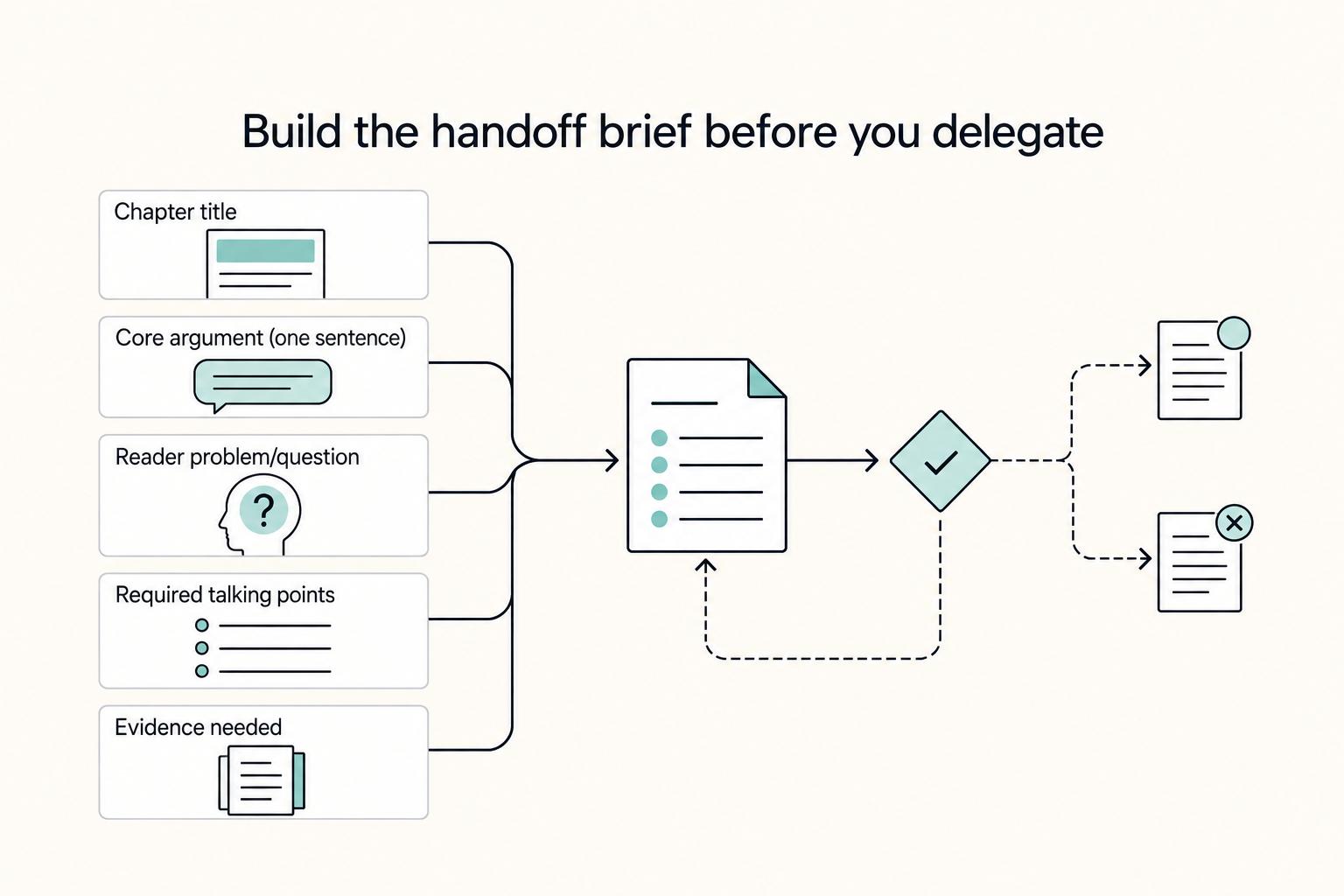
Build the handoff brief before you delegate#
Create a reusable chapter handoff brief before you assign work. This keeps ghostwriter, researcher, or editor work aligned with your outline.
| Brief field | What to add |
|---|---|
| Chapter title | Pending chapter title |
| Core argument (one sentence) | Pending core argument |
| Reader problem/question | Pending reader problem or question |
| Required talking points | Pending required talking points |
| Evidence needed | Confirm the supporting evidence from its original source |
| Example/case/anecdote | Pending verified example or input |
| Voice notes to preserve | Pending voice notes |
| Practical takeaway | Pending practical takeaway |
| Scope boundary (book vs services) | Pending scope boundary |
| Reviewer | Pending reviewer assignment |
| Approval standard | Pending approval standard |
Use this template per chapter:
- Chapter title: pending chapter title
- Core argument (one sentence): pending core argument
- Reader problem/question: pending reader problem or question
- Required talking points: pending required talking points
- Evidence needed: confirm the supporting evidence from its original source
- Example/case/anecdote: pending verified example or input
- Voice notes to preserve: pending voice notes
- Practical takeaway: pending practical takeaway
- Scope boundary (book vs services): pending scope boundary
- Reviewer: pending reviewer assignment
- Approval standard: pending approval standard
Do not move a chapter into final approval while required evidence fields are unresolved.
Use a simple change gate#
Run every scope change through one decision gate before you accept it. New ideas are useful only when they support the book's job and fit the plan.
| Gate check | Decision question |
|---|---|
| Job alignment | Does this clearly support the original job-to-be-done? |
| Scope/timeline impact | What expands, and what deadline moves? |
| Approval path | Who must approve before drafting or redrafting starts? |
Check each proposed change in order:
- Job alignment: does this clearly support the original job-to-be-done?
- Scope/timeline impact: what expands, and what deadline moves?
- Approval path: who must approve before drafting or redrafting starts?
If alignment is weak, cut it or park it for a later asset. Protect momentum by limiting long interruptions; use an alarm for breaks and keep them short, for example, ten minutes. Keep paragraphs developed but controlled: more than one sentence, but shorter than a full double-spaced page.
For a step-by-step walkthrough, see How to Find a Book Editor for Your Manuscript Stage.
Your Outline is Your Strategy. Execute with Confidence.#
Use your outline as a control document, not a topic list. Before drafting starts, it should give you clear direction, keep you on track, and show scope decisions early so you do not draft chapters you will later cut.
Confirm the operating basics before you draft#
Treat the outline like an operating brief for the project: what this book must do, what is in scope now, what is deferred, what gets delivered, when handoffs happen, and who is accountable at each milestone.
| Control point | In your outline | How you verify it is complete |
|---|---|---|
| Objective | One key question the book will answer | You can say it in one sentence, and every chapter clearly supports it |
| Scope | Chapter-by-chapter plan with each chapter's job | You can explain why each chapter exists, with no obvious overlap or drift |
| Exclusions | A short "save for later" list | You can point to topics you are intentionally deferring |
| Deliverables | Chapter synopsis plus notes and proof gaps | Every chapter is draftable, and open items are marked as pending verification |
| Timeline | Milestones (outline signoff, draft start, review, revision) | Every milestone has a target date or is clearly marked as date pending |
| Owner | One accountable owner per milestone | Every milestone has a named owner, even if that owner is you |
Before-drafting decision gate#
Proceed to drafting only if your chapter flow holds from start to finish without logic gaps and each chapter supports the key question. Revise the outline first if chapters overlap, evidence is still thin, or the idea set feels too narrow for the full manuscript. If you keep stalling mid-book, treat that as a signal to strengthen the outline before writing more pages.
Execute this week#
- Write your one-sentence objective and key question.
- Complete every row in the table with a concrete answer or a neutral pending note.
- Run one pass to cut overlaps and confirm exclusions.
- Start drafting only after milestones have both dates and owners.
Frequently Asked Questions
How do I choose the right structure for my book?
Choose structure from the reader outcome you promise, then pressure-test it against reader context. There is no single nonfiction structure that fits every project. If a chapter does not support that promised outcome, cut it or move it. Next action: Write your controlling idea in one sentence, then tag every chapter as keep, cut, or move.
How do I align the outline with lead generation without making the book feel like a pitch?
Keep the outline centered on real reader outcomes first. Give useful guidance in each chapter, and keep any mention of deeper support brief and optional. If a chapter reads like a sales page or does not advance the promised outcome, trim it. Next action: Add one line to each chapter brief that says "reader can do this now," and one line that says "next step if more depth is needed."
When is my outline detailed enough to hand off to a collaborator?
You are ready when each chapter has a clear core point, the reader problem it answers, and open questions marked. The common failure mode is vague scope, which forces collaborators to guess. Next action: Review every chapter brief and replace each blank with either a clear note or a pending-status note.
What setup should I use for outlining, drafting, and revisions?
Pick the lightest setup that keeps your roadmap clear and gets you drafting quickly. Match depth and format to reader mode. | Workflow option | Works well when | Reader mode cue | Revision watchout | |---|---|---|---| | Single document outline | You are writing solo and chapter order is mostly stable | Skimmer-oriented sections can stay concise (often around 900 to 1,200 words) | Do not let version naming become the main task | | Nested outliner or card view | You expect to move sections during planning | Mixed reader modes across chapters | Leave notes when sections move so the promise stays clear | | Draft outline plus chapter checkpoints | You are drafting under deadline and need quick progress checks | Deep-study sections may need fuller build-out (often around 3,000 to 5,000 words) | A fast outline is draft-worthy, not final; revision still takes work | Your verification point is practical: in one view, you should be able to see the current chapter, the next chapter, and the key open question. Next action: Choose one row from the table, set it up for Chapter 1 today, and label one version by date.
How do I avoid over-planning and actually start writing?
Stop refining the outline once it is good enough to draft from. Too much open-ended planning can push you into theory instead of pages, and editing methods become a problem when they replace writing instead of guiding it. Set one short session to build a draft-worthy outline for the next chapter, then draft the opening section before you revise anything else. Next action: Give yourself one short session to build a draft-worthy outline for the next chapter, then draft the opening section before you revise anything else.
Try a related tool
Researched and edited by the Gruv editorial team. Gruv builds cross-border billing, payouts, and finance-operations software for global businesses.
Sources
Includes 1 external source outside the trusted-domain allowlist.
- files.eric.ed.gov/fulltext/ED349461.pdftrusted
- govinfo.gov/content/pkg/CHRG-107hhrg81961/html/CHRG-107h...trusted
- med.upenn.edu/bushmanlab/assets/user-content/documents/sci...trusted
- pdc.utah.edu/wp-content/uploads/2025/10/DFCM-Design_Requi...trusted
- pressbooks.lib.vt.edu/commskillshandbook1/chapter/3-4-draftingtrusted
- tiffin.edu/wp-content/uploads/AI-Tools-with-Description...trusted
- waketech.edu/programs-courses/non-credit/personal-enrichmenttrusted
- bubblecow.com/blog/writing-craft/non-fiction-structure/how...external
Educational content only. Not legal, tax, or financial advice.
Related Posts

Digital Nomad Health Insurance Comparison for Long-Stay Moves
Use focused time now to avoid expensive mistakes later. Start with a practical `digital nomad health insurance comparison`, then map your route in [Gruv's visa planner](/tools/visa-for-digital-nomads) so we anchor policy checks to your real plan before pricing pages pull you off course.

How to Write a Book as a Freelancer Without Scope Drift
The book needs a defined job and a defined boundary before you draft. In this cycle, give it one job: either support your client book services, or strengthen your own authority book so your niche, offer, and sales conversations become clearer.
How to Write a Book Proposal for a Nonfiction Book
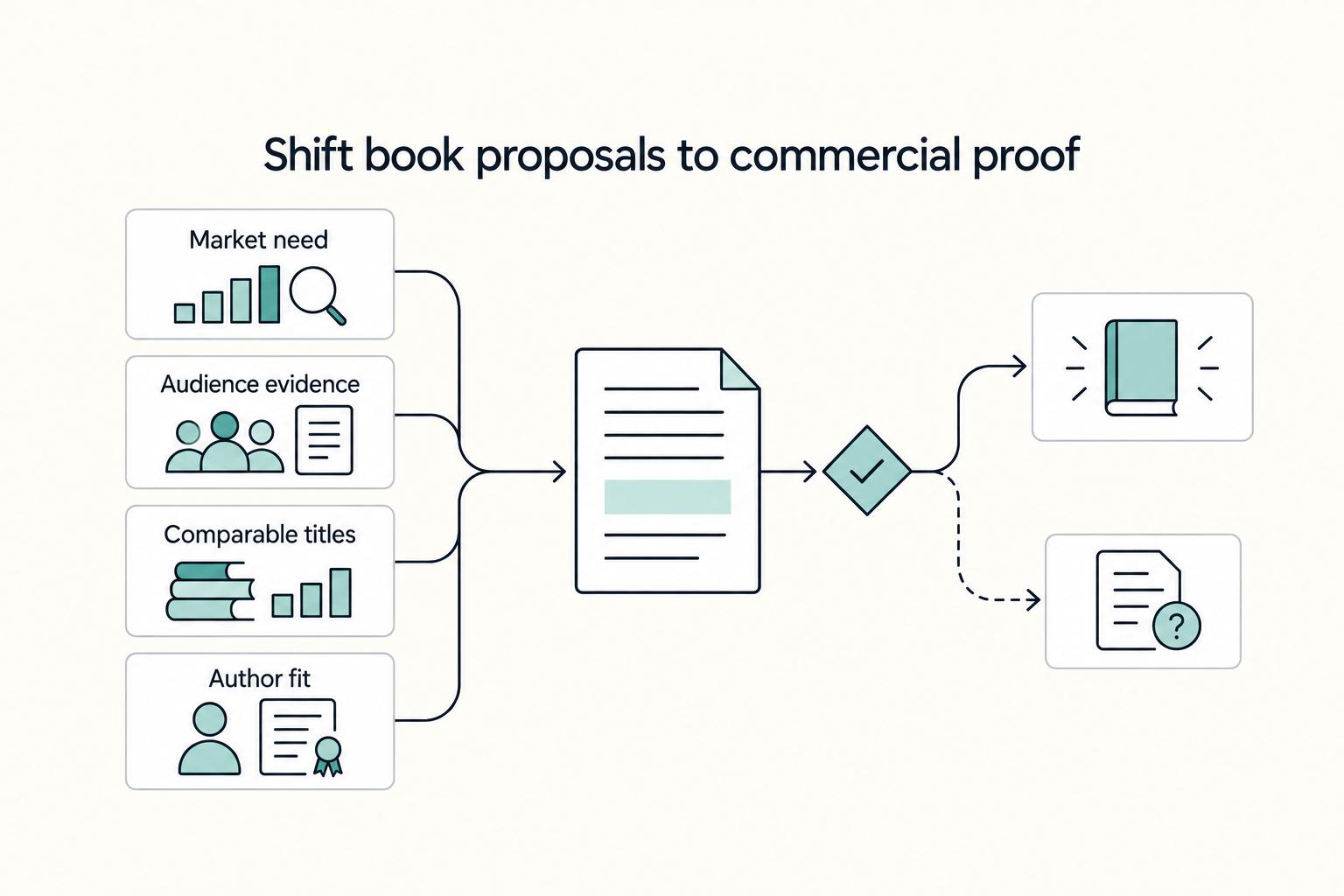
A nonfiction book proposal is not just a request for approval. It is a business case. An editor is weighing acquisition risk: is there a clear need, a reachable audience, a distinct concept, and an author who can help sell the book?