
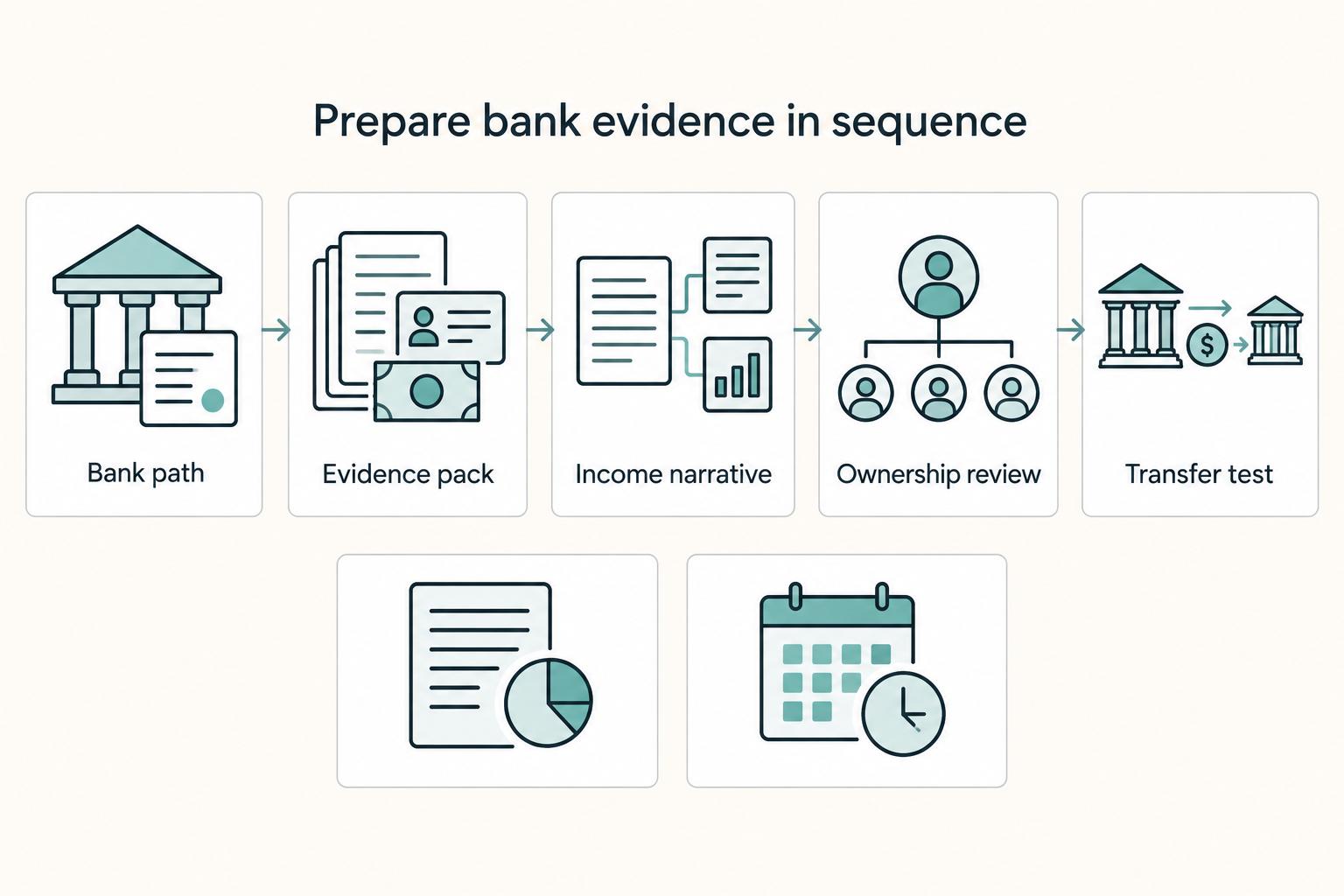
Quick Answer
Non-resident products exist, but approval and attendance requirements depend on the bank and account. Confirm eligibility, permitted activity, fees and opening channel before submitting identity, address, tax-residency and source-of-funds evidence. Test transfers after approval. Keep CRS self-certification, any applicable U.S. FBAR filing and tax-residency analysis separate.
How to Open a Bank Account in Uruguay#
Opening a bank account in Uruguay is usually a compliance exercise, not a quick branch errand. You will usually move faster if you choose the right bank path first, then submit a source-of-funds file that makes KYC and AML review easier.
Before you start, expect identity checks, address verification, tax-residency questions, and extra documentation if you are a foreigner or non-resident. Uruguayan due diligence rules apply to all clients, and banks may also ask for beneficial-owner details when you apply through a company or similar structure.
Choose your bank path first#
Pick the path before you collect paperwork. It shapes almost everything that follows. The onboarding channel, document burden, and day-to-day usefulness can vary a lot by product.
| Path | Onboarding friction | Transfer practicality | Best use case | Compliance burden |
|---|---|---|---|---|
| Traditional local bank | BROU requires new foreign non-resident clients to contract a fixed-term deposit of at least USD 5,000 or currency equivalent for at least 181 days, alongside its documentation checks. | Confirm supported currencies, receiving instructions, fees and transfer limits for your use case. | You want a local banking relationship and can meet product conditions. | High at entry, with product-specific checks. |
| International bank with local presence | Medium to high. Itaú lists ID, proof of address, and a bank reference letter; published non-resident account cost is USD40 mensuales. Santander markets remote opening for one non-resident product, but onboarding mode is conditional in its terms. | Local account features and international transfer terms depend on the chosen product; group recognition does not establish lower cost or easier approval. | You want a local account with a more international onboarding model. | High, but can be easier to map to non-resident requirements. |
| Fintech-to-local transfer workflow | Varies by provider, and this is not immediate local bank-account onboarding. | Can help with collection or conversion before local settlement, depending on provider and corridor. | You need payment collection now and local account setup later. | Separate provider rules apply; local-bank due diligence still applies once you open a Uruguayan bank account. |
Santander’s June 2025 non-resident product sheet states branch opening below USD 100,000 and in-person attendance for accounts exceeding USD 500,000, despite its remote-opening headline. The Select and private-banking service bands are not a universal remote-eligibility promise. Confirm the current product, amount and exact attendance requirement in writing before arranging travel or transferring funds.
A simple way to make this decision is to work backward from your first real use case. If your immediate need is to receive local payments or hold funds inside Uruguay, a traditional local bank or international bank with local presence may make sense despite higher onboarding friction. If your immediate problem is getting paid at all and local settlement can wait, the fintech-to-local workflow can buy you time while you prepare for local bank review.
Before you collect documents, verify three points for the exact product you want:
- whether the product is actually available to non-residents;
- whether the process is branch-based, partly remote, or conditionally remote; and
- whether the account is useful for your intended transfer pattern after opening.
- whether the product permits your intended freelance or business receipts, rather than assuming a personal account covers commercial activity.
Build the application package#
A strong application package does two jobs: it proves who you are, and it makes the money trail easy to follow. Keep one clean folder with consistent filenames and a short cover note that explains what you do, how you get paid, and why you need the account.
| Document | Why the bank asks for it | What strong evidence looks like | Common rejection trigger | Your pre-submit check |
|---|---|---|---|---|
| Passport or ID | Core identity due diligence | Clear, valid, full-page scan | Expired document or cut-off scan | Name matches all other documents |
| Proof of address | Profile and non-resident verification | Recent official document showing the address | Old document or mismatched address | Same address format across forms |
| Tax ID and tax-residency details | CRS tax-residency due diligence and annual reporting duties | Official tax number and clear residence statement | Missing TIN or unclear residency answer | Declare every tax residence and corresponding TIN, or the permitted reason a TIN is unavailable; do not force multiple residencies into a single-country answer |
| Bank reference letter (when requested) | Third-party comfort on banking history | Letter confirming relationship and account-holder identity | Generic note with missing identity details | Date, full name, and identity details are clear |
| Source-of-funds file | Review of the origin of funds | Contracts, invoices, and statements that show matching deposits, plus a short summary note | Payment trail does not reconcile | You can trace each sample payment from work to deposit |
A common delay here is an unclear source-of-funds narrative. Make it explicit: what service you provide, who pays you, and where each payment appears in your statements. If the reviewer has to guess how the money moved, your file slows down.
For example, suppose an invoice is USD 1,000 but the bank credit is USD 975. Include the agreement, invoice, transfer reference and bank entry, then explain the USD 25 deduction using the available payment record. If an affiliate pays for the client or a provider reference differs from the invoice number, document that mapping. An unexplained difference is harder to review than a labelled fee or authorized payer relationship.
A practical folder structure helps more than most applicants expect. Keep identity documents, address proof, tax details, bank reference, and source-of-funds evidence separated clearly. Avoid sending a loose pile of screenshots, mixed file types, or duplicate versions of the same document. The goal is not to overwhelm the bank with paper. It is to reduce reviewer effort.
Your cover note should be short and factual. A useful version usually does four things:
- states your occupation or business activity in one line;
- explains how clients or counterparties pay you;
- explains why you need the account; and
- points to the documents that support those statements.
Check names, addresses and identifiers across the file. Explain legitimate differences, such as an old address on a historical statement, an abbreviated bank reference or an authorized separate payer. Do not alter genuine records just to make every field look identical.
If you apply through a company or similar structure, prepare the file with beneficial-owner review in mind instead of waiting to be asked. The bank should not have to infer who in the end controls the structure from scattered attachments. Make sure the ownership picture and the account purpose are easy to understand from the start.
Submit and prepare for follow-up#
Do not submit until you have confirmed the exact product, onboarding channel, and whether a branch visit is required. Remote marketing language does not always mean the whole process stays remote.
| Failure mode | What to re-check | Effect |
|---|---|---|
| Assumed remote opening meant no branch involvement at all | Whether a branch visit is required and which step becomes in person | Adds time because the bank has to resolve uncertainty |
| Source-of-funds explanation in email does not match the submitted note | Use the same factual base every time | Adds time because the bank has to reconcile conflicting explanations |
| Bank reference or address proof lacks enough identifying detail | Identifying detail in the bank reference or address proof | Adds time because the bank has to resolve uncertainty |
| Company-related applications do not surface beneficial-owner information clearly enough at the start | Prepare beneficial-owner details as part of due diligence | Adds time because the bank has to resolve uncertainty |
Expect questions on AML, KYC, CRS, tax residency, and possibly PEP status. If you are a politically exposed person, disclose it early. Enhanced review can include senior approval and deeper source-of-funds checks. If you apply through a company, prepare beneficial-owner details as part of due diligence.
Applications often stall when answers arrive slowly, arrive in fragments, or change depending on who is asking. Treat follow-up as part of onboarding, not as a surprise exception. Once you submit, keep your full document pack and your summary note at hand so you can answer from the same factual base every time.
Answer each follow-up from current facts and supporting records. Reuse the source-of-funds mapping where it remains accurate, but disclose and explain any changed address, activity or tax residence instead of repeating an outdated application answer.
This is also the point where process discipline matters. If the bank asks for an additional file, send exactly that file rather than re-sending everything unless requested. If a branch visit is needed, confirm what originals or printed copies you should bring. If the account is conditionally remote, clarify which step becomes in person and at what point in the sequence. That saves unnecessary back-and-forth.
Integrate the account and calendar compliance#
Approval is not the end of the job. Before you start routing meaningful client money, run a small inbound and outbound transfer, confirm online access, and store SWIFT and account operating details securely. That simple test reduces avoidable payment errors later.
| Topic | Trigger or criterion | Timing or note |
|---|---|---|
| CRS | Reportable accounts under the institution’s due-diligence rules | Supply accurate self-certification and update changes; the institution handles its reporting to DGI |
| FBAR | U.S. person with financial interest in or signature authority over reportable foreign accounts; aggregate value exceeds USD 10,000 at any time during the calendar year | Due April 15, with an automatic extension to October 15, subject to applicable exceptions or special relief |
| Uruguayan fiscal-residency certificate | Presence of more than 183 días in a calendar year | Opening the account by itself is not one of the listed criteria; other criteria also exist |
Under CRS, provide accurate tax-residency self-certification and update the bank when it changes; the financial institution, rather than every account holder, handles its reportable-account submission to DGI. Separately, a U.S. person with financial interest in or signature authority over reportable foreign accounts generally has an FBAR duty when their aggregate value exceeds USD 10,000 at any time during the calendar year. The usual due date is April 15 with an automatic extension to October 15. Check applicable exceptions and special filing relief.
Keep tax residency analysis separate from account opening. Opening the account by itself is not one of the listed criteria for a Uruguayan fiscal-residency certificate. One official criterion is presence of more than 183 days in a calendar year, and other criteria also exist. For operations, pair your banking setup with a repeatable payment process using this freelance finance automation guide. Handle residency planning in parallel with Uruguay's digital nomad visa and tax context.
After that, organize your records as if future questions are normal. Keep the opening pack, approval communications, and transfer details together. If the bank later asks about activity, you will be able to answer from the same materials you used at onboarding. That continuity matters, especially if your income comes from recurring professional work rather than a single employer.
Once the account is active, standardize your payment flow. Use consistent invoice details, keep counterparties aligned on how they reference payments, and save supporting records as you go. That way, if the bank asks about incoming funds later, you are not reconstructing the story from old emails and scattered statements.
Do you always need to appear in person?#
No universal rule applies across products. Some products advertise remote onboarding, but the terms can still require branch presence depending on balance bands or other product conditions. Confirm the exact requirement for your chosen product before you submit.
Do not rely on broad marketing wording alone. Ask whether the product you want is available to a non-resident, whether the initial application can be filed remotely, and whether any later verification step still requires in-person completion. Those are different questions, and confusing them is one of the easiest ways to lose time.
What most often slows approval?#
An unclear source-of-funds file can become a blocker. If contracts, invoices, and deposits do not reconcile, review can take longer or pause for follow-up. Make the money trail easy to follow without extra explanation.
In practice, this often means the bank can see income but cannot easily see origin, sequence, or linkage. Fix that before submission by choosing a few representative payments and tracing each one from the underlying work to the statement entry. If the connection is obvious to a stranger, your file is in much better shape.
Can you apply with only a passport and proof of address?#
Those are usually the starting documents, not always the full file. Banks can request additional evidence, especially for foreigners and non-residents. Plan for follow-up requests from day one.
Treat passport and address proof as the front door, not the whole application. If your profile is straightforward and the product is simple, those documents may move the process forward. If your income pattern, residency status, or account purpose needs more review, you will want the rest of the package ready rather than assembled under deadline.
Final action checklist#
| Step | Action | Why it matters |
|---|---|---|
| 1 | Confirm your bank path and the exact non-resident product terms | Product clarity tells you what to collect |
| 2 | Assemble ID, proof of address, tax details, and reconciled source-of-funds evidence, plus a bank reference when requested | A clean evidence pack makes follow-up easier to answer |
| 3 | Write a one-page income narrative tied to specific documents | Make the money trail easy to follow |
| 4 | Pre-check whether your case triggers PEP or beneficial-owner review | Disclose PEP status early and prepare beneficial-owner details as part of due diligence |
| 5 | Test transfers after opening; update CRS self-certification and assess any applicable personal reporting or residency duties separately | Verify actual account operation without treating bank reporting as your own filing obligation |
Before choosing the payment route, use the Payment Fee Comparison tool to estimate costs, then verify the bank’s actual fees, exchange quote, transfer limits and delivery timing.
If you want a cleaner operating model for receiving bank transfers and tracking money movement, review Virtual Accounts to confirm fit and coverage for your setup.
Frequently Asked Questions
Do you always need to appear in person?
No universal rule applies across products. Some products advertise remote onboarding, but the terms can still require branch presence depending on balance bands or other product conditions. Confirm the exact requirement for your chosen product before you submit.
What most often slows approval?
An unclear source-of-funds file can become a blocker. If contracts, invoices, and deposits do not reconcile, review can take longer or pause for follow-up. Make the money trail easy to follow without extra explanation.
Can you apply with only a passport and proof of address?
Those are usually the starting documents, not always the full file. Banks can request additional evidence, especially for foreigners and non-residents. Plan for follow-up requests from day one.
Try a related tool
Researched and edited by the Gruv editorial team. Gruv builds cross-border billing, payouts, and finance-operations software for global businesses.
Sources
Includes 5 external sources outside the trusted-domain allowlist.
- irs.gov/businesses/small-businesses-self-employed/re...trusted
- oecd.org/en/publications/peer-review-of-the-automatic...trusted
- brou.com.uy/personas/cuentas/clientes-no-residentes-extr...external
- gub.uy/secretaria-nacional-lucha-contra-lavado-acti...external
- gub.uy/direccion-general-impositiva/comunicacion/pu...external
- itau.com.uy/inst/cuentaNoResidente.htmlexternal
- santander.com.uy/sites/default/files/2025-08/CARTILLAS_Cuenta...external
Educational content only. Not legal, tax, or financial advice.
Related Posts
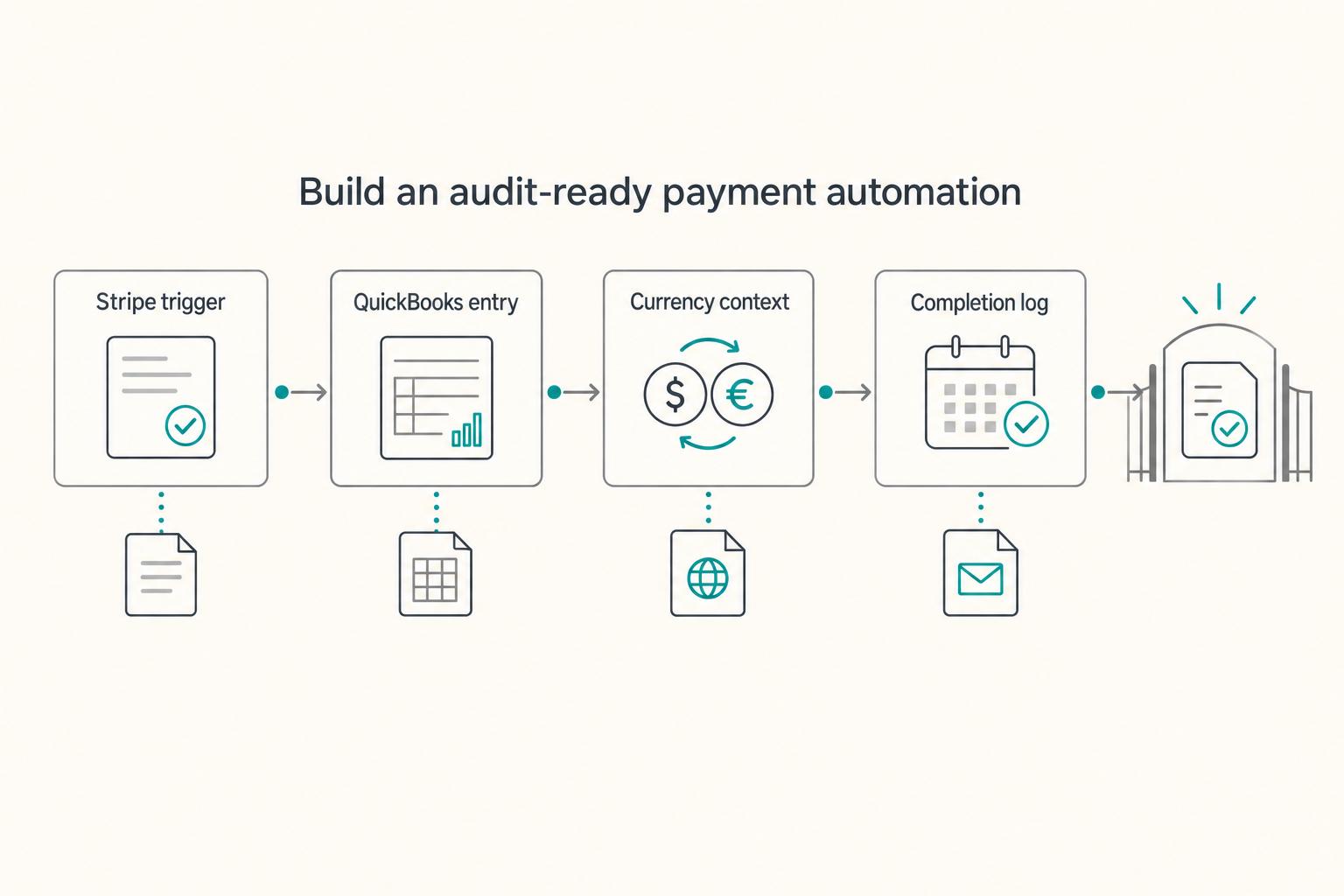
Automating Your Freelance Finances: A Zapier Workflow for Connecting Stripe, QuickBooks, and Wise
Start with one payment flow you understand, then automate its accounting record without losing the source reference. Stripe captures payments, QuickBooks holds the books, Zapier connects the selected steps, and Wise records any separate cross-border balance or conversion activity.

Hungary White Card Guide for Digital Nomads: Eligibility, Documents, Fees, and Timeline
Treat this like an audit, not a hope-and-pray submission. Your job is to decide whether your real-world setup fits the permit logic, pick the right filing route, then build one evidence pack that stays coherent even if someone reviews it line by line.
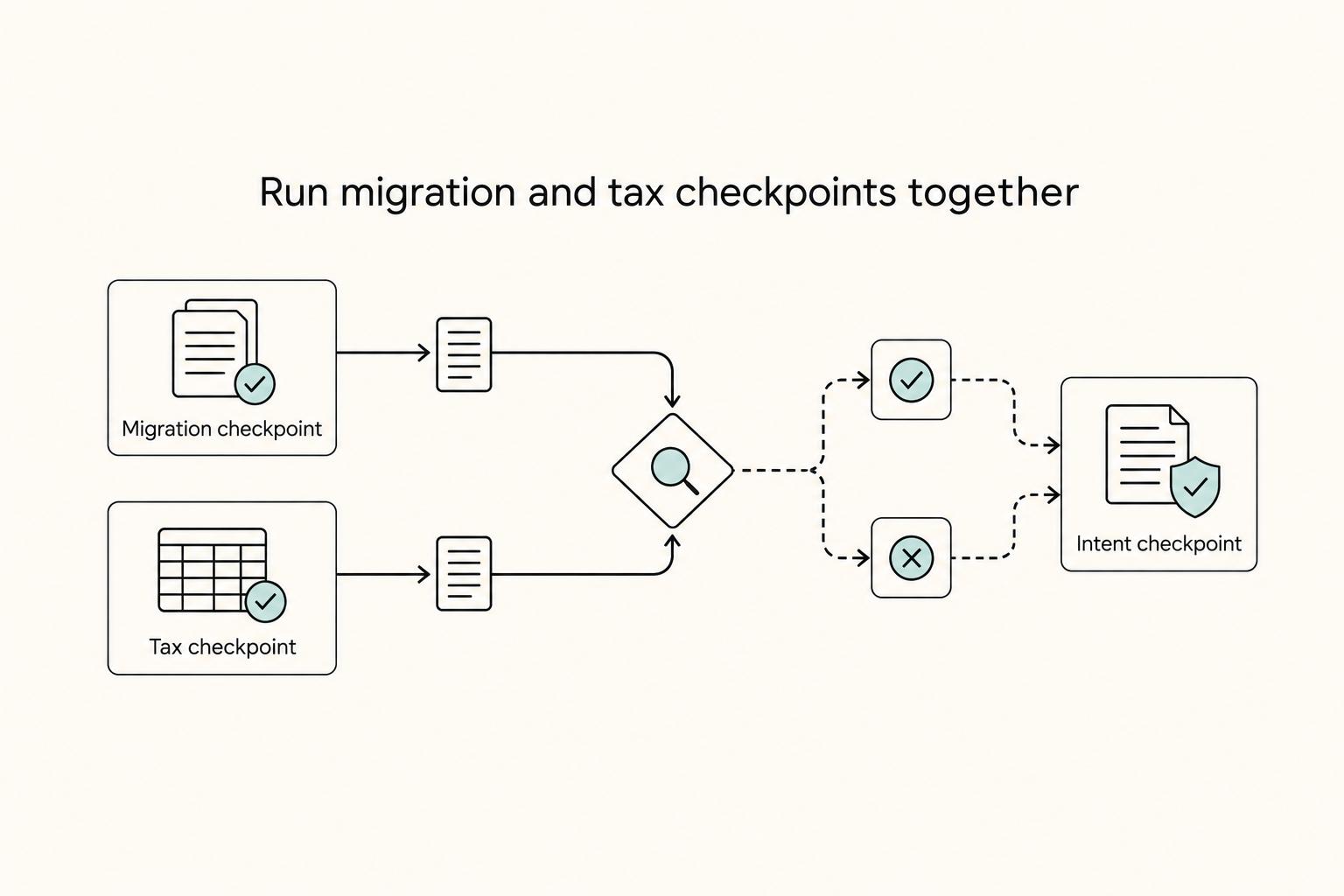
Uruguay Digital Nomad Visa: Stay Length, Tax Residency, and Income Treatment
If you're looking at the **uruguay digital nomad visa**, the bigger risk is often not entry itself. It is letting a short-stay setup drift forward without making separate decisions about migration timing, tax residence, and how different income is treated.