
Quick Answer
Verify the exact document first: for police clearance for visa, request the certificate from the authority named in your destination process, not a generic local background printout. Then align your submission timing to the stricter rule between the issuer and the visa authority, and confirm whether translation, apostille, or other legalization is required. Keep a country-by-country tracker so you can act quickly if validity or filing status changes.
Why Your Police Clearance Certificate is the Most Critical Document in Your Application#
A police clearance mismatch can slow your case, leave your file incomplete, or trigger rejection where document rules are strict. In U.S. workflows, police records are routine in immigrant civil-document packages but not routinely required in nonimmigrant cases. For visa use, treat the police certificate as a civil document from the exact government authority named in your destination program instructions. Do not treat it as just any criminal record printout.
Choose the exact record the visa authority asks for#
This is the first decision that matters because police records are country- and program-specific. The document name and issuing authority can vary by country and program. A local police background check may be a different document type altogether. Foreign use may also bring authentication requirements, including Apostille and non-Apostille paths. If the document language does not meet program conditions, certified translation may also be required.
Use a simple rule: request the document from the authority and jurisdiction level named in the official checklist or country document tool. In U.S. immigrant processing, documents are expected from designated authorities. If you plan to use an FBI Identity History Summary or a local police report, confirm that exact format is accepted before you file. Quick verification before applying:
- Issuing authority named in official instructions
- Required level (national/federal/state/local)
- Accepted format (original/electronic/copy rules)
- Translation/authentication/Apostille requirements
Decide whether you need a certificate, and from which countries#
Do not carry one country’s rule into every visa pathway. Police certificate triggers are program-specific. The right question is not "Do applicants usually need one?" It is "What does this process require for my age, residence history, and arrest history?"
Use this checklist to separate known examples from rules that still need official confirmation:
- Age trigger: U.S. consular guidance example uses
16+; Canada Express Entry uses18+. - Residence trigger (nationality/current residence): U.S. consular guidance example includes more than
6 months. - Residence trigger (other countries): U.S. consular guidance example includes
12+ months; Canada Express Entry uses the last10 yearsand stays of6 months in a row or longer. - Arrest trigger: U.S. consular guidance can require a certificate regardless of age or duration of stay.
- Official unavailability: if country guidance says a certificate is unavailable, it may be waived.
- Confirm the destination-program threshold for your visa category with the visa authority
- Confirm the prior-residence and arrest-history rules with the visa authority
Manage timeline risk from issue date to submission date#
Timing risk is usually a rule mismatch, not a generic "expiry" problem. What matters is whether the certificate still meets the program rule at the moment you must submit it.
| Record type | Typical issuing authority level | Acceptance format | Translation/legalization need | Consequence of mismatch |
|---|---|---|---|---|
| Local police background check | City or local police department | Varies by destination program | May still need translation/authentication and may still be the wrong jurisdiction level | Can be treated as the wrong document |
| Visa-use police certificate | Designated authority named in official instructions | Exactly as program specifies | May require certified translation and authentication/Apostille | Delay, incomplete file, or rejection (program-dependent) |
Use grounded timing examples to model your plan:
- Canada: current-residence certificate must be issued within
6 monthsbefore submission; Express Entry gives60 daysto submit police certificates. - U.S. Embassy/Consulate in Japan guidance: certificate validity stated as
2 years, with an exception for a prior residence country if you have not returned since issuance.
For your case, confirm current residence validity, prior residence validity, submission window, and renewal trigger against official instructions before you plan filing dates.
Treat “incomplete” as a quality mismatch, not only missing files#
"Incomplete" often means the file is present but unusable. In practice, the predictable failure points are the same: wrong issuing authority, wrong jurisdiction level, unauthorized copy, stale issue date, missing translation, missing authentication, or the wrong format for that country and program.
Official outcomes vary by workflow. Some processes delay cases for missing civil documents. Others reject unauthorized or non-accepted copies. The State Department civil-documents FAQ is a useful cross-check, but you still need the country-specific instruction set. To reduce that risk, verify in this order before submission: issuer and format first, then timing, then translation or legalization.
If you want a deeper dive, read the 2026 Global Digital Nomad Visa Index.
Phase 1: Architect Your Strategy#
Treat this as one managed process, not a set of separate errands. Build a single tracker and make every police certificate decision pass through it before you file anything. Use the tracker to hold any country-specific legal requirement until you confirm it from official sources.
Build one dashboard and assign ownership#
Use one spreadsheet or task board as your single source of truth. If a detail is not in that tracker, treat it as not ready. Use fixed fields for each country row:
- Country
- Visa program or filing stage
- Required authority level
- Acceptable application channel
- Required output format
- Translation needed
- Legalization or apostille needed
- Owner
- Status
- Submission deadline
- Issue date
- Validity window
- Evidence link or folder path
- Notes with source URL and date checked
Assign one owner per row, even if that owner is you. Use clear status labels such as Not started, Rule verified, Applied, Waiting, Received, Needs translation, Needs legalization, Ready to file, Blocked, and Reissue needed.
Select the document with a repeatable decision tree#
Consistency matters more than speed here. If you use the same decision order for every country, you reduce the chance of requesting the wrong document.
Start with the authority level, then the application channel, then the output format. Only after that should you lock the translation or legalization path.
- Authority level
Record the exact authority level once confirmed from official sources.
- Application channel
Record the accepted application channel once confirmed from official sources.
- Output format
Record the required result format once confirmed from official sources.
- Translation/legalization path
Record whether translation, notarization, or legalization is required. Keep one explicit checkpoint for Certified + Notarized Translation when relevant.
Important control: commercial pages, including pages built around "Get a quote," may help you plan services, but they are not official proof of immigration requirements.
Build a critical-path timeline#
Your timeline should be built around the slowest or most failure-prone certificate, not the easiest one. Map the sequence before you submit any requests, then run independent tasks in parallel where you can.
- Longest-lead PCC: Confirm the current processing window with the issuing authority
- Pre-request dependencies: Confirm the current document requirements with the issuing authority
- Parallel tasks that can start immediately
- Renewal trigger: Confirm the current validity window with the issuing authority
- Reissue checkpoint before filing
Operational rule: if translation or legalization is still pending, mark the item Received, not filing-ready.
Use a lane comparison table template#
A comparison table helps only if it reflects verified current options. Do not assume turnaround time or cost, and do not fill this in from memory.
| Country record | Main delay risk | When to escalate |
|---|---|---|
| Current residence country | Identity or address mismatch | If pending past your internal buffer date |
| Prior residence country 1 | Routing or format mismatch | If no update as filing date approaches |
| Prior residence country 2 | Translation/legalization lag | If received but still not filing-ready |
Run a pre-submission readiness checklist#
Before you call any country row ready, make sure your evidence is organized. Set up one folder per country and keep identity files, address-history support, receipts, status confirmations, certificate files, translation outputs, legalization tracking, and verification screenshots together. Before marking any row Ready to file, confirm:
- Identity details match across passport, application, and certificate request
- Address history is consistent across forms and requests
- Translation path is decided and aligned with your verified requirement
- Legalization or apostille path is mapped and aligned with your verified requirement
- Evidence capture exists for each submission and follow-up (receipt, tracking, email, or portal screenshot)
That record makes follow-up easier if you later need to explain what was submitted, when, and in what format. Related: 10 Freelance Contract Red Flags That Scream 'Run Away'.
Phase 2: Execute with Precision#
Execution is mostly verification. Before you start any application, confirm three items in the official instructions: issuing authority, exact certificate name, and accepted submission channel.
Verify the issuing authority, certificate name, and channel#
Start with the immigration authority’s instructions, then map them to the issuing body.
- Confirm the issuing authority. For U.S. immigrant visas, reciprocity pages explain how to obtain civil documents, including police records. For Canada, IRCC says that in most cases you must contact local police or government authorities, and some countries require an IRCC request letter before issuing a certificate.
- Confirm the exact certificate name. Common examples are the FBI Identity History Summary Check, the UK Police Certificate via ACRO, and Australia’s AFP National Police Check (Home Affairs: purpose code 33).
- Confirm the accepted submission channel. Verify both the certificate request channel and the visa filing channel, since filing to the wrong office or portal can delay processing.
Verification checkpoint: save the instruction page as a screenshot or PDF with the URL and date checked, then log it in your country row.
| Country | Issuing body |
|---|---|
| United States | FBI |
| United Kingdom | ACRO |
| Australia | AFP |
| Canada example | RCMP or other instructed authority |
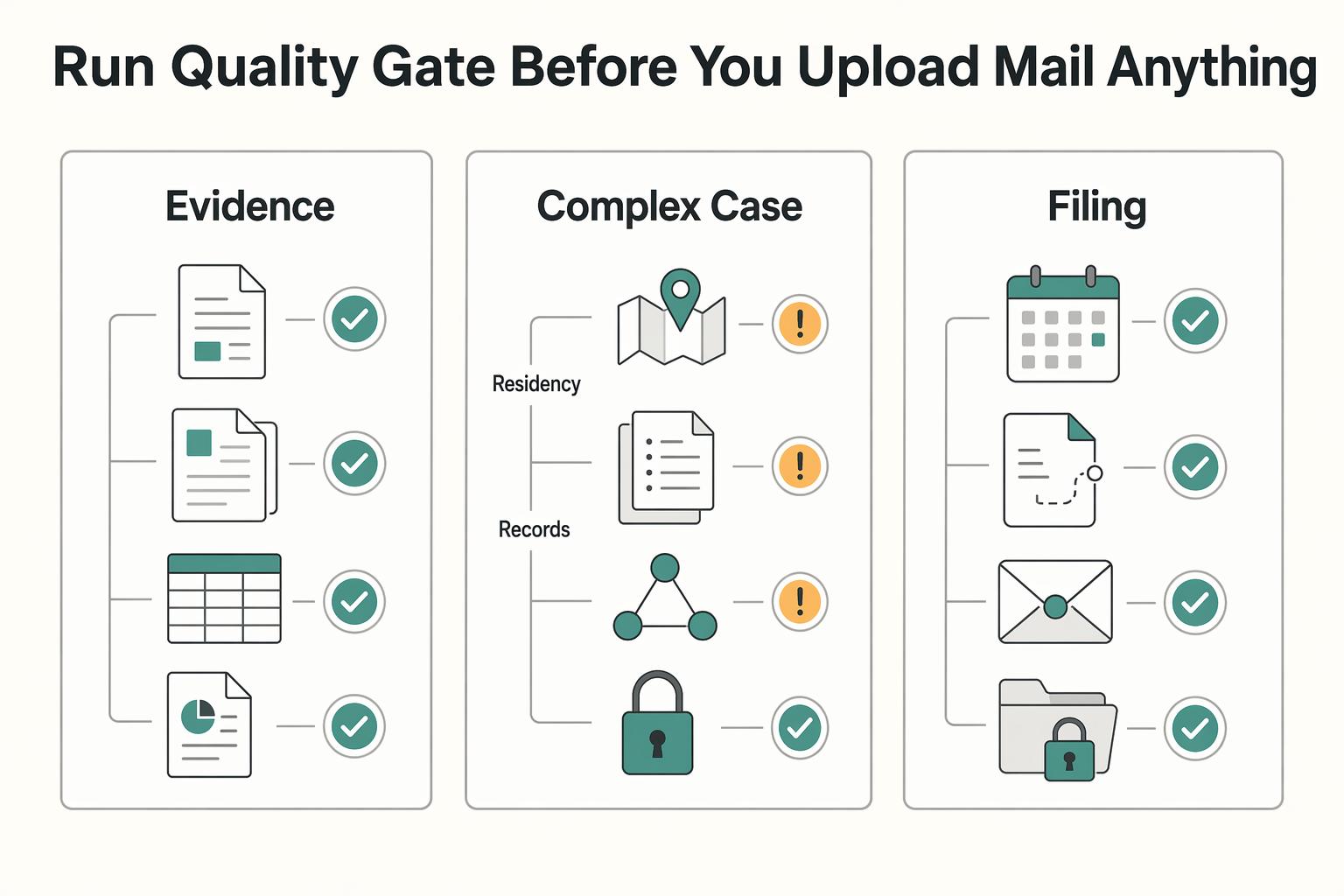
Run a quality gate before you upload or mail anything#
Many avoidable problems show up here before the document is issued.
- Document type match: A police certificate is a criminal record statement, but the accepted version is program-specific. If instructions require a national-level product, do not substitute a local or employer screening record.
- Address-history consistency: Where requested, align address dates across the certificate process, visa forms, and your supporting records.
- Identity-data consistency: Use your passport as the control record. Keep full legal name formatting consistent across forms and certificate requests.
- File-format compliance: Follow program-specific file rules. For IRCC Express Entry, police certificates must be color scans of the original certificate, and certified true copies or unauthorized copies are not accepted. For USCIS filings, do not send originals unless instructions require them. If required, include a full English translation with translator certification.
Create a submission package folder for each country#
Create one submission package folder per country before you file. Save:
- application copy or confirmation page
- payment proof, if applicable
- tracking reference or portal receipt, if provided
- certificate file and any translation file
- correspondence log with dates, names, and message summaries
Use that folder as your escalation and re-submission record if processing stalls or someone asks for clarification.
Classify post-submission issues before you react#
When issues appear after submission, classify the problem before you react. That keeps you from escalating the wrong thing or reapplying with the same defect.
- Pending too long: Compare your case to published processing guidance. Escalate only after the current escalation window is confirmed from official sources. For IRCC, use the over-normal-processing-time path; repeated web forms do not speed processing.
- Request for clarification: Respond only to what is asked, using your saved package to keep names, dates, and document versions consistent.
- Rejection notice: Classify the cause first (document type, identity mismatch, translation, or format), then re-verify the current official requirement before reapplying.
You might also find this useful: How to Get an FBI Police Clearance Certificate for a Foreign Visa.
Before you submit, run a final timeline-and-doc pass with the Visa Cheatsheet for Digital Nomads.
Managing the Multi-Country Challenge#
Multi-country cases become manageable when every jurisdiction is handled with a consistent framework. Complete a country-by-country intake first. Then run requests in parallel and track each one in a single row with four fields: official issuing authority, application channel, delivery format, and translation/authentication path.
Build a country intake sheet#
Start from the visa authority’s country instructions, then map them to the issuing body. In U.S. immigrant cases, start with Step 7: Collect Civil Documents and then confirm the country entry in the State Department Reciprocity Table. In Canada workflows, requirements are country-specific, and some countries issue certificates only after an IRCC request letter.
For each row, record whether delivery is postal, whether the embassy or requesting authority accepts that certificate type, and whether you need a certified translation, Apostille, or non-Apostille authentication. Save the official page as a PDF or screenshot with the URL and date checked.
Lock the fingerprint plan#
Fingerprinting is its own track, and it should not be mixed up with visa biometrics. Confirm the accepted fingerprint requirements for each country, verify provider compatibility, and document any special handling requirement once confirmed from official sources before you book.
If you need an FBI Identity History Summary Check, valid channels include participating U.S. Post Office electronic capture, a mailed fingerprint card, or an FBI-approved Channeler. Do not assume one provider works for every country. Do not plan on U.S. embassies or consulates abroad for fingerprinting. For FD-258 cards, incomplete required fields can trigger rejection, and prints must be rolled nail-to-nail.
Sequence the dependencies#
Once the intake and fingerprint plan are set, sequence the work around what can actually hold up filing.
| Dependency | Confirm first | Why it matters |
|---|---|---|
| Critical-path certificate | Longest published processing time or limited channel | Sets your true earliest filing date |
| Shipment dependency | Hard-copy delivery, courier risk, alternate address | Postal disruption can stall the package |
| Translation dependency | Whether certified translation is required before filing | Certificate may be usable only after translation |
| Embassy submission dependency | Embassy/requesting-authority acceptance | Not every certificate format is accepted everywhere |
Example: ACRO lists up to 20 working days (standard) and up to two working days (premium), but hard-copy delivery can still become the delay point.
Triage blockers and run a ready-to-file gate#
A weekly status review is a practical control, especially once several countries are in motion. For each delayed row, classify the blocker first: authority delay, fingerprint rejection, shipping issue, translation hold, or acceptance uncertainty. Then use your recorded contact path and escalate only after the current escalation window is confirmed from official sources.
If a document is genuinely unavailable, use the process-specific fallback where allowed. In the NVC flow, that can mean selecting “Not available” and submitting a detailed explanation. Before final filing, confirm that every required certificate is still valid for that authority and in the accepted format. Also confirm that it is translated or authenticated when needed.
For a step-by-step walkthrough, see Should You Choose Indonesia’s Second Home Visa for a Long Stay?.
Conclusion: From Anxious Applicant to Confident Project Manager#
The shift that helps most is simple: handle this like a managed filing process, not like a last-minute document chase. Verifying details against official government guidance is your first job.
Obtaining a PCC does not have to stall your plans. What reduces stress is structure. Once you verify the right issuing authority, the right certificate type, and the right timing rule for each country, the rest becomes execution.
Treat the process as a project with clear controls:
- Architect: Turn uncertainty into a workable structure by mapping each destination’s requirements, accepted certificate types, and timing rules. These are not universal, and issuance windows can differ depending on where you currently live and where you lived before.
- Execute: Use official instructions for each visa route and country, then request the right document from the right authority. Confirm acceptance criteria early, because a certificate accepted in one destination may be rejected in another.
- Mitigate: Build buffer time into your critical path. Police certificates can take time to obtain, and officers may still require one under program rules, so starting early is practical risk control.
What you are really protecting is not just a document checklist. You are protecting your time, your momentum, and your ability to keep the case moving. Every early verification step lowers the chance of avoidable delay and gives you more control over the outcome.
We covered this in detail in Digital Nomad Visa Guide for 2026 Moves. For your next move, keep your visa and relocation admin in one practical workflow with Gruv Tools.
Frequently Asked Questions
How long is a police clearance certificate valid for a visa?
While requirements vary, a globally accepted best practice is to assume a PCC is valid for six months from its date of issue. Some authorities may accept certificates up to 12 months old, but basing your timeline on the stricter six-month window is the safest approach to avoid rejection.
What is the fastest way to get a police clearance certificate?
For time-sensitive applications, use expedited services. For the United States, use an FBI-Approved Channeler for results in 24-48 hours. For the United Kingdom, use the ACRO 'Premium Service' for processing in two working days. For Australia, the official AFP online portal is already very fast, often completing applications within 48 hours.
Can I apply for a police clearance certificate online?
Yes. For nearly all major destinations, including the US (via channelers), the UK, and Australia, online applications are the standard and most efficient method. Digital portals offer superior tracking and reduce the risk of documents lost in the mail.
What happens if my police clearance certificate expires before my visa is processed?
If you realize a certificate will expire while your visa is pending, do not wait to be asked. Immediately apply for a new certificate, notify the embassy or consulate handling your application with proof of your new application, and submit the new certificate the moment you receive it. This proactive approach reinforces your credibility.
What is a master checklist of documents needed for a police clearance certificate?
While the precise list varies, the core requirements are consistent. Have these ready: a high-resolution color scan of your passport's biographical data page, proof of your current address, a complete history of your previous addresses, a recent passport-style digital photograph, a completed application form, and payment for the fee. Always verify this list against the official website of the specific issuing authority before you apply.
Researched and edited by the Gruv editorial team. Gruv builds cross-border billing, payouts, and finance-operations software for global businesses.
Sources
- dot.ca.gov/-/media/dot-media/programs/design/documents/...trusted
- ecfr.gov/current/title-22/chapter-I/subchapter-E/part...trusted
- fbi.gov/how-we-can-help-you/more-fbi-services-and-in...trusted
- fbi.gov/how-we-can-help-you/more-fbi-services-and-in...trusted
- fema.gov/sites/default/files/2020-08/fema543_design_g...trusted
- forms.fbi.gov/cjis-ucr/identity-history-summary-checks-reviewtrusted
- jp.usembassy.gov/visas/immigrant-visas/police-certificatetrusted
- jp.usembassy.gov/visas/faq-list/police-certificatestrusted
Educational content only. Not legal, tax, or financial advice.
Related Posts

The 2026 Global Digital Nomad Visa Index for 50+ Countries
Start with legal fit, not lifestyle filters. The practical order is simple: choose a route you can actually document, then decide where you want to live. That single change cuts a lot of wasted comparison work and stops you from falling in love with places that were never a real filing option.
10 Freelance Contract Red Flags That Scream 'Run Away'
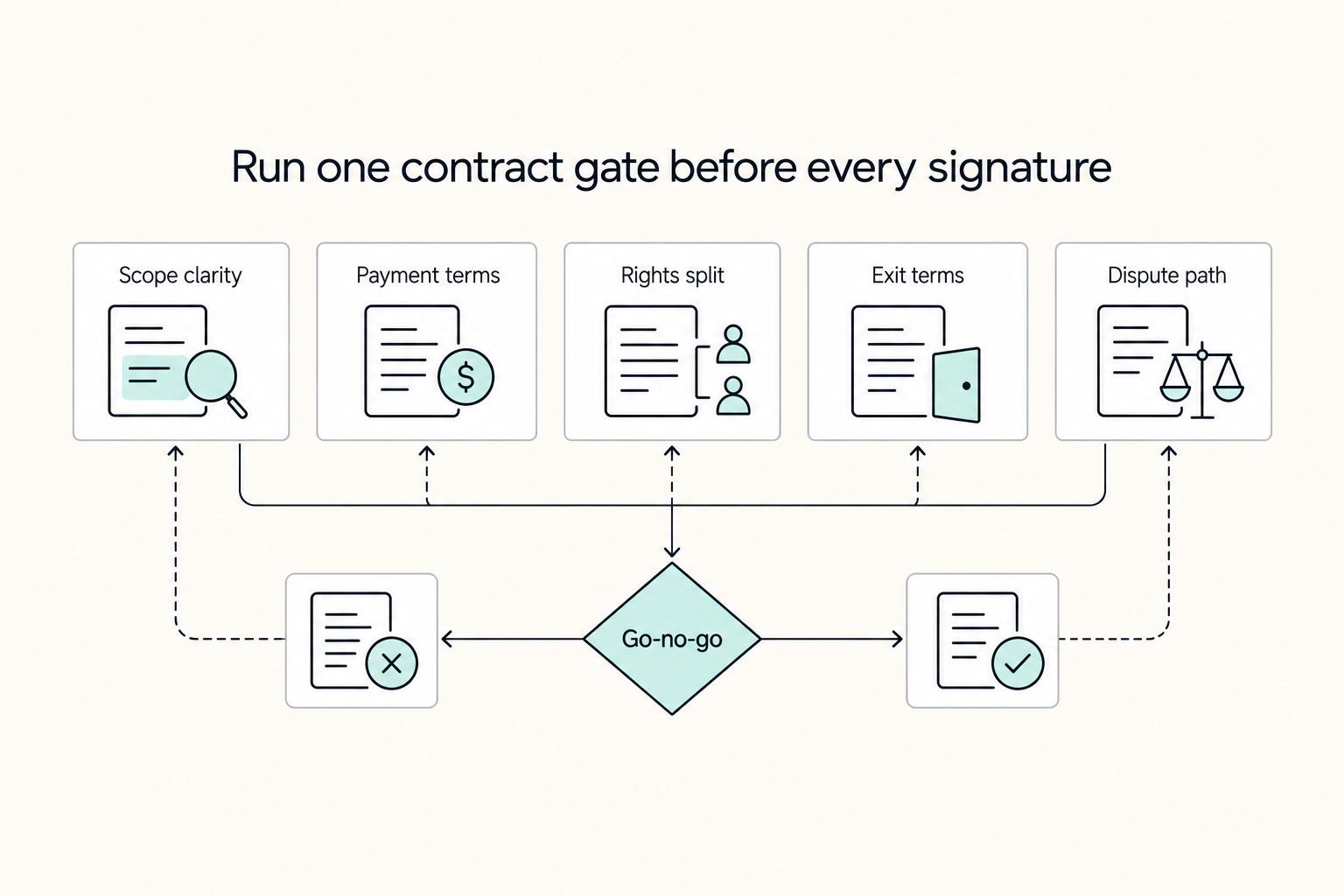
Use this as a fast decision screen, not a legal theory exercise: sign the Freelance Contract, send a Contract Redline, or walk away.

The Freelance Payment Penalty: A Modeled Audit of Platform Fees, FX Spreads, and Payout Delays
The money rarely disappears through a single, easy-to-spot fee. The real loss is stacked. A marketplace takes its commission, a processor adds a charge for international cards, a bank or payment company converts the currency at a spread, a platform holds the funds before release, and a wire sheds a little to intermediaries on the way in. Each layer looks defensible on its own, but the worker feels the combined result as a smaller deposit and a later payday.