
Quick Answer
Start with routing, not paperwork: define your exact outcome, then confirm the current channel with the competent authority for your case before you assemble documents. Keep VAT mechanisms such as OSS and CBR on a separate track, because they do not determine Italian personal-ID issuance. After issuance, compare the recorded identity fields to the primary document used at filing and reuse one canonical profile across counterparties. If a record is rejected, request the exact mismatched field and escalate with your filing evidence.
Separating Personal-ID, VAT, and Residency Tracks#
Use this as a control framework, not a shortcut. Its job is to help you sort the problem correctly, check the live route before you act, and protect the result once the number is issued. That matters because people often lose time at the start by treating three different issues as one: personal-ID issuance, EU VAT reporting choices, and tax-residency analysis.
This framework helps you separate those tracks so you do not build the wrong file or ask the wrong authority the wrong question. It does not establish the Codice Fiscale issuance procedure itself, and it should not be treated as a substitute for current instructions from the competent authority for your facts.
If your main question is tax residency, treat that as a separate analysis. Do not try to infer residency from a personal-ID step or from a VAT setup choice. Use Gruv's Tax Residency in Italy guide for that separate question.
In practice, use this playbook like this:
- first, define exactly what outcome you need;
- then, confirm the current route for that outcome before you assemble documents;
- then, after issuance, control how the data gets reused so a small mismatch does not become a larger systems problem.
That is usually where speed comes from: not from guessing a channel first, and not from borrowing a process from someone whose facts are not the same as yours.
Step 1. Define the Exact Problem Before You Start#
You can usually save time by defining the exact problem before you start. Many avoidable delays happen when people mix personal-ID issuance with VAT or residency questions and end up following the wrong process.
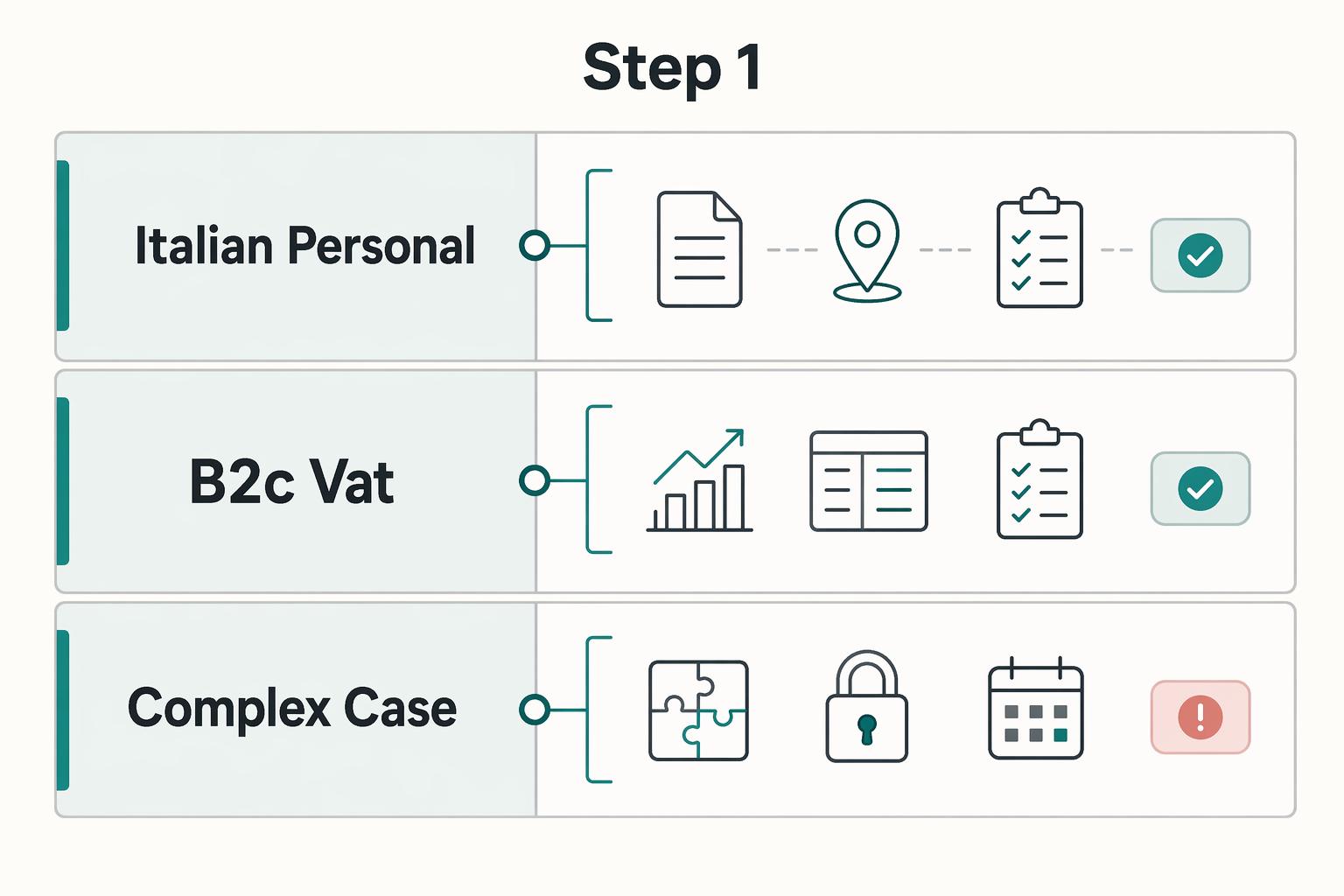
Before you gather anything, write the problem in one sentence answering one basic question: what, exactly, are you trying to get resolved right now? If the answer is "I need the Italian personal-ID issuance path for my case," that is one track. If the answer is "I need to know how to report covered EU B2C VAT," that is another. If the answer is "I need certainty on complex cross-border VAT treatment," that is a third. If you cannot state the outcome clearly, you are not ready to submit anything yet.
This first step sounds simple, but it is where time often gets lost. People often begin with a mixed objective such as "I need my Italian tax setup sorted," then start collecting forms, screenshots, and advice that belong to different systems. That creates a file that looks busy but does not actually move the right issue forward.
Use the distinction below as your first filter.
| What you need to decide | Track to use | What this track can answer | What it cannot answer |
|---|---|---|---|
| Italian personal-ID issuance path | Current Italian issuing instructions for your case | Which authority or channel you should use | EU VAT treatment, tax residency conclusions |
| EU B2C VAT reporting setup | One Stop Shop (OSS) | Whether you can register in one Member State for covered VAT declaration and payment | Personal-ID issuance in Italy |
| Complex cross-border VAT treatment | VAT Cross-border Rulings (CBR) | Advance VAT treatment rulings for complex cross-border transactions | Personal-ID issuance, immigration outcomes |
Read the table as a routing tool, not as background theory. Its purpose is to stop category mistakes before they cost you time.
A practical way to use Step 1 is to create three separate working lines in your notes, even if only one of them applies:
- Personal-ID line: what is the current issuing route for your case?
- VAT line: do you also have an OSS or CBR question that should be handled separately?
- Residency line: are you actually trying to answer a residency question that belongs in a different analysis?
If only one line applies, good. If more than one applies, keep them separate from the beginning. Separate notes, separate evidence, separate decision points.
That separation matters because each track produces a different kind of answer. A personal-ID process tells you where and how to pursue issuance for your facts. OSS addresses covered VAT declaration and payment in one Member State. CBR addresses advance VAT treatment rulings for complex cross-border transactions. None of those outputs is a shortcut to the others.
A common failure mode at this stage is using a true statement from one track as if it answers another. For example, VAT planning may be part of your wider business picture, but it does not tell you the correct personal-ID route. Likewise, a personal-ID step does not answer residency. Even if the subjects feel connected in real life, you should resist turning them into one combined filing problem unless the competent authority for your case tells you to do that.
If VAT is part of the picture, keep two things separate. OSS can centralize covered VAT declaration and payment in one Member State, and CBR requests are submitted in a participating country where you are VAT-registered. Both are VAT tools, not substitutes for a personal-ID procedure.
That means you should avoid using VAT terminology as a proxy for personal-ID routing. Do not assume a parallel VAT process means the personal-ID path will follow the same timeline, use the same channel, or rely on the same evidence. The control move is to split the workstreams before either one gets messy.
A practical way to do that is to give each track its own minimal file:
- one file for personal-ID routing and issuance evidence;
- one file for VAT planning or VAT procedure steps;
- one file for residency analysis if that issue exists.
Even a simple folder structure helps. It forces you to ask, "Does this piece of information answer the question in this file, or does it belong somewhere else?" If not, move it out. That discipline prevents mixed submissions and mixed assumptions.
Another useful check at this step is to identify the decision you need now versus the decisions you can defer. If your immediate task is personal-ID issuance, do not let an unresolved VAT question delay the basic routing check unless the competent authority for your case makes that connection explicit. The same logic applies the other way around. If your immediate task is VAT setup, do not assume you need to solve personal-ID routing first unless the relevant process actually requires it for your facts.
You can also pressure-test your issue statement by asking two control questions:
- What exact output am I trying to obtain right now?
- Which authority or process is capable of giving that output?
If you cannot answer both questions cleanly, you are still in Step 1. Once you have separated the issue, confirm the live route before you assemble documents.
That sequencing matters. Do not build a large file first and ask routing questions later. If the route is wrong, the quality of the file will not save you. You can have a neatly organized package and still be in the wrong process entirely. Step 1 is what stops that from happening.
Step 2. Confirm the Current Issuing Route for Your Case#
Confirm the current issuing route for your case before you build your file. That is the control point that can prevent wasted effort.
| Item | Confirm | Why it matters |
|---|---|---|
| Case handling | Who currently handles your case type | Everything else is provisional until this is clear |
| Attendance | Whether attendance is required | Do not infer this from how another process works |
| Representation | Whether a representative is allowed | It changes how you plan your next step |
| Identity fields | Which identity fields must match exactly across documents | Small mismatches can be repeated from one system to the next |
| Instruction record | The exact instruction source and date you relied on | It gives you a defensible basis if the route is later questioned |
This is the step where you stop relying on assumptions, second-hand accounts, old screenshots, or process stories from people whose facts may not match yours. What was true for someone else, or even what looked true recently, doesn't apply here. Only what the competent authority currently says for your case does.
This guide does not support fixed claims about consulate versus in-country versus delegated filing, specific forms, or permit-channel routing, so verify those directly with the competent authority for your facts.
That verification should happen before you spend time assembling a document pack. The right route can determine what you need to prepare, who handles the case, whether attendance is required, whether a representative is allowed, and which data points need to match exactly. If you build the file first, you risk doing precise work for the wrong route.
Use this short checklist:
- Confirm who currently handles your case type.
- Confirm whether attendance is required.
- Confirm whether a representative is allowed.
- Confirm which identity fields must match exactly across documents.
- Save the exact instruction source and date you relied on.
The value of this checklist is not its length. It is the order.
Start with who handles the case type. Until that is clear, everything else is provisional. If the answer is unclear, ask the authority to restate the route in simple terms. You are trying to remove ambiguity, not collect fragments. A vague answer that leaves the channel uncertain is not enough to build on.
Then confirm whether attendance is required. Do not infer this from how another process works, and do not assume a step is remote just because communication can begin remotely. Your aim here is to understand the route as it currently operates for your case, not as you hope it operates.
Then confirm whether a representative is allowed. If the answer is yes, do not stop there. Make sure you understand that this point belongs to the current route for your facts, not just to a general scenario you found elsewhere. If the answer is no or unclear, that matters too, because it changes how you plan your next step.
Then confirm which identity fields must match exactly across documents. This point deserves more attention than people usually give it. Downstream trouble can come from small mismatches that look minor at first and then get repeated from one system to the next. If the authority identifies exact-match requirements, treat them as control data and preserve them carefully.
Finally, save the exact instruction source and date you relied on. This is not just tidy recordkeeping. It gives you a defensible basis for your actions if the route later gets questioned, a counterparty asks how you proceeded, or you need to explain why you followed one channel rather than another. It also helps if you need to revisit the issue later and check whether the instructions changed.
A good way to handle Step 2 is to create a one-page routing record with five items:
- your one-sentence problem statement from Step 1;
- the authority or channel you confirmed for your case;
- the answer on attendance;
- the answer on representation;
- the saved instruction source and date.
That one page becomes the control sheet for the file. If a later action does not line up with it, stop and re-check before you proceed.
Another practical safeguard is this: if different sources appear to point in different directions, do not "average" them into a guess. Resolve the conflict first. Conflicting routing signals are exactly the kind of thing that lead to duplicate effort and avoidable delay. When in doubt, go back to the competent authority for your facts and ask for clarification tied to your case type.
You should also resist the temptation to over-prepare before the route is settled. Over-preparation feels productive, but in this context it can mean creating a larger clean-up problem later. A document pack built for an unconfirmed route can easily become a source of confusion, especially if it contains materials gathered to satisfy assumptions rather than actual instructions.
The smarter move is to verify the route first, then build a lean, controlled file around that route. That approach usually feels slower for an hour and faster over the whole process.
If VAT work is running in parallel, keep it in a separate process. For example, in certain OSS Union-scheme identification scenarios, the selected Member State can bind you for the decision year plus two following calendar years. That matters for VAT planning, not for proving a personal-ID route.
Keep the point simple: a real planning consequence can exist in the VAT track without changing the personal-ID track. So if VAT work is moving at the same time, you need two separate control questions:
- what decision has to be made in the VAT process; and
- what route has to be confirmed for the personal-ID process.
Do not let one answer stand in for the other.
A practical way to keep the separation clean is to maintain distinct evidence bundles. In the personal-ID bundle, keep only what supports routing, identity consistency, and proof of the instructions you followed. In the VAT bundle, keep the planning notes, registration logic, and any materials relevant to OSS or CBR. This protects you from a common operational mistake: reaching into the wrong file when someone asks a question and then answering with information that is true, but true in the wrong context.
Another control point in Step 2 is timing discipline. When you receive current route information, note it clearly and act from that version. If there is a long pause before you submit or follow up, check again before relying on the old note. The point is not that change always happens. The point is that your framework should not depend on stale assumptions.
You should also keep your wording disciplined when you ask questions. Short, direct questions tend to produce cleaner answers. Ask about the route, attendance, representation, identity-field matching, and source. Avoid broad "tell me everything" requests that invite general information but leave the operational point unresolved. Your aim is not to collect more words. Your aim is to get a route you can actually rely on.
Then, once the number is issued, the next risk is reuse errors across other systems.
Step 3. Control Identity Data Reuse After Issuance#
Treat issuance as the start of the control work, not the end. Many downstream problems can come from small identity mismatches that get copied into banks, contracts, payroll, or platforms.
| Order | Action | Why it matters |
|---|---|---|
| 1 | Re-check identity fields against the primary identity document used at filing | Keeps the review anchored to the original source |
| 2 | Ask which exact field mismatches | Helps distinguish a data-entry error, a formatting problem, or something for the issuing authority |
| 3 | Return to the issuing authority with the mismatch details and your original filing evidence | Makes the escalation concrete |
| 4 | Keep one canonical identity profile and reuse it consistently across systems | Reduces retyping drift and repeated mismatches |
This is where many people relax too early. They assume that once the number exists, the job is finished. In practice, issuance often solves only the first problem. The second problem is making sure the same identity data is reused consistently everywhere else.
If a mismatch enters one downstream system, it can get copied into another. Then the issue stops being a single correction and becomes a chain of cross-check failures. That is why Step 3 is about control, not celebration.
Use this escalation order:
- Re-check identity fields against the primary identity document used at filing.
- If a counterparty rejects the record, ask which exact field mismatches.
- Return to the issuing authority with the mismatch details and your original filing evidence.
- Keep one canonical identity profile and reuse it consistently across systems.
Each point matters for a different reason.
First, re-check identity fields against the primary identity document used at filing. Do not compare against memory, an informal note, or a later re-entry into another system. Compare against the baseline you actually filed from. That keeps your review anchored to the original source rather than to a version that may already contain a mistake.
Second, if a counterparty rejects the record, ask which exact field mismatches. Do not accept a vague statement that "the system doesn't match." You need the exact field problem. Until you have that, you cannot tell whether the issue is a data-entry error, a formatting problem inside the receiving system, or something that needs to be taken back to the issuing authority.
Third, return to the issuing authority with the mismatch details and your original filing evidence. The quality of your escalation depends on the precision of your record. If you can show what you submitted, what instruction source you relied on, and which field is now disputed, the problem becomes concrete. If you arrive with only a general complaint that "another system rejected it," the issue is harder to resolve.
Fourth, keep one canonical identity profile and reuse it consistently across systems. This means choosing a single controlled version of your identity data and treating that as the reference point whenever the information is entered elsewhere. The purpose is not bureaucracy for its own sake. The purpose is to reduce retyping drift and stop small differences from multiplying.
A simple operational habit helps here. Every time a new institution or platform asks for identity data, do not free-type from memory if you can avoid it. Work from your canonical profile and check it against the primary identity document and the issuance evidence. That extra minute is often cheaper than correcting a mismatch later.
You should also keep your correction trail. If a mismatch was identified and resolved, save the correspondence or notes that explain what happened and how it was fixed. This is useful because the same mismatch pattern can reappear in another system. When it does, you will not be starting from zero.
If you have unresolved cross-border residency overlap, repeated registry mismatches, or channel ambiguity, escalate early to a qualified advisor instead of improvising across multiple authorities.
Escalate early. Once a problem involves more than one authority, or the same mismatch keeps resurfacing, improvisation can get expensive. Repeated informal fixes may create inconsistent records rather than a clean resolution. If the problem is broader than a simple field correction, treat it as broader and get qualified support before the file becomes harder to unwind.
Step 3 is also where discipline from Steps 1 and 2 pays off. If you separated tracks early and saved the exact route information you relied on, you will have a cleaner basis for downstream corrections. If you did not, the same mismatch may now be mixed up with residency assumptions, VAT discussions, or old routing guesses that should never have been part of the file.
Fastest Route in Practice#
The fastest route is the one the competent authority confirms for your exact case before you submit anything. In practice, speed comes from correct routing and consistent data, not from guessing a channel first.
That is worth taking literally. The route that looks faster at the start is not always the route that is faster across the full process. A guessed route can feel efficient for a day. It can still lose much more time later if it turns out to be the wrong one, requires you to rebuild the file, or produces a mismatch that has to be corrected downstream.
Real speed usually comes from three things working together:
- the issue was defined correctly at Step 1;
- the live route was confirmed at Step 2;
- the resulting identity data was controlled at Step 3.
If any one of those fails, apparent speed tends to disappear. So when you ask "what is the fastest route," the practical answer is not a channel name. It is a method: confirm first, then submit through the route actually confirmed for your case, then keep the data consistent after issuance.
Online Processing Reality Check#
Do not assume there is one online path for everyone. This guide does not support a universal digital process for all applicants, so confirm the current channel rules directly.
That means you should treat "online" as a question to be verified, not a default expectation. Even where some communication can happen digitally, that does not automatically tell you whether the whole process for your case is handled that way. The only reliable move is to ask the competent authority what the current route is for your facts and to save the source and date of that instruction.
When you verify this point, be precise. You are not trying to prove that some digital element exists somewhere. You are trying to confirm the actual channel rules that apply to your case now. If the answer is incomplete, ask again until the route is clear enough to act on.
Non-EU Applicants Handling Permit Formalities#
Treat this as a routing question that has to be confirmed case by case with the competent authority. This guide does not support a fixed permit-channel rule you can safely generalize.
The practical takeaway is not to borrow certainty from a process that may be happening in parallel. Permit formalities and personal-ID routing may be related in your broader situation, but that does not mean you should assume one automatically determines the other. Keep the question narrow: for your facts, who currently handles the personal-ID route, and what are the channel rules?
This is especially important if someone around you says, in effect, "people in your situation usually do it this way." "Usually" is not the same as confirmed. And when the issue is routing, a general pattern is not a substitute for current instructions for your case.
How OSS and CBR Differ from Codice Fiscale Routing#
No. OSS and CBR are VAT mechanisms, while your personal-ID process is a separate track and should be managed separately.
If you remember only one control rule from this article, make it this one: a VAT mechanism is not a substitute for a personal-ID procedure. OSS helps with covered VAT declaration and payment in one Member State. CBR addresses advance VAT treatment rulings for complex cross-border transactions. Your personal-ID route answers a different question. Once you blur those questions together, the file gets harder to manage and easier to derail.
So keep the tracks separate, keep the evidence separate, and keep the decision points separate. That is the operating habit that gives you both speed and control.
If you want a deeper dive, read the digital nomad tax guide. For residency planning, map your travel days and compliance checkpoints in the Tax Residency Tracker. If your case mixes routing uncertainty and residency overlap, use Contact Gruv to confirm the safest next-step sequence.
Decision Timeline and Escalation Triggers#
Use a timed control loop to avoid drift: run a route check within 72 hours, validate your document pack in 7 days, and re-confirm unresolved issues by day 30. That cadence reduces stale assumptions and makes escalation points obvious.
| Checkpoint | Target window | What to confirm | Escalation trigger |
|---|---|---|---|
| Route confirmation | 0-72 hours | Authority, channel, attendance, representation | Conflicting instructions across channels |
| Document validation | Days 3-7 | Exact-match identity fields and baseline records | Any unresolved field mismatch |
| Submission readiness | Days 7-14 | Final packet alignment with route notes | Missing proof of current instructions |
| Post-issuance control | Days 14-30 | Downstream record consistency in external systems | Repeated rejection after one correction cycle |
For route and residency sequencing, align this timeline with your Italy residency checklist and your annual planning in the Digital Nomad Tax guide.
When you need official channel language, start with the Agenzia Entrate guidance and record the exact page version you relied on.
Document Pack Template Before Submission#
A lean, standardized pack improves acceptance rates because reviewers can validate identity, route, and timing in one pass. Keep one controlled folder with dated notes and one canonical identity profile.
Identity Field Normalization#
Normalize at least 6 fields before submission: full legal name, date of birth, place of birth, nationality, passport or ID number, and current address. The same 6 fields should be copied without format drift across your invoice templates, contract drafts, and any account onboarding form.
Routing Record Snapshot#
Your routing record should include 4 essentials: authority contacted, date/time, exact instruction quote, and planned next action. Save that snapshot alongside your tax residency tracker notes so travel-day decisions and filing-route decisions stay separated.
Operational Next Steps#
If your case stays straightforward, execute one route at a time and close each checkpoint before opening new dependencies. If route answers conflict twice, escalate to a specialist instead of adding more unverified paperwork.
Use this progression: confirm route, build pack, verify identity fields, submit, then reconcile downstream systems. For broader tax architecture questions, pair this article with the Tax Residency in Italy guide and the Digital Nomad Tax guide.
Codice Fiscale FAQ#
These short answers are designed for fast operational checks and should be used with current authority instructions for your exact facts.
Who should you contact first for route confirmation?#
Contact the authority currently responsible for your case type first, then save the page or message you relied on with a timestamp. That record gives you a defensible baseline if instructions shift later.
Can VAT OSS registration replace a Codice Fiscale request?#
No. OSS and CBR solve VAT reporting and ruling questions, while Codice Fiscale routing is a separate personal-ID process. Keep VAT work in its own file and keep personal-ID routing in another.
How many records should you reconcile after issuance?#
Reconcile at least 4 systems in your first pass: banking, contracts, payroll or invoicing, and platform profiles. If any one of those fails a field match, reopen your canonical profile before editing individual systems.
What data mismatch should trigger escalation?#
Escalate when a counterparty still rejects a named field after one documented correction cycle. Ask for the exact field and format issue, then return with your baseline filing evidence.
Do non-EU applicants follow a different channel by default?#
Do not assume a default. Confirm channel rules case by case, especially when permit formalities are running in parallel. Parallel processes can overlap in timing without sharing the same route.
When should you involve a tax advisor or legal specialist?#
Bring in specialist support when you hit repeated mismatches, route conflicts across authorities, or combined residency and permit complexities. Early escalation usually costs less than repeated corrections.
Frequently Asked Questions
Who should you contact first for route confirmation?
Start with the authority that currently handles your case type and save the exact source and date before preparing documents.
Can VAT OSS registration replace a Codice Fiscale request?
No. OSS and CBR are VAT mechanisms and do not replace the personal-ID routing process.
How many records should you reconcile after issuance?
Reconcile at least your bank, payroll or invoicing platform, contract templates, and payment platform profile against one canonical identity profile.
What data mismatch should trigger escalation?
Escalate when a counterparty cannot match a named field after you verified it against your primary filing baseline.
Do non-EU applicants follow a different channel by default?
Not by default in this guide. Confirm channel rules case by case with the competent authority for your facts.
When should you involve a tax advisor or legal specialist?
Escalate early if you face repeated mismatches, multi-authority routing conflicts, or overlap with residency and permit obligations.
Try a related tool
Researched and edited by the Gruv editorial team. Gruv builds cross-border billing, payouts, and finance-operations software for global businesses.
Sources
- agenziaentrate.gov.it/portale/web/english/nse/individuals/tax-iden...trusted
- irs.gov/individuals/international-taxpayerstrusted
- oecd.org/taxtrusted
- taxation-customs.ec.europa.eu/archives/taxable-persons/vat-cross-border-ru...trusted
- vat-one-stop-shop.ec.europa.eu/index_entrusted
- vat-one-stop-shop.ec.europa.eu/one-stop-shop/register-oss_entrusted
Educational content only. Not legal, tax, or financial advice.
Related Posts

Digital Nomad Taxes in 2026 With a Defensible Filing Plan
With digital nomad taxes, the first move is not optimization. It is figuring out where you may be taxable, where filings may be required, and what proof supports that position.

The Best Cookie Consent Tools for GDPR Compliance
Choosing among cookie consent tools is a compliance control decision, not just a design choice. You are deciding how consent is collected, managed, and documented while client work keeps moving.

Tax Residency in Italy for Freelancers and Nomads
You can usually reach a defensible first view in one focused sitting: based on your facts, are you more likely tax resident in Italy right now or not. This draft is for freelancers and consultants who want a practical first pass on whether Italy tax residency is likely, then a low-stress routine to keep records aligned with that position.