
Quick Answer
Market a freelance accounting practice by showing trust, risk reduction, and process clarity before a prospect contacts you. Lead with the client risks you reduce, build niche-specific pages with proof and a clear call to action, publish pain-driven content tied to paid services, and use structured discovery, scoped proposals, and visible onboarding controls to convert qualified leads.
Step 1: Build Your "Trust Signal" Brand Foundation#
Start by making your brand answer one question fast: why should someone trust you with work that carries financial risk? If you want to market a freelance accounting practice well, the first move is not a prettier logo or a longer services page. It is a clearer client experience that shows how you communicate, what you handle, and how carefully you handle it.
We covered this in detail in How to Apply the Long Tail Theory to Your Freelance Niche.
Reframe your offer around client risk#
Lead with the risk you reduce, not just the task you perform. Branding is the experience clients have with your business, so your wording needs to sound like a competent operator, not a generic vendor. Describe the problem they are trying to avoid, then the practical outcome they get when the work is done well.
| Service label | Client risk | Practical outcome |
|---|---|---|
| Monthly bookkeeping | Incomplete or unclear records that hide issues until a deadline is close | Reconciled records and a clear list of exceptions to review |
| Tax preparation | Missing documents, rushed decisions, and filing confusion | A documented intake checklist, timeline, and prepared filing package |
| Financial reporting | Decisions made without current numbers | Regular reports that show cash position, trends, and open questions |
That shift matters because prospects often choose an accountant online before they ever speak to one. If your website only lists tasks, you look interchangeable. If your pages connect your work to record clarity, deadline control, and fewer avoidable mistakes, you look like someone who understands the stakes.
Use this checkpoint. Can a prospect tell at a glance who you serve, what problems you reduce, and what the next step is? If not, your positioning is still too broad.
Build pages that prove you are credible#
Your website should work like a set of solution pages, not a menu. A well-optimized site with clear service pages and helpful articles can act as a trust-building credibility element for accountants. It is also easier to execute than most people think.
| Page element | Primary detail | Secondary detail |
|---|---|---|
| Homepage | your niche and the problems you solve | one primary call to action |
| Niche-specific solution pages | distinct client situations | not just service names |
| Proof layer on each page | credentials, short bio context, client types served | links to useful educational content |
| Clear CTA path | what happens after they inquire | what documents you need |
A practical page structure looks like this:
- A homepage that names your niche, the problems you solve, and one primary call to action.
- A few niche-specific solution pages built around distinct client situations, not just service names.
- A proof layer on each page with credentials, short bio context, client types served, and links to useful educational content.
- A clear CTA path that tells the prospect what happens after they inquire and what documents you need.
If you serve a city or region, your Google My Business profile belongs in this foundation work too. Most people now search online before choosing an accountant, and if your firm does not appear on page one, potential clients may never know you exist. Make sure your local listing includes accurate business details, service categories, office hours, and location information. Then review how you handle reviews. A professional reply, including to negative feedback, is itself a trust signal.
One tradeoff is worth remembering. More badges do not always help. A November 2025 marketplace study used a 2 × 2 experiment with n = 794 and found no significant effect on pricing or perceived trustworthiness from adding another trust cue in an already signal-heavy setting. So do not clutter pages with every logo and badge you can find. Pick a few strong cues and make them concrete.
For a step-by-step walkthrough, see How to Write a Freelance Instagram Bio That Filters for Fit.
Make transparency operational, not promotional#
Trust is easier to build when your process is easy to inspect. Before a careful client signs, many will want to see the boundaries, handling details, and escalation points. Show those plainly.
Use a repeatable case format for proof: context, risk, action, result. Keep it anonymized and verifiable. For example, "Context: consultant with disorganized year-to-date records. Risk: inaccurate reporting before a financing review. Action: rebuilt the monthly books, documented missing items, and set a submission schedule. Result: records brought current before review date; financing package submitted on time." If you cannot verify a figure, leave it out or use a factual outcome without a number.
Your transparency checklist should cover five items:
- Scope boundaries: what is included, excluded, and what triggers extra work
- Response policy: how clients should raise routine questions versus urgent issues
- Document handling: how clients send files, where files wait for review, and who has access
- Tool and access rules: the approved tools and access rules you actually use
- Escalation path: what happens if an issue falls outside normal bookkeeping or tax prep
That kind of detail can make a practice feel more reliable. In accounting marketing, credibility often comes less from saying "trust us" and more from a process a prospect can inspect without finding anything vague. This pairs well with our guide on How to Automate Your Freelance Sales Process.
Step 2: Launch a "Pain-Driven" Content Engine#
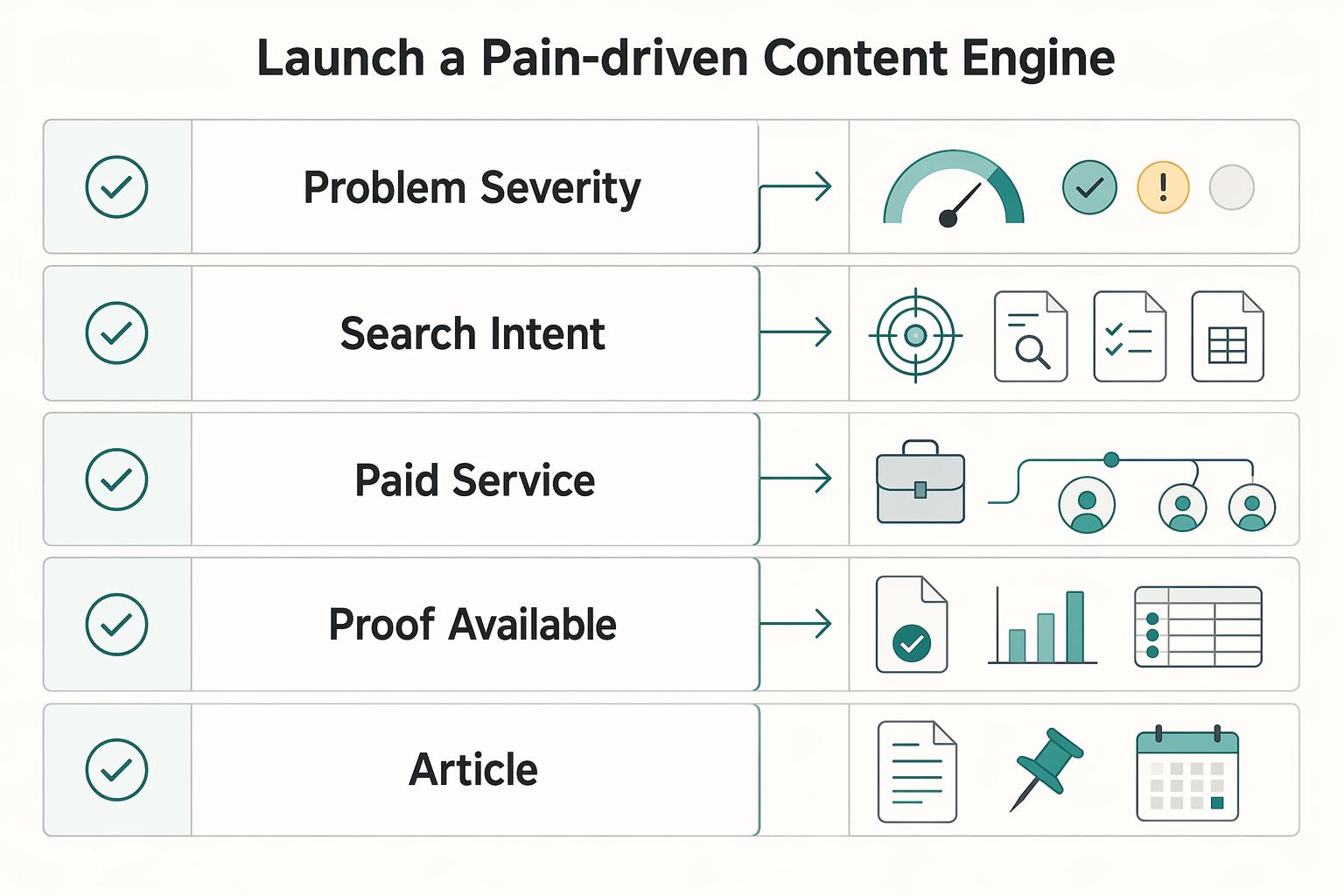
Content should screen for fit before it tries to rank. Publish fewer pieces, but make each one answer a buyer problem you can solve and prove. If you want to market a freelance accounting practice without filling your site with low-value traffic, treat every topic like a service-screening decision, not a writing exercise.
| Screening question | What to evaluate |
|---|---|
| Problem severity | how severe is the problem for the reader if it stays unresolved? |
| Search intent | is the search intent close to action, such as comparing options, checking requirements, or preparing documents? |
| Paid service connection | does the topic connect directly to a paid service you offer? |
| Proof available | do you have proof available, meaning firsthand process detail, anonymized examples, current reference material, or a reviewable checklist? |
A simple way to choose topics is to score them on four questions. First, how severe is the problem for the reader if it stays unresolved? Second, is the search intent close to action, such as comparing options, checking requirements, or preparing documents? Third, does the topic connect directly to a paid service you offer? Fourth, do you have proof available, meaning firsthand process detail, anonymized examples, current reference material, or a reviewable checklist?
That fourth filter is useful because content can sound informed but still fail under review. Use the same discipline behind decision-useful reporting. One accounting course description, ACCT 3301, defines analytics as turning raw data into "meaningful information that is useful in the decision making process." Your content should do the same. If a draft cannot help a reader decide what to do next, or you cannot verify the claim, cut it.
Use this checkpoint before you draft. Write one sentence each for the problem, the service fit, the proof source, and the next CTA. If one of those is weak, the topic is probably a traffic play, not a client acquisition piece.
| Format | When to use it | Reader problem it resolves | Next CTA |
|---|---|---|---|
| Article | The buyer is researching a problem and needs explanation plus decision criteria | "I do not understand what applies to my situation" | Book a consult or request a scope review |
| Checklist | The buyer needs a concrete self-audit or prep aid | "I need to know what I am missing before I ask for help" | Download intake pack or send documents for review |
| Tool | The buyer needs a repeatable utility, template, or calculator | "I need to complete this task correctly and faster" | Request implementation help |
| Webinar | The buyer needs guided explanation, examples, and live Q&A | "I want to understand the issue before I commit" | Register for consult or join waitlist |
For lead magnets, favor assets people can use the same day: intake checklists, record-request templates, monthly close prep sheets, onboarding document lists. Add a short usage note, who it is for, who it is not for, and a compliance disclaimer where needed.
If legal wording or jurisdiction-specific text belongs in the asset, verify the current requirement from official, counsel-reviewed, or client source records before publishing it. That is safer than using stale or unsupported language.
Keep expert collaboration narrow. Partner with one or two adjacent specialists, such as a business attorney, payroll specialist, or tax adviser in a specific jurisdiction. Co-create formats that are easy to review: a short Q&A article, a focused webinar, or a checklist with clearly labeled sections. Keep a lightweight review step before publishing:
- mark each claim as your scope, partner scope, or general education
- attach source notes or client-safe proof for factual statements
- remove anything that looks like personalized advice outside your service boundary
A common temptation is trying to sound complete. The safer move is to be narrower and more credible. That is what turns content into trust, and trust into qualified inquiries. Related: The Best Webinar Software for Freelancers.
Step 3: Diagnose, Confirm Scope, Price, Then Onboard#
Once your content has filtered for fit, your sales process should confirm judgment, not perform confidence. A strong conversion arc has four plain parts: diagnose, confirm scope, price by operating reality, then onboard with visible controls.
Related reading: How to Build a Sales Pipeline for Your Freelance Business.
Run a structured introductory call#
Treat the introductory call as a working diagnosis. You are not asking, "What do you want me to do?" You are checking three things: whether the problem is real, whether your scope matches it, and what evidence you still need before you recommend anything.
Start with a short pre-call intake so the meeting is not spent collecting basics. Keep it lean: business model, entities involved if relevant, current tools, the main trigger for reaching out, what a good outcome looks like, and any known blockers. If you need prior reports or bookkeeping exports before the call can be useful, say that upfront as a prerequisite.
Use three question clusters during the call:
- Process exposure: Where does the current process feel uncertain, what gets delayed, what is manually tracked, and where have records or handoffs broken down before?
- Workflow complexity: Which entities, tools, payment platforms, contractors, or customers create complexity, and who currently decides what needs specialist review?
- Decision priorities: How will you judge success, what cost concerns are in play, what challenges have you already hit with automation or follow-up, and who needs to approve the engagement?
That last cluster matters because prospects often want help evaluating cost, success measurement, and likely challenges before they buy. If you skip those questions, your proposal may read polished, but it will still feel incomplete.
Send a short recap the same day. A simple template works: "You told me X. The main risks appear to be Y. I still need Z to confirm scope. My recommended next step is A by B date." The verification point is simple. After the call, both sides should be able to name the problem, the likely service fit, and the missing evidence. If you cannot do that, you did an intake chat, not discovery.
Need the full breakdown? Read How to Build a Freelance Portfolio Clients Trust.
Map each service activity to a risk and an evidence pack#
Your proposal should help the client decide, not admire your menu. Replace generic task lists with a direct map from activity to business risk, then state what evidence you need before any claim becomes a promise.
| Service activity | Business risk addressed | Client-facing outcome | Evidence needed |
|---|---|---|---|
| Monthly transaction review and categorization | Incomplete records and late issue spotting | Clearer books and earlier identification of exceptions that need review | Prior month exports, chart of accounts, access list, sample reports |
| Workflow and software review | Records and handoffs spread across tools can create confusion and rework | Clearer view of what can be handled in scope and what needs tool or specialist support | Tool list, user roles, workflow summary, sample reports |
| Automated reminders and tailored follow-ups for document collection | Missing inputs stall close, reporting, or advisory work | Fewer document delays and a more predictable handoff process | CRM setup, email process, contact segmentation, reminder schedule |
If you use proposal language tied to CRM tools, email campaigns, analytics, or segmentation, say exactly what is already in place and what must be configured. A common failure mode is copying a template forward until it carries stale assumptions. Treat old proposal language the same way you would treat catalog information generated on Dec. 7, 2025. It is useful starting context, not final truth. Check the current source before you publish or promise.
Price and onboard around operating boundaries#
Value-based pricing works when it reads like operating design, not persuasion. Define tiers by scope boundaries, complexity signals, and service-level expectations. That includes number of entities, handoff frequency, reporting depth, document volume, and whether you are executing a stable process or managing ongoing exceptions. If a prospect needs specialist coordination or frequent judgment calls outside the base scope, move them up a tier or quote a separate project.
| Onboarding element | What it should cover |
|---|---|
| Responsibility map | who prepares, reviews, approves, and owns outside-specialist coordination |
| Document workflow | one upload path, file rules, and what happens when something is missing |
| Communication protocol | channels, meeting cadence, and where sensitive questions belong |
| Security and privacy controls | where files are exchanged and who gets access |
| Escalation path | anything urgent, ambiguous, or time-sensitive |
That same logic should carry straight into onboarding, because this is where trust either hardens or softens. Your first engagement phase should include a visible checklist the client can verify:
- responsibility map for who prepares, reviews, approves, and owns outside-specialist coordination
- document workflow with one upload path, file rules, and what happens when something is missing
- communication protocol covering channels, meeting cadence, and where sensitive questions belong
- security and privacy controls stated plainly, including where files are exchanged and who gets access
- escalation path for anything urgent, ambiguous, or time-sensitive
The checkpoint is practical. By the end of onboarding, your client should know who does what, where documents go, and what the next decision point is. If they are still guessing after week one, the issue is not trust. It is clarity.
Turn Positioning, Proof, and Sales Process into Weekly Habits#
If you want this approach to hold up in a crowded market with more than 85,000 accounting practices, turn the last three sections into weekly operating habits. The job is straightforward: make your positioning clearer, your proof easier to verify, and your sales process tighter around risk, scope, and trust.
Step 1. Narrow your brand until a prospect can repeat it. Choose whether your niche practice is a full specialization or a focused segment inside a broader firm. Then write one sentence that names the buyer, the trigger problem, and the operating context. The checkpoint is blunt: if a past client or referral partner cannot restate that sentence accurately, your positioning is still too broad. For any jurisdiction-specific work, name only what you can support today and verify any current rule from official, counsel-reviewed, or client source records before use.
Step 2. Publish content that answers the questions buyers ask before they book. Digital marketing matters because prospects evaluate accounting services online, but you do not need every channel at once. Pick one discovery channel, then create a small set of practical assets: two problem-specific articles, one short case note, and one service page that states boundaries. A common failure mode is generic tax tips that attract curiosity but not fit. If your content does not mirror discovery-call questions, rewrite it.
Step 3. Convert with diagnosis, evidence, and scoped offers. Use the first call to confirm tools, document volume, entities involved if relevant, and who owns specialist coordination. Follow with a recap that lists risks, missing records, and next steps. Relationship-building still matters here. Thought leadership, direct outreach, and even targeted personal contact can open doors, but the close happens when your proposal reads like a clear advisory scope, not a vague promise.
- Define niche sentence and referral test
- Publish 1 service page, 2 articles, 1 case note
- Add proof: certifications, software proficiency, process notes
- Build call recap template with risk, scope, evidence pack, and current requirement pending official/source-record verification
- Review monthly: wrong-fit leads, repeated objections, missing proof
Your operating standard is not charisma. It is consistent process, evidence-led messaging, and advisory work that stays inside clear scope. You might also find this useful: How to Use AI for Market Research in Your Freelance Business. Want to confirm what's supported for your specific market/program? Talk to Gruv.
Frequently Asked Questions
How narrow should your niche be?
Your niche should be narrow enough that your brand can name one buyer, one trigger problem, and one operating context without hedging. If you serve freelancers or independent contractors, say that plainly and note whether the work starts in a project-by-project, part-time, or 1099-MISC context rather than a W-2 context. For jurisdiction-specific filing questions, include only details verified against official, counsel-reviewed, or client source records before you use them.
Which channel should you start with?
Start with one channel buyers already use to evaluate your judgment. Support that channel with content that answers the same questions you hear on calls, and do not spread across several channels before your positioning and proof are tight. If LinkedIn is your first channel, tie it to your content engine instead of posting generic tips.
How should you price without guessing?
Price around scope boundaries, complexity signals, and review load, not vague value claims. Ask about entities, tools, document volume, and who owns specialist coordination before you quote. If jurisdiction-specific filing duties come up, verify the current requirement from official, counsel-reviewed, or client source records before you promise anything.
What proof builds trust fastest?
The fastest trust builder is proof that shows you can handle real operating detail. Use a short case note that names the starting mess, the tools involved, the change made, and the client inputs required. One example is a QuickBooks Desktop to QuickBooks Online transition with standardized invoicing and real-time data access. You can also point prospects to your expertise, certifications, and software proficiency.
How do you convert the first conversation without sounding pushy?
Treat the first conversation as diagnosis, not performance. Ask what is breaking, what tools they use, how remote communication works, and who decides. Then send a same-day recap with the risks, missing evidence, and next step. If you still cannot name the problem, scope boundary, and evidence pack after the call, you are not ready to pitch.
Try a related tool
Researched and edited by the Gruv editorial team. Gruv builds cross-border billing, payouts, and finance-operations software for global businesses.
Sources
- baker.edu/wp-content/uploads/Undergraduate-Course-Desc...trusted
- catalog.albertus.edu/certificates/courses/index.pdftrusted
- catalog.southernct.edu/undergraduate/courses.htmltrusted
- catalog.tamuct.edu/course-information/tamucttrusted
- doh.wa.gov/sites/default/files/2022-09/EvalCN22-22.pdftrusted
- egrove.olemiss.edu/cgi/viewcontent.cgitrusted
- esu.edu/_archive/grad-catalog1718.pdftrusted
- northeast.edu/_documents/academics/catalog/2025-catalog.pdftrusted
Educational content only. Not legal, tax, or financial advice.
Related Posts

LinkedIn for Freelancers Who Want a Predictable Client Pipeline
Treat LinkedIn as two jobs you run at the same time: a credibility check and a conversation engine. If you only chase attention, you can get noise. If you only send messages, prospects may click through to a thin profile and hesitate.
How to Get Health Insurance in Portugal as a Digital Nomad
If you are searching for health insurance portugal nomad options, treat the decision as part of your visa file before you treat it as a product search. The policy matters, but timing, wording, and document quality often determine whether your file moves cleanly or turns into a clarification request.
The Best Webinar Software for Freelancers
Start with one rule: do not buy from rankings or feature pages alone. A safer choice is the platform that handles your main webinar job, fits the exact plan you can afford, and passes a proof test in your real setup.