
Quick Answer
Manage your mental health as a solopreneur by setting visible work hours and response windows, planning for both normal and low-capacity days, and reviewing energy, recovery, and support each week. Define a reliability floor, cut optional work before extending hours, communicate scope or timing changes early, and use written escalation triggers when warning signs keep returning.
Set a Weekly Baseline#
When a business depends on one person, mental strain becomes a delivery risk, not a side issue. Isolation, blurred boundaries, and constant responsibility can reduce consistency long before anything looks dramatic from the outside. Missed commitments often start as small leaks in capacity, then turn into delays, rushed work, and harder client conversations.
The practical question is not whether pressure exists. It is whether you can keep commitments without being available at all hours. Clear work hours and a defined response window turn always-on behavior into an agreement you can actually sustain. That shift matters because it removes daily renegotiation. You stop deciding your availability in every message and start working from rules you already chose.
Think of this as a weekly operating routine for capacity, communication, and recovery. You are not trying to create perfect days. You are setting up repeatable decisions for normal-capacity and low-capacity weeks so delivery is less dependent on mood, adrenaline, or last-minute heroics. The simpler the sequence, the more likely you are to use it when you are tired, behind, or overloaded.
- Set a reliability floor. Decide what must still ship even on a rough day: active deliverables, minimum client updates, and one admin task that prevents backlog.
Expected outcome: you can state your weekly non-negotiables in one sentence before Monday starts.
- Lock visible boundaries. Define work hours and a response window, then place both where clients already look.
Verification point: a new client can find your availability quickly in your onboarding and email signature.
- Split your daily task plan into two modes. Keep a full-capacity list and a low-capacity list. On low-capacity days, run a shorter sequence: one priority deliverable, one admin item, then recovery time.
Failure mode to avoid: treating every day as a peak-output day, then extending hours to catch up and risking quality.
- Write escalation triggers before you need them. Predefine warning signs and add one external accountability check-in you can keep during stressful weeks.
Expected outcome: when pressure rises, you follow a decision rule instead of improvising under strain.
By the end, you will have decision rules, a practical daily plan, escalation triggers, and a copy-paste checklist you can run weekly. That gives you a way to protect both your work and your mental health without pretending hard weeks will disappear. Before you change anything, start with the week you actually had.
What To Prepare Before You Start#
Start with evidence, not intentions. This gives you cleaner inputs before you change your schedule or client communication. If you skip it, you risk building a plan for the week you hoped to have instead of the one you are actually living.
You need one place where the basics live together. Create a simple note called Weekly Snapshot and keep it open during planning. It does not need to be polished. It just needs to make your decision points visible when energy drops, deadlines pile up, or your memory gets fuzzy.
-
Gather one week of real inputs. Put your calendar, current work hours, client response window, and last daily task plan in one place. Use what actually happened, including where work spilled outside planned hours and which commitments moved.
-
Open a simple journal and log risk signals. Track burnout pressure signals, signs of isolation, and missed recovery blocks. Keep entries short enough to maintain on busy days. A useful format is three lines at day end: what drained you, what restored you, and what slipped.
-
Define your minimum business continuity standard. Write what must still ship on a low-capacity day. This becomes your scope-cut rule when energy drops. If a task does not support that minimum, it is the first candidate to delay.
-
Pick one external accountability channel now. Choose one format you can keep in hard weeks, such as a peer check-in, industry group, or webinar. Schedule the next check-in before you close this step so accountability is not optional later.
Before you move on, do one quick verification pass:
- Can you point to your current work hours in writing?
- Can you show your response window as a client would see it?
- Can you name the one deliverable that must ship even on a low-capacity day?
- Can you name your next accountability date and who will see your update?
Finish by putting one recovery period on your calendar as a real commitment. If it is not on the calendar, it is easy to replace it with more work and call that temporary. With this baseline in place, the next steps get much easier because you are setting boundaries around real behavior instead of guesses.
Set Work-Life Boundaries You Can Actually Enforce#
Boundaries only work when clients can see them and you apply them the same way every time. Start simple. The rule should be easy for you to remember, easy for clients to find, and boring enough to repeat without debate. Mixed signals weaken boundaries fast, especially when your inbox behavior quietly contradicts what your onboarding says.
Set these in order. First decide when you are available. Then decide how quickly you respond within that window. Then decide what happens when something arrives outside that window. If you reverse that sequence, you can end up promising speed that only works when you are constantly checking messages.
-
Lock work hours first. Set on-hours and off-hours before you promise response speed. Share the same hours across onboarding and regular client communication. Keep the wording consistent so clients are not guessing which version is real.
-
Define a response window that matches those hours. Pick a cadence that fits your current load and communicate it upfront. If morning and afternoon checks work for your service, that can be a sustainable pattern. If your work requires long focus blocks, use a slower cadence and state it plainly.
-
Apply one rule for off-window requests. Acknowledge receipt, confirm when you will reply, and handle it inside your stated window. That protects trust without reopening your full day every time someone writes late.
-
Use a dedicated workspace boundary. When you leave that space, work is off unless a true emergency exists. Keep your emergency definition narrow and written so you do not renegotiate it when tired.
Use this simple script in real conversations:
- Acknowledge quickly
- Confirm timing clearly
- Avoid extra explanation
Example structure:
- Received, thank you.
- I will respond during my next response window.
- If this affects a current deadline, I will propose the next best timing.
Some clients may notice slower replies at first. The tradeoff is usually more sustainable delivery and fewer interruptions from always-on availability. In practice, consistency tends to matter more than instant replies you cannot maintain for long. Once those boundaries are visible, the next job is making sure your day can absorb uneven capacity without breaking them.
Build Two Operating Modes For Normal Days And Low-Capacity Days#
The common trap is treating every day like a high-output day, then trying to make the math work by borrowing from evenings, weekends, or recovery time. A two-mode setup gives you a cleaner alternative. It is not a way to squeeze more out of yourself. It is a way to keep commitments realistic when your capacity changes midweek.
Low-capacity mode is not failure. It is your continuity plan. If you define it in advance, you spend less time deciding what to do when focus drops and more time protecting the work that actually matters.
Use one document, two lists, and one checkpoint. Keep the format boring on purpose so you can still use it when concentration is low and everything feels louder than it should.
-
Create one plan with two labeled lists. Keep
Normal DayandLow-Capacity Dayin the same document so switching modes is simple. Put critical client work at the top of both lists so your priorities do not drift. -
Choose a repeatable low-capacity sequence. One option is: morning routine, journal brain dump, one priority task, one admin task, then a recovery block. Adjust the sequence to fit your needs, but keep it short enough to follow without negotiation.
-
Pick a consistent checkpoint. Midday can work well. At your check, decide whether to stay in normal mode or switch to low-capacity mode, then trim noncritical scope if needed.
-
Avoid the high-output trap. Optional work can slip. Critical commitments should stay visible. Write that tradeoff into your plan before the week starts so you do not debate it under stress.
Use a short checkpoint checklist:
- Did I complete the top priority or make meaningful progress?
- Is my focus stable enough for another deep task?
- Are client commitments at risk if I keep current scope?
If two answers are no, switch modes and cut scope.
At day end, log the mode you used, what shipped, and what starts first tomorrow. Add one sentence on what caused friction. After a few weeks, those notes usually tell you more than memory will. They also set up the next step, which is not just tracking time, but understanding what your week is actually costing you.
Run A Weekly Energy Audit And Redesign Your Workload#
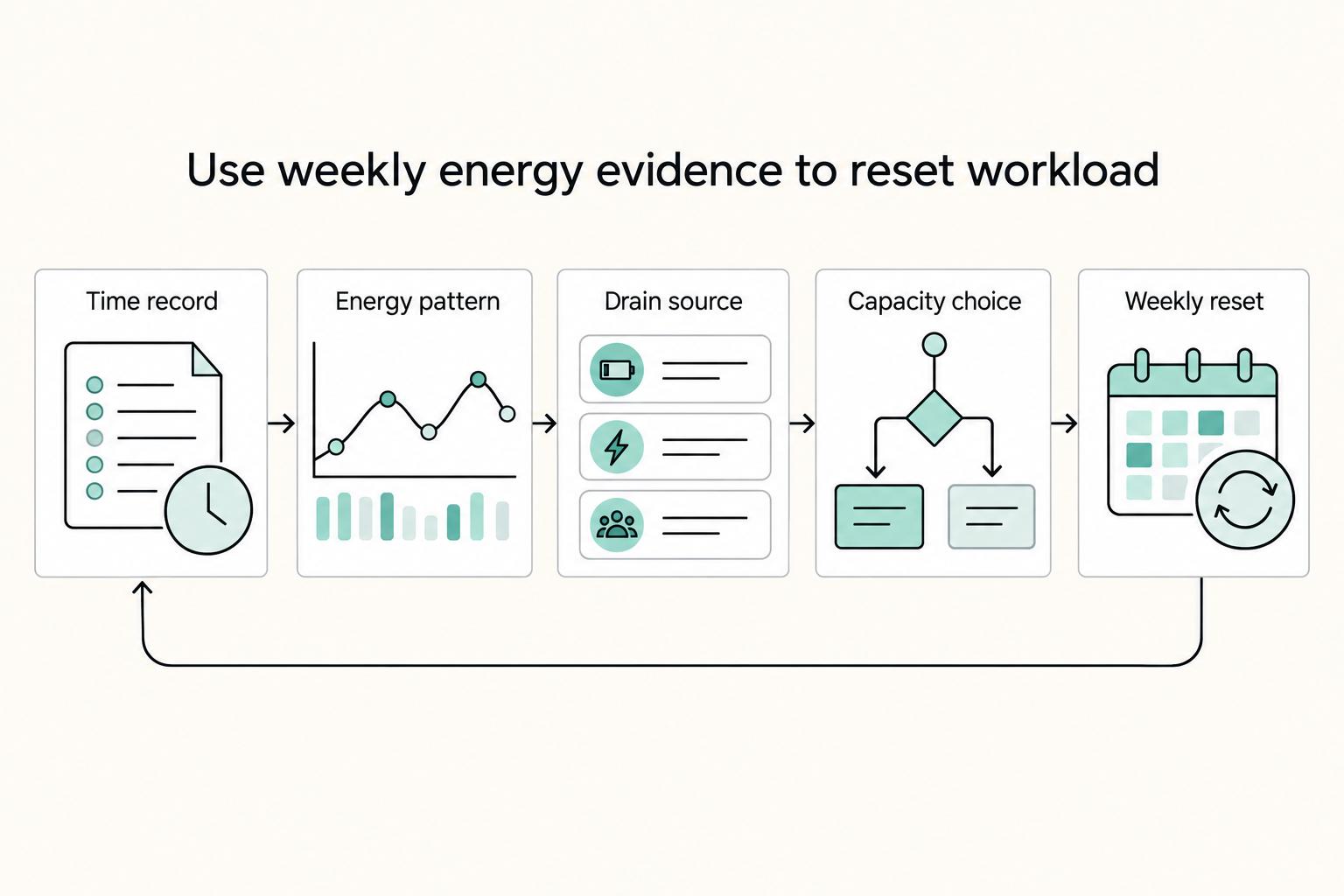
If you only track hours, you miss why your week felt workable or punishing. Time tracking shows where the time went. An energy audit shows which parts of the week keep draining your ability to deliver. You need both if you want smarter workload decisions.
Keep the first pass light. For one week, pair each meaningful task with an energy label, then use what you learn to redesign the next week. The point is not perfect categorization. The point is to stop repeating the same drains and calling that discipline.
-
Track energy, not just time. Label each task
draining,neutral, orrestoringin your weekly notes. Apply labels right after each block or at day end while the memory is still fresh. -
Place deep work in your best window. Move demanding client or creative work to your strongest hours. Move draining admin to lower-energy blocks or an automation queue. Protect your best window from message checking where possible.
-
Set a trigger for repeating drains. If the same task keeps draining you week after week, treat it as a design signal and consider delegation, automation, or batching before adding more discipline tactics.
-
Protect one recovery block after heavy client work. Put it on the calendar as a fixed block, not a reward you hope to earn later. Recovery helps preserve cognitive quality instead of forcing you to push through nonstop.
Use this redesign table to make decisions:
| Task Type | Energy Pattern | Next Move |
|---|---|---|
| Deep client deliverable | Draining but high value | Keep in best-focus window |
| Repetitive admin | Draining and low value | Batch, automate, or delegate |
| Planning and review | Neutral to restoring | Keep at week start and week end |
| Social touchpoint | Restoring when brief | Schedule inside work hours |
Close the audit by carrying forward only what supports consistent delivery. If a pattern keeps breaking your week, redesign it instead of pushing harder. That is also the point where outside structure becomes useful, because some forms of drift are easier to catch when another person can see them.
Add External Accountability That Survives Bad Weeks#
One good check-in can prevent a lot of silent drift. The goal is not pressure for its own sake. It is to keep decisions visible when stress rises, isolation creeps in, or your own judgment starts getting too generous with delay.
Keep this light. The best accountability format is usually the one you can still maintain in a bad week. If the process becomes another report to write, it will disappear right when you need it most.
-
Pick one rhythm you can keep in a bad week. Use a weekly peer call, an async check-in, or a short public commitment post. Choose the lightest option you can sustain consistently.
-
Use the same proof format every time. One simple format is four lines: planned tasks, completed tasks, blockers, next actions. Repetition makes updates faster and easier to compare week to week.
-
Keep the check-in on low-output weeks. Shrink scope if needed, but still report what will ship, what will slip, and what decision you are making.
When selecting an accountability partner, look for three traits:
- They ask direct questions and do not over-accommodate delay stories.
- They can keep the cadence even when your output is uneven.
- They focus on next actions, not postmortem debates.
A practical script for low-capacity updates:
- Planned: one priority deliverable and one admin task.
- Completed: list what moved.
- Blockers: name the real constraint.
- Next action: state the exact scope cut or timing adjustment.
Solo accountability can feel sufficient when things are going well. External accountability earns its place when capacity dips, because it helps keep your next move concrete. It also solves only part of the problem. Drift and isolation often overlap, but they are not the same thing.
Reduce Freelance Loneliness Without Overloading Your Calendar#
Treat freelance loneliness as a schedule design issue, not a character flaw. If you wait until isolation feels heavy, the default fix is often more screen time, more open tabs, or more unplanned social activity spilling past your workday. A better move is planned, repeatable contact that supports your boundaries instead of dissolving them.
The key is to keep connection structured and light. You want contact that makes the week easier to sustain, not one more thing to manage. Before changing anything, confirm your work hours, client response window, and workspace boundary so your social plan does not quietly expand your day.
-
Schedule a light social stack. Choose a small number of realistic touchpoints you can maintain during busy weeks. Keep durations short enough to survive heavy weeks.
-
Keep contact inside your stated availability. Place these touchpoints within work hours and protect off-hours from spillover. This preserves recovery time and keeps connection from turning into another source of stress.
-
Respond to isolation with structure, not longer days. If meaningful contact starts to drop, add planned connection before adding work hours. Longer hours can blur work-life boundaries and increase burnout risk.
-
Use short breaks on solo-heavy days. A brief walk or reset block can lower pressure and improve follow-through on social commitments.
Use one weekly review question: did my social plan make the week easier to sustain or harder to manage? If it made the week harder, shorten duration first and keep the cadence. Consistency beats intensity here.
- Track
7+hours of sleep on at least4nights in your workweek. - Keep
2short social touchpoints inside your published availability window. - Protect
1non-negotiable recovery block before adding more client hours.
If loneliness is part of the current pattern, The Best Ways to Overcome Loneliness as a Digital Nomad includes practical ideas you can adapt without expanding your schedule. For a practical workplace baseline, use the CDC mental health at work guide.
Protect Client Delivery When Mental Load Spikes#
When mental load rises, trust is protected by predictability and early communication, not by trying to hide the strain until the last minute. Most delivery problems get harder when you wait. Scope cuts, timing changes, and status updates are easier to manage before a deadline window starts closing.
| Tier | Covers | When pressure rises |
|---|---|---|
| Tier 1 | Commitments that affect current client trust if delayed | Protect quality and timing whenever possible |
| Tier 2 | Important work that can move with advance notice | Communicate adjustments early |
| Tier 3 | Internal improvements and optional tasks | Cut first |
Start each week with a quick baseline: active deliverables, your response window, and your recent real work hours. That baseline keeps commitments tied to actual capacity instead of optimistic estimates. If those numbers already do not fit, more availability is usually not the answer. A cleaner plan is.
-
Define your business continuity minimum. For each active client, note what must ship, communication cadence, and handoff notes needed if you are briefly unavailable. Keep this list short and visible.
-
Use delay scripts before problems compound. Prepare two copy-ready messages: one for timing slips and one for scope adjustments. Include current status, revised timing, and a clear client choice.
-
Build a small resilience buffer. Keep update templates, simple priority tiers, and one backup option for urgent support with execution. This lowers decision friction when stress is high.
-
Run a Friday fit check against energy and hours. Confirm next week commitments fit real capacity. If they do not, renegotiate scope before Monday.
Keep those tiers visible. When pressure rises, cut Tier 3 first and communicate Tier 2 adjustments early. Protect Tier 1 quality and timing whenever possible. That sequence matters because it keeps the highest-cost damage from spreading.
Delay script structure:
- Current status in one sentence.
- What changed in timing or scope.
- One clear option for next step.
- Confirmation of next update time.
If early warning signs keep building, switch to short-term continuity triage and reset your near-term plan. The critical move is to adjust scope early instead of extending hours by default. And if the same warning signs keep returning, that is when you need a clearer line for outside support.
Use Clear Escalation Triggers For Support#
Escalation works best when the rule is written before strain peaks. In the moment, it is easy to move the goalposts, tell yourself one more week will fix it, or swap in more productivity tactics because they feel easier than asking for help. Written triggers reduce that drift.
Keep this concrete. Define the warning signs, set your self-management window, and decide what happens if those triggers persist. You are not trying to predict every scenario. You are giving yourself a practical handoff from self-management to outside support.
-
Write triggers in observable terms. List warning signs you can actually track, such as ongoing sleep disruption, difficulty starting basic tasks, repeated missed commitments, or sustained burnout feelings. Avoid vague language so you can spot triggers quickly.
-
Set your self-management window and rule. Give your normal habits a defined period to work. If triggers continue beyond that window, escalate instead of adding more productivity tactics.
-
Prepare a private escalation list. Keep contacts and first-step actions on one journal page, including the first message you would send.
A practical escalation page can include these items:
- Trigger list with checkboxes
- Start date of current self-management window
- Support contacts in priority order
- One short message draft for each contact
- Next available time to reach out
One common failure mode is rewriting your trigger rules when you feel worse. Protect against that by writing the rules on a stable day and reviewing them weekly rather than renegotiating them in the middle of a hard stretch.
A useful checkpoint at week end:
- Did any trigger appear more than once?
- Did I use the same coping tactic repeatedly without improvement?
- Did delivery reliability decline despite scope cuts?
If the answer is yes across these checks, consider escalating to support. This guide supports planning and self-management. It does not replace clinical care. If you need immediate crisis support in the U.S., use the 988 Lifeline right away. For non-urgent self-management support, review NIMH guidance on caring for your mental health. Once the escalation rule exists, the final piece is knowing what to do when your week is already off the rails and you need a fast reset.
Common Mistakes And Fast Recovery Moves#
When overload is already high, do not start with a full redesign. Start with the fastest correction that reduces risk today. The goal is to stop the bleed, protect delivery, and get enough stability back that you can think clearly again.
| Mistake | Recovery | Key implementation |
|---|---|---|
| Broad goals without a daily task plan | Reduce the day to three priorities and one must-do deliverable | Convert each broad goal into one task with a visible completion point |
| Extending work hours to compensate for low focus | Shorten work hours, protect one recovery block, and cut noncritical scope | Keep your original stop time or bring it earlier for the next few days |
| Confusing isolation with discipline | Add one external accountability check-in and one social work touchpoint within seven days | Keep both short and repeatable |
| Waiting for a perfect week to reset | Restart today with one morning routine anchor and one boundary script | Re-run the same pair for several days before adding more changes |
Use this section like a quick reference. Identify the mistake, apply the paired recovery move now, and verify the result at the end of the week.
- Mistake: broad goals without a daily task plan.
Recovery: reduce the day to three priorities and one must-do deliverable. When broad goals turn into constant task switching, fatigue and stress usually climb with them.
Fast implementation:
- Convert each broad goal into one task with a visible completion point.
- Put the must-do deliverable first on the list.
- Move optional tasks below the line for later review.
By day end, aim to point to one completed output, not just a pile of partial starts.
- Mistake: extending work hours to compensate for low focus.
Recovery: shorten work hours, protect one recovery block, and cut noncritical scope. Long hours with poor focus do not reliably produce better work. They usually just make tomorrow harder.
Fast implementation:
- Keep your original stop time or bring it earlier for the next few days.
- Drop one noncritical task per day until focus stabilizes.
- Protect one recovery block after heavy work.
Verify at week end: fewer late-hour sessions and steadier next-day focus.
- Mistake: confusing isolation with discipline.
Recovery: add one external accountability check-in and one social work touchpoint within seven days. A light support structure can reduce drift while work keeps moving.
Fast implementation:
- Schedule one accountability update with a fixed format.
- Add one work-related social touchpoint inside work hours.
- Keep both short and repeatable.
If loneliness is part of the pattern, The Best Ways to Overcome Loneliness as a Digital Nomad offers practical ideas you can adapt.
- Mistake: waiting for a perfect week to reset.
Recovery: restart today with one morning routine anchor and one boundary script. Keep the reset small enough to run on a low-capacity day, because that is the real test.
Fast implementation:
- Choose one simple morning anchor you can repeat.
- Use one boundary message template for off-window requests.
- Re-run the same pair for several days before adding more changes.
If you cannot complete the reset actions on busy days, simplify again.
These recovery moves work because they reduce decisions while you are under strain. They do not solve everything, but they help you regain enough traction to return to the weekly routine instead of improvising every day.
Conclusion And Copy-Paste Weekly Checklist#
Reliable delivery does not come from heroic weeks. It comes from a repeatable routine that protects your capacity, keeps commitments realistic, and gives you a plan for the days when your energy drops.
The point is not to eliminate stress. It is to stop stress from quietly taking over your schedule, your client communication, and your decisions. Start small, keep the sequence stable, and review outcomes weekly. If strain starts building, adjust scope early instead of waiting for a cleaner week to reset.
Set and publish work hoursSet and enforce client response windowCreate normal-day and low-capacity-day daily task planRun one weekly energy auditSchedule one recovery time block after heavy workComplete one external accountability check-inRun one weekly business continuity review for next weekReview escalation triggers and support contacts
If this starts slipping, reduce complexity instead of adding more tactics. Consistency is the win. Keep the checklist visible, run it on the same day each week, and let it guide the next decision when pressure rises.
Frequently Asked Questions
Are solopreneurs happier than employees?
There is no clean yes-or-no answer. Freedom can become pressure when boundaries are weak and every problem lands on one person. If flexibility is creating chaos instead of relief, tighten your work hours and response expectations first.
What are the biggest mental health risks for a solopreneur?
The common risks are burnout, blurred work-life boundaries, and carrying full responsibility alone. They often show up in delivery before they look dramatic. Needing more hours just to maintain the same output is a practical warning sign.
What should I do first this week?
Start with the smallest set of changes that makes your week more predictable. Set clear work hours, define your client response window, and write your reliability floor. Then create one normal-day list and one low-capacity-day list.
How do I protect mental health without hurting growth?
Protecting capacity protects growth because burnout eventually hurts delivery, judgment, and consistency. Put high-value work in your best hours, reduce repeat drains where possible, and keep commitments realistic. If demand rises, control scope and improve sequencing before expanding work hours.
When should I seek professional support?
Seek support when warning signs persist and your normal routines are no longer restoring daily functioning or delivery reliability. If your trigger list keeps appearing beyond your self-management window, move to your support contacts and take the first action on your escalation page. Do not wait for a catastrophic week.
Can I do this if my schedule is already overloaded?
Yes, if you keep the reset narrow. Start with one boundary and one low-capacity-day protocol instead of rebuilding everything at once. A fixed stop time and a reduced task plan with one must-do deliverable are a workable starting pair.
How do I keep this from becoming another abandoned system?
Keep it small enough to survive a bad week. Use a short weekly checklist, one accountability check-in, and one consistent planning note. If the process starts slipping, simplify it instead of adding more tactics.
Try a related tool
Researched and edited by the Gruv editorial team. Gruv builds cross-border billing, payouts, and finance-operations software for global businesses.
Sources
Includes 6 external sources outside the trusted-domain allowlist.
- cdc.gov/workplace-health-promotion/health-strategies...trusted
- nimh.nih.gov/health/topics/caring-for-your-mental-healthtrusted
- 988lifeline.orgexternal
- lifestarr.com/podcast/the-solopreneurs-burnout-trap-are-yo...external
- lifestarr.com/starting-running-growing-solopreneur-businessexternal
- onfolio.com/discourse/12-ways-to-manage-your-mental-heal...external
- podcasts.apple.com/us/podcast/holistic-mental-health-for-women-...external
- psychologytoday.com/us/blog/pioneering-perspectives-on-workplace...external
Educational content only. Not legal, tax, or financial advice.
Related Posts
The Best Ways to Overcome Loneliness as a Digital Nomad
If you run a business of one while moving city to city, treat connection as an operating issue, not a personality verdict. You do not need to become louder, more social, or permanently available. You need a repeatable way to move from unknown faces to familiar ones.
How to Get Featured in the Press as a Freelance Expert
Treat press outreach as a repeatable earned media channel, not a lottery ticket. The goal is to be quoted, mentioned, or featured because your expertise fits a real story, not to expect instant placement in outlets like Forbes or TechCrunch.

The Freelance Payment Penalty: A Modeled Audit of Platform Fees, FX Spreads, and Payout Delays
The money rarely disappears through a single, easy-to-spot fee. The real loss is stacked. A marketplace takes its commission, a processor adds a charge for international cards, a bank or payment company converts the currency at a spread, a platform holds the funds before release, and a wire sheds a little to intermediaries on the way in. Each layer looks defensible on its own, but the worker feels the combined result as a smaller deposit and a later payday.