
Quick Answer
Use a pre-trip workflow: classify each absence, check how it affects residence analysis and your Article 93 position, and verify assumptions before you commit. For dias de ausencia spain tax decisions, keep one ledger that ties dates, location, beneficiary entity, and compensation records together. Treat unverified limits as provisional, and escalate before filing when mixed trips, family presumption, or cross-border treaty issues could change your classification.
Decide Before a Trip, Document While Away, Escalate Unclear Facts#
If you want a lower-stress way to handle dias de ausencia spain tax decisions, use this cockpit. It gives you a practical way to decide what to do before a trip, what to document while you are away, and when to escalate facts that are not clear.
Before you start#
Use this if you are already in Spain's Article 93 special regime, or if you are actively checking whether you meet the conditions to elect it. It is also relevant if you moved to Spain after the 1 January 2023 changes that widened the regime to additional profiles, including remote workers.
| Step | What to do | Outcome |
|---|---|---|
| Assess | Assess each planned absence before it happens | Classify it as low risk, review required, or adviser required, and identify whether it affects residence analysis, your special-regime position, or both |
| Track | Track the facts that support your position | Keep an evidence pack you can actually use, including travel dates, work-location records, contracts or instructions, and key filing documents |
| Project | Project future scenarios before you commit | Spot when a longer stay abroad, a new client setup, or a work-pattern change could create a filing or residency issue that should be escalated early |
This is not for day-count-only planning or for assuming the special regime applies automatically to any self-employed setup. Spain's residence analysis is broader than physical presence. It can also consider your economic interests and, in some cases, a family-based presumption.
Before you rely on thresholds or deadlines, verify current AEAT guidance against your exact facts. As reflected in the sources used here, the Article 93 regime can apply for the move year plus five tax periods if conditions are met. The option is filed on Form 149, and the annual return is filed on Form 151.
- Assess each planned absence before it happens.
Outcome: you classify it as low risk, review required, or adviser required, and identify whether it affects residence analysis, your special-regime position, or both.
- Track the facts that support your position.
Outcome: you keep an evidence pack you can actually use, including travel dates, work-location records, contracts or instructions, and key filing documents.
- Project future scenarios before you commit.
Outcome: you can spot when a longer stay abroad, a new client setup, or a work-pattern change could create a filing or residency issue that should be escalated early.
Start by separating two issues that are often conflated. Spain's 183-day residence test, including sporadic absences, is a different question from how the special regime is applied. For related background, see Tax Guide for Digital Nomads in Thailand.
First, A Critical Distinction: The 183-Day Rule vs. Beckham Law Absences#
Treat this as two separate checks: a residence day-count question and a special-regime income-attribution question. If you use one answer for both, you raise the risk of misclassification, weak support, and avoidable filing mistakes.
dias de ausencia is where people often blur the facts. For recordkeeping, personal days abroad are primarily presence/location facts. Work-related days abroad may add an income-attribution question, because you may also need to classify what work happened and how that work ties to pay. Keep those buckets separate in your notes, and use this working split after each trip:
| Scenario | What to monitor first | Documentation examples to keep | Which check to review first |
|---|---|---|---|
| Personal travel, no work activity | Dates and travel purpose | Itinerary, calendar notes | Residence/presence check |
| Work-related travel | Dates, location, and work performed | Travel records, meeting/work logs, pay-period or invoice linkage | Special-regime income-attribution check, then residence/presence |
| Mixed trip (personal + work) | Which days were personal vs work | Day split notes, work records, updated calendar | Review both, using separated day groups |
| Extended period abroad with ongoing work | Whether work pattern changed while abroad | Day-by-day log, work output trail, pay/invoice linkage | Review both in parallel |
Before relying on any rule, verify authority quality. A practical checkpoint is whether official EU legal or government material is on the europa.eu domain. If you use EUR-Lex, confirm you are reading the full text, not only an excerpt. Do not base tax decisions on non-authoritative academic sources.
If you mix these two checks, the result can be incorrect filings and a weaker position if your facts are reviewed later. Verify the current threshold and the possible tax, interest, or penalty exposure before you file.
Once that distinction is clear, the next step is simpler: decide which trips need routine tracking and which ones need closer review. If you want a deeper dive, read our guide to a defensible 2026 filing plan.
Step 1: Assess Your Risk - The Beckham Law Threat Matrix#
Rate every trip before you travel. If your plan depends on a disputed reading of work abroad under the special regime, pause now instead of discovering the problem at year-end.
The special impatriate regime is governed by Art. 93 LIRPF and Arts. 113-120 RIRPF. AEAT content also states that employment income during the regime is treated as obtained in Spain. If your decision relies on any fixed foreign-work percentage, treat that threshold as unverified until you confirm the current legal text and, when needed, get professional advice.
Rate the trip before you book it#
Use this matrix to decide whether to proceed, proceed with stronger evidence, or pause for review.
| Risk band | Scenario type | Why it is risky | Suggested evidence file | Escalation trigger | What to do next |
|---|---|---|---|---|---|
| Green | Short personal trip with no work, or brief work travel where you are not relying on foreign-work treatment | Residency presence still matters, and sporadic absences can still be counted unless foreign tax residence is proven | Itinerary, travel confirmations, calendar, short note on whether work occurred | Spain presence nearing 183 días, or facts are messy | Proceed and document within the same week |
| Yellow | Mixed trip, repeated remote work abroad, or consulting that may benefit a non-resident client/group entity | Work purpose and income attribution are less clear, so weak records increase challenge risk | Day-split notes, scope of work, meeting logs, pay-period or invoice linkage, recipient-entity details | You are relying on an unverified fixed foreign-work threshold, or you cannot explain who benefited | Proceed only with extra evidence and a written classification note |
| Red | Multi-week or multi-month work abroad, pay tied to foreign delivery, or a year where disputed days could change outcome | A weak file or inconsistent treatment can affect special-regime analysis and residency review | Full travel file, contracts or SOW, work-output trail, payroll or invoice linkage, adviser memo if available | Material reliance on foreign-work treatment, uncertainty under Art. 93 or Art. 114, or possible exclusion requiring Modelo 149 review | Pause and get professional review before travel or billing |
A quick quality check applies in every band: can you show presencia certificada for key days? If not, you are exposed. TEAC describes permanence as an aggregate of certified presence, días presuntos, and ausencias esporádicas.
Apply one policy to every gray-zone day#
Consistency matters more than trying to make each day look tidy after the fact. Use one personal classification policy all year and apply it the same way every time.
| Day type | How to log it | Key note |
|---|---|---|
| Residency days | Do not prorate by hours | AEAT guidance says a counted day is a full day, with no minimum-hour requirement |
| Mixed days | Tag by activity | If personal travel also included work abroad, mark it as mixed-work in your records |
| Transit days | Do not assume they are excluded | If work happened in transit, log it as transit-work and keep timestamped support |
| Partial workdays | Record the work detail, but keep the day whole for presence counting | The work detail can still matter to your factual file |
Do not classify by intention. Guidance states residency is not decided unilaterally, and case-law summaries reject personal will as the test for sporadic absences.
Check who benefited before you travel#
Before any work-related trip, answer these questions in writing: Who received the real economic benefit of the work? Where is that entity based? If challenged, can you defend your planned income treatment?
Use "beneficial effect" as a checkpoint, not as a shortcut rule for the Beckham regime. If the facts could affect your regime status, remember Modelo 149 is used not only to opt in, but also for renunciation or exclusion reporting. Once the trip is risk-rated, log it immediately in your compliance ledger with the same labels and matching evidence.
Separately, you might also find this useful: A Guide to Local SEO for Freelancers.
Step 2: Track with Precision - Your Compliance Ledger#
Use your ledger as your main working record. If an entry cannot explain what happened and point to evidence, treat it as incomplete.
| Field | Why it matters | Evidence to attach | Common mistake to avoid |
|---|---|---|---|
| Trip ID / file name | Keeps all records for one trip in one place | Folder link or consistent naming pattern | Different names across calendar, receipts, and invoices |
| Date range | Anchors the timeline for review and filing prep | Tickets, boarding passes, accommodation record, calendar export | Logging departure but not return |
| Location (country/city) | Shows where activity occurred | Itinerary, meeting location, accommodation record | Recording only broad location detail |
Internal day label (personal, work, mixed, transit, unclear) | Keeps later review traceable | Daily note, calendar entry, call or meeting log | Re-labeling later without documenting why |
| Purpose summary | States the business context in plain language | Agenda, meeting invite, project note | Vague labels like "travel" |
| Beneficiary entity/client | Documents who received the work outcome | Contract or SOW, instructions, recipient entity details | Naming a project but not the legal entity |
| Income link | Connects activity to compensation or billing | Payroll period reference, invoice reference, engagement record | Waiting until year-end to reconstruct |
Evidence status (complete, provisional, escalate) | Flags what still needs action | Missing-doc note, checklist state | Assuming you will remember open items |
Policy note for mixed and ambiguous days#
Use one internal labeling policy all year to reduce misinterpretation, and keep uncertainty visible when the facts are not clean. These labels are for recordkeeping consistency, not legal definitions. For mixed or unclear entries, add a note that the classification rule still needs verification.
If a day includes both personal and work activity, log both facts in the same row. Do not force a cleaner label than your evidence supports.
Evidence stack checklist#
A usable file can stay compact. It should show dates, location, purpose, and how the work ties to income. Before sharing sensitive information, verify that the website is official and secure, for example .gov and HTTPS.
| Evidence type | Examples | What it shows |
|---|---|---|
| Travel proof | Tickets, boarding passes, accommodation records, calendar export, and other date or location records | Dates and location |
| Work proof | Meeting invites, call logs, deliverable drafts, time notes, or project updates tied to specific dates | Purpose and work activity tied to specific dates |
| Business-purpose and income-link proof | Contract or SOW, instructions or approvals, notes on beneficiary entity or client, and payroll or invoice linkage | Business purpose and how the work ties to income |
Logging workflow#
Do not leave this until filing season. Capture the core facts while the trip is still fresh, then clean the file once you are back.
- Capture during travel: log day labels and save core documents while details are fresh.
- Reconcile after return: align dates, labels, and attachments; resolve obvious gaps.
- Set recurring review cadence: clear provisional rows and escalations before filing pressure builds.
Escalate before filing if record quality is weak#
Weak record quality can become obvious before filing if you check for it. Escalate before the deadline if any of these apply:
- You have many
mixedoruncleardays with no verified classification rule. - Beneficiary entity or client, or business purpose, cannot be explained clearly in writing.
- Travel records and work records conflict on key dates.
- Material decisions depend on reconstructed memory instead of contemporaneous records.
- Your ledger narrative is stronger than your underlying evidence file.
This pairs well with our guide on Malaysia Tax Residency for Digital Nomads. If you want cleaner records before filing season, use the tax residency tracker to help track workdays abroad and personal travel as you log them.
Step 3: Project Your Future - The "What-If" Scenario Planner#
Use your ledger before you commit, not just after the fact. If a cross-border engagement changes where you work, who benefits from that work, or your in-and-out-of-Spain day pattern, run the scenario first. That is where most avoidable dias de ausencia spain tax mistakes begin.
Step 3.1 Define the engagement before discussing tax outcomes#
Start by turning the proposed engagement into a decision file, not a loose note. Put the draft facts in one place before deciding whether the engagement is workable.
At minimum, log proposed dates, countries, travel pattern, paying entity, beneficiary entity, where work will be performed, and delivery model. If you are under the régimen especial (art. 93 LIRPF), verify current regime conditions and deadlines before deciding. Do not fill them from memory.
If scope language is vague, such as on-site as needed or mostly remote with some travel, pause. Tighten the contract or SOW first so location, cadence, and beneficiary entity are explicit.
Checkpoint: you can explain the engagement in six clear lines without guessing.
Step 3.2 Map residency and sourcing impact across the full year#
Model the full natural year, not only the assignment window, because AEAT guidance treats fiscal residence by complete calendar years.
Run Spain's domestic tests together. Check for more than 183 días in Spain, possible núcleo principal o base de actividades o intereses económicos in Spain, and the family presumption when a non-separated spouse and minor children habitually reside in Spain. A low day-count impact can still sit inside a broader residency risk.
Treat absences conservatively. AEAT says ausencias esporádicas are counted unless you prove tax residence in another country. TEAC also frames counting on objective criteria, not intent, and indicates a counted day does not require a minimum number of hours.
| Scenario | Expected tax-residency impact | Documentation needed | Negotiation complexity |
|---|---|---|---|
| Original offer with full on-site travel | Highest pressure on annual day count, treaty review, and any current art. 93 conditions after verification | Draft contract, itinerary, work-location calendar, beneficiary-entity details, income estimate | Medium |
| Reduced travel with fixed on-site blocks | Lower pressure if day exposure is capped and remote delivery terms are explicit | Revised SOW, capped travel schedule, calendar plan, written remote-delivery terms | Medium to high |
| Re-scoped delivery with Spain-based execution and limited visits | Often cleaner to evidence where core work is performed | New SOW, deliverable schedule, meeting plan, records of work performed from Spain | High initially |
Checkpoint: at least one version is defensible with objective dates and documents.
Step 3.3 Test parallel compliance clocks#
Before you approve any scenario, run a conflict check across all the moving parts:
- Domestic residency clock: assess the full natural year.
- Sporadic absences: if your outcome depends on non-Spain days not counting, confirm what foreign-residence proof you will actually have.
- Economic-interests test: check whether your main activity or economic base still points to Spain.
- Family presumption: include spouse and minor-children habitual-residence facts where relevant.
- Treaty track: AEAT residency guidance is expressly subject to double-tax treaties, so cross-border facts need parallel treaty review.
- Special-regime administration: if applicable, confirm Modelo 149 timing; AEAT guidance states a maximum 6 meses from activity start for the option filing.
Talk to a professional before accepting when two countries could both treat you as resident. Do the same when foreign-residence proof is not yet secured, when beneficiary entity and work location do not align clearly, or when your conclusion depends on unverified regime conditions.
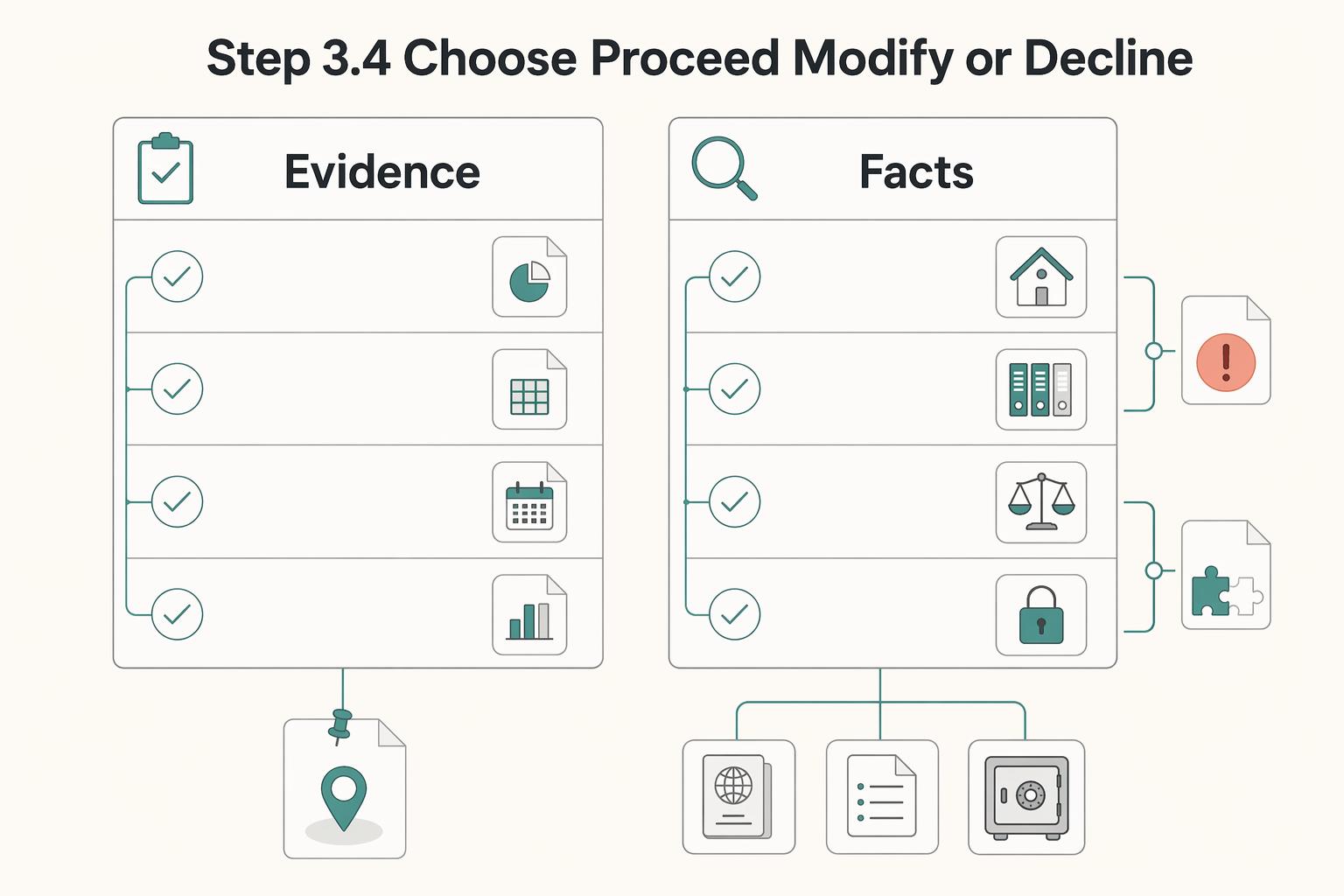
Step 3.4 Choose proceed, modify, or decline#
A good decision here is usually plain to state. Either the facts support the position now, or they do not.
- Proceed: verified conditions hold, evidence can be built now, and contract language matches the tax position.
- Modify: risk is fixable by reducing travel, changing timing, tightening deliverables, or clarifying beneficiary and work-location facts.
- Decline: the scenario only works with optimistic counting, treaty assumptions, or evidence you expect to reconstruct later.
Attach a one-page note to the scenario tab: proposed facts, verified facts, open questions, required documents, and decision. If you cannot write that note clearly, do not commit yet. For a step-by-step walkthrough, see How to handle 'tax residency' if you're stuck in a country due to a crisis.
Conclusion: Use One Repeatable Decision Pattern Before Each Trip#
Your goal is not perfect certainty. It is a repeatable decision pattern you can use before each trip or assignment: Assess, Track, and Project. Use this same four-line template every time:
opportunitycompliance impactdecisiondocumentation next step
Step 1 Assess#
Start with the specific opportunity, not abstract rules. If your conclusion depends on an unverified threshold or legal definition, note the missing limit or buffer rule and pause until it is verified.
Step 2 Track#
Keep your ledger current so you are not reconstructing facts later. Make sure your calendar, travel records, agreements, and payment records tell the same story, and split mixed trips while details are still fresh.
Step 3 Project#
Before you commit to the next opportunity, run the same check forward: what changes in your ledger, what becomes ambiguous, and what documentation you will need from day one.
Maintain the ledger, run pre-commit scenario checks, and escalate to a tax professional when facts are mixed or the rule interpretation is unclear. For a deeper walkthrough, see Spain Tax Residency for Mobile Freelancers Who Need Defensible Records.
Frequently Asked Questions
How should you calculate the relevant percentage or threshold?
Start from your compliance ledger, not memory. Classify each entry as work performed abroad, personal travel, or work performed in Spain, then verify the current regime limit before you rely on the result. If the applicable threshold is not verified, treat the outcome as provisional and escalate before filing, especially when a trip mixes business and personal time or a payment spans multiple countries.
Does personal travel count the same way as work performed abroad?
Not always, and this point is fact-dependent. Keep personal travel separate from work performed abroad in your records, split mixed trips by date and activity, and escalate when purpose is mixed or another country may assert taxing rights.
What documents should you keep?
Keep a concise evidence pack per trip that shows dates, place, purpose, and beneficiary so your classification can be reviewed later. In practice, teams often keep travel records, dated calendar entries, the in-force contract or SOW, payment records, and a short classification note such as work, personal, or mixed. Escalate if beneficiary facts are unclear, contract wording is vague, or related-party cross-border work may raise extra documentation pressure.
What happens if you get the classification wrong?
The immediate risk is a weaker overall file when your ledger, calendar, and payment records conflict. Correct entries as soon as you detect issues, keep dated revisions, and document why each reclassification was made. Escalate when corrections could change your residency position, affect a special-regime filing, or create overlap with another country’s claim.
When is treaty or cross-border advice worth paying for?
It is worth paying for when two countries have plausible claims and the issue turns into treaty interpretation rather than a clear domestic fact pattern. Some disputes may require Mutual Agreement Procedure handling, so prepare one file with the country pair, tax year, residence documents, and disputed trips before you seek advice. Escalate early when rules conflict, foreign-residence proof is incomplete, or your position depends on treaty interpretation.
Try a related tool
Researched and edited by the Gruv editorial team. Gruv builds cross-border billing, payouts, and finance-operations software for global businesses.
Sources
- ecb.europa.eu/press/key/date/previous/html/index.en.htmltrusted
- eur-lex.europa.eu/legal-content/pt-en/TXTtrusted
- europarl.europa.eu/doceo/document/CRE-9-2024-03-12_NL.pdftrusted
- sede.agenciatributaria.gob.es/Sede/ayuda/manuales-videos-folletos/manuales...trusted
- sede.agenciatributaria.gob.es/Sede/en_gb/irpf/tengo-que-presentar-declarac...trusted
- ssa.gov/agency/glossary/english-spanish-glossary.htmltrusted
- state.gov/wp-content/uploads/2020/09/19-1127-Taxation-...trusted
Educational content only. Not legal, tax, or financial advice.
Related Posts

Digital Nomad Taxes in 2026 With a Defensible Filing Plan
With digital nomad taxes, the first move is not optimization. It is figuring out where you may be taxable, where filings may be required, and what proof supports that position.

Thailand Tax for Digital Nomads Without Residency Mistakes
The most expensive mistakes here happen before anyone opens a tax return. People pick a visa, assume the tax answer comes with it, then try to rebuild the year from scraps after the fact. By then, the damage is usually not one dramatic error. It is a pile of small gaps: an unverified day count, a transfer with no clear purpose note, invoices that do not line up cleanly with payments, and assumptions nobody wrote down when the facts were still fresh.
A Guide to Local SEO for Freelancers
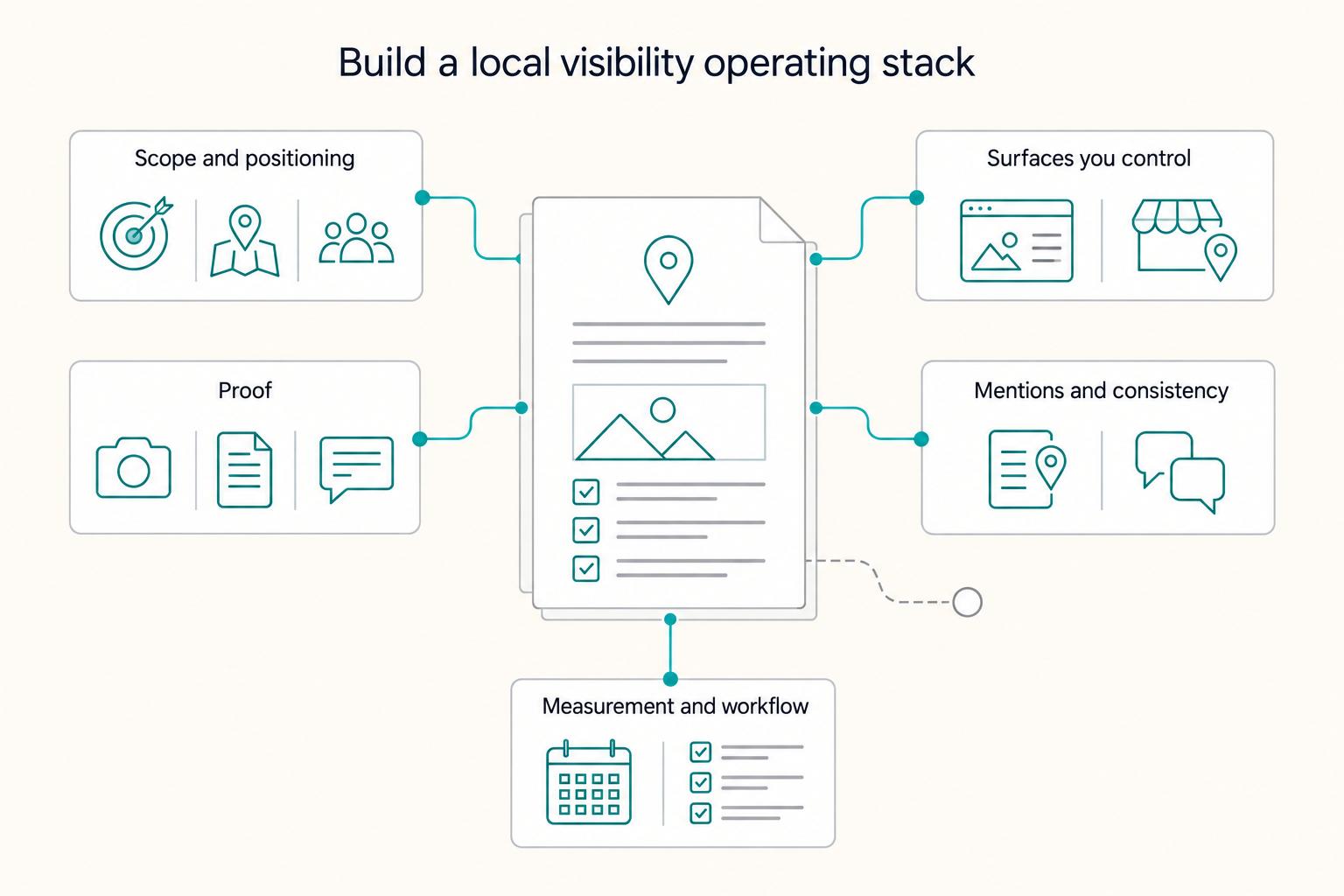
Run local SEO for freelancers like an operator: build one defensible local entity across Google Business Profile, your website, and your proof, then tighten it over time instead of spraying tactics. As the CEO of a business-of-one, you are not collecting "marketing tasks." You are building an asset you can maintain and defend. The goal is stable visibility and trust, not constant fiddling.