
Quick Answer
Forecast revenue and all delivery costs at completion, calculate delivery margin, and keep due dates and available cash beside it. Use agreed billing triggers and change controls; investigate each variance before treating it as paid extra scope. A profitable project can still need funding before its invoices are collected.
Review project margin and cash timing together#
Invoiced revenue can look healthy while cash is still unavailable. That gap is where a project that looks profitable can start to pressure routine operating costs such as payroll, rent, utilities, and equipment.
Treat cash timing as a first-class project control, not a finance afterthought. You need one decision path before kickoff, one during delivery, and one at closeout. That keeps delivery choices tied to what the business can actually fund week to week.
Working capital is current assets minus current liabilities. Available cash is one part of it; invoices due from customers are another, and supplier bills reduce it. A positive working-capital balance does not guarantee enough bank cash for this week’s payroll.
One risk is confusing invoice status with spendable cash. An invoice can be approved and sent, and still not arrive when labor and vendor costs hit. That is why you should review project profitability on two clocks at the same time: margin direction and expected cash date.
When teams ignore that split, they can staff against booked revenue and only react when cash is late. A better sequence is to treat expected cash date as a delivery input, then match pace and spend to that date from kickoff onward.
Use these checkpoints each week to keep both clocks visible:
- Track invoice date and expected cash date as separate fields, then review both in the same weekly meeting.
- Set a go-or-pause rule before kickoff when expected collection timing misses upcoming costs.
- Reconfirm cash timing at major scope and billing milestones so delivery pace does not drift ahead of cash reality.
Escalate a failed checkpoint and stop optional new commitments where you can. Change delivery dates or suspend contracted work only under the agreement and applicable notice rules, or through a mutually agreed amendment.
Define project profitability in terms you can operate weekly#
Define project profitability as revenue against total project costs, and write that cost set before delivery starts. If cost categories stay vague, results can look strong while the project still loses money.
| Term | Use |
|---|---|
| Delivery surplus | Revenue minus the defined delivery cost set; state every inclusion |
| Delivery margin (%) | Delivery surplus divided by revenue ×100; undefined at zero revenue |
| After-overhead project operating contribution | Delivery surplus less separately allocated overhead; not necessarily company net profit |
Use a forecast delivery view and a view after allocated overhead. Project operating contribution after overhead is not automatically company net profit: financing, taxes and other company items may still remain.
Before kickoff, lock a shared term sheet:
- Record
Revenue,Direct Costs, andOverhead. - State what each line includes and excludes for this scope.
- Assign an owner and data source for each line.
Document cost definitions precisely enough to avoid double counting. If a loaded labor rate already includes an overhead item, do not allocate that item again. Sales, delivery and finance should calculate the same result from the same inputs.
Use profitability language consistently:
- Keep delivery-cost definitions explicit and avoid double counting loaded overhead.
- Express margin as a percentage of revenue; markup uses a cost denominator.
- Separate project operating contribution, company net profit and available cash.
A practical verification step is to have two teammates run the same calculation before kickoff. If they get different results from the same inputs, your definitions are not clear enough yet.
Keep a short assumptions note beside the term sheet with what changed, who approved it, and when it changed. That record prevents quiet edits in week three from rewriting what everyone thought was agreed in week one.
If revenue or cost assumptions are unclear at kickoff, treat the work as unpriced risk and pause scope finalization until those assumptions are written and aligned.
Prepare your inputs before you price or sign anything#
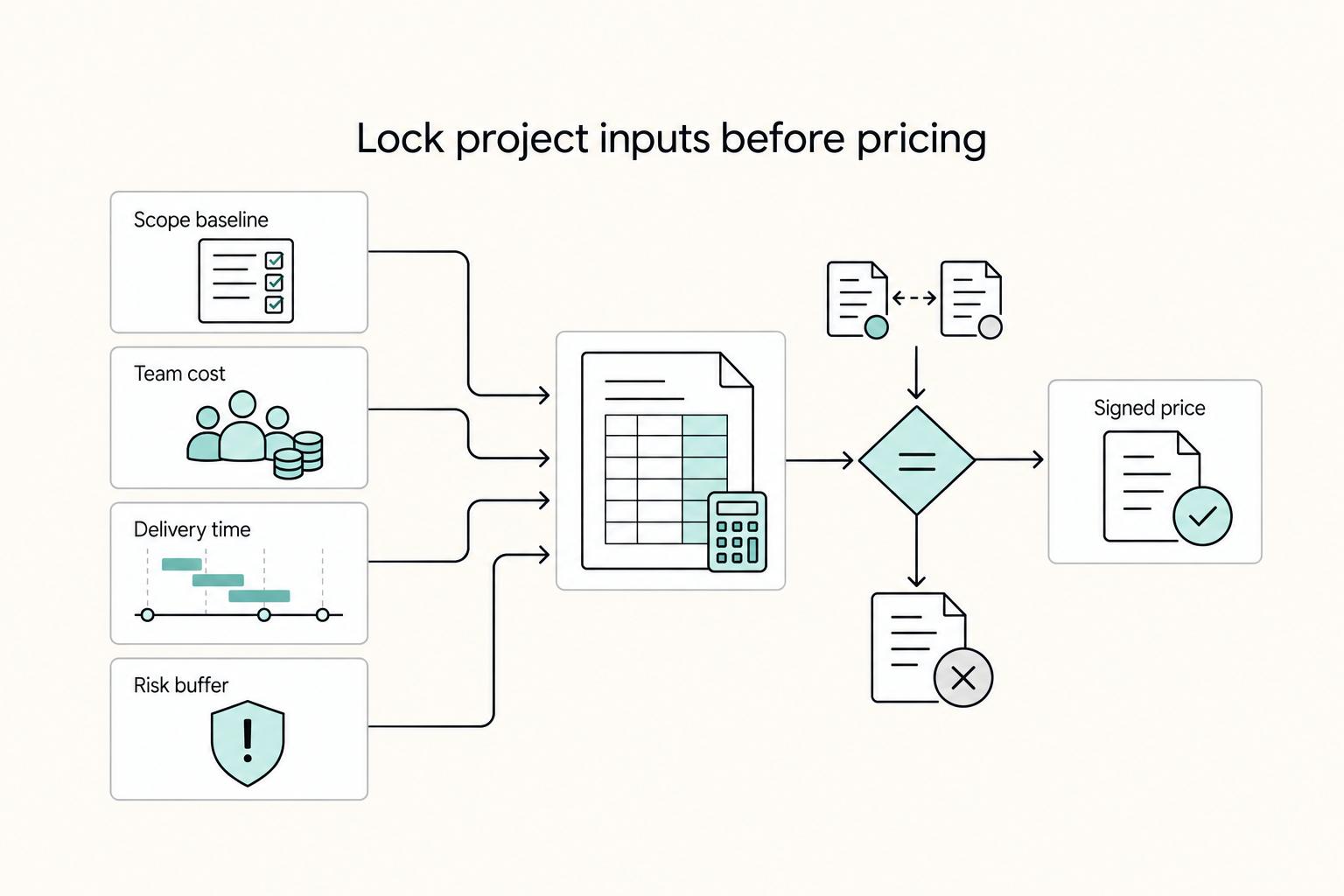
Before you price or sign, build one shared input sheet and keep it current. When assumptions drift across versions, it gets harder to compare performance over time.
Keep planned, incurred, committed and remaining costs separate. Estimate at completion = costs incurred plus expected costs to finish; expected revenue excludes tax and reflects agreed changes and credits. A bank balance is a separate cash view.
- Build a one-page data pack.
Use one Google Sheets tab with scope, staffing, timeline, and payment milestones. Keep it short enough to review in one meeting, with one active version so you are less likely to price from stale assumptions.
- Capture effort with role-level assumptions.
Estimate every project hour by role, including coordination, revisions and non-billable work. Apply documented internal cost rates, distinct from client prices. Use a realistic capacity denominator and identify any overhead already loaded into those rates.
- Classify third-party spend before margin math.
Split outside spend into consistent categories using your written internal definitions. Keep labels fixed unless an approved change is logged with date, owner, and reason.
- Set verification checkpoints.
At the top of the sheet, name who approves assumptions, where changes are logged, and what triggers re-estimation. When scope, timeline, or staffing changes, update inputs first and then adjust scope or price.
A useful quality check is to compare proposal language against the sheet before signature. If role mix, milestone names, or timeline wording do not match, fix the sheet and documents before the project starts.
Before signature, run a short handoff review across sales, delivery, and finance using the same sheet on one screen. Confirm that each team reads the same cost lines and milestone labels the same way, then log unresolved items before the contract moves forward.
It can feel administrative, but it reduces the risk of pricing from partial effort assumptions and finding missing cost lines after delivery has begun.
For a subcontracted delivery plan, read Hiring Your First Subcontractor alongside the task-level cost sheet.
Set your pricing floor with a break-even test#
Set a project cost floor before proposal review. At a zero delivery margin, price only covers the defined delivery costs; it may leave nothing for shared overhead, financing or tax. Calculate the price needed for your target margin rather than applying a markup and calling it a margin.
Freeze one quote version of scope, staffing, timeline, and payment milestones before the test. Any material input change means you rerun it. Do not negotiate from a moving baseline.
- Calculate blended internal cost and a break-even hurdle.
Hypothetical fixed-fee project: designer 60 hours at 40 cost = 2,400; lead 20 hours at 60 = 1,200; subcontractor 1,000; direct tools 200. Total estimated delivery cost is 4,800. Coordination hours are included and these cost rates exclude shared overhead.
- Apply a hard decision rule.
At a 6,000 fee, delivery surplus is 1,200 and delivery margin is 1,200 / 6,000 × 100 = 20%. For a 30% delivery margin at 4,800 cost, price = 4,800 / (1 − 0.30) = 6,857.14. A 30% markup gives 6,240 and only 23.08% margin. Re-scope or agree a suitable price before committing.
- Compare pricing models with the same inputs.
| Model | What stays true | Main margin risk | Guardrail |
|---|---|---|---|
| Time-based hourly | Price tracks time spent | Revenue is capped by finite billable hours, and faster delivery can reduce billable revenue | Set hour caps and require approval for overages |
| Project-based fixed fee | Price is fixed for defined scope | If delivery takes longer, client price does not rise automatically | Require written change orders before out-of-scope work |
At GBP 80 per hour and 30 billable hours for 52 weeks, gross revenue is GBP 124,800. With six non-billing weeks it is GBP 110,400. Neither amount is profit; holidays, admin, costs and collection timing still matter.
- Attach written assumptions to the quote.
Add staffing mix, hours, client input deadlines and a defined delay/change process to the quote. An illustrative 50/25/25 schedule on a 6,000 fee is 3,000 advance, 1,500 at the agreed midpoint and 1,500 at completion; choose terms the client accepts and your actual costs support.
Before sending, run one final contradiction check. If your quote assumes fast client approvals, your contract should define how delays change timing or price. If it does not, margin risk can stay hidden.
Keep superseded quote versions in the project file rather than deleting them. This helps explain margin movement later and reduces confusion if negotiations reopen earlier assumptions.
Write payment terms that protect margin, not just revenue#
Payment terms should protect cashflow and margin during delivery, not just revenue reporting after the fact. Keep terms clear enough that both sides can see when payment is due, when scope changes need approval, and what happens if payments are delayed.
| Control | What to include | Detail |
|---|---|---|
| Advance or deposit | Amount, due date, work it covers and unearned-balance treatment | Choose an agreed structure; not every engagement needs a deposit |
| Time/milestone billing | Actual time, date or deliverable trigger and due date | 50/25/25 is illustrative, not a required standard |
| Late payment | Lawful fee, escalation and undisputed-payment process | Match terms across documents |
| Scope changes | New request, cost/timing effect and authorized approval | Owed defect correction is separate |
| Suspension | Contractual right, required notice/cure and restart conditions | Do not automatically stop existing duties merely because cash is late |
- Standardize core payment clauses.
Use clear terms for whichever structure fits: advance, periodic time billing or agreed milestones, due dates, fees and lawful late-payment remedies. A deposit is an option, not a universal requirement. The 50/25/25 example has different triggers for its advance and later invoices.
- Require a written
Change Order Clauseprocess.
If a request is out of scope, document and approve the change before extra work starts. This helps prevent unpriced expansion from blending into the base fee.
- Set a clear pause rule for missed payments.
Define any suspension right, notice and cure period before signing. A missed payment is an escalation trigger; apply only the suspension the agreement and law permit, preserve required handover/safety duties and document restart conditions.
- Use one client-facing explanation script.
We agree the invoice schedule before staffing the project. If you request new scope or change a deadline, we estimate the effect and agree the change first. If a payment is overdue, we contact the billing owner and follow the notice and suspension terms in our agreement.
- Check alignment before signature.
Confirm proposal, scope document, and invoice schedule use matching clause names, milestone dates, and payment amounts.
A practical handoff detail is to store the signed clauses beside the project brief used by delivery. If account terms live in one place and delivery assumptions in another, it is easier to miss payment triggers.
At kickoff, restate payment triggers and any pause rule with delivery leads and account owners. A shared readout early makes later escalation cleaner because everyone agreed on what activates a pause.
Run a five-checkpoint profitability cadence during delivery#
End-only reviews can catch problems too late. Use five fixed checkpoints during delivery so effort drift, billing lag, and payment risk show up while you can still act.
| Checkpoint | When | Main review |
|---|---|---|
| 1 | Kickoff | Confirm signed scope, staffing, timeline, margin assumptions, and payment schedule |
| 2 | Mid-project | Compare actual work with plan, including remaining effort on work in progress |
| 3 | When invoice is issued | Track issue, due and expected bank dates; current/not-due separately from overdue 1–30, 31–60, 61–90 and over 90 days |
| 4 | When payment is received | Confirm funds are available and flag Chargeback and Payment Hold risk |
| 5 | Post-mortem | Capture variance drivers and carry at least one concrete rule into the next proposal |
- Checkpoint 1 at kickoff.
Confirm signed scope, staffing, timeline, margin assumptions, and payment schedule. If contract language and delivery brief conflict, reconcile one version before work proceeds. Record owner names for each critical metric so follow-up is not ambiguous.
- Checkpoint 2 mid-project.
Reforecast costs incurred plus work still to finish. A new client request may justify a priced change; underestimated effort or correction of your own defective work does not automatically entitle you to more money. Escalate the cause and offer options under the existing agreement.
- Checkpoint 3 when invoice is issued.
Track invoice date, due date and expected bank date separately. Define aging as days overdue, with a separate current/not-due bucket and overdue 1–30, 31–60, 61–90 and over 90 days. Put one owner and next action on each unpaid item.
- Checkpoint 4 when payment is received.
Confirm funds are available, then flag Chargeback and Payment Hold risk fast. A dispute can reverse funds, and holds can delay availability. If payment state is uncertain, avoid committing new spend that assumes immediate access.
- Checkpoint 5 in post-mortem.
Capture variance drivers throughout delivery and close the loop in post-mortem. Carry at least one concrete rule into the next proposal. Tie that rule to a specific stage such as quote review, contract review, or kickoff.
A simple discipline keeps this cadence useful: each checkpoint should end with one decision and one owner. Without that closeout, review meetings become status summaries instead of control points.
If a checkpoint closes without a decision, reopen it in the same week and assign a single owner to resolve the block. That prevents unresolved issues from rolling quietly into the next stage.
Manage subcontractor-heavy projects without margin leakage#
Subcontracted delivery needs its own cost discipline. If subcontractor assumptions stay vague, invoiced revenue can still hide thin margin and weak cash outcomes.
Before work starts, assemble one evidence pack for each subcontracted scope: task list, quoted cost basis, expected coordination time, payment terms, and linked client milestones. Keep this pack visible during regular reviews so committed vendor cost and client cash timing can be checked together.
- Map delivery cost by task before pricing.
Assign each subcontracted task an owner, unit basis such as hour, day, or fixed output, expected revision rounds, and internal coordination time. Include non-billable coordination effort because it still consumes cost. If any task is still marked TBD, treat pricing as unresolved risk.
- Classify pass-through and managed delivery costs consistently.
If you use adjusted gross income (AGI), define it here as agency revenue less specified external pass-through costs, not the US tax term of the same name. Do not deduct a subcontractor cost in AGI and again in delivery costs. Principal-versus-agent revenue presentation should follow the applicable accounting assessment, not an invoice label alone.
- Negotiate supplier schedules and forecast client collection separately.
Forecast subcontractor due dates independently of client collection. Negotiate a workable schedule before kickoff or fund the gap; a late client does not automatically release you from your own supplier payment obligations.
- Control change exposure during delivery.
Estimate and approve genuine extra scope before authorizing it. Record corrections owed under the original scope separately. Compare actual, committed and remaining subcontractor costs at every review, and act on a material variance immediately rather than waiting for it to repeat.
One practical contrast helps here. If revision rounds stay within plan and approvals are on time, coordination time is easier to keep visible. If revisions grow while approvals lag, untracked coordination time can build and quietly erode margin.
Keep subcontractor quote versions and approved scope changes in the same evidence pack. That makes it easier to explain variance during client reviews and can reduce disputes about whether extra effort was part of original scope.
For legal and onboarding controls that support these financial decisions, pair this section with Hiring Your First Subcontractor: Legal and Financial Steps.
Handle cross-border payment and compliance friction before it hits cashflow#
Confirm the payment route and provider-required checks early, and flag unresolved items in the collection forecast. Internal document readiness is not permission to defer a legally required invoice or statutory payment.
Create one cross-border payment file per client-payee pair before delivery starts. Track legal entity names, country route, payout path, tax-document status, account details, and release approvers.
The key is sequencing. Confirm documentation readiness before milestone release decisions, not after invoices are already in motion. This keeps collection forecasts realistic and protects staffing plans tied to expected payment dates.
- Map required compliance checks by payout lane.
List each party that can trigger a hold, then mark which checks must clear before a milestone is considered collectible. If any required check remains unresolved, classify cash timing as uncertain.
- Collect required tax forms early, based on payee context.
Confirm whether the payer needs W-9 for a US person, the relevant W-8 for a foreign person, or another document for this payment. Forms are not interchangeable and not every cross-border invoice requires them. Follow actual payer/legal requirements while keeping invoice and payment deadlines visible.
- Reconcile gross customer payment, fees and bank receipts.
Hypothetical final 1,500 client payment with a 30 processor fee gives 1,470 in the bank. Record 1,500 against the client debt and 30 as a fee; do not leave a false 30 receivable. If the provider holds another 200, bank cash is 1,270 plus 200 held funds, not an additional client shortfall.
Keep initiated, received, held, available and reversed states distinct. At the project close, reconcile gross fees of 6,000, delivery cost of 4,800 and any processor costs excluded from that estimate before comparing your forecast with the result.
- Treat indirect tax checks as route-specific and assign ownership.
Define what must be confirmed for each route, who owns it, and when it is complete. If tax documentation is unresolved at invoicing, mark the milestone cash date as uncertain.
When documentation causes repeated delays, fix checklist ownership and avoid optional unfunded starts. Existing invoice deadlines, payment obligations and lawful delivery commitments still need to be honored.
A useful control is to assign one document owner for each client-payee file and one reviewer for milestone release. Clear ownership reduces handoff gaps when cross-border items move between finance, delivery, and account teams.
Catch the early warning signs before a project turns unprofitable#
Early warning signs often show up in operations before month-end reporting does: rising effort without approved scope change, repeated approval delays, and aging receivables. Keep one weekly view that combines Billable Hours, utilization, approval timing, receivables aging, approved scope changes, and Delivery Margin trend so you can separate timing issues from structural margin loss.
- Monitor effort against approved scope.
When project hours rise, check whether the cause is new scope, inefficient delivery or owed rework. Update the cost-to-complete estimate; only new agreed scope should automatically enter the change-order pricing discussion.
- Treat repeated late approvals as potential cost risk.
Track planned approval date, actual decision date, and affected tasks. When delay repeats, rebalance staffing and reduce speculative work so labor cost growth stays controlled.
- Separate cash delay from structural margin failure.
Read receivables aging with Delivery Margin trend. If margin is stable while receivables stretch, treat it as timing pressure. If margin declines across reviews, treat it as structural scope, staffing, or pricing failure.
- Match response to the pattern.
For timing pressure, escalate collections and confirm milestone readiness. For structural pressure, renegotiate scope, rebalance staffing, and stop unpriced work.
Define utilization as billable hours divided by the stated available-hours denominator, and distinguish invoiced from merely logged time. Set capacity limits from your own role mix, leave, coordination and quality requirements; an unsupported universal 75–85% target can hide overload.
A useful team habit is to log each red flag with a direct label such as timing-driven or margin-driven. This reduces debate and speeds action in weekly reviews.
Do not smooth these signals away with broad averages or headline revenue alone. A short spike in unapproved effort or aging receivables can be an early warning that profitability and cash are starting to diverge.
Recover a project that is already underwater#
Use the following recovery sequence to compare options from current facts; it is a practical planning framework, not a validated universal protocol.
Once a project is underwater, stop incremental patching and make one documented recovery choice based on current economics and payment behavior. Start from one shared baseline: signed scope, approved changes, receivables status, remaining staffing plan, and latest margin view. If teams are using conflicting versions, reconcile first.
Recovery gets harder when teams run parallel fixes. Choose one path, align owners, and communicate that decision quickly to both the client side and the internal team.
- Rebuild the remaining-job view with current assumptions.
Suppose 4,800 planned delivery cost rises to 5,400 at completion while the agreed fee stays 6,000. Delivery surplus falls to 600, or 10%. With 600 separately allocated overhead, project operating contribution is zero. Costs already spent are sunk, but remaining costs and contractual obligations still determine whether and how to finish.
- Choose one path and commit.
Compare continuing as agreed, a mutually approved scope/price amendment, staffing changes that preserve quality, and a lawful exit. Show the remaining incremental costs, collection risk and commitments for each; an internal recovery memo does not rewrite client obligations.
- Write the recovery memo before changes go live.
Document revised economics, remaining work, payment milestones, owners, and dates so client communication and execution stay aligned.
- Seek agreed payment changes before taking optional extra scope.
Seek a deposit or revised future payment schedule by agreement before taking optional extra scope. Do not unilaterally accelerate an existing due date or hold owed corrections as a new paid service.
- Define a short client communication sequence.
Explain the variance and cause, offer priced scope options, and record any agreed amendment and effective date. If no new terms are agreed, avoid optional additions while honoring existing work and any lawful termination/suspension process.
A recovery decision is only complete when the next checkpoint is scheduled and assigned. Without that follow-through, projects can slip back into the same risk pattern.
After the decision, freeze optional additions until the project returns to an agreed baseline. That keeps the recovery plan focused on restoring control instead of taking on new scope during instability.
Review weekly and monthly so profitability becomes a system#
Keep forecast revenue and costs at completion beside incurred costs and cash. Delivery margin (%) = (project revenue − defined delivery cost) / project revenue × 100. Calculate after-overhead project operating contribution separately; neither result equals bank cash or necessarily company net profit. For zero revenue, margin percentage is undefined.
- In-flight review for control.
Recalculate forecast delivery margin with remaining costs included. Non-billable project coordination and owed rework consume delivery cost. Investigate scope, estimating and execution causes before proposing a price change.
- Monthly review for planning accuracy.
Review closed projects against earlier margin expectations, then log recurring variance drivers such as scope creep, unbilled time, and underpriced labor.
- Single dataset for decisions.
Maintain a single source of truth for profitability reporting. If reports conflict, reconcile them before deciding.
- Quarterly metric cleanup.
Remove indicators that never trigger action. Keep metrics tied to decisions such as re-scoping, staffing changes, or pricing updates.
A practical monthly closeout step is to convert findings into one update in your estimate template and one update in your contract checklist. That keeps review work connected to the next project instead of staying in notes.
Keep a short variance register that links each recurring issue to one preventive control. Reviewing that register each month can help reduce repeat errors.
Turn this into your standard operating checklist#
Use this checklist first, then decide whether you need additional tooling. The order matters because each step reduces a specific risk before the next one starts.
A practical rhythm is to run it before proposal send, during in-flight reviews, and at post-mortem handoff. Using the same checklist across these moments keeps assumptions and delivery decisions aligned.
- Confirm cost assumptions before pricing. Keep the same cost definitions across estimate, proposal, and review. If assumptions change midstream, update every active document before sending client-facing updates.
- Check margin math before proposal send. Build labor cost from tracked hours by role and fully loaded cost rates, including non-billable project work such as client communication and rework. If margins look weaker than planned at this step, re-scope before negotiation.
- Insert payment and scope controls in every contract draft. Define payment timing and change-order handling before signature. Verify that milestone labels and dates match across proposal, contract, and invoice schedule.
- Run recurring checkpoints on every project. Cover kickoff, in-flight effort checks, invoicing and payment status, and post-mortem. Close each checkpoint with one decision, one owner, and one next review date.
- Escalate late payments, cost drift and new scope promptly; agree amendments or follow lawful existing suspension/termination terms.
- Document recovery decisions and reuse them. Capture revised assumptions, current project cost, open commitments, and the next billing action. Move at least one lesson into your next estimate template so each project improves the next one.
- Add tools only after controls are stable. Prioritize traceability for gross margin and realization rates so resource drains show up early. Tooling helps most when your terms, checkpoints, and ownership rules are already consistent.
Use the pricing calculator to test a proposed fee, then put the agreed invoice schedule into your project tracker.
Frequently Asked Questions
How do agencies track project profitability in real time without overcomplicating operations?
Use one shared tracker with current project revenue and project cost so teams can act while work is still in progress. Keep the review cadence simple and consistent instead of relying only on end-of-project reports. The key is decision ownership: each exception should have one owner and a clear next action. Tools can support financial management, but disciplined weekly review helps keep drift visible.
What is the difference between Net Profit and Delivery Margin on a single project?
In this guide, delivery margin is revenue less defined delivery costs, divided by revenue, expressed as a percentage. Subtract separately allocated overhead from the delivery surplus to get project operating contribution. Company net profit may include financing, tax and other items; do not relabel a project-only number as company net profit.
How should I calculate profitability when subcontractors are a large share of Delivery Costs?
Include subcontractor, coordination and revision costs once, then add costs still to finish to costs incurred. Delivery margin (%) = (revenue − defined delivery costs) / revenue × 100. Keep supplier due dates separate from customer collection; your supplier is not automatically paid only when your client pays.
Which metrics should I review weekly versus monthly?
Weekly reviews should focus on in-flight margin direction, current financial status, and new cost exceptions you can still act on. Monthly reviews should focus on closed-project outcomes and repeated variance patterns. Keep those cadences separate so weekly meetings drive immediate action and monthly meetings improve planning quality. Use monthly findings to update future estimates and internal process rules.
What payment terms reduce Chargeback and late-payment risk most effectively?
Agree actual invoice triggers, due dates, change approvals, lawful suspension/notice rules and a process for undisputed payment. Preserve delivery evidence and monitor holds or reversals. Contract wording cannot eliminate card chargeback rights or guarantee that a client will pay.
What should I do first when a project drops below my Break-even Hurdle Rate?
Check the inputs and forecast cost to complete, then compare remaining work, committed supplier bills and expected collection dates. Separate timing pressure from a cost overrun. Document a feasible response under the existing contract or an agreed amendment before adding optional scope.
Try a related tool
Researched and edited by the Gruv editorial team. Gruv builds cross-border billing, payouts, and finance-operations software for global businesses.
Sources
Educational content only. Not legal, tax, or financial advice.
Related Posts

Hiring a Subcontractor for the First Time Without Costly Surprises
Hiring your first subcontractor works best when you can describe the job, review the result and afford the coordination time. Agree on scope, authority and payment terms before handing over client work, then pay according to those terms.

How to Launch a Podcast for Your Freelance Business
Treat your podcast like a documented operating process that compounds your positioning over time. You're running a business of one, and the job is to build a machine you can run without chaos. Once you decide this is a business move rather than a weekend experiment, you need structure that protects your time and keeps shipping predictable.

The Freelance Payment Penalty: A Modeled Audit of Platform Fees, FX Spreads, and Payout Delays
The money rarely disappears through a single, easy-to-spot fee. The real loss is stacked. A marketplace takes its commission, a processor adds a charge for international cards, a bank or payment company converts the currency at a spread, a platform holds the funds before release, and a wire sheds a little to intermediaries on the way in. Each layer looks defensible on its own, but the worker feels the combined result as a smaller deposit and a later payday.