
Quick Answer
Build a healthy routine while traveling by shrinking your plan to non-negotiable anchors and scheduling them before departure. Classify the trip first, then separate required tasks from optional upgrades so continuity risks are clear. In the early window, lock destination checks and care logistics; in the final window, complete refills, pack medication in carry-on, and stage arrival basics. During transit, use three defaults: brief movement, planned food backup, and accessible hydration. Measure success by consistent execution rather than perfect days.
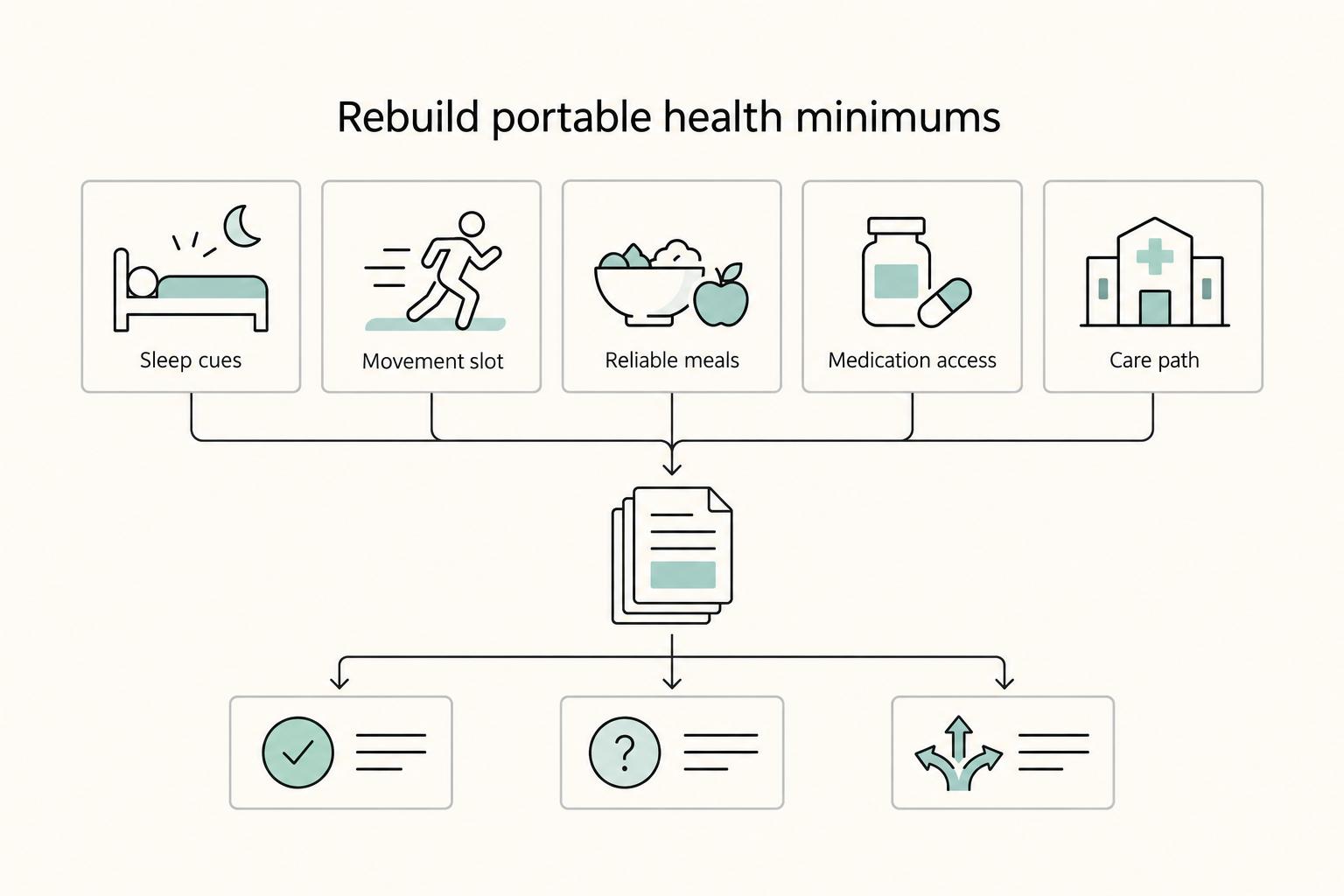
Travel removes your defaults, so rebuild them as portable minimums#
Your routine usually breaks during travel because your defaults disappear, not because your discipline disappears. You lose familiar sleep cues, meal access, movement timing, medication handling, and care logistics at the same time, while your schedule gets less predictable.
At home, many decisions are automatic. On the road, they become active decisions you have to make again. If your destination is more than 3 hours from your home time zone, jet lag is more likely. CDC guidance is to follow destination sleep and waking routines when you arrive.
Reframe what actually broke#
What broke is your cue system. Circadian rhythms are shaped by environmental cues across a 24-hour cycle, so changes in light exposure, meal timing, and work timing can disrupt your routine quickly.
If you work remotely, the pattern is familiar. You land, meetings start, and you improvise everything else. Instead of inventing a brand-new routine, transplant a smaller version of one you already trust. Use one concrete anchor from your existing start-of-day setup, like the approach in A Digital Detox Routine for Freelancers.
Install portable replacements#
Replace each lost default with a simpler version that still works under delays, fatigue, and limited options.
| Default lost | Portable replacement | First action to install today |
|---|---|---|
| Sleep cues | Destination-timed sleep and daytime light exposure | If the time shift is more than 3 hours, set your first local bedtime and wake alarm now |
| Known movement slot | Weekly movement minimum that does not depend on a gym | Block your first three movement windows before meetings fill your calendar |
| Reliable meals | Safe, repeatable food choices | Define one arrival meal, one backup meal, and one carry-on snack |
| Medication access | Carry-on medication continuity bundle | Pack enough medication for the full trip plus extra for delays, and keep it out of checked luggage |
| Familiar care path | Pre-decided care access plan | Save insurance details and your destination care contact path in one note |
Set minimum standards for core anchors#
Use minimums, not intentions. A travel routine holds up when the floor is clear enough to survive a bad week.
| Anchor | Baseline | Action |
|---|---|---|
| Movement | At least 150 minutes/week of moderate activity or 75 minutes/week of vigorous activity, plus muscle-strengthening activity on 2 or more days/week | Set a movement floor that can survive disruptions |
| Food safety | Fully cooked hot food is generally the safest choice; if temperature control is unclear, the food danger zone is 40°F to 140°F | Use food safety as your baseline, not perfection |
| Medication continuity | Bring enough medicine for the full trip plus extra for delays | Verify country restrictions with the relevant U.S. Embassy and keep medication in your carry-on |
| Care access | Know how you will get care, review insurance, and plan for out-of-pocket costs abroad where needed | Lock care access before departure |
Set a movement floor that can survive disruptions. WHO guidance for adults is at least 150 minutes/week of moderate activity or 75 minutes/week of vigorous activity, plus muscle-strengthening activity on 2 or more days/week.
Use food safety as your baseline, not perfection. Unsafe food and drinks can derail a trip, and travelers' diarrhea is common. Fully cooked hot food is generally the safest choice. If temperature control is unclear, remember the food danger zone is 40°F to 140°F.
Treat medication continuity as non-negotiable. Bring enough medicine for the full trip plus extra for delays. Verify country restrictions with the relevant U.S. Embassy, and keep medication in your carry-on for immediate access.
Lock care access before departure. Know how you'll get care, review your insurance, and plan for out-of-pocket costs abroad where needed. You are rebuilding defaults in a specific order so your routine still works when conditions change.
In practice, you will:
- label your trip so you can separate mandatory actions from optional ones
- lock baseline decisions for sleep timing, movement, food, medication, and destination-specific vaccine, medicine, and risk checks
- prepare your travel health kit and confirm care access before departure
- pack and stage your anchors so they still work during delays, transit, and your first 24 hours
Start by labeling the trip, because that determines what is mandatory and what is just helpful.
You might also find this useful: How to Eat Healthy While Traveling Long-Term.
What kind of trip are you taking - and what's mandatory vs optional?#
Classify the trip before you do anything else. If you skip this step, you may over-plan a simple trip or miss a requirement that becomes a problem once work starts.
Set up your trip note first#
Create one trip note with your destination and dates. Use it for two outputs only:
- your one-line trip label
- your mandatory checklist
For anything that sounds like a requirement, verify it before you mark it mandatory. Treat .gov + https as your baseline trust signal for U.S. government pages. If you use legal summary pages, remember that some sources, like eCFR, are authoritative but unofficial. Use them to check and track updates, not as your only proof.
Classify your trip with three gates#
Write the label in plain language so it reflects your planning burden, not just the destination.
| Gate | Question | Planning impact |
|---|---|---|
| Gate 1 | Are you staying in one country, or crossing a border? | If you are crossing a border, treat it as higher-complexity planning until you verify requirements for your route |
| Gate 2 | Is this a short stay, or an extended stay? | Extended stays can raise continuity risk for routines, refills, and care access |
| Gate 3 | Is this lower-friction or higher-friction for you? | Base this on care or pharmacy uncertainty, language friction, multi-stop travel, time-zone shift, or refill or coverage continuity risk |
Gate 1: Are you staying in one country, or crossing a border? If you are crossing a border, treat it as higher-complexity planning until you verify requirements for your route. Save one verified source and the check date for that route.
Gate 2: Is this a short stay, or an extended stay? Extended stays can raise continuity risk for routines, refills, and care access.
Gate 3: Is this lower-friction or higher-friction for you? Base it on your real disruption points. Think about care or pharmacy uncertainty, language friction, multi-stop travel, time-zone shift, or refill or coverage continuity risk.
Use a one-line label like:
- Domestic + short stay + lower friction
- International + short stay + border complexity
- International + extended stay + refill continuity risk
- Multi-stop + extended stay + language friction + limited care certainty
If any part of the label makes an action mandatory, store proof under that item now with a check date.
Refine the label with routine-break factors#
A basic label is often not enough. Tighten it with the factors most likely to break continuity before you start assigning dates.
Use these five questions:
- How many border or transit handoffs are in your route?
- Is your stay pattern stable (one base) or shifting (multiple lodgings)?
- Do you know your care path and pharmacy replacement path?
- Will language friction slow care or pharmacy communication?
- Could refill timing or coverage continuity break mid-trip?
Do not rely on memory here. Keep medication details, coverage details, and border-proof links in one place you can access offline.
Convert the label into mandatory vs optional actions#
Once the label is clear, convert it into actions. This is where planning gets simpler: each trigger either creates a must-do task or it does not.
| Trigger condition | Mandatory action | Optional enhancer | Where to store proof/details |
|---|---|---|---|
| Any border crossing | Save the official page you relied on and the check date | Keep an offline screenshot/PDF | Trip note with links + check date |
| Extended or multi-stop stay | Write a weekly continuity plan for sleep, food, movement, and care | Add a first-48-hours arrival plan | Trip note + calendar blocks |
| Refill or coverage continuity risk | Build your medication and coverage bundle before departure | Add prescriber or insurer contact shortcuts | Offline note + printed backup |
| Uncertain care/pharmacy access | Define care path and replacement path before travel | Add a quick health summary you can show | Phone note + travel folder |
| High language friction | Prepare plain-language medication or allergy details | Add translated key terms you may need | Offline note + screenshot album |
Quick verification rule: pages can change. eCFR itself flags that content is authoritative but unofficial and provides change and history checkpoints. Log what you checked and when.
Finish this section before you touch the timeline#
Do not move into timeline planning until this section is done. Finish with only:
Your trip label Example: "International + extended stay + border complexity + refill continuity risk."
Your mandatory checklist Keep it binary and pre-timeline. If it is mandatory, it must be done before scheduling the 4-6 week actions.
If you want a deeper dive, read How to Stay Healthy and Fit While Traveling.
Before you lock your mandatory-vs-optional list, use the Digital Nomad Visa Cheatsheet to sanity-check destination entry and stay assumptions.
4-6 weeks out: lock your baseline health + destination risk plan (before your calendar explodes)#
This is your decision window. Lock the items that can break entry, care access, or medication continuity if you handle them too late.
Start one Trip Health Plan file#
Create one file: Trip Health Plan. Tag every item as:
- Required: missing it could block entry, break care continuity, or create a medication problem
- Recommended: lowers risk, but the trip can still function without it
- Time-sensitive: has a deadline, validity window, or start date that can force schedule changes
Use this file as your single offline record for your care pathway, medication constraints, and destination-specific restrictions.
Decide on a pre-travel consult now#
For international travel, decide now whether you need a pre-travel consult. CDC says to book at least 4-6 weeks before departure. WHO guidance supports a broader 4-8 weeks (preferably) window.
| Item | Timing | Why it matters |
|---|---|---|
| CDC pre-travel consult timing | At least 4-6 weeks before departure | This is the CDC booking window |
| WHO pre-travel consult timing | 4-8 weeks (preferably) | This is the broader WHO planning window |
| Yellow fever proof | Only valid 10 days after vaccination when required | Lead time can affect entry readiness |
| Some malaria regimens | Start 1-2 weeks before travel | Medication timing may require earlier action |
| Other malaria regimens | Start 1-2 days before travel | Medication timing still needs to be planned in advance |
Close this step with one of two outcomes:
- consult appointment scheduled
- "no consult needed" documented with your reason
Write specific questions for the visit: vaccines, medication timing, destination restrictions, and what would require plan changes. Keep lead-time risks explicit. Yellow fever proof is only valid 10 days after vaccination when required. Some malaria regimens start 1-2 weeks before travel, while others start 1-2 days before travel.
Run destination screening in a fixed order#
Use a fixed sequence so you do not miss a higher-priority risk while chasing lower-value details. Check in this order, and only change your plan when the continuity risk changes:
- CDC destination page (vaccines, medicines, disease-risk requirements)
- CDC Travel Health Notices (including outbreak or disaster signals that may limit care availability)
- U.S. Department of State Travel Advisory (4 levels of risk)
- STEP enrollment (free) for eligible U.S. travelers abroad (destination updates from embassy or consulate)
| Signal | Impact on your trip | Immediate next action |
|---|---|---|
| CDC destination page shows vaccine, medicine, or proof requirement | You may need an appointment, medication choice, or valid documentation before departure | Mark as Required or Time-sensitive and log deadline or check date |
| CDC Travel Health Notice indicates outbreak or infrastructure damage | On-the-ground care access and precautions may change | Update care pathway and verify trip continuity |
| State advisory is Level 4 ("Do not travel") | Major continuity and safety red flag | Recheck route and dates before further prep spend |
| Embassy guidance restricts a prescription | Entry or medication continuity can fail | Record restriction, required documents, and country-by-country plan, including transit stops |
Finalize the Trip Health Plan file#
Before you move on, the Trip Health Plan should support real decisions, not just research notes.
Include:
- care pathway for getting medical help during travel
- medication constraints and embassy-verified prescription restrictions
- destination-specific proof or restriction items
- medical profile card details: blood type, chronic conditions, current medicines, allergies
Also log unresolved coverage questions now. Do not assume your current policy covers care abroad, and plan for possible out-of-pocket payment at destination facilities.
Carry these into the next section:
- Updated checklist: required items, proof links, check dates
- Open follow-ups: pending consults, embassy verification, insurance questions
- Scheduled prep tasks (before departure): refills, health kit build, care-access confirmation
For a step-by-step walkthrough, see How to Keep Your Valuables Safe While Traveling.
1-2 weeks out: refill prescriptions, build the health kit, and confirm care access#
This window is for execution, not more research. By the end, you should have a refill plan that reduces missed doses, a trip-specific kit, and a written care-access plan you can use under stress.
Confirm every refill path#
Start with medication continuity and go through your list one medication at a time with your pharmacy. Record what is ready, what is pending, and what you will do if delays extend the trip.
Add this checklist to your Trip Health Plan:
- medication name, generic name, dose, and schedule
- pharmacy and prescriber contact details
- refill status and next-fill plan
- extra supply for delays, if available
- where each essential medication will be stored in transit
Verification check: you can answer, without guessing, "If I'm delayed, how do I avoid missed doses?" If your answer depends on finding a new pharmacy after arrival, fix that now. Domestic trips can still create friction because brands and availability vary, and international trips usually need more planning.
Build your kit by risk, not habit#
Travel kits often fall short when they are built from habit instead of itinerary. Pack for your trip and your known needs, not for a generic "just in case" scenario.
| Item category | Must pack now | Conditional add-on | Where stored |
|---|---|---|---|
| Prescription medicines | Active meds; prescription copies with generic names | Extra supply for delay exposure | Essentials in your personal bag; remainder in main luggage if needed |
| OTC symptom support | Products you already use and tolerate | Trip-specific add-ons based on your destination or history | Easy-access pouch |
| First aid supplies | Basic first aid supplies | Expanded supplies for remote or higher-friction travel | Main kit, easy to reach |
| Monitoring tools | Only tools already used in your care | Pulse oximeter if you have lung or heart disease | Personal bag if relevant |
Verification check: each item has a clear reason, and you know exactly where it is packed.
Write your care-access decision tree#
Do this now so you are not improvising when you are tired or unwell. Keep the sequence simple and tailored to your trip: include what you can self-manage, when to contact a pharmacist or clinic, and when worsening symptoms mean you should seek urgent care.
Keep one offline note with:
- medication list
- prescription copies with generic names
- pharmacy contact details
- insurance card image and contact number, if applicable
- care options near where you are staying, if already identified
Verification check: you can access this note without internet.
Travel-week handoff: prescriptions and copies are already packed, essentials stay accessible during transit, and your watchlist only includes pending pickups or unresolved care contacts.
This pairs well with our guide on Healthy Snacks for Work That Support a Productive Day.
Travel week: pack like an operator (and pre-load routine anchors you can actually execute)#
In travel week, routine breakdown is often an access problem, not just a motivation problem. If you cannot reach it in transit, clear it at security, or do it in a basic room, it is not part of your real routine.
Define your minimum before you pack#
Write two one-line answers in a single note:
- What breaks first for you?
- What still counts as "on track" this week?
Keep your minimum explicit. For example: take every dose, cover missed meals, do one short movement block, and protect sleep on arrival.
| Item type | With you | Checked | Buy on arrival |
|---|---|---|---|
| Prescription meds, prescription copies, dose schedule | Yes, keep with you | No | No |
| Liquid medications over 3.4 ounces (100 milliliters) | Yes, declare if medically necessary | No | No |
| Power bank and spare lithium batteries | Yes, carry-on only | No | No |
| Shelf-stable food backup you already tolerate | Yes | No | Maybe for extras only |
| Basic first aid and noncritical backups | If space allows | Yes | Sometimes |
Step 1: Pack one movement anchor Choose one no-equipment session you can do in a plain room or transit space. It should support progress toward 150 minutes per week without relying on a gym. How to verify: you can run the full session from memory in normal clothes.
Step 2: Carry a real food backup Pack shelf-stable food you already tolerate. If food safety may be uneven on arrival, use a simple first-meal rule: hot cooked food and sealed beverages. How to verify: if a delay passes meal time, you can still eat without depending on airport options or airline service, which may not arrive until up to two hours into a tarmac delay.
Step 3: Keep time-sensitive continuity on your person Keep your medications, dose schedule, and replacement details in your personal bag. Standard carry-on liquids are limited to 3.4 ounces (100 milliliters) per container. Medically necessary liquids can be carried in larger amounts when declared at screening. If you cross time zones, set dosing by elapsed time since your last dose, not the local clock time. How to verify: you can point to each critical item and state your next dose timing without guessing.
Step 4: Pre-load arrival-day stability Schedule your first food stop and first movement block now, and protect a sleep window of at least 7 hours. Keep your arrival-day workload light enough to preserve recovery. How to verify: your first 24 hours already include food, movement, charging, and sleep.
Step 5: Run a 2-minute disruption drill Assume your checked bag is delayed or transit runs long. Test one question: can you still eat, move, charge devices, and maintain critical continuity with what is with you now? How to verify: if the answer is not an immediate yes, repack before you leave.
We covered this in detail in A Guide to Creating a 'Digital Detox' Routine.
How do you survive transit day without torching your routine?#
Transit day goes better when you run a simple default plan instead of trying to recreate your full home routine. Protect three anchors, keep medication continuity non-negotiable, and judge the day by execution.
Travel decisions stack up fast, and health habits can slip behind logistics before you notice. Reduce choices in the moment so you stay functional through delays, reroutes, and late arrivals.
Protect three anchors#
Use a three-anchor protocol with one clear default per anchor.
| Anchor | Default action | Mid-transit check |
|---|---|---|
| Movement | Take one short walk or one simple mobility block when you get a safe window. If you have a longer wait, run a 15 minute no-equipment block you already know. | You have moved since your last long sit, or completed the 15 minute block. |
| Food | Get a solid meal when available, then carry a backup food you already tolerate. | You know your next meal, and still have a backup if plans slip. |
| Hydration | Keep water accessible and refill when you reasonably can. If you track intake, use your own target. | Your bottle is not empty for long, and you know your next refill point. |
Without normal gym access, it is easy to drift into inactivity. Transit day is not for perfect training. It is for interrupting that drift.
Make food choices early#
Make food choices early with a short sequence:
- Buy the most filling main option you can get without a long wait.
- Add fruit or a vegetable if one is easy to find.
- Add one shelf-stable backup for the next delay, transfer, or closed kitchen.
- If choices are limited, pick a reliable option you can eat now and move on.
This helps when decision fatigue is high. Waiting until you are very hungry and tired can make reactive choices more likely; burnout symptoms can include comfort eating or excessive drinking.
Keep medication continuity intact#
Treat medication continuity as non-negotiable.
Keep your medication plan and written guidance easy to access during transit. If timing changes come up, follow your pre-set clinician guidance and do not improvise in transit.
Use one quick check: you can physically access the medication, name the next dose time from your plan, and show written guidance if needed. If not, fix it before the next leg.
Transit day is still a win if you keep the anchors alive. If one slips, reset at the next meal, next refill, or next short walk, and stay on your medication plan.
Related: How to Integrate Calendly with Your Website.
If you want one place to run cross-border money workflows with clear controls, explore Gruv's tools.
Try a related tool
Researched and edited by the Gruv editorial team. Gruv builds cross-border billing, payouts, and finance-operations software for global businesses.
Sources
Educational content only. Not legal, tax, or financial advice.
Related Posts

A Digital Detox Routine for Freelancers Who Need to Stay Reachable
Use your devices as operating tools, not open doors to constant interruption. The goal is not to quit screens. It is to control when they get to interrupt your work.

How Remote Professionals Stay Healthy During Long Stays Abroad
Use this sequence before workload, housing, and travel friction make health tasks harder to execute. If you are traveling for months, treat this as four pass-fail gates. A gate is closed only when you have a written output you can verify.

How to Integrate Calendly with Your Website
Start with a simple three-step launch sequence: choose the embed path that fits the page, lock in your real availability, then validate the booking flow before you publish. That turns a Calendly embed into a client-facing booking process, not just a design element on the page.