
Quick Answer
Keep one organized digital archive with separate folders for income proof, expense proof, travel evidence, foreign-account records, and copies of filed returns. To stay audit-ready, save each document when received, link it to the bookkeeping entry and payment record, update travel and foreign-account files on a schedule, and keep records for the applicable retention period.
For a global professional, autonomy only works if your records can keep up with the way you work. Multi-currency income, foreign accounts, and constant travel make tax compliance easy to postpone and hard to reconstruct later. That turns routine filing into year-end stress and audit anxiety.
Treat recordkeeping as part of the business. When you move from reactive cleanup to a repeatable system, compliance becomes easier to manage and defend. This 3-Pillar Framework gives you a practical way to build an audit-ready business of one.
Pillar 1: Records You Can Produce on Request (Your System)#
Your system works if you can quickly prove income, expenses, travel, and foreign-account reporting when asked. The IRS lets you choose your format, but your records still need to clearly show income and expenses and you need to be able to produce them.
Step 1. Choose one storage stack as your single source of truth#
The setup that works is usually the one you will actually use every time. Pick one final destination for every tax document and stick to it. If the same file lives across email, chat, downloads, and bookkeeping, retrieval can break when you need it most.
Use the simplest setup that still lets you retrieve files quickly, export records, and reproduce them clearly during an exam. IRS exams now use electronic accounting records, and software backup files may be requested early through Form 4564.
| Layer | Safe-default setup | Higher-control setup |
|---|---|---|
| Storage | One cloud drive with year-based folders | Cloud drive plus separate local backup copy |
| Capture | Mobile scanner app or direct PDF download | Scanner plus standardized PDF settings and naming rules |
| Books | Basic bookkeeping tool tied to bank feeds | Bookkeeping tool with scheduled backup exports and locked month-end files |
Use the higher-control setup if you run multiple businesses, need reliable software backup files, or work across countries and devices.
Step 2. Build folders around audit questions#
A useful folder structure should answer the same questions an examiner would ask. Build folders around proof, not convenience. Inside each tax year, use folders like these:
| Folder | Keep here | Key note |
|---|---|---|
| 01 Income proof | invoices, payment confirmations, 1099s, platform statements, and deposit support | Inside each tax year |
| 02 Expense proof | receipts, bills, canceled checks, contracts, and business-purpose notes | Inside each tax year |
| 03 Travel evidence | records supporting travel deductions and, when relevant, physical presence | A calendar alone may not be enough; keep records that can reconstruct 330 full days in 12 consecutive months, with a full day defined as 24 consecutive hours (midnight to midnight) |
| 04 Foreign account records | statements and FBAR records for FinCEN Form 114 | Keep this separate because FBAR depends on aggregate foreign-account value exceeding $10,000 at any point in the year, whether or not the accounts produced taxable income |
Quick check: if someone else opened the folder, could they tell what each file proves?
Step 3. Run the same intake checklist every time#
Consistency matters more than sophistication here. A simple intake routine, done every time, keeps your archive usable. Use one repeatable process:
- Capture the document the day you receive it.
- Name it consistently, for example,
YYYY-MM-DD_Vendor_Amount_Category. - Categorize it into the correct year and proof folder.
- Verify it is legible, complete, and matched to the bookkeeping entry.
- Archive the final file, then remove loose duplicates.
Handle exceptions immediately. If a file is missing or unreadable, request a duplicate from the vendor or bank, log the gap, and pull an IRS transcript when you need wage and income history. A transcript can fill part of the trail, but it does not replace core business documentation.
Step 4. Escalate when system complexity increases#
Once your setup stops being straightforward, bring in help early. Multi-entity operations, shared personal and business accounts, signature authority over foreign accounts, or cross-border reporting issues can turn a decent filing system into a weak one if the records do not line up.
If your setup is simpler, keep it boring and consistent. That is what makes notice responses and examinations manageable.
Pillar 2: The Global Compliance Dossier (Your Documents)#
Once storage is stable, the next question is whether each file actually supports what you filed. Your dossier works when every document ties to a specific return position and the amounts in your books.
Step 1. Build a chain of proof for every transaction#
For each income or expense item, keep a full trail rather than a single document. In practice, that is what lets you trace a filed amount back to the source and verify it in the other direction too. Use this four-link chain:
| Link | Record examples |
|---|---|
| Source document | invoice, receipt, bill, sales slip, or contract |
| Payment evidence | paid bill, deposit slip, canceled check, or payment confirmation |
| Account statement | bank, card, or platform line showing the charge, deposit, or transfer |
| Categorization record | your bookkeeping entry with classification and tax year |
Your books need to show income, deductions, and credits, but one document is often not enough to substantiate all elements. Keep the full set together so each filed amount can be traced from books to documents and from documents back to books.
Quick control: each month, test five entries from books to source and five source documents back to books. If a link breaks, fix the file immediately.
Step 2. Strengthen deduction support before documents disappear#
Weak support gets harder to repair over time. If a category already tends to draw stricter substantiation, do not rely on the easiest record you can find. Keep the strongest record you can still recover.
| Record type | Stronger support | Potentially weak on its own | What to add |
|---|---|---|---|
| Ordinary vendor purchase | Itemized receipt or invoice plus payment proof | Card statement with merchant name only | Detailed receipt showing what was purchased |
| Online subscription or software | Vendor invoice/receipt plus statement line | Bank or card statement only | Vendor receipt email or billing-page PDF |
| Travel cost | Receipt/invoice plus dates, amount, and business-purpose note | Statement line only | Underlying invoice plus your dated purpose note |
| Auto or gift expense | Detailed receipt plus payment proof and supporting note | Manual entry with no source document | Original receipt and contemporaneous note |
If a document is missing, use an exception workflow right away:
- Request a duplicate from the vendor or provider.
- Keep fallback records, such as the statement line, order confirmation, and relevant emails.
- Add a written note with payee, amount, date, and business purpose.
That fallback is not as strong as original documentation, but it preserves a trail when the original record cannot be recovered.
Step 3. Keep foreign-account records separate and threshold-driven#
Foreign-account records are easier to manage when you keep them separate from the start. Use a dedicated folder and tie it to the filing trigger, not to whether the account produced taxable income.
| Control item | Requirement |
|---|---|
| FBAR filing trigger | aggregate foreign-account value over $10,000 at any point in the calendar year |
| Support to keep | account-identifying details and maximum-value support for each reportable account |
| FBAR due date | April 15 |
| Automatic extension | October 15 |
| FBAR record retention | 5 years from the report date |
| Form 8938 threshold note | Confirm the current Form 8938 filing threshold with the IRS or a tax advisor. |
| Form 8938 scope note | The threshold depends on filing status and whether you live inside or outside the United States. |
| Form overlap | Form 8938 does not replace FBAR. |
Use the folder as a live control sheet. For FinCEN Form 114 (FBAR), keep account-identifying details and maximum-value support for each reportable account. For Form 8938, keep a control note in the folder and verify the current threshold before filing.
Escalate early when account ownership, reporting scope, or form overlap is unclear.
Step 4. Build a Form 2555-ready FEIE travel dossier#
If FEIE may be in play, build the file for the full claim, not just for day counting. Travel records are easier to defend when chronology is captured as you go instead of reconstructed later.
You must attach Form 2555 to Form 1040/1040X. Your tax home must be in a foreign country during the qualifying period. If you use physical presence, you need 330 full days in a 12-month period, with a full day defined as 24 consecutive hours (midnight to midnight).
Use this checklist for Form 2555 Part III support:
- Flight and travel confirmations with dates
- Passport stamps, where available
- Visa or residence-permit pages
- Lodging invoices or similar location records
- Day-by-day location log showing where you were at midnight
- Beginning and ending dates for your 12-month qualifying period(s) and arrival/departure dates
- Notes for U.S. days, transit days, and unclear entries
If records conflict, reconcile them to one primary chronology first, then annotate any mismatch directly in the file. Escalate to a qualified tax professional when travel logs are incomplete, tax-home facts are unclear, or cross-border timing does not align cleanly with Form 2555 dates. That matters even more if you are supporting an exclusion claim up to $132,900 per qualifying person for 2026.
Related: The Best Digital Nomad Cities for Entrepreneurs and Startups.
Pillar 3: The Proactive Protocol (Your Habits)#
A good archive still fails if you only touch it at filing time. Your system stays defensible when you maintain it on a schedule and close open issues before they spread into the next period.
Cadence design#
Use the minimum routine only when volume is low and your cross-border facts are stable. If you have multiple accounts, frequent travel, or possible FEIE or FBAR exposure, default to the strong routine.
| Cadence | Minimum viable routine | Strong routine |
|---|---|---|
| Weekly | Import and categorize new transactions; save receipts and invoices from email and apps | Do the minimum routine, then test sample entries from books to source and source to books |
| Monthly | Reconcile bank and card statements; update open document requests | Reconcile all accounts, update foreign-account tracker, refresh travel-day evidence, and check in-year tax status |
| Quarterly | Review year-to-date income, expenses, and tax payments | Do the minimum routine, then review exceptions, retention gaps, and cross-border items for professional escalation |
Step 1. Close each week while evidence is still easy to recover#
Waiting even a few weeks can make missing receipts, unclear transfers, and unlabeled charges harder to fix.
- Inputs: new receipts, invoices, payment confirmations, and bank, card, or platform activity.
- Actions: categorize transactions and attach support for each material income, deduction, or credit item.
- Close condition: every uncategorized item is either fully supported or placed in an exception log with an owner and follow-up date.
Quick control: sample two expenses and confirm the full chain is intact: source document, payment evidence, account statement, and bookkeeping entry. Do not treat a statement line alone as complete support when a detailed receipt is needed.
Step 2. Treat the monthly close as a compliance checkpoint#
Use the monthly close as a compliance checkpoint, not just a bookkeeping task. This is where you catch problems while they are still fixable.
- Inputs: monthly statements, open exceptions, foreign-account tracker, travel records, and tax-payment notes.
- Actions: reconcile every account and clear differences before closing.
- Close condition: no unresolved reconciliation is silently carried forward.
When the books tie out, run three compliance checks:
- Foreign accounts: update tracking because FBAR filing can be triggered when qualifying foreign accounts exceed $10,000 at any time during the calendar year. That rule applies whether or not the accounts produced taxable income.
- Travel evidence: if Form 2555 or physical presence may apply, refresh the travel file so day-level support remains current for the 330 full days in a 12-month test.
- Estimated tax: prepare the next payment-period note and confirm whether you are tracking toward the 90%/100% benchmark, or flag the calculation for follow-up.
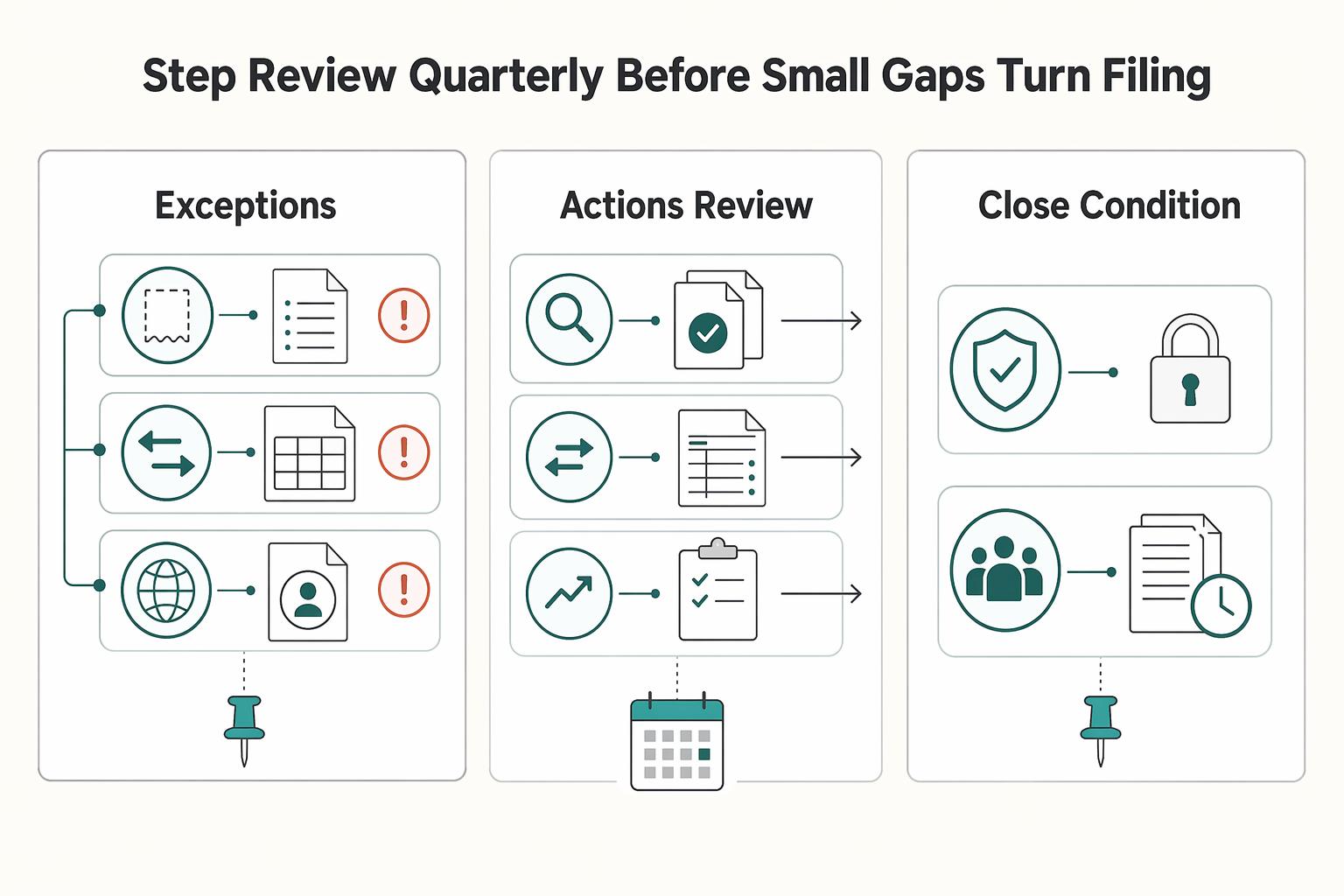
Step 3. Review quarterly before small gaps turn into filing risk#
A quarterly owner review keeps small record gaps from becoming filing risk. By this point, you are not just checking math. You are deciding what needs to be fixed before the next estimated-tax period.
- Inputs: year-to-date P&L, balance sheet or account summaries, tax payments, and exception log.
- Actions: review what changed, what remains unresolved, and what must be fixed before the next estimated-tax period.
- Close condition: you have a short decision note with assigned next actions and dates.
Common risk signals at quarter-end are missing receipts, unresolved transfers, and unclear foreign-account ownership. If you have employees, keep employment-tax records for at least 4 years.
Step 4. Escalate before a records issue becomes a filing problem#
Escalate early when records cannot be cleanly substantiated. That is a control, not overreaction. Pause and consult an authorized representative or qualified tax professional if any of these appear:
- Missing source documents cannot be recovered and only partial fallback evidence exists.
- A reconciliation remains unresolved into the next month.
- Foreign accounts involve ownership or other cross-border ambiguity.
- Travel chronology conflicts with your travel records tied to Form 2555.
- You expect to owe tax but cannot confidently estimate what to pay during one of the four payment periods.
Use your right to retain an authorized representative before a records issue becomes a filing or examination problem.
For a step-by-step walkthrough, see How to Document 'Reasonable Cause' for IRS Penalty Abatement.
If your weekly routine keeps breaking, use the Tax Residency Tracker to keep travel evidence and tax-residency notes organized in one place.
The Professional's Archive: Official IRS Retention Timelines#
Archiving is not just a storage decision. It is a risk decision. As a practical policy, move records from active files to archive only after you classify the return-year issue and confirm which period of limitations applies.
Step 1. Classify closed-year records by risk, not file type alone#
Classify closed-year records by tax position and risk, not by file type alone. That gives you a retention standard you can actually defend later.
| Common record type | Retention treatment bucket | Current IRS treatment |
|---|---|---|
| Receipts, canceled checks, statements, and support for filed items | Standard return support | 3 years when listed exceptions do not apply |
| Income records with omission risk | Underreported-income risk | 6 years when omitted income is more than 25% of gross income shown, or when omitted income is attributable to foreign financial assets over $5,000 |
| Documentation for bad-debt deduction or worthless-securities loss | Special-loss claims | 7 years |
| Return-year file where no return was filed | Non-filing risk case | Indefinite |
| Return-year file with fraud issue | Fraud-risk case | Indefinite |
Before moving anything, confirm the archive label ties back to the exact return item it supports - income, deduction, or credit, not just the tax year folder.
Step 2. Separate permanent records from bulk support#
Keep permanent records separate from bulk support. That split makes retrieval faster and keeps you from burying important files inside low-value archive material.
- Keep in permanent storage: copies of filed tax returns, since they support future return prep and amended-return computations.
- Keep active or immediately retrievable: property-basis records until the limitation period expires for the year you dispose of the property.
- Move to cold storage as an internal operations choice: reconciled support files that no longer need day-to-day access, once the applicable retention window is confirmed.
As an internal control, preserve basic retrieval metadata on archived files, such as tax year, transaction date, account or counterparty, related return or filing, and evidence type (for example, source document, payment proof, or filed return copy).
Step 3. Confirm edge-case retention rules instead of guessing#
Do not guess on edge cases. When retention rules get murky, that is the point to confirm them.
If FBAR applies, use its separate record-retention clock, generally five years from the FBAR due date. The due date is April 15, with an automatic extension to October 15. If you are handling amended returns, foreign tax credit issues, disputed worker classification (Form SS-8), or cross-border filings with unclear rules, confirm retention requirements with a qualified tax professional. For audit, collection, or appeals disputes, use a representative with full IRS practice rights: attorney, CPA, or enrolled agent.
Conclusion: Your Records Are Your Freedom#
Good records protect your autonomy when tax questions show up. The practical goal is simple: make storage reliable, make proof easy to trace, and make maintenance routine enough that nothing important sits unresolved for months.
- Control storage: keep filed returns and supporting records in one archive organized for fast retrieval.
- Control proof: replace weak summaries with underlying source records and keep travel evidence aligned to the exact claim, especially when Section 911 minimum-time tests apply.
- Control maintenance: run a recurring review so missing or unclear records get fixed before filing season or an IRS Information Document Request.
When you want your invoicing and cross-border payment flow to stay traceable with fewer manual handoffs, review Gruv for freelancers.
Frequently Asked Questions
How do I keep records if I am an expat or digital nomad?
Keep FEIE evidence, foreign-account records, and support for income, deductions, and credits in separate files so each issue stands on its own. For FEIE, eligibility turns on time in foreign countries, not residence labels or intent, so keep day-count support for the exact 12 consecutive months you claim. Keep foreign-account records separately and keep copies of filed tax returns.
How do I prove my days outside the United States for FEIE?
Use records that support 330 full days abroad in a 12-consecutive-month period, with each full day running from midnight to midnight. Keep a day-by-day location log showing where you were at midnight, plus flight confirmations, passport stamps where available, and lodging or similar location records. If you had to leave because of war, civil unrest, or similar adverse conditions, keep records supporting that because a waiver may apply.
What is a practical digital storage standard for audit readiness?
Use one storage stack as your single source of truth so support is easy to retrieve. A practical default is one cloud drive with year-based folders. If you need more control, add a separate local backup copy and scheduled backup exports from your bookkeeping tool.
What do I keep for foreign account reporting?
Keep foreign-account records in a separate folder and tie them to the filing trigger, not to whether the account produced taxable income. For FBAR, keep account-identifying details and maximum-value support for each reportable account. For Form 8938, keep a control note in the folder and verify the current threshold for your filing status and whether you live inside or outside the United States.
What tax forms do my clients need from me?
This article does not specify which client tax form applies to your setup. Verify the correct form and workflow separately based on your payer setup and tax status. Keep a note of the form requirement you verified, a copy of what you submitted, and submission confirmation when available.
Try a related tool
Researched and edited by the Gruv editorial team. Gruv builds cross-border billing, payouts, and finance-operations software for global businesses.
Sources
Educational content only. Not legal, tax, or financial advice.
Related Posts

Digital Nomad Taxes in 2026 With a Defensible Filing Plan
With digital nomad taxes, the first move is not optimization. It is figuring out where you may be taxable, where filings may be required, and what proof supports that position.
The Best Digital Nomad Cities for Entrepreneurs and Startups
Choosing a nomad base for your company is an execution decision first. Lifestyle matters, but it belongs in the second round. The costly mistakes usually show up after the city-ranking stage, when a place that looks great online turns into a slow or expensive setup once you start invoicing, signing contracts, and working against real deadlines.

The Freelance Payment Penalty: A Modeled Audit of Platform Fees, FX Spreads, and Payout Delays
The money rarely disappears through a single, easy-to-spot fee. The real loss is stacked. A marketplace takes its commission, a processor adds a charge for international cards, a bank or payment company converts the currency at a spread, a platform holds the funds before release, and a wire sheds a little to intermediaries on the way in. Each layer looks defensible on its own, but the worker feels the combined result as a smaller deposit and a later payday.