
Quick Answer
Yes, a freelance mastermind group is worth joining when it runs like a decision forum, not a support chat. Start by checking for a written charter, member vetting, and a meeting format that ends with a clear owner and next action. A practical size is usually small enough for real participation, often around four to five people, with one focused issue per hot seat. If the group cannot challenge assumptions or track follow-through, skip it.
How a Freelance Peer Group Produces Decisions and Next Actions#
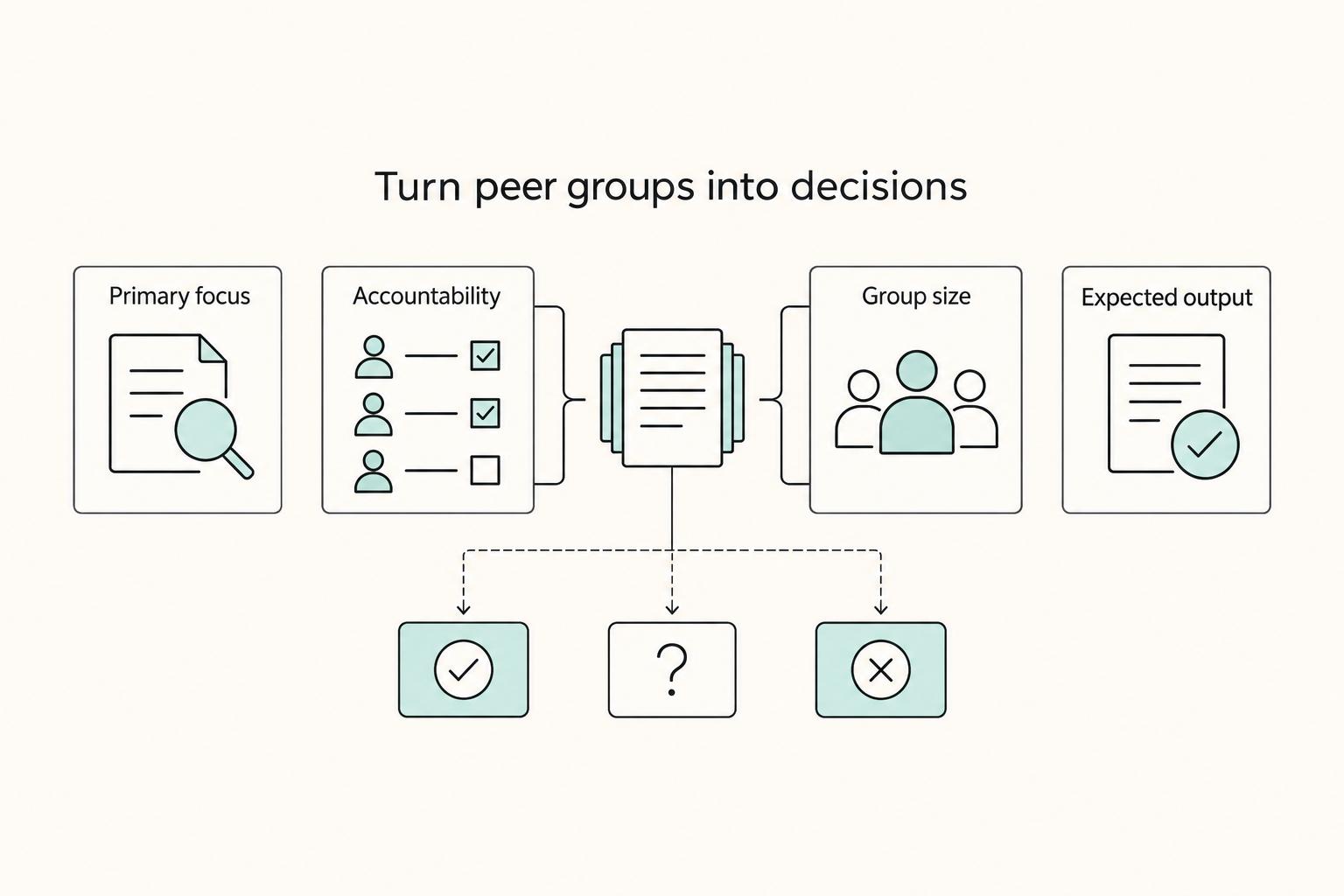
A freelance peer group can do more than make you feel less alone. At its best, it works like a personal board of directors: a small group that meets regularly to discuss issues, test decisions, and hold each other accountable, not just a general support circle.
| What happens in the room | Support-focused group | Board-style peer group |
|---|---|---|
| Primary focus | Encouragement and mutual support | Support plus decision-focused peer input |
| Accountability style | General check-ins | Clear next actions tied to the deadlines you set |
| Group-size tradeoff | Very small groups can feel thin if one person misses | Larger groups can take longer to get through meetings |
| Expected output | Relief, motivation, camaraderie | A clearer next move and follow-up plan |
Step 1 Challenge your assumptions#
Start with one decision that matters now, not a vague frustration. Good examples include whether a prospect is really a fit, where your pricing position is drifting, or whether scope is getting loose before the work even starts.
Use a simple checkpoint. Can peers restate your real decision and name the assumption under it? If not, you are still circling the issue instead of working on it.
Step 2 Use the group to widen the picture#
Working alone makes it easy to get stuck in your own patterns. A small recurring group gives you more angles on the same decision and surfaces options you might miss on your own.
Keep the format realistic. One freelancer guide recommends 3-5 people, with four as an ideal and five as an outside limit, noting that very small groups can lose discussion quality when someone misses and larger groups can slow meetings down.
Step 3 Leave with a decision and evidence to gather#
Do not leave with "a lot to think about." Leave with a choice and one or two next actions. Also leave with a short list of what still needs verification before you act, such as a proposal draft or pricing options.
Choose a cadence that fits your goal. Some accountability-team formats run every week for 6 weeks, while some roundtable formats are quarterly and ongoing.
If your current group cannot challenge assumptions, widen your perspective, or produce clear next actions, you do not have a board-style group. You have a conversation group.
For a related take on choosing a peer forum, you might also find this useful: How to Find and Join a Writers Group That Actually Helps.
How to Recruit Your Board: A Vetting Framework for High-Caliber Peers#
Recruit this like advisory-seat selection, not social networking. This four-step screen helps you test fit before full inclusion.
| Step | Action | Lens | Checkpoint |
|---|---|---|---|
| Define the seat | Write a short peer profile | Strategic fit and perspective mix | You can explain in two sentences why this person belongs and what angle they add |
| Collect comparable evidence | Use one structured application for everyone | Signal quality over charisma | You can compare responses side by side without relying on memory |
| Interview for decision quality | Run one focused fit conversation | Decision quality under uncertainty | They can restate the real decision and name the underlying assumption |
| Prove fit in practice | Use a trial period before final membership | Consistency in real sessions | They help the room produce one decision, one owner, and one next action |
Before you start#
Set your screening standards before outreach. Start with the charter basics you need for selection: confidentiality, contribution expectations, and a no-unsolicited-advice norm.
Do not use hard filters you cannot verify. If you need a maturity bar, leave it unresolved until you can defend it. The stronger test is practical: can this person work on one decision that matters now, identify the assumption under it, and leave with one or two next actions?
Step 1 Define the seat you are filling#
Define the seat before you contact anyone. Action: Write a short peer profile. Lens: Strategic fit and perspective mix. Checkpoint outcome: You can explain in two sentences why this person belongs and what angle they add.
Use four selection lenses: strategic alignment, confidentiality readiness, contribution quality, and communication style. You want different backgrounds that widen options, not identical thinking that only speeds agreement. If your profile cannot name the decisions this person should help test, it is still too loose. To widen your candidate pool, use How to Network Effectively as a Remote Freelancer.
Step 2 Collect comparable evidence#
Standardize evidence so you can compare candidates fairly. Action: Use one structured application for everyone. Lens: Signal quality over charisma. Checkpoint outcome: You can compare responses side by side without relying on memory.
Ask each candidate for one current business decision, one recent mistake, and how they give feedback when they disagree. Include one confidentiality question and one scenario tied to the no-unsolicited-advice norm. Look for specifics: what facts they gathered, what tradeoff they saw, and what they did next.
Step 3 Interview for decision quality#
Use a short fit interview to test thinking under uncertainty. Action: Run one focused fit conversation. Lens: Decision quality under uncertainty. Checkpoint outcome: They can restate the real decision and name the underlying assumption.
Ask them to walk through a recent choice with real tradeoffs. Strong candidates clarify before advising, stay concrete, and use peer input to test thinking. If someone mainly needs a mentor relationship, point them to a better fit such as How to Find a Mentor as a Freelancer.
Step 4 Prove fit in practice#
Confirm fit in live operation, not from one good call. Action: Use a trial period before final membership. Lens: Consistency in real sessions. Checkpoint outcome: They help the room produce one decision, one owner, and one next action.
During the trial, verify preparation, confidentiality behavior, assumption-challenging, and follow-through. Good attendance alone is not enough if contributions stay abstract or drift into directive advice.
| Stage | Ask or test | Pass signal | Disqualifying signal |
|---|---|---|---|
| Define | What decisions should this person help sharpen? | Clear seat definition and useful perspective difference | Main reason is only "smart person" |
| Apply | What decision, mistake, and feedback style do they describe? | Specific examples with tradeoffs and reflection | Generic ambition and broad opinions |
| Interview | Can they restate the decision and name the assumption? | Clarifies before advising | Jumps straight to "you should" |
| Trial | What happens in a live session? | Helps produce clear next actions | Discussion grows, decision movement stalls |
If you want to sharpen candidate inputs before interviews, see How to Use AI for Market Research in Your Freelance Business. Strong vetting is what makes your charter useful and your meetings high-ROI.
Establishing Your Charter: The Rules of Engagement for a High-Impact Board#
Write the charter before your first working session. If your group cannot protect sensitive context, challenge assumptions, and leave with one decision, one owner, and one next action, it is a conversation group, not a board-style peer system.
Step 1 Write five rules you can run in real time#
Keep the purpose simple: this group exists to test real decisions, not collect general advice. Then make every rule operational with a policy, an owner, and a review path.
| Rule | Policy statement | Owner to name in charter | Review path |
|---|---|---|---|
| Confidentiality | Nothing shared in session leaves the group without explicit permission from the member who shared it. | All members flag concerns; final reviewer to be named in the charter | Pause sharing, document the issue, review it under the charter, and decide next steps through the written process |
| No unsolicited advice | Ask what facts are missing first; use questions and experience, not "you should" commands. | Facilitator in session | Reframe once in the room, then move repeated issues to written review |
| Hot-seat structure | One member brings one live issue, and discussion stays on that decision until closeout. | Facilitator | If prep is unclear, pause and reschedule the seat instead of drifting |
| Contribution expectations | Members prepare, participate, and follow through; the charter should state what missed prep or follow-through triggers review. | Review owner to be named in the charter | Move the member to review status and follow the documented exit path |
| Decision rights and conflict handling | The member in the seat owns the final decision; disagreements move out of live debate into the documented review path. | Conflict reviewer to be named in the charter | Record the disagreement, take it offline, and resolve it through the written process |
Scenario-test each rule before adoption: can peers restate the real decision and the key assumption before giving input? If not, tighten the language. If someone wants directive advice instead of peer challenge, they may need a different format, such as How to Find a Mentor as a Freelancer.
Step 2 Adopt it before you meet#
Use a short charter adoption checklist before the first session: circulate the draft for review, run a scenario test out loud, get member sign-off, and name the first review trigger before the group starts using the charter.
Your charter is the operating script for the room; the next section shows how to run meetings with it.
Running the Meeting: How to Generate Maximum ROI from Every Session#
A charter only works if each session ends with one decision, one owner, and one next action. Hold that standard every time, or the group slips back into conversation instead of operating like a board.
Before the meeting starts, assign the facilitator, confirm the hot-seat brief is usable, and state the decision the room is working. If the brief is vague or framed as a general frustration, pause that seat and move to the next member.
| Phase | Main outcome | Verification checkpoint |
|---|---|---|
| Prep | Process discipline | Can the group name the decision and the core assumption under it? |
| Hot seat | Decision quality | Are members still asking for missing facts before recommending a move? |
| Close | Follow-through | Is the owner, next action, blocker, and follow-up checkpoint written down? |
Step 1 Focus the room on one decision#
Start narrow: one current decision, not a broad complaint. Open with a direct prompt, then restate the decision and its core assumption so the room can confirm both before discussion continues. If peers cannot restate both, the issue is still too fuzzy.
Use the same facilitator checklist each meeting:
- confirm agenda and hot-seat order
- enforce the no-unsolicited-advice norm
- timebox each phase with a duration agreed before the session
- protect speaking balance so one voice does not dominate
- capture the final decision, owner, next action, blocker, and items needing verification
Step 2 Diagnose before anyone prescribes#
Run this as a sequence, not a free-form discussion. Use a short question ladder: clarify the decision, identify missing facts, surface constraints and alternatives, then hand off to option generation. The final handoff returns to the member in the seat to choose a direction or test.
If advice appears too early, pause and return to diagnosis. Stronger rooms ask for missing facts before recommending action. If the decision itself still needs sharpening, use How to Choose a Niche for Your Freelance Business before the next session.
Step 3 Close with a visible accountability record#
Close with a written record, not reflections alone. Log these four items every time: owner, next action, blocker, and follow-up checkpoint. Keep action scope tight; one or two next actions are usually enough when the decision is clear.
If a blocker stays unresolved, route it through the group's documented review path from the charter, or bring it back as the next hot seat.
After this meeting system is running, use the FAQ to troubleshoot cadence, format fit, and participation friction.
Your Next Strategic Move: Assemble Your Board#
If you want better decisions, not just better morale, do not start with invitations. Start with a written charter, then use it to decide who fits and how the group will run.
| Launch lens | Support circle | Board-style freelance mastermind group |
|---|---|---|
| Decision quality | Members share perspective and encouragement | Members bring live business decisions and pressure-test assumptions |
| Accountability | Follow-through depends on individual momentum | Each session ends with a named owner, next action, and review point |
| Execution outcome | You may leave with clarity | You leave with one decision or action to test |
- Step 1: Define the mission now. Write one sentence that states the focus and outcome, and confirm whether this is a business/professional forum or a broader personal-success group. Name the meeting cadence only after the group agrees on a workable rhythm.
- Step 2: Define member-fit criteria before outreach. Set your filters up front: relevant business context, willingness to contribute, and readiness to report back honestly. If you use a size cap, treat it as group-specific; one published listing shows
Maximum Group Size: 8, but treat that as an example, not a universal rule. - Step 3: Define operating rules in writing. Document attendance expectations, preparation standards, contribution norms, and who the facilitator/contact is. This is a core quality check because facilitator skill is a primary driver of group outcomes.
- Step 4: Define meeting workflow and follow-up ownership. Decide how members submit issues, who facilitates the session, how actions are captured, and who verifies follow-through in the next meeting. Treat virtual vs in-person as a format choice, not a quality guarantee.
If you need stronger peer options before you lock membership, use How to Network Effectively as a Remote Freelancer and How to Find a Mentor as a Freelancer to improve your candidate pool. We also covered execution discipline in How to Build a Sales Pipeline for Your Freelance Business.
Launch only when your charter is complete enough that a candidate can read it and clearly understand mission, fit criteria, meeting mode, and accountability mechanics. If that is not true yet, do not send invitations.
Frequently Asked Questions
Are masterminds worth it?
They are worth your time when the group improves decision quality, not just morale. Ask how the facilitator keeps the discussion on track, how next actions are recorded, and how commitments are checked at the next meeting. If the answer is loose, expect discussion with low value and limited business progress.
How do you vet members for a professional group?
Start with contribution fit, not personality chemistry alone. You are building a circle of trust, so start smaller and run potential new members by the full group before any invitation goes out. A practical check is whether the candidate can bring a real business decision, ask useful questions, and report back honestly on what happened after advice was tested. If you need to widen your bench before you choose peers, How to Network Effectively as a Remote Freelancer is a practical place to start.
What rules should a strong group have?
Put the core operating basics in writing: a regular meeting time and format, plus how the group will review follow-through. Many groups also document trust expectations, contribution standards, and what happens when someone repeatedly shows up unprepared. A simple checkpoint works well: by the end of each session, can the group point to the decision, owner, next action, blocker, and follow-up review? If not, your charter is still too vague.
How much should you pay?
There is no single price that proves whether a group is good. Judge the offer by evidence you can verify: member screening, facilitator quality, meeting structure, and whether accountability is visible between sessions. A serious red flag is a cheap front door followed by pressure into expensive tiers, especially when earnings claims do most of the selling. In one FTC-cited case, the allegations described offers starting at $49 or less and escalating to $4,997 and $29,997.
What is the right size and cadence?
There is no single ideal size or meeting schedule for every group. The practical guidance is to start small enough that everyone can contribute and be challenged. Published suggestions range from two to four other people, to four or five people, with 10 treated by one source as a workable upper limit. Pick the smallest format that still gives you useful peer challenge, then review whether it still works after six months.
What is the difference between a mastermind and group coaching?
Choose based on where the value comes from. In a peer group, members bring the issues and the facilitator keeps the conversation on track. In group coaching, the coach is the center of the format, and some sessions may focus on problems that are not yours. If you want recurring peer challenge and accountability, the first model usually fits better. If you want coach-led instruction, the second usually fits better. | Decision criterion | Mastermind | Group coaching | | --- | --- | --- | | Choose this when | You want peer input from people facing similar business decisions | You want instruction, feedback, or direction from one expert | | Who drives the session | Members bring the issue; facilitator keeps the room on track | Coach drives the session and teaching | | Commitment style | You contribute to others, test decisions, and report back | You attend, learn, and implement the coach's guidance | | Main risk | Weak vetting or loose facilitation can turn it into talk without progress | A session may center on someone else's issue and be less directly relevant |
When should you wait before joining a freelance mastermind group?
Wait if you cannot protect time for regular attendance, are not ready to share real business context with trusted peers, or are unlikely to report back on agreed actions. A board-style group works best when members bring live decisions and close the loop. If you need a lighter first step, start with one advisor through How to Find a Mentor as a Freelancer. Implementation note: mirror these exact H3 questions and answers into the page's FAQPage schema so the on-page FAQ and structured data stay aligned.
Try a related tool
Researched and edited by the Gruv editorial team. Gruv builds cross-border billing, payouts, and finance-operations software for global businesses.
Sources
Includes 6 external sources outside the trusted-domain allowlist.
- academicworks.cuny.edu/cgi/viewcontent.cgitrusted
- ftc.gov/business-guidance/blog/2018/06/ftc-alleges-m...trusted
- 48days.com/mastermind-groupsexternal
- allthingsic.com/product/vip-mentoring-package-3monthsexternal
- beafreelanceblogger.com/plan-bexternal
- blog.editors.ca/a-little-help-from-my-friends-starting-a-mas...external
- consultingsuccess.com/coaching-for-consultantsexternal
- createincomeindependence.com/mastermind-faqsexternal
Educational content only. Not legal, tax, or financial advice.
Related Posts

Digital Nomad Health Insurance Comparison for Long-Stay Moves
Use focused time now to avoid expensive mistakes later. Start with a practical `digital nomad health insurance comparison`, then map your route in [Gruv's visa planner](/tools/visa-for-digital-nomads) so we anchor policy checks to your real plan before pricing pages pull you off course.

How to Network Effectively as a Remote Freelancer
Treat **remote freelance networking** as recurring relationship work, not a burst of applications or random visibility. That shift turns a noisy week into a useful one. You spend less time in low-fit conversations, lose less time to busywork, and end each session knowing the next move.
How to Find a Mentor as a Freelancer
If revenue is uneven, delivery feels messy, or your pipeline has gone soft, do not start by chasing the most visible advisor you can find. Start by naming the one business constraint that is costing you money or time right now, then choose support by role.