

Quick Answer
For a normal German service invoice, include full party details, supplier tax identifier, issue date, unique number, service date/description and a coherent amount/tax block. Choose VAT treatment from the actual supplier and service facts. Send the accepted format, preserve the issued record, link corrections and reconcile each receipt to the invoice.
Start here and avoid the two invoice failures that cost freelancers money#
If you want a Rechnung that gets paid without back-and-forth, treat first-pass accuracy as a cash flow task, not admin cleanup. Two failures are common and expensive: sending a duplicate or conflicting invoice, and invoicing while scope or acceptance is still disputed.
Before you start#
This guide covers B2B service invoices to a German GmbH. First identify where the supplier is established and which establishment receives the service. German domestic invoices, cross-border reverse-charge services and exempt small-business invoices can require different tax and format fields.
That scope matters. Public summaries help, but they do not settle every edge case. When key billing details are not clear from your facts, the conservative move is to stop, verify, and issue once rather than fix it later after the client has already logged or paid the wrong version.
Step 2. Prevent the first expensive failure: duplicate invoicing. Duplicate invoicing is not a minor clerical slip. It is a direct time-and-money risk, and it often starts with weak checks and version control. For freelancers, it tends to show up in three avoidable ways: you resend an edited PDF without a clean status trail, you issue a replacement invoice without clearly withdrawing the first one, or you bill the same milestone twice because your email, contract, and invoice records do not match.
Keep one issued invoice record, one payment claim and a timestamped send trail. When details need correction, preserve the original and link the correction document. If your system cancels and replaces an invoice, mark the cancellation and cross-reference the replacement before sending it.
Step 3. Prevent the second failure: invoice disputes that should have been resolved earlier. Ignored invoice disputes cost time and money too. If the buyer thinks the service description, dates, amount, or acceptance status does not match the deal, the invoice can become the point where a contract argument starts.
Before billing, establish the actual contractual or legal trigger and collect its supporting records:
- the signed scope or statement of work
- the accepted deliverable or milestone approval
- the agreed fee and currency
- the exact legal entity name of the buyer you are billing
Use the preparation, tax, correction and reconciliation steps below. For additional field examples, see How to Write a Legally Compliant Invoice in Germany.
What to prepare before you draft the invoice#
Before you draft, line up four things: proof the invoice is due, exact party and tax identifiers, your tax treatment lane, and one clean audit trail.
| Item | What to confirm | Record/notes |
|---|---|---|
| Evidence pack | Signed scope or SOW, applicable acceptance/billing trigger, agreed fee and currency | Collect the records that support issuing the invoice |
| Identity fields | Supplier and buyer legal details, required supplier tax identifier and any case-specific buyer VAT ID | Keep wording consistent across your records |
| Tax lane | Domestic taxable, eligible §19-exempt, reverse charge or a specific exception | If you are unsure whether the supply is taxable in Germany, pause and verify before issuing |
| Audit trail | Final PDF, supporting documents, invoice number log, send timestamp, and payment status | File history should make version status clear |
Collect the records supporting this billing trigger: the scope or SOW, acceptance where required, agreed fee/currency and any advance payment. Verify the buyer’s exact contract name, including GmbH where applicable.
Use your seller’s full legal name and address, the contracting GmbH’s billing name and address, and the applicable tax identifiers. For a normal German invoice, the supplier’s Steuernummer or USt-IdNr. is required; the personal Steuer-ID is not the same identifier. A buyer VAT ID is not a substitute for your own required number. Cross-border reverse-charge invoices may need both parties’ VAT IDs.
Select domestic taxable, eligible §19-exempt, or cross-border reverse-charge treatment from the actual supplier, customer and service facts. A German GmbH customer does not by itself mean the supplier must charge German VAT.
Keep the issued document, supporting records, number log, send evidence and payment status together. For an e-invoice, preserve its structured data rather than only a PDF preview. Keep corrections linked to the original record.
Build the invoice fields a German GmbH AP team expects#
Use one consistent invoice structure each time: include all required content, then add payment-routing details that make processing easier.
A normal invoice under §14(4) UStG includes full party names and addresses, the supplier’s Steuernummer or USt-IdNr., issue date, unique invoice number, service nature and scope, service date, consideration split by tax treatment and agreed discounts, and the applicable tax rate/amount or exemption note. Record any additional fields required by the particular tax case. Layout and payment instructions are separate from those statutory contents.
Step 1. Arrange the fields in one consistent order#
A practical default order is: seller identity, buyer identity, invoice number, issue date, service period/date, service description, net/tax/total block, then payment terms.
For service work, state the service date or period explicitly. If your contract says "Strategy retainer for February 2026," print that period on the invoice instead of relying on the issue date alone.
Step 2. Verify the highest-risk fields before sending#
Run these checks before you send:
- Legal-name match: buyer name and address match the contract party exactly, including the GmbH suffix where applicable.
- Math tie-out: line items, subtotal, tax, and total reconcile after any edits.
- Deliverable wording: line items map to the agreed milestone, period, or accepted output in your scope documents.
Step 3. Add payment-routing details to reduce avoidable back-and-forth#
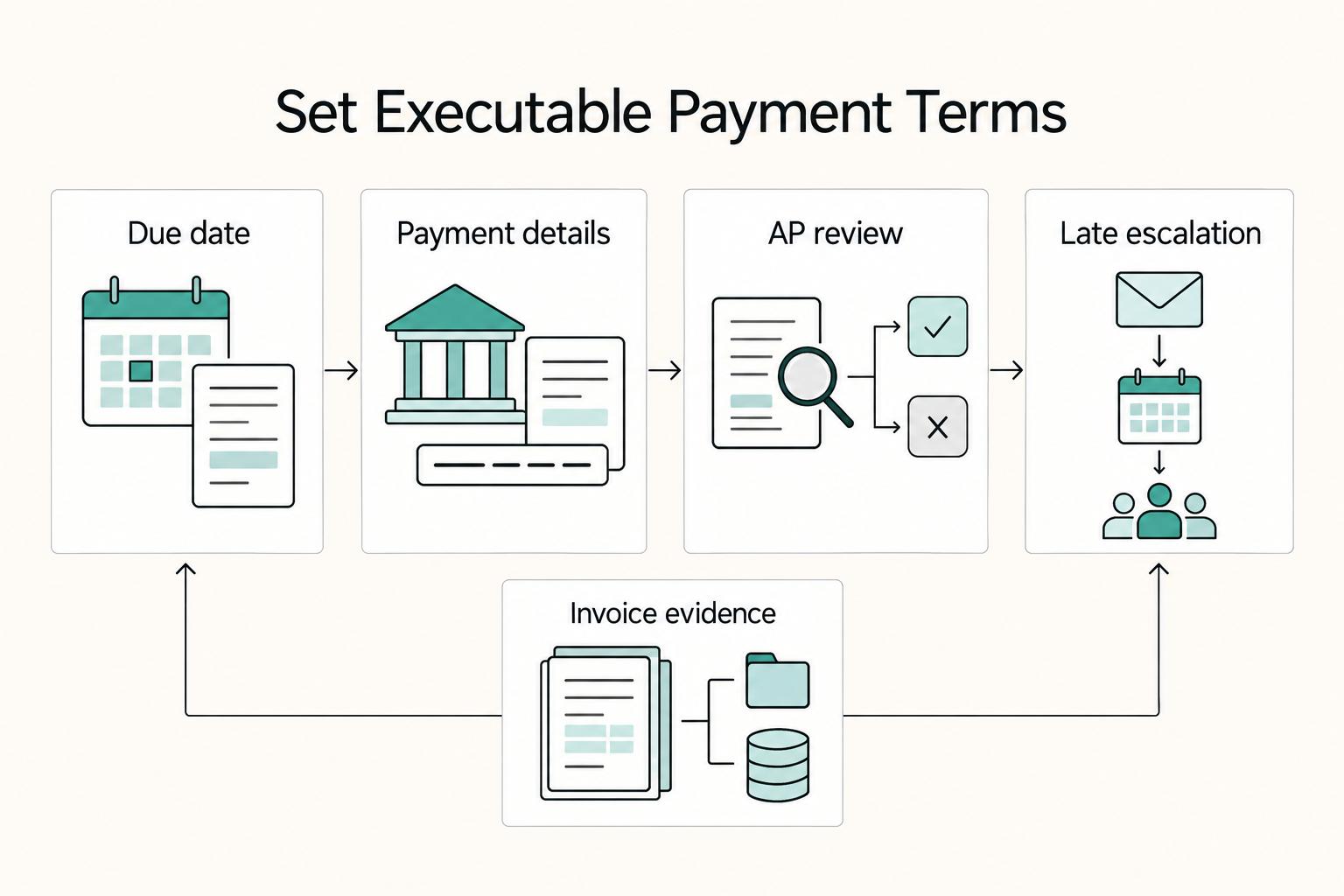
Payment instructions are not the same as legal minimums, but they help AP route and settle invoices. Include due date, bank details, transfer reference, and a remittance contact. Federal e-invoicing guidance also maps payment terms and bank details into structured processing fields, which is a strong operational signal to include them clearly.
| Area | Minimum compliant | Dispute-resistant |
|---|---|---|
| Party details | Full party names and addresses plus required supplier tax identifier | Exact legal-name match to contract and vendor records, including GmbH suffix |
| Timing and numbering | Issue date, unique consecutive invoice number, service date | Service period phrased to match the billed milestone or retainer period |
| Amounts | Consideration by tax treatment, agreed reductions, tax rate/amount or applicable exemption/reverse-charge note | Line-by-line tie-out to agreed deliverables, with reviewed math after edits |
| Payment block | Core legal fields only | Due date, bank details, transfer reference, and remittance contact |
| Worked domestic consulting invoice | Example value |
|---|---|
| Supplier and tax identifier | Use the real freelancer’s full name/address and Steuernummer or USt-IdNr. |
| Customer | Example GmbH; use its actual contract name and address |
| Number / issue date | 2026-1048 / 4 October 2026 |
| Service | September 2026 strategy consulting; 20 hours × €100 |
| Net / VAT / payable | €2,000 / €380 at 19% / €2,380 |
| Payment instructions | Agreed due date, receiving IBAN and reference 2026-1048 |
This hypothetical example assumes a German-established supplier under normal VAT taxation and an ordinary domestic service taxed at 19%, with no advance payments or discounts. A §19-exempt version would request €2,000 with its exemption note and no separately charged VAT. The foreign-consultant reverse-charge case below also requests €2,000, but for a different tax reason. If an advance was already paid, show its allocation and the remaining amount instead of collecting the full invoice again.
The simplified §33 UStDV small-amount rules apply to eligible invoices up to €250 gross, but exclude transactions under §§3c, 6a and 13b UStG. A €200 reverse-charge invoice cannot use that shortcut merely because it is small.
Decide VAT treatment before you send#
For ordinary taxable services supplied by a German-established freelancer to a German GmbH, use the applicable German VAT rate. An eligible Kleinunternehmer supply is exempt under §19, with an exemption note and no separately charged VAT. A foreign supplier’s ordinary B2B service can instead place the tax obligation on the German customer through reverse charge. Confirm special-service exceptions before choosing the lane.
Step 1. Choose the tax basis before you build the amount block#
Set the tax basis first, because tax contradictions are harder to fix than wording issues.
For an eligible German small-business supply, a usable exemption note is: “Steuerbefreiung für Kleinunternehmer gemäß § 19 UStG.” Show the consideration as one sum and do not separately charge VAT. §34a UStDV specifies its minimum invoice information, including party details, supplier tax identifier, issue date and service description. Continue using a unique number and service period for clear bookkeeping even where that simplified rule does not require them.
Before sending, run one manual check on just the money section and tax note:
- If using § 19 UStG: net and total should match, no VAT amount shown, and the § 19 wording included.
- If using your normal VAT setup: rate, tax amount, and total should reconcile consistently across the invoice.
Since 2025, domestic §19 eligibility uses prior-year turnover not exceeding €25,000 and current-year turnover not exceeding €100,000, subject to the statutory turnover calculation and any election for normal taxation. Do not infer eligibility from invoice size. Foreign EU suppliers need the separate cross-border small-business conditions and identification process; a non-EU supplier cannot simply copy a domestic §19 note.
Step 2. Avoid the error that can still create tax exposure#
An incorrect or unauthorized separate VAT display can create liability under §14c UStG. Its subsections distinguish excess tax from tax shown without entitlement, and their correction requirements differ. Changing the PDF alone does not establish that the tax exposure is resolved.
If you are in the Kleinunternehmer lane, treat visible tax fields as high-risk until checked. Common failure patterns are reused templates, software defaults, or manual edits that leave a tax line behind.
For taxable domestic services, show the correct rate and amount; for an exempt or reverse-charge supply, use its specific basis rather than labeling every no-VAT invoice “0%.” Keep the template consistent with the selected treatment.
| Scenario | Required fields and wording | Main risk | Escalation path |
|---|---|---|---|
| Domestic taxable service | Supplier identifier, full fields and correct tax rate/amount | Wrong rate or missing identifier | Check service classification and the normal-taxation status |
| Eligible Kleinunternehmer supply | §34a minimum fields and §19 exemption note; no VAT charged | Exemption assumed or VAT left in a reused template | Confirm eligibility and correct any unauthorized tax display |
| Foreign supplier, ordinary B2B service to German establishment | Applicable invoice rules, required identifiers and reverse-charge note; no German VAT collected by supplier | Confusing no supplier VAT with exemption for the customer | Check supplier establishment, recipient business use and §13b |
| Special service or unclear receiving establishment | Prepare facts before finalizing tax | Property, admission or other exception applied incorrectly | Resolve the concrete place-of-supply question before issuance |
Step 3. Pause when cross-border place of supply is not obvious#
For ordinary services to a business for business use, §3a(2) generally places the supply at the customer’s business or receiving establishment. For a supplier established abroad without an involved German establishment, §13b can make the German business customer the tax debtor. Property-related services, event admission and other exceptions need a separate classification.
For example, a U.S. consultant supplies €2,000 of ordinary remote business consulting to a German GmbH’s German establishment, with no involved German supplier establishment. Under those stated facts, the invoice requests €2,000 without German VAT and identifies reverse charge, for example “Steuerschuldnerschaft des Leistungsempfängers (Reverse charge).” The GmbH accounts for the tax. An EU supplier also checks its home-state invoice rules and applicable VAT-ID/reporting requirements; the German buyer’s location does not replace those obligations.
Add contract protections that stop scope and payment fights early#
Bill when the agreed contractual or legal trigger is met. Keep the acceptance record where acceptance is required, but distinguish a dispute about one item from an undisputed amount already due. Do not postpone a statutory invoice deadline indefinitely because the buyer has not signed new paperwork.
Step 1. Match invoice lines to the signed Agreement#
If your contract uses an MSA and work orders or SOWs, name the specific project, milestone and controlling version in the line description or sending note. This is a documentation pattern, not a rule that every German client needs an MSA.
Keep wording aligned with the signed text:
- Use the same milestone and acceptance language as the contract.
- Bill extra work only through the written change path required in the signed terms.
- Treat written acknowledgment or confirmation as the control point for scope and effect.
Before sending, check each billable line against the signed document titles and trigger language.
Step 2. Put termination billing logic in writing before the relationship turns#
Do not let the final invoice create new rules. If termination is in play, make sure the contract terms already state what is billable at termination, what written support is required, and how final payment timing is handled, then have the invoice point back to those terms.
Attach the records that support the final amount: completed work, acceptance where required, approved changes and any termination calculation. If a document is missing, resolve the evidence gap while preserving the applicable billing deadline and any undisputed claim.
Step 3. Keep invoice disputes from reopening bigger risk arguments#
If your MSA includes Limitation of Liability and Indemnification, keep the invoice tied to the governing Agreement or SOW so the invoice is not treated as a new risk negotiation. You do not need to restate those clauses on the Rechnung; you do need a clear cross-reference trail.
Record approval of changes in the method required by the applicable agreement and law. Email, electronic or other assent can be relevant; do not assume only a wet signature creates an enforceable agreement. An invoice footer cannot unilaterally settle competing standard terms.
Lock enforcement terms before the first invoice#
Keep the governing accepted records together, including the contract, orders, relevant email approvals and valid amendments. Use them to identify the payment trigger and dispute route without requiring a newly signed document set before an already-due invoice.
Step 1. Confirm the enforcement clause in the signed contract#
Identify the contract, accepted orders and amendments that govern payment and notices. If buyer terms conflict with your terms, resolve which were incorporated and any individual agreement; do not declare the buyer’s terms non-binding merely because you did not sign a separate document. Under §305b BGB, individual agreements take priority over standard terms.
Step 2. Mirror the agreed dispute path in your invoice terms#
If your signed agreement already includes dispute-handling steps or timing, mirror that wording in the invoice note or footer. Keep it short and consistent with the contract language. The goal is alignment, not new rights: your invoice should point back to the same order or contract terms that already govern billing and notices.
Step 3. Agree any future process changes#
Where useful, agree a short addendum for future billing notices or dispute handling through the valid amendment method. Keep the existing record and original due dates intact. Do not make agreement to new terms a prerequisite for invoicing already completed work.
Send, track, and reconcile without losing traceability#
After you issue the invoice, run one traceable workflow end to end: one final record, one provable send event, and one payment reference you can reconcile.
| Stage | Action | Evidence/status |
|---|---|---|
| Finalize | Use one issuance channel per Rechnung and treat the finalized version as the only live document | One final document or platform record, one invoice number, one payment reference |
| Send | Use a send method that leaves a receipt trail | Store the send timestamp, recipient address or portal, and any AP acknowledgment |
| Track | Confirm receipt, monitor the agreed due date, record disputes and chase overdue amounts through the applicable contract/legal path | Keep a clear state model such as sent, due, and in dispute, or Stripe states draft, open, paid, uncollectible, and void |
| Reconcile | Verify amount matches, reference matches, and close-out evidence is stored with the original invoice | Keep status history, payment confirmation, and accounting exports as audit artifacts |
Step 1. Finalize one authoritative invoice record. Use one issuance channel per Rechnung, and treat the finalized version as the only live document. Do not send drafts from multiple tools or resend edited PDFs under the same number. In Stripe Invoicing, finalization adds an invoice number, locks certain fields, and creates both a hosted payment URL and a PDF link. Your checkpoint: one final document or platform record, one invoice number, one payment reference.
Step 2. Send it with receipt evidence. For disputes, you generally need proof that invoices and reminders were received, and sending an email alone does not prove receipt. Use a send method that leaves a receipt trail, then store the send timestamp, recipient address or portal, and any AP acknowledgment. If a client portal is required, save the submission confirmation with the invoice record.
Track issued, received, due, paid and disputed as separate facts. Send an operational pre-due reminder if useful, then follow the applicable collection path when payment becomes overdue. A payment reminder, legal default and litigation are different steps; a fixed series of unanswered reminders is not universally required. If you use Stripe states such as draft, open, paid, uncollectible and void, map them to your records without treating a software status as legal extinguishment of the debt.
Step 4. Reconcile payment before close-out. When payment arrives, verify three items before closing: that the amount matches, the reference matches, and close-out evidence is stored with the original invoice. If you use a platform, keep status history, payment confirmation, and accounting exports (for example CSV) as audit artifacts. If amount or reference does not match, keep the invoice open internally until the payment is tied to the correct record.
Common rejection points and how to recover fast#
Choose the correction that repairs the error while preserving the original record and preventing a second payment claim. §31(5) UStDV permits a document that specifically and unambiguously corrects missing or wrong details; cancellation and replacement is one possible workflow, not the only legal route.
| Issue | Recovery path | Key detail |
|---|---|---|
| Wrong buyer name | Use a correction specifically linked to the original, or a documented cancellation/replacement if your system requires it | Full name and address of seller and buyer are core invoice fields, and the wrong German GmbH entity can block booking |
| Wrong VAT/Umsatzsteuer treatment | Correct tax and totals through the appropriate §14c/tax-accounting path; keep original and correction/replacement linked | Only one invoice should remain payable |
| Disputed line item | Attach acceptance evidence and map each line item to the agreed deliverable and service period | AP can route a concrete package for sign-off |
| E-invoicing format or channel not confirmed | Confirm the buyer's accepted format and delivery route before producing XRechnung or sending via Peppol | Domestic taxable B2B scope and issue transition differ from receiving capability; foreign suppliers and exempt small-business supplies have different rules |
Step 1. Fix party-identity errors first. If the buyer name is wrong, stop and correct it before anything else. Full name and address of seller and buyer are core invoice fields, so the wrong German GmbH entity can block booking. Check the legal entity across the contract party, billing instructions or portal profile, and the invoice header before reissuing.
Never silently overwrite the issued record. A correction can state “Correction to invoice 2026-014 dated 14.03.2026: recipient address is …; all other details unchanged,” if that is the permitted correction for the error. If you cancel and replace instead, identify both documents and tell AP which remains payable. The original invoice number links the history; it is not evidence of an additional receivable.
If VAT or totals are wrong, coordinate the document correction with the VAT records and any customer input-tax treatment. A cancellation/replacement workflow may fit your system, but preserve all records and confirm any §14c correction conditions. Do not treat an AP acknowledgment or deletion of the old PDF as proof that a tax liability ended.
For structured documents, BG-3 carries the preceding invoice reference. Peppol’s German rules identify BT-3 code 384 for a corrected invoice and 381 for a credit note; its corrected-invoice rule expects the preceding reference where both parties are German. Validate the actual schema/profile and accounting effect. Changing a code alone does not withdraw the original payment claim.
Step 3. Resolve scope disputes with evidence mapping. If a line item is disputed, attach acceptance evidence and map each line item to the agreed deliverable and service period. This usually clears approval faster than broad wording changes because AP can route a concrete package for sign-off.
For covered supplies between German-established businesses, receiving e-invoices has applied since January 2025. Issue transition permits paper through December 2026, or an unstructured electronic invoice such as PDF with recipient consent; qualifying issuers with prior-year turnover up to €800,000 have a further 2027 transition. Small-business exempt supplies have an issue exception. A foreign supplier without an involved German establishment is not brought into domestic mandatory issuance merely by German VAT registration.
Agree the delivery route with AP and validate the structured invoice, rather than sending a renamed PDF. XRechnung is a structured format, EN16931 the core standard and Peppol a transmission network. Private B2B invoicing does not universally require a federal Leitweg-ID or government portal.
Copy-paste pre-send checklist#
Use this as your final pre-send gate: make the invoice easy for AP to accept, easy to reconcile, and easy to defend later.
- Client legal name matches the contract party.
Check the invoice customer name against the executed agreement or vendor record for the German GmbH, not a brand label or email signature variant.
- Invoice number and dates are clean.
Use a unique number and record service dates consistently. Only use the €250 simplified invoice route for an eligible transaction; §13b reverse-charge supplies are excluded from that shortcut.
- VAT path is explicit and consistent.
If VAT applies, show VAT rate(s) and VAT amount(s) (unless an exemption applies). If you are under Kleinunternehmer treatment, invoice without VAT and include the § 19 UStG note. Do not mix both approaches on one invoice.
- Payment terms and remittance reference are unambiguous.
Keep terms, due date, and payment reference obvious on the invoice, and use the invoice number as the reference where possible.
- Governing accepted records and billing trigger are referenced.
Check the actual billing trigger, agreed payment terms and dispute/notice route. Reference the governing records and approved changes. New indemnity or jurisdiction clauses are not a universal prerequisite for issuing an invoice that is already due.
- Send record, format acceptance, and tracking are logged in one trail.
Keep the issued invoice and correction history together. German VAT invoice retention under §14b is eight years; preserve structured e-invoice data, not just its visual copy. The period and any other applicable retention duties depend on the record. Confirm format and delivery requirements for this transaction before sending.
Frequently Asked Questions
What must a compliant invoice to a German GmbH include at minimum?
For an ordinary German invoice, include complete party names/addresses, supplier tax number or VAT ID, issue date, unique number, service description and date, consideration by tax basis, agreed reductions and VAT rate/amount or the applicable exemption/reverse-charge note. Special rules such as §34a for eligible Kleinunternehmer supplies change the minimums. Payment details and due date help AP, but do not substitute for required tax fields.
Do I always need to issue an invoice for B2B services in Germany?
For supplies covered by §14(2), a business invoice is generally required within six months, with statutory exceptions and special deadlines. Cross-border rules can differ; for certain intra-EU services, the applicable issue deadline is the fifteenth day of the following month. Bill according to your valid trigger promptly and keep enough records to explain the service, rather than treating six months as a recommended wait.
Can I send an invoice without VAT if I am a Kleinunternehmer under § 19 UStG?
Yes, for a supply that qualifies for §19 exemption. Use the §34a required details, identify the small-business exemption and do not separately charge VAT. Keep your eligibility decision and use a unique number/service period for bookkeeping. Exemption, reverse charge and a zero-rated supply are different treatments.
What is the practical difference between an invoice template and a compliant Rechnung?
A template is only a layout. A compliant Rechnung is a finished document with the right party identity, the right tax path, complete booking details, and records that let you defend it later if AP or procurement asks questions. The red flag is treating a generic template as proof of compliance when it still contains the wrong GmbH name, vague line items, or tax fields that contradict your status.
Do freelancers need structured e-invoicing now, and where do XRechnung, Peppol, EN 16931, and KoSIT fit?
Domestic B2B receiving capability has applied since January 2025, while issuance has transition rules through 2026 and, for qualifying smaller issuers, 2027. Kleinunternehmer supplies are excepted from mandatory issuance but the business must still receive e-invoices. XRechnung and compliant ZUGFeRD are formats; EN16931 is the standard, KoSIT maintains XRechnung and Peppol is a network. Federal-government requirements are a separate regime, not the private GmbH rule.
What should I verify about a GmbH before sending the invoice to avoid payment delays?
Verify the exact legal name and billing address first, because mismatched party details are a common reason invoices are sent back for correction. Also confirm the delivery route the buyer accepts, especially if they want structured e-invoicing rather than a PDF. If the buyer has shared a vendor profile or billing instruction sheet, match your invoice against those records before you send.
Try a related tool
Researched and edited by the Gruv editorial team. Gruv builds cross-border billing, payouts, and finance-operations software for global businesses.
Sources
Includes 6 external sources outside the trusted-domain allowlist.
- bundesfinanzministerium.de/Content/DE/FAQ/e-rechnung.htmlexternal
- docs.peppol.eu/poacc/billing/3.0/rules/ubl-peppol/DE-R-026external
- docs.peppol.eu/poacc/billing/3.0/rules/ubl-peppolexternal
- gesetze-im-internet.de/ustg_1980/__14.htmlexternal
- gesetze-im-internet.de/ustg_1980/__14a.htmlexternal
- xeinkauf.de/aktuelles/xrechnung/pflichtangaben-nach-ustg...external
Educational content only. Not legal, tax, or financial advice.
Related Posts
How to Write a Legally Compliant Invoice in Germany
The goal is simple: send a Rechnung that meets German requirements and is easy to review and pay. Use the same order every time: legal minimum fields first, payment terms second, pre-send risk checks third. Treat it as a defensive sequence, not a design template or a complete legal checklist for every case.

The Freelance Payment Penalty: A Modeled Audit of Platform Fees, FX Spreads, and Payout Delays
The money rarely disappears through a single, easy-to-spot fee. The real loss is stacked. A marketplace takes its commission, a processor adds a charge for international cards, a bank or payment company converts the currency at a spread, a platform holds the funds before release, and a wire sheds a little to intermediaries on the way in. Each layer looks defensible on its own, but the worker feels the combined result as a smaller deposit and a later payday.

How to Respond to a Subpoena for Business Records
Move fast, but do not produce records on instinct. If you need to **respond to a subpoena for business records**, your immediate job is to control deadlines, preserve records, and make any later production defensible.