
Quick Answer
Digital nomads can invest in real estate safely by choosing a model that fits their travel schedule, cash buffers, and ability to manage issues remotely. Start with reserves, a cloud-based document system, written decision rights, and a clear operator plan. If your income is lumpy or you cannot respond during local business hours, a lower-ops option like REITs may be the safer default than direct ownership.
You're mobile. Real estate is "location-locked." Here's the risk-first way to make it work anyway.#
Run anything with money and moving parts like an operations system (cash, docs, delegation, and controls), not a "passive income" vibe. Real life stress-tests weak spots. You change time zones, a client pays late, and something breaks at the worst moment. As the CEO of a business-of-one, your job is to build a setup that keeps working when you are not available on demand.
If you're managing commitments while traveling, treat every new obligation as a test of reliability under stress, not optimism. You want a system that still functions when you cannot jump on a call during local business hours. Prioritize controls you can repeat: reserves, reporting, and decision rules.
Step 1: Define what "works" (before you commit)#
Write down your non-negotiables in plain language. Keep it tight:
- Cash discipline: You separate "money I can spend" from "money the system needs."
- Ops discipline: You decide how many hours per week you will spend coordinating anything related to the thing you're managing.
- Evidence discipline: You require documentation you can store, search, and hand to a professional without reconstructing history.
Hypothetical scenario: you are in a new country with unstable internet, and something time-sensitive goes wrong. Your system either (1) routes the issue through a documented process with clear approvals, or (2) drags you into ad hoc decisions that steal your workday and your sleep. You want option (1).
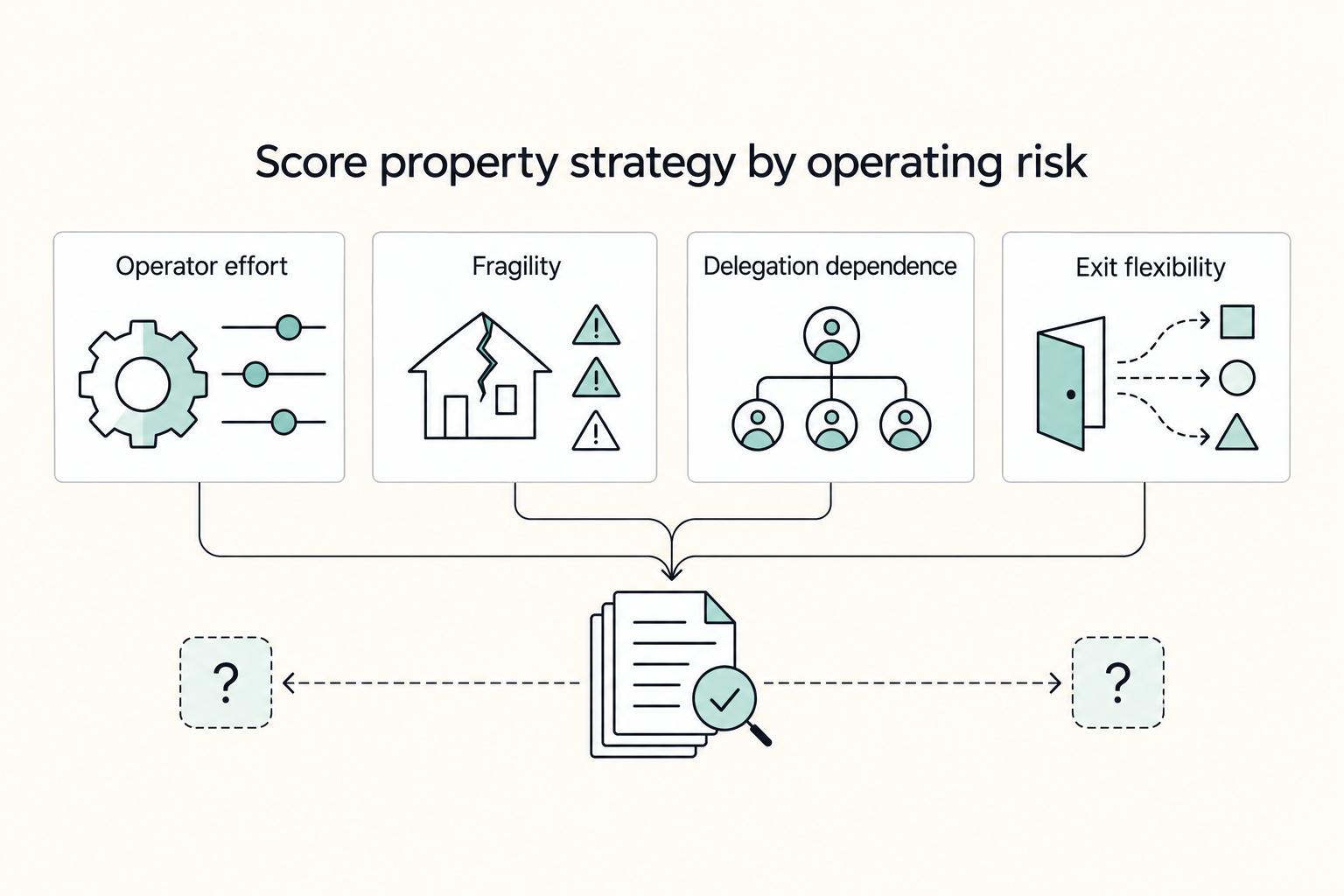
Step 2: Use a strategy matrix to avoid getting trapped#
You will likely evaluate options that range from "hands-off" to "hands-on." Don't start by asking "which returns more?" Start by asking "which model matches my constraints?"
| Decision axis (risk-first) | What you measure | What "good" looks like for a nomad |
|---|---|---|
| Operator effort | Hours per week you can commit | A workload you can keep during travel weeks |
| Fragility | How easily one issue breaks the month | You can absorb delays and surprises without panic |
| Delegation dependence | How much you rely on third parties | Clear roles, written expectations, review cadence |
| Exit flexibility | How hard it feels to change course | You can unwind without a drawn-out rescue mission |
Step 0 - Prerequisites: what to prepare before you invest (so you don't create a second job)#
Before you buy anything, set up cash buffers, remote-ready documents, and an operator plan. Real estate punishes "figure it out later." This step sets a floor under your workflow so real estate does not become a second job that competes with your primary income.
1) Build a "surprises won't break me" buffer (property + personal)#
A cash-flowing rental property only counts as "cash-flowing" after vacancy, repairs, and delays show up. Set a written reserve rule that covers two buckets:
- Property reserves: your all-in monthly property burn (mortgage or rent, insurance, taxes where applicable, HOA, utilities if owner-paid, property management fees if used, plus a maintenance buffer).
- Personal runway: enough personal liquidity that a rough property month does not force you to chase tenants, vendors, or refinance from a place of panic.
Operator move: write a single sentence you will follow every time. For example: "I only buy when I can fund an unplanned repair and a gap in rent without relying on incoming rent to cover it."
2) Create your "document spine" and decision rights (so ops stays clean)#
Remote ownership runs on documents and delegation. Create one cloud folder you can access anywhere, then keep it current:
| Prep item | What it covers | Ops note |
|---|---|---|
| Government ID | Identity document that may come up during onboarding | Keep it in the cloud folder you can access anywhere |
| Proof of address | Address document that may come up during onboarding | Keep it current in the same folder |
| Basic banking details | Banking details that may come up during onboarding | Keep them current in the same folder |
| "Who can do what" memo | What the property manager can approve, what requires your sign-off, and how they reach you reliably | Use it to define decision rights |
| Ownership wrapper decision | Whether you buy in your personal name or through an entity such as a U.S. LLC | This can change who signs documents and how you handle paperwork |
Keep the folder current so onboarding does not turn into a scavenger hunt while you're traveling.
If you invest across borders (or interact with institutions in other countries), expect onboarding and tax-related paperwork to vary by jurisdiction and by your profile. Treat this as a prompt to verify requirements early with a qualified pro, not as a universal rule.
Ownership wrapper: decide early whether you buy in your personal name or through an entity (for example, a U.S. LLC). That choice can change who signs documents and how you handle paperwork. If you need help thinking it through, start here: Tax Implications for a UK Resident Owning a US LLC.
Practical pass/fail check (use this before direct ownership) Use this as a safe default before you add direct real estate exposure:
| Check | Pass looks like | If you fail |
|---|---|---|
| One surprise repair | You can pay it from reserves without scrambling for short-term cash | Pause direct ownership. Consider lower-ops exposure like diversified index funds or ETFs (for example, via a robo-advisor or online brokerage), or real estate exposure that doesn't require you to be physically present (like a real estate crowdfunding platform or being a silent partner). |
| Time-zone resilience | You can respond reliably, or you delegated approvals and escalation | Do not wing it. Add delegation and written limits first. |
Step 1 - Does real estate even fit your nomad workflow (or should you default to REITs)?#
Decide on operational fit first, because the wrong real estate model turns mobility into chronic context switching. With buffers and a document spine in place, you can pressure-test whether direct ownership supports your reality.
Run a quick fit check (no scoring needed)#
Answer these questions with uncomfortable honesty. Write the answers down, because future-you will rationalize.
- How often do you change countries or time zones, and do you reliably take calls during the property's local business hours?
- When a vendor needs a decision, do you have bandwidth to respond consistently, or will you go dark for days during travel?
- Does your income arrive predictably, or do you run a "client pays when they pay" business?
- If you put a big chunk of net worth into one single-family rental, will you sleep, or will you obsess?
Hypothetical scenario: you land in a new country, your client invoice runs late, and your property management company asks you to approve a repair the same week. If that combo creates panic, direct ownership probably does not fit yet.
Make the location-lock problem explicit. If you cannot visit a property periodically, even just occasionally, you increase your dependency on whoever you hire locally. Treat that as a core risk. Mitigate early with written approval limits, clear escalation paths, and documentation habits that let you audit decisions from afar.
Pick your safe default (use decision rules, not vibes)#
Use the table to choose a starting point, then commit to it for a full cycle, not a week.
| Your current reality | Safer default to start | What "done" looks like before you level up |
|---|---|---|
| Client income feels lumpy or unpredictable | Non-direct-ownership exposure (for example, REITs) | You stabilize reserves and can handle delays without raiding savings |
| You want leverage and control | A turnkey rental property only if you can actively oversee whoever is operating it | You agree in writing on how updates and approvals will work, and you keep a buffer for surprises |
| You cannot reliably respond during local business hours | Avoid direct ownership of a single-family rental (for now) | You delegate decision rights and create an escalation workflow |
Practical pass/fail: if a brief vacancy or an unplanned repair would force you to miss your own rent, payroll, or essential bills, you are not ready to rely on a "cash-flowing rental property." Choose non-direct-ownership exposure (including REITs, if that fits your plan) while you rebuild stability. Revisit direct ownership when your downside stops threatening your base life.
Step 2 - Which model wins: REITs vs turnkey vs direct ownership (the nomad strategy matrix)#
Pick the model that minimizes what can break while you sleep for your travel cadence, not the one that sounds most passive. You are not trying to win a debate. You are trying to match a model to your constraints, then run it with controls.
Build your nomad strategy matrix (score with evidence, not opinions)#
Use four nomad-critical axes. You are not trying to predict returns here. You are trying to predict operational stability.
| Axis you must pressure-test | REITs: what to verify | Turnkey rental property: what to verify | Direct single-family rental: what to verify |
|---|---|---|---|
| Cashflow predictability | What cash distributions (if any) depend on, what can change them, and how you'll handle a down period without touching personal runway. | Your assumptions vs reality: request real operating statements where available and reconcile rent received vs expenses paid. | Your underwriting plus how you'll monitor collections, delinquencies, and reserves from abroad (whether you self-manage or delegate). |
| Operator effort | What you must actually do to stay compliant and informed (paperwork, tracking, taxes, account maintenance). Define a monthly "touch time" limit. | What "hands-off" really means in writing: reporting cadence, what you can approve remotely, and what happens when the plan breaks. | Your system for vendors, approvals, documentation, and decision turnaround while you're in a different time zone. |
| Downside exposure | What the downside scenarios look like for you personally (including volatility and needing cash at the wrong time), and what you can live with. | How vacancies, repairs, and upgrades are handled, who authorizes work, and how you see invoices and any markups. | Concentration risk plus repair volatility, and whether you can fund surprises without destabilizing your client work. |
| Exit liquidity | What it takes to exit in practice (process, timing, and any constraints), not just in theory. | Resale mechanics and what "unwinding" looks like if operations underperform. | Selling timeline, transaction complexity, and how you will manage a sale remotely. |
Translate "passive income" into ops math: downtime plus repairs plus fees plus financing costs equals your reality check for a cash-flowing rental property. If the deal only "works" when everything goes right, it does not work.
Apply the if-this-then-that rules (safe defaults)#
Use rules that stop you from buying complexity you cannot supervise.
- If you move countries often, bias toward the model you can run with written controls, documented approvals, and predictable reporting. Keep your workflow simple.
- If you can be on-site occasionally, treat that as a potential operational advantage only if you will actually use it (inspections, vendor meetings, issue resolution).
Pass/fail: if you cannot recite the fee schedule and decision rights on a turnkey rental property, you are not evaluating a deal. This includes who approves what, when you pay, and what gets marked up. You are consuming marketing.
Step 3 - "Is turnkey rental property truly passive?" (Myth vs reality + the manager-dependency test)#
If you're planning to be overseas for months at a time, "passive" only works when the work is actually delegated and verifiable. Treat the setup like an outsourcing contract: the deliverable is disciplined management, not a pretty listing.
Reframe turnkey: you're buying execution capacity#
If you're buying a rental with "done-for-you" management, you're also choosing the people and processes that will run it when you're not there. The property matters, but your day-to-day outcome depends on how the manager documents decisions and escalates problems. Run this mental swap:
| If you treat turnkey like... | You optimize for... | You miss... | Operator safe default |
|---|---|---|---|
| A product | Photos, neighborhood story, "pro forma" | Decision rights, documentation, response times | Assume friction until the manager proves controls in writing |
| An outsourcing contract | Clear responsibilities, artifacts, escalation | "Feel good" simplicity | Buy only what you can verify, review, and enforce remotely |
Run the manager-dependency test (verify in writing)#
You do not need perfection. You need predictable behaviors you can audit.
| Area | What to verify | What to request |
|---|---|---|
| Reporting cadence | What you receive, how often, and in what format | A consistent package you can use to reconcile rent collected, expenses paid, open items, and reserve balance |
| Authority limits | What they can approve without you and what requires your explicit approval | Written approval limits |
| Escalation path | Who takes point when a tenant stops paying, when a repair affects habitability, or when a vendor no-shows | Names or roles plus how quickly you should expect responses |
| Fees | Every recurring fee and every per-event fee | Management, leasing, and maintenance-related add-ons in the model |
| Owner-facing package | What "good" looks like on paper | A sample statement plus supporting invoices and a lease summary |
If they stay vague on the reporting rhythm, approval limits, or escalation path during the sales process, expect that vagueness later.
Fee drag reality check: Model your net cashflow after every recurring fee and every per-event fee (management, leasing, and any maintenance-related add-ons). Costs can be lumpy, so you need a process that keeps surprises from wrecking your plan.
Pass/fail (my default): If the manager will not share a sample owner-facing package (for example: a statement plus supporting invoices and a lease summary), pause. If you can't see what "good" looks like on paper, you can't manage it from abroad.
Step 4 - How do you evaluate a property remotely without flying in? (Remote due diligence that actually catches bad deals)#
Evaluate remotely by standardizing what you request, adding independent verification where you can, and stress-testing the cash flow before you sign. Once the manager side is clear, you pressure-test the asset. This is how you get out of "trust the listing" mode.
Step 1: Build a reusable remote diligence packet (copy, paste, reuse)#
Stop improvising per deal. Create one folder template and request the same core information every time, even for a single-family rental where people often skip "commercial-style" documentation.
| Packet item | What you want to learn | Operator move (remote-safe) |
|---|---|---|
| Lease and tenant status | Who pays, when the lease ends, and where risk hides | Request the full lease plus a plain-language summary from the property management company |
| Current income picture | What the property should collect vs what it actually collects | Ask for a simple, written breakdown of the expected rent and what has actually been collected recently |
| Repair and maintenance history | Whether the home behaves like a money pit | Ask for invoices and receipts where available, not just a seller summary. Flag repeat issues |
| Insurance and risk history | Whether the property has a pattern of damage risk | Ask what's been claimed or repaired and what work followed, if this info is available |
| Local comps | Whether the rent and price align with reality | Pull your own comps. Do not rely on seller-provided numbers |
Then add verification layers you control. Consider an independent inspection, request a video walkthrough that follows your checklist, and get independent repair quotes for any flagged items when feasible.
Step 2: Install contract and closing controls (workflow first, jurisdiction second)#
Treat paperwork like production ops, but keep it flexible because details vary by jurisdiction and deal structure.
| Control | What to confirm | Record |
|---|---|---|
| Version clarity | What changed and what you're actually signing | Keep drafts organized |
| Signature record | What was signed and when | Use a signing process that leaves a clear trail |
| Deposit handling | How any deposit is held and released | Get it in writing |
| Ownership and onboarding | Ownership structure and any required onboarding paperwork, especially cross-border | Clarify early |
Keep drafts organized, use a signing process that leaves a clear trail, and get deposit handling in writing.
If you own cross-border, clarify ownership structure and any required onboarding paperwork early. You want fewer surprises at the finish line, not a scramble during closing. For deeper entity and residency edge cases, reference: Tax Implications for a UK Resident Owning a US LLC.
Stress-test the nomad "bad month": assume vacancy plus one meaningful repair plus an FX move if your income arrives in one currency and property costs hit another. One useful gut-check number is your all-in monthly cost at 0% occupancy. If you cannot state that number confidently, you cannot judge whether a cash-flowing rental property stays stable under pressure. Want a quick next step on the admin side? Try the free invoice generator.
Step 5 - Your remote operations stack: run the property like a finance system, not a side hustle#
Build a remote operations stack that assigns clear roles, tracks a few owner-level metrics, and runs decisions through documented agreements. The point is not more tools. The point is fewer surprises and faster decisions.
Step 1: Assign the operating roles (so accountability never blurs)#
Start by defining roles, even if one vendor wears multiple hats. You want one owner-facing point of contact, but you also need clarity on who actually does what.
| Role | Owns what (your expectation) | Your operator questions |
|---|---|---|
| Property management company | Tenant communication, rent collection workflow, reporting cadence, vendor coordination | "Who covers after-hours issues?" "Who approves invoices?" "How do you document decisions?" |
| Maintenance vendors | Execute repairs, provide documentation, close tickets | "Do you send photos?" "Do you quote in writing?" "Who warranties work?" |
| Bookkeeper or accountant | Categorization, month-end reconciliation support, clean records | "What do you need from the manager each month?" "How do you handle CapEx vs repairs?" |
| Tax preparer (optional, cross-border) | Filing guidance when you deal with international property and expat finance complexity | "Have you handled cross-border rental reporting before?" "What inputs do you expect?" |
If you add tech, treat it as support, not a substitute. Pick tools that reduce friction, but keep human accountability as your core control.
Step 2: Put the manager on a scoreboard and agree on escalation ahead of time#
Review a short scoreboard once a month, fast. You do not need "industry standard" KPIs. You need consistent definitions you can compare month to month. For example:
- Days-to-fill vacancy (however you define the start and end points)
- Rent collection rate (collected vs billed for the month)
- Average maintenance ticket cost (to spot cost drift)
- Aging open tickets (anything open longer than your agreed window)
Agree on a monthly owner packet you can reconcile against bank activity. Request the specific artifacts you need (such as statements, invoices, lease updates, and a ticket log), especially if you also hold REITs and you want clean, separated reporting across accounts.
Then get your escalation rules written down before anything breaks:
- Delinquency path: agree on how delinquency is handled and when the manager escalates to you. Rules vary by jurisdiction, so confirm local legal steps with the right professional.
- Repairs: agree on an approval limit and when the manager should get additional quotes. Define "emergency" versus "non-emergency" in writing.
Practical check (pass/fail): if you cannot point to one shared folder that holds leases, monthly reporting, and invoices for your single-family rental, your documentation is not centralized yet.
Step 6 - Cashflow reliability: how to collect, hold, convert, and reconcile rental income like an operator (Gruv-aligned workflow)#
Design your rental cashflow like a controlled money pipeline: separate collection, explicit FX conversions, policy-gated payouts, and reconciliation-ready records. If the money layer is sloppy, everything else becomes guesswork.
Step 1: Separate "investment return" from "money movement reliability"#
Returns tell you whether the rental property works on paper. Money movement reliability tells you whether you can run it while juggling client invoices, travel, and time zones. Operator rule: if you cannot answer "Did rent land, where is it now, and what can I safely spend?" in under two minutes, your system needs work.
Use this quick comparison to spot what you must fix:
| Problem pattern | What it looks like | Operator fix |
|---|---|---|
| Mixed inflows | Client revenue and rent hit the same account | Dedicated receiving setup for rental income |
| Unclear status | "Paid" in the portal, but not in your bank | Track statuses: expected, received, cleared |
| Audit gaps | No invoice, no photos, no work order | Link artifacts to transactions, every time |
| Mystery FX | You only notice the rate after the fact | Force an explicit quote then conversion moment |
Step 2: Build the money lifecycle (Collect → Hold/Track → Convert → Pay out)#
Run the same lifecycle every month, whether you own a single-family rental, an international property, or also hold REITs in a brokerage account.
- Collect: Route rent into a dedicated receiving setup. If your provider supports Virtual Accounts (where enabled), use them so rental income stays distinct from client revenue by default.
- Hold/Track: Go ledger-first. Categorize rent, late fees, management fees, repairs, CapEx, and reserves. Attach the statement, invoice, and ticket evidence to the transaction so your month-end story writes itself.
- Convert: If your spending currency differs, define two moments: FX quote (decision point) and conversion (execution). This avoids "mystery FX" that hides fee drag in blended rates.
- Pay out: Pay vendors through approvals and policy gates (where configured, and where required). Use batch payouts (where enabled) when you pay the manager, insurance, and a plumber in the same window.
Cross-border reality checks (confirm specifics): If you are a U.S. citizen or U.S. resident living abroad, learn the IRS concepts behind FEIE so you do not misclassify what qualifies. At a high level, you need foreign earned income and a tax home in a foreign country. The physical presence test requires being physically present in a foreign country or countries for 330 full days during any period of 12 consecutive months, and the days do not have to be consecutive. Another common miss: you still file a tax return reporting the income to claim the exclusion. Separately, if you have foreign financial accounts, learn whether FBAR and FinCEN Form 114 apply in your situation (rules vary by situation).
Practical check (pass/fail): if you cannot produce a month-end reconciliation pack (income received, expenses paid, reserve balance) for one cash-flowing rental property, do not buy a second.
Step 7 - Common mistakes nomads make (and exactly how to recover when things go wrong)#
Fix remote real estate problems by tightening expectations, restoring buffers, separating money flows, and pausing expansion until you can explain performance cleanly. Distance does not forgive assumptions. The recovery play is usually the same: stop the bleed, restore control, then decide whether to keep or exit.
Step 1: Diagnose the mistake fast (so you stop the bleeding)#
Use this table like a triage board. Your goal: identify which system broke, then apply one recovery move before you "optimize" anything.
| Mistake | What it looks like at a distance | Recovery move (operator-safe) |
|---|---|---|
| You assume a rental will be "hands-off" | You learn about delinquencies late. Repairs show up as surprises. Statements feel inconsistent month to month. | Put expectations in writing. Ask your property manager for a consistent reporting cadence, clear decision rights, and a documented escalation path when something goes off-track. If basic transparency is a constant fight, consider switching managers. |
| You run too thin on cash cushion | You "borrow" from rent to cover repairs. Every maintenance ticket triggers stress and decision fatigue. | Pause discretionary owner draws while you rebuild a cushion you can defend. Write a simple, forward-looking maintenance and replacement list so you plan instead of react, then refine it over time. |
| You expand into a new jurisdiction without mapping the rules first | You discover new paperwork after the fact. Banks ask for documents you did not expect. | Pause expansion. Get qualified local help to map what applies in your situation, and assume requirements vary by jurisdiction. Turn what you learn into a checklist before you buy again. |
| You mix funds across client work and property income | You cannot reconcile quickly. You argue with yourself about what you "really made." | Separate accounts. Standardize memos (property, unit, month, vendor, ticket). Maintain a simple vendor and document folder so you can answer questions fast. |
Hypothetical: you wake up abroad to a vague "maintenance" charge and an email thread you cannot parse. Don't debate the bill first. Ask for the invoice, the work order, and any supporting documentation (including before and after photos if available). If your manager cannot produce basics, you just found the real problem.
Step 2: Run the one-paragraph variance test (pass/fail)#
Write one paragraph: planned vs actual income, planned vs actual expenses, and the single biggest driver of variance. If you can't explain last month's variance in one paragraph, your system needs fixing before your rental property portfolio grows (or before you add international property on top).
Conclusion - Choose the model, define controls in writing, protect cashflow, confirm compliance#
Run nomad-style real estate investing like a system: choose the model, define controls in writing, then protect cashflow with clean money flows and confirmed compliance. The win is not a perfect plan. The win is a repeatable one.
Step-by-step: your operator sequence (use this as a reusable workflow)#
Step 1: Run the fit test. Decide if you can tolerate time-sensitive decisions from your current time zone, or if you need lower-touch exposure (for example, via public vehicles) while you stabilize your schedule and cash buffers.
Step 2: Choose a strategy with eyes open. Use a simple decision table so you stop debating vibes and start managing tradeoffs:
| Model | You optimize for | What you still must control |
|---|---|---|
| REITs | Potentially lower day-to-day operations | Review process, sizing discipline, liquidity plan |
| Turnkey rental property | Potentially faster start with delegated operations | Manager oversight, fee visibility, cash buffer discipline |
| Direct single-family rental | Maximum control over asset decisions | Vendor coordination, documentation, approvals, exception handling |
Step 3: Do remote diligence that you can audit later. If you cannot explain the "bad month" number (all-in monthly cost at 0% occupancy), you cannot trust the cashflow story.
Step 4: Lock controls contract-first. If you want control through a property management company, get contract-level clarity on reporting expectations, approval limits, and escalation steps. Ask for sample reporting up front. Do not improvise after the first delinquency or repair.
Step 5: Protect cashflow with separation and reconciliation. Keep books clean across clients plus rental property income. Hypothetical: you're abroad when a tenant pays late. Clean money lanes let you pause owner draws without guessing what you can afford.
Step 6: Confirm compliance before you scale. If you live abroad as a U.S. person, the IRS taxes worldwide income. The Foreign Earned Income Exclusion (FEIE) may apply to foreign earned income if you qualify, which generally involves having foreign earned income, a tax home in a foreign country, and meeting a qualifying test (like being physically present in foreign country/countries for 330 full days during any period of 12 consecutive months, or qualifying under the bona fide residence test). Excluded foreign earned income still must be reported on a U.S. tax return, and the exclusion applies only if you file a return reporting the income. Confirm how your facts apply with a qualified pro.
If you're building a multi-income money workflow (clients plus property), consider tooling that keeps collection and payout statuses visible with audit-ready records and reconciliation exports where supported. If Gruv sits on your shortlist, request access or book a demo to verify fit and regional availability.
Copy/paste checklist (run this before any purchase):
- I chose my model based on my time budget and risk tolerance.
- I can state the all-in monthly cost at 0% occupancy (the "bad month" number).
- My management and vendor workflows are defined in writing (reporting expectations, approval limits, escalation paths).
- I separated money flows (income, expenses, reserves) and can reconcile month-end activity.
- I confirmed the basics for my U.S. tax situation abroad: worldwide income applies; FEIE eligibility depends on foreign earned income, a foreign tax home, and meeting a qualifying test; excluded income is still reported on a filed return.
Frequently Asked Questions
What is the Foreign Earned Income Exclusion (FEIE)?
FEIE is a potential exclusion for qualifying individuals with foreign earned income. To qualify, you generally need foreign earned income, a foreign tax home, and to meet an eligibility test such as bona fide residence or the physical presence test.
Who can qualify for FEIE?
You may qualify if you are a U.S. citizen who is a bona fide resident of a foreign country or countries for an uninterrupted period that includes an entire tax year. You may also qualify if you are a U.S. resident alien who is a citizen or national of a treaty country and is a bona fide resident of a foreign country or countries for that same kind of period. A U.S. citizen or U.S. resident who meets the physical presence test may also qualify.
What is the physical presence test (and do the days have to be consecutive)?
You generally meet the physical presence test by being physically present in a foreign country or countries for at least 330 full days during any period of 12 consecutive months. The 330 days do not have to be consecutive. The test is based on how long you stay abroad, and the article notes your tax home must be in a foreign country.
Do I still have to file a U.S. tax return if I’m excluding income under FEIE?
Yes. Excluded foreign earned income still needs to be reported on a U.S. tax return. The exclusion applies only if you file a return reporting the income.
How much foreign earned income can I exclude under FEIE?
It depends on the tax year and your qualifying income. For tax year 2025, the maximum FEIE is $130,000 per qualifying person, limited to the lesser of your foreign earned income or the maximum, and two married individuals who both qualify can exclude as much as $260,000 together. For tax year 2026, the maximum FEIE is $132,900 per person.
How does the foreign housing exclusion/deduction limit work (at a high level)?
At a high level, qualified housing expenses are generally limited to 30% of the maximum FEIE, with location-based variation. The housing amount limitation is $39,000 for 2025 and $39,870 for 2026.
Does FEIE apply to rental income?
Not necessarily. FEIE is about foreign earned income, so you should not assume the same treatment applies to rental income. The article says to get professional confirmation because rules can vary based on the type and sourcing of income.
Watch
Real Estate Investing for Digital Nomads
Try a related tool
Researched and edited by the Gruv editorial team. Gruv builds cross-border billing, payouts, and finance-operations software for global businesses.
Sources
Educational content only. Not legal, tax, or financial advice.
Related Posts

Japan Digital Nomad Visa 2026: Six-Month Planning Runbook
Treat this as your operating model: identify the right mission first, commit to one route, and keep dated records before you make irreversible plans. That is what keeps the rest of your timeline, paperwork, and decisions coherent.

Tax Implications for a UK Resident Owning a US LLC
When people search **uk resident owning us llc tax**, they often start with the wrong question. You do not win by chasing a clever position. You win by running a compliant system that can handle the way the US and UK classify LLC income differently, with records you can defend.

The Freelance Payment Penalty: A Modeled Audit of Platform Fees, FX Spreads, and Payout Delays
The money rarely disappears through a single, easy-to-spot fee. The real loss is stacked. A marketplace takes its commission, a processor adds a charge for international cards, a bank or payment company converts the currency at a spread, a platform holds the funds before release, and a wire sheds a little to intermediaries on the way in. Each layer looks defensible on its own, but the worker feels the combined result as a smaller deposit and a later payday.