
Quick Answer
You incorporate a Cayman company by first confirming the structure fits a real cross-border need, then using a licensed provider to reserve the name, prepare the Memorandum and Articles, complete diligence documents, submit the application and statutory fees, and set up post-incorporation records. For most readers, the relevant vehicle is an exempted company intended for operations mainly outside Cayman, with ongoing annual return, beneficial ownership, and possible economic substance obligations.
Does a Cayman company solve a real cross-border problem?#
Start with fit, not forms. If you're considering a Cayman company, first test whether it solves a real cross-border problem in your business. Do not start with whether it sounds sophisticated. A Cayman structure may be useful in some cases, but this is not enough on its own to confirm legal or tax specifics.
Step 1. Define the decision in plain English before you price it#
Define the decision in plain English before you price it. From the available excerpt, all we can really confirm is that this sits under Business Set Up and is framed with benefits-oriented headings in the Inside this Article navigation.
The legal or tax mechanics of the structure itself are not covered here. Do not assume specific tax outcomes, reporting outcomes, or legal protections without direct verification from qualified counsel.
Verification point: if you cannot explain in one sentence why you need a Cayman company instead of your current setup, stop here.
Step 2. Use the quick fit snapshot before you go further#
Use this quick fit snapshot before you go further:
- More likely worth exploring if your objectives are structural, your operations are cross-border, and you can support ongoing compliance work.
- Probably a poor fit if your business is mostly tied to one home market, you are shopping for vague "benefits," or you want minimal paperwork.
- Financial threshold check: do not apply any revenue/profit cutoff unless your advisers validate one for your facts.
A simple self-screen helps. Map your objectives, revenue geography, risk exposure, and compliance capacity. If one of those four is weak, the case usually gets harder to justify.
Step 3. Build an evidence pack for adviser conversations#
Build an evidence pack before Stage 1. For adviser conversations, gather your ownership map, where clients pay from, where work is performed, proof of identity, source-of-funds materials, and your open legal/tax questions.
A common failure mode is reading only benefits pages and skipping the hard parts. The excerpt itself is benefits-forward and does not surface detailed risk or compliance mechanics, so treat that as a cue to verify before you spend money.
You might also find this useful: How to Form and Run a Cayman Islands LLC.
Stage 1: The Diagnostic - Is a Cayman Structure the Right Play?#
Use this stage to make a go/no-go call quickly. If the facts do not support a Cayman setup, stop here and choose a simpler path.
For most readers, the Cayman option is an exempted company, which is intended for operations mainly outside the Cayman Islands. If your business is not genuinely offshore in that sense, treat that as an early warning.
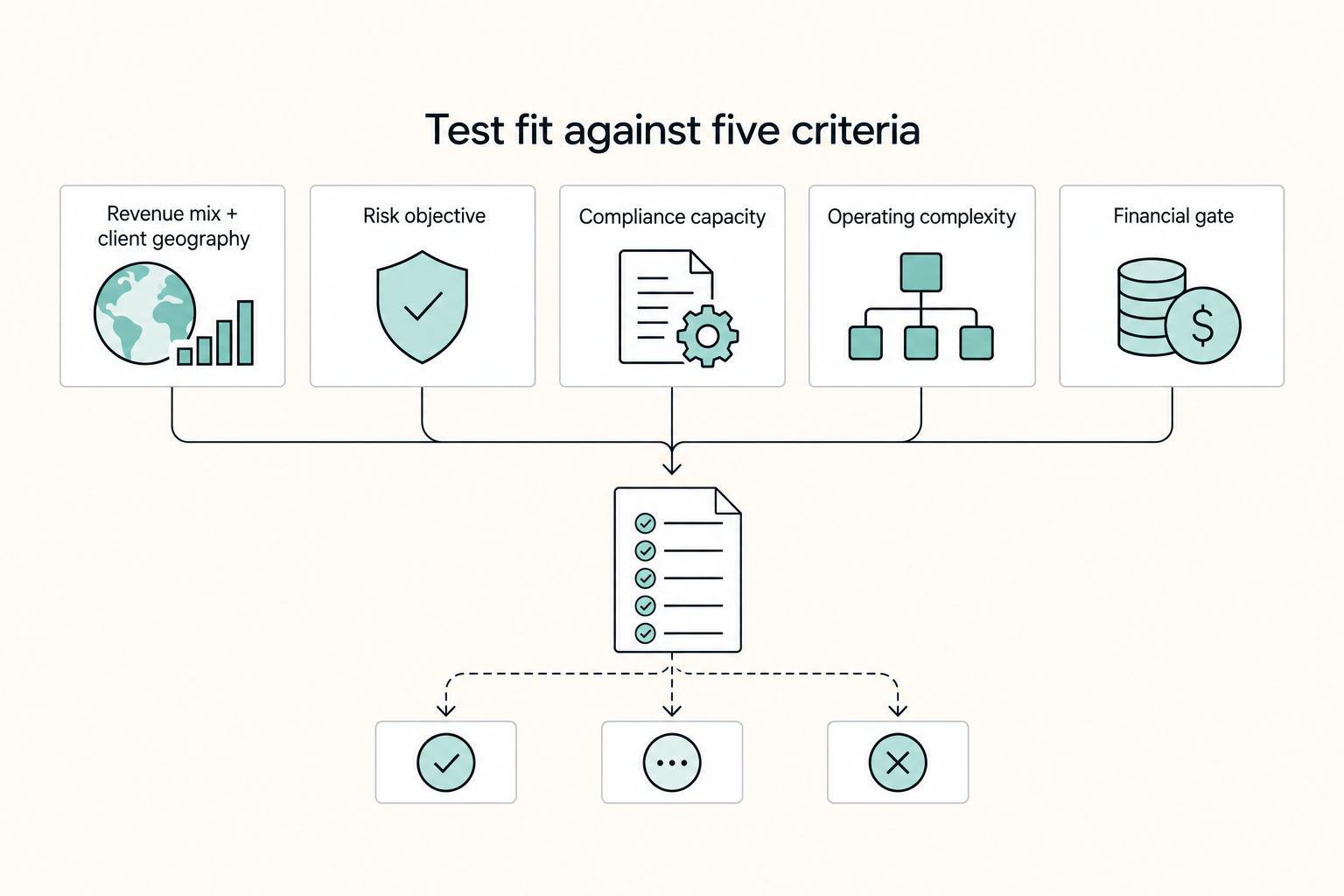
Step 1. Test fit against five criteria#
Test fit against five criteria: revenue mix, client geography, risk objective, compliance capacity, and operating complexity.
- Revenue mix + client geography: If your work, contracts, and payment flows are mostly in one home market, a Cayman structure usually adds complexity without solving the core business reality.
- Risk objective: The case is stronger when you need a separate offshore vehicle for international business and liability separation.
- Compliance capacity: You need the discipline and budget for ongoing filings and recordkeeping.
- Operating complexity: You should be prepared for multi-jurisdiction administration before you form anything.
- Financial gate: Do not apply a profitability or retained-earnings cutoff until your advisers verify one against current source records and your facts.
Keep the headline benefits in perspective. Cayman is tax-neutral on the Cayman side, but entity choice does not replace tax residency analysis, reporting compliance, or substance analysis. For U.S. persons, worldwide income is generally still taxable, and state residency can still apply through domicile or statutory rules (for example, New York's permanent-place-of-abode plus 184 days test).
In Cayman, the Economic Substance Notification is required before filing the Annual Return and is due by 31 March each year. If a relevant entity carries on a relevant activity, an Economic Substance Return may also be due within twelve months after each financial year end.
Step 2. Use the decision table before you pay for formation#
Use this decision table before you pay for formation.
| Option | Usually fits when | Compliance burden | Banking friction | Governance effort | Usually underperforms when |
|---|---|---|---|---|---|
| Cayman exempted company | Operations are mainly outside Cayman | Medium to high (annual return, ESN, and possibly ES return) | Case-by-case; verify onboarding requirements early | Formal company governance and maintenance | Business reality remains mostly in one home market |
| Cayman LLC | You want a Cayman separate legal entity with limited liability | Medium to high, depending on activities and reporting exposure | Case-by-case; verify onboarding requirements early | Ongoing member governance and records | You actually need a company form for your use case, or local Cayman trading |
| Cayman resident company | You will carry on business within Cayman | Depends on local operating requirements | Depends on local model and bank requirements | Built for Cayman-facing operations | Activities are mainly outside Cayman |
Two hard checks before moving forward:
- If your proposed name uses restricted words, prior approval may be required from CIMA or the Registrar.
- If you plan regulated business (for example, banking or insurance), CIMA approval is required before registration.
Step 3. Apply disqualifiers and route to the better default path#
Apply disqualifiers and route to the better default path.
A Cayman structure is usually a poor fit when:
- Your primary reason is generic "tax savings."
- Your operations are mostly domestic.
- You are not ready to maintain clean ownership, contract, invoice, and source-of-funds records.
- You are not prepared for cross-border reporting obligations.
For U.S. taxpayers, that includes potential FBAR filing once aggregate foreign account value exceeds $10,000, and possible Form 8938 filing at applicable thresholds (baseline $50,000 for certain taxpayers). Form 8938 does not replace FBAR, and Form 5471 filing failures can trigger penalties.
Before Stage 2, confirm:
- You can explain, in one sentence, why your path is exempted company, Cayman LLC, or not Cayman.
- Your tax adviser has separately reviewed residency, state tax exposure, and international reporting obligations.
- Your documentation pack is ready (ownership map, IDs, source-of-funds support, activity summary, draft names).
- You have ruled out regulated activity or confirmed required approvals, and you have scoped substance analysis.
If you want a simpler baseline comparison, read Sole Proprietorship vs. LLC: The Definitive Guide for Global Freelancers.
Stage 2: Documents, governance, and a licensed provider before you file#
If Stage 1 still points to Cayman, pause before you file. The outcome here turns on document quality, governance clarity, and a licensed provider with a clearly defined scope.
Step 1. Define the company before filing#
For an exempted company, lock the constitutional documents first:
| Item | What it covers | Key detail |
|---|---|---|
| Memorandum of Association | Company name, registered office, objectives, company type, and share-capital basics | Core filing for an exempted company |
| Articles of Association | Internal governance rules | Includes meetings and director/officer powers |
| Registered office | Official address for service of process and required notices | Use physical and mailing address; if a CSP provides the office, the CSP name should appear |
In practice, the Memorandum of Association and Articles of Association do most of the work: the Memorandum states the company name, registered office, objectives, company type, and share-capital basics, while the Articles set the internal governance rules, including meetings and director/officer powers.
Treat the registered office as a real control point, not a formality. It is the official address for service of process and required notices. Registered-office details should include physical and mailing address, and if a CSP provides the office, the CSP name should appear in that address. Carrying on business without a registered office can trigger $10 per day penalties (up to $500), and companies may be listed for strike-off after 30 days if notice of the appointment is not made to the Registrar.
Step 2. Vet the licensed provider and define boundaries#
For exempted companies, Registry guidance points you to a licensed professional firm. That matters because company-management services for profit are regulated, and licence scope is limited by statute.
| Evaluation point | Why it matters | Warning sign |
|---|---|---|
| Licence status and service category | Confirms the firm can lawfully provide the services you need | Unclear answers on licensing or permitted services |
| Service scope (registered office, filings, optional nominee/director/officer/management services) | Prevents assumptions about what is and is not covered | "We do everything" with no clear carve-out |
| Advice boundary | CSP services do not replace Cayman legal advice or home-country tax advice | Provider presents operational support as legal/tax advice |
| Filing communication and accountability | You need reliable handling of submissions, notices, and updates | No named contact, slow replies, no escalation path |
| Fee breakdown | Statutory items (including cited $50 stamp duty) are distinct from provider fees | Single bundled quote with no annual recurring breakdown |
| KYC/CDD expectations | Strong providers state required evidence quality up front | Repeated ad hoc requests without a written checklist |
If the proposed name includes restricted terms such as "bank" or "insurance," or the business is regulated, CIMA approval is required before registration.
Step 3. Build a reusable diligence pack and run the filing workflow#
Build one high-quality pack you can reuse across incorporation, onboarding, and ongoing compliance.
| Step | Action | Key detail |
|---|---|---|
| 1 | Engage | Use a licensed provider and confirm service scope, onboarding steps, and the provider's current timeline before relying on dates |
| 2 | Reserve | Reserve the company name and screen restricted terms that may require CIMA approval |
| 3 | Prepare | Prepare the Memorandum and Articles with final governance and share-structure choices |
| 4 | Complete | Complete the diligence pack: certified ID, proof of address, ownership chart, business-activity summary, source-of-funds support, provider-requested references, and any document-validity windows verified from the current provider checklist |
| 5 | Submit | Submit the incorporation application, signed consent forms, and statutory fees, including the cited $50 stamp duty |
| 6 | Confirm | Confirm post-incorporation records: directors/officers register at the registered office, first copy to Registrar within 60 days of first appointment, and changes filed within 30 days |
Run the workflow in that order: engage, reserve, prepare, complete, submit, confirm.
Common delay points are usually documentation quality issues: inconsistent names or addresses across documents, weak source-of-funds explanations, incomplete beneficial-owner particulars, or unusable scans.
Keep the privacy guardrail clear: Cayman privacy is commercial, not anonymity from authorities. Member-register data is not publicly available from the Registrar, but beneficial ownership filing is still required. A beneficial owner includes a person holding, directly or indirectly, more than 25% of shares or voting rights, and access to beneficial-ownership information is conditional under regulations in force from 28 February 2025.
The blueprint is complete when four things are true: governance choices are final, constitutional documents are clean and consistent, provider and tax adviser are aligned on ownership facts, and record-keeping is ready before compliance deadlines begin.
For a step-by-step walkthrough, see How to Incorporate a Company in the British Virgin Islands (BVI).
Stage 3: U.S. compliance discipline once the company exists#
Once the company exists, your real protection is disciplined U.S. compliance. For a U.S. owner, the fortress is not the incorporation certificate. It is a repeatable system that catches anti-deferral tax treatment, information-return duties, and evidence gaps before they become penalties or audit problems.
Step 1. Classify ownership correctly before money moves#
Start with the definitions that drive everything else. A foreign corporation can be a controlled foreign corporation (CFC) when U.S. shareholder ownership is more than 50 percent under the statutory test, and attribution rules can treat stock as owned even when the cap table looks cleaner than the legal analysis. Separately, U.S.-shareholder status has its own threshold analysis, and current law uses vote and value concepts.
| Checkpoint item | Record type | When to reconcile |
|---|---|---|
| Cap table | Ownership record | After every share issue, transfer, nominee change, signer change, or restructuring; reconcile in the same week |
| Memorandum and Articles (if amended) | Constitutional documents | After the same ownership or control changes; reconcile in the same week |
| Cayman beneficial-ownership facts | Beneficial ownership record | After the same ownership or control changes; reconcile in the same week |
| Bank-signer list | Signer authority record | After the same ownership or control changes; reconcile in the same week |
| U.S. tax workpapers | U.S. tax records | After the same ownership or control changes; reconcile in the same week |
The key consequence is that tax treatment can diverge from cash movement. Under Subpart F, certain CFC earnings can be reportable by a U.S. shareholder whether or not the foreign corporation actually makes a distribution. Do not assume "no cash transfer" means "no U.S. tax event."
Use one ownership verification checkpoint after every share issue, transfer, nominee change, signer change, or restructuring. Reconcile these five items in the same week: cap table, Memorandum and Articles (if amended), Cayman beneficial-ownership facts, bank-signer list, and U.S. tax workpapers.
Advisor triggers: escalate to cross-border tax counsel#
Escalate if ownership is split across family members or entities, if control exists without a clean majority on paper, if the company reorganizes or issues stock, or if you add banking, clients, or tax exposure in multiple non-U.S. jurisdictions. Ownership and control can turn on facts and circumstances, so this is not a template-only area.
Step 2. Assign filings to named owners before year-end#
A checklist is not enough. Use a filing matrix with a named internal owner, required inputs, and the primary failure mode.
| Filing category | Who files | Dependency inputs | Internal owner | Main failure risk |
|---|---|---|---|---|
| Cayman exempted company annual return | Usually coordinated through your Cayman provider; verify current process | Confirmation that operations have been mainly outside the Cayman Islands | Founder + registered-office contact | Status/admin drift if provider assumptions and actual activity diverge |
| Cayman beneficial ownership upkeep | Company through provider workflow; verify update process | Current ownership chain, control rights, and anyone holding more than 25% of shares or voting rights | Founder or legal admin | Regulatory transparency mismatch when changes are not updated |
| Form 5471 | Relevant U.S. person, separately for each relevant foreign corporation | Ownership analysis, entity events, financials, stock changes, prior-year filings | U.S. tax preparer with founder signoff | Penalties, potential foreign-tax-credit reduction, and continuation penalties until corrected |
| FBAR (FinCEN Form 114) | U.S. person with reportable foreign account interest/signature authority | Foreign account list and highest balances; trigger applies if aggregate value exceeds $10,000 at any time in the year | Founder or finance lead | Missed filing when accounts are reviewed one by one instead of in aggregate |
| Form 8938 | Individual taxpayer with the income-tax return | Specified foreign financial asset data; confirm the current filing threshold for your status and residence with the relevant tax authority | Individual tax filer | Missed duplicate reporting because Form 8938 does not replace FBAR |
For an exempted company, keep one Cayman-specific control in view: the annual return ties to the representation that operations have been mainly outside the Cayman Islands. Your contracts, invoices, management records, and banking trail should not conflict with that position.
Step 3. Keep audit-ready operating evidence and a clear privacy boundary#
Treat this as an evidence system, not a label. Keep the directors/officers register at the registered office, send the first copy to the Registrar within 60 days of first appointment, and report later changes within 30 days. Keep business and personal accounts separate, retain records supporting each income or expense item, and maintain a clean contract trail showing who signed, which entity invoiced, and where payment landed.
Most failures are operational, not dramatic: personal signatures on contracts while the company invoices, mixed personal and corporate spending, or bookkeeping that cannot explain account transfers. Keep a short decision log for major events such as new accounts, large transfers, share changes, and director changes so legal records and tax filings stay connected.
Commercial privacy exists, but regulatory transparency still applies. Cayman companies must maintain and file beneficial ownership information. CRS is an automatic exchange framework, Cayman FATCA supports reporting on U.S.-person accounts to the IRS, and FBAR remains a separate U.S. filing through FinCEN channels. The practical boundary is simple: reduced public visibility does not remove reporting obligations.
Maintenance checks: monthly, quarterly, and at entity changes#
- Monthly: Reconcile foreign accounts, preserve statements, and capture year-high balances for FBAR prep.
- Quarterly: Review ownership, signers, directors, and any person above the 25% beneficial-owner threshold.
- At any entity change: Pause and recheck Form 5471 impact, especially acquisitions, dispositions, and reorganizations.
- Before tax season: Assemble financials, account data, and prior-year filings, then verify current Form 8938 thresholds and Form 5471 category treatment.
- Before Cayman anniversary cycle: Confirm annual-return readiness, provider workflow, and registered-office records.
For context, see What is FinCEN? A Guide for Freelancers and FinTech Users.
Conclusion: Confirm the facts before you form the company#
Your next move is simple: do not form first and rationalize later. Use Diagnose, Blueprint, Fortress in that order, and stop if the facts do not support the structure.
Diagnose fit first#
Start with the entity you are actually choosing. An exempted company is a Cayman company form meant for activities carried on mainly outside the Cayman Islands, so it generally fits international operations better than a business centered on Cayman itself. Fit signals can include operations mainly outside Cayman, readiness to maintain foreign records, and willingness to handle extra administration. Mismatch can include low tolerance for annual filings or assuming this structure alone changes U.S. tax obligations. If that is you, choose a simpler structure first and revisit later.
Define who does what before filing#
Use a licensed professional firm and get specific about who does what. A beneficial owner is the person who in the end owns or controls the company, with Cayman guidance pointing to more than 25% of shares or voting rights as a key threshold. Before filing, verify who will maintain and submit beneficial ownership information, who holds the registered office, and what records you will retain to support governance and filings. Miss beneficial ownership updates and you can end up facing strike-off risk.
Build the compliance routine#
This is where good structures fail in practice. Economic substance is a test for relevant entities carrying on relevant activities, and the Economic Substance Notification is due annually as a prerequisite to the annual return, no later than 31 March each year. For U.S.-connected owners, a CFC issue can arise when U.S. ownership crosses more than 50% voting power. FBAR is FinCEN Form 114 when aggregate foreign accounts exceed $10,000, due April 15 with an automatic extension to October 15. FATCA reporting on Form 8938 is separate and can apply from a $50,000 baseline for certain taxpayers after residency and filing-status checks. If Form 5471 is required, the IRS says substantial penalties can apply if you miss it.
| Decision | Owner | Cadence | Evidence to retain |
|---|---|---|---|
| Confirm beneficial owner filings and update on ownership changes | Cayman provider + founder | At setup and on change | BO register extracts, cap table, notices, confirmations |
| Review Economic Substance Notification and annual return readiness | Founder + Cayman provider | Annual, before 31 March | ES analysis memo, annual return receipt, provider emails |
| Check U.S. foreign-corporation filing position, including CFC/Form 5471 exposure | Founder + cross-border tax advisor | Annual and before major changes | Tax memo, organizer chart, year-end trial balance |
| Monitor foreign account reporting triggers for FBAR and FATCA | Founder + tax preparer | Ongoing and at year-end | Bank statements, highest balance support, filed forms |
Structure choice, tax treatment, and reporting outcomes still depend on verified personal facts and qualified advice. That is not a disclaimer to ignore. It is the operating rule that keeps the first year clean.
We covered this in detail in BVI vs Cayman Islands for an Investment Holding Company in 2026.
Frequently Asked Questions
How much does it cost to incorporate in cayman islands?
This article does not give a fixed total cost, so use a live quote rather than an old blog number. Final cost can vary by provider scope, company type, and added services such as nominee arrangements or director support. Ask for a breakdown against the current General Registry fee schedule, and keep statutory items such as the cited $50 stamp duty separate from provider fees.
Is a Cayman company legal for a U.S. citizen or U.S. resident?
Yes, forming a foreign company is generally legal, but legality is separate from tax treatment and reporting. If you are U.S.-resident for tax purposes, worldwide income is still reportable in the United States. Depending on ownership and control, Form 5471, FBAR, and possibly Form 8938 can apply, and a foreign corporation can be a CFC when U.S. shareholder ownership exceeds 50 percent.
Cayman company or U.S. LLC: which is usually the cleaner choice?
There is no universal winner. A U.S. LLC is a state-law entity whose federal tax treatment depends on elections and facts, while a Cayman exempted company is intended for operations mainly outside the Cayman Islands. For U.S.-connected owners, a Cayman structure can add foreign-corporation analysis and offshore reporting.
Do I need to visit Cayman to form the company?
Often no. Many founders use a licensed professional firm and handle the process remotely, though requirements can vary by company type and facts. You still need to provide owner information, review ownership details, sign consent forms, and keep later filings current.
What does “Exempted Company” actually mean?
An exempted company is a Cayman company type intended for operations mainly outside the Cayman Islands, and it requires a declaration to the Registrar that the business will be conducted mainly outside Cayman. It does not mean exempt from home-country tax rules. For U.S.-connected owners, it does not remove Form 5471, FBAR, or Form 8938 analysis.
How long does setup usually take?
The article does not give one fixed setup timeline. Processing can differ by company type, document readiness, and whether the activity touches a regulated area that may require CIMA approval. Verify the provider's current timeline before relying on it.
When should I avoid this structure?
Avoid this structure when the compliance burden does not match your situation. The article flags poor fit cases such as mostly domestic operations, generic tax-saving motives, weak documentation, or low tolerance for ongoing foreign-company compliance. The burden is not just cost; it includes annual Cayman upkeep, beneficial ownership updates, annual return timing, and U.S. reporting discipline.
Try a related tool
Researched and edited by the Gruv editorial team. Gruv builds cross-border billing, payouts, and finance-operations software for global businesses.
Sources
Educational content only. Not legal, tax, or financial advice.
Related Posts

Sole Proprietorship vs LLC for Global Freelancers in 2026
For most freelancers in 2026, the practical default is still simple: use the simplest structure you can run cleanly, then formalize when risk actually rises. If your work is still in validation mode and the downside is contained, a sole proprietorship is often the practical starting point. When contract exposure, delivery stakes, or dispute risk starts climbing, forming an LLC deserves earlier attention.

What Is FinCEN for Freelancers and FinTech Users
If you are asking **what is fincen**, focus first on the decision in front of you. FinCEN, the Financial Crimes Enforcement Network, is tied to FBAR filing through FinCEN Form 114 when foreign financial accounts create reporting duties. By the end, you should know whether to act now, gather records, or escalate.
How to Form and Run a Cayman Islands LLC
This is for independent professionals who need a compliant operating setup, not a fund-structuring memo. The goal is practical: decide fit, form carefully, and run ongoing compliance with fewer avoidable mistakes.